Federal IG report finds safety deficiencies at the Wrentham and Hogan Centers, but misses the big issue – What about the group homes?
A federal investigative agency has reported deficiencies in safety and emergency preparedness in Massachusetts’ two developmental centers for persons with intellectual and developmental disabilities.
The October 2024 report by the Inspector General with the U.S. Department of Health and Human Services alleged 44 deficiencies related to life safety and emergency preparedness at the Wrentham Developmental Center and the Hogan Regional Center.
The IG’s report, however, raises a number of questions, in our view. First, will the IG similarly examine safety policies in the much larger, corporate-run group home network in Massachusetts?
The number of privatized, yet state-funded group homes has grown exponentially as developmental centers, also known as Intermediate Care Facilities (ICFs), have been closed over the past decade.
Secondly, why did the IG not address the quality of care in the ICFs and the group homes? It is in the group home system today that the most serious problems of abuse and neglect are endemic.
Thirdly, why not investigate the lack of access to ICFs for people needing residential care, and the misguided efforts to close them?
Finally, how serious were the safety deficiencies at Wrentham and Hogan that the IG’s report identified? The report did not appear to provide sufficient detail to answer that question.
No discussion of seriousness of deficiencies
The IG report stated that as a result of the deficiencies, “the health and safety of residents, staff, and visitors at the two ICFs are at an increased risk of injury or death during a fire or other emergency.” The question is how much of an increased risk?
The deficiencies included such things as fire extinguishers that had not been inspected on a monthly basis; placement of oxygen cylinders in hazardous storage areas; exits in some buildings that were obstructed, sprinkler heads that were “blocked or obstructed” in some instances; portable space heaters that were improperly placed in residential areas; and holes in some ceilings and walls.
While some of those things sound potentially serious, a problem with the report was that it gave few if any details about them. For instance, what else was contained in the hazardous storage areas? How were the sprinkler heads blocked, and how many were blocked?
Strangely, the report never named either of the two Massachusetts ICFs, so it never specified which of the deficiencies were found in which of the two facilities.
The report noted that the portable fire extinguishers that had not been inspected monthly were found in one of the ICFs, although, as noted neither of the ICFs was named in the report. The report also didn’t say how many fire extinguishers in that facility had not been inspected, or how many months had gone by without inspections.
The report didn’t explain what it meant by blocked or obstructed sprinkler heads. In a photograph that was included in the report, it didn’t appear that the sprinkler in the photo was broken, but rather that the sprinkler had been installed in the ceiling of a closet, and that it was partially blocked by objects placed underneath it.
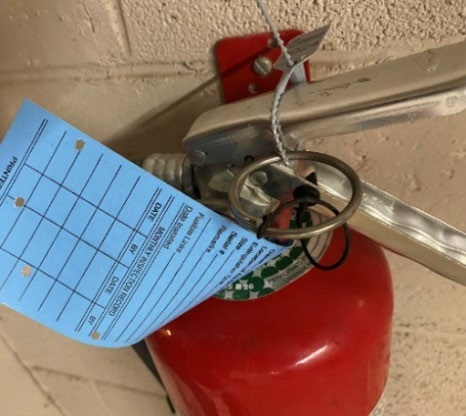
Fire extinguisher with the monthly inspection tag not filled out. From IG report.
Also, many of the deficiencies involved failures to provide documentation. It’s hard to judge the seriousness of some of those findings, particularly because some of them seemed ambiguous. For instance, the report stated that, “Both ICFs did not have a formal communications plan that was updated at least every 2 years.”
What is a “formal” plan versus an informal plan, and does this mean the facilities had no plan at all? There was no explanation or details provided about that.
The report also stated that “one ICF did not have policies and procedures that address the facility’s emergency preparedness plan and identified hazards within the facility’s risk assessment.”
What exactly does that mean? Did it mean that that particular ICF did have an emergency preparedness plan, but didn’t have “policies and procedures that address” the plan? Don’t plans refer to policies and procedures?
Robert Goldstein, commissioner of the Massachusetts Department of Health, which inspects the ICFs annually, responded to the IG report, stating that the majority of the audit findings were “immediately corrected” by the staff of each of the facilities.

Deficiency identified as “obstructed sprinkler head.” From IG report.
It’s also not clear to us why the federal IG singled out the Wrentham and Hogan Centers for this inspection report. We understand that the IG conducts investigations when it is requested to do so by an elected official. Who would have wanted such an investigation done just about the Wrentham and Hogan Centers, and why?
The report itself noted that there are approximately 5,400 Medicaid-certified ICFs in the U.S., and that Massachusetts has just two of them. Four others were closed in this state between 2012 and 2015.
The IG noted that its report on the Massachusetts ICFs is the first in a planned series of audits that will similarly assess compliance with federal “life safety, emergency preparedness, and infection control requirements for ICFs.” So, it does appear that the IG will be conducting similar searches for fire extinguishers without inspection tags and blocked exits in ICFs in other states.
Hopefully, those coming reports will provide more explanatory details about the deficiencies that will surely be found. It would also be nice if the IG were to expand the scope of its investigations to include the broader questions why ICFs around the country are being closed, and what the quality of care is in the group home systems.
We are not holding our breath in anticipation of those broader investigations.
 COFAR blog
There a people with intellectual issues living on their own under the oversight of DDS and their paid vendors who are often negligent in their care. I have a nephew whose 10 hours of care mostly includes being driven to the bank to cash checks to pay for a phone bill and t-pass both of which could be done on line.
LikeLiked by 2 people
While I agree that group homes should be similarly inspected, what about shared living? I believe that’s where we’ll find the most safety concerns.
LikeLiked by 2 people
My son is in a corporate group home. The people who care for him, and he, are so neglected. He requires a team for his care. Everyone involved in direct care deserves respect and adequate resources. Dismantling ICFs is not the solution.
LikeLiked by 2 people
This is all part of DDS’s wanting to close the last two ICF facilities. First, DDS won’t refer anyone to either facilities. Now they had the Inspector General go in and do a report on birth facilities to further their agenda.
The corporate providers, group homes, etc. need to be investigated. I myself has been a witness to abuse coming from a corporate provider as well as from DDS towards a special needs person, it was unfathomable.
LikeLike