Archive
Compromise bill expands DDS eligibility to some, but not all people with developmental disabilities
After months of negotiations with a limited group of advocates for the developmentally disabled, key state legislators have approved a draft of a bill intended to expand services to people who are not currently eligible for help from the Department of Developmental Services.
The bill (H. 3715) would expand eligibility for residential and other services to people with what is now referred to as Autism Spectrum Disorder, although the legislation uses the older term “autism” to describe the group. The bill also specifically mentions Prader-Willi Syndrome – a disability often associated with autism.
While a step forward, the compromise bill appears to leave out a number of other disabilities that are eligible for similar services in many other states, such as cerebral palsy, epilepsy, spina bifida, and traumatic brain injury, and cognitive impairments such as Williams Syndrome.
We understand top Patrick administration officials were concerned about the price tag in including a large list of developmental disabilities in the bill. State law currently restricts eligibility for services from DDS to persons having an “intellectual disability” as measured by an IQ score of approximately 70 or below. Intellectual disabilities are considered a subset of developmental disabilities.
Currently, thousands of people in the state are developmentally disabled in that they are unable to care for themselves or otherwise function adequately in society; yet, they are ineligible for services from the state because they do not have an intellectual disability.
The new bill, which appears to have been hastily drafted, would extend DDS services to people with developmental disabilities, but would restrict the definition of a developmental disability to “a severe, chronic disability of an individual 5 years of age or older that is attributable to a mental or physical impairment’s (sic) resulting from intellectual disability, Autism or Prader-Eilli (the spelling should be Prader-Willi) Syndrome.” The bill was approved on October 21 by the Children, Families, and Persons with Disabilities Committee and sent to the Health Care Financing Committee.
Colleen Lutkevich, COFAR Executive Director, cited, as an example of someone who would fall through the cracks of the new legislation, a person with normal intelligence but with a severe level of cerebral palsy that precludes him or her from being able to feed or toilet himself or herself. Under the compromise bill, that person would not be considered developmentally disabled and therefore would still not qualify for services. “Services are needed at all levels for people with all types of disabilities,” Lutkevich said.
A previous draft of the bill had not specified any developmental disabilities in expanding DDS eligibility, but had defined developmental disability as a condition “attributable to a mental or physical impairment,” which results in “substantial functional limitations” in three or more “major life activities.” Those activities included self-care, receptive and expressive language, learning, mobility, self-direction, a capacity for independent living, and economic self-sufficiency.
That previous draft would have included people with disabilities such as cerebral palsy if those disabilities were severe enough to cause substantial functional limitations in three or more major life activities. As such, the previous draft would have “focused pragmatically on the challenges faced by the individual and their family, and avoided leaving people to fall between the cracks,” as one advocate described it.
We are hopeful that the Legislature and the administration will find a way to include in this bill all those who are in need of DDS services. Many other states have figured out ways to avoid leaving vulnerable people behind, and Massachusetts should be among those innovative states.
Fatal assault at Templeton Center raises questions about admissions and staffing
The death last month of an intellectually disabled man, who was allegedly assaulted at the Templeton Developmental Center by a resident there, appears to raise questions about the dangerousness of the people being admitted to the facility and the adequacy of the staffing and supervision there.
Dennis Perry, 64, was allegedly assaulted on September 16 by Anthony Remillard, 22, while the two men were working at the Templeton facility’s dairy barn. At the time, Perry was a resident of a group home and was working in the barn on a daily basis.
The Worcester Telegram & Gazette reported that Perry had allegedly been shoved by Remillard into a boiler in the barn and suffered a serious head injury. The incident occurred in front of two staff members whose statements indicated the attack was unprovoked, according to the newspaper, which was quoting from a State Police report of the incident. Perry died on September 27 at UMass Memorial Medical Center.
Prior to his admission to Templeton, Remillard had been charged in a May 6, 2012 arson in a vacant building in Worcester, according to the newspaper. At his arraignment on that charge, prosecutors recommended that Remillard be evaluated at either Bridgewater State or Worcester State Hospital. But the recommendation was rejected by the judge, and Remillard was allowed to enter a “pre-trial release commitment” at Templeton.
The Templeton Center, located in Baldwinville in central Massachusetts, has been marked for closure since 2008. The facility is scheduled to be converted into state-operated group homes from its current status as an Intermediate Care Facility for the developmentally disabled (ICF/DD).
Paula Perry, Dennis Perry’s sister, said she and other family members were told by the Worcester County District Attorney’s Office that Remilard’s attorney didn’t feel that either Bridgewater State or Worcester State Hospital would be a safe environment for his client, and Remillard “was okayed to go to Templeton.” She said her family was unaware that there were any residents with criminal backgrounds or criminal charges at Templeton. They only found out about Remillard’s previous arrest on the arson charge after reading about it in the newspaper.
Paula Perry added that she understands that Templeton had the option of refusing to accept Remillard. “Why they would accept someone like that I don’t know,” she said.
While Templeton has historically accepted individuals with criminal backgrounds as residents, those persons have in the past been carefully evaluated as to their level of dangerousness prior to admission, according to Bonnie Valade, a COFAR Board member and the mother of a Templeton resident.
At this point, we don’t know if Remillard has an intellectual disability or not. If he does have ID, it might have been appropriate to have considered him for admission to Templeton. However, Dennis Perry’ death does appear to raise questions about whether Remillard should have been there and whether the staff supervision of him was adequate. Here was someone who had an allegedly violent criminal past and who was allegedly capable of unprovoked violence. To us, the two linked questions here are: Why was Remillard admitted to Templeton over the objection of the DA, and why was he allegedly able, once there, to attack and fatally injure someone?
We sent an email request on Monday to DDS Commissioner Elin Howe, seeking the Department’s policies and procedures regarding both admission to Templeton, and staff supervision of residents who have either behavioral problems or criminal convictions or charges on their records. We want to know specifically whether persons who are not intellectually disabled are ever sent to Templeton, and whether any of the Department’s policies regarding admissions and staffing have changed since Templeton was slated for closure in 2008.
Since 2008, the Patrick administration has significantly phased down operations at two ICFs/DD — Templeton and the Fernald Developmental Centers, and closed two others — the Glavin Regional Center and the Monson Developmental Center. ICFs/DD are required to meet strict federal standards for treatment and staffing that do not apply to group homes and other community-based residential settings in Massachusetts and other states.
Since 2008, Templeton’s residential population has been reduced from 123 to 42. Valade maintains that as the population there has gone down, both staffing and services at the center have been steadily reduced as well. Here is what Valade had to say about Templeton in an email in the wake of Dennis Perry’s death. The situation she describes may have a bearing on the case:
Shortly after the (Templeton) closure was announced, the staff that had been there started to leave. I was reminded that none were let go. Well, no one had to be told to leave…if you are told your place of employment is closing you look elsewhere for work. So they lost the best staff. These staff members had been there for years, which made them the best qualified staff I have ever known, and the clients felt like they were family.
… I am in fear for my son…with his issues he could have been the Dennis (Perry) or the Anthony (Remillard). For years I have felt my son was in a safe environment, and now here I am worried sick about his care.
No one with a family member in the DDS system should be worried sick about their care. The Department can help by providing answers as soon as possible to the questions we’ve asked about their admissions and staffing policies at Templeton. And we hope the Department cooperates fully with the Perry family, in particular, in providing the answers they are seeking in this case.
A disappointing update on sheltered workshops in Massachusetts
In a post the other day, I suggested that state Department of Developmental Services Commissioner Elin Howe talk to family members of sheltered workshop participants, who maintain the programs have provided their loved ones with valuable social and skill-building activities.
But no such luck.
In an email notice send out yesterday, Howe announced that no new DDS clients will be referred to sheltered workshops in Massachusetts after January 1. As we feared, this is the beginning of the end of this valuable program in the state.
Sheltered workshops provide opportunities for developmentally disabled people to do assembly work and other tasks in group settings, usually for small amounts of pay. But for Commissioner Howe and other opponents of sheltered workshops, these programs are politically incorrect. Sheltered workshops, they argue, “segregate” disabled people from their non-disabled peers, apparently in just the same way schools and businesses in the South segregated blacks in the days before the Civil Rights movement.
Howe said sheltered workshop providers have been instructed to develop plans to “transition their workshop services to more integrated employment options,” meaning the plan is to place all workshop participants in the mainstream workforce.
Let’s leave aside the question whether it is really valid or fair to compare intellectually disabled people, whose guardians voluntarily place them in programs that provide them with work activities, to blacks who were forced until the 1960’s in this country to drink at separate water fountains and go to separate schools from whites.
For now, I would simply argue that we’re skeptical that closing programs that provide work activities for people with developmental services will somehow increase their overall employment opportunities.
I wonder if Commissioner Howe has thoroughly reviewed a 2011 report by the University of Massachusetts Boston on trends in employment prospects for people with developmental disabilities.
While the UMass report does appear to be biased against sheltered workshops, it notes that there has been relatively little movement so far toward mainstream employment of people with intellectual disabilities from sheltered workshops around the country. The report cites as reasons for this lack of movement, “staff resistance, family resistance, and funding structures that do not adequately support community-based services for people with high support needs.”
In other words, families like and want their loved ones to stay in sheltered workshops; and it takes money to place people with Intellectual and developmental disabilities into mainstream jobs with the types of supervision and support they need. And we’ve seen, that money isn’t there. All of this seems to raise questions about the wisdom of DDS’s decision to stop all new referrals to sheltered workshops.
In fact, one of the outcomes of closing sheltered workshops, which appears to be highlighted in the UMass report, is that many, if not most, of the people who are participating in sheltered workshops will end up being transferred to what are called “non-work” settings if those workshops are closed. Non-work settings, also known as day programs for people with developmental disabilities, may or may not provide them with meaningful work activities to do.
The UMass report noted that in 2010, there were 3,700 people with Intellectual disabilities in sheltered workshops in Massachusetts and about 3,500 people in “integrated employment.” However, there were about 9,500 people in “non-work” settings. The report stated that: “State, county, and local IDD (intellectual and developmental disabilities) dollars are increasingly being spent on CBNW (Community-based Non-Work) services and not integrated employment.”
So, our concern is that when all sheltered workshop programs are ultimately closed in Massachusetts, most of the former participants will end up in day programs where they do nothing and get no pay at all. And even if many of these people are placed in so-called integrated employment, the outcomes may not all be good. Howe certainly didn’t consult the Buonomo’s about their son’s disappointing experience working at Walmart, for instance.
Given all that, it was amusing to read in her email that Howe remains “strongly committed to working with all of our stakeholders” in ultimately closing all remaining sheltered workshops in the state. I don’t recall her asking for our opinion on it or acknowledging the opinions of most family members of sheltered workshop participants.
Sheltered workshops under fire in Massachusetts
Paul Buonomo enjoys his job stuffing envelopes, collating papers and carrying out other tasks in a program in Danvers known as a sheltered workshop.
His parents, Doris and Joe Buonomo, maintain that the workshop, run by Heritage Industries, is the best such program Paul has ever been in.
But in the wake of a national debate over the political correctness of sheltered workshop programs for people with developmental disabilities, programs such as Paul’s may soon be phased out. Here in Massachusetts, the Department of Developmental Services is reviewing its policies regarding sheltered workshops and has invited state-funded providers into a working group to determine what the future will be for the programs.
Sheltered workshops provide opportunities for developmentally disabled people to do assembly work and other tasks, usually for a small amount of pay, in group settings. The charge of political incorrectness stems from the fact that the workers are not participating in the nation’s mainstream workforce and are therefore allegedly being “segregated” from non-disabled people. In many – perhaps in most – cases they also receive sub-minimum wages.
The charge that sheltered workshops promote segregation and inadequate pay to disabled people is being leveled not only by a number of advocacy groups, but by government agencies, including the federal Department of Justice and the National Council on Disability.
These are the same advocates and agencies, by the way, that have long opposed all forms of congregate care for the developmentally disabled.
But supporters of sheltered workshops, many of whom are family members of the workshop participants, argue that these programs provide their loved ones with fulfilling work and skill-building activities, and that if the programs were eliminated, there would often be nothing to take their place.
The Buonomos, for example, don’t believe their son, who is 60 and has moderate intellectual disability, is at all segregated or placed at a disadvantage because he isn’t receiving a competitive wage in a mainstream workforce setting. Heritage Industries provides Paul with a check every two weeks that varies from $2 to $10, depending on the amount of work Paul does, according to Joe Buonomo. It’s not much money, Joe says, but Paul lives in a state-operated group home and doesn’t personally have to deal with financial pressures that would necessitate a job paying a competitive wage.
Gail Orzechowski, whose sister, Carol Chunglo, 73, participates in a sheltered workshop in Orange operated by Interface Precision Benchworks, maintains that the program has “opened up her (Carol’s) world. I don’t know how they can say she’s segregated,” she adds.
The Arc of Massachusetts has stated that the impetus in Massachusetts to reconsider its sheltered workshop policies stems from litigation in Rhode Island and Oregon, which has involved the Justice Department.
In the Rhode Island case, a service provider was accused of improperly “segregating” developmentally disabled persons in a sheltered workshop and paying them sub-minimum wages. Under a settlement of the case, clients in sheltered workshops will be switched to supervised mainstream employment, which implies the end of sheltered workshops in that state.
Following the June settlement in Rhode Island, a Department of Justice official maintained that from that point on, every developmentally disabled client in the state’s sheltered workshops would receive “real jobs with real wages,” and would no longer be subject to “the tyranny of segregation.”
It’s not quite clear to us, though, how providing real jobs at real wages to all disabled people will actually happen. Like the Buonomos and Gail Orzechowski, we also don’t buy the charge of segregation when it comes sheltered workshops, in particular. Doris Buonomo says she hopes DDS will listen to outside voices, particularly those of parents like her and her husband Joe, who believe the workshops have made a positive difference in their loved ones’ lives. Thurs far, we have heard only that DDS has invited the Massachusetts Association of Developmental Disabilities Providers and the Massachusetts Arc to participate in the working group that is reviewing the Department’s sheltered workshop policies. Both of those organizations have taken positions against the workshops (here and here).
Meanwhile, family members and other supporters of sheltered workshops around the country are fighting the tide of closures of sheltered workshop programs. They contend the Justice Department and other opponents of the workshops are fighting an ideological war, but are offering no viable alternatives.
In New Jersey, the state Legislature stepped in this summer to prevent a plan by the state to close the state’s sheltered workshops. The New Jersey plan to defund the workshops met with opposition from advocates and from program participants and their families around the state, according to The Burlington County Times.
An online petition filed by Missouri AID, an advocacy organization for the intellectually disabled, states that sheltered workshops “are the only places where some individuals can work and function as productive members of the community.” The petition, which garnered 3,092 signatures, adds that:
There are countless horror stories about individuals who have tried supported (mainstream) employment, and they fell in with the wrong group of individuals, were taken advantage of, sent to prison, or ended up walking the streets alone. Sheltered workshops throughout the U. S. provide a safe environment for adults with (intellectual and developmental disabilities) to work, interact with their peers, and gain a sense of accomplishment…
The Missouri AID petition adds that “We should be creating more employment opportunities for people with disabilities – not eliminating options.”
While the idea that people with developmental disabilities should work alongside non-disabled peers and earn competitive wages is good in theory, it doesn’t always work in practice, Doris Bunomo notes. In Paul’s case, for instance, a job at Walmart ended badly for Paul even though he had gotten good performance evaluations there for a job stocking shelves, and had even earned a promotion.
Doris said Paul had been working at Walmart for a year, but an incident occurred one day in which he got “upset,” leading to a situation in which he was lectured by the manager and threatened with being fired. Doris said a support staff person for Paul did not follow an agreed-upon protocol between the residence and Walmart, and Paul did not work there again. Doris maintains that many people with developmental disabilities can work in professional or business settings with careful supervision, but that is not always possible.
“I think he’s very pleased where he is,” Joe Buonomo says of his son, adding that while Paul primarily interacts with other developmentally disabled people in his sheltered workshop, there are many opportunities in his life to meet people who are not disabled.
”I don’t think he (Paul) feels restricted in any way,” Joe maintains. In addition to the many community-based functions that Paul attends via his group home, he often helps Doris deliver books and other items to their local library and church. Also, given Paul’s lifelong love of trains, his parents have also often taken him to the freight train terminal in South Portland, Maine, where he has “made a ton of friends with the workmen” over the years, Joe says.
Orzechowski says the workshop that employs her sister Carol has helped teach her how to function socially. “Her eating habits and her other social habits have improved, and she’s developed friendships since she’s been in the program,” Orzechowski says of her sister, who she describes as having a severe level of intellectual disability. Carol, she says, also has many opportunities to interact with people in the community, including vacations that she has taken with money earned from her workshop program.
It’s far from clear what may happen in Massachusetts regarding sheltered workshops. We certainly hope that whatever is done, DDS will first consult with the families involved such as the Buonomos and Gail Orzechowski. If DDS does listen to those people, the Department will find a way to keep these valuable sheltered workshop programs running.
Bedford group home resident’s injuries raise disturbing questions
We don’t yet know what happened to cause the serious injuries suffered in late August by Paul Stanizzi, a resident of a group home for the intellectually disabled in Bedford.
The incident is currently under investigation by the Bedford Police Department, which, as of Friday, was declining comment on the matter and would not even issue a police report. But whether Stanizzi was assaulted or whether the injuries were somehow self-inflected or an accident, the incident raises serious questions about the operation and management of the residence.
Fox25 TV news reported on September 9 that Stanizzi, who is non-verbal, was found lying on the floor in his room by a staff worker at the group home, which is run by the Edinburg Center, Inc., a nonprofit provider that is funded by the state Department of Developmental Services.
After Paul Stanizzi’s mother was called by the staff worker, the family rushed to a hospital and found Paul unresponsive in a hospital bed. His brother Joe pointed out to Fox25 reporter Mike Beaudet that Paul had a black eye, a bloody nose, bruises on his fingers, scratches on his arm, what appeared to be fingerprint bruises on his arms, two larger bruises on his leg, a cut on his knee, and other abrasions.
Despite all that, the hospital was about to discharge Paul, Beaudet reported. But when Paul’s father tried to raise him from the bed, his head flopped down. An MRI subsequently revealed damage to the vertebrae around his neck. According to the Fox report, medical records noted “possible recent injury” as a cause. The doctors performed emergency surgery. It is apparently not clear whether Paul, who remains in the hospital, has been permanently paralyzed from that injury.
In a statement, Edinburg CEO Ellen Attaliades told Fox25 she could not discuss Stanizzi’s medical condition because of patient confidentiality rules. But she added, “Unfortunately there are instances when individuals with severe developmental disabilities can injure themselves through their own physical actions. To allege abuse without any evidence and without considering all factors is both wrong and unjust to his devoted caregivers.”
It’s certainly true that developmentally disabled persons, like anyone else, can injure themselves, although the extent of Paul Stanizzi’s injuries in this case points strongly toward the possibility of abuse. But even if it turns out to be the case that Paul Stanizzi somehow injured himself, what does that then say about the staffing and management of the group home? If Attaliades believes that the scenario under which Paul injured himself lets her agency and the residence entirely off the hook in this case, we think she’s mistaken.
DDS regulations require that facilities funded for the care of the developmentally disabled must be safe environments. We hope the Bedford police and the Disabled Persons Protection Commission are asking questions to determine just how safe this particular environment could have been. Did Paul haven a history of self-injurious behavior? If so, how carefully was he supervised? How long was he lying on the floor before he was discovered? Was he physically capable of injuring himself to the extent described? Were background checks done on all of the staff there? What kind of training was provided to the staff?
An online DDS licensing report on the Edinburg Center states that Edinburg’s two-year license to operate residential group homes was being “deferred” because of problems with medication administration. Other problems were noted in the report that required a 60-day follow-up by DDS, although there were no references to specific problems with abuse or neglect there.
The licensure report also stated that Edinburg had been experiencing growth since 2008 and yet was “dealing with economic decline and its ongoing impact on agency services.” The report added that the provider had lost clinical and emergency services and yet had opened two new 5-person homes in FY 2010. It seems strange that a provider would be cutting services and yet opening new homes at the same time.
Opening new facilities at the same time that services are being cut may indicate that this provider may be stretched thin on its staffing, or was stretched thin as of December 2010. (The posted licensure report was dated December 2010, which would make it about 9 months out of date. DDS licensure reports and operating licenses are valid for two years, meaning that a new report should have been posted on the website in December 2012. We have pointed out in the past that many of the licensure reports posted on the DDS website are out of date.)
Fox25 stated that Attaliades, the Edinburg CEO, told them that Paul Stanizzi is considered “part of The Edinburg Center family and his health and well-being are their primary concern.” We hope that is the case, but a thorough investigation is the only way to be at all certain of that.
We and others have long pointed out that care in widely dispersed group homes in this and other states is very difficult to monitor. Earlier this year, U.S. Senator Chris Murphy of Connecticut called for a federal investigation “into the alarming number of deaths and cases of abuse of developmentally disabled individuals in group homes.” Unfortunately, the Massachusetts DDS, in particular, does not appear to have placed a high priority on the safety of the provider-run care system that the Department funds.
The community-based, group home system in Massachusetts needs to be more tightly overseen, and the experience of Paul Stanizzi is one more in a long line of disturbing incidents that demonstrate that need.
The story of a remarkable woman
I never met Joanna Bezubka, who lived at the Fernald Developmental Center for 39 years and then spent the final seven years of her life in a state-operated group home in Lynnfield.
But after reading “Joanna, God’s Special Child,” a new memoir by George Mavridis, I feel I got to know her well enough that I’m sad I never will meet her in the flesh. That’s because Mavridis, Joanna’s cousin and co-guardian, has written an account of her life that makes you realize what a truly remarkable person she was — filled with charm and humor and an independent spirit.
These are qualities that many of us would not think possible in a person with a profound intellectual disability whose vocabulary was limited to about 50 words and a small range of vocal inflections. Joanna, who had Down syndrome and the cognitive ability of a two-year-old child, died in January 2012 at the age of 60 after developing Alzheimer’s disease.
Given its title, some people might think this book comes at its subject from a religious or sentimental perspective. It is neither of those. As Mavridis explains, “God’s special children” was a description given in the 1950’s by Richard Cardinal Cushing, Roman Catholic Archbishop of Boston, to individuals with mental retardation, now known as intellectual or developmental disability.
It’s not that Mavridis rejects Cardinal Cushing’s description. Mavridis is in fact a practicing Catholic who pushed hard to allow Joanna to continue attending Mass every Sunday at the Chapel of the Holy Innocents at Fernald, long after she had left the facility as a resident. It’s that Mavridis goes so much further than Cardinal Cushing’s description in telling us who Joanna really was.

George Mavridis and Joanna Bezubka celebrate her 59th birthday
Mavridis, a former president of COFAR and The Fernald League, has chronicled Joanna’s life down to some of the smallest details in a matter-of-fact, journalistic style that is all the more compelling because it deals honestly with the major issues of her life, even some of the most difficult and painful episodes. Those episodes include a sexual assault of Joanna, allegedly by staff in a group home in which she lived, and Mavridis’s dogged pursuit of the investigation of the incident.
It’s important to note that Mavridis is a strong defender of a comprehensive system of care for people with developmental disabilities, including the availability of federally regulated Intermediate Care Facilities (ICFs) for those, like Joanna, who need or needed them. Mavridis has been a central figure in the still-ongoing effort to keep Fernald open. He is also a member of the legislative committee of the VOR, a national advocacy organization for the developmentally disabled, which, like COFAR, supports ICF-level care. As a VOR legislative committee member, Mavridis organizes visits with the health aides of the members of the New England congressional delegation.
But the purpose of Mavridis’s book is not to make a statement on one side or the other in the debate over institutional versus community care. It is rather to chronicle a person’s life and to demonstrate the necessity and effectiveness of advocacy for the most vulnerable among us.
If you are the guardian or family member of a developmentally disabled person and you are looking for help in how to cope and advocate on their behalf, I think this book will be very helpful. I think it would also be helpful to legislators and others who seek a better understanding both of who developmentally disabled people are and what is involved in caring and advocating for them.
If nothing else, this book provides a detailed set of reasons for the importance of a provision in federal law, which states that family members should be seen as the “primary decision-makers” in caring for intellectually disabled persons. As Joanna’s co-guardian and the family member most intimately involved in her life, Mavridis was an a far better position to understand her needs and to act in her best interest than the bureaucrats and even some other advocates who often claimed to know what was best for her.
There is one small but telling incident in the book that illustrates that point particularly well. Joanna was a diminutive woman — only four-foot, four inches tall — and Mavridis bought all her clothes for her. He recounts that he would occasionally hear disapproving comments from Department of Developmental Services staff members that the Disney characters on the sneakers he had bought for her were not appropriate for a woman her age. “I would respond,” he writes, “that they should go to a shoe store and look for a woman’s size 2 1/2 pump with a low heel and buy them for Joanna.”
Joanna’s mother died during a heart operation in 1966 when Joanna was 15 years old. As a result, Mavridis’s mother, Stella, became her guardian, and Mavridis himself became co-guardian in 1991. In later years, Joanna’s brother Ronald Bezubka became a co-guardian along with Mavridis; but as Ronald was living in England, Mavridis remained in charge. In Joanna’s later years, Mavridis would visit her twice a week at her group home and take her to his home in Peabody every Saturday.
Throughout, Joanna’s story is told with warmth and humor, largely because of Mavridis’s clear and obvious love for his cousin. He writes that his mother “always said that I was the brother that a girl feels she could hold under her thumb, and Joanna never let me up.”
We learn, for instance, that although Joanna’s teeth had been removed and her food had to be ground, she was a “gourmet,” who “ate very slowly and savored every morsel.” At Fernald, the staff “served her first and picked up her dishes last, so she had time to enjoy her meals.” She also liked to sip coffee all day long and always had a cup with her, which she invariably perched on the edge of the table. “Many times my mother would move it back, away from the edge,” Mavridis writes, “but Joanna wold move it back with a stern look.”
One of Joanna’s favorite games with people was to ask them to cuff her shirt sleeves. “After you did it, Joanna would straighten the sleeves and ask you to cuff them again. This exercise became endless.” Her favorite activities also included playing with Lego toys and tearing paper into ever smaller pieces. Mavridis found he was obliged to carry a supply of both Lego pieces and pieces of paper with him because Joanna liked to hand out both as tokens of friendship to anyone who came by her.
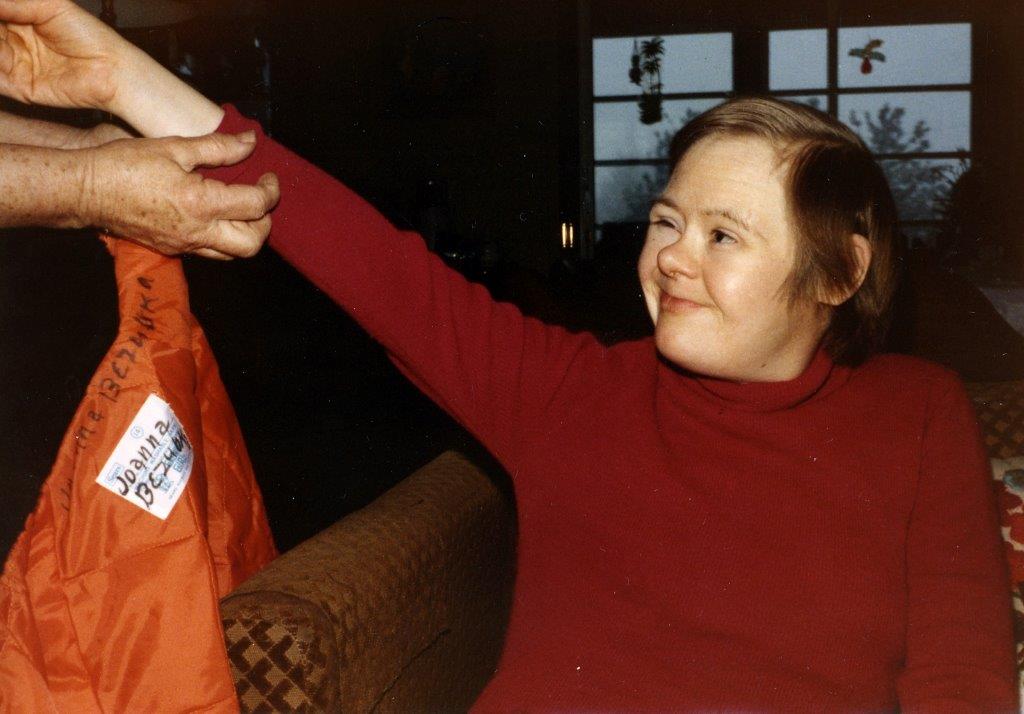
Playing the shirt-sleeve cuffing game
Mavridis also speaks frankly about his own quadruple coronary artery bypass operation, which happened in the same year as the sexual assault, and the effect of his temporary incapacitation on Joanna. He also details Joanna’s physical and mental decline beginning in 2008, when she developed Alzheimer’s Disease, a condition which afflicts nearly all people with Down syndrome as they age.
Mavridis relates how sad it was for him to watch Joanna’s limited ability to communicate disappear in her final four years. She stopped tearing paper and she stopped playing with Legos and handing them out as tokens. Mavridis nevertheless was determined to make her life as comfortable as possible and bought special lift equipment for her as well as a special hospital bed and recliner.

“I bet I blinked first,” Mavridis says of this photo.
Near the start of his book, Mavridis includes a short article by a writer, Emily Perl Kingsley, about what parents go through when they first learn that their child is intellectually disabled. “When you’re going to have a baby, it’s like planning a fabulous vacation trip to Italy,” Kingsley writes. Instead, the plane lands in Holland.
“The important thing is that they haven’t taken you to a horrible place,” Kingsley continues. “It’s just a different place, so you must go out and buy new guide books and you must learn a whole new language…but after you’ve been there for a while…you begin to notice that Holland has windmills; Holland has tulips; Holland even has Rembrandts.”
“Joanna, God’s Special Child” is the story of a wonderful journey to Holland for Mavridis and his family, and of their discovery of the windmills, tulips, and Rembrandts there.
Seven Hills families win a reprieve from eviction
This post is about one of the few cases in Massachusetts in which families and guardians of the residents of a congregate care facility for the disabled appear to have won out over ideological efforts to move their loved ones into community-based group homes.
Some 43 residents of the Seven Hills Pediatric Center in Groton, who had been targeted for eviction under a federal lawsuit, will now apparently be allowed to stay in their long-time home at the nursing facility some five years after their parents began a campaign against the moves.
In May of this year, a federal district court judge formally ended the Rolland v. Patrick suit after the plaintiffs agreed the Patrick administration’s efforts to move hundreds of developmentally disabled nursing home residents to group homes had satisfied the conditions of the suit.
Given that the suit is now over, the impetus to move the 43 residents out of the Seven Hills center is apparently over as well.
Advocates for community-based care and the Patrick administration are congratulating themselves on the final resolution of the Rolland case as an example of a successful effort to move disabled people out of institutional facilities.
To the extent that the Rolland suit has enabled people who don’t belong in nursing homes to get adequate care in the community system, we applaud those who brought the case. Among them are The Center for Public Representation, a government-funded legal advocacy organization that advocates for legal rights for people with developmental disabilities and their families.
Where we take issue with the CPR and their supporters is their apparent failure to distinguish between congregate care facilities that don’t provide adequate treatment and those that do. In announcing the end of the Rolland case, neither the CPR nor the Patrick administration made any mention of the Seven Hills families who had wanted their children to stay at the center and who didn’t want to be part of the lawsuit.
There was also no mention of the fact that there are some institutions, such as Seven Hills and state-run developmental centers, that might be appropriate settings for people with severe and profound levels of disability. The anti-institutional ideology of the CPR, the Arc of Massachusetts, and similar organizations is so strong that those groups never acknowledge that care in congregate facilities might be appropriate under any circumstances.
Rolland is a class-action lawsuit brought in 1999 against inadequate nursing home care for people with intellectual and developmental disabilities. There is no question that many people with developmental disabilities have been inappropriately placed in nursing homes, which do not provide the level of treatment and activities these residents require. Ironically, many of these inappropriate nursing home placements have occurred as Intermediate Care Facilities (ICFs) such as the Fernald, Glavin, Monson, and Templeton developmental centers, have been phased down or shut by the administration.
But unlike most nursing homes, Seven Hills is staffed and equipped to care for people with severe and profound levels of developmental disability and complex medical conditions. As the Seven Hills families’ website notes, none of the residents there can talk or walk, and all have a mental age of less than one year.
In 2008, the Seven Hills families were informed by the Patrick administration that their children were on a list to be moved to the community system as part of a settlement agreement in the Rolland case. The families were outraged by this, partly because they knew that any attempts to move their children would be disruptive and dangerous to them, and because they knew that the specialized care at Seven Hills was not likely to be found elsewhere. The families’ website noted the following about the children living there:
Their fragile lives have been sustained thanks to the care-givers at Seven Hills. Their families believe that state-mandated placement changes to so-called group homes are likely to have tragic consequences.
The Seven Hills family website details stories of residents there such as David Braga and Eric Voss, both of whom are quadriplegics and who have severe intellectual disabilities. As the Boston Globe put it in a story on the pending evictions from the facility in 2008:
The (Rolland) lawsuit hinges on the argument that, according to federal law, the mentally retarded must be provided with the opportunity to exercise personal choice, participate in and contribute to the community, develop and sustain varied and meaningful relationships, and acquire skills that increase self-reliance…
(But Frank Voss, Eric Voss’s father) argues that his son, who was born with cerebral palsy, differs dramatically from those who might benefit from the (Rolland) settlement. Eric is fed through a tube. He cannot talk and has little affect, except to smile sometimes at voices he recognizes. He requires a custom-made wheelchair.
Louis Putterman, whose daughter is a Seven Hills resident, said that since the dismissal of the Rolland suit, the families have been notified that their children will not be moved from the facility. But, he said, the administration has not acknowledged that it may have been wrong in the first place to have targeted the residents there for transfer from the center.
For five years, Putterman said, he and the other Seven Hills families lived with uncertainty over the fates of their loved ones. They also had to put up with what he said were detrimental changes in the care of their children as a court monitor in the case heaped paperwork and other bureaucratic requirements on the Seven Hills facility. Putterman said his daughter suffered significant health effects from being transferred to a different floor and room in response to a complaint by the court monitor about waiting times at elevators in the building. “It was done without adequate regard for consequences,” he said.
The Seven Hills parents fought back, however, dogging Governor Patrick at campaign and town meeting events (remember those?). The families also went to court in May 2008 to decertify the Rolland class and appeal the settlement. Their motions were denied, in part, on the basis that they had waited more than 10 days to try to opt out of the suit. They contend they were not informed of its existence for nine years.
“No Seven Hills guardians were informed that the suit existed until 2008,” Putterman maintained. He said he complained to the state Attorney General’s Office in 2009 that he believed the plaintiffs attorneys had falsely stated to the Circuit Court that the families received notification of the suit in 1999, but he said he never received a response from the Attorney General’s Office.
The Seven Hills families’ years of uncertainty actually began in 2008, following what turned out to be a second settlement of the original Rolland lawsuit. Following the initial settlement of the case in 2000, the state had placed about 1,000 class members in the community. But the plaintiffs charged that the state had largely failed to provide specialized services to about 800 class members who remained in nursing homes.
In the 2008 settlement, the state agreed to move an additional 640 of the 800 class members remaining in nursing homes to community placements over four years. But unlike the 2000 settlement, the 2008 settlement did not give parents a veto of decisions to transfer their children.
In another bit of irony regarding this case, the 2000 settlement agreement’s specialized-services provisions required the state to provide “active treatment” to nursing home residents, based on regulations governing ICFs – the very facilities that the CPR and the administration have sought to dismantle.
In their May 2008 legal motions, the Seven Hills families argued that the differences in the levels of disability between their children and the other class representatives made the class certification improper. They also sought a provision giving them the right to veto a transfer decision, as the 2000 settlement had done. The parents’ motions were denied in the district court, and they lost on appeal to the First Circuit U.S. Court of Appeals. We think the motions were denied largely on technical grounds.
The real problem here, in our view, lies with those who lose sight in their zeal to promote “community-based care” that no single system necessarily works for everyone. Community-based care is appropriate for those who need it and who want it. But the wishes and life experience of the families and guardians of all profoundly developmentally disabled people should be respected.
In June, the Seven Hills families adopted a public policy statement that asserts, in part, that:
…while community placement may lead to an improvement in quality of life for many higher-functioning cognitively impaired individuals, there exist more severely impaired and medically fragile individuals whose interests are better addressed by care in a facility such as SHPC (Seven Hills Pediatric Center). We will continue to work to inform the public, legislators, and policy-makers about the need for a continuum of care options. May the well-being of our loved ones always take precedence over ideology when making the life-and-death decisions that affect them.”
Federal law recognizes families and guardians as the “primary decision makers” with regard to the care of their disabled loved ones. The CPR and the Patrick administration should be among the first to show they are aware of that.
Massachusetts lags in criminal background checks for caregivers to disabled
While the Patrick administration appears to support national criminal background checks for people hired to care for the intellectually disabled, the administration has failed to apply for federal grant funding that would help it design a federal background check program.
The administration also does not seem to have aggressively pursued proposed legislation in Massachusetts that would authorize national background checks of people hired to work in the Department of Developmental Services system.
This is an administration that has been nothing short of enthusiastic about closing state-run care facilities and moving the residents in them to community-based group homes. But as far as protecting those people from abuse and neglect in the community system is concerned, the administration’s level of enthusiasm seems to drop off sharply.
National background checks involve matching a job applicant’s fingerprints against a federal database maintained by the FBI. This table I compiled shows how each state compared as of 2008 regarding national background check requirements, and which states have taken advantage of federal grant funds available since 2010 to design a national background check program.
As the table shows, Massachusetts was one of 16 states as of 2008 that had no national background check requirements. (The information is based on a survey by the National Conference of State Legislatures.) It is still the case today that Massachusetts requires only in-state criminal background checks of people hired to work in the DDS system.
As the table also shows, Massachusetts is among as many as 27 states that haven’t applied for the grants that have been available from the Centers for Medicare and Medicaid Services under the Affordable Care Act “to design comprehensive national background check programs for direct patient access employees.” A total of 23 states and Puerto Rico have been awarded a total of $53.4 million in those grants, which have been as high as $3 million per state.
Every advocacy group for the disabled that I know of agrees that state-only background checks are not sufficient in screening applicants seeking jobs in caring for the disabled because those checks turn up only convictions for criminal activity in that state. The checks do not identify criminal convictions that a job applicant might have from another state.
In testimony to the state Legislature’s Judiciary Committee last month, State Representative Martin Walsh stated that the state Disabled Persons Protection Commission had identified 1,000 cases in which “criminal abusers” were working in Massachusetts, and that one out of five of them had come from outside the state.
I contacted the Massachusetts Executive Office of Health and Human Services and the Department of Developmental Services regarding the federal grant program, and received a response from Victor Hernandez, a deputy assistant DDS commissioner. Hernandez stated in an email that the state has not applied for a CMS grant because Rep. Walsh’s legislation authorizing national background checks by DDS is not yet in place. Once such legislation is enacted, Hernandez wrote, “we will pursue the federal dollars.”
That sounds reasonable enough except that under the grant rules, the state is not obliged to wait for enactment of a national background check statute before receiving the funding. In an online FAQ about the grant program, the CMS states that in cases in which “necessary state legislation is not in place prior to the start of the grant period,” CMS would “work with the state to identify a portion of the potential grant funds that would be available immediately and additional funds that may be available at a later time when the additional authority is in place.”
I also received an email from CMS, which stated that there are a number of states “that have been in the (national background check grant) program for several years and have yet to be successful in implementing state laws.”
I wrote back to Hernandez to ask if the Patrick administration has worked with CMS to identify a portion of the grant funds that might be immediately available to the state. I haven’t yet heard back.
It’s not only the administration that can’t seem to get excited about protecting the developmentally disabled from abuse and neglect. The Legislature as a whole doesn’t seem to have an attitude that is much different in that regard.
As I’ve previously noted, Walsh’s proposed national background check legislation for new workers in the DDS system has been stalled for a number of years in the Legislature. Last year, the Legislature did pass a bill to implement a national background check requirement for people hired to work in public and private school systems in the state. Massachusetts, however, was reportedly the last state in the nation to enact a national background check for school personnel.
This year’s national background check bill for DDS system workers (H. 1674) was filed by Walsh in January and referred to the Judiciary Committee at that time. The committee only got around to holding a public hearing on it on July 9, and still has not acted to approve the measure.
Walsh noted in his testimony to the Judiciary Committee that his bill had been approved twice in the past two years by that committee only to be sent to the House Ways and Means Committee to die a slow death.
That the developmentally disabled are subject to abuse and neglect in the community system of care is hardly disputed by anyone who looks at the matter objectively. The VOR has cited an “alarming number” of deaths and cases of abuse of developmentally disabled individuals around the country, and noted the “prevalence of preventable deaths at privately run group homes across this nation.” Community-based care, which is primarily delivered in widely dispersed group homes, is by definition harder to monitor and oversee than care delivered in larger congregate-care settings.
But whether abuse, neglect, or misappropriation of funds occurs in the privatized or state-run systems of care, the federal CMS has recognized those three issues as “a widespread problem for millions of Americans receiving LTC (long-term care) services.”
Let’s hope that both the Patrick administration and the state Legislature begin soon to place a higher priority on finding a solution to those problems. The administration could show it is placing a priority on addressing abuse and neglect, at least, by applying immediately for a CMS grant to design a workable national background check program in Massachusetts; and the Legislature could begin by acting as quickly as possible to pass Rep. Walsh’s national background check bill.
Making care for the disabled a zero-sum game
There is no question that Massachusetts is facing budget problems that are making it increasingly difficult to fund services for our most vulnerable citizens, particularly those with intellectual and other disabilities.
One thing we shouldn’t do in this situation, though, is try to help one group at the expense of another. That, in our view, is what two pieces of proposed legislation now before the Children, Families, and Persons with Disabilities Committee would do.
Both bills were the subject of a public hearing last week before the committee. I wanted to testify about both of them, but they were way down on the committee’s hearing list. After waiting two and a half hours to testify and then realizing by that time that almost all of the legislators on the committee had left, I left the hearing without testifying publicly and submitted my remarks in writing to the committee staff the next day.
I’ve already written several times about one of these two bills – the ‘Real Lives’ bill (H. 151), though not specifically about how it would potentially divert funding from intellectually disabled people living in state-operated group homes to corporate providers that contract with the Department of Developmental Services. I’ll get to that in a bit.
Early on in last week’s hearing, I first found out about the other bill, which was filed by state Representative Tom Stanley at the behest of the Association of Developmental Disabilities Providers (ADDP), the lobbying organization for those same state-funded, corporate providers.
Stanley personally appeared before the Children and Families Committee to promote the ADDP bill (H. 156), which would require that at least half of the “savings” in closing state-run DDS developmental centers be used to fund programs run by corporate providers. (Legislators don’t have to wait to testify at committee hearings, but are given the floor when they show up.)
Specifically, Stanley’s bill would require that “not less than 50 percent” of those developmental center closure “savings” be used to “fund and implement Chapter 257 of the Acts of 2008.”
What is Chapter 257 of the Acts of 2008? As the ADDP notes, it is a statute that provides for “standardization and adjustment for rates to contracted human and social service providers.” In other words, it’s intended to adjust state payments to the group home providers upwards. Last January, the ADDP was anticipating that the administration would provide up to $175 million in funding in the current-year budget to implement Chapter 257.
As the ADDP put it on their website:
After waiting for nearly 25 years, developmental disability programs (read “the providers”) may finally see their prayers answered with Governor Deval Patrick’s FY 14 House One Budget….
An administration document posted by the Providers’ Council, another provider lobbying group, last January indicated that the governor had proposed that at least $53 million in Chapter 257 funding go directly to the provider residential line item in the DDS budget in the current fiscal year.
The ADDP’s and the Providers’ Council’s prayers, however, were apparently not fully answered. The total proposed Chapter 257 funding apparently did not materialize in the final budget for the current fiscal year. The provider residential line item in the final budget, as approved by the Legislature, is $13.1 million less than what the governor proposed in January.
In a July 2 recap of the final FY 14 budget, the Arc of Massachusetts, a close ally of the ADDP and the Providers’ Council, stated that the organization was hoping for passage of a supplemental budget this year “to fully implement Chapter 257 in Residential Services for 2014.”
But what if such a supplemental budget is not forthcoming? Maybe that explains the need for Rep. Stanley’s bill. Because the Legislature was apparently not willing to put the amount of additional money into the provider group home line item that the ADDP, the Providers’ Council, and the Arc were seeking, the ADDP figured they could get it from somewhere else. That somewhere else is apparently the developmental center closure “savings.”
While we would dispute that there has actually been any savings in closing the developmental centers, what has occurred is that the developmental center line item in the DDS budget has been cut by some $80 million since FY ’09, when the administration first announced it planned to close four of the centers.
It seems the funding cut from the developmental center line item has gone in the past five years to the state’s General Fund, rather than being plowed back into the provider-run, community-based system, as the administration had originally promised. However, at least some of that money has been transferred back from the General Fund to both the state-operated and provider-run group home accounts.
As the developmental centers have been closed, a large percentage of the former residents has been moved primarily to one of two remaining developmental centers and to state-operated group homes. The state-operated group home line item has thus been increased by about $41 million since FY ’09, largely to accommodate that influx of residents. The provider-run group home line item has been increased by some $230 million in that time.
So, now we have Rep. Stanley’s bill, which says, as we understand it, that at least 50 percent of the funds cut from the developmental centers must be directed to fund Chapter 257. Given that passage of this bill would result in a significant increase in funding for the providers (or else why would the ADDP want this bill filed?), what does that mean for the state-operated group homes? There is only a finite pot of money involved. Funding for the state-operated group homes would potentially have to be cut.
We know that the state-operated residential facilities are struggling in Massachusetts. These facilities are required under court order to provide care for most former developmental center residents that is equal or better to the care they previously received. Although funding has been increased to the state-operated group homes, the increase this year was significantly less than what the administration projected was needed.
These are among the questions I posed in a phone call on Thursday to Rep. Stanley. In filing his bill on behalf of the ADDP, did he understand the full implications for the state-operated group homes, in particular, and the level of services the residents in them would continue to receive?
Stanley responded that he believed his bill would “help both the state-operated and provider-operated group homes.” He said it was his understanding that Chapter 257 would boost funding to most, if not all, DDS line items and that he would get back to me to confirm that. I’m waiting for his follow-up call.
As I noted to Stanley in an email following our Thursday phone call, there are many documents online about Chapter 257, and they indicate, as I’ve noted above, that Chapter 257 was intended and drafted to fund purchase-of-service programs only, not state-operated programs.
For example, there is that administration document posted by the Providers’ Council, linked above, which shows the proposed $53 million in Chapter 257 funding going into the provider residential line item in the DDS budget. While some of the Chapter 257 funding would go to other agencies in the Executive Office of Health and Human Services, nothing in the document indicates that any of the Chapter 257 funding would go toward the DDS state-operated group homes. Chapter 257 is clearly targeted toward contracted services obtained from corporate providers to DDS and other EOHHS agencies.
So, how much money are we talking about in diverting 50 percent of the funding cut from the developmental centers to the providers? In the current fiscal year, it appears the developmental center line item has been cut by $10.8 million from the previous fiscal year. Fifty percent of that figure would be $5.4 million.
As noted above, the final FY 14 budget provided $13.1 million less in funding for the provider residential line item than did the governor’s budget proposal. Thus, if Rep. Stanley’s bill is passed, it would seem the providers would get back some $5.4 million – or about 41 percent – of the amount the Legislature had cut from the governor’s proposal in the current fiscal year. Not the whole ball of wax, but it would reduce the amount that would be needed in that hoped-for supplemental budget to satisfy the providers.
It turns out, though, that Rep. Stanley’s bill was not the only piece of legislation heard by the Children and Families Committee last week that would divert funding from the developmental centers to the providers. There’s also the Real Lives bill, proposed by Rep. Tom Sannicandro. While I was there, a long line of legislators testified in favor of that measure, which is intended to give all DDS clients more choice in services. The Real Lives bill happens to state that 40 percent of the “savings” in closing at least three of the developmental centers must be directed to a fund that would support “self-directed services,” presumably for all DDS clients.
As I’ve previously pointed out, the Real Lives bill specifies a large role for the providers in establishing that self-directed services fund. And one of the purposes of the fund would be to subsidize providers who lose funding when their clients leave their facilities for facilities run by other providers.
So, between these two bills (proposed by Reps. Sannicandro and Stanley), it would seem that at least 90 percent of the funding cut from the developmental centers would be earmarked for specific funds or line items that would help the providers, in potential competition with the state-operated group homes and other DDS accounts. Ninety percent of the $10.8 million cut from the developmental center line item in the current fiscal year totals roughly $9.7 million. Now, we’re talking about the providers getting back $9.7 million – or almost three quarters – of the amount the Legislature had cut from the governor’s proposed funding for provider-run group homes.
To be clear, we support adequate funding of provider-run group homes and thus we support full funding of Chapter 257. But we don’t support that funding increase coming at the expense of the state-operated group homes or other DDS line items. Robbing Peter to pay Paul should not be the solution to the problems the administration is facing in providing care to everyone who needs it.
We can do better than the final DDS budget for current fiscal year
As we start the 2014 fiscal year, there was some good news, but mostly bad news for people with intellectual disabilities and their families in the final budget produced by the Legislature last week .
The bad news is that funding for state-operated care fared poorly in the final budget bill as it emerged from a House/Senate Conference Committee on June 30. As explained below, this has negative implications for corporate-run, community-based care as well.
The good news is that there will at least be a hearing on the so-called ‘Real Lives’ bill, if that flawed piece of legislation ever gets enacted. The Conference Committee did not approve the Real Lives language, which we have objected to and which had been quietly inserted into the budget bill by its prime sponsor.
The Real Lives bill’s supporters will have to go back to pushing the measure (H. 151) through the normal legislative process. The proposed legislation, which is still in the Children and Families Committee, still hasn’t been scheduled for a hearing, according to the legislative website.
The budget Conference Committee did accept the Senate’s proposed funding level for the state-operated group home line item, which is slightly better news than had the Committee accepted the House funding level. As a result, the state-operated group home line item was cut by only $1.5 million from the governor’s budget, rather than $1.96 million, as the House had previously voted.
The Conference Committee’s proposed funding for the state-operated residences is $9.1 million higher than in the just-ended fiscal year, but it apparently still represents a shortfall in the amount needed, according to the Department of Developmental Services. That is largely because state-operated group homes appear to be the preferred care setting for a large number of residents of developmental centers that have been marked for closure.
The Conference Committee also decided to cut the DDS administrative line item (which funds service coordinators) by $700,000 from the governor’s budget and cut the developmental center line item by close to $400,000 from the governor’s budget. Both of those cuts are bad news for state-operated care, and they will adversely affect the quality of community-based care.
First, service coordinators are state employees who make sure that DDS clients receiving both state and privately provided care are getting the right services. For years, their funding has been cut even as their caseloads have grown. Service coordinators are integral to maintaining the quality of care in the DDS community-based system. DDS Commissioner Elin Howe has referred to service coordinators as “the heart and soul of our agency.”
Secondly, while many proponents of community-based care may think that the continuing cuts to funding of the developmental centers is good news for the community system, the opposite may in fact be true. We’ve noted repeatedly that the money “saved” in phasing down and closing the developmental centers has not been diverted into most community-based accounts as the administration had promised.
The result is that as the developmental centers are closed, their residents are being moved into community-based care ahead, in many cases, of people who have been waiting for years for residential placements. And those former developmental center residents appear to be absorbing whatever additional funding has been put into the community-based system as the developmental centers are phased down.
For example, we understand that the last residents of the Glavin Regional Center in Shrewsbury were moved in recent weeks into state-operated and corporate-operated group homes in the surrounding area. Those former Glavin residents were clearly placed ahead of other developmentally disabled persons in the Shrewsbury-Worcester area waiting for residential care.
Some community-based line items did fare slightly better in the Legislature’s budget than they had in the governor’s budget plan last January. The Conference Committee approved a $2.8 million increase over the governor’s budget for adult family supports, a $1 million increase in autism services, and a $500,000 increase in Turning 22. The Committee accepted the governor’s budget amounts for both community transportation and day programs. The Senate had cut the governor’s proposals for both of those line items by $500,000.
The Conference Committee, however, cut the community residential line item by $13 million from the governor’s budget proposal. That still represents a $59 million increase over the just-ended fiscal year. But it appears the community system would need a far larger increase than that to begin to address the serious shortfall in care and services that the system is plagued with.
In sum, the administration and the Legislature have chosen with this budget to continue the expansion of corporate care of the disabled without adequate funding or oversight.
The state is continuing to close small, strategically located developmental centers, which provide the most intensive and heavily monitored levels of care, and to scatter the residents to inadequately monitored group homes. At the same time, the decision has been made to continue to cut funding for one of the few sources of monitoring left of the privatized system — the service coordinators.
And that privatized, community-based system itself continues to be underfunded, contravening the administration’s promised “Community First” agenda. It would seem that a state that prides itself on the care it provides its most vulnerable citizens could and should do better than that.
 COFAR blog