Archive
What are they afraid of?
It’s now clear that there will be no independent study of the cost of closing versus maintaining the Templeton, Monson, and Glavin developmental centers for people with profound intellectual disabilities in Massachusetts.
Instead, the Patrick administration will continue on its path of closing these critically important institutions on the basis of its largely unscrutinzed claim that doing so will save money.
We figured the administration and the Association of Developmental Disabilities Providers wouldn’t want an independent assessment of that savings claim. Now we know the leadership in the House and Senate didn’t want it either. As a result, it will not happen.
Last week, the Senate leadership scuttled a budget amendment, which would have specified that a study of the cost of closing Monson, Templeton, and Glavin be undertaken by a non-governmental entity selected by the Inspector General.
This occurred after the House had scuttled a similar amendment, and after the ADDP and The Boston Herald had cited inflated numbers on the cost of operating the Fernald Developmental Center. (Fernald, by the way, wouldn’t even have been included in the proposed cost study.)
What were the administration and the ADDP, in particular, so afraid of?
I think I can guess. There is a possibility that the entity selected to undertake the study would have come up with a conclusion that the administration, the ADDP, and the legislative leadership didn’t want to hear, i.e., that there would be little or no savings in closing the three facilities.
Even if you believe we will save money in closing these institutions, why not verify that with an impartial study? Because it might delay the closures of these facilities by a few months?
In fact, the administration is on schedule, as far as we know, to close all of these facilities as of Fiscal Year 2013. Fernald, which was first on the closure list, remains open, not because of any cost studies that have been conducted, but because of administrative appeals filed by the guardians of its remaining residents.
The administration has steadily moved residents out of all four of these developmental centers. This has caused tremendous displacement and anxiety among hundreds of families and guardians, and is leading us toward a system that no longer meets the same high federal standards of care as do the developmental centers.
Elderly residents of these centers are being forced to leave homes many have known for practically their whole lives. The key justification the administration has given for doing all this is saving money. Yet, we are told we cannot afford to have an impartial review of that savings claim because it might slow down this march of “progress” by a few months.
The fact is that studies in other states have come to conclusions that don’t support the Patrick administration’s claim that closing developmental centers saves money. (See, for instance: Journal of Mental Retardation cost studies review and Connecticut DDS studies of the cost of closing the Southbury Training School.) Were an independent study in this state to reach a conclusion similar to those out-of-state studies, it would present a public relations problem, at the very least, for the Patrick administration.
That, it seems to us, is the real reason the administration and the ADDP fought so hard to make sure the independent cost study amendment didn’t see the light of day here in Massachusetts. Last month, Rep. Brian Dempsey, House Ways and Means chairman, wouldn’t allow the study amendment, which had been sponsored by Rep. Anne Gobi, even to come to a floor vote in the House.
A staff member for Senator Michael Moore, the sponsor of the independent cost study amendment in the Senate, would only say this week that “(Senate) Ways and Means was not supportive” of the amendment. As we understand it, Moore was first told he would not be allowed to include language in the measure requiring legislative approval of the study.
Then Moore was told he would have to knock Templeton and Monson out of the amendment, and restrict the study just to Glavin, which is in Moore’s district. Moore complied with all of those directives. But it didn’t help.
Moore’s watered-down cost study amendment was nevertheless then reportedly bundled with other budget amendments in the Senate’s consolidated “no” pile, meaning it was doomed to be rejected, along with all the other amendments unwanted by the leadership, in a single voice vote on the Senate floor. You couldn’t have done in this cost study amendment more thoroughly if you tried.
You have to hand it to the administration and the ADDP. If they don’t want something getting through the legislative process in Massachusetts, it apparently doesn’t get through. The problem is that doesn’t say much for the democratic process in Massachusetts.
The Herald headline and story are wrong
On Tuesday of this week, The Boston Herald’s readership was treated to a bombshell headline and story, purportedly about government waste due to delays in the closure of the Fernald Developmental Center.
The headline was “$16M to care for 14 people”; and the story went on to imply that the 14 remaining residents of Fernald, whose guardians have filed administrative and court appeals of their transfers from the Center, are each costing taxpayers more than $1 million per year.
The only problem is that the headline and story are wrong. I just received a letter from Department of Developmental Services Commissioner Elin Howe, confirming our information that the annual cost of caring for the remaining 14 people at Fernald is projected at $8.9 million. It seems the $16 million is the projected cost of keeping Fernald open throughout the current fiscal year, during which time there have been far more than just 14 people living there.
As of the end of last June (at the start of the current fiscal year), there were some 70 residents left at Fernald, according to our records, and by the end of July, that number was down to about 40. The adminstration has steadily moved people out, and 14 is the number of residents who remain as of this month. So, the $16 million cost clearly reflects a higher number of residents than 14.
Moreover, Commissioner Howe stated in her May 25 letter that:
While the costs associated with operating Fernald have dropped following the census (residential population) reduction, the per-person costs have actually increased as the census declines in the final stage of closure. This has been a typical pattern in previous closures.
In other words, a per-person cost spike is something that occurs in virtually all developmental center closures — it’s not something unique to Fernald because of the appeals filed by the guardians. There are certainly added costs associated with the delay in closing Fernald, but those costs are something the administration should have anticipated as part of the overall cost of closure.
Nevertheless, the inaccurate claim that $16 million is being spent on 14 residents was immediately seized upon this week by the Association of Developmental Disabilities Providers, whose members stand to benefit from new state contracts as Fernald and three other developmental centers are closed. ADDP President Gary Blumenthal decried the alleged $16 million cost as “tremendous” and “excessive,” and implied that the Fernald guardians are responsible for it.
On Wednesday, the Herald’s editorial page picked up on the theme, stating that the alleged $16 million being spent on 14 Fernald residents is taking away from community-based services “and it’s impossible to argue that point.” It’s especially difficult to argue it when the editorial’s point is based on deliberately misleading and inaccurate information.
The Herald editorial, by the way, is very carefully worded not to equate the $16 million directly with the 14 residents, although it puts the two numbers as close together in the same paragraph as possible. And of course the editorial never even bothers to mention our longstanding contention that the costs of operating Fernald and the other developmental centers have been overstated by the administration in comparisons made with the community system.
(I talked at length, by the way, with the Herald reporter about that whole developmental center-versus-community cost issue when she called me the day before her story ran on Tuesday. None of that made it into print, of course.)
I would also note that Howe stated in her letter that the 95 staff left at Fernald is a projected number after a current round of layoffs is completed. Howe provided a number of reasons for that apparently high number of remaining staff, and concluded that “all appropriate staff reductions have been or are being taken and the remaining staff are necessary to meet the remaining residents’ needs.”
Setting the record straight about Fernald and COFAR
If any more evidence was needed that the human services providers and the Patrick administration are attempting to tarnish the Fernald Developmental Center’s families in order to discredit the highly successful model of state-run care for the intellectually disabled in Massachusetts, today’s Boston Herald story provides it.
“16M to care for 14 people,” is the headline; and in the story, Gary Blumenthal, president of the Association of Developmental Disabilities Providers, calls the cost “excessive” and blames it on the guardians of the remaining Fernald residents because they are delaying the Center’s closure. Those guardians have simply exercised their statutory right to file administrative and Superior Court appeals of the transfers of their wards out of Fernald.
Moreover, we’ve just learned that DDS stated in Superior Court earlier this month that the cost of operating Fernald may actually be $9.8 million, not $16 million (more about that below). Secondly, if, in fact, 95 staff do remain at Fernald for the remaining residents, as the Herald story and DDS say, that is an indication of mismanagement on the part of DDS; it’s not the fault of the guardians.
Meanwhile, in a comment on our previous post on Blue Mass Group about the use of Fernald as a political football, Blumenthal (under the user name, Garyof Sudbury), chides COFAR for encouraging “endless appeals and endless studies” in an effort to keep the developmental centers open. This is a mischaracterization of COFAR’s role in advocating for adequate care for DDS clients.
Here, to the best of our knowledge, is what is really happening regarding Fernald and the other developmental center closures:
1. Earlier this month, the administration provided numbers on the cost of operating Fernald that are nearly 40 percent lower than what it is publicly citing to the Herald. In a comment posted on the COFAR blogsite, Stephen Sheehy, the attorney representing the remaining Fernald residents, states that on May 6, DDS submitted an affidavit in Middlesex Superior Court that the cost of keeping Fernald open is approximately $9.8 million per year.
DDS Commissioner Elin Howe stated in a conference call last week that the cost of operating Fernald this year was $15.6 million. The Herald is saying $16 million (and stating, by the way, that was the cost last year when there were far more than 14 people left at Fernald). So, who knows what the real figure is.
2. The administration and the ADDP are ignoring COFAR’s longstanding proposals to rightsize the remaining developmental centers in Massachusetts or otherwise operate them more efficiently.
COFAR and other affiliated organizations have long called for “postage-stamp” arrangements at the developmental campuses that would enable current residents to remain there and receive the same level of care while the rest of the campuses were developed for other uses. No one is advocating the preservation of large, outdated buildings on these campuses. What we do want to preserve is the model of care that currently exists there in the most cost-effective way possible.
The administration has never even wanted to discuss the postage-stamp approach. They have always viewed the issue in purely binary terms: either we continue to operate all the facilities as they are today, or we close them all and evict all their remaining residents. There have been no other options even worth considering for them.
3. The ADDP is deliberately mischaracterizing the history of litigation over Fernald in order to paint COFAR as somehow responsible for the cost of delay in closing Fernald.
Here’s a brief history of that litigation (reprised from my response to GaryofSudbury):
From 1974 to 1993, U.S. District Court Judge Joseph Tauro presided over the landmark Ricci v. Okin consent decree case, which brought about significant improvements in care and services at Fernald and other developmental centers in Massachusetts.
In 2004, the Fernald plaintiffs in the Ricci case (some of whom are COFAR members) urged Tauro to reopen the case, not to delay Fernald’s closure, which Tauro said he would not do, but to investigate apparent violations of Tauro’s order that transfers out of Fernald must result in equal or better care. It was the Patrick administration — not COFAR or the Fernald plaintiffs — who then went to court to appeal Tauro’s 2007 ruling in which he found that DDS had engaged in a systemic violation of his order.
In 2008, the U.S. Court of Appeals overturned Tauro’s 2007 ruling. The Fernald plaintiffs appealed to the U.S. Supreme Court, arguing that the Appeals Court had not given Tauro due deference in their decision. The Supreme Court declined to hear the case.
Since that time, some of the Fernald guardians have exercised their statutory and regulatory rights to file administrative appeals of the transfers of their wards from Fernald, on the grounds that these transfers would not result in improved services. COFAR has not publicly or privately encouraged or discouraged those appeals. We fully support the personal decisions that any guardian chooses to make in these cases.
It’s perhaps ironic that if the administration had agreed years ago to consider our proposal to develop cost-effective group homes delivering the current level of care on the current campuses, we could have avoided all the delays and litigation that the providers and the administration are now decrying.
In summary, as we pointed out in our previous post, what we’re now seeing is a campaign by the administration and the providers to use Fernald to discredit a proposed budget amendment that would require an independent cost study before the Templeton, Monson, and Glavin developmental centers could be closed. The argument being made by the administration and the provders is that this budget amendment would cause delays in the closures of those three facilities, and that soon we will be paying the same high costs to keep those centers open that we’re allegedly paying for Fernald.
This is nonsense. An independent cost study will simply help us determine whether we’re on the right track fiscally in closing these facilities. As I hope we’ve shown, we can’t leave it solely up to this administration to provide credible numbers or other information about this matter.
Fernald being used as political football
The Fernald Developmental Center may be almost closed, but it’s now apparently being used as a political football by the administration and the human service providers who are seeking to close at least three additional state facilities for persons in Massachusetts with intellectual disabilities.
In the past month, both the providers and the administration have cited an allegedly high current operating cost for Fernald as a reason to oppose a cost study prior to closing the Monson, Templeton, and Glavin centers. Nevermind that Fernald is not even included in a proposed state budget amendment calling for the cost study.
Moreover, while we haven’t yet seen the Fernald budget numbers the providers and the administration are citing, we understand the reportedly high cost is due to a decision by the administration to maintain an unusually high number of staff at the facility for its 19 remaining residents. The reason for the high staffing level isn’t clear. The guardians of those remaining residents have filed administrative appeals of Fernald’s closure.
During the ongoing budget debate in the Legislature, the Department of Developmental Services and the Association of Developmental Disabilities Providers have been telling legislators that it is costing as much as $917,000 per resident per year to operate Fernald. As the linked State House News story shows, ADDP President Gary Blumenthal last month cited that Fernald cost figure, which was disclosed by DDS, in order to discredit a House budget amendment requiring an independent cost study prior to closing Monson, Templeton, and Glavin.
The logic of the administration and the provders appears to go something like this: “Because we’re spending an unusually high amount this year to keep the Fernald Center open for the remaining residents, we shouldn’t even waste time studying the cost of closing or maintaining three other facilities where the costs actually happen to be considerably lower. The Fernald cost shows we must close all four of these facilities as fast as possible.”
That this tactic has had an impact in the Legislature became clear when a small group of COFAR members met on Wednesday of last week with a staff member of Senator Stephen Brewer, chairman of the Senate Ways and Means Committee, to push for the cost study amendment. The staffer, without any prompting, mentioned she had heard Fernald was costing $18 million this year to operate.
That afternoon, in a conference call, I asked DDS Commissioner Elin Howe about the reported $18 million cost. Howe said the cost was closer to $15.6 million, which would translate to a still sky-high figure of $821,000 per person to keep Fernald running this year. When I asked what the money was being spent on, Howe said the high cost was due to the fact that 95 staff remain at Fernald — a staff-to-resident ratio of 5 to 1.
I was so taken aback by what Howe had just said that I didn’t think to ask her why the administration is maintaining such a high staffing ratio at Fernald. That ratio appears to be the reverse of the 1 to 3.2 staff-to-resident ratio required under federal regulations for Intermediate Care Facilities. The next day, at DDS’s request, I submitted a written question to Howe about the situation. I haven’t yet gotten a response.
Howe, by the way, said that if I wanted to get the same Fernald budget numbers that Blumenthal was citing to the State House News Service and which DDS has apparently provided to legislators, I would have to file a freedom of information request. I did so the next day.
I then heard that day from Senator Brewer’s office that the high staffing level at Fernald is reportedly due to a court order that has prevented DDS from moving the remaining 19 residents there into one building on the campus. But we’ve heard from other sources that there may not actually have been any such court order.
Whatever the reason for Fernald’s current operating cost, to introduce Fernald into a debate over whether to even study the cost of operating the Monson, Glavin, and Templeton centers is disingenuous and misleading. Luckily, Senator Brewer now appears to understand that. “We know it’s not accurate (to link the alleged Fernald cost to the other three facilities),” the staff member said.
Administration admits to discrepancies in vendor salary info
Patrick administration officials appear to be admitting we may be on to something when we pointed out the state may be getting different information than the federal government gets about salaries earned by human services contractors in Massachusetts.
In an email sent to us on May 11, Terry McCarthy, director of audit in the state Operational Services Division (OSD), acknowledged there were discrepancies between executive salary information provided to the OSD and to the federal Internal Revenue Service for the same contractors.
McCarthy stated that the OSD will “reexamine the cited (federal and state salary reports) for proper compensation disclosures,” and will seek explanations from two of the contractors we identfied for apparent discrepancies in their numbers.
At the same time, McCarthy put forward at least three explanations for the discrepancies, none of which fully satisfy our concerns about them.
First, a bit of background. Concern has mounted around the country about salaries of executives of nonprofits. In Massachusetts, that concern has largely centered around the pay of executives of hospitals and health insurers, but it has also extended to the hundreds of nonprofit vendors that contract with the state to provide human services to people with disabilities.
The OSD, which oversees the contracts with these vendors, requires them to provide detailed financial reports that disclose, among other things, the salaries made by their executives. In addition, a state regulation caps the amount of state funding that goes to pay these salaries at $143,986 a year, meaning that sources other than the state would have to fund salaries higher than that amount.
One of the purposes of this regulation capping executive salaries is to ensure that an adequate amount of state funding is put towards wages of direct-care workers.
COFAR examined state Uniform Financial Reports (UFRs), which are filed with the OSD, and Form 990s, which are filed with the IRS, for the May Institute, Vinfen, and Seven Hills, three of the largest contractors to the Department of Developmental Services. In each case, the UFRs for the Fiscal Year 2009 listed lower salaries and other compensation for the same executives than did 2009 IRS tax filings for the same firms.
The UFRs also listed a lower number of executives earning high levels of compensation than were listed on the Form 990s for the same firms. These discrepancies imply that OSD may be unaware of the total amount of state funding potentially being used to pay salaries of these executives.
In his response, McCarthy acknowledged that the total compensation of four of five identified Vinfen executives appeared to be underreported on the UFRs by $101,539, while the compensation of two executives of Seven Hills appeared to be underreported by $18,509. McCarthy said OSD will seek explanations from those contractors about those differences.
COFAR also reported that the 2009 IRS form for Seven Hills listed four employees making over the $143,986 threshold, while the state UFR listed only two employees making over that amount. The difference in reported compensation between the two forms was $385,000.
For Vinfen, the 2009 IRS form listed a total of 10 employees earning more than the threshold compensation amount, while the UFR listed only four employees earning more than that amount. The difference was $1.2 million.
McCarthy, as noted, stated that the OSD will reexamine the compensation disclosures made by these vendors. However, he also offered two explanations for the differences in the numbers of executives listed on the state and federal forms. One is that there are different filing deadlines for the two forms: the IRS forms lag behind the UFRs.
That may be, but it doesn’t seem a sufficient reason to list different salary numbers on each report or to report salaries for more people on the 990 forms than on the UFRs. Moreover, the 2009 Form 990 for Vinfen was signed by its president on May 14, 2010. The UFR was first submitted to OSD in November 2009 and refiled in April 2010 and then in December 2010. Again, there’s no apparent reason why the final UFR, which was submitted after the Form 990, would have less executives listed and lower salaries than the Form 990.
The second explanation offered by McCarthy was that the Form 990 has “more expansive” compensation disclosure requirements than the UFR. McCarthy said the UFR is limited to including individuals in policy making positions, and would therefore not include a highly paid clinician, for instance.
That doesn’t seem to jibe, however, with the OSD’s reimbursable cost regulation, which doesn’t say anything about exempting non-policy making individuals from the salary cap.
Also, all of the 13 individuals listed in the May Institute Form 990 as making over $150,000 are executive-level employees, starting at senior vice presidents on up to the president and CEO. Those people are all clearly policy-making individuals, yet only two of them are listed on the UFR.
Finally, McCarthy addressed our finding that there was more than a half million dollar difference in the reporting of the compensation of the CEO of the May Institute on the state and federal forms in 2009. This, he said, appeared to be largely due to a one-time $682,343 distribution to the CEO on a vested deferred compensation plan that had been previously reported annually as deferred compensation.
It wasn’t clear, however, whether McCarthy was saying that because this was a one-time distribution on a previously reported deferred compensaton plan that it didn’t need to be reported on the 2009 UFR. But even if the CEO’s compensation isn’t counted, the difference between the total compensation for the 12 other May Institute executives listed on the IRS form and the compensation for the one other executive listed on the state UFR is $2.8 million.
We’re glad the OSD will go back to these three vendors and check to see that their UFRs were filled out accurately. But we’re concerned that there is a potentially larger problem here. It seems OSD does not have the capacity to adequately oversee the contracting system in this state. One indication of that is that the latest online version of the May Institute 2009 UFR had been submitted by the contractor on March 22, 2010, more than a year ago, yet it still hadn’t been reviewed by OSD as of today’s date.
This administration needs to get a better handle on the human services contracting system in Massachusetts.
Seeking a chance to speak truth to power

State Rep. Anne Gobi (right) listens to Joan Douty (center) talk about her daughter's experience at Glavin
The administration, which also has no time to listen to people like Joan Douty, claims Glavin and the other centers must be closed because they’re too expensive to operate. But COFAR has maintained that the administration’s claimed cost savings in closing the centers appears to be based on an apples-to-oranges comparison of the average community-based resident and the average facility-based resident. Developmental center residents are older, more medically involved and more intellectually disabled on average than community-based residents.
Moreover, as COFAR and other advocates have noted, the centralized services model of the developmental centers is highly cost-efficient when compared to the dispersed clinical, medical, and day services that characterize the community system.
COFAR has called since last year for an independent study of the cost of closing or maintaining the developmental centers because previous budget amendments have resulted in flawed analyses done by the administration itself, concluding, of course, that the facilities should be closed.
But here’s the problem. In the Massachusetts Legislature, a handful of people make all the decisions, and Rep. Dempsey is one of them. There was no floor vote this week on Rep. Gobi’s amendment for the independent study. In a closed-door meeting in his office, Dempsey simply ordered that Gobi’s amendment be scuttled. It was not included in a catch-all budget amendment boosting human services line items that will be voted on this week.
Among those who Rep. Dempsey apparently has been listening to are the human service vendors in Massachusetts, who run most of the community-based group homes in the state and who are seeking more business when the developmental centers are closed. In a letter sent to Dempsey and other legislators a day before Gobi’s amendment was thrown out, the Association of Developmental Disabilities Providers continued to pump out misinformation about the developmental centers.
The ADDP letter called for rejection of Gobi’s amendment and repeated the dubious claim that the developmental centers are “expensive and inefficient to operate.” So why not agree to an independent study which would settle the question as to which system is most efficient? To that, the ADDP letter made the ridiculous assertion that “this issue has been the subject of study for 30 years.”
Among the other pieces of misinformation in the ADDP letter was the claim that the developmental centers aren’t needed because “families overwhelmingly choose community settings for their loved ones.” The ADDP letter didn’t mention that that’s because admissions to the developmental centers have been effectively blocked since the 1980s.
The fact is that families that are being transferred from the developmental centers targeted for closure have overwhelmingly chosen to be placed at other developmental centers or in state-operated group homes. They are avoiding the vendor-run system because they know it is beset with problems of poorly paid and under-trained staff.
The Senate now remains the only real hope for this sorely needed independent cost study. We believe the study should be done by a non-governmental entity selected by either the State Inspector General or State Auditor. Once again, though, the question remains whether Senate leaders will allow such an amendment to be debated in the light of day or whether they will do what the House did and quietly kill it in the proverbial smoke-filled room.
Where is our money going?
How accurately is the state tracking salaries earned by human services contractors in Massachusetts?
We looked at state fiscal reports, known as Uniform Financial Reports (UFR’s), which were filed by three of the largest contractors to the Department of Developmental Services, and we think these records raise that question.
In each case — the May Institute, Vinfen, and Seven Hills — the UFRs for the Fiscal Year 2009 listed lower salaries and other compensation for the same executives than did 2009 IRS tax filings for the same firms (Form 990s available on GuideStar). The UFR’s also listed a lower number of executives earning high levels of compensation than were listed on the Form 990s for the same firms.
Why might this be a problem? Because the state Operational Services Division (OSD) depends on the information in the UFRs to determine how much in state funds to apply to that compensation. By regulation, state funds going towards an indivdual contractor executive’s compensation are capped at $143,986 a year, according to OSD.
Take the May Institute, for instance. According to its UFR, the nonprofit contractor took in roughly $105 million in revenues in 2009, of which about 66 percent came from the Department of Developmental Services and a variety of other government agencies in Massachusetts. About 79 percent of the total revenues came from all government sources.
As of April 8, 2011, the online UFR states that Walter Christian, the May Institute CEO, made $509,798 in salary and other compensation in the year ending June 30, 2009. Based on that number and on information from OSD, we calculate that OSD would have been required to “disallow” about $366,000 of that total compensation, meaning that amount would have to come from other sources than the State of Massachusetts.
However, the IRS Form 990 for the May Institute for the same 2009 fiscal year lists Christian’s total compensation as $1.087 million. That’s a difference of more than half a million dollars between Christian’s compensation as listed on the state’s UFR and on the IRS 990 form. If Christian really earned $1.087 million in compensation, we calculate that the state should have disallowed more than $940,000 of it, not just $366,000 of it.
All of this suggests that based on the 2009 UFR, the commonwealth may mistakenly think that more than half a million dollars in potential state funds went into direct care or other operations at the May Institute, when it really went toward Christian’s compensation.
I would note that the UFR website stated as of April 8, 2011, that the latest online version of the May Institute 2009 UFR had been submitted by the contractor on March 22, 2010, more than a year ago, and still hadn’t been reviewed by OSD. A previous version of the UFR had been submitted in December 2009. The website stated that there were “no issues pending” regarding that version.
On March 21, I submitted a written question to OSD about the discrepancy in the listing of Christian’s compensation on the UFR and Form 990, and followed up with a phone call and an email on April 5, saying I was preparing a blog post about the issue. I still haven’t received a response.
An OSD official told me in the April 5 phone conversation that he had been too busy to get an answer to my question (and a few related questions about the UFR) and was going on vacation the following week. He said he didn’t know when he would be able to get the answers.
It’s not just with Christian’s compensation that there are discrepancies between the UFRs and the Form 990s, however. The May Institute UFR lists only Christian and one other executive as making over the $143,986 compensation threshold, above which compensation must come from sources other than the state. The Form 990 lists a total of 13 employees of the May Institute as making over that threshold amount. The discrepancy in listed compensation between the two forms was $3.4 million.
For Vinfen, the 2009 Form 990 listed a total of 10 employees as making over the threshold compensation for a total of $2.2 million, whereas the UFR lists a total of only four employees making only $997,000 — a difference of $1.2 million.
The UFR website stated as of April 8, 2011, that the latest online version of the Vinfen 2009 UFR had been submitted by the contractor on December 10, 2010, and was found by OSD to be “deficient.” No further information was provided.
For Seven Hills, the 2009 Form 990 lists four employees making over the threshold, for a total of $1.2 million in compensation, compared with the UFR, which lists only two employees making a total of $816,000. That’s a difference of $385,000.
The latest online version of the Seven Hills 2009 UFR was submitted to OSD on April 21, 2010. The OSD website stated that there were “no issues pending.”
Last month, The Globe published a letter I wrote on behalf of COFAR, suggesting that Governor Patrick scrutinize the salaries of human services contractors as part of an overall crackdown he had announced on salaries in the state’s independent agencies.
In response, Michael Weekes, president of the Providers’ Council, accused me of attempting to “smear the leaders” of the human services sector and of “making scurrilous attacks that distort the facts and mislead taxpayers.” Weekes said my concern over executive compensation was “moot” because state law caps the amount of state funds that can be applied to executive compensation. He added that my “real concern” should be over the low pay of direct-care workers in the human services contract system, many of whom only make $12 an hour and have gone three years with no increase.
I agree with Weekes that we should be concerned over the low pay to those direct care workers. That’s exactly why we’re asking these questions about the salaries of executives making as much as $1 million or more a year, and whether those executives’ salaries may be soaking up state funds that should be going to the direct care workers.
The fight goes on to save the Glavin Center
At a breakfast on Tuesday at the Glavin Regional Center in Shrewsbury, state lawmakers heard from family members and guardians trying to save this critically important facility from closure.
And the families heard from the lawmakers, who said they will have a tough battle on their hands to get their message heard among the well-organized forces on Beacon Hill calling for the shutdown of all remaining developmental centers in the state for persons with intellectual disabilities.
Meanwhile, lawmakers will file an amendment to the state budget bill coming up for debate in the House, requiring an independent cost analysis before Glavin and two other centers can be closed.
State Senator Michael Moore of Milbury made the comment during the Glavin breakfast, saying the amendment will specify that the study be done by the state auditor, inspector general, or another independent entity selected by a competitive bidding process.
COFAR has criticized a cost analysis submitted to the Legislature last summer by the Patrick administration, which claims that closing the Glavin, Monson, and Templeton developmental centers will save the state $20 million a year. No analysis was submitted at all for the Fernald Developmental Center, which is the first on the administration’s closure list.
Because we believe there are numerous flaws in the administration’s cost analysis, we at COFAR have urged that an independent study be submitted to the Legislature.
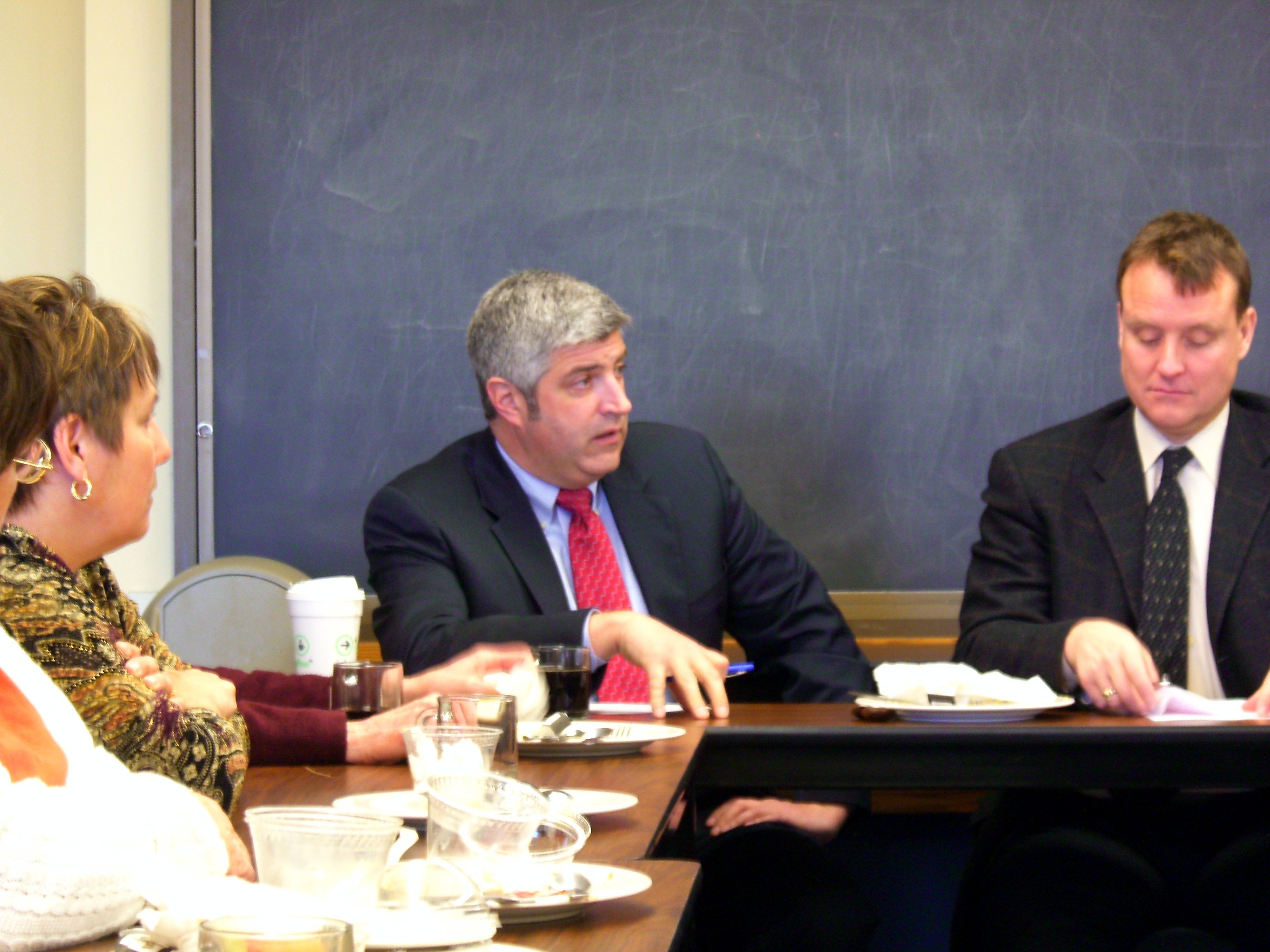
Rep. Anne Gobi (left), Rep. Vincent Pedone (center), and Senator Michael Moore (right) at Glavin breakfast. Moore said lawmakers will file a budget amendment calling for an independent analysis of the costs of closing three developmental centers.
At Tuesday’s breakfast, Al Bacotti, a former director of the Glavin Center, made the case to the lawmakers that Glavin is both cost-effective to operate and functions as a “safety net” for a group of severely intellectually disabled people who have been unable to live successfully in community-based settings.
Bacotti maintained that he saw a number of instances in which costs tripled for Glavin residents needing intensive care, after they were transferred to community residences. Those residents no longer had the benefit of centralized clinical, therapeutic, and medical services, which had been available at Glavin, he said.
Bacotti also disputed the argument made by facility closure advocates that Glavin and the other developmental centers are segregated from the surrounding community and restrict residents’ freedom.
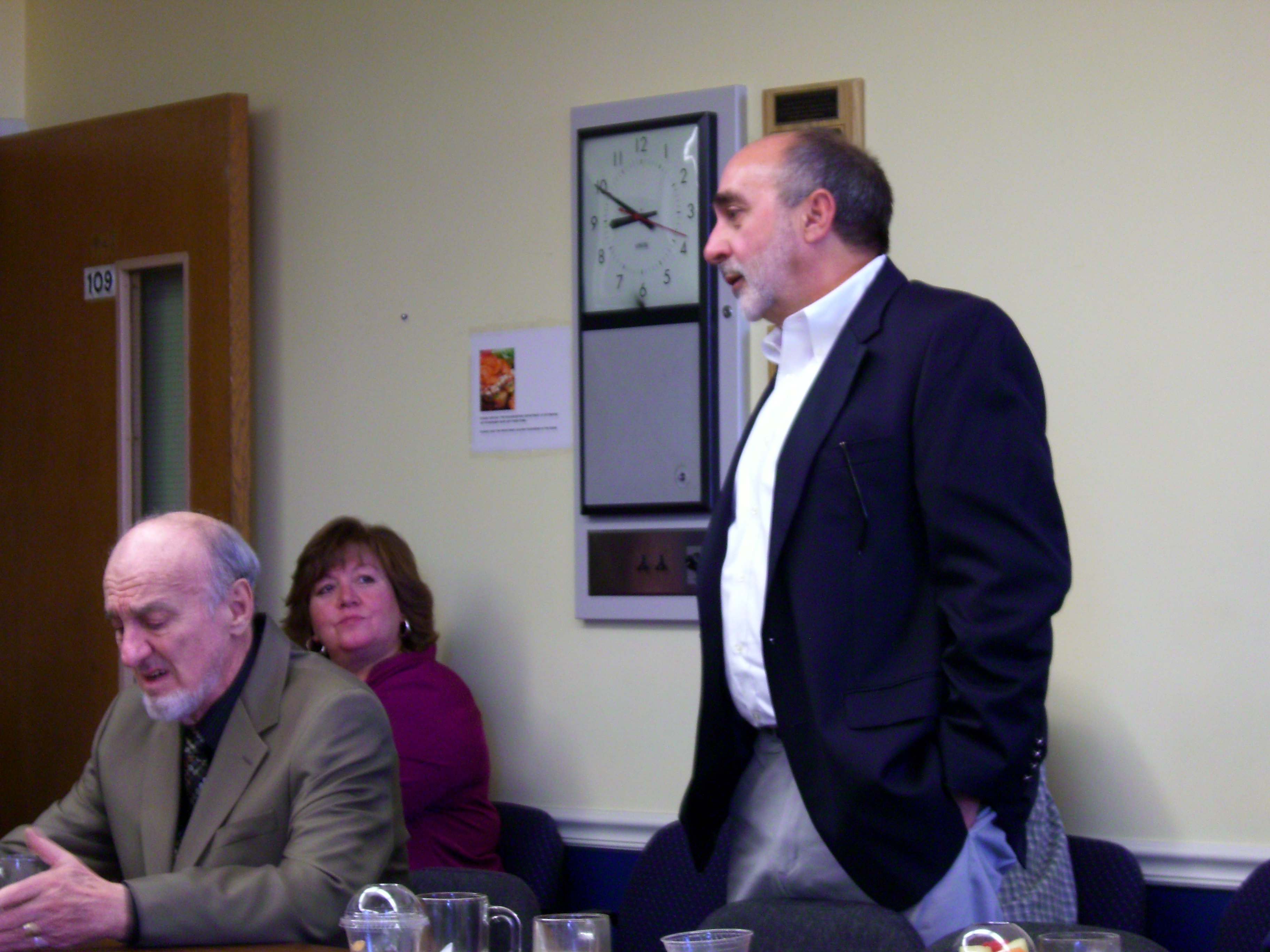
Former Glavin Director Al Bacotti (standing) speaks at breakfast. Seated to his left is Roland Charpentier, president of Friends of Glavin. Bacotti termed Glavin "cost effective" and a "safety net."
“There are actually more freedoms here (at Glavin) than for many people in community settings,” Bacotti said. “To the argument that everyone should be in the community, my answer is it didn’t work for the people here.”
Rep. Vincent Pedone of Worcester replied at that point that he needs more data on those cost issues because “people (on Beacon Hill) are telling us the opposite is true.” COFAR delivered a set of facts and figures on developmental center and community costs directly to Rep. Pedone today (Wednesday).
During the Tuesday breakfast meeting, Wilfred Dumont told the lawmakers about his son, Stephen, 26, who has been a Glavin resident for the past four years. Stephen is intellectually disabled and is deaf and has cerebral palsy and other medical conditions. Prior to coming to Glavin, he lived in a community-based facility where he began banging his head so severely that even a helmet didn’t help.
“He opened up his head at least 30 times,” Dumont said. That behavior has ceased since he’s been at Glavin. “Now he’s smiling for the first time and he comes home on weekends,” Dumont added. He said Stephen still has some behavioral episodes, but they no longer go on for a month at at a time. “To move him to another facility won’t work. You might as well put him in a cage,” he said.

Stephen Dumont (center) with his mother, Rose, and father, Wilfred. The staff at Glavin got Stephen to stop banging his head and injuring himself.
We will tell more about Stephen’s case and about other Glavin family members’ stories in our upcoming, May issue of The COFAR Voice.
Other lawmakers attending Tuesday’s legislative breakfast included Reps. Anne Gobi of Spencer, Kimberly Ferguson of Holden, Paul Frost of Auburn, and Matthew Beaton of Shrewsbury.
Update: some progress to report in abuse case
There have been some new developments in a case we reported on here, involving the alleged assault of an intellectually disabled man by a group home staff worker.
A state investigator has recommended that John Saunders, who has been charged with assaulting John Burns during an outing from his West Springfield-based group home last June, no longer be allowed to work with Department of Developmental Services clients. Saunders was fired after the alleged assault from the group home, which is run by the Center for Human Development.
Saunders allegedly hit Burns in the face while toileting him, causing Burns to suffer two black eyes. Saunders is scheduled to appear in Falmouth District Court on Monday, March 28, at 9 a.m. for a pre-trial hearing that has already been continued several times.
Charges against Saunders were personally brought by Sheila Paquette, Burns’ sister and co-guardian, after Paquette became frustrated with the slow pace of the state’s investigation into the case. Paquette has also been frustrated that she has gotten little information about the case so far from state and law enforcement authorities, which have not released an investigative report done by DDS on the matter.
However, in an email late last week to Paquette, Gail Quinn, the deputy general counsel of the Disabled Persons Protection Commission, did provide Paquette with the investigator’s recommendations. In addition to the recommendation against allowing Saunders to work with DDS clients, the investigator’s report cites the group home for failing to “identify” Burns’ injuries before sending him to his day program the morning after the alleged assault, and recommends retraining of staff in that regard.
Quinn also said the DPPC is changing its policy as a result of this case of withholding investigative reports from guardians of victims of alleged abuse pending the outcome of criminal investigations. She stated that the agency will notify district attorneys’ offices of its intention to send out investigative reports to guardians within a specified time frame unless the district attorney objects. Quinn wrote that the DPPC has issued such a notification to the district attorney in Burns’ case.
Quinn added in her email that, “The delay in getting (investigative) Reports out has been very concerning to us. Your case has brought the issue to the fore, and we have been able to deal with it in a manner that we think represents everyone’s interests in the content of the Report.”
Paquette, who is president of the Advocacy Network and a COFAR member, termed the DPPC’s new policy “encouraging,” but said she still isn’t convinced the system is fully on the victim’s side in these types of cases. Nevertheless, she said she is appreciative of Quinn’s comments.
Instances of assault and abuse of persons with intellectual disabilities often don’t get prosecuted by law enforcement authorities, and other state agencies tend to function slowly and inefficiently in these cases. Paquette said she was told by an investigator that had she not personally pressed charges in this case, it could have taken as long as two years for the matter to reach criminal court.
I talked about that today with Emil DeRiggi, deputy executive director of the DPPC, who said the agency supports decisions of individual family members or guardians to personally press charges in abuse cases. “We generally support anyone who learns something happened and believes filing charges is the right thing to do,” DeRiggi said. “I would encourage people to do whatever they think is best in these instances.”
DeRiggi said that in the case of Paquette’s brother, the State Police Unit assigned to the DPPC referred the matter to the district attorney’s office on Cape Cod, where the alleged assault took place. While that implies the case would have gone to criminal court without Paquette’s intervention, it does appear that her decision to press charges on her own may have, at the very least, speeded up the wheels of justice in this instance.
One other note: We have recieved the police report in the case from the Falmouth Police Department, where Paquette initally filed the assault charges. The report states that the alleged assault was witnessed by Burns’ roommate, who “reported seeing Mr. Saunders hand covering the mouth of Mr. Burns…and then witnessed Mr. Saunders strike Mr. Burns in the face with an open hand.” Saunders has denied the charge, according to the police report.
More on the ‘miracle’ of Templeton
[NOTE: Last month, we first posted an article here about the importance of the Templeton Developmental Center to three men living there and to their families. Below, I’ve posted some more information about those men and their experience, which didn’t make it into that first blog and which we weren’t able to include in the just-released March issue of The COFAR Voice.]
Jimmy Holdsworth kept getting thrown out of community-based group homes and sheltered workshops because his behavior was too volatile and his size and strength were too much for the staff to handle.
For Tony Welcome, community-based programs were ineffective in getting him to stop stealing cars.
Bobby Shepherd’s habit of wandering and trying to make friends with strangers frequently got him into trouble, and community-based programs didn’t provide the structure and supervision he needed.
In each of those cases, the Templeton Developmental Center turned out to be the solution to years of pain and struggle, not only for the men, but for their families. But it’s a solution that will no longer be available to those families or the families of the 103 other remaining residents of Templeton as of the end of Fiscal Year 2013.
The Templeton Center is one of four state-run Intermediate Care Facilities in Massachusetts that the Patrick administration has targeted for closure. The others slated to be closed are the Fernald, Glavin, and Monson developmental centers.
Families and guardians of the residents of the facilities have protested the planned closures and, in the case of Fernald, have filed administrative appeals of the transfers of the residents.
But as many guardians see it, it’s not the closures of the buildings that make up the developmental centers that are at issue; the problem lies in the planned elimination of the federally prescribed level of care provided in them.
At Templeton, for instance, the administration plans to continue to operate three existing residences for persons with intellectual disabilities as community-based programs and to build two additional duplex homes on the grounds. Those residences, however, will no longer be subject to federal ICF regulations governing staffing and care.

The dairy barn at Templeton
Bonnie Valade, Tony Welcome’s mother and guardian, was only able to get her son admitted to Templeton after a long struggle with the then Department of Mental Retardation (now Developmental Services), which had continually contended that Tony was not intellectually disabled.
By the time Tony was 19, he had already been placed in a number of mental health facilities, which had failed to control his impulse to steal cars. His IQ had continually been measured in the 50s, which is well below the DMR requirement that a person have a maximum IQ of 70 in order to receive services.
But when Tony was tested by DMR at at the age of 19, his IQ was found to be 75, making him ineligible for DMR care. Two years later, DMR rejected him again after measuring his IQ at 71, just one point over the cut-off for eligibility. As a result, Tony was placed in a Department of Mental Health facility with eight emotionally disturbed females, which turned out to be inappropriate for him, and later in a homeless shelter.
At one point, with eight different car theft charges pending against him, Tony spent six months in the Worcester County Jail, where he was beaten so badly by another inmate that he had to be placed in solitary confinement for his own protection. Since Tony was accepted at Templeton in 1989 at the age of 24, he has not had any further behavioral incidents, Valade says.
When Tony was in the community system, he had alcohol problem. Today, he suffers a low red blood cell count because anti-psychotic drugs had been improperly administered to him in the community-based system while he was drinking alcoholic beverages. The licensed nursing staff at Templeton understand this, Valade says; but Valade is concerned that once he is back in the community system, drugs will be administered to Tony by direct-care workers with minimal training.
As far as Tony Shepherd is concerned, it will no longer be beneficial for his brother, Bobby, to continue living in his residence at the Templeton Center following a change from ICF-level care there to community-based care. Shepherd, who is Bobby’s guardian, is concerned that under the community-based care model, the intensive clinical and medical supports that have sustained Bobby for more than 50 years will be greatly reduced.
Shepherd said, for instance, that he is grateful for quick action by Templeton’s nursing staff when he was visiting Bobby last fall and noticed while they were having lunch in the cafeteria that he seemed to be feeling unwell. Shepherd asked if a nurse was available, and one arrived within two minutes, checked Bobby’s color and vital signs and then returned with a wheelchair and took him to the nurse’s station.
There, according to Tony Shepherd, further examination showed that Bobby was experiencing a drop in his oxygen level. He was administered oxygen and kept overnight at the nurse’s station for observation. Had he been living in a community-based group home, it is unlikely that a nurse would have been available to respond to the emergency, Shepherd believes.
Shepherd notes that at Templeton, nurses, doctors, and other trained medical personnel are available on a full-time basis to monitor Bobby’s health and administer his medications. A clinical board meets quarterly to evaluate the effectiveness of his prescriptions.
Bobby Shepherd’s intellectual disability stems from low oxygen levels that he experienced at birth. He is verbal, Tony says, but can’t read or write. He has always been nonviolent, but was never easy for his parents to control because of his habit of wandering away from his house. He has a trusting and friendly nature, and has always tried to make friends with total strangers. That would sometimes get him into trouble.
At Templeton, Bobby lives with four other men in a two-story, white farmhouse called Waite Lodge. He’s free to come and go on the Templeton campus, but lately his breathing problems have kept him from venturing out.
Tony Shepherd is worried about Bobby’s future after Templeton closes. At 73, Tony is seven years older than Bobby. “What’s going to happen to him and who is going to look after him if he’s still around after I’m gone?” Shepherd asked. Bobby, he adds, is a “genuine ‘babe in the woods’” who would become “a target of ridicule and abuse [in a less supervised environment] because of his natural but naive belief that everyone is his friend.”
Had the administration not planned to eliminate the ICF model of care at Templeton, Shepherd said he would be a lot less worried about his brother. “The staff is simply not going to be here once this place is switched over to state-operated group homes,” he said. “We’ll be lucky if there are any clinical people left here at all.”
For Jimmy Holdworth’s parents, a social life proved impossible because no community-based residence or program could handle their son, and because he couldn’t be left at home with caretakers other than themselves.
It was only when his parents were in their 60s that Jimmy was finally admitted to Templeton, according to his sister, Judy Holdsworth, who is now his guardian. “At Templeton, he learned for the first time to control himself. It was amazing to me,” she said.
Holdsworth said that in addition to intensive behavioral therapies, the clinical staff at Templeton placed Jimmy on medications to control his impulsiveness and aggression. At first, she said, her parents resisted the idea of placing their son on any medications, but they were persuaded it was the right thing to do when they saw how carefully it was monitored.
“His psychiatrist and nurse always talked with us about it,” Holdsworth said. “We’ve been very satisfied with the way it has worked.” She said her brother is active, alert, and healthy, and “everyone at Templeton can tell when something is bothering him. That’s part of the miracle that occurred with my brother.”
 COFAR blog