The fight for Glavin is winnable, Senator Brewer
Despite the Patrick administration’s determination to close the Glavin Regional Center by next June, families of residents in the facility are prepared to wage a legal battle to save it, The Worcester Telegram & Gazette reported on Sunday.
The families are planning to use the same administrative and court appeal process to stay at Glavin that guardians of 14 residents of the Fernald Developmental Center have used to keep that facility operating more than two years past its scheduled closure date.
The appeal process is based on a state law, which says that the state must prove that a resident’s services and quality of life will be improved if he or she is to be transferred to another location.
“We’re not going to leave here without a fight,” Wilfred Dumont, the father of 28-year-old Stephen Dumont, a Glavin resident, told The Telegram & Gazette. Dumont and his wife, Rosemary, are among several Glavin guardians who are actively opposing the transfers of their loved ones from the facility.
Not only has Glavin provided a high level of care that these families have not been able to find in the Department of Developmental Services community-based system, but Glavin has also provided a range of medical, dental and other services to community-based DDS clients.
As COFAR Executive Director Colleen Lutkevich stated in a letter submitted yesterday to the editor of the Telegram & Gazette:
…the reality is that Glavin is a wonderful community of residents, families, and staff. Instead of closing this innovative state-of-the-art residence, built with such hope and promise not that long ago, we call on Governor Patrick and DDS Commissioner Howe to admit their mistake and cancel Glavin’s closure. It is not only the morally right thing to do, it is good economics.
Ironically, the Glavin families, like their Fernald counterparts, have been forced to adopt the administrative appeal strategy because key state legislators have never supported proposals for either an independent cost study prior to closing those facilities or for legislative approval of the closures.
Senator Stephen Brewer, chairman of the Senate Ways & Means Committee, is quoted in the Sunday Telegram & Gazette story as saying he wouldn’t support an independent cost study for Glavin this year because the fight to preserve the center “is unwinnable.” He also raised a perennial red herring about the $10 million cost of operating Fernald for 14 residents (more about that below).
All along the way, however, Brewer has tried to play both sides of the fence, telling The Springfield Republican in May 2010 that he did support a cost study prior to closing Glavin and three other facilities, and saying: “We’re in this to try to help the people stay in the places they call home. Some of those people have been there 60 years.”
It’s now clear that Brewer himself has personally played a major role in bringing about the closures of Fernald, Glavin, and the Monson and Templeton centers. Meanwhile, he’s still trying to have it both ways. In the debate over the current-year budget, Brewer supported an independent cost study prior to the closure of Taunton State Hospital, a Department of Mental Health facility.
As to the contention that Fernald and the other DDS centers have become too expensive to continue to operate, here’s what we’ve said many times: confirm that with an independent study. No one in Massachusetts has done a comprehensive and independent study of the relative cost of care in the developmental centers versus community-based group homes. That’s why COFAR began calling in late 2011 for such a study to be done by an accounting firm or other entity selected by the Inspector General.
If Senator Brewer and other opponents of the DDS developmental centers are convinced it is more expensive to continue to operate them than to move everyone in them to community-based group homes, why do they oppose an independent study of that issue?
It is true that the cost per resident at Fernald, in particular, is currently very high. But as DDS Commissioner Elin Howe herself has noted, the cost per resident of any institution that is being closed spikes as fixed costs are spread over a shrinking base of residents. Let’s not forget, it was the administration’s choice, not the families’ and guardians’ choice, to move residents out of Fernald, Glavin, Monson, and Templeton.
The fact is that state funding for the four developmental centers has dropped by close to $70 million in the past four years. Yet, funding for community-based programs such as transportation services, family supports, and day programs remains well below what it was in Fiscal Year 2009. That the $70 million in so-called savings hasn’t helped those community line items should be of more concern to Senator Brewer than the temporary cost of continuing to operate Fernald or Glavin while guardians there exercise their lawful appeal rights.
Meanwhile, Brewer and other legislators should also be concerned about the loss of the intensive Intermediate Care Facility (ICF) model that is occurring as Fernald, Glavin, Templeton, and Monson are shut down. ICF care conforms to federal standards that are much more stringent than the standards that govern community-based care. This has real implications for care.
In their study of a major deinstitutionalization in California in the mid-1990s, Robert Shavelle, David Strauss, and Steven Day found that as of 1999, there had been 81 deaths among residents transferred from institutions to community-based group homes — a 47 percent increase in mortality over that expected in the institutions. (The results were significant at the 95% confidence level.)
The California study concluded that the reasons for the higher mortality rate in the community system were the less intensive medical care and supervision available in the community than in the institutions in that state.
We should also respond to statements made by DDS Commissioner Howe in the Telegram & Gazette story on Sunday. Howe said, among other things, that closing the developmental centers in Massachusetts follows a New England and national trend; that Connecticut has only one institution for people with developmental disabilities, and that none of the other New England states have any such facilities.
First of all, Connecticut currently has a total of six state-run ICFs that provide care under the same federal standards as Glavin, Fernald, Monson, Templeton and two other facilities in Massachusetts. The Connecticut public ICFs include the Southbury Training School and five regional centers.
In addition, Connecticut has 69 privately operated ICF facilities, and private ICFs also exist in Maine, New Hampshire, Rhode Island, and Vermont. Massachusetts, however, has no ICFs outside of six state-run facilities, four of which are targeted for closure.
While the national trend has been to move people from large, state-run institutions to smaller, privately run facilities, the ICF model is not being phased out nationally as it is in Massachusetts. More than 7,000 public and private ICFs operate nationwide, according to the American Health Care Assocation. For the record, we have long supported the downsizing or “rightsizing” of the remaining developmental centers in Massachusetts. What we oppose, as noted, is the phase-out of the ICF model.
We also prefer that the ICFs continue to be state-operated because state workers tend to receive better pay and benefits, and consequently have less turnover, than those in privately run facilities.
Howe also maintained that the community system and two remaining developmental centers in Massachusetts “are strong enough to meet all of the individuals’ needs.”
Tell that to Wilfred and Rosemary Dumont, who were unable to find a community-based facility that could successfully treat Stephen, who had a habit of opening up a permanent wound on his head by repeatedly banging his head on hard objects. Tell that to Brad and Joan Douty, whose daughter Anna hit herself in the head so often while living in a group home that she eventually detached the retinas in both eyes and is now blind.
Both Stephen Dumont and Anna Douty have been living successfully at Glavin for several years.
Or tell that to Roland Charpentier, who moved his brother Richard out of Glavin and into a non-ICF group home on the Glavin grounds a few years ago. After his brother contracted pneumonia four times, Roland had him moved back into Glavin.
“My intention is to keep Richard here (at Glavin) no matter what the state wants to do,” Roland Charpentier told The Telegram & Gazette. “I’m going to stand and fight for Richard’s rights.”
Music therapy transforms an evening at a group home
On a warm Wednesday evening this week, Kathleen Downey handed a maraca to each of two men who were seated in chairs in a sunny lounge in a group home operated by the Department of Developmental Services in Clinton.
Downey next handed a set of small bells to an elderly woman seated nearby and then took a ukulele out of its case. She tuned it, and with a big smile on her face launched into “You Are My Sunshine.”
Melody and rhythm immediately worked a change on the room. Where there had been silence and stillness, everything now seemed to pulse with movement and sound. A little ukulele can have big effect on a small room.
For the past 15 years, Downey, a music educator and therapist, has been playing and singing to residents of the Templeton Developmental Center in Baldwinville and in both state and privately operated group homes for the intellectually disabled, including the Clinton facility.
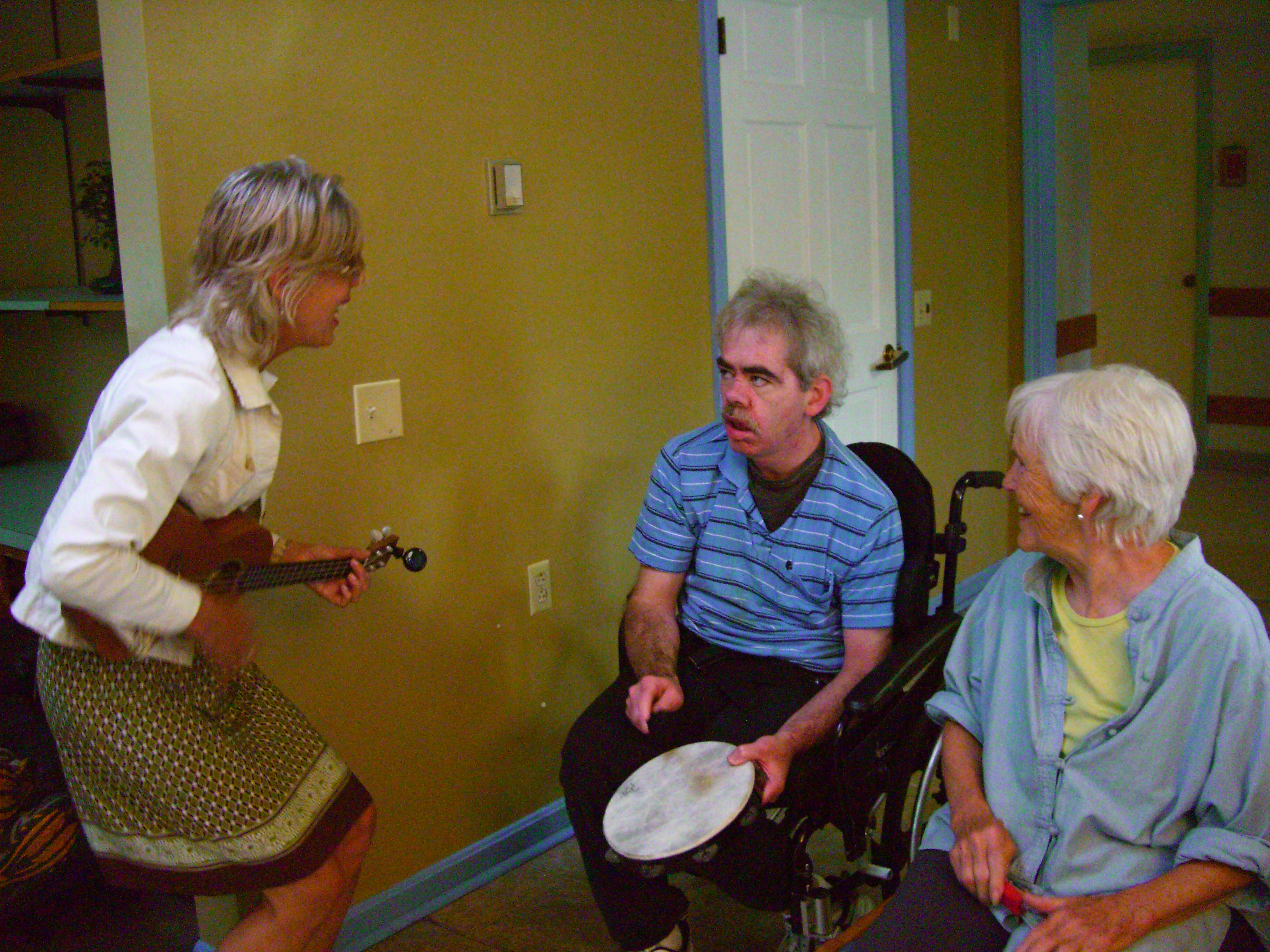
Paul Frain (center), a resident of a DDS group home in Clinton, helps out with the rhythm as music therapist Kathleen Downey (left) sings “Sugar in the Morning” Wednesday. At right is Paul’s mother, Maryalice Frain.
From Downey’s first song onward on Wednesday, one of the men with the maracas shook it and smiled. Maryalice Frain, the mother of Paul Frain, a resident who had not yet arrived from his bedroom, tapped a set of spoons. Another resident waved his arms to the beat. A member of the group home staff danced in the middle of the seated circle of residents and engaged them one by one.
For Downey, the tapping, singing, and waving was a sign that her music was having its intended effect.
A man named Walter didn’t want to participate in the music session at first. “I want to go to bed,” he said. Downey, walked up to him while strumming the ukulele and gave him a big smile. “Welcome, Walter,” she said. Immediately, his frown softened and he started waving his arms in time. “I do it with compassion,” Downey says of her work.
Trained in music education at the Berklee College of Music in Boston, Downey also works with Alzheimer’s patients in nursing homes. She is about to launch a program, called AlzAlive, that uses music, movement and touch to improve the lives of people battling that disease. No matter the setting, she says, the music has a similar effect.
“People become more communicative, more relaxed, more self confident,” Downey says. “Their stress level goes down.” The change is noticeable over the course of the hour, but it is also noticeable over a longer period of months and years. Paul Frain, who arrived in a wheelchair pushed by an attendant about five minutes into the session in Clinton, is a case in point.
“Initially, Paul was not interested in coming” to the twice-a-month sessions that she holds at the group home, Downey says. “Now, he’s the most active participant. And he’s really improved his drumming and listening skills.”
Paul Frain, who is the brother of Tom Frain, the president of COFAR, was seated next to his mother, Maryalice. Downey handed him a tambourine and a stick to beat it with. She began a folk song called “Sugar in the Morning,” and Paul sang along, beating the tambourine. Then she did the Beatles’ “Love Me Do.”
“It’s Lenny’s turn to sing,” Downey said next, turning toward one of the men to whom she had handed a maraca, but who had at first shown no reaction to it. “Do you want to do ‘I’ve Been Working on the Railroad,’ or ‘Take Me Out to the Ball Game?’” she asked him.
“Ball game,” Lenny answered. And the song began.
Downey next reached for a guitar and started singing “If I Had a Hammer” and then “Working on the Railroad,” and it was as if a loud party had been going on in the small room. She strolled across the middle of the circle as she sang. “Someone’s in the kitchen with Walter,” she sang to him. Walter started clapping in time.
One of the staff members then proclaimed that it was Downey’s birthday. That launched a quick round of “Happy Birthday to Me.” “How old are you now?” another staff member ribbed her. “I’m 39 and holding,” she retorted. “You don’t look it,” Paul Frain said. “You look younger.”
Guitar still in hand, Downey next sang “This Land is Your Land,” then “Jambalaya,” and then a soulful rendition of “Good Evening Blues,” which Paul helped bring to an end with some strong drumming on the tambourine. “We should take this on the road,” Downey said to him.
As the hour wound, down, Downey switched to a silver alto flute and quieted things down with solo versions of “Love Me Tender” and “Over the Rainbow.”
Afterwards, Paul pronounced it to have been a good session. What was his favorite tune? “This Land is Your Land,” he said.
More information about Downey’s music therapy for the intellectually disabled and people with Alzheimer’s can be found on her website at www.miracle-moments.com. Her email contact is justgrand@msn.com.
DDS proposes to reduce services and family rights in care plans
The state Department of Developmental Services is proposing changes to its regulations that we believe will take away guardian and family rights and water down the scope of services that are listed in individual clients’ care plans.
We at COFAR view these proposed changes as an attempt to reverse critically important gains made by the intellectually disabled and their families and guardians in Massachusetts from the 1970s through the 1990s.
We’re joined in our concerns by the Wrentham Association, a COFAR member organization and one of the original plaintiffs in the landmark Ricci v. Okin federal consent decree case that upgraded care of the intellectually disabled in Massachusetts. In written comments submitted to DDS last week, the Wrentham family group maintained (and we concur) that the proposed changes to the regulations would violate the historic 1993 Disengagement Order in the Ricci case of U.S. District Court Judge Joseph Tauro.
As the Wrentham Association letter noted, the Disengagement Order requires DDS “to continually evaluate the needs of each individual class member and to develop strategies to address those needs.” Several of the proposed changes to the DDS regulations “would substantially dilute” client care plans, known as Individual Support Plans or ISPs, and would exclude or limit family participation in the ISP process, the letter stated.
As we noted in our own comments on the proposed regulations:
The ISP process is fundamental to the provision of adequate supports and services to some of the most fragile and vulnerable members of our society…The protection of the rights of the individuals, family members, and guardians involved is central to the ISP process and the Disengagement Order. We therefore strongly oppose efforts to begin chipping away at those rights, as the proposed regulations appear to do.
Among the key proposed changes by DDS is the elimination of the requirement that services be listed in each client’s ISP “without regard to the availability” of such services. A second proposed change would take away the current requirement that the ISP contain strategies to address the “unmet support needs” of clients.
These were key concerns of Judge Tauro’s Disengagement Order — that the ISPs be drafted first and foremost to identify the needs of the client and that the Department then come up with funding strategies to meet those needs. The proposed changes would eliminate that dynamic.
In addition, DDS is proposing to change its regulations to take away rights of family members to participate in the ISP process and even to schedule a meeting with a DDS service coordinator to have the ISP explained to them.

Diane Booher, a Fernald guardian, testifies against proposed DDS regulations changes during a sparsely attended public hearing at the Worcester Public Library on June 15.
In our comments submitted to DDS, we added that the proposed changes would also appear to violate a key provision of the federal Developmental Disabilities Assistance and Bill of Rights Act, which states that individuals with developmental disabilities and their families are the “primary decision-makers” regarding the services and supports they receive.
On Friday of last week (June 15), DDS held a public hearing on the proposed regulations, which, to my surprise, attracted few attendees. I arrived at the scheduled start of the hearing at the Worcester Public Library at 10 a.m. and was the only person in the audience when DDS Commissioner Elin Howe opened the proceedings. Soon after, two other people arrived to testify — Diane Booher, a Ricci class representative from the Fernald Developmental Center and the guardian of three men who still reside there; and a representative of Vinfen, a major nonprofit operator of group homes in Massachusetts and other states.
Booher maintained in her written testimony that “there is no question” that the proposed changes to the regulations would violate Judge Tauro’s Disengagement Order.
The Vinfen representative appeared to have some technical issues with the proposed changes, but no major objections — a position I didn’t find surprising. Vinfen and other group home providers will get the same state funding whether the ISPs contain strategies for unmet needs or not.
I looked around for someone from the Arc of Massachusetts. Surely, they would be rallying to defend the rights of families and DDS clients? I guess not.
At about 10:45 a.m., Commissioner Howe called a recess in the hearing, after the three of us had testified and no one was left to speak. I left shortly after that. If a flood of people arrived anytime after I left and before the scheduled close of the hearing at 3 p.m., I haven’t heard about it.
In addition to the proposed changes that would water down the scope of services in ISPs, here are some of the other proposed changes to the regulations (115 CMR 6.20-6.25), which we find the most troubling:
- Addition of language giving guardians and individuals the authority to exclude family members from participating in ISP planning and the ISP process. This is particularly concerning to us in cases in which corporations or attorneys are appointed as guardians of individuals and are paid by DDS.
- Exclusion of family members from the list of persons receiving periodic updates from group home providers regarding the implementation of the ISP.
- Removal of language stating that families and guardians have a “right” to a meeting with the service coordinator to have the ISP explained to them within 10 days of its receipt.
- Removal of language requiring the service coordinator to explain ISP appeal rights to individuals, guardians, and family members.
- Removal of language that a service coordinator must have the approval of the family to waive a meeting to discuss changes to the ISP.
Update: Assistant D.A. blames trial delays on administrative mistakes
Three of the four postponements in the scheduled trial of a former West Springfield group home care worker charged with assaulting an intellectually disabled man were due to separate scheduling mistakes by court personnel, the prosecutor in the case said last week.
In a phone call on Thursday, Kerry Whalen, an assistant district attorney in Falmouth District Court, who is prosecuting the case against John Saunders, took responsibility for one of the scheduling mistakes and contended that the court clerk’s office was responsible for two others.
We reported that Saunders’ trial had been delayed last week for the fourth time since January, resulting in several fruitless trips from western Massachusetts to the Cape for several prosecution witnesses. Among those witnesses is Sheila Paquette, the sister and co-guardian of the alleged victim, John Burns. Paquette has expressed growing frustration with the delays and had gotten seemingly conflicting answers to her questions about them. The trial has now been scheduled for July 30.
Paquette has been pursing the case against Saunders since June 2010, when Saunders allegedly hit Burns in the face while toileting him during an outing on the Cape. Burns suffered two black eyes and other injuries in the alleged assault. Paquette, who is president of the Advocacy Network, a COFAR member organization, personally filed charges against Saunders in July 2010.
For nearly two years, Paquette has dealt with a state and court system whose progress in bringing about justice in a case involving a disabled victim has seemed glacial. The case has finally reached the trial stage, but the trial never seems to start. The trial was originally scheduled for January 9, but was postponed until March 27 when Saunders failed to appear on the January 9 date, and then was postponed for the second time until June 4 when a defense witness failed to appear on the March 27 date. It was postponed for the third time until June 5, and for the fourth time until July 30.
Whalen said the postponement in March was due to the fact that the defense witness had not been properly notified of the March 27 trial date. She said she personally caused the third postponement in the case when she mistakenly assumed there would be jurors available in the court on June 4th to hear the case. There were no jurors convened that day, requiring a one-day postponement until June 5.
Whalen blamed the fourth postponement in the trial until July 30 again on the court clerk’s office, saying that this time the office failed to issue new summonses to witnesses for both the prosecution and the defense with the new June 5 trial date.
“The clerk’s office failed to do this (notify the witnesses in that instance). I don’t think it was intentional,” Whalen said. The result was that one witness for the defense and one for the prosecution later said they never received any notice of the new trial date and that they wouldn’t be available that day.
I left a message with the court’s clerk magistrate last week to ask if he had a response to Whalen’s account. I haven’t received a call back.
Whalen contended it would be impossible to schedule a new trial date earlier than July 30. I asked her if this case will now be treated as a priority on July 30 because three of the four postponements were the result of the court personnel’s own mismanagement; and I asked whether anyone could guarantee that the trial will go forward at that time.
Whalen’s response was that the Saunders case “will take precedence over other cases,” but there is no way to guarantee it will go forward in July. Because Saunders is out on bail, she said, his case could be subordinated to another case on July 30 if the defendant in that other case happened to be in custody. That is due to rules limiting the length of time defendants can be kept in custody prior to their trials.
Whalen did not apologize for any of the mistakes leading to the postponements of the trial.
Paquette was angry when told of the reasons given by Whalen for the postponements in the case. “This is gross incompetence, a waste of taxpayer dollars,” she said. “I feel like I’m in a foreign country trying to get justice.”
Justice delayed is justice denied
Sheila Paquette has now traveled from her home in western Massachusetts to Falmouth District Court on Cape Cod three times to testify in an assault trial involving her brother that never seems to start.
Today (Tuesday) was the fourth scheduled trial date in the case against John Saunders, who is charged with assaulting Paquette’s brother, John Burns, an intellectually disabled group home resident, while they were on an outing on the Cape in June 2010. Saunders, a care worker at Burns’ residence in West Springfield, was subsequently fired from the job.
On Monday afternoon, after Paquette had made the three-hour, one-way journey to Falmouth from her home in Westfield for the sixth time, counting the pre-trial proceedings in the case, she learned there would be yet another postponement. The trial, which had first been scheduled for early January, was now being rescheduled until July 30. (The previously scheduled trial dates were January 9, March 27, June 4, and today, the 5th.)
“This has become a travesty,” Paquette said this morning as she was on her way back home after yet another fruitless trip to the Cape. “It’s gotten to the point where I don’t believe anything anybody is telling me about this case.”
Paquette said the victim advocate at Falmouth District Court gave her three different reasons for the latest postponement. One was that there was only one judge scheduled to be on duty today to handle all of the cases. The second was that the court was not able to round up a jury for today. And the third was that one witness for the prosecution and one for the defense indicated they would not be available to appear today.
“What is the excuse going to be next time?” Paquette said. “Is it possible this trial will never go forward? Will my brother ever receive justice as every other citizen does?”
Saunders is accused of hitting Burns in the face while toileting him during the June 2010 outing. Burns suffered two black eyes and other injuries in the alleged assault. Paquette, who is president of the Advocacy Network, a COFAR member organization, personally filed charges against Saunders in July 2010.
Saunders failed to show up at his first trial date this past January 9. He was reportedly arrested by police a couple of days after the January trial date and was released after posting bond that had been set by a judge at $1,000.
In late March, after a judge had postponed the trial for the second time, the reason given for the postponement was that a defense witness had failed to appear. At that time, Paquette was explicitly assured by the assistant district attorney prosecuting Saunders that the judge would not grant another postponement based on the failure of a witness to appear. (I know that’s the case because I heard the assistant D.A. say it to Paquette.)
Now, that assurance has gone out the window. Paquette is also left wondering why the postponements are so lengthy. “Why did they wait from January until March, and then from March until June, and now from June until the end of July to re-schedule this trial?” Paquette asked. “Why can’t they schedule it for the next court session each time?
We had those same questions for the District Court and the District Attorney’s Office. I spoke today to Ed Teague, the clerk magistrate for the Falmouth District Court, who said that while the court schedules jury trials on two days each week, it is not unusual for it to take a month or more to reschedule a trial.
Teague said, in fact, that several trials are often scheduled for the same day in the court, and that there are only enough jurors to hold one of those trials per day. Another trial was ongoing today, he said, and for some reason took precedence over the trial scheduled for Saunders. The same thing may well happen on July 30, he acknowledged.
Teague said I should ask Cape & Islands District Attorney Michael O’Keefe’s Falmouth Office for the specific reasons for the continual postponements of the Saunders case. However, when I called the D.A.’s office, I was told no one there would speak to me about it.
Saving the Glavin Center comes down to one man
In many of the photographs that Rosemary Dumont has of her son Stephen, a red vertical wound can be seen at the top of his forehead, almost seeming to divide his forehead in two.
That wound is the result of Stephen’s habit of banging his head on any hard object near him, such as the corner of a table. Before he was admitted to the Glavin Regional Center in Shrewsbury five years ago, he would open up the wound on practically a daily basis.
Community-based residences and hospitals tried to solve the problem with drugs, which didn’t work. It got to the point where no community-based group home would keep or accept him as a resident. At one point, the only place his parents, Rosemary and Will Dumont, were able to find for him was the controversial Judge Rotenberg Center. There, Stephen was given electric shocks when he banged his head. But that didn’t stop the behavior.
The story was finally different at the Glavin Center where the staff have been able to reduce Stephen’s head-banging episodes to once or twice a year through constant supervision and supportive behavioral treatments. Now, he’s able to go home to stay with his parents on weekends without the threat of a flare-up of his aggressive behavior. Those home visits weren’t possible while he was in the community system.
The Dumonts know this “miracle” of treatment for their son will disappear when Glavin is closed, as the Patrick administration is moving quickly to do. Not only is there no community-based setting that is likely to accept, much less successfully treat, Stephen, any change at all in his living arrangement is likely to trigger a descent into his old cycle of self injury.
For Stephen, who has an intellectual disability in addition to having cerebral palsy and deafness, the act of leaving a long-term home such as Glavin and its staff and fellow residents results in a conviction that those people have all died. “He loves all these people (at Glavin) to death,” Rosemary says. “He can’t handle the change.”
For that reason, the Dumonts are desperate to keep Glavin open. And they know that for now, the fate of the center rests with one man — State Senator Stephen Brewer of Barre.
Under the Legislature’s current budget process, it is totally up to Brewer whether to approve a state budget amendment that would require an independent cost analysis before the Department of Developmental Services can move more people out of Glavin and subsequently close the center. Brewer, who is chairman of the powerful Senate Ways and Means Committee, has the authority to decide whether to place all proposed budget amendments in either a reject pile or a pile of amendments headed for a single up-or-down vote on the Senate floor this week.
So far, Brewer hasn’t given the Dumonts much reason for hope that he will accept the study amendment for the floor vote. When the Dumonts and a small group of other Glavin family members met with Brewer earlier this month to urge him to allow the study amendment to reach the floor, Brewer told them that he “didn’t have the energy” to fight for the Glavin Center, Will Dumont said. Dumont said Brewer referred to it as a “losing battle.” The Dumonts, who live in North Brookfield, happen to be constituents of Brewer’s.
The administration is closing Glavin and three other developmental centers, contending they have become too costly to continue to operate. The Dumonts and other supporters of the centers disagree with the administration’s cost analysis. COFAR, a family-supported nonprofit organization that I work for, maintains that the administration’s cost analyses for all of the centers have been flawed and that an independent study is needed.
COFAR moreover believes it would be cost effective to the state to expand the missions of Glavin and the other developmental centers by enabling them to provide medical and other hard-to-get services to community-based DDS clients. Glavin, for intance, has long provided medical, dental, speech, psychology, guardianship and other services to intellectually disabled persons throughout central Massachusetts.
It’s the hope of the Glavin families that an independent cost study will establish once and for all that the savings in closing the facility are illusory. That, they hope, would convince the Legislature to block the administration’s plans to close Glavin.
But the administration strongly opposes an independent study, as does the Arc of Massachusetts and the Association of Developmental Disabilities Providers, which are vocal opponents of the developmental centers. And Brewer has shown little inclination to oppose those organizations or the administration, as evidenced by his statement to the Dumonts about lacking the energy to fight for the facility.
Yet, if the battle has been a losing one, that has at least partly been because of Brewer himself. Last year, Brewer scuttled a similar independent study amendment, which had been filed by Senator Michael Moore of Worcester. Moore has once again filed the study amendment. It would require that the cost study be done by a non-governmental entity selected by the state Inspector General.
Will and Rosemary Dumont are hoping this time they can scrounge up enough local support for Glavin that they can put some counter-pressure on Brewer. Will Dumont has enlisted all his friends in his hunting club near his hometown of North Brookfield to call and email Brewer’s office. Last week, Will, Rosemary and some other Glavin family members visited legislators’ offices in the State House. Meanwhile, Rosemary has been signing up friends on Facebook to support the cost study, and said last week that her effort had “gone viral.” Other Glavin families are making calls and sending emails as well and urging their friends to do so.
We may know whether their efforts have paid off by tomorrow when the Senate begins debate on the budget. We hope Senator Brewer has enough compassion for the residents and families of the Glavin Center that he will at least put the amendment for the cost study into the pile for a Senate floor vote.
DPPC faults care plan in group home resident’s death
A state investigative agency has concluded that a Tyngsborough group home resident died last year as a result of having ingested an inedible object, and that there was sufficient evidence to conclude that his death was due to a lack of adequate supervision by caregivers.
The 50-year-old man, who had formerly lived at the Fernald Developmental Center, had reportedly ingested a plastic bag
The March 29, 2012 report by the Disabled Persons Protection Commission, which was obtained by COFAR, concluded, however, that there was insufficient evidence to identify when or how the man had obtained the material he ingested, or whether he was in his group home, day program, or being transported between the two when he ingested it. The report also appeared to place the blame for the lack of supervision on the fact that the man’s plan of care, also known as an Individual Support Plan or ISP, had no requirement that he be kept in sight by staff at all times.
The 50-year-old man had lived in the group home for about a year after having been transferred there from the Fernald Center. According to sources, the man had a history of ingesting foreign objects, a condition known as pica.
The July 6 death of the resident is one of two cases of sudden death involving former developmental center residents, both men in their 50s, which COFAR first reported about last August. COFAR also reported about the case of another man who died suddenly of a blood clot in his lung in a Tewksbury group home on July 24, four days after having been transferred there from the Templeton Developmental Center. An investigation of that death is apparently still ongoing.
Both Fernald and Templeton are among four developmental centers that have been targeted by the Patrick administration for closure.
The March 29 DPPC report leaves many questions unanswered about the Tyngsborough group home resident’s death, including whether the man’s ISP was changed in a significant way after he left the Fernald Center, and whether his level of supervision in the group home was less than the level he had received while at Fernald. There is an indication in the report that the man’s ISP was changed in September 2010, apparently after he moved to the group home, to remove “target (presumably inedible) items” from mention in the plan. Much of this discussion, however, is redacted in the report.
…the appropriate DDS designee review the above noted additional finding of risk pertaining to (blank) and ISP language and determine what, if any, action should be taken to identify within a person’s ISP those specific items known to be ingested by the person, as a means to minimize or eliminate the risk they pose.
In a third case about which COFAR recently reported, a 51-year-old resident of a Northeast Residential Services home died on February 7, 2012 after having been sent back to his residence twice by Lowell General Hospital. That man had formerly lived at the Fernald Center as well.
House Ways & Means budget for DDS continues many of the governor’s cuts
Last week, Department of Developmental Services Commissioner Elin Howe described the House Ways & Means Committee’s proposed Fiscal Year 2013 budget for DDS programs and services as “the best budget the department has had in five years.”
Speaking with advocates during a conference call, Howe cited some boosts in funding in the HW&M plan. Those include a proposed $10 million increase over the governor’s plan for Adult Family Supports, which help families care for intellectually disabled people at home. They also include $1 million more than the governor proposed for Turning 22 services, which are geared toward people who are moving from the special education system to the adult service system.
But we wouldn’t agree this is a particularly good budget overall for people with intellectual disabilities. In fact, this budget fails to restore most community-based line items to what they were four and five years ago, and it continues to decimate the state developmental centers and to underfund other state-operated residential services.
In the conference call, Howe acknowledged that “the state side has taken the burden of the reductions” under the HW&M plan, but termed it “good news for the private sector.” We disagree that the HW&M budget is really all that good for the private sector; but Howe’s remark does unfortunately underscore this administration’s well-known bias against state-delivered care.
On the state side, the HW&M budget plan would lead to the loss of critically important service coordinators because it proposes to fund the DDS administrative line item, which pays for them, at about $1.1 million less than the governor’s plan.
SEIU Local 509, which represents service coordinators in the DDS system, had previously stated that the governor’s proposal would essentially level-fund service coordinator staffing for the coming year. The HW&M budget proposal would lead to a loss of 24 service coordinator positions.
Also, the HW&M budget plan fails to rectify a $4.1 million shortfall in the governor’s budget plan in the state-operated group home line item. At a time when the administration is busy trying to close four state developmental centers, we think it makes little sense to fail to adequately fund the state-operated group home system and to cut service coordinator jobs.
Under the HW&M budget for FY 13, funding for the developmental centers would be down $71 million from FY 09 in inflation-adjusted dollars, according to the Massachusetts Budget and Policy Center’s excellent budget line item calculator. But while the $71 million cut in the developmental center’s line item reflects the administration’s efforts to phase down and close the four developmental centers, there hasn’t been a corresponding increase in most community-based line items.
We need to take a larger view on monitoring human services vendors
Alleged state credit card misuse and other financial irregularities at the Life Focus Center of Charlestown are the latest in a series of mini-scandals involving human service contractors to the Department of Developmental Services and other state agencies.
A few months ago, we learned of financial improprieties at the Merrimack Special Education Collaborative. Also during the past year, we heard about the Northeast Center for Youth and Families. And then there was Adlife Healthcare and the Greater Lawrence Community Action Council.
The problem is that in uncovering all of these mini-scandals, the state’s auditing agencies and the media seem to be focusing on the trees and overlooking the larger problem of the forest. The approach has been decidedly piecemeal — the steady release of individual audits of individual vendors, with the details of the previous audit forgotten as soon as the next one is issued.
As we’ve maintained many times, the state has a serious problem in monitoring its $2.6 billion human services contracting system. A more systematic approach to dealing with it is needed than we’ve seen so far. While state legislators appear to be interested in cracking down on welfare recipients who use electronic benefit or EBT cards, there seems to be no such impetus to examine the widespread potential for corruption by human services contractors.
To be fair, two state lawmakers, Reps. Kevin Kuros and Sheila Harrington, last year called for legislative hearings following the Merrimack Collaborative and Greater Lawrence Community Action Council audits. This, however, led The Nonprofit Quarterly’s investigative writer Rick Cohen to suggest that there needs to be a wider investigation:
into why the Commonwealth of Massachusetts is so deficient in its oversight of state-subsidized nonprofits that years of dysfunction and misspending could go unnoticed.
Do you suppose these hearings have yet been scheduled, by the way? The answer would be no, according to an aide to Harrington.
State Auditor Suzanne Bump last September asked for legislation that would give her agency authority to subpoena records of nonprofits that contract with the state. But it isn’t clear whether Bump or Attorney General Martha Coakley, whose office is investigating the Adlife Healthcare case, are taking as broad a view of the nonprofit monitoring problem as we think they should.
The Life Focus of Charlestown audit by Bump’s office illustrates problems that crop up over and over again in the vendor system. In her March 7 report on the company, Bump stated that the audit identified $129,982 in unallowable expenses related to state-funded contracts and $1.1 million in undocumented employee compensation expenses.
Among the specific problems alleged in the audit:
- For 114 days in which Life Focus billed DDS $239,969, there were no block schedules or other records to substantiate these billings.
- During fiscal years 2009 and 2010, the company’s executive director and deputy director charged 1,291 expenses totaling $123,173 against the company’s corporate credit cards. A total of $28,436 in credit card expenses were questionable in that they were either inadequately documented or did not appear to be directly related to program activities.
- Hundreds of thousands of dollars were spent on consulting services done by family members of company staff without competitive bidding or signed contracts.
Interestingly, a defense used by Life Focus to the audit findings was that none of these alleged problems was identified in a previous DDS licensure survey of the company. In fact, an October 21, 2010 DDS licensure report for the Life Focus Center called the Center “a viable and thriving community resource,” and cited the organization for only minor problems in its operations.
However, in our view, that clean bill of health that the DDS license staff gave Life Focus may say more about the inability of the state to monitor its vendors adequately than it does about this particular company. Moreover, it was apparently only after Bump’s audit was released that DDS started to crack down on the vendor.
The Boston Herald reported that DDS Commissioner Elin Howe sent a March 27 letter to the Life Focus Center’s Board of Directors, expressing “significant concerns” about Bump’s audit findings and the reportedly continuing unchecked use by John Millerick, the executive director, of the company credit card. This is apparently the second letter Howe has written to the Board in the wake of the audit.
Howe and DDS have yet to show much concern over the larger problem of oversight of all of the department’s vendors.
Meanwhile, while Life Focus’s Board chairman resigned in the wake of Bump’s audit, The Herald also reported that the company had hired Rasky Baerlein Strategic Communications, a PR firm, to protect the company’s image. Whether the state pays for that cost or not, it’s money that will not be going toward direct care services.
Trial in alleged assault of intellectually disabled man is put off again
Today (Tuesday) marked the fifth time Sheila Paquette has traveled from her home in western Massachusetts to Cape Cod to seek justice in the alleged assault of her brother, John Burns, an intellectually disabled resident of a group home in West Springfield.
But Paquette learned today she will have to make yet another trip to the Cape, along with David V., another resident of Burns’ group home, and Dan Aguda, a Department of Developmental Services instructor. The three were scheduled to testify today in Falmouth District Court in the trial of John Saunders, a former resident of Burns’ group home, who is charged with assaulting Burns during an outing on the Cape in June 2010.
As Paquette and the others sat in the courtroom all morning on Tuesday waiting for the proceedings to finally begin, the judge at the last moment postponed the trial until June 4 because a defense witness had failed to appear. Paquette, who is president of the Advocacy Network, a COFAR member organization, was visibly shaken by the sudden decision.

Sheila Paquette (left) in front of Falmouth District Court Tuesday after the trial of the man accused of assaulting her brother, John Burns, was postponed yet again. To Paquette's right are Dan Aguda, a DDS instructor in John Burns' day program; Deborah Reid, the house manager in Burns' group home; David V., a resident of the group home; and Ed Strout, a Board member of the Advocacy Network, a COFAR member organization.
“I can’t believe this is happening again,” Paquette said to Assistant District Attorney Kerry Whalen. “I’ve come down here five times, and every time there’s another delay.”
“It’s been almost two years (since the alleged assault),” Aguda added. “Memories will start to fade in terms of testifying.”
Whalen tried to reassure them and said she believes the trial will go forward on June 4. The judge, she said, will not grant another continuance to the defense witness.
Paquette isn’t convinced of that, but she and the other prosecution witnesses are prepared to travel to Falmouth again in June. “Anyone who assaults the intellectually disabled should know that these cases will be pursued,” she said.
The last time Paquette and the group from western Massachusetts were in court on the Cape was January 9, when Saunders’ trial was first scheduled. But Saunders himself was a no-show that day.
Saunders was reportedly arrested by police a couple of days after the January trial date and was released after posting bond that had been set by the judge at $1,000. The Falmouth District Attorney’s Office stated that it had requested a $5,000 bond for Saunders. He was present in the courtroom on Tuesday.
Paquette personally filed assault charges against Saunders in July 2010 after she became frustrated with the slow pace of state and law enforcement authorities in investigating the case. The Center for Human Development, a nonprofit firm that contracts with the state Department of Developmental Services to operate the group home in which Saunders worked, subsequently fired Saunders.
Saunders allegedly hit Burns in the face while toileting him during a vacation outing on the Cape for residents of the group home. Burns suffered two black eyes and other injuries. In recent months, Burns has been confined to a wheelchair. Paquette says she was told by her brother’s neurologist he has a neck injury typical of serious whiplash.
Saunders has denied assaulting Burns. The Disabled Persons Protection Commission concluded there was reasonable cause to believe Saunders had used excessive force and had physically assaulted Burns.
The DPPC also recommended that Saunders no longer be permitted to work with DDS clients and cited the CHD group home for failing to identify Burns’ injuries before sending him to his day program the morning after the alleged assault.
 COFAR blog