Archive
Federal ‘Settings Rule’ that discriminates against congregate care needs to go
COFAR is joining a number of advocacy groups in urging the Trump administration to rescind a federal regulation that has sharply limited the size of residential settings and other programs for people with intellectual and developmental disabilities (I/DD) in order to make them “community-based.”
In our view, the regulation, which was implemented during the Obama administration, is a key reason the state is continuing to move away from congregate residential care facilities such as the Wrentham and Hogan Centers. It also appears to have led to the elimination of sheltered workshops and other work-based programs in Massachusetts.
The regulation, known as the “Settings Rule,” specifies that in order to meet requirements for federal Medicaid reimbursement, so-called “community-based settings” cannot be “institutional.” That means they can’t group together disabled people because that supposedly isolates them from their nondisabled peers.
Yet, as Together For Choice, a nationwide advocacy group that is leading the fight against the Settings Rule, points out, federal and state governments shouldn’t be able to determine what a “community” is. Rather, communities should be chosen by the individuals receiving the services or by their families or guardians.
Those communities could well exist within a congregate care center such as Wrentham or Hogan. Or they could exist within a sheltered workshop or a day program that provides work activities.
But partly due to the pressure of the federal government, the Massachusetts Department of Developmental Services (DDS) maintains that a community is only found in a group home or possibly even something smaller than that, such as a staffed apartment.
The Settings Rule potentially precludes even group homes from community-based reimbursement if they happen to be located “on the grounds of, or adjacent to, a public institution” such as a developmental center.
You can suggest the elimination of the Settings Rule
In May of this year, the Trump administration asked the public to identify regulations that should be rescinded. Together for Choice and a number of other advocacy organizations have identified the Settings Rule as one such regulation that needs to go. You can go to Regulations.gov to submit your own suggestion in that regard. We are doing so as well.
Suggestions will be accepted on the Regulations.gov site until July 10. Feel free to copy and paste portions of this post in the form that appears. Here is a guide to filling out the form.
We previously raised concerns about the Settings Rule, starting in 2014, when it was first proposed (see our posts here and here). More recently, we’ve asked Health and Human Services Secretary Robert F. Kennedy Jr. to reverse federal restrictions on congregate care. Eliminating the Settings Rule may be a key to that.
Mistaken definition of community
The Settings Rule appears to be one of the reasons the Healey administration today is allowing the Wrentham and Hogan Centers to die by attrition. In denying requests for placement at Wrentham and Hogan, DDS maintains that the care provided there is not community-based and therefore is not the “least restrictive” care available.
But this administration policy ignores the wishes of many individuals and their families, who argue that Wrentham and Hogan are communities in themselves, and are well integrated into their surrounding neighborhoods, cities, and towns. Those families also argue that so-called community-based group homes are often not truly integrated into surrounding communities, and are actually quite restrictive in their policies.
As Irene Tanzman, a COFAR member who has created a Facebook group in support of Wrentham and Hogan, pointed out, residents of Wrentham and Hogan “enjoy substantial access to the community. But no matter what they (the facilities) do, according to the Settings Rule, they are deemed as ‘institutional.’”
In March, Scott Mendel, chairman of Together for Choice, wrote to Drew Snyder, deputy administrator and director of the Center for Medicaid and CHIP Services, terming the Settings Rule “one of the biggest impediments to the development of a wide variety of (residential) settings.”
As Mendel noted in his letter:
At present, the implication of the (Settings Rule) is that there is a single “community,” and that community is the geographic area around the setting. This is an artificial and inaccurate construct…
Rather, (communities) are based on common interests, which is, in fact, the dictionary definition of “community.” Individuals with developmental disabilities should have that same right. They should have access to the “communities” of their choosing and such communities should not be geographically confined. Many individuals with disabilities living in a campus setting (like my daughter) or on a farmstead properly view the campus or farmstead as one of their communities. That individual choice should be respected.
Mendel added that:
There is no reason to discriminate against high quality campus settings, farmsteads and intentional communities. They provide a very legitimate model of care for some individuals with developmental disabilities. They should not be presumed to isolate or segregate the individuals they serve.
The result of the Settings Rule is that shortages of available residential placements have been made worse around the country. “Families across the country are clamoring for the easing of regulatory restrictions to enable the development of appropriate settings for their loved ones,” Mendel stated. “The Settings Rule stands in the way.”
In Massachusetts, neither Wrentham nor Hogan is generally offered by DDS as an option to any of the thousands of people who are waiting for residential placements.
In order to stem the tide of the deinstitutionalization movement, which has become an ideological juggernaut over the years, it is important to recognize that the movement has taken root not only at the state level but the federal level as well. To that extent, getting rid of the Settings Rule appears to be a good first step in restoring real choice to disabled individuals and their families in where and how they live.
Retired Superior and Appeals Court judge writes about the care his brother receives at the Wrentham Developmental Center
[Editor’s Note: As we have previously reported, the number of residents remaining at the Wrentham Developmental Center and the Hogan Regional Center has continued to drop. As a result, these remaining, vitally important Intermediate Care Facilities (ICFs) in Massachusetts will eventually close if that decline is allowed to continue.
Mitchell Sikora, a member of COFAR’s Board of Directors, wrote the essay below about the importance of the Wrentham Center to his brother Stephen and himself, and submitted it to a member of U.S. Senator Ed Markey’s staff. We met last week on Zoom with one of the senator’s staff members to discuss our concerns about the future of the ICFs.
Mitch, 78, is a Massachusetts attorney and served as an assistant state attorney general for seven years; a private legal practitioner for 17 years; a justice of the Massachusetts Superior Court for 10 years; and a justice of the Massachusetts Appeals Court for 8 years. Since reaching the mandatory retirement at age 70, he has served as a voluntary mediator in the Superior Court.
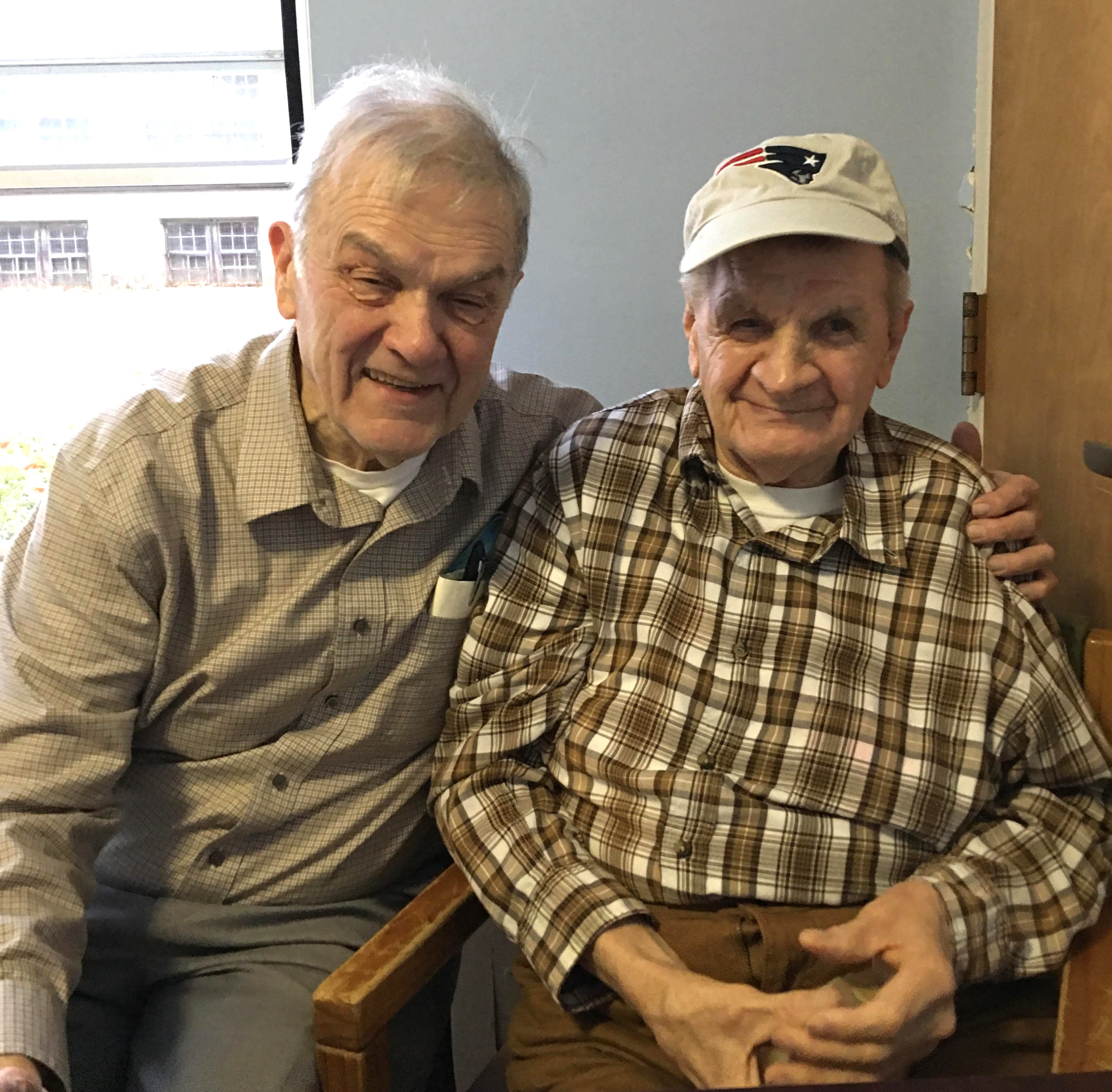
Mitch and Stephen Sikora
We think Mitch’s account of the care that his brother receives at the Wrentham Center offers a clear explanation as to why ICFs are so important, and why eliminating those facilities as an option for care will be disastrous in Massachusetts.
It costs money to provide all of the specialists at Wrentham who care for Stephen and his fellow residents. But as we have seen, the closures of four of the six remaining ICFs in Massachusetts since 2012 has not resulted in a promised savings to the state. Over the past decade, the corporate provider-run group home line item in the state budget has grown from $760 million to $1.6 billion.
Moreover, We think Mitch’s list of recreational activities, both on-and-off-campus, that are provided to the residents at Wrentham debunks the myth that congregate-care facilities such as this one are institutional in character and warehouse or segregate those clients.]
My experience with ICFs in Massachusetts
By Mitchell Sikora
I am writing to report my experience with, and my support of, the continued operation of the remaining two ICFs for developmentally disabled residents of the commonwealth: the Wrentham Developmental Center in southeastern Massachusetts and the Hogan Regional Center in northeastern Massachusetts.
My younger brother Stephen, now 72 years old, has lived since age 10 at the Wrentham facility. The Center (originally named the Wrentham State School) has provided him with protection, care, affection, and community, especially since the major upgrade of all of the then Massachusetts state schools by federal district court litigation in the 1970s and 1980s, known collectively as the Ricci case and consent decree.
Since then, the Wrentham Center has functioned effectively as a campus village of concentrated human and physical resources benefitting Stephen enormously as he has aged.
I will do my best to describe the Wrentham Center’s human resources, its physical resources, and its communal benefits.
Human resources
The following personnel are assigned at the Wrentham Center to Stephen and each resident. A medical doctor oversees his health status. A nurse practitioner examines him promptly for any symptoms of illness. A daily staff nurse administers his medications and monitors his appearance.
His assigned social worker regularly visits him in his cottage dormitory and in socialization classes, and communicates her observations to us (his brother and sister).
A physical education specialist provides him with exercise at the Center’s gymnasium and swimming pool. A physical therapist has treated him for multiple orthopedic problems over the last 20 years, including knee replacements from arthritis, and hip and pelvic fractures from falls.
Vocational instructors have trained him to perform (to his own satisfaction) simple useful on-campus work, such as the collection and delivery of recyclable papers and objects. A recreational therapist periodically takes him for off-campus trips and treats, such as a stop at MacDonald’s. A psychologist responds to any episodes of behavioral or mood problems. A nutritionist watches his diet.
The Center also supports a “service specialist” program in which retired employees contract with families to take residents for off-campus rides or on trips to the families’ homes. Typically, the service specialists are familiar with the resident from years of work at the Center. With the fading of the COVID pandemic, the service specialist process can now resume.
Once each year, the Center must conduct a conference with each family to maintain and update the resident’s ongoing Individual Service Plan (ISP). The continuous Plan describes the resident’s health, activities, progress, problems, goals, needs, and spending objectives for the past and oncoming year. The Plan typically approximates 25 pages. The majority of the personnel enumerated above participate directly in the Conference (conducted by Zoom during the pandemic years) or contribute to the Plan.
As a final word about human resources, I should add that over the past 20 years, the Wrentham Center has received the dedicated service of three longtime facility directors and the involvement of devoted members of the Wrentham Family Association.
Physical resources
The Wrentham Center occupies a campus landscape of approximately 20 square blocks surrounded largely by open fields. The grounds include walking paths and picnic tables. The residents live in large cottages or small dormitories, each with a capacity of six to ten occupants.
Each resident has his or her own room. The communal bathrooms (with advanced shower facilities), kitchen, dining, and TV rooms are large and clean. Direct care workers are present at all times.
The campus contains a freestanding health care facility, the May Clinic, comprised of about 10 beds, three or four fulltime nurses, and visiting physicians. The Tufts Dental School maintains an office in the clinic.
The Wrentham Center has standing relationships with a number of hospitals, including New England Baptist for orthopedic care, and Brigham and Women’s Hospital, Sturdy Memorial Hospital, and Norwood Hospital for urgent and general care.
The campus buildings include a modern school structure of classrooms and meeting rooms; a gymnasium; a swimming pool; a canteen/snack bar; and two administrative buildings. Eight to 10 pre-1980s brick dormitories now long-abandoned remain scattered across the campus. The general setting is expansive and tranquil.
Communal benefits
A number of activities get the residents up and out of the cottage or dormitory:
- Physical ed classes at the gymnasium and pool. Classes at the school building in adult education, vocational education, and speaking skills.
- Day trips off campus to recreational parks, sports events, and the inevitable snack shops.
- The campus-wide Christmas decorations and party.
- A campus-wide spring celebration.
- A late summer week long country fair on campus conducted by a professional amusement company.
- Summer vacations of 3 or 4 days off campus conducted by staff and financed by families able to do so, or by the Center.
- The above mentioned service specialist program.
In all these activities the continuity and affection of the Center’s employees play a crucial role. Some of my brother’s caregivers have known and served him for more than 30 years.
My apologies for the length and detail of this message. I hope that it demonstrates the role of a well functioning ICF as a healthy community and home for its residents. It can serve as a unique concentration of both professional competence and elemental compassion.
A while back an old adage made a comeback: “It takes a village to raise a child.” I have thought that it applies even more so to the care of the developmentally disabled. At the very least, the families of the disabled deserve the informed choice of placement of their member in a well functioning ICF.
Since the great upgrade of the ICF system in the 1980s, the state has progressively reduced information made available to the public about the availability of the ICFs so that now only two ICFs remain in operation in Massachusetts. Those two facilities are subject to declining enrollment.
Post-Ricci administrations appear to retain a pre-Ricci vision of the care and conditions in the ICFs. That approach appears to have become dogmatic policy. It seems to me wrong upon several grounds. First, it is factually inaccurate and outdated. Second, it deprives applicant families of the opportunity of an informed placement choice. Third, it appears to violate requirements of both federal and state law that individuals and their families and guardians be able to make informed decisions about all available placements.
The federal Medicaid law and regulations require that individuals determined to be likely to need ICF-level care be informed of “the feasible alternatives” to that care, but also “given the choice of either institutional or home and community-based services.” [42 U.S.C.§ 1396n, and 42 C.F.R. § 441.302(d)].
However, as COFAR has often reported, families and guardians are generally not informed of the existence of the Wrentham or Hogan Centers. As such, those families and guardians are not being given the information or choices specified by the federal requirements.
Similarly, the Massachusetts Department of Developmental Services (DDS) regulations call for “informed consent” for admission to any departmental facility, including an ICF or group home. [115 CMR 3.04.] I suspect that additional sources of law and context would fortify the inherently fair and rational standard of informed consent and choice.
Faithful compliance with the legal standard of informed choice requires DDS to provide a family in need of a placement with a clear and explicit description of the ICFs and their resources and activities, and, if requested, with visiting tours of those facilities.
I hope that these thoughts are useful. Please do not hesitate to contact me for more information. Email: mitchsikora@gmail.com.
Sheltered workshops being closed in MA despite protective budget language
Despite the passage of protective language in the state budget last year and this year, the Department of Developmental Services appears to be moving rapidly to shut down all remaining sheltered workshops in the state for people with developmental disabilities.
“Can’t believe after all the hard work so many people put in, it (the workshop closures) is still happening,” one workshop supporter wrote in an email, referring to grassroots lobbying efforts mounted in the past two years to keep the workshops open.
The protective language that was inserted by State Representative Brian Dempsey in the past two years into the DDS community day line item in the budget seemed to be definitive. The language states that DDS “shall not reduce the availability or decrease funding for sheltered workshops serving persons with disabilities who voluntarily seek or wish to retain such employment services.”
At the same time, however, Dempsey’s House Ways and Means Committee supported the appropriation of $1 million last year and $3 million this year in a separate DDS line item to fund the transfer of people from sheltered workshops to community-based day or employment programs. So, even while the language in one line item has appeared to protect the workshops for those who want to remain in them, the other line item has funded the removal from the workshops of everyone whose guardians haven’t formally objected to moving them to the day programs.
Sheltered workshops around the country have become an ideological target of the federal government and of many states, which contend that the workshops “segregate” people with developmental disabilities from their peers in the mainstream workforce. But many families of the sheltered workshop participants have countered that the programs are fully integrated into the surrounding communities and provide the participants with meaningful activities and valuable skills.
Sheltered workshops provide developmentally disabled persons with a range of assembly jobs and other types of work, usually for a small wage.
In 2013, the Massachusetts DDS and the state’s major lobbying organizations for corporate DDS providers issued a plan to close all sheltered workshops as of last June, and to transfer all of the participants to either DDS day programs or to “integrated individual or group employment at minimum wage or higher.”
Sheltered workshops are defined by the Social Security Administration as “a private non-profit, state, or local government institution that provides employment opportunities for individuals who are developmentally, physically, or mentally impaired, to prepare for gainful work in the general economy. These services may include physical rehabilitation, training in basic work and life skills…”
Integrated employment is defined by the federal Labor Department as “jobs held by people with disabilities in typical workplace settings where the majority of persons employed are not persons with disabilities, where they earn at least minimum wage, and where they are paid directly by the employer.”
Our concern regarding the DDS/corporate provider plan to close sheltered workshops is that there appears to be a limited number of opportunities in Massachusetts for persons with developmental disabilities to find jobs in “typical workplace settings” where the majority of the people employed are not disabled. Unless and until these integrated workforce opportunities exist in sufficient quantities, we don’t think sheltered workshops should be eliminated as options.
Unfortunately, the state’s attitude concerning care for the developmentally disabled has long been to close facilities that are considered expensive or that otherwise don’t fit an ideological mold, without having a plan or sufficient resources to adequately replace those facilities.
The director of one sheltered workshop program I talked to said that while there hasn’t actually been a directive from DDS to transfer everyone out of his workshop by a particular date, DDS recently indicated that transfer funding had become available and that his workshop should “determine who would move at this time.”
The workshop director said he planned to transfer more than half of the program’s current participants out between next month and March of next year. While the protective language in the budget would appear to allow the guardians of the workshop participants to object to the transfer plans, the workshop director said no one had yet voiced an objection. It’s possible, he said, that people will begin to object once the transfers start. But he said he sensed less resistance among families and guardians to the prospect of leaving his workshop program than was the case two years ago.
One of the existing integrated work settings in Massachusetts is MicroTek in Chicopee, an electronic cable manufacturer. The company employs 130 people, 15 of whom have disabilities, according to Cynthia Piechota, the company’s program director. Piechota said she knew of only a handful of other integrated work programs in the state.
A workplace program that is smaller than MicroTek, but similar to it, is Interface Precision Benchmarks (IPB) in Orange, where six people are employed in manufacturing electronic cables. The IPB workforce is currently divided evenly between disabled and nondisabled employees (3 disabled and 3 nondisabled); thus it’s not clear that IPB actually fits the Labor Department’s definition of an integrated workplace.
Ed Orzechowski, whose sister-in-law, Carol Chunglo recently retired as an IPB employee, said he and his wife, Gail, “can’t say enough about what a positive experience it was for Carol to work at IPB. There should be more places like it.” Ed Orzechowski is a COFAR Board member and president of The Advocacy Network, an affiliated advocacy organization for people with developmental disabilities in Massachusetts.
A University of Massachusetts report noted that in 2010, there were 3,700 people with intellectual disabilities in sheltered workshops in Massachusetts and about 3,500 people in “integrated employment.” However, there were about 9,500 people in “non-work” settings, which appear to include DDS day programs.
COFAR has filed a Public Records Law request with DDS to try to determine how many people the Department anticipates will be transferred over the next five years to integrated workplaces, and how many will be transferred over that time to DDS day programs.
It’s unfortunate that sheltered workshops appear to be going the way of so many other previous high-quality programs and services for people with developmental disabilities in Massachusetts. The potential elimination of these services is usually vigorously opposed by families and guardians who understand how critically important they are. But DDS has long perfected a wait-them-out strategy.
The Department understands that grassroots resistance to new, untried policies, can be worn down over time.
The politically incorrect idea of bringing congregate and community care together
Two initiatives in two separate states call for something that would seem to make perfect sense — expand the missions of congregate care facilities for the developmentally disabled, and merge them with their surrounding communities.
In one case, the State of Delaware is proposing to expand services available at the Stockley Developmental Center by offering medical and dental care now available there to developmentally disabled and under-served persons living in the community. A Delaware state task force has also called for considering an indoor community sports center or outdoor playing fields at the Stockley facility; and opening up a therapeutic horseback riding program and a therapeutic pool at Stockley to the surrounding community as well.
Like most of the developmental centers in Massachusetts, the Stockley Center sits on hundreds of acres of largely unused land, and currently serves only a small fraction of the hundreds of people who lived there four decades ago.
In the second initiative, the Arc of Jacksonville in Florida has been awarded state funding and tax credits to help construct a “planned neighborhood” in that state for adults with intellectual and developmental disabilities, according to The Florida Times Union. The newspaper reported that the “Arc Village” will house about 120 adults – ages 18 and older – in 97 one- and two-bedroom apartments. The $17.7 million project will allow residents to “live, work, shop, recreate, and socialize,” in one place.
Unfortunately, neither of these innovative initiatives would be likely to move forward in the “progressive” state of Massachusetts, and neither may get the backing of the Obama administration. That’s because each of the proposals envisions providing services to a large number of people in one location — a non-starter to the ideological opponents of “congregate care.”
Congregate care, you see, is “institutional,” and therefore bad by definition for people with developmental disabilities. It’s apparently better that they live in small group homes or apartments dispersed throughout the state. We happen to think that placing everyone in dispersed group homes or apartments is actually a recipe for isolation and a new form of warehousing of people with developmental disabilities, all the while lining the pockets of the executives of hundreds of state-funded, corporate providers. (More about that in a coming post.)
But the Patrick administration in Massachusetts has voiced its opposition to congregate care and has moved to close four out of six remaining developmental centers in this state. Two of those centers have now been shut and most the residents have moved either to one of the two remaining centers or to group homes throughout the commonwealth. Longstanding proposals by advocates of those developmental centers to more effectively merge them with their surrounding communities — similar to the Delaware proposal for the Stockley Center — were all rebuffed by the Patrick administration.
Meanwhile, the federal Centers for Medicare and Medicaid Services (CMS) are moving to change their definition of federally reimbursable community-based care to exclude even group homes that happen to be located on the grounds of, or even near to, a public institution such as a developmental center. And the National Council on Disability has declared that an “institution” is a “facility of four or more people who did not choose to live together.” The NCD’s definition, which applies even to many group homes, was contained in a report in 2012 that states in its first sentence that closure of all such “institutions” should be “a top public policy priority in every state where such institutions exist.” The NCD advises the president and Congress on disability issues.
It’s hard to imagine the NCD supporting the Arc of Jacksonville’s proposal, in particular, which would establish a single setting, albeit a “neighborhood,” which would house 120 clients. And the Stockley Center proposal would not appear to conform to the CMS’s proposed definition of community-based care.
It seems to us, though, that the inclusive approaches being proposed in Delaware and Florida represent the future of care of the developmentally disabled in this country. Both proposals appear to recognize that congregate care is a valid option for people who want and need it, and that it can coexist with, and even be a part of, community-based care. Note that we’re not saying congregate care is right for everyone or that it should replace care in smaller settings.
The administration of Delaware Governor Jack Markell certainly appears to recognize that a congregate care center such as Stockley, which meets federal Intermediate Care Facility ICF/DD) standards, is worth maintaining as a residential option for its current residents. The Delaware state task force report states among its “general principles” that its proposal for the Stockley Center would include “a commitment to maintain and build upon a peaceful environment that the people at Stockley Center currently enjoy.”
Rita Landgraf, secretary of the Delaware Department of Health and Social Services, was quoted in The Wilmington (DE) News Journal as saying: “We do have individuals who still live here on site. It is critically important that we bring inclusion to them. This was not a discussion of closing Stockley. Sometimes I hear that, out in the public. But we are not closing Stockley.”
Among the specific task force proposals for the Stockley Center that would establish the center as a critical component of community-based care in Delaware are the following:
- Creation at the Stockley facility of a “Center for Excellence,” which would offer “integrated health support and disease prevention services to communities for which health services are hard to access.”
- Creation of a facility at Stockley to support respite care, both for individuals with disabilities in the community system and caregivers.
- Expanding the use of the Stockley pool or other therapeutic facilities for individuals with disabilities “first in Sussex County (DE) and beyond, as feasible.”
- Creating an “intergenerational multi-use center for wellness that supports active living and wellness, including classes for smoking cessation, fitness, nutrition, behavioral health, obesity, cardiovascular disease and stress management.”
- Developing fully accessible community vegetable gardens for an “integrated community” of county residents, including low income families; and hosting a farmers’ market.
- Creating a “model of mixed-use development”on the Stockley campus site, including affordable housing, stores, restaurants, dental and medical, and recreational facilities.
- Creating a training center to provide professional development for medical and care providers.
- Encouraging schools to use the Stockley property for nature and science instruction.
- Providing education, support, life skills and vocational or job training programs for people with disabilities.
- Creating a center for volunteer and nonprofit groups.
- Creating an outdoor trail system for users of all ages and abilities.
Contrast the excitement and vision of that approach with Massachusetts where we’ve seen only the systematic dismantling of congregate care for people with developmental disabilities. We will soon be down to two remaining ICF-level care centers, and what remains of state-operated care is under siege as facilities and services continue to be privatized. It’s refreshing to know that not all state administrations have that mindset, and that in some places, new ideas are being tried by people who are not blinded by outdated ideologies. We, however, are being left in their dust.
 COFAR blog