Archive
Harvard researcher looks for the key to understanding the link between Down syndrome and Alzheimer’s disease
The link between Down syndrome and Alzheimer’s disease has become the subject of increasing scientific interest, and a major new study is seeking to shed further light on that connection.
Dr. Florence Lai of Harvard University, McLean Hospital in Belmont, and Massachusetts General Hospital, is the lead Massachusetts investigator in a multi-center, five-year study funded by the National Institutes of Health.

Dr. Florence Lai
In an interview with COFAR, Dr. Lai said the study is seeking “biomarkers” that may predict the onset of Alzheimer’s disease and enable researchers to learn more about Down syndrome. It is intended to be “the most comprehensive study of the links between Down syndrome and Alzheimer’s disease up to this point.”
Lai and her colleagues, Dr. Diana Rosas, a neurologist, and Dr. Margaret Pulsifer, a psychologist, are in charge of the Massachusetts portion of the study.
While the average person with Down syndrome develops symptoms of Alzheimer’s disease in their early 50’s, some may not develop the dementia until the age of 70, and a very few escape it altogether.
“The study seeks, among other things, to learn the reasons for that variation,” Dr. Lai said.
The Massachusetts General Hospital’s facility at the Charlestown Navy Yard is one of seven sites around the country and England that are coordinating their research efforts as part of the study. The other sites include Columbia University (New York City), the University of California Irvine, the University of Pittsburgh, Cambridge University (UK), the University of Arizona (Phoenix), and the University of Wisconsin (Madison).
The NIH study represents a natural progression in Dr. Lai’s clinical practice and research. Over several decades, she has evaluated and followed some 750 individuals with Down syndrome, including Joanna Bezubka, a cousin of COFAR Board member and former president, George Mavridis. In 2013, Mavridis published a compelling memoir about his experience in caring for Joanna, who died of Alzheimer’s disease in 2012 at the age of 60.
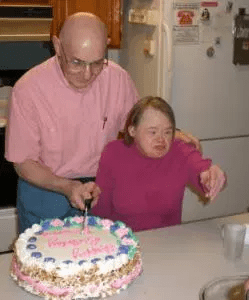
George Mavridis and Joanna Bezubka on Joanna’s 60th birthday. Joanna, who had Down Syndrome, died in 2012 at the age of 60 of Alzheimer’s Disease. She had been one of Dr. Lai’s clinical patients.
In a recent letter to Mavridis, Lai said that her hunch that women with Down syndrome who developed menopause early were more likely to develop Alzheimer’s disease earlier, led to an earlier multi-year NIH study by a colleague who proved the hypothesis.
Another hunch of hers that immunological factors in Down syndrome might be involved in Alzheimer’s disease is now the subject of intense scientific interest with many researchers concentrating on neuro-inflammation as a causative factor.
Those avenues of inquiry “may pave the way to think outside the box for potential treatments for AD (Alzheimer’s disease),” Lai wrote to Mavridis.
In her interview with COFAR, Dr. Lai said scientists have discovered that people with Down syndrome are genetically predisposed to create large concentrations in their brains of amyloid protein, which is connected with destruction of brain cells in Alzheimer’s disease.
The gene for the precursor of amyloid protein is located on Chromosome 21. Since people with Down syndrome have an extra copy of Chromosome 21, Dr. Lai explained, they “make the amyloid earlier and more of it. That may be the reason for the high incidence of Alzheimer’s disease in people with Down syndrome.”
In order to learn more about the impact of the amyloid protein and other potential biomarkers of Alzheimer disease, the NIH study is designed to collect a broad range of information from the participants in the study, including information on their health history, cognitive functioning, immune and genetic factors, and daily living activities. The information is obtained from cognitive testing, from blood samples that are sent to specialized labs around the country, and from caregivers of the participants.
The study also includes an MRI brain scan of the subjects and an optional PET scan (Positron Emission Tomography), which involves the introduction of a small dose of radioactive material to examine the presence of amyloid protein in the brain. Another optional part of the study includes analyzing the cerebral spinal fluid obtained from a spinal tap.
The 3-year NIH study is limited to adults over the age of 40 with Down Syndrome at three of the sites (including Charlestown) and over age 25 at the other four sites. At the MGH Charlestown site, the study involves three cycles of visits with each cycle involving two to three visits of up to five hours each. The second and third cycles each take place 16 months after the previous cycle.
Although the study was initially funded in September 2015, it took about a year to “harmonize the procedures at all the sites,” Dr. Lai said, and to receive the necessary approvals from the participating institutions including the Research Review Committee of the Department of Developmental Services in the case of Massachusetts. Lai said the researchers at the seven study sites hope to recruit up to 700 individuals to participate in the study.
Lai said that although the NIH authorized the multi-million dollar study in 2015, the federal agency recently announced that it will be forced to cut some of the funding. She noted that the study is expensive to perform. A large number of specialized personnel is needed, and doing the brain scans is “very costly.”
At the MGH site, about 20 participants have been recruited so far and have been through a preliminary visit, Lai said. They receive a modest payment for their participation. The information collected is anonymous, she said. Even the researchers analyze only coded, aggregate data.
Continuing to treat Down Syndrome patients
Apart from the NIH study, Drs. Lai and Rosas continue to clinically treat, test, and follow the life histories of patients with Down syndrome at McLean hospital. They see each patient once a year and generate neurological evaluations which are shared with caregivers and family.
Lai has collected hundreds of blood samples, some of which have been stored at a Harvard-affiliated facility at -80 degrees C. However, the samples have lain dormant for many years due to a lack of funding needed to analyze them. Lai noted that many of her colleagues have experienced the same funding frustrations, and have had to supplement federal funding with industry grants and philanthropic donations.
It was actually due to the generosity of several families of her patients, Lai said, that she herself was able to start a Down Syndrome Fund for Alzheimer Research at MGH. The Fund got a boost of several thousand dollars a few years ago when a member of the MGH Board of Directors called Lai to thank her for her care of a patient with Down syndrome whom he knew personally.
Lai said that if the Down Syndrome Fund ever does get more sizeable contributions, her “dream” is to team up with colleagues to fully analyze the stored blood samples, and “to encourage a younger generation of clinicians and investigators to devote their energies to care for and study those with Down syndrome.”
Persons interested in learning more about the NIH study at MGH can call 617-726-9045 or 617-724-2227.
Those interested in an evaluation and follow-up with Drs. Lai and Rosas at the McLean Hospital Aging and Developmental Disabilities Clinic can call 617-855-2354.
Dental practitioner bills could undercut care of the developmentally disabled
Sometimes even well-intentioned bills in the Legislature can have unintended impacts, and we’re concerned about two such bills that authorize mid-level dental practitioners to perform basic dental procedures in order to address under-served populations around the state.
Versions of one of the bills are being promoted in several states, including Massachusetts, by the Pew Charitable Trusts. The second bill is being promoted by the Massachusetts Dental Society.
While we appreciate the intent behind the bills, we are concerned that passage of either one as currently written could actually result in the loss of existing services to clients of the Department of Developmental Services.
If either bill is enacted, many DDS clients, who are currently served by experienced dentists, could be switched by the administration to less skilled and experienced practitioners as a money-saving measure.
Backers of the Pew Trusts bill (S. 1169) point out that large numbers of adults and children in this and other states around the country are unable to access dental care either because they live in under-served areas or because only about a third of U.S. dentists accept publicly provided health insurance.
Under S. 1169, practitioners known as “dental therapists” would work under supervisory agreements with dentists, and would be authorized to do such things as fill cavities, extract teeth, and apply crowns. While this may work well for patients in the general population, we don’t think it is workable for many people with developmental disabilities who require dentists with advanced skills and significant experience.
As such, we would not support either S. 1169 or the competing bill from the Massachusetts Dental Society (S. 142) unless either bill contained language specifying that dentists must continue to treat persons with developmental disabilities.
The primary sponsors of S. 1169, Senator Harriette Chandler and Representative Smitty Pignatelli, maintain that hundreds of thousands of children covered by Masshealth in Massachusetts do not regularly see a dentist.
However, it has apparently not been as difficult to find a dentist for people with intellectual and developmental disabilities (ID/DD). Right now, the availability of dental services to persons with ID/DD appears to be quite high in Massachusetts. The Massachusetts Developmental Disabilities Council’s (MDDC) State Plan for Fiscal 2017 states that between 90% and 97% of DDS clients have continued to receive annual dental exams.
Some 7,000 developmentally disabled persons in Massachusetts receive dental care in seven state-funded clinics run by the Tufts University School of Dental Medicine. Pediatric dentistry is offered by Franciscan Hospital for Children.
Despite that high level of service provision, we have seen in the past that administrations have proposed elimination of some of the Tufts clinics in order to save money. Strong opposition from families of DDS clients helped to preserve at least one such clinic temporarily at the now closed Fernald Developmental Center, but that clinic was ultimately closed.
Our concern is that as currently written, either S. 1169 or S. 142 might actually give the Baker administration an excuse to reduce funding for the Tufts clinics because those clients could now presumably be served by the dental therapists or hygienists, as authorized by the legislation. If that is the case, there could be an increasing impetus to close additional Tufts facilities for those clients.
Moreover, while S. 1169 requires that the dental therapists receive training in treating people with ID/DD, the therapists would certainly not have the expertise or experience of the dentists in the Tufts clinics. The bill actually doesn’t specify the amount of training the dental therapists would be required to receive.
The Tufts Dental school declined to comment on either bill. Dentists themselves in Massachusetts oppose S. 1169, arguing that it does not provide for sufficient training of the dental therapists or direct supervision of them in all cases. The dentists also fear the use of dental therapists could lead to reduced reimbursement rates from insurance companies.
The Dental Society’s bill (S. 142) would establish more stringent educational and supervisory requirements regarding mid-level practitioners than does S. 1169. The Dental Society bill would require, for instance, that mid-level practitioners, which S. 142 refers to as public health dental practitioners, be under the direct, on-site supervision of a dentist at all times.
If either bill does pass, we would urge that language be added to prohibit the dental therapists or public health dental practitioners from having authorization to treat people with ID/DD unless an individual’s guardian specifically requested it.
We think that language along those lines would potentially protect existing dental services for people with ID/DD. Allowing guardians to request the therapists or public health dental practitioners would keep those options open if full dental services were not available for a developmentally disabled individual.
We emailed a Pew Charitable Trusts dental campaign officer on February 17 to express our concerns about the S. 1169, but have not as yet received a response from him.
Last week, I also contacted a legislative aide to Senator Chandler, who defended S. 1169, contending that it would would not result in reduced services to persons with ID/DD, but would “strengthen Tufts” and allow them to provide the same services at a “slightly lower cost.”
The aide said he would convey our concerns to Senator Chandler and would try to arrange for someone from Pew to get back to us with their response to our concerns. As noted, that hasn’t happened yet.
No one from Rep. Pignatelli’s office has yet responded to an email we sent early last week.
S. 1169, which currently has 30 co-sponsors from the House and Senate, has been referred to the Legislature’s Public Health Committee. Please call the Committee at (617) 722-1206 and urge them to insert language into the legislation to prevent dental therapists from treating people with developmental disabilities unless a guardian requests that. Or you can email the co-chairs of the Committee — Senator Jason Lewis ( Jason.Lewis@masenate.gov) and Representative Kate Hogan (Kate.Hogan@mahouse.gov).
The Massachusetts Dental Society’s bill (S. 142) has been referred to the Consumer Protection and Professional Licensure Committee. That bill should also be amended to include our protective language. Please call that Committee at(617) 722-1612. Or you can email the co-chairs — Senator Barbara L’Italien (barbara.l’italien@masenate.gov) and Representative Jennifer Benson (Jennifer.Benson@mahouse.gov).
DDS providers pushing Gov. Baker to phase out state-run care
The major lobbying organizations for corporate providers to the Department of Developmental Services appear to be pushing the Baker administration and the Legislature to privatize more and more state-run care.
And the administration and Legislature have so far appeared to be more than willing to accommodate the providers.
Governor Baker’s Fiscal Year 2018 budget, which he submitted to the Legislature last month, further widens a spending gap between privatized and state-run programs within the Department of Developmental Services. In doing so, it appears largely to satisfy budget requests from both the Arc of Massachusetts and the Association of Developmental Disabilities Providers (ADDP).
In fact, the increase proposed by the governor in funding for privatized group homes is $26 million more than the $20.7 million increase the Arc had sought. The ADDP may be a little disappointed only because that organization had asked for a $176 million increase in that account!
The chart below shows the widening gap in funding for key privatized and state-run DDS services over the past several years, adjusted for inflation. Under this trend, funding for corporate-run, residential group homes, in particular, has risen steeply while funding for state-operated group homes and developmental centers continues to be stagnant or cut.
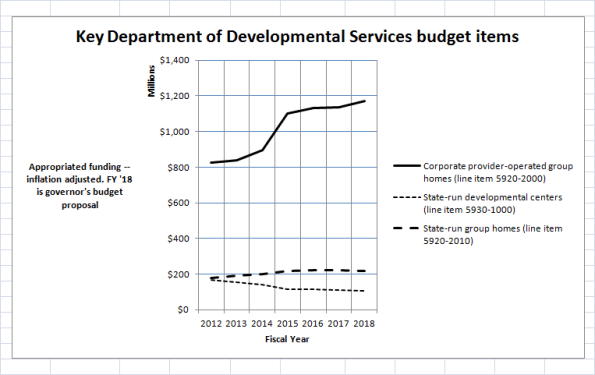
For Fiscal 2018, the Arc requested a $20.7 million increase in funding for privatized group homes (line item 5920-2000), and the governor obliged with an even higher $59.9 million, or 5.4 percent, increase, as noted.* The ADDP, as noted, wanted a $176 million increase in that line item.
In the privatized community day line item (5920-2025, not shown on the chart), both the Arc and ADDP asked for a $40.2 million increase, and the governor responded with a proposed $13.6 million increase.
At the same time, both the Arc budget request for Fiscal 2018 and the ADDP request effectively asked for zero increases in funding for the state-run DDS accounts. Those include accounts funding state-operated group homes, developmental centers, and departmental service coordinators. (The column labeled “Request” in the linked Arc budget document is left blank for those state-run program line items. The ADDP budget request simply doesn’t include those line items.)
The governor appears to have more than obliged the provider organizations regarding those state-run accounts as well. His Fiscal 2018 budget proposes a $1.8 million cut in the state-operated group home account (5920-2010). This amounts to a $6.9 million cut when adjusted for inflation.
In addition, the governor is proposing a $2.4 million, or 2.2%, cut in the state-run developmental centers line item. (5930-1000). That’s a $4.9 million cut when adjusted for inflation.
And the governor is proposing a cut of $96,000 in the DDS administration account (5911-1003). That is a $1.7 million cut when adjusted for inflation, and means a likely cut in funding for critically important DDS service coordinators, whose salaries are funded under the administrative account.
It’s well known that the Arc and the ADDP oppose developmental centers because those two organizations oppose congregate care for the developmentally disabled and support only care in group homes or smaller settings. What may not be as well known is that the Arc and ADDP appear to have no interest in more funding for service coordinators or state-run group homes, in particular.
Late last month, Baker submitted his proposed Fiscal 2018 budget to the Legislature’s House Ways and Means Committee. In a letter to Representative Brian Dempsey, the chair of the budget panel, COFAR requested that, at the very least, the committee approve a plan to redirect some of the governor’s proposed increase in the corporate residential account to the state-operated group home, facilities, and service coordinator accounts.
(We would note that we have been urging this kind of redirection of funding for the past two years, and neither the governor’s office nor the Legislature are listening.)
Service coordinators
Service coordinators are DDS employees who help ensure that clients throughout the DDS system receive the services to which they are entitled under their care plans. In recent years, funding for service coordinator salaries has failed to keep up with their growing caseloads.
A reason for the Arc’s apparent disinterest in service coordinators may be that the organization has long promoted privatized “support brokers,” in which the Arc is financially invested.
The job descriptions of the Arc support brokers and the DDS service coordinators appear to be quite similar. The Arc notes on its website that “consumers or families hire a support broker to help them find appropriate services and supports to thrive in their community.”
The job description of DDS service coordinators states that they are responsible for “arranging and organizing DDS-funded and generic support services in response to individual’s needs.”
COFAR Executive Director Colleen M. Lutkevich terms the DDS service coordinators “the eyes and ears that make sure that the providers who report to DDS are doing their best for the residents in a large, confusing system. Without them, the provider agencies have total control, and families do not even have a phone number or a name to call outside the provider they are dealing with.”
Underfunding of state-operated group homes
In addition to provider-run group homes, DDS maintains a network of state-run group homes that are staffed by departmental employees. State workers receive better training on average than do workers in corporate provider-run residences, and have lower turnover and higher pay and benefits.
State-operated group homes provide a critically important alternative to the largely privatized residential care system that DDS oversees. But we have found that DDS routinely fails to offer state-operated homes as an option for people waiting for residential care, and instead directs those people only to openings in the privatized residences.
To be clear, we do not object to a highlight of Governor Baker’s budget — his proposed $16.7 million increase in the DDS Turning 22 account, which would amount to a 222% increase in that account over the current year appropriation. Turning 22 funds services for a growing number of developmentally disabled persons who leave special education programs at the age of 22 and become eligible for adult services from DDS. This account has been historically underfunded.
But our concern is that as they enter the DDS system, those 22-year-olds will be placed almost exclusively in privatized programs. An important choice is being taken away from them and their families.
As we noted in our letter to the House Ways and Means chair, the pattern of privatization in Massachusetts state government has become almost permanently established even though the benefits of privatization are highly debatable. Many questions have been raised about the privatization of prisons and the privatization of education in Massachusetts and elsewhere around the country.
The privatization of human services may be the biggest prize of all for government-funded contractors. We need to preserve what’s left of state-run services.
(*The $59.9 million figure for the governor’s proposed increase in the corporate provider line item is based on numbers provided by the nonpartisan Massachusetts Budget and Policy Center. The Arc’s budget document claims the governor’s requested increase was $46.7 million.)
Disability Law Center aids woman who has been kept away from father and sister by DDS
In the wake of reports that an intellectually disabled woman has been prohibited for more than a year by the Department of Developmental Services from having any contact with her father and sister, a federally funded legal assistance agency has arranged for legal representation to help the woman challenge the ban.
The Boston-based Disability Law Center opened an investigation late last year of a decision by a DDS-paid guardian to prohibit contact between the woman and her father, David Barr, and sister, Ashley Barr. Based on privacy concerns raised by the DLC, we are no longer publishing the woman’s name.
Earlier this month, a DLC attorney said the agency had assisted in making an attorney available at no charge to the woman to challenge the visitation ban in probate court, if she chooses to do so. The attorney said he was precluded by confidentiality requirements from discussing the investigation or any conclusions he may have reached in the case.
Since Thanksgiving of 2015, David and Ashley Barr have had no information about the woman’s whereabouts. She is believed to be living in a DDS-funded group home, but the Barrs have no idea where that residence might be located.
COFAR has reported that a DDS guardian imposed the ban on all contact with the woman by David and Ashley primarily because they were viewed as too emotional when they were allowed to visit her. Neither David nor Ashley Barr have been charged or implicated in any crimes, yet they said they feel they have been treated by DDS as if they are criminals.
In COFAR’s view, restricting family members from visiting a loved one impinges on a fundamental human right, and the DDS guardian should at least have obtained a probate court order before doing so. DDS should also have made sure the woman had access to legal counsel who could challenge the visitation ban on her behalf. DDS reportedly did neither of those things.
The case appears to involve a clear violation of DDS regulations, which state that people in the Department’s care have the right …“to be visited and to visit others under circumstances that are conducive to friendships and relationships…” (115 CMR 5.04)
The right to visitation is, moreover, a key aspect of family integrity in international human rights law. As an article in the Berkeley Journal of International Law states, “Sufficient consensus exists against particular types of family separation…to constitute customary international law.”
The article discusses Nicholson v. Williams, a class action lawsuit by a group of mothers against the New York City Administration for Child Services (ACS). The lawsuit “challenged ACS’s policy of automatically removing children from homes where domestic violence had occurred even if it meant removing them from the victims rather than the perpetrators of that violence.”
The children of the plaintiffs in Nicholson were kept in foster care for several weeks. According to the law journal, the court “cited the emotional and developmental damage done to the children, (and) the destruction of their family relationships…” that occurred as a result of the separation of the children from their parents (my emphasis).
We would note that the ACS lawsuit was a case involving the removal of children for just a few weeks. The Barr case involves the removal of a family member for more than a year so far, with no indication from DDS that family contact will ever be restored.
While the developmentally disabled woman in Barr case is no longer a child, she has been found to be mentally incapacitated and in need of a guardian. As such, she is in a similar legal position to a child in that she is not considered competent to manage her personal or financial affairs.
The court in Nicholson v. Williams cited specific international provisions including the Universal Declaration of Human Rights, and found that the New York ACS policy “violated the basic human rights of family integrity and freedom from arbitrary interference with family life, as well as the specific right of a child to be cared for by her parents.”
In what seems almost an obvious observation, but one that doesn’t seem to have occurred to DDS, the Berkeley law journal article notes:
People simply care a great deal about their families, and often suffer more from losing them than they do even from serious individual harms they suffer personally.
A couple of other points made in the law journal article are worth highlighting. One is a statement that temporary removal of children from families may cause “lasting harm to the children…especially if frequent visitation is not allowed during the removal period.”
The article also points out that the International Convention on the Rights of the Child (ICRC) imposes obligations on states in situations where families have already been separated. In particular, the ICRC states that where children are separated from one or both parents “the state must furnish the parents or children with any available information regarding their family members’ whereabouts” (my emphasis).
The Massachusetts Supreme Judicial Court weighed in last spring with a decision upholding the right of the grandfather of a developmentally disabled woman to challenge severe restrictions placed on his right to visit her.
As we’ve said before, and will again, major reforms are needed in the state’s probate court system in order to ensure the rights of families to maintain contact with their loved ones in DDS care. One of the first steps is for the Legislature to finally pass a bill (filed in the current session as HD 101) that would require probate judges to presume parents to be suitable guardians for persons with developmental disabilities.
DDS commissioner paints overly rosy picture of employment for developmentally disabled
In opening remarks at a conference on employment opportunities for the developmentally disabled late last year, Department of Developmental Services Commissioner Elin Howe gave what appears to be an overly rosy assessment of the likelihood of mainstream jobs for those people.
In her written remarks delivered to the November 30 conference, which was hosted by DDS and the UMass Institute for Community Inclusion, Howe appeared to imply that former participants in sheltered workshops, which the administration has worked to close, have been placed in mainstream jobs at a record rate.
“There are now more people working in individual jobs in the community than ever before,” Howe stated.
But while the numbers Howe cited show an increase in the number of people placed in mainstream jobs since 2013, it appears that most of that increase occurred between 2013 and 2014, before the workshop closures took place. Since 2014, DDS data indicates that the number of people finding mainstream jobs declined rapidly.
Howe noted that all remaining sheltered workshops in the state were closed as of last July 1, and that Massachusetts was only the fourth state in the nation to do that. But the loss of those workshops should not be a cause for concern, Howe contended, because, there were now more than 3,300 individuals working in “group supported employment” in the state – an increase of over 1,300 people since June 2013.
An increase of 1,300 disabled people in group supported employment would work out to a 65 percent increase in the number of people in that category since 2013, which sounds like a major success story.
But of that total increase cited by Howe of 1,300 individuals, 998 — or nearly 77 percent of them — appear to have entered group supported employment between 2013 and 2014, according to data provided by DDS.
The DDS numbers show there was an increase of only 146 people in group supported employment between August 2014 and August 2015. Between August 2015 and November 2016, when all remaining sheltered workshops were closed, there was an increase of only 156 people in group supported employment.
So, while the number of people in group supported employment appears to have increased by almost 50 percent between 2013 and 2014, the increase in the two-year period from 2014 to 2016 dropped to about 10 percent.
Group supported employment is defined by DDS as “a small group of individuals, (typically 2 to 8), working in the community under the supervision of a provider agency.” In contrast to sheltered workshops, supported employment places an “emphasis…on work in an integrated environment,” which means that developmentally disabled persons work in the same location as non-disabled individuals.
The closures of the sheltered workshops in Massachusetts has resulted in the removal from those programs of close to 2,000 participants since 2013; but those closures did not appear to have translated into a steady flow of people into supported employment. Even Howe appears to acknowledge that a significant percentage of those former workshop participants have not found mainstream workforce jobs.
In her remarks, Howe stated that “many people transitioned (from sheltered workshops) to Community Based Day Support programs,” but didn’t say how many. Day programs are often really just daycare programs that do not offer work-based or skill-building activities to the people in them.
The Massachusetts Developmental Disabilities Council, which is part of the Baker administration, appears to acknowledge the problem of employment in its State Plan for 2016, noting that:
…there are fewer people being placed in successful employment due to staff layoffs and the current fiscal environment. In order for more services to be made available, it is important to create partnerships and work with various state agencies in order to address this significant issue that is and will continue to be of concern. (my emphasis)
Last year, however, the Legislature failed to provide funding sought by Governor Baker for the transition from workshops to supported employment.
Rather than touting the supposed good news about the closures of the workshops, Howe should have acknowledged ongoing concerns about the apparent difficulty of finding mainstream work for people with developmental disabilities.
Opaque Massachusetts budget process hides state’s real priorities
In a preview this week of the Fiscal 2018 state budget, the Massachusetts Budget and Policy Center points out a key shortcoming in the budget process.
That process is not transparent, the nonpartisan think tank argues, because it doesn’t provide a needed context for the proposals and decisions that the governor and Legislature make.
As the Budget and Policy Center notes, that needed context lies in the release of a public “maintenance budget” that discloses the projected costs of continuing “current services” from one fiscal year to the next. Without that “maintenance budget” context, it is difficult, if not impossible, for the public to really know whether proposed funding levels are meeting real needs or falling short of them.
The problem can be clearly seen in the current-year funding of group homes operated by the Department of Developmental Services.
Last January, Governor Baker proposed a $3.7 million — or 1.7 percent — increase in the DDS state-operated group home line item. But while that sounds like more funding for those facilities, it was in actuality a cut when adjusted for inflation. The inflation rate was 1.8 percent, according to the Policy Center’s numbers.
Moreover, the funding increase proposed by the governor for the state-operated group homes was reportedly about $500,000 less than what DDS wanted in order to maintain current services in the residences. That $500,000 figure, however, wasn’t readily available to the public. The figure was casually mentioned by DDS Commissioner Elin Howe during a conference call on the budget last year with advocates for the developmentally disabled.
At the same time, Howe didn’t intend to do anything about that actual shortfall in funding for the state-operated group homes. As we noted last May, while Howe admitted the funding proposed by the governor for the group homes was inadequate, she also said DDS did not intend to seek an amendment in the House budget to increase that funding. Howe’s response to us was, “we’re just going to have to manage it.”
This is exactly why the maintenance budget disclosure is needed as part of the process. It would give the public a better insight into what the governor and Legislature actually intend with their budget proposals and deliberations.
It appears to us that the DDS mindset is that it is not worthwhile to push even for maintenance-level funding for the state-operated group homes and potentially other state-run programs. That’s because the Department’s ultimate priority or aim, as we see it, is to privatize these services.
Interestingly, the Budget and Policy Center also pointed out that certain other budgetary accounts were underfunded in the current fiscal year, including a human services account that helps fund corporate provider-run or privatized group homes in the DDS system. That account was underfunded by $14.7 million. However, the administration apparently plans to fully fund those accounts next year, the Center noted.
Partly as a result of the unfunded accounts and the use of a host of one-time revenues and temporary solutions to balance the current-year budget, the Policy Center is projecting a $616 million budget shortfall in Fiscal 2018.
The Policy Center’s preview suggested that one of the major reasons for the Legislature’s underfunding of the privatized group home and other accounts was the lack of a publicly available maintenance budget document. The Policy Center points out that 19 other states publish a maintenance budget document, but Massachusetts is not among them.
The Policy Center is also calling for the public release of a baseline tax revenue growth estimate. This sounds like a suggestion that the administration adjust its usual revenue projections to take into account any tax cuts or tax increases that have been enacted. As the Policy Center noted,
The initial tax revenue growth estimates for FY 2017 were unusually optimistic, but there was no easy way to see that because of the way the estimates were presented.
We concur with the Budget and Policy Center’s recommendations, particularly on the need for disclosure of a maintenance budget. The more information the public has with which to assess the budgetary process, the better off we are, and this appears to be a key piece of missing information.
Our January issue of The COFAR Voice is online
Our January 2017 issue of The COFAR Voice newsletter is now online, with stories about:
- The bleak outlook for the DDS budget for Fiscal 2018
- How a family has been banned for more than a year from all contact with a young woman in the DDS system
- Changes proposed by DDS in regulations on restraints and behavioral modification techniques that appear to make those rules more vague
- Publication of a gritty and compelling book on the life of Donald Vitkus, a survivor of the former Belchertown State School. The book was written by Ed Orzechowski, a COFAR board member and president of the Advocacy Network.
and much more.
Our January issue is a recap of highlights and critical issues we faced in 2016. It was a year that culminated in our December 29 meeting with two key members of Governor Charlie Baker’s staff. The unusual (for us) meeting was arranged by Marty Corry, our long-time, pro bono lobbyist on Beacon Hill.

COFAR’s December 29 meeting with key members of Governor Baker’s staff. From left are Kaitlyn Sprague, Baker’s legislative director; Ryan Coleman, Baker’s deputy chief secretary; Thomas J. Frain, COFAR Board president; Colleen M. Lutkevich, COFAR executive director; and David Kassel, COFAR communications director.
Prior to the meeting, Marty arranged a conference call in which we discussed how we would boil down the many issues we wanted to discuss into a format that could be absorbed in the half hour to 45 minutes that we expected we would have. In the end, Kaitlyn Sprague, Baker’s legislative director, and Ryan Coleman, Baker’s deputy chief secretary, talked with us for over an hour.
Our theme for the meeting was an emphasis on the rights of individuals with developmental disabilities and their families and guardians to the fullest possible choice in care and services. We focused on three areas of concern:
- Protecting and preserving the state-run line items in the DDS budget, particularly Line Item 5920-2010 (the state-operated group homes) and Line Item 5930-1000 (the developmental centers)
- Ensuring that DDS disclose state-run care as an option to people seeking services, as required by federal law. (The Home and Community Based waiver of the Medicaid Law [42 U.S.C., Section 1396] requires that intellectually disabled individuals and their guardians be informed of the available “feasible alternatives” for care.
- Achieving the passage of H. 1459, which proposes that a spouse or parent be presumed in probate court to be the proper person to be a guardian of a developmentally disabled or otherwise incapacitated person unless competent evidence is introduced to the contrary.
We consider H. 1459 to be a critically important rights measure for family members of people with disabilities — particularly developmental disabilities. We have found that families are routinely overruled in decisions about the care of their loved ones in probate court proceedings by medical and clinical “experts,” DDS, probate court judges, and service providers. Yet, this bill, which has no known source of opposition, dies every year in the legislative process.
Enactment of this legislation could prevent tragic situations such as the ongoing case of the Barr family in which the father and sister of an intellectually disabled woman, have been prevented by a DDS-paid guardian from all contact with her for more than a year.
Our January newsletter touches on all of these issues. We hope you will check it out. It’s coverage you will find nowhere else.
Without interviewing family, DDS upholds complete ban on family contact with developmentally disabled woman
After a “careful review” that did not happen to include interviews with at least two of the three principals in the case, the Department of Developmental Services has upheld an indefinite ban on all contact between those two individuals and a developmentally disabled woman.
The ban has now been in effect since Thanksgiving of 2015 on all communication between the disabled woman, and her father, David, and her sister, Ashley. We are withholding the woman’s name.
Meanwhile, Ashley and David Barr said they feel abandoned by two of their state legislators who have declined even to send a letter to DDS Commissioner Elin Howe expressing concern about the emotional distress that Ashley and David are experiencing in being denied contact with an immediate family member for more than a year. (More about that below.)
COFAR has reported that a DDS guardian imposed the ban on all contact with the woman by David and Ashley primarily because they were viewed as too emotional when they were allowed to visit her. Since the beginning of this year, DDS has not even informed David or Ashley as to where she is living.
COFAR has asked DDS Commissioner Howe to restore David and Ashley’s contact with the woman, who has both an intellectual disability and mental illness. In early October, Howe stated that the matter was under review by the Department.
Howe did not respond to subsequent requests by COFAR Executive Director Colleen M. Lutkevich in early November for information on the status of the Department’s review or whether it would include interviews with Ashley and David Barr.
Then, in a November 17 email to Lutkevich, DDS General Counsel Marianne Meacham stated that the departmental review had concluded that the restrictions on the Barrs’ contact with the woman and the Department’s handling of the matter had all been appropriate.
“Without disclosing confidential information, this matter has been carefully reviewed, and we believe that appropriate steps have been taken by the Department and the Probate Court,” Meacham’s email stated. “Should circumstances change, there is recourse through the Probate Court.”
Both Ashley and David said they had not been contacted by anyone from DDS as part of that departmental review. They said they had hoped for a call, and would have gladly answered any questions DDS might have had about what actually occurred when they were previously permitted limited visits with their family member.
“There is no way DDS has done a careful review in this case,” Lutkevich said. “This has all the earmarks of a state agency that embarked on an internal review with a predetermined outcome, which was to clear itself of any mishandling of this matter. This case needs to be reviewed by an impartial, outside party.”
While state law prevents us from discussing criminal charges that may be connected with this case, we can state categorically that neither David nor Ashley has been implicated or charged in any crimes. Yet both feel they have been treated like criminals in being kept in the dark about their family member and prevented from having any contact with her.
And while Ashley and David may technically have the ability to go to court, they have not been able to afford the expense of a lawyer. As a result, all of the decisions made by probate court judges in the case have gone against them, including a bid by David to regain guardianship of his daughter.
As COFAR has reported, a DDS attorney and the disabled woman’s DDS guardian and service coordinator all made what appeared to be prejudicial and damaging statements about David and Ashley during an August 2015 probate court hearing in which David had sought to be named his daughter’s guardian. None of those statements was challenged during the hearing.
The prejudicial statements include a claim by Whitbeck that erroneously implied that David provided inadequate care for his daughter when she previously resided with him, and a separate speculative statement that David and Ashley wanted to visit her out of “a sense of guilt.”
In addition, hearsay statements were made in the hearing by both Dorothy Wallace, the woman’s then temporary guardian, and Jill Casey, her DDS service coordinator, that appeared to be intended to cast David and Ashley in a negative light before the probate court judge.
In one instance, Wallace testified that David had been overheard by staff in one hospital promising his daughter he would become her guardian and would take her home soon. That reportedly made her resistant to the idea of continuing to stay in the hospital. But David denied that he said that.
No evidence was presented in the August 2015 probate hearing supporting Wallace’s additional claim that emotional family interactions caused psychotic symptoms in the woman. That claim by Wallace, however, appears to be a primary reason for her decision to impose increasingly severe restrictions on family contact, culminating in the total ban as of Thanksgiving of 2015.
The Barrs’ legislators decline to stand up to DDS for them
Following the imposition of the ban on contact with the woman, a friend of the family sought help for the family from state Representative Linda Dean Campbell of Methuen, David Barr’s local House member. The friend said Campbell’s office did not provide any help as far as she knew.
COFAR contacted Campbell’s office in early October and spoke to a member of Campbell’s staff, who said he did contact DDS about the matter after hearing from the Barr family’s friend. At the time, the DDS staff member said, DDS put him in touch with Wallace, who gave similar reasons for having cut off the family’s contact with the woman that she had given in probate court.
Campbell’s staff member said that after that conversation with Wallace, he didn’t pursue the matter further. The staff member did not contact either David or Ashley to ask for their response to Wallace’s claims.
COFAR attempted to renew the request for help for the family with both Campbell’s office and the office of Senator Kathleen O’Connor Ives, whose district includes Methuen. A staff member from Ives’ office did subsequently contact Ives’ office’s DDS liaison — a DDS deputy assistant commissioner. However, she said the DDS liaison refused to discuss the matter with her for reasons that she said were not clear to her.
At that same time, COFAR requested that both Campbell and Ives send a joint letter to DDS Commissioner Howe, expressing concern about the cutoff of David and Ashley’s contact with their family member.
However, in mid-November, about 10 days after COFAR made the request, the staff members for both Campbell and Ives said the lawmakers would not send a letter to Howe. Ives’ staff member said Ives didn’t think a letter was necessary or would accomplish anything, while Campbell’s staff member said Campbell’s legal counsel raised a concern that sending such a letter could violate the woman’s privacy rights.
In an email sent in response to both legislative staff members, I said that we at COFAR strongly disagreed that a letter from the legislators to Howe would not accomplish anything. We also disagree that the woman’s privacy would be violated by such a letter.
“Given that the DDS liaison has not been helpful in this case, it is all the more important to go up the line to the commissioner,” I said in my email message. “This family needs to know that someone in the political system cares about their situation.”
“Lutkevich also sent an email message to Campbell’s staff member. Lutkevich’s message stated that:
There is really no valid reason that a simple letter can’t be sent asking why this family cannot 1) be informed of their intellectually disabled daughter/sister’s whereabouts, and 2) set up visits, even if supervised. Prisoners are allowed visitors, as are families under DCF (Department of Children and Families) supervision, but this young woman with an intellectual disability is not even being allowed to have the slightest bit of contact with the only family she knows. We can only imagine how abandoned she must be feeling.
Neither Lutkevich nor I received any response from either Campbell’s or Ives’ offices to our emails.
Unfortunately, it is no longer surprising to us that DDS would disregard its own regulations that require humane and least restrictive care, or even that members of the state Legislature would decline to go to bat for their constituents.
As I noted in a recent blog post that generated a lot of discussion about the reasons for the outcome of this year’s presidential election:
Whether it is a global trade deal that ships American jobs overseas, or a decision by a state legislator not to stand up for a constituent who has a grievance with the executive branch, government has lost sight of its real purpose.
Court statements show DDS employees held a bias against family members seeking to visit intellectually disabled woman
In statements made in a probate court hearing last year, an attorney for the Department of Developmental Services and two other DDS employees appeared to demonstrate a bias against the father and sister of a developmentally disabled woman who have been seeking to visit her.
The August 17, 2015 hearing in Essex Probate and Family Court appears to have set the stage for a complete ban as of last Thanksgiving on all contact with the woman by her father, David, and sister, Ashley. COFAR is withholding the woman’s name.
COFAR has urged DDS Commissioner Elin Howe to restore David and Ashley’s contact with the woman, who has both an intellectual disability and mental illness. COFAR is also questioning why DDS recommended the appointment of a guardian for the woman who had never previously met her.
In recommending the guardian, DDS passed over David, Ashley, and a family friend, who had offered to be the woman’s guardian and knew her well.
In the wake of allegations that the woman had been sexually assaulted over a two-year period by an alleged boyfriend of her mother’s, the woman was removed from her mother’s care and from regular contact with most of her family in 2014.
Since last Thanksgiving, David and Ashley have been barred by the guardian from all contact with the woman, and even from knowledge of her whereabouts. However, neither David nor Ashley have been charged or implicated in the sexual assault case.
The 70-minute recording of the probate hearing is replete with statements and testimony from Dorothy Wallace, the woman’s then temporary guardian, and from Jill Casey, a DDS service coordinator, and Barbara Green Whitbeck, a DDS attorney, that appear to indicate a bias against David and Ashley. The statements appeared to be intended to sway the probate court judge against appointing David as the woman’s permanent guardian or allowing more family contact with her.
The prejudicial statements in the hearing include a claim by Whitbeck that erroneously implied that David either caused or was responsible for abuse of the woman when she was 12 years old, and a separate speculative statement that David and Ashley wanted to visit the woman out of “a sense of guilt.”
Other statements by Whitbeck, Wallace, and Casey appeared to be hearsay, and are strongly disputed by Ashley and David Barr. However, the statements all went unchallenged during the probate hearing because the Barrs did not have an attorney present at the proceeding who might have cross-examined the DDS employees.
The recording of the court hearing provides an unusual glimpse into how DDS, a large public agency, uses its superior legal power and resources to overcome family resistance to its decisions about developmentally disabled people in its care. Without an attorney to represent them, individuals are virtually helpless in probate court cases.
The hearing concerned a request by David and Ashley that they resume regular contact with the woman and that David be appointed as her guardian. The judge, however, ruled instead in favor of the appointment of Dorothy Wallace, the candidate recommended by DDS, as the woman’s permanent guardian.
In her testimony, Wallace said the reason for her restrictions on contact with the woman was that David and Ashley became too emotional when they were permitted visit her, and that this caused the woman to have psychotic symptoms.
Wallace also said that clinicians in one hospital were upset that David had promised the woman he would become her guardian and would take her home soon. That reportedly made the woman resistant to the idea of continuing to stay in the hospital, according to Wallace.
Wallace’s testimony about what David might have said to the woman appears to be hearsay, however. David denied that he ever promised his daughter he would immediately take her home from the hospital. None of the clinicians who reportedly overheard David making that promise to his daughter were asked or required to testify at the probate hearing.
No evidence was provided at the 2015 hearing, moreover, as to how or why an emotional interaction with her family would cause the woman to have psychotic symptoms. Wallace repeatedly testified that her intention was to reunite the family once the woman had been clinically stabilized. Yet, David and Ashley remain barred from any contact with her more than a year later.
In what was perhaps an unintentionally telling admission about the level of isolation to which the woman has been subjected, Wallace testified at one point that she was surprised to find out that an aunt of the woman’s had actually gotten in to see her at a hospital a few weeks before the probate hearing was held. “A clinician called and said an aunt had visited her,” Wallace testified. “I said I didn’t think anyone was visiting. How did they find her?”
In early October, DDS Commissioner Elin Howe responded to an email from COFAR Executive Director Colleen M. Lutkevich, saying the Barr case was under departmental review. Since that time, however, neither David nor Ashley Barr have been contacted by DDS as part of that review.
Howe has not responded to follow-up emails from Lutkevich, seeking information on the status of the DDS review of the case or whether or when David and Ashley will be allowed to see the woman again.
DDS has also declined to comment on the statements made at the 2015 probate hearing. In an email, DDS General Counsel Marianne Meacham stated that the Department would not comment “on matters involving confidential and protected client information, and which are the subject of a pending criminal prosecution.”
The recording of the 2015 probate hearing, however, is a public document. While cases involving sensitive probate issues are usually impounded, meaning they are blocked from public access, DDS, for unknown reasons, only requested that the Barr case be impounded last August, a year after the hearing was held.
Damaging opening statement from the DDS attorney
During the August 2015 Probate Court hearing, DDS Attorney Whitbeck made an opening statement that was potentially damaging and yet highly misleading about David Barr. Whitbeck said witnesses she planned to call to testify in the hearing would:
…give a clear picture of a young woman who really has suffered unspeakable traumas in her life, beginning all the way back to about age 12 when she was residing with her father, and again in the past couple of years when she was residing with her mother… (my emphasis).
This statement appears to imply that David Barr either personally abused his daughter or was responsible for abuse. But no evidence was given to support such an assertion.
There was no testimony given at the hearing that implicated David or Ashley in any abuse of the woman.
Whitbeck also said in her opening statement that “it is understandable that the family wants to be involved with the woman, out of a sense of obligation and maybe guilt…” This statement also went unchallenged. It’s a potentially damaging statement. Whitbeck never specified what the family’s guilt might be about and was never questioned about it.
David and Ashley portrayed as overly combative
Other statements made by Casey and Wallace appeared to be intended to portray David and Ashley as overly combative with them. Whitbeck described David as a “bully,” and Casey testified that he had sworn at her when they first met and had once left a threatening message on her answering machine. She said his threat on the answering machine was a statement that “‘I’ll get you people,’ or something like that.” During the hearing, David tried to dispute that he had said that, but was admonished by the judge for interrupting.
Ashley maintains that David has never been physically threatening, but may have threatened to sue DDS at some point over the restrictions placed on his contact with his daughter.
Wallace, when asked to describe the family’s interaction with her, testified that the family had been “chaotic and caustic.” But Wallace provided no examples of statements or actions by David or Ashley that could be characterized in those terms.
Wallace said she had talked with David only once or twice, and had had “multiple conversations” with Ashley in which she had tried “to educate Ashley in regards to how truly sick her sister is psychiatrically.” As Wallace described her interaction with Ashley:
She (Ashley) kept saying all she (her sister) needs is family. I agree that at some points (the woman) needs her family. It was never my intent to take her away, but when she is not stable and the hospital is calling me saying they’re (the family is) destabilizing her even more, I had to come and say we’re going to terminate things.”
Hearsay statements
Many of the accusations made against the family by Wallace and Casey at the hearing were based on apparent hearsay. In particular, Wallace testified that she had heard someone in one hospital say that David told his daughter she would be coming home soon and that he would be named her guardian. This apparently upset the clinicians at the hospital, who then asked Wallace to ban further family visits, according to Wallace.
But Ashley and David disputed that David had made any such promise to his daughter. Rather, he said, he was trying to reassure her that one day she would be coming home.
Similarly, Whitbeck stated that she understood Ashley had been overheard telling the woman not to listen to hospital staff. Ashley disputed that during the hearing, testifying that she had told her sister only not to listen to other children in the hospital whom her sister said she believed had been making fun of her. “I would never tell (her sister) not to listen to doctors,” Ashley testified. ” We want her to get the treatment she needs. We are not trying to interrupt her treatment.”
Casey also testified that she heard that David had taken the woman to a doctor for anti-psychotic medications only once. This also appears to be hearsay. Ashley told COFAR that David took the woman for medications and to doctors’ appointments “multiple times.”
A lack of familiarity with the woman and her family
Testimony provided by Wallace indicated either a lack of familiarity with the woman and her family or a lack of time to represent her adequately or act in her best interest. This raises questions in our view as to why Wallace was recommended by DDS to be the woman’s guardian, and why an offer from a family friend who knew the woman well was apparently disregarded.
Wallace, who had never met the woman until just before she was appointed as her temporary guardian, appeared to be unaware or unsure of details of the woman’s care and living arrangements in the months prior to the August 2015 probate hearing.
After having been removed from her mother’s care, the woman was moved in and out of shared-living arrangements and hospitals. She was admitted to Arbor Fuller Hospital in Attleboro in March 2015 and discharged in June of that year, just two months prior to the probate hearing. Asked during the hearing where the woman was sent after her discharge from Arbor Fuller, Wallace testified that she was unsure. “I think she want to respite or to Donna’s (a shared-living arrangement). I don’t know,” she said.
Wallace said she was aware that the woman ended up at Tewksbury State Hospital in early August 2015, but she was unsure of the name of the psychiatrist at Tewksbury State who was in charge of the woman’s anti-psychotic medications there. Under questioning, Wallace also said she was unaware that the woman had a sister in addition to Ashley.
Asked how many times she had visited the woman in the seven-month period since she had been appointed as her temporary guardian, Wallace described what appeared to be approximately six meetings with her. Few if any of those meetings appeared to be strictly social visits. At least one of those meetings was a clinical care planning meeting regarding the woman’s ISP (Individual Support Plan), while another visit was to meet an aunt of the woman’s who was allowed to visit her at Tewksbury State.
As we’ve noted before, we think this case is being mishandled by DDS. We see no justification for the continuing refusal of DDS to allow any contact in this case between a young woman with special needs and members of her family who have nothing to do with the criminal proceedings that are involved. That denial of contact is further victimizing both this young woman and innocent members of her family.
A gritty new book on a survivor of Belchertown State School
Donald Vitkus spent his childhood years in the 1950’s at the Belchertown State School, one of the large institutions for people with developmental disabilities that used to be common in Massachusetts, but have now largely been shut down.
“You’ll Like it Here,” which is scheduled for publication on November 1 by Leveller’s Press of Amherst, MA, is the ironically titled story of Vitkus’s life, as told to Ed Orzechowski, a COFAR Board member and president of the Advocacy Network, an affiliated organization. A book signing is scheduled for Sunday, November 13, at 4 p.m. at the Florence Civic Center, 90 Park Street, in Florence, MA.
I had a chance to read an advance copy of the book. It is an emotionally gripping account of the resiliency of the human spirit. The result of more than 40 hours of interviews, it is Vitkus’s recollection of growing up at Belchertown, how that experience shaped the rest of his life, and his “passionate desire that we never return to those days.”

In 2005, Orzechowski was assisting at a book signing at Holyoke Community College for “Crimes Against Humanity,” a detailed account by Benjamin Ricci of conditions at Belchertown and the other institutions prior to the 1970’s. Ricci had been instrumental in bringing about a class action lawsuit in that decade that resulted in major improvements in the care and conditions in the facilities.
Following that 2005 book signing, Orzechowski says, a member of the audience approached him. It was Vitkus, then a 62-year-old student at HCC. Vitkus had actually been responsible for arranging Ricci’s talk.
Vitkus told Orzechowski he had grown up at Belchertown, and was looking for someone to help him write his life story. That conversation evolved into Orzechowski’s book. Vitkus is now an advocate for people with developmental disabilities and is vice president of the Advocacy Network.
Vitkus was sent by a foster family to Belchertown in 1949, when he was six years old. He had a tested IQ of 41 and was labled “a moron” in the state school records. But as you read this account, you realize just how faulty IQ tests can be. In fact, Vitkus and many of his fellow “inmates” at Belchertown had to use their wits to survive there.
You may marvel, for instance, at the ingenuity Vitkus and a handful of other boys used in a number of instances to light cigarette butts they had found, using only an empty overhead light socket in a boys bathroom and a strand of steel wool. Matches were forbidden.
As I read this story, I got the impression that there are actually two main characters in it. The primary character, of course, is Vitkus. But I found myself viewing Belchertown as a character as well — it’s a brooding presence throughout the book. Belchertown is the evil institution incarnate. It is Vitkus’s triumph that he was able to survive Belchertown and get on with his life, and ultimately to help others in the largely privatized group-home system that has replaced the large institutions.
This is a gritty book, and a disturbing one. It is not for the faint of heart. Some of the incidents are mind-numbingly horrifying.
What Vitkus and so many others went through at Belchertown in the 1950’s was the result of an attitude at that time that people with intellectual disabilities were not only sub-human, but that horrendous things could be done to them without fear of retribution. The residents were abused and treated as prison inmates by many of the staff. The place was overcrowded and unsanitary.
Beyond the abuse, there was an attitude at Belchertown at the time that few of the people living there had any potential to live outside of the institution, or any need to be treated with basic human dignity. For instance, the residents were not even allowed to receive Communion in Catholic services that they attended at Belchertown.
The only person who would receive Communion was the residing priest, Vitkus told Orzechowski, “who would give it to himself while we all watched. We were never allowed to receive, I guess because we never had confession. I think they figured us morons wouldn’t know when we were sinning, anyway.”
And yet, there were exceptions to the prevailing conditions and attitudes at Belchertown: The actual school on the grounds was a haven for Vitkus. Unlike most ward attendants, the teachers in the school were encouraging, he notes.
There were little satisfactions, such as the sudden appearance in Vitkus’s ward of a television set, which had been bought by members of the Belchertown Friends Association, a group formed by parents of patients. “Without them, we wouldn’t have known what television was. I wouldn’t have gotten to see the only World Series the Dodgers ever won in Brooklyn.”
TV also showed Vitkus news coverage about the civil rights struggles of the late 1950’s. These images raised troubling questions for him. “Why were colored people treated like that?” he wondered. “Why was anyone treated like that? Why did places like Little Rock, Montgomery, and Belchertown exist? Where was justice?”
There were occasional outings from Belchertown as well — to the Belchertown Fair and to Camp Chesterfield, a boy scout camp.
But Vitkus’s experiences at Belchertown were mostly hellish. At one point, he began refusing to take mind-numbing Thorazine and bit off the finger of an attendant who was trying to jam the pills down his throat. He spent 34 days in solitary confinement as a result. “Lithium and Thorazine were chemical restraints used to supplement leather straps,” he states.
In 1960, Vitkus was “paroled” from Belchertown at the age of 17, after graduating from the sixth grade at the school. His IQ now tested at 80, and he was sent to a program run by the Catholic Church called Brightside. Conditions there were remarkably better than Belchertown had been. There was no one there to force meds down his throat, Vitkus notes.
But Vitkus was clearly smarter than his stated IQ. After he did leave Belchertown and was living on his own, he bought a set of the Encyclopedia Britannica from a salesman and proceeded to read it. But he was dogged by the state having classified him “as a moron.” His draft card read 4-F, which meant he was unsuitable for the military.
That 4-F classification was so offensive to him that he resolved to change it; so he went to the local draft board office and got it changed to 1-A. He was eventually shipped off to Vietnam where he first served as a cook for the Army, then engaged in combat and lost his buddy who was killed in a firefight. Combined with the experience of Belchertown, Vietnam resulted in continuing guilt feelings and posttraumatic stress disorder for him.
After his return from Vietnam, Vitkus got married to a young woman whom he’d met while he was a resident at Brightside. They had two children, a boy and a girl. He also took night classes at a local high school and received a high school diploma.
Yet the wounds inflicted by Belchertown were always still there, even in his marriage. He was incapable of affection with his wife and could not relate in basic ways to his kids, and they all resented it. Eventually, his wife filed for divorce.
Vitkus later reconnected with his son, Dave, who became a police officer in Northampton, and the two of them went on an exhaustive hunt together for information about Vitkus’s past. They first went back to Belchertown, which was then in the final process in the early 1990’s of closing, and later to court houses across the state for information about Vitkus’s mother and family. With the help of a probate court investigator, they eventually found two of Vitkus’s sisters and a brother, with whom he reunited.
At the age of 52, Vitkus remarried. But his past still wouldn’t let him be. When his son Dave applied for a sensitive federal job, Vitkus was questioned during the background check by FBI agents. The agents, who knew about Vitkus’s background, interrogated him regarding some unsolved crimes. It was another reminder that his past was still a part of who he was and who people perceived him to be.
Vitkus eventually lost his job due to the continuing decline of the manufacturing industry in western Massachusetts. But it was the beginning of a new career in caregiving to people with developmental disabilities. He earned an associates degree in human services at Holyoke Community College — his college education was funded by the company that had laid him off. He began working in a group home and took on a difficult resident there in whom he recognized potential as well as some of his own character traits.
A lingering irony
For me, this book highlights a key irony in the history of Belchertown and the other facilities like it in Massachusetts. The irony lies in the aftermath of the class action lawsuit that Ben Ricci filed in the 1970’s with the help of Beryl Cohen, a Boston attorney, who was the 16th attorney Ricci had approached. The federal court case was overseen by U.S. District Court Judge Joseph Tauro, who required major improvements in care and conditions in the facilities.
While the state ultimately spent hundreds of millions of dollars to upgrade the institutions and the care provided in them, governors of Massachusetts began a major push starting in the 1990’s to close those same facilities and privatize their services.
The question remains whether the privatized group home system is a truly adequate replacement for the upgraded institutions. As Orzechowski states at the end of the book, Vitkus:
…knows that abuse and neglect still exist in the system. Battles involving agencies like the Massachusetts Department of Developmental Services, privately contracted vendors, families, whistle blowers and advocates continue—often in court—across the United States.
Ultimately, “You’ll Like it Here” is an uplifting account of the life of a man who survived some of the worst experiences life has to offer. If you want to get a sense of what it was like, and what it took to survive, in large institutions before the intervention of people like Ben Ricci, Beryl Cohen, and Judge Tauro, you should read this book.
 COFAR blog