Archive
Update: new claims cast doubt on a cover-up of alleged assault at Templeton
Many concerns have been raised about the state’s oversight of care of the developmentally disabled in the wake of the alleged fatal assault of Dennis Perry on September 16 at the Templeton Developmental Center.
But a failure to notify investigating authorities about the incident may not be one of those issues.
It seems there is some disagreement between the Worcester County DA’s office and the Disabled Persons Protection Commission as to when and by whom the DA was notified of the alleged assault. The assault was allegedly committed by Anthony Remillard, a resident at Templeton who had been admitted there despite an apparent record of previous assaults and other crimes.
As you may know, The Worcester Telegram reported on October 27 that the DA’s office was never notified by Templeton Center officials about the alleged assault of Perry, and only learned of it from the chief state medical examiner’s office. Paul Jarvey, a spokesman for the DA’s office, confirmed that account to me after the Telegram & Gazette story broke and again when I spoke with him on November 6. He said it was only after Perry died on September 27 that the chief state medical examiner contacted Templeton Police who then contacted the state police detective unit attached to the DA’s office.
As a result, I posted here on October 30, asking whether the Patrick administration covered up a serious crime at a Department of Developmental Services facility.
However, Emil DeRiggi, DPPC deputy executive director, emailed me on November 6 that the DPPC was in fact notified of the alleged assault on September 17, one day after the incident occurred. DeRiggi later contended that according to the DPPC’s database, the DPPC’s state police unit notified the Worcester DA’s office that same day – September 17 – about the alleged assault.
Sgt. Timothy Grant of the DPPC state police unit said to me yesterday that he has a copy of a September 17 email that his office sent to the DA about the alleged assault, along with a copy of the DPPC intake form regarding the incident. Thus, according to the DPPC’s account, the Worcester DA was notified about the alleged assault one day after it occurred, and at least 10 days earlier than the Worcester DA claims to have been notified. DeRiggi said he could not reveal who notified the DPPC about the alleged assault.
So, while it is not absolutely clear who reported the case, it would seem that if the DPPC’s account of the manner and timing of the notification is correct, it would have been impossible for DDS to have covered the matter up.
On November 6, Jarvey had told me he could not comment on the DPPC’s assertion that the DPPC had been notified of the incident on September 17th. When I called him yesterday morning to discuss Sgt. Grant’s claim that the DPPC’s state police unit notified the DA of the alleged assault on September 17, Jarvey said he would “double check” the DA’s records and get back to me.
I sent an email yesterday to DDS Commissioner Elin Howe, asking whether she would comment on whether and when DDS notified either the DPPC or the DA, or both, about the alleged incident.
I would note that none of this addresses the DA’s additional claim that Templeton administrators also failed to report the alleged assault directly to the DA, as required by law. And it does not address an alleged failure by DDS to report an incident eight months earlier in which Remillard allegedly assaulted a Templeton staff worker. That incident was supposed to have been reported to the district court judge who had ordered Remillard sent to Templeton.
In any event, as we’ve said before about this case, there are many other questions and concerns about DDS’s management and oversight that are raised by this case — in particular, why Remillard was admitted to Templeton and whether the supervision of him there was adequate.
In a November 7 letter sent to Bonnie Valade, the mother of a Templeton resident, Howe said the circumstances surrounding the assault of Perry and the process under which Remillard was admitted to Templeton are under review by DDS. Howe maintained in the letter that while staffing at Templeton has been reduced in recent years as the residential population there has been phased down, the ratios of staff-to-residents are currently at “the highest level they have ever been.”
Howe’s letter added that: “(Templeton) has been an excellent program and has supported individuals with challenging behaviors successfully for many years.” She maintained that the center’s residential admissions practices “have remained consistent historically including throughout the closure period.”
All of that may be the case, but, as Valade has pointed out, many of the best and most experienced staff at Templeton have left the center since it was marked for closure by the administration in 2008. Despite the rosy cast that Howe’s letter has placed on the staffing and admissions situation at Templeton, the fact that an intellectually disabled man was assaulted and killed, allegedly by a resident at the center who was supposedly under close supervision, indicates that something is wrong there.
We believe an independent and comprehensive review of the circumstances surrounding Dennis Perry’s death is needed, and have asked the Legislature’s Children, Families, and Persons with Disabilities Committee to conduct that review and hold a hearing as part of it.
Did the administration cover up an alleged fatal assault at the Templeton Center?
Did the Patrick administration cover up a serious crime last month at a Department of Developmental Services facility?
That question is certainly raised by a story on Sunday in The Worcester Telegram & Gazette about the death of Dennis Perry, an intellectually disabled man, who was allegedly assaulted at the Templeton Developmental Center.
In what has been described by witnesses as an unprovoked attack, Anthony Remillard, 22, allegedly shoved Perry, 64, into a boiler on September 16 while the two men were working at the Templeton facility’s dairy barn. Perry suffered a head injury in the incident and died at UMass Memorial Medical Center on September 27.
We’ve raised a number of questions about the admission and supervision of Remillard at Templeton, but Sunday’s Telegram & Gazette article reveals many new facts about the case, based on court records. Among them was that Templeton administrators never reported the alleged attack on Perry by Remillard to police or the district attorney.
According to the newspaper, investigators learned of the alleged assault from the state medical examiner. When state police arrested Remillard on October 2 — more than two weeks after the alleged assault — he was still living at the Templeton Center.
In failing to report the alleged assault on Perry, the administration appears to have violated a state law (M.G.L. Chapter 19B, Section 10), which requires the superintendent of any DDS facility to report any serious crime at that facility to the district attorney within a week. It seems questionable that the superintendent of a state facility should be given even that much time to get around to reporting a serous crime to police. But, in this case, more than two weeks apparently went by with no report.
Moreover, as a spokesman for the Worcester County District Attorney’s Office confirmed to me, by the time investigators learned of the alleged assault, Dennis Perry was already dead, meaning this case involves a potentially unreported homicide. It seems unlikely that top administrators at DDS were not informed about both the alleged assault when it happened and Dennis Perry’s death 11 days later. Why did they not report either one?
But that’s not the only thing the administration apparently failed to report about this case.
According to the Telegram & Gazette story, a Worcester Superior Court judge had set conditions in sending Remillard to Templeton last year, one of which was that any incidents involving him be reported to the court. Eight months before he allegedly shoved Perry in the barn, Remillard allegedly punched a Templeton staff member in the chest and had to be restrained. Templeton never reported that incident, the newspaper reported, quoting investigators. (The D.A. spokesman confirmed to me that alleged reporting failure as well.)
As the newspaper previously reported, Remillard had been charged prior to his admission to Templeton in a May 2012 arson in a vacant building in Worcester. At his arraignment on that charge, the Worcester County D.A. had recommended that he be evaluated at either Bridgewater State or Worcester State Hospital. But the recommendation was rejected by the judge, and Remillard was allowed to enter a “pre-trial release commitment” at Templeton, a less secure facility.
On Sunday, The Telegram & Gazette reported that Remillard was developmentally disabled and repeatedly found not competent to stand trial in previous criminal cases. His history includes charges that he hit his 12-year-old brother in the face with a baseball bat in May 2011, and that four months later he threatened someone with a knife and punched him in the face. In addition, in June 2012, one month after he allegedly set fire to the vacant building in Worcester, Remillard was admitted to a psychiatric facility due to a “psychotic break,” and cut off a GPS bracelet.
Remillard did have a treatment plan at Templeton, which required that he be monitored by staff at all times except when in his room with his door alarm on, the newspaper reported. Among the many questions raised by this case is how he could have been in a position to allegedly assault and fatally injure Perry if he was under close staff supervision.
“My concern is that a man is dead, and there were things that were supposed to happen that could have prevented this, and they didn’t happen,” District Attorney Joseph Early told the Worcester paper.
Thomas Frain, COFAR’s president, is quoted in the article as noting that the administration is moving to close and privatize intermediate care facilities such as Templeton. As a result, most of the residents remaining in these state facilities are elderly. “This population is old, frail and medically needy,” Frain said. “Why were they holding someone violent and dangerous with a docile 64-year-old man? Someone is dead for no apparent reason. If you’re going to take someone like that, you have an obligation to keep everyone safe. I think they should answer for what happened there.”
The only answer the Telegram & Gazette was able to get from the administration in response to all of these questions is the same one-paragraph response we received when we asked for DDS’s policies and procedures regarding admissions and supervision of people with behavioral problems at Templeton. That response reads as follows:
In response to your basic questions about admission criteria and policies at Templeton Developmental Center, all individuals referred to TDC for admission must be eligible for supports by the Department of Developmental Services. Staffing and clinical services are individualized for each person and DDS works to promote the health and safety of all residents.
At the very least, we hope that state legislators will hold a hearing on the apparent administrative failures that allowed this tragedy to happen and the alleged failure on the part of the administration to report a serious crime to police.
It would be one thing if Dennis Perry’s death had happened out of the blue. But Remillard was well known to be dangerous and prosecutors were concerned enough about him that they didn’t want him sent to Templeton. DDS knew about Remillard’s background and apparently did not do enough to protect those around him. Coupled with this is the fact that the administration has been steadily downsizing staffing in facilities like Templeton and exposing remaining residents there to increasingly dangerous conditions.
On top of all of that, it appears there may be a policy in place of not reporting violent incidents even to police, and it’s hard to believe that policy does not come from the top at DDS and perhaps even at the Executive Office of Health and Human Services.
It looks an awful lot to us like a cover-up was put in place in this case. Certainly, so far, no one at DDS or in the administration as a whole is publicly accepting any responsibility for what happened to Dennis Perry. There seems to be no accountability.
Compromise bill expands DDS eligibility to some, but not all people with developmental disabilities
After months of negotiations with a limited group of advocates for the developmentally disabled, key state legislators have approved a draft of a bill intended to expand services to people who are not currently eligible for help from the Department of Developmental Services.
The bill (H. 3715) would expand eligibility for residential and other services to people with what is now referred to as Autism Spectrum Disorder, although the legislation uses the older term “autism” to describe the group. The bill also specifically mentions Prader-Willi Syndrome – a disability often associated with autism.
While a step forward, the compromise bill appears to leave out a number of other disabilities that are eligible for similar services in many other states, such as cerebral palsy, epilepsy, spina bifida, and traumatic brain injury, and cognitive impairments such as Williams Syndrome.
We understand top Patrick administration officials were concerned about the price tag in including a large list of developmental disabilities in the bill. State law currently restricts eligibility for services from DDS to persons having an “intellectual disability” as measured by an IQ score of approximately 70 or below. Intellectual disabilities are considered a subset of developmental disabilities.
Currently, thousands of people in the state are developmentally disabled in that they are unable to care for themselves or otherwise function adequately in society; yet, they are ineligible for services from the state because they do not have an intellectual disability.
The new bill, which appears to have been hastily drafted, would extend DDS services to people with developmental disabilities, but would restrict the definition of a developmental disability to “a severe, chronic disability of an individual 5 years of age or older that is attributable to a mental or physical impairment’s (sic) resulting from intellectual disability, Autism or Prader-Eilli (the spelling should be Prader-Willi) Syndrome.” The bill was approved on October 21 by the Children, Families, and Persons with Disabilities Committee and sent to the Health Care Financing Committee.
Colleen Lutkevich, COFAR Executive Director, cited, as an example of someone who would fall through the cracks of the new legislation, a person with normal intelligence but with a severe level of cerebral palsy that precludes him or her from being able to feed or toilet himself or herself. Under the compromise bill, that person would not be considered developmentally disabled and therefore would still not qualify for services. “Services are needed at all levels for people with all types of disabilities,” Lutkevich said.
A previous draft of the bill had not specified any developmental disabilities in expanding DDS eligibility, but had defined developmental disability as a condition “attributable to a mental or physical impairment,” which results in “substantial functional limitations” in three or more “major life activities.” Those activities included self-care, receptive and expressive language, learning, mobility, self-direction, a capacity for independent living, and economic self-sufficiency.
That previous draft would have included people with disabilities such as cerebral palsy if those disabilities were severe enough to cause substantial functional limitations in three or more major life activities. As such, the previous draft would have “focused pragmatically on the challenges faced by the individual and their family, and avoided leaving people to fall between the cracks,” as one advocate described it.
We are hopeful that the Legislature and the administration will find a way to include in this bill all those who are in need of DDS services. Many other states have figured out ways to avoid leaving vulnerable people behind, and Massachusetts should be among those innovative states.
Fatal assault at Templeton Center raises questions about admissions and staffing
The death last month of an intellectually disabled man, who was allegedly assaulted at the Templeton Developmental Center by a resident there, appears to raise questions about the dangerousness of the people being admitted to the facility and the adequacy of the staffing and supervision there.
Dennis Perry, 64, was allegedly assaulted on September 16 by Anthony Remillard, 22, while the two men were working at the Templeton facility’s dairy barn. At the time, Perry was a resident of a group home and was working in the barn on a daily basis.
The Worcester Telegram & Gazette reported that Perry had allegedly been shoved by Remillard into a boiler in the barn and suffered a serious head injury. The incident occurred in front of two staff members whose statements indicated the attack was unprovoked, according to the newspaper, which was quoting from a State Police report of the incident. Perry died on September 27 at UMass Memorial Medical Center.
Prior to his admission to Templeton, Remillard had been charged in a May 6, 2012 arson in a vacant building in Worcester, according to the newspaper. At his arraignment on that charge, prosecutors recommended that Remillard be evaluated at either Bridgewater State or Worcester State Hospital. But the recommendation was rejected by the judge, and Remillard was allowed to enter a “pre-trial release commitment” at Templeton.
The Templeton Center, located in Baldwinville in central Massachusetts, has been marked for closure since 2008. The facility is scheduled to be converted into state-operated group homes from its current status as an Intermediate Care Facility for the developmentally disabled (ICF/DD).
Paula Perry, Dennis Perry’s sister, said she and other family members were told by the Worcester County District Attorney’s Office that Remilard’s attorney didn’t feel that either Bridgewater State or Worcester State Hospital would be a safe environment for his client, and Remillard “was okayed to go to Templeton.” She said her family was unaware that there were any residents with criminal backgrounds or criminal charges at Templeton. They only found out about Remillard’s previous arrest on the arson charge after reading about it in the newspaper.
Paula Perry added that she understands that Templeton had the option of refusing to accept Remillard. “Why they would accept someone like that I don’t know,” she said.
While Templeton has historically accepted individuals with criminal backgrounds as residents, those persons have in the past been carefully evaluated as to their level of dangerousness prior to admission, according to Bonnie Valade, a COFAR Board member and the mother of a Templeton resident.
At this point, we don’t know if Remillard has an intellectual disability or not. If he does have ID, it might have been appropriate to have considered him for admission to Templeton. However, Dennis Perry’ death does appear to raise questions about whether Remillard should have been there and whether the staff supervision of him was adequate. Here was someone who had an allegedly violent criminal past and who was allegedly capable of unprovoked violence. To us, the two linked questions here are: Why was Remillard admitted to Templeton over the objection of the DA, and why was he allegedly able, once there, to attack and fatally injure someone?
We sent an email request on Monday to DDS Commissioner Elin Howe, seeking the Department’s policies and procedures regarding both admission to Templeton, and staff supervision of residents who have either behavioral problems or criminal convictions or charges on their records. We want to know specifically whether persons who are not intellectually disabled are ever sent to Templeton, and whether any of the Department’s policies regarding admissions and staffing have changed since Templeton was slated for closure in 2008.
Since 2008, the Patrick administration has significantly phased down operations at two ICFs/DD — Templeton and the Fernald Developmental Centers, and closed two others — the Glavin Regional Center and the Monson Developmental Center. ICFs/DD are required to meet strict federal standards for treatment and staffing that do not apply to group homes and other community-based residential settings in Massachusetts and other states.
Since 2008, Templeton’s residential population has been reduced from 123 to 42. Valade maintains that as the population there has gone down, both staffing and services at the center have been steadily reduced as well. Here is what Valade had to say about Templeton in an email in the wake of Dennis Perry’s death. The situation she describes may have a bearing on the case:
Shortly after the (Templeton) closure was announced, the staff that had been there started to leave. I was reminded that none were let go. Well, no one had to be told to leave…if you are told your place of employment is closing you look elsewhere for work. So they lost the best staff. These staff members had been there for years, which made them the best qualified staff I have ever known, and the clients felt like they were family.
… I am in fear for my son…with his issues he could have been the Dennis (Perry) or the Anthony (Remillard). For years I have felt my son was in a safe environment, and now here I am worried sick about his care.
No one with a family member in the DDS system should be worried sick about their care. The Department can help by providing answers as soon as possible to the questions we’ve asked about their admissions and staffing policies at Templeton. And we hope the Department cooperates fully with the Perry family, in particular, in providing the answers they are seeking in this case.
The story of a remarkable woman
I never met Joanna Bezubka, who lived at the Fernald Developmental Center for 39 years and then spent the final seven years of her life in a state-operated group home in Lynnfield.
But after reading “Joanna, God’s Special Child,” a new memoir by George Mavridis, I feel I got to know her well enough that I’m sad I never will meet her in the flesh. That’s because Mavridis, Joanna’s cousin and co-guardian, has written an account of her life that makes you realize what a truly remarkable person she was — filled with charm and humor and an independent spirit.
These are qualities that many of us would not think possible in a person with a profound intellectual disability whose vocabulary was limited to about 50 words and a small range of vocal inflections. Joanna, who had Down syndrome and the cognitive ability of a two-year-old child, died in January 2012 at the age of 60 after developing Alzheimer’s disease.
Given its title, some people might think this book comes at its subject from a religious or sentimental perspective. It is neither of those. As Mavridis explains, “God’s special children” was a description given in the 1950’s by Richard Cardinal Cushing, Roman Catholic Archbishop of Boston, to individuals with mental retardation, now known as intellectual or developmental disability.
It’s not that Mavridis rejects Cardinal Cushing’s description. Mavridis is in fact a practicing Catholic who pushed hard to allow Joanna to continue attending Mass every Sunday at the Chapel of the Holy Innocents at Fernald, long after she had left the facility as a resident. It’s that Mavridis goes so much further than Cardinal Cushing’s description in telling us who Joanna really was.

George Mavridis and Joanna Bezubka celebrate her 59th birthday
Mavridis, a former president of COFAR and The Fernald League, has chronicled Joanna’s life down to some of the smallest details in a matter-of-fact, journalistic style that is all the more compelling because it deals honestly with the major issues of her life, even some of the most difficult and painful episodes. Those episodes include a sexual assault of Joanna, allegedly by staff in a group home in which she lived, and Mavridis’s dogged pursuit of the investigation of the incident.
It’s important to note that Mavridis is a strong defender of a comprehensive system of care for people with developmental disabilities, including the availability of federally regulated Intermediate Care Facilities (ICFs) for those, like Joanna, who need or needed them. Mavridis has been a central figure in the still-ongoing effort to keep Fernald open. He is also a member of the legislative committee of the VOR, a national advocacy organization for the developmentally disabled, which, like COFAR, supports ICF-level care. As a VOR legislative committee member, Mavridis organizes visits with the health aides of the members of the New England congressional delegation.
But the purpose of Mavridis’s book is not to make a statement on one side or the other in the debate over institutional versus community care. It is rather to chronicle a person’s life and to demonstrate the necessity and effectiveness of advocacy for the most vulnerable among us.
If you are the guardian or family member of a developmentally disabled person and you are looking for help in how to cope and advocate on their behalf, I think this book will be very helpful. I think it would also be helpful to legislators and others who seek a better understanding both of who developmentally disabled people are and what is involved in caring and advocating for them.
If nothing else, this book provides a detailed set of reasons for the importance of a provision in federal law, which states that family members should be seen as the “primary decision-makers” in caring for intellectually disabled persons. As Joanna’s co-guardian and the family member most intimately involved in her life, Mavridis was an a far better position to understand her needs and to act in her best interest than the bureaucrats and even some other advocates who often claimed to know what was best for her.
There is one small but telling incident in the book that illustrates that point particularly well. Joanna was a diminutive woman — only four-foot, four inches tall — and Mavridis bought all her clothes for her. He recounts that he would occasionally hear disapproving comments from Department of Developmental Services staff members that the Disney characters on the sneakers he had bought for her were not appropriate for a woman her age. “I would respond,” he writes, “that they should go to a shoe store and look for a woman’s size 2 1/2 pump with a low heel and buy them for Joanna.”
Joanna’s mother died during a heart operation in 1966 when Joanna was 15 years old. As a result, Mavridis’s mother, Stella, became her guardian, and Mavridis himself became co-guardian in 1991. In later years, Joanna’s brother Ronald Bezubka became a co-guardian along with Mavridis; but as Ronald was living in England, Mavridis remained in charge. In Joanna’s later years, Mavridis would visit her twice a week at her group home and take her to his home in Peabody every Saturday.
Throughout, Joanna’s story is told with warmth and humor, largely because of Mavridis’s clear and obvious love for his cousin. He writes that his mother “always said that I was the brother that a girl feels she could hold under her thumb, and Joanna never let me up.”
We learn, for instance, that although Joanna’s teeth had been removed and her food had to be ground, she was a “gourmet,” who “ate very slowly and savored every morsel.” At Fernald, the staff “served her first and picked up her dishes last, so she had time to enjoy her meals.” She also liked to sip coffee all day long and always had a cup with her, which she invariably perched on the edge of the table. “Many times my mother would move it back, away from the edge,” Mavridis writes, “but Joanna wold move it back with a stern look.”
One of Joanna’s favorite games with people was to ask them to cuff her shirt sleeves. “After you did it, Joanna would straighten the sleeves and ask you to cuff them again. This exercise became endless.” Her favorite activities also included playing with Lego toys and tearing paper into ever smaller pieces. Mavridis found he was obliged to carry a supply of both Lego pieces and pieces of paper with him because Joanna liked to hand out both as tokens of friendship to anyone who came by her.
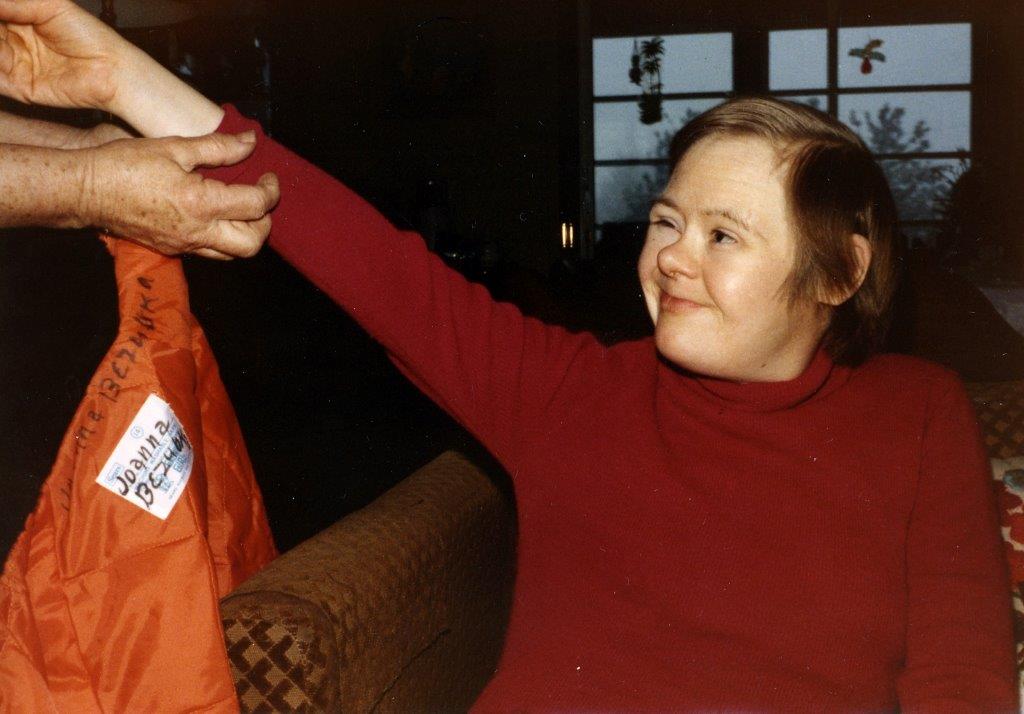
Playing the shirt-sleeve cuffing game
Mavridis also speaks frankly about his own quadruple coronary artery bypass operation, which happened in the same year as the sexual assault, and the effect of his temporary incapacitation on Joanna. He also details Joanna’s physical and mental decline beginning in 2008, when she developed Alzheimer’s Disease, a condition which afflicts nearly all people with Down syndrome as they age.
Mavridis relates how sad it was for him to watch Joanna’s limited ability to communicate disappear in her final four years. She stopped tearing paper and she stopped playing with Legos and handing them out as tokens. Mavridis nevertheless was determined to make her life as comfortable as possible and bought special lift equipment for her as well as a special hospital bed and recliner.

“I bet I blinked first,” Mavridis says of this photo.
Near the start of his book, Mavridis includes a short article by a writer, Emily Perl Kingsley, about what parents go through when they first learn that their child is intellectually disabled. “When you’re going to have a baby, it’s like planning a fabulous vacation trip to Italy,” Kingsley writes. Instead, the plane lands in Holland.
“The important thing is that they haven’t taken you to a horrible place,” Kingsley continues. “It’s just a different place, so you must go out and buy new guide books and you must learn a whole new language…but after you’ve been there for a while…you begin to notice that Holland has windmills; Holland has tulips; Holland even has Rembrandts.”
“Joanna, God’s Special Child” is the story of a wonderful journey to Holland for Mavridis and his family, and of their discovery of the windmills, tulips, and Rembrandts there.
Massachusetts lags in criminal background checks for caregivers to disabled
While the Patrick administration appears to support national criminal background checks for people hired to care for the intellectually disabled, the administration has failed to apply for federal grant funding that would help it design a federal background check program.
The administration also does not seem to have aggressively pursued proposed legislation in Massachusetts that would authorize national background checks of people hired to work in the Department of Developmental Services system.
This is an administration that has been nothing short of enthusiastic about closing state-run care facilities and moving the residents in them to community-based group homes. But as far as protecting those people from abuse and neglect in the community system is concerned, the administration’s level of enthusiasm seems to drop off sharply.
National background checks involve matching a job applicant’s fingerprints against a federal database maintained by the FBI. This table I compiled shows how each state compared as of 2008 regarding national background check requirements, and which states have taken advantage of federal grant funds available since 2010 to design a national background check program.
As the table shows, Massachusetts was one of 16 states as of 2008 that had no national background check requirements. (The information is based on a survey by the National Conference of State Legislatures.) It is still the case today that Massachusetts requires only in-state criminal background checks of people hired to work in the DDS system.
As the table also shows, Massachusetts is among as many as 27 states that haven’t applied for the grants that have been available from the Centers for Medicare and Medicaid Services under the Affordable Care Act “to design comprehensive national background check programs for direct patient access employees.” A total of 23 states and Puerto Rico have been awarded a total of $53.4 million in those grants, which have been as high as $3 million per state.
Every advocacy group for the disabled that I know of agrees that state-only background checks are not sufficient in screening applicants seeking jobs in caring for the disabled because those checks turn up only convictions for criminal activity in that state. The checks do not identify criminal convictions that a job applicant might have from another state.
In testimony to the state Legislature’s Judiciary Committee last month, State Representative Martin Walsh stated that the state Disabled Persons Protection Commission had identified 1,000 cases in which “criminal abusers” were working in Massachusetts, and that one out of five of them had come from outside the state.
I contacted the Massachusetts Executive Office of Health and Human Services and the Department of Developmental Services regarding the federal grant program, and received a response from Victor Hernandez, a deputy assistant DDS commissioner. Hernandez stated in an email that the state has not applied for a CMS grant because Rep. Walsh’s legislation authorizing national background checks by DDS is not yet in place. Once such legislation is enacted, Hernandez wrote, “we will pursue the federal dollars.”
That sounds reasonable enough except that under the grant rules, the state is not obliged to wait for enactment of a national background check statute before receiving the funding. In an online FAQ about the grant program, the CMS states that in cases in which “necessary state legislation is not in place prior to the start of the grant period,” CMS would “work with the state to identify a portion of the potential grant funds that would be available immediately and additional funds that may be available at a later time when the additional authority is in place.”
I also received an email from CMS, which stated that there are a number of states “that have been in the (national background check grant) program for several years and have yet to be successful in implementing state laws.”
I wrote back to Hernandez to ask if the Patrick administration has worked with CMS to identify a portion of the grant funds that might be immediately available to the state. I haven’t yet heard back.
It’s not only the administration that can’t seem to get excited about protecting the developmentally disabled from abuse and neglect. The Legislature as a whole doesn’t seem to have an attitude that is much different in that regard.
As I’ve previously noted, Walsh’s proposed national background check legislation for new workers in the DDS system has been stalled for a number of years in the Legislature. Last year, the Legislature did pass a bill to implement a national background check requirement for people hired to work in public and private school systems in the state. Massachusetts, however, was reportedly the last state in the nation to enact a national background check for school personnel.
This year’s national background check bill for DDS system workers (H. 1674) was filed by Walsh in January and referred to the Judiciary Committee at that time. The committee only got around to holding a public hearing on it on July 9, and still has not acted to approve the measure.
Walsh noted in his testimony to the Judiciary Committee that his bill had been approved twice in the past two years by that committee only to be sent to the House Ways and Means Committee to die a slow death.
That the developmentally disabled are subject to abuse and neglect in the community system of care is hardly disputed by anyone who looks at the matter objectively. The VOR has cited an “alarming number” of deaths and cases of abuse of developmentally disabled individuals around the country, and noted the “prevalence of preventable deaths at privately run group homes across this nation.” Community-based care, which is primarily delivered in widely dispersed group homes, is by definition harder to monitor and oversee than care delivered in larger congregate-care settings.
But whether abuse, neglect, or misappropriation of funds occurs in the privatized or state-run systems of care, the federal CMS has recognized those three issues as “a widespread problem for millions of Americans receiving LTC (long-term care) services.”
Let’s hope that both the Patrick administration and the state Legislature begin soon to place a higher priority on finding a solution to those problems. The administration could show it is placing a priority on addressing abuse and neglect, at least, by applying immediately for a CMS grant to design a workable national background check program in Massachusetts; and the Legislature could begin by acting as quickly as possible to pass Rep. Walsh’s national background check bill.
Making care for the disabled a zero-sum game
There is no question that Massachusetts is facing budget problems that are making it increasingly difficult to fund services for our most vulnerable citizens, particularly those with intellectual and other disabilities.
One thing we shouldn’t do in this situation, though, is try to help one group at the expense of another. That, in our view, is what two pieces of proposed legislation now before the Children, Families, and Persons with Disabilities Committee would do.
Both bills were the subject of a public hearing last week before the committee. I wanted to testify about both of them, but they were way down on the committee’s hearing list. After waiting two and a half hours to testify and then realizing by that time that almost all of the legislators on the committee had left, I left the hearing without testifying publicly and submitted my remarks in writing to the committee staff the next day.
I’ve already written several times about one of these two bills – the ‘Real Lives’ bill (H. 151), though not specifically about how it would potentially divert funding from intellectually disabled people living in state-operated group homes to corporate providers that contract with the Department of Developmental Services. I’ll get to that in a bit.
Early on in last week’s hearing, I first found out about the other bill, which was filed by state Representative Tom Stanley at the behest of the Association of Developmental Disabilities Providers (ADDP), the lobbying organization for those same state-funded, corporate providers.
Stanley personally appeared before the Children and Families Committee to promote the ADDP bill (H. 156), which would require that at least half of the “savings” in closing state-run DDS developmental centers be used to fund programs run by corporate providers. (Legislators don’t have to wait to testify at committee hearings, but are given the floor when they show up.)
Specifically, Stanley’s bill would require that “not less than 50 percent” of those developmental center closure “savings” be used to “fund and implement Chapter 257 of the Acts of 2008.”
What is Chapter 257 of the Acts of 2008? As the ADDP notes, it is a statute that provides for “standardization and adjustment for rates to contracted human and social service providers.” In other words, it’s intended to adjust state payments to the group home providers upwards. Last January, the ADDP was anticipating that the administration would provide up to $175 million in funding in the current-year budget to implement Chapter 257.
As the ADDP put it on their website:
After waiting for nearly 25 years, developmental disability programs (read “the providers”) may finally see their prayers answered with Governor Deval Patrick’s FY 14 House One Budget….
An administration document posted by the Providers’ Council, another provider lobbying group, last January indicated that the governor had proposed that at least $53 million in Chapter 257 funding go directly to the provider residential line item in the DDS budget in the current fiscal year.
The ADDP’s and the Providers’ Council’s prayers, however, were apparently not fully answered. The total proposed Chapter 257 funding apparently did not materialize in the final budget for the current fiscal year. The provider residential line item in the final budget, as approved by the Legislature, is $13.1 million less than what the governor proposed in January.
In a July 2 recap of the final FY 14 budget, the Arc of Massachusetts, a close ally of the ADDP and the Providers’ Council, stated that the organization was hoping for passage of a supplemental budget this year “to fully implement Chapter 257 in Residential Services for 2014.”
But what if such a supplemental budget is not forthcoming? Maybe that explains the need for Rep. Stanley’s bill. Because the Legislature was apparently not willing to put the amount of additional money into the provider group home line item that the ADDP, the Providers’ Council, and the Arc were seeking, the ADDP figured they could get it from somewhere else. That somewhere else is apparently the developmental center closure “savings.”
While we would dispute that there has actually been any savings in closing the developmental centers, what has occurred is that the developmental center line item in the DDS budget has been cut by some $80 million since FY ’09, when the administration first announced it planned to close four of the centers.
It seems the funding cut from the developmental center line item has gone in the past five years to the state’s General Fund, rather than being plowed back into the provider-run, community-based system, as the administration had originally promised. However, at least some of that money has been transferred back from the General Fund to both the state-operated and provider-run group home accounts.
As the developmental centers have been closed, a large percentage of the former residents has been moved primarily to one of two remaining developmental centers and to state-operated group homes. The state-operated group home line item has thus been increased by about $41 million since FY ’09, largely to accommodate that influx of residents. The provider-run group home line item has been increased by some $230 million in that time.
So, now we have Rep. Stanley’s bill, which says, as we understand it, that at least 50 percent of the funds cut from the developmental centers must be directed to fund Chapter 257. Given that passage of this bill would result in a significant increase in funding for the providers (or else why would the ADDP want this bill filed?), what does that mean for the state-operated group homes? There is only a finite pot of money involved. Funding for the state-operated group homes would potentially have to be cut.
We know that the state-operated residential facilities are struggling in Massachusetts. These facilities are required under court order to provide care for most former developmental center residents that is equal or better to the care they previously received. Although funding has been increased to the state-operated group homes, the increase this year was significantly less than what the administration projected was needed.
These are among the questions I posed in a phone call on Thursday to Rep. Stanley. In filing his bill on behalf of the ADDP, did he understand the full implications for the state-operated group homes, in particular, and the level of services the residents in them would continue to receive?
Stanley responded that he believed his bill would “help both the state-operated and provider-operated group homes.” He said it was his understanding that Chapter 257 would boost funding to most, if not all, DDS line items and that he would get back to me to confirm that. I’m waiting for his follow-up call.
As I noted to Stanley in an email following our Thursday phone call, there are many documents online about Chapter 257, and they indicate, as I’ve noted above, that Chapter 257 was intended and drafted to fund purchase-of-service programs only, not state-operated programs.
For example, there is that administration document posted by the Providers’ Council, linked above, which shows the proposed $53 million in Chapter 257 funding going into the provider residential line item in the DDS budget. While some of the Chapter 257 funding would go to other agencies in the Executive Office of Health and Human Services, nothing in the document indicates that any of the Chapter 257 funding would go toward the DDS state-operated group homes. Chapter 257 is clearly targeted toward contracted services obtained from corporate providers to DDS and other EOHHS agencies.
So, how much money are we talking about in diverting 50 percent of the funding cut from the developmental centers to the providers? In the current fiscal year, it appears the developmental center line item has been cut by $10.8 million from the previous fiscal year. Fifty percent of that figure would be $5.4 million.
As noted above, the final FY 14 budget provided $13.1 million less in funding for the provider residential line item than did the governor’s budget proposal. Thus, if Rep. Stanley’s bill is passed, it would seem the providers would get back some $5.4 million – or about 41 percent – of the amount the Legislature had cut from the governor’s proposal in the current fiscal year. Not the whole ball of wax, but it would reduce the amount that would be needed in that hoped-for supplemental budget to satisfy the providers.
It turns out, though, that Rep. Stanley’s bill was not the only piece of legislation heard by the Children and Families Committee last week that would divert funding from the developmental centers to the providers. There’s also the Real Lives bill, proposed by Rep. Tom Sannicandro. While I was there, a long line of legislators testified in favor of that measure, which is intended to give all DDS clients more choice in services. The Real Lives bill happens to state that 40 percent of the “savings” in closing at least three of the developmental centers must be directed to a fund that would support “self-directed services,” presumably for all DDS clients.
As I’ve previously pointed out, the Real Lives bill specifies a large role for the providers in establishing that self-directed services fund. And one of the purposes of the fund would be to subsidize providers who lose funding when their clients leave their facilities for facilities run by other providers.
So, between these two bills (proposed by Reps. Sannicandro and Stanley), it would seem that at least 90 percent of the funding cut from the developmental centers would be earmarked for specific funds or line items that would help the providers, in potential competition with the state-operated group homes and other DDS accounts. Ninety percent of the $10.8 million cut from the developmental center line item in the current fiscal year totals roughly $9.7 million. Now, we’re talking about the providers getting back $9.7 million – or almost three quarters – of the amount the Legislature had cut from the governor’s proposed funding for provider-run group homes.
To be clear, we support adequate funding of provider-run group homes and thus we support full funding of Chapter 257. But we don’t support that funding increase coming at the expense of the state-operated group homes or other DDS line items. Robbing Peter to pay Paul should not be the solution to the problems the administration is facing in providing care to everyone who needs it.
‘Real Lives’ bill proponents are abandoning the democratic process
It appears the supporters of the flawed ‘Real Lives’ bill are trying an end-run around the normal democratic process for getting bills enacted in the state Legislature.
Their latest strategy has been to insert the language of the proposed legislation into the state budget bill for the coming fiscal year via an amendment process that does not require any recorded votes or public hearings. The fate of the proposed legislation therefore will now be decided as part of the closed-door horse-trading that is going on among the six members of a House-Senate conference committee on the budget.
I’ve written before about our concerns with the Real Lives bill, which is intended to give clients of the Department of Developmental Services more choice in the services they receive. While we support the overall concept of the bill, our concerns about it center around provisions that we believe are primarily intended to benefit corporate providers to DDS. As we see it, one of those provisions will essentially compensate providers for not providing services.
The prime sponsor of the bill, Representative Tom Sannicandro, has tried without success in recent years to get the bill enacted through the normal legislative process. That process of course involves first referring the measure to the appropriate legislative committee (or committees).
The appropriate committee — in this case, the Children, Families, and Persons with Disabilities Committee — would then schedule the bill for a public hearing and vote the measure up or down. If approved by the committee, the measure would ultimately be voted up or down by the full membership of the House and Senate, whose votes on the measure would be recorded.
Last year, the Real Lives bill was passed by the House, but the Senate declined to take it up, so it died at the end of that session as a result. We first expressed our concerns about the provider-friendly provisions of the bill to Sannicandro during the debate on it last year.
Unfortunately, when Sannicandro re-introduced the bill (now H. 151) at the start of the current legislative session in January, he made no changes to it, despite our concerns. The corporate-friendly provisions were all still there.
The bill was duly referred on January 22 to the Children and Families Committee. To date, the committee has not scheduled the bill for a public hearing. I called the committee this week to ask why no public hearing had yet been scheduled and was told it was because Sannicandro had asked that a hearing on the bill not be scheduled because the language in the bill was being proposed as a budget amendment.
Sannicandro’s budget amendment was in fact adopted by the House during its budget deliberations in April, meaning the House leadership agreed to put the amendment in the “yes pile” of amendments approved as a bloc by an unrecorded voice vote on the House floor. However, an identical amendment was subsequently placed by Senate leaders in the “no pile,” meaning it got rejected in that chamber by a similar unrecorded voice vote. As a result, it’s now up to the conference committee to decide whether the Real Lives bill lives or dies.
We don’t think the “yes pile” and “no pile” process used in the House and the Senate for deciding budget amendments is a particularly good or democratic one. We understand the rationale for it is that it saves a lot of time taken up by debate on budgetary issues — something we understand used to occur in the distant past in the Massachusetts Legislature.
But while there may be a valid rationale for taking up budget-related amendments in blocs that are not subject to debate or recorded votes, we don’t think that rationale applies to something like the Real Lives bill. The Real Lives bill is intended to make far-reaching changes in the way services are delivered to people with developmental disabilities. It appears to be only marginally a budgetary measure, and that’s only because of the special fund it sets up to compensate providers for not providing services.
For that reason, we wrote to Sannicandro yesterday, urging him to prevail on the conference committee not to adopt his bill, but to let the measure take the normal, democratic course in the Children and Families Committee. We think that’s the right way to go on this important issue.
Thousands falling through the cracks in the DDS system
Lauren Baletsa has Prader-Willi Syndrome, a genetic defect that causes such a strong compulsion to overeat that she forged her father’s signature on checks to buy food.
Baletsa was one of dozens of people who testified on Tuesday before the Legislature’s Children, Families, and Persons with Disabilities Committee in support of proposed legislation that would require the state to provide services to people with Prader-Willi and other developmental disabilities.
Many people with these disabilities have cognitive impairments and autism, leaving them unable to function normally or adequately in society. However, many of them have IQs that are just above the cutoff level to qualify for services from the Department of Developmental Services.
In testimony before the Committee, Rick Glassman of the Disability Law Center maintained that Massachusetts appears to be the only state in the nation that does not grant eligibility for services unless the individual has an intellectual disability as measured by an IQ score.
Glassman said research done by the DLC indicates that every other state provides services based on at least some additional measures of disability such as substantial functional limitations or designated impairments such as autism. “I hope I’m wrong about that and am missing something,” Glassman said. “But if so, I can’t figure out what it is.”
Glassman and other advocates, including COFAR, noted that DDS’s restrictive eligibility standard for services has left thousands of people in the state without services of any kind. COFAR has joined the DLC, the Arc of Massachusetts, the Aspergers Association of New England and other organizations in urging support for legislation (H.B. 78 and similar measures) that would require DDS to provide services to people with developmental disabilities and not just “intellectual disabilities.”
As Glassman and others pointed out, just because someone has an IQ higher than 70 (the DDS’s approximate cutoff level for providing services) does not mean that person is high functioning or able to complete even basic tasks such as dressing or bathing without assistance.
Awilda Torres is a case in point. She testified Tuesday that her son Carlos, 22, who has autism, was recently riding in a van when he jumped out while the van was moving, ran to a policeman and insisted he had been kidnapped by the driver. Carlos’s IQ, Torres said, is just above the DDS cutoff point for services.
Other parents of autistic adults testified that while services and even state-supported day and work programs were available to their children before they turned 22, those programs ceased once the children reached that age. At the age of 22, people with intellectual disabilities in Massachusetts, who had been receiving special education services through local school districts, must enter the DDS system with its more restrictive eligibility standard.
Karen Kadzen-Pandolfi testified that her son, who is now 23, lost his services a year before because his IQ was measured at 71. He has a problem with aggression and violent behavior. As a result, she must now stay home from her job to care for him. “My life is on hold,” Kadzen-Pandolfi said. “I keep searching for an answer, but there are no answers.”
Delivering COFAR’s testimony, I noted that the public is largely unaware of the severity of these developmental disabilities and of the fact that so many people are not receiving any services to cope with them. Tuesday’s hearing at the State House was not covered by any mainstream media outlets nor was a similar hearing last November in Worcester that had been held by DDS to consider proposed regulations regarding its IQ eligibility standard.
State audit confirms salary overpayments to DDS provider
The state improperly reimbursed the May Institute, a corporate provider to the Department of Developmental Services, for hundreds of thousands of dollars paid to company executives in excess of a regulatory cap on their salaries, according to the state auditor.
The auditor’s findings confirm concerns we raised in April and May 2011 that the state may have paid Walter Christian, the CEO, and other executives of the May Institute more than the state’s approximately $143,000 regulatory limit on individual executive salaries.
The auditor also found that Christian was improperly paid roughly $140,000 for a home health aide for his wife, day care fees for a grandson, the use of a minivan in Georgia, and a separate vehicle that he used when visiting Massachusetts. Christian, who retired in January, had been living in Georgia for a decade while running the Massachusetts-based company, according to the audit report.
Our blog posts in 2011 specifically noted that the May Institute appeared to be under-reporting Christian’s and other executive salaries as well as the number of people receiving those salaries, on Uniform Financial Reports (UFRs) submitted to the state Operational Services Division.
The two posts also noted that the same under-reporting of salaries appeared to be the case with Vinfen and Seven Hills, two other DDS providers. The state auditor focused solely on the May Institute, however.
The state auditor’s report noted that a state regulation capped state reimbursements to providers for salaries and other compensation paid to their executives at $143,986 in FY 2010 and $149,025 in FY 2011. Providers can pay their executives more than those amounts in salaries and other compensation, but the state is permitted to reimburse the providers only up to the threshold amount in a given year. The state attempts to keep track of those payments via the UFR’s, which the providers are required to submit to the Operational Services Division on a yearly basis.
We noted in our April 2011 post that the May Institute’s UFR listed only Christian and one other executive as making over the state salary threshold in 2009. Yet, a federal tax form, which was filed by the May Institute with the IRS for the same fiscal year, listed 13 individuals in the company as making over $150,000 each.
An OSD official maintained at the time that the state agency allows the state to pay costs in excess of the salary limit for clinicians working for providers. However, COFAR’s May 2011 post noted that all 13 May Institute employees who made over $150,000 were not listed on the IRS form as clinicians, but as executive-level employees, starting at senior vice presidents on up to the president and CEO.
In its report, the state auditor also found that several May Institute employees who were paid over the threshold amounts were managers and not clinicians.
We think this report by the state auditor lends strong support to our call for a comprehensive, independent study of outsourcing of care by DDS. The auditor’s findings also support the need for more funding for state-operated group homes for the developmentally disabled as an alternative to provider-operated residences.
But as I noted in a previous post, House leaders last month rejected budget amendments that would have both authorized a study of the DDS system and restored cuts made by the House Ways & Means Committee in the governor’s budget for state-operated residences. There is one more chance for these amendments coming up in the Senate, of course.
We applaud the state auditor for examining the May Institute’s payments to its executives. We hope, though, that Auditor Suzanne Bump expands her review to include additional providers in the wake of our concern that this is a potentially wider problem than just one company.
 COFAR blog