Archive
Couple with disabled son who complained about second-hand cigarette smoke in their apartment are facing possible eviction
A couple that complained that second-hand cigarette smoke from another unit in their Kingston housing complex was harming the health of their disabled son are facing the possibility of eviction from their apartment.
Nicole and Cang Duong have accused the Alexan Kingston housing complex management and its attorneys of delaying their application for a state program that would help them keep up with their monthly rent.
As a result, Nicole Duong said, their RAFT rental assistance application expired on July 13, increasing their chance of eviction. They reapplied for the assistance on Monday (July 17).
The Duongs maintain that even though they took the proper steps to obtain rental assistance, they may still face eviction because of the application processing delay.
We reported on July 5 that the Duongs had complained to the management in May of a cigarette smoke odor that was coming from the air ducts in their apartment. Their 3-year-old son Caleb has Down Syndrome and severe obstructive sleep apnea. Cigarette smoke is particularly dangerous to his health, Nicole said.
Nicole said that while the housing complex management did subsequently inspect the ventilation system in their apartment and placed filters in the air ducts in response to their concerns, the management never sent anyone to their unit to investigate the origin of the alleged cigarette smoke. Yet, the complex has a strict no-smoking policy that applies to all areas, inside and outside.
In fact, the management suggested that the Duongs themselves should move out of the complex. The Duongs believe this is a violation of federal and state fair housing laws, which forbid discrimination against persons with disabilities.
Management’s lawyers allegedly “dragged their feet” in approving a rental payment plan
Nicole said she and her husband had been struggling to pay the rent on their apartment, and first applied for the RAFT assistance on June 7. She said that in compliance with the RAFT rules, they did not pay their June or July rent while the original RAFT application was being processed.
The Duongs’ monthly rent for their two-bedroom apartment, which is classified as an affordable rental unit, is $2,256.
Nicole said the approval of the RAFT assistance by the state Department of Housing depended on the family reaching agreement with the Alexan Kingston management by July 13 on a payment plan for two months’ worth of back rent.
Emails show that the Housing Department repeatedly asked Nicole earlier this month to provide a signed rental payment agreement under which the Duongs would pay $903 toward the overdue rent, and the RAFT program would pay the remainder of the $4,512 in back rent.
The first request from the Housing Department for the agreement was on July 6. An email from the Department to Nicole stated that the agreement must be submitted by July 13 “or your application process will be discontinued, and you will need to begin the application process again.”
Nicole said that while she provided the suggested RAFT agreement amount to the apartment management, the management turned the matter over to its law firm, and the law firm didn’t immediately respond. Emails show Nicole asked the apartment management and their attorneys for a copy of such an agreement on July 10 and July 11.
On July 10, the Alexan Kingston resident manager responded to Nicole, saying that he had contacted the management attorneys “to follow up on this item for us. I’ll touch base with them tomorrow as I know it’s very time sensitive.”
On July 11 at 4:53 p.m., still not having received a proposed agreement, Nicole emailed a member of the law firm, saying the RAFT application was scheduled to “time out” or expire two days later, and that a response from the management “needs to be done ASAP.”
The law firm finally sent an email with the proposed agreement to the Duongs at 7:10 p.m. on July 12, the day before the expiration of the original RAFT application. Nicole maintained that the law firm’s proposed agreement was unacceptable to them, but that it was too late in the day to contact either the management or the law firm about it.
Management’s proposed agreement included extra charges
Although the Duongs owed $4,512 in back rent, the law firm’s proposed agreement would require them to use their RAFT assistance to pay a total of $5,183, including $293 in “court costs” and $378 in “utilities/fees” as of next February 28.
Nicole contends there is no reason for her and her husband to pay court costs because the payment agreement should not require Housing Court involvement. In addition, she said, the utilities/fees cost was not explained in the proposed agreement.
The proposed agreement specified a periodic monthly payment schedule for the Duongs of $115 in addition to their monthly rent payments. The agreement stated that any late payments would constitute a material breach, which would allow eviction proceedings to begin in seven days. The Duongs would also waive their rights to an appeal or trial in the Housing Court.
Nicole said the proposed agreement would shorten the usual eviction notice period from 30 days to those seven days. She also said she and her husband would not want to sign away their right to take their case to the Housing Court.
Waiting for Section 8 placement since 2020
Even though their apartment is classified as affordable, the Duongs said they have been on a waiting list in Massachusetts for a Section 8 housing voucher since 2020.
Nicole said their rent constitutes 65% of their total income from her husband Cang’s job. She said her husband works overnight from 6 p.m. to 6 a.m., and that she needs to stay home to care for her son.
“I’m at the point of a nervous breakdown because I don’t want to lose our home,” she said.
We previously wrote to the housing complex management to urge them to fully investigate complaints from the Duongs and other residents of cigarette smoke odors in their apartments. We have now written them again to urge them to commit to reaching a timely payment agreement with the family that will cover their rental costs only.
We hope the apartment management will work to ensure that this family is not forced into homelessness.
Parents battle housing complex over effect of second-hand smoke on their disabled child
For more than a month, Nicole and Cang Duong smelled cigarette smoke in the ventilation ducts in their apartment in a housing complex in Kingston.
They were concerned about it mainly because their 3-year-old son Caleb has Down Syndrome and severe obstructive sleep apnea. Cigarette smoke is particularly dangerous to his health.
On May 24, Caleb needed three major surgeries – tubes inserted in his ears, and his tonsils and adenoids extracted. The cigarette smoke odor was evident while he was back home recovering, Nicole said.

Nicole, Caleb, and Cang Duong.
Nicole said that while the housing complex management did subsequently inspect the ventilation system in their apartment and placed filters in the air ducts in response to their concerns, the management never sent anyone to their unit to investigate the origin of the alleged cigarette smoke. Yet, the complex has a strict no-smoking policy that applies to all areas, inside and outside.
In fact, the management suggested that the Duongs themselves should move out of the complex. The Duongs believe this is a violation of federal and state fair housing laws, which forbid discrimination against persons with disabilities.
Housing discrimination includes failing or refusing to make reasonable accommodations for tenants with disabilities, according to the Massachusetts government website.
Cigarette smoke believed to be coming from unit above
The Duongs moved into the Alexan Kingston housing complex on March 18. Their apartment is classified as an affordable rental unit.
Nicole said new people moved into the unit directly above them on May 13. She said almost immediately, she and her husband began to smell cigarette smoke in their bedroom and then in the living room. Then their oldest son, Joseph, who is 19, smelled it in his bedroom.
Nicole said that on May 13, she first texted the management about the smoke odor. On May 16, after some initial correspondence, the management sent a text to the Duongs suggesting they consider moving out of the complex:
Based on the information and concerns you just provided…we are concerned that maybe the Alexan Kingston (housing complex) may not be the best residence for you and your family. We are happy to discuss a lease-break option with you if you decide our apartment community does not meet the needs of your family.
On May 23, Nicole responded in an email to the management, stating that they did not intend to leave the complex, but that they wanted an immediate transfer to another unit within the complex. She stated that in the meantime, she was requesting that the air ducts in their unit be cleaned. That was the day that she and her husband took Caleb to the hospital for the surgeries.

Caleb playing at home.
On May 26, the management did send a maintenance man to inspect the apartment’s air ducts. He found there were no filters in those ducts, and installed some. This was the day after Caleb had come home from the hospital.
At the end of June, Nicole said, the management transferred the upstairs occupants to another apartment in the complex for unspecified reasons. The smoke odor is now gone. But Nicole said she and her husband remain concerned that the problem could happen again.
Contradictory messages from management and attorney
Nicole said that after she requested the transfer to another unit, Jefferey Turk, the management’s attorney, asserted in a June 7 letter to the Duongs that they had failed “to provide any basis for the request to transfer (to another apartment in the housing complex). Your email does not identify any reason you require a transfer or any nexus between any conditions which your son may have and his need to reside elsewhere on the property. As such, until we receive such information, the request cannot be granted.”
At the same time, Turk’s letter seemed to contradict that statement. Its final paragraph started:
Notwithstanding the foregoing, and in an attempt to resolve this matter, my client is willing to offer you a transfer to the next available apartment which is assigned to the affordable housing program and for which you qualify. You will be responsible to move yourself to that new apartment when it is available.
Nicole said that on June 28, another attorney with the management’s law firm texted her, also saying the Duongs would be allowed to transfer to another apartment in the complex. But the attorney stated that in order to do so, the Duongs would have to pay “prorated rent” for the new unit in addition to the full monthly rent on their current unit.
Nicole said she and her husband rejected that offer because it would amount to paying up to half a month of rent for the new unit as of the move-in date, plus the full month for their current unit. She said they are hopeful, for the moment, that they will not need to transfer because the upstairs tenants, who apparently created the odor problem, are no longer there.
Management attorney’s letter appeared to ignore Duongs’ evidence
Turk also maintained in his June 7 letter that the Duongs had not demonstrated that their son is actually disabled. Yet Nicole said they had fully documented their son’s disabilities. Nicole forwarded to us a letter from the state Department of Developmental Services (DDS), which she said she had sent to Turk and to the management. The DDS letter, which was dated June 2, stated that Caleb had met the Department’s eligibility criteria for services to children under five years old.
Also, the Duongs noted that Turk’s June 7 letter itself referred to a report the Duongs had provided him from Quincy Pediatric Associates. That report stated that Caleb had been diagnosed with Trisomy 21, a genetic condition that causes Down Syndrome. The pediatric report also stated that Caleb had been diagnosed with severe obstructive sleep apnea.

Caleb in the ICU after his surgeries in May.
Noise problem
Nicole said there also was a noise problem from the unit above, which disturbed Caleb. He woke up crying one night due to loud, continuous banging or stomping from that apartment. The noise continued from that Friday through Sunday night, and periodically after that.
Nicole said no one from the management office ever came to their apartment to investigate either for the smoke or noise.
No outside investigation
The Duongs said they were unsuccessful in getting any outside authorities to investigate the alleged cigarette smoke odor. The federal Department of Housing and Urban Development (HUD), which manages their affordable rent application, took preliminary information from them about the cigarette odor. But the federal agency closed out the case after 30 days, also without anyone having visited their apartment, Nicole said.
We have written to the management company to urge them to fully investigate complaints from residents such as the Duongs. It is unfortunate that rather than doing such an investigation, the management simply implied that the Duongs should consider leaving. Moreover, we requested that if the Duongs do request a transfer to another apartment, the management should not add an excessive “prorated” rental charge on the new unit.
It is disappointing that both management entities and oversight agencies, such as HUD, which are entrusted with providing housing to persons, many of whom have disabilities, often appear to be indifferent to the wellbeing of the people living in their residential facilities.
Harvard researcher looks for the key to understanding the link between Down syndrome and Alzheimer’s disease
The link between Down syndrome and Alzheimer’s disease has become the subject of increasing scientific interest, and a major new study is seeking to shed further light on that connection.
Dr. Florence Lai of Harvard University, McLean Hospital in Belmont, and Massachusetts General Hospital, is the lead Massachusetts investigator in a multi-center, five-year study funded by the National Institutes of Health.

Dr. Florence Lai
In an interview with COFAR, Dr. Lai said the study is seeking “biomarkers” that may predict the onset of Alzheimer’s disease and enable researchers to learn more about Down syndrome. It is intended to be “the most comprehensive study of the links between Down syndrome and Alzheimer’s disease up to this point.”
Lai and her colleagues, Dr. Diana Rosas, a neurologist, and Dr. Margaret Pulsifer, a psychologist, are in charge of the Massachusetts portion of the study.
While the average person with Down syndrome develops symptoms of Alzheimer’s disease in their early 50’s, some may not develop the dementia until the age of 70, and a very few escape it altogether.
“The study seeks, among other things, to learn the reasons for that variation,” Dr. Lai said.
The Massachusetts General Hospital’s facility at the Charlestown Navy Yard is one of seven sites around the country and England that are coordinating their research efforts as part of the study. The other sites include Columbia University (New York City), the University of California Irvine, the University of Pittsburgh, Cambridge University (UK), the University of Arizona (Phoenix), and the University of Wisconsin (Madison).
The NIH study represents a natural progression in Dr. Lai’s clinical practice and research. Over several decades, she has evaluated and followed some 750 individuals with Down syndrome, including Joanna Bezubka, a cousin of COFAR Board member and former president, George Mavridis. In 2013, Mavridis published a compelling memoir about his experience in caring for Joanna, who died of Alzheimer’s disease in 2012 at the age of 60.

George Mavridis and Joanna Bezubka on Joanna’s 60th birthday. Joanna, who had Down Syndrome, died in 2012 at the age of 60 of Alzheimer’s Disease. She had been one of Dr. Lai’s clinical patients.
In a recent letter to Mavridis, Lai said that her hunch that women with Down syndrome who developed menopause early were more likely to develop Alzheimer’s disease earlier, led to an earlier multi-year NIH study by a colleague who proved the hypothesis.
Another hunch of hers that immunological factors in Down syndrome might be involved in Alzheimer’s disease is now the subject of intense scientific interest with many researchers concentrating on neuro-inflammation as a causative factor.
Those avenues of inquiry “may pave the way to think outside the box for potential treatments for AD (Alzheimer’s disease),” Lai wrote to Mavridis.
In her interview with COFAR, Dr. Lai said scientists have discovered that people with Down syndrome are genetically predisposed to create large concentrations in their brains of amyloid protein, which is connected with destruction of brain cells in Alzheimer’s disease.
The gene for the precursor of amyloid protein is located on Chromosome 21. Since people with Down syndrome have an extra copy of Chromosome 21, Dr. Lai explained, they “make the amyloid earlier and more of it. That may be the reason for the high incidence of Alzheimer’s disease in people with Down syndrome.”
In order to learn more about the impact of the amyloid protein and other potential biomarkers of Alzheimer disease, the NIH study is designed to collect a broad range of information from the participants in the study, including information on their health history, cognitive functioning, immune and genetic factors, and daily living activities. The information is obtained from cognitive testing, from blood samples that are sent to specialized labs around the country, and from caregivers of the participants.
The study also includes an MRI brain scan of the subjects and an optional PET scan (Positron Emission Tomography), which involves the introduction of a small dose of radioactive material to examine the presence of amyloid protein in the brain. Another optional part of the study includes analyzing the cerebral spinal fluid obtained from a spinal tap.
The 3-year NIH study is limited to adults over the age of 40 with Down Syndrome at three of the sites (including Charlestown) and over age 25 at the other four sites. At the MGH Charlestown site, the study involves three cycles of visits with each cycle involving two to three visits of up to five hours each. The second and third cycles each take place 16 months after the previous cycle.
Although the study was initially funded in September 2015, it took about a year to “harmonize the procedures at all the sites,” Dr. Lai said, and to receive the necessary approvals from the participating institutions including the Research Review Committee of the Department of Developmental Services in the case of Massachusetts. Lai said the researchers at the seven study sites hope to recruit up to 700 individuals to participate in the study.
Lai said that although the NIH authorized the multi-million dollar study in 2015, the federal agency recently announced that it will be forced to cut some of the funding. She noted that the study is expensive to perform. A large number of specialized personnel is needed, and doing the brain scans is “very costly.”
At the MGH site, about 20 participants have been recruited so far and have been through a preliminary visit, Lai said. They receive a modest payment for their participation. The information collected is anonymous, she said. Even the researchers analyze only coded, aggregate data.
Continuing to treat Down Syndrome patients
Apart from the NIH study, Drs. Lai and Rosas continue to clinically treat, test, and follow the life histories of patients with Down syndrome at McLean hospital. They see each patient once a year and generate neurological evaluations which are shared with caregivers and family.
Lai has collected hundreds of blood samples, some of which have been stored at a Harvard-affiliated facility at -80 degrees C. However, the samples have lain dormant for many years due to a lack of funding needed to analyze them. Lai noted that many of her colleagues have experienced the same funding frustrations, and have had to supplement federal funding with industry grants and philanthropic donations.
It was actually due to the generosity of several families of her patients, Lai said, that she herself was able to start a Down Syndrome Fund for Alzheimer Research at MGH. The Fund got a boost of several thousand dollars a few years ago when a member of the MGH Board of Directors called Lai to thank her for her care of a patient with Down syndrome whom he knew personally.
Lai said that if the Down Syndrome Fund ever does get more sizeable contributions, her “dream” is to team up with colleagues to fully analyze the stored blood samples, and “to encourage a younger generation of clinicians and investigators to devote their energies to care for and study those with Down syndrome.”
Persons interested in learning more about the NIH study at MGH can call 617-726-9045 or 617-724-2227.
Those interested in an evaluation and follow-up with Drs. Lai and Rosas at the McLean Hospital Aging and Developmental Disabilities Clinic can call 617-855-2354.
The story of a remarkable woman
I never met Joanna Bezubka, who lived at the Fernald Developmental Center for 39 years and then spent the final seven years of her life in a state-operated group home in Lynnfield.
But after reading “Joanna, God’s Special Child,” a new memoir by George Mavridis, I feel I got to know her well enough that I’m sad I never will meet her in the flesh. That’s because Mavridis, Joanna’s cousin and co-guardian, has written an account of her life that makes you realize what a truly remarkable person she was — filled with charm and humor and an independent spirit.
These are qualities that many of us would not think possible in a person with a profound intellectual disability whose vocabulary was limited to about 50 words and a small range of vocal inflections. Joanna, who had Down syndrome and the cognitive ability of a two-year-old child, died in January 2012 at the age of 60 after developing Alzheimer’s disease.
Given its title, some people might think this book comes at its subject from a religious or sentimental perspective. It is neither of those. As Mavridis explains, “God’s special children” was a description given in the 1950’s by Richard Cardinal Cushing, Roman Catholic Archbishop of Boston, to individuals with mental retardation, now known as intellectual or developmental disability.
It’s not that Mavridis rejects Cardinal Cushing’s description. Mavridis is in fact a practicing Catholic who pushed hard to allow Joanna to continue attending Mass every Sunday at the Chapel of the Holy Innocents at Fernald, long after she had left the facility as a resident. It’s that Mavridis goes so much further than Cardinal Cushing’s description in telling us who Joanna really was.

George Mavridis and Joanna Bezubka celebrate her 59th birthday
Mavridis, a former president of COFAR and The Fernald League, has chronicled Joanna’s life down to some of the smallest details in a matter-of-fact, journalistic style that is all the more compelling because it deals honestly with the major issues of her life, even some of the most difficult and painful episodes. Those episodes include a sexual assault of Joanna, allegedly by staff in a group home in which she lived, and Mavridis’s dogged pursuit of the investigation of the incident.
It’s important to note that Mavridis is a strong defender of a comprehensive system of care for people with developmental disabilities, including the availability of federally regulated Intermediate Care Facilities (ICFs) for those, like Joanna, who need or needed them. Mavridis has been a central figure in the still-ongoing effort to keep Fernald open. He is also a member of the legislative committee of the VOR, a national advocacy organization for the developmentally disabled, which, like COFAR, supports ICF-level care. As a VOR legislative committee member, Mavridis organizes visits with the health aides of the members of the New England congressional delegation.
But the purpose of Mavridis’s book is not to make a statement on one side or the other in the debate over institutional versus community care. It is rather to chronicle a person’s life and to demonstrate the necessity and effectiveness of advocacy for the most vulnerable among us.
If you are the guardian or family member of a developmentally disabled person and you are looking for help in how to cope and advocate on their behalf, I think this book will be very helpful. I think it would also be helpful to legislators and others who seek a better understanding both of who developmentally disabled people are and what is involved in caring and advocating for them.
If nothing else, this book provides a detailed set of reasons for the importance of a provision in federal law, which states that family members should be seen as the “primary decision-makers” in caring for intellectually disabled persons. As Joanna’s co-guardian and the family member most intimately involved in her life, Mavridis was an a far better position to understand her needs and to act in her best interest than the bureaucrats and even some other advocates who often claimed to know what was best for her.
There is one small but telling incident in the book that illustrates that point particularly well. Joanna was a diminutive woman — only four-foot, four inches tall — and Mavridis bought all her clothes for her. He recounts that he would occasionally hear disapproving comments from Department of Developmental Services staff members that the Disney characters on the sneakers he had bought for her were not appropriate for a woman her age. “I would respond,” he writes, “that they should go to a shoe store and look for a woman’s size 2 1/2 pump with a low heel and buy them for Joanna.”
Joanna’s mother died during a heart operation in 1966 when Joanna was 15 years old. As a result, Mavridis’s mother, Stella, became her guardian, and Mavridis himself became co-guardian in 1991. In later years, Joanna’s brother Ronald Bezubka became a co-guardian along with Mavridis; but as Ronald was living in England, Mavridis remained in charge. In Joanna’s later years, Mavridis would visit her twice a week at her group home and take her to his home in Peabody every Saturday.
Throughout, Joanna’s story is told with warmth and humor, largely because of Mavridis’s clear and obvious love for his cousin. He writes that his mother “always said that I was the brother that a girl feels she could hold under her thumb, and Joanna never let me up.”
We learn, for instance, that although Joanna’s teeth had been removed and her food had to be ground, she was a “gourmet,” who “ate very slowly and savored every morsel.” At Fernald, the staff “served her first and picked up her dishes last, so she had time to enjoy her meals.” She also liked to sip coffee all day long and always had a cup with her, which she invariably perched on the edge of the table. “Many times my mother would move it back, away from the edge,” Mavridis writes, “but Joanna wold move it back with a stern look.”
One of Joanna’s favorite games with people was to ask them to cuff her shirt sleeves. “After you did it, Joanna would straighten the sleeves and ask you to cuff them again. This exercise became endless.” Her favorite activities also included playing with Lego toys and tearing paper into ever smaller pieces. Mavridis found he was obliged to carry a supply of both Lego pieces and pieces of paper with him because Joanna liked to hand out both as tokens of friendship to anyone who came by her.
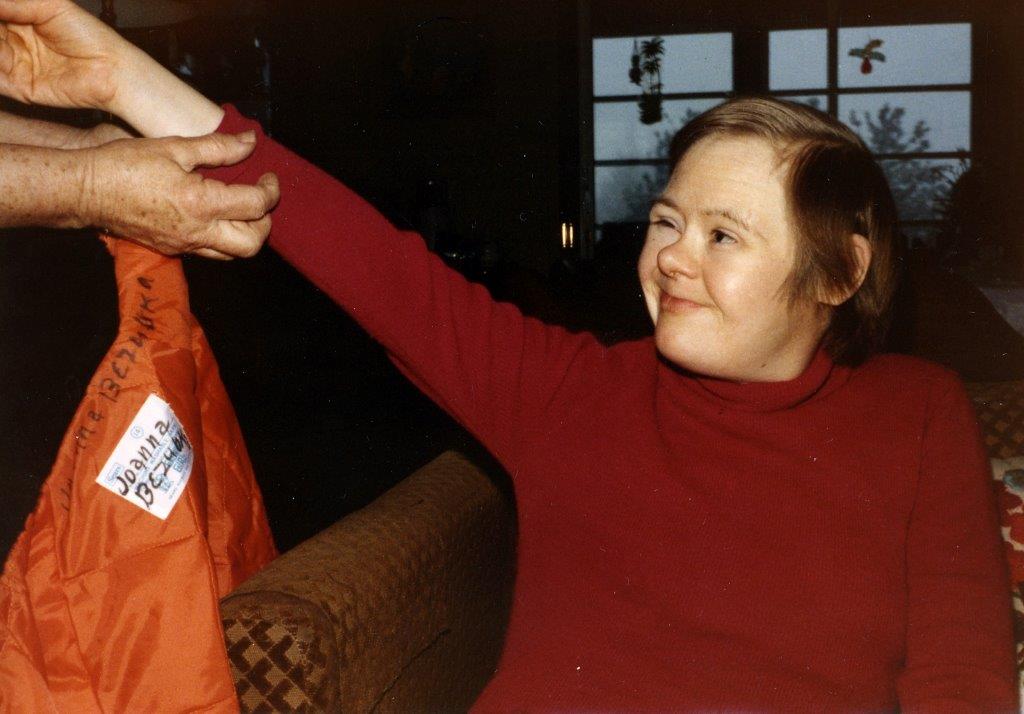
Playing the shirt-sleeve cuffing game
Mavridis also speaks frankly about his own quadruple coronary artery bypass operation, which happened in the same year as the sexual assault, and the effect of his temporary incapacitation on Joanna. He also details Joanna’s physical and mental decline beginning in 2008, when she developed Alzheimer’s Disease, a condition which afflicts nearly all people with Down syndrome as they age.
Mavridis relates how sad it was for him to watch Joanna’s limited ability to communicate disappear in her final four years. She stopped tearing paper and she stopped playing with Legos and handing them out as tokens. Mavridis nevertheless was determined to make her life as comfortable as possible and bought special lift equipment for her as well as a special hospital bed and recliner.
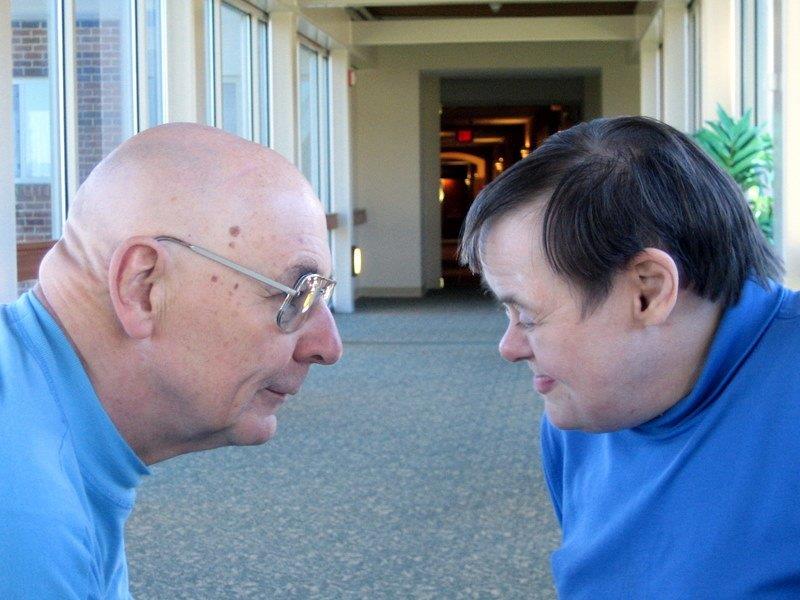
“I bet I blinked first,” Mavridis says of this photo.
Near the start of his book, Mavridis includes a short article by a writer, Emily Perl Kingsley, about what parents go through when they first learn that their child is intellectually disabled. “When you’re going to have a baby, it’s like planning a fabulous vacation trip to Italy,” Kingsley writes. Instead, the plane lands in Holland.
“The important thing is that they haven’t taken you to a horrible place,” Kingsley continues. “It’s just a different place, so you must go out and buy new guide books and you must learn a whole new language…but after you’ve been there for a while…you begin to notice that Holland has windmills; Holland has tulips; Holland even has Rembrandts.”
“Joanna, God’s Special Child” is the story of a wonderful journey to Holland for Mavridis and his family, and of their discovery of the windmills, tulips, and Rembrandts there.
 COFAR blog