Archive
Guardianship under fire by the same groups that oppose congregate care and support privatization
Guardianship of persons with developmental disabilities is under fire in Massachusetts and elsewhere, and families could see their advocacy rights eroded as a result.
One prominent threat to guardianship appears to be embodied in a process called Supported Decision Making (SDM).
Under SDM, individual guardians are replaced by teams or “network supporters,” who enter into written agreements with disabled individuals to “help them make decisions” about their care, finances, living arrangements and other areas. The network supporters can include family members, friends, and corporate service providers, according to the Center for Public Representation, which is pushing for SDM in Massachusetts.
There are some promising aspects to SDM, but a number of concerning aspects as well.
To the extent that it can or does replace irresponsible or uncaring guardians with supportive teams, SDM would appear to have a potential to improve the lives of many people.
On the concerning side, SDM does not appear to be well designed for people with severe levels of disability. Those people are most in need of the protections of guardianship; yet, many SDM advocates paint guardianship with a broad, negative brush and don’t appear to acknowledge the value that family members, in particular, bring as guardians to the lives of their loved ones.
As Jill Barker notes in the Michigan-based DD News Blog:
Many advocates for SDM state explicitly that their goal is to eliminate guardianship. Others state that this is not what they are trying to do, but their words and actions show that they intend to make guardianship as difficult to obtain as possible.
Moreover, many of those SDM advocates appear to be from the same groups that have long opposed critically important congregate-care options for the developmentally disabled, and their language in support of SDM is similar to their longstanding ideological language in opposition to congregate care. In particular, they make the same questionable charges about guardianship that they have about congregate care — that guardianship leads to “segregation,” and that all persons under guardianship are prevented from “reaching their potential.”
We believe that like congregate care, guardianship is a necessary part of the total spectrum of care, particularly for people with the most severe levels of developmental disability, and that those choices and options shouldn’t be taken away from disabled individuals and their families.
As a result, we counsel parents of developmentally disabled children to consider obtaining guardianship rights when their child reaches the age of 18. Without such rights, family members are likely to have virtually no say in the decisions that are made by providers and the Department of Developmental Services with regard to their loved ones with developmental disabilities.
In a position paper on SDM, the VOR, a national advocacy organization for people with developmental disabilities and a COFAR affiliate, contends that SDM “could weaken protections for those who are the most vulnerable, the very people for whom guardianship laws were originally written.” The VOR adds that SDM threatens “to remove an individual who lacks the capacity to make his or her own decisions from the protection of the court and ongoing evaluation.”
Similar groups and similar language against guardianship and congregate care
The CPR and similar advocacy organizations in other states favor reducing residential options and choices, particularly when it comes to congregate care, and they use similar arguments to support the replacement of guardianship with SDM.
The CPR has supported or been involved in numerous lawsuits to close developmental centers over the objections of families of residents. Their argument has been that clinical experts know better than family members about what is in the best interest of their loved ones. Those advocates also support the dismantling of sheltered workshops and the privatization of residential services for the developmentally disabled.
The CPR is now making similar questionable claims against guardianship and in favor of SDM. In a PowerPoint presentation delivered in 2014, the CPR maintained that guardianship results in “civil death” for developmentally disabled persons, and that a key principle of SDM is that “people are not inherently incompetent.”
That latter claim, which has also been made in opposition to congregate care, seems absurd to us if it means that no individual can be found to be incompetent. Laws in Massachusetts and most other states require that people be found incompetent by courts in order to be considered for guardianship. If SDM advocates believe that no one is truly incompetent, then they must believe court rulings around the country involving thousands upon thousands of people were wrong. We don’t believe it’s possible that all, or even most, of those decisions were wrong.
Nevertheless, in a law journal article, SDM-proponent Leslie Salzman includes the following statement, which includes no citation, in a footnote:
Virtually everyone has the ability to participate in the decisions affecting his or her life, with the possible exceptions of persons who are comatose or in a persistent vegetative state. (my emphasis)
The CPR does acknowledge that some things about guardianship are good. In the 2014 PowerPoint, the CPR states that guardianship “offers a form of protection and provides some safeguards against abuse,” and that guardianship “makes it clear who is the ‘decider.’” But the CPR goes on to claim that guardianship results in a “loss of legal personhood” and a loss of civil rights such as the right to marry and vote. And the CPR contends that guardianship leads to possible exploitation by the guardian.
We disagree with the CPR’s claims. First, it does not appear to be true that a person under guardianship can’t vote. According to the Handbook for Massachusetts Guardians, which is published by the Massachusetts Guardianship Association, some incapacitated persons may have sufficient capacity to marry or vote. In those cases, the guardian can seek the court’s approval for such actions.
Also, as the Massachusetts handbook notes, current state law provides a number of protections for persons under guardianship and encourages limited guardianships when possible. Among the legal protections in place now is a requirement that guardians seek court authorization to make many major decisions for the incapacitated person – for example, admitting someone to a nursing facility for long-term care. The guardianship handbook further advises guardians to act in the incapacitated person’s best interest at all times, to do what that person desires to do, and to visit them at least monthly.
While it’s true that guardians can potentially exploit incapacitated people in their care, we are not sure that exploitation is less likely with SDM. If corporate providers, in particular, are on the SDM “network” teams, then there is a potential conflict of interest involved, since providers stand to make money by advocating for more services.
Barker points out in the DD News Blog that “guardianship abuse from family members can occur,” but she draws a crucial distinction — which SDM advocates appear to ignore — between the appointment of family members as guardians, and the appointment of attorneys, corporate entities and other professionals to that role. Family members, Baker states, are far more likely to attend to the needs and wishes of their loved ones under guardianship than are corporate or state guardians “with dozens of wards.”
Barker, who is critical of the SDM movement, adds:
Although there are horrific stories about what can happen to people under guardianship, we rarely see stories about unpaid family guardians who defend their family members against agencies and individuals who, through neglect or the intentional desire to do harm or simply to save money, exploit vulnerable people with disabilities.
We’ve witnessed this type of family support in many, many cases, such as that of Stan McDonald, who stopped clinicians and providers from giving unnecessary and dangerous anti-psychotic medications to his son, Andy.
Confusing the causes of isolation
In the law journal article, Salzman brings up many of the same arguments against guardianship that the CPR and the providers have used against congregate care, including the segregation charge. But she doesn’t appear to distinguish between degrees of intellectual or developmental disability.
For instance, Salzman states that when an incapacitated person loses their decision-making power to a guardian, they experience feelings of isolation and helplessness, which leads to a further loss in functional abilities in a “vicious cycle.” But while this might be true for relatively high-functioning persons, it is certainly less true for lower-functioning individuals. And it incorrectly assumes that all guardians, including family members, act as dictators and don’t solicit or take into account their wards’ wishes.
Salzman also appears to identify the wrong causes of the isolation she refers to. She argues that persons with developmental disabilities feel isolation due to guardianship and to living in large institutions. But we have found that the isolation felt by these individuals is not due to guardianship or living in institutions, but actually to living in community-based settings.
There is often little real community integration in these privatized settings despite their being characterized as community-based. Unfortunately, there are usually few if any other choices available to guardians among residential settings because so many congregate-care settings have now been shut down and because states like Massachusetts fail to inform people waiting for residential placements of either congregate-care or state-operated sites that remain.
The lack of congregate-care options combined with the privatization of residential care appear to have actually increased the isolation of both individuals with disabilities and their families. Family-supported networking organizations have disappeared as developmental centers have been shut down. People with developmental disabilities are often trapped in group homes in which they are rarely taken out into the community.
In Connecticut, families have lately protested the planned privatization of state-run group homes, with one family filing a lawsuit to preserve their current facilities. There are huge amounts of money to be made in privatization, in particular, and families seem to get in the way of that process.
As we noted, SDM may well work for high-functioning people, but we believe there would nevertheless have to be strict controls on it. We think that means, at the least, that corporate providers should not be permitted on the SDM “network” teams.
For lower-functioning people, our concern is that even if family members enter into SDM voluntarily, they may not realize that their decision-making power may well be diluted under those circumstances. Why would a family member want to agree to be just one vote on a team when it comes to the care of a son, daughter, brother, or sister? We are all for limited guardianships when appropriate, but that team approach doesn’t make sense to us unless it is clear that the family member has the final say in all decisions.
Rather than eliminating guardianship, it would seem we should continue to work to improve the system, particularly for incapacitated individuals and their families. One reform is to ensure that attorneys are appointed to represent all individuals under guardianship if it is requested. Another is for the Legislature to finally pass Stan McDonald’s bill that presumes family members to be the most suitable guardians for their loved ones.
More than six months later, Andy McDonald still has no legal representation in his guardianship case (with update)
UPDATE: A new attorney for Andy McDonald will be appointed this week (the week of September 5) to represent him in his guardianship case, according to Mark Larsen, the director of the Mental Health Litigation Division of the Committee for Public Counsel Services (CPCS), the state’s public defender agency.
After letting us know on Friday that his agency would “look into” why the Middlesex County Probate Court has failed since last March to appoint an attorney to represent Andy McDonald, Larsen emailed me on Sunday (Sept. 4) with news of the imminent appointment.
The failure of the probate court to appoint attorneys to represent developmentally disabled or otherwise incapacitated persons is apparently a persistent problem in Massachusetts.
In his message on Friday, Larsen stated that appointments of attorneys in guardianships are “made as needed” and requested from lists that the CPCS provides to the probate court. I asked Larsen via email how these lists are compiled and whether the attorneys are recommended by the Department of Developmental Services. Larsen said he will be out of the office until September 19 and will respond to my question at that time.
It has been more than six months since Andy McDonald’s attorney in his guardianship case resigned, and no one has yet been appointed to replace that previous attorney, according to Andy’s parents.
In addition, no up-to-date, independent clinical evaluation of Andy, who is intellectually disabled, appears to have yet been done. Such an evaluation has long been advocated by Andy’s parents, Stan and Ellen McDonald, and by the McDonalds’ local legislators and COFAR.
We’ve written about the McDonald case many times already, but it seems that every time we check in on the case, there has been some new development that works to the disadvantage of Andy and his family.
As we’ve previously noted, Andy’s parents, Stan and Ellen McDonald have been trying to overcome a devastating and factually inaccurate probate court ruling from a decade ago in which a judge concluded that Andy is so dangerous that he must be banned for life from ever returning to his hometown of Sherborn, where Stan and Ellen still live.
Stan is now 81 and Andy is 49, and Stan is not sure how much longer he will be able to visit Andy in his group home in Northborough. Stan and Ellen maintain that Andy is not dangerous and should be allowed supervised visits home. They note that even John Hinkley, who shot President Ronald Reagan in 1981, was permitted to leave institutional care last month and go back home to live with his mother, based on updated clinical evaluations.
Yet, none of those factors appears to have had any effect on the way the probate court system and the Department of Developmental Services continue to treat Andy and his family. Andy continues to be denied visits home; Stan and Ellen are rarely even informed about major events or issues regarding Andy’s guardianship; and as I noted, the Middlesex County Probate Court has failed even to appoint an attorney to represent Andy, as required by law.
The state’s Uniform Probate Code (M.G.L. c. 190B, s. 5-106) states that the probate court must appoint an attorney for a developmentally disabled or otherwise incapacitated person in a guardianship case if such an appointment is requested.
Last March, when Stan and Ellen arrived at the Middlesex Probate Court to attend a hearing held to appoint yet another third-party guardian for Andy, they were told that Andy’s court-appointed attorney in the case had resigned as of that day. While that DDS-recommended attorney had also not advocated for home visits, at least Andy was technically represented legally in the case.
During a break in that March 17 hearing, the then attorney told Stan that she would work with Andy’s new guardian to ensure that a new, “experienced” attorney was appointed as soon as possible to replace her. Stan said this week that as far as he knows, that hasn’t happened.
On August 1, Stan contacted the Committee for Public Counsel Services (CPCS), the state’s public defender agency, for help in getting an attorney appointed for Andy, and was told that same day by an administrator there that the organization would inquire about “getting a successor counsel appointed.” He said he has not heard anything further about the matter.
Since Stan and his former wife voluntarily relinquished their guardianship of Andy in 1986 as part of a custody battle, Andy has lived under a series of court-appointed guardians. Like many people who lose or fail early on to secure guardianship of developmentally disabled members of their families, Stan and his current wife, Ellen, have been repeatedly stymied in their efforts to obtain that guardianship.
As a result, the courts and DDS view Stan and Ellen as having no no legal standing to request a clinical evaluation of Andy or anything else relating to the case. For years, they have had to watch helplessly as court-appointed guardians, who have hardly known Andy and rarely visited him, have made major decisions about his care.
The need for an up-to-date, independent, clinical evaluation
In light of the 2006 probate court decision that concluded that Andy was dangerous, Stan and Ellen believe an independent clinical evaluation is the only way to bring about the approval of home visits for Andy. In fact, it’s not clear that any clinical evaluation was done by DDS when Andy’s latest guardian was formally appointed earlier this year.
The Uniform Probate Code requires that a petition filed for a new guardianship of a developmentally disabled individual include a “clinical team report” done within the previous 180 days. Stan said he asked for a copy of that clinical team report and was told by Andy’s DDS service coordinator that it was confidential and that he would not be allowed to see it.
Stan added that if a clinical team did in fact evaluate Andy within the past year, such a team never sought either his or Ellen’s input in that evaluation. Yet, as Andy’s parents, Stan and Ellen do appear to have at least some legal standing in Andy’s guardianship case, even if they aren’t his legal guardians.
In a recent Supreme Judicial Court case (Guardianship of B.V.G.), the high court ruled that anyone interested in the well-being of an incapacitated individual in a guardianship case is considered under the Uniform Probate Court to be an “interested person” in those proceedings. As such, they should be afforded certain rights, such as visitation rights.
Moreover, the court in the B.V.G. case specifically noted that the probate code requires that an incapacitated individual’s changed behavior and “expressed desires” be considered in decisions made by their guardians. Not only should a guardian consider the incapacitated person’s expressed desires, but the guardian has a duty to immediately notify the court if the person’s “condition has changed so that he or she is capable of exercising rights previously limited.”
Andy has expressly stated to his family and in open court his desire for home visits; and his behavior has reportedly been exemplary for more than a decade.
This leaves us with a number of questions. Has Andy’s new DDS-appointed guardian been working to keep the court informed about Andy’s current behavior and expressed desires, and has she pushed for an independent clinical evaluation of Andy? Most immediately, why hasn’t a new attorney been appointed to represent Andy?
The lack of legal representation and an independent clinical evaluation are just two of the many ways in which the system appears to have continued to fail Andy and his family just as it continues to fail countless other individuals with developmental disabilities and their families.
SJC decision could help family members denied contact with developmentally disabled loved ones
In a decision that could boost the rights of family members in guardianship disputes, the Massachusetts Supreme Judicial Court ruled last month that the grandfather of a young, intellectually disabled woman has the right to intervene in a probate court proceeding in order to gain permission to communicate with her.
It appeared the ruling could be applied to other ongoing probate court cases in which family members have been excluded from contact with loved ones in the care of the Department of Developmental Services.
The woman in the case before the SJC was identified as B.V.G. The SJC ruled that even though the grandfather was not B.V.G.’s guardian, he was an “interested person” within the meaning of the state’s Uniform Probate Code. As such, he had the right to intervene in the court proceeding in order to remove restrictions on his contact with his granddaughter.
According to the SJC ruling, B.V.G. had had a “strong relationship” with her grandfather, which both B.V.G. and the grandfather wished to maintain. However, B.V.G.’s father, who was appointed as her permanent guardian, had sought to sharply restrict or prohibit her contact with her grandfather, and, in fact, with all of her other maternal relatives.
COFAR has reported on a number of cases in which guardians of DDS clients have either made or upheld decisions to restrict contact and visitation rights of family members. Those cases have stemmed from the appointment of attorneys and other non-family members as guardians.
In the B.V.G. case, the restrictions on the grandfather’s contact with his granddaughter were imposed by another family member. The SJC ruling noted that the grandfather had been permitted by the father to send B.V.G. only one email message per day, and to receive no more than one email message from her. But the woman did not have access to email at the residential facility where she lived, so the grandfather and granddaughter effectively had no contact with each other.
The SJC noted that the Uniform Probate Code (which is contained in the state’s general laws) allows anyone defined as an “interested person” to intervene in a guardianship proceeding in probate court. A probate court judge had previously ruled in the case that the grandfather of B.V.G. was not an interested person because he was not her guardian and because he did not demonstrate that he had a financial stake in the court proceeding.
But the SJC concluded that an individual can be considered an interested person under the Uniform Probate Code simply by being interested in an incapacitated person’s well-being. As such, the grandfather of B.V.G. was clearly an interested person, the high court concluded.
In one ongoing case on which COFAR has reported, Stan McDonald, the father of a 49-year-old intellectually disabled man, has been fighting for increased contact with his son, including visits by Andy to Stan’s home. Stan’s son, Andy, lives in a group home. Andy is currently barred from such visits, under a 2006 probate court order, which concluded he was dangerous.
COFAR has reported that the 2006 court order contained a number of factual misrepresentations regarding Andy’s alleged dangerousness.
While it would appear that Stan McDonald would be considered under the Uniform Probate Code to be an interested person in his son’s guardianship, Stan has been told that he has no right even to request home visits from Andy or to discuss such visits with him. Stan has even been threatened with contempt of court for doing so.
Stan’s wife, Ellen, who is Andy’s step-mother, was not permitted to attend a recent probate court hearing on the appointment of a new guardian for Andy, even though she, too, appears to meet the SJC’s interpretation of an interested person in the case.
As interested persons, it would seem that the McDonalds should have input into the terms of Andy’s contact with them. Although the 2006 court order barred home visits for Andy due to his alleged dangerousness, the McDonalds have repeatedly called for an independent clinical evaluation of Andy. Their requests have seemingly been ignored, possibly because they have not been considered to have standing in the case.
As we have noted, not only was the 2006 court order banning Andy’s home visits based on factual misrepresentations in the record, but Andy’s general behavior has greatly improved since that decision was issued.
Both the SJC and the Appeals Court noted in the B.V.G. case that the Uniform Probate Court requires that an incapacitated individual’s changed behavior and “expressed desires” be considered in decisions made by their guardians.
The Appeals Court pointed out that not only should a guardian consider the incapacitated person’s expressed desires, but the guardian has a duty to immediately notify the court if the person’s “condition has changed so that he or she is capable of exercising rights previously limited.”
Andy has repeatedly expressed his desire to visit his parents’ home, and even told a probate court judge of his wish last October. As noted, his behavior has changed since 2006. We are not sure that the probate court has been notified about that. We sent a letter about those issues to the former and current judges handling the McDonald case in Middlesex Probate Court, but have received no indication whether our letter would be accepted into the court record.
By the way, in its amicus brief in the SJC case, the Massachusetts Arc also supported the idea of a family member or friend having the right to intervene in a guardianship proceeding “in order to accommodate the inevitable changes during the lifetime of the person under guardianship.” (our emphasis.)
It isn’t clear to us how the SJC decision will affect cases such as the McDonald case, but we hope that it will lead to a change of attitude within both the probate court system and DDS regarding the rights and standing of family members in guardianship cases.
The attorney for B.V.G. stated at the hearing on the grandfather’s motion to intervene that “we all took it for granted that grandfather had no rights…” That presumption needs to change.
Yet another frustrating morning in probate court for Stan and Ellen McDonald
Stan and Ellen McDonald spent a morning last week in probate court, and the outcome, as usual, was frustration and disappointment for them.
If any case illustrates the absolute necessity of maintaining guardianship over a person with developmental disabilities, this case is it.
Stan and his wife, Ellen, are trying to overcome a devastating court ruling from a decade ago in which a judge concluded that their son, Andy, an intellectually disabled man, is so dangerous that he must be banned for life from ever returning to his hometown of Sherborn, where Stan and Ellen still live.
We have pointed out that the 2006 ruling by former Probate Judge Edward Rockett contains factual misrepresentations about both Andy and Stan, and that the decision does not take into account changed circumstances in the case, including greatly improved behavior on Andy’s part. That ruling, however, was supported by Andy’s previous court-appointed guardian and by DDS; and Stan and Ellen have found that their opinion of the ruling doesn’t count for much.
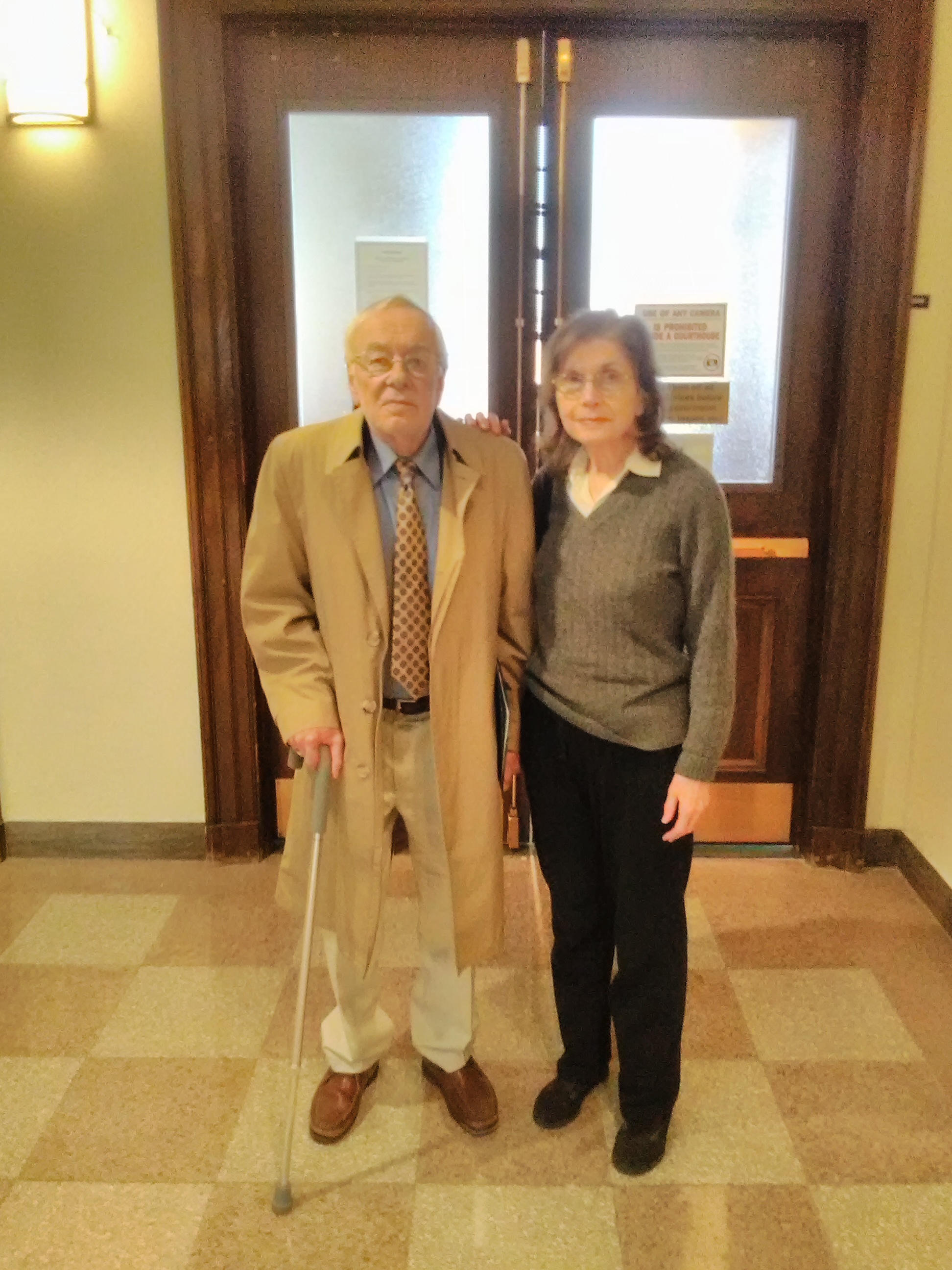
Stan and Ellen outside a probate courtroom where they encountered yet another round of frustration and disappointment last week.
In 1986, Stan and his former wife agreed to the appointment of a guardian for Andy as part of the settlement of a longstanding custody battle over him. Since then, Stan has learned the hard way that once you agree to the appointment of a guardian from outside of the family, it can be difficult if not impossible to regain guardianship rights. And if you are not a legal guardian, you have little or no standing in probate court.
Andy is now 48 and Stan is now 80; and Stan isn’t sure how much longer he and Ellen will be able to make the trip to visit Andy in his group home in Northborough.
Lately, though, Stan and Ellen have found themselves repeatedly making an even more arduous trip — to the Middlesex Probate Court building in East Cambridge, where they have been fighting what has been a more than frustrating battle to convince the court that there would be virtually no risk in supervised home visits for Andy. But just getting up the two flights of outside and inside steps in the court building to where the elevator is located now presents a major challenge for Stan.
To say the system is stacked against Stan and Ellen would be an understatement, particularly since, at this point in their lives, they can’t afford to hire an attorney to represent them. I accompanied them to a scheduled hearing last Thursday in the courthouse. The purpose of the hearing was to appoint a new permanent guardian for Andy — needless to say another guardian from outside the family. Stan and Ellen have never met the new guardian, who was appointed on a temporary basis last October.
I can tell you that other than the clerk to the probate court judge in the case, no one at the court house appeared to be particularly helpful let alone nice to Stan or Ellen. The DDS attorney on the case, in fact, repeated a threat she first made last fall to seek contempt of court charges against Stan if he were to mention to the judge his desire for home visits from his son.
It’s strange because it is apparently perfectly okay for Andy himself, or his court-appointed attorney, to say in court that Andy desires home visits. Why Stan could end up getting sent to jail for saying the same thing is beyond me.
Last October, there seemed to be a ray of encouragement for the McDonalds. The probate judge at the time, Megan Christopher, seemed to be open to considering home visits for Andy. Andy did testify at that hearing and politely asked that he be granted a supervised visit home for a couple of hours. Christopher said she would take it under consideration.
But shortly after the October hearing, Christopher was re-assigned to another courthouse, and all of her cases went to another judge, Randy J. Kaplan. It’s not that we have any reason to believe Judge Kaplan will be less sympathetic to the McDonalds, but it’s as if the whole ordeal of the October hearing never happened, and the McDonalds had to begin again with a new judge.
Last week, when Stan and Ellen arrived at the probate court, Andy wasn’t there. Andy’s attorney told Stan that Andy had said he didn’t want to make the trip to the court that day. And then Andy’s attorney let Stan know that she was resigning from the case as of that day. So, as far as we know, no one in the McDonald family has legal representation in the case right now.
When Stan and Ellen’s case was finally called at close to noon, there was a short conversation between the DDS attorney, Andy’s attorney, and Judge Kaplan at the bench. The court officer then announced that the hearing would be closed, and all non-parties had to leave. That included me, but it also included Ellen, who has no legal standing in the case. This was not the case with Judge Christopher, who had let Ellen, myself, and another advocate for the McDonalds remain in the hearing she presided over last fall.
In last week’s hearing, Stan alone was allowed to stay, apparently because he is on record as having objected to the appointment of the new, non-family guardian for Andy. So, Stan was by himself in there, without legal representation and being threatened with contempt of court if he said the wrong thing as far as the DDS attorney was concerned.
The hearing itself was over in minutes. It was essentially continued until June 2.
At this point, we think the only hope for home visits for Andy lies in having an independent clinical evaluation done to determine whether he really is dangerous. Actually, we have been calling for this for two years.
We don’t think Andy is dangerous and we don’t think anyone who knows or cares for him regularly believes he is. But whether to have an independent evaluation is a decision that can only be made by Andy’s new guardian.
As usual, Stan and Ellen, the people most directly involved and affected, have no say in it.
Sen. Brownsberger and Rep. Fernandes once again order family rights bill sent into legislative black hole
More than a year after an important family rights bill (H. 1459) for persons with developmental disabilities was sent to the Legislature’s Judiciary Committee, the committee co-chairs have decided it’s time to study the measure.
Yes, we understand that as of yesterday, three days before the Thursday drop-dead date for bills that have not been voted on in committees in the current legislative session, Senator William Brownsberger and Representative John Fernandes ordered H. 1459 sent to yet another legislative study.
Of course, we know what a study really means in Massachusetts Legislature-speak. It’s a euphemism for a legislative graveyard, or to use another metaphor, a legislative black hole from which nothing ever emerges. No study will ever be done on H. 1459. It will have to be refiled as a new bill next year if it is ever to see the light of day again.
Since the bill is only technically still alive, but is in actuality dead, I think we can refer to it in the past tense. The bill proposed that a spouse or parent be presumed in probate court to be the proper person to be a guardian of a developmentally disabled or otherwise incapacitated person unless competent evidence is introduced to the contrary.
We consider H. 1459 to have been a critically important rights measure for family members of people with disabilities — particularly developmental disabilities — who are routinely overruled in decisions about the care of their loved ones in probate court proceedings by medical and clinical “experts,” state agencies, probate court judges, and service providers.
In many of those cases, developmentally disabled people are viewed as valuable funding sources, particularly by privatized group home providers who get billions of dollars in taxpayer money to provide those people with residential services. That is why the Department of Developmental Services, which is intent on further privatization of its services, is particularly eager to get attorneys and corporate providers appointed in probate court as guardians. Those non-family guardians are much more likely than are family members to cooperate with DDS’s privatization agenda.
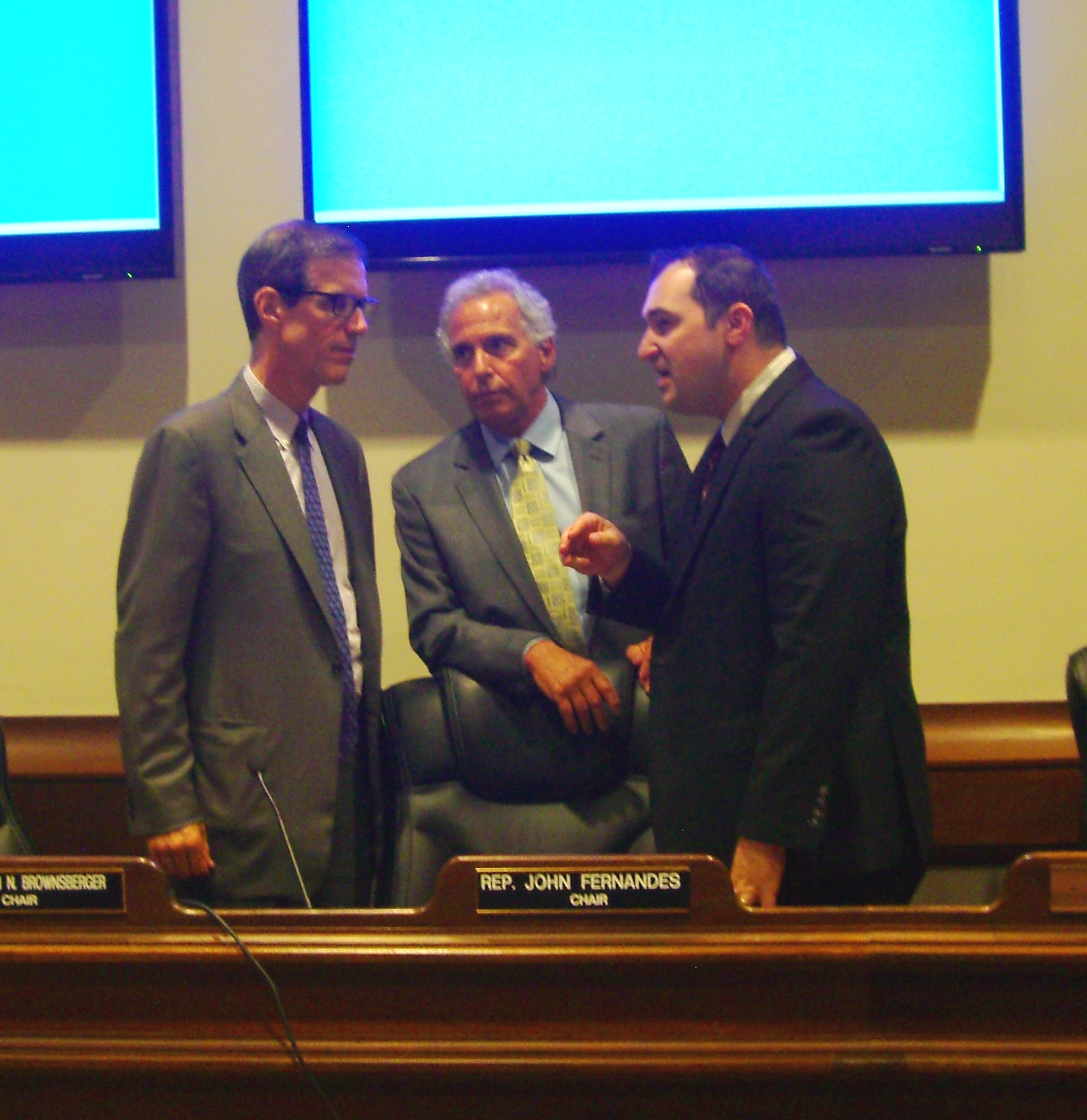
State Sen. William Brownsberger (left) and Rep. John Fernandes (center), co-chairs of the Judiciary Committee, confer with a legislative aide during a committee hearing in June 2015 on H. 1459 and related bills. It now appears they were probably discussing their legislative “black hole” strategy for many of those bills.
If Brownsberger and Fernandes and other members of the Legislature really cared about the issues that H. 1459 is concerned with, they would have acted on the bill by now. In fact, they had 17 years to study it, including the entire year and two months that the bill sat in the Judiciary Committee in the current session with no action on it. This bill has been repeatedly filed since 1999, and we know it has been sent to similar “studies” in past legislative sessions. But apparently, no one has learned a thing about the bill in those past studies, and we’re sure that will be the case yet again.
As we reported last month, this legislative session initially appeared to be different with regard to H. 1459. While COFAR has long supported the measure, it garnered the support last year for the first time of other major advocacy organizations for the developmentally disabled, including the Massachusetts Developmental Disabilities Council, which is technically part of the Baker administration. The MDDC listed H. 1459 as one of its legislative priorities for 2015-2016.
The Judiciary Committee did hold a public hearing on H. 1459 last June. COFAR, the MDDC and other organizations submitted testimony in support of the measure. As far as we know, the bill was not controversial, and no one raised any opposition to it at the hearing.
But the months dragged on and the Judiciary Committee did nothing about the bill. In January, State Sen. Richard Ross and Rep. David Linsky sent a letter to Brownsberger and Fernandes, urging them to finally pass the bill and saying it had their full support. Their letter noted that in light of continuing budget cuts to service coordinators in the DDS system, “family guardians are particularly crucial in managing their child’s transition and medical decisions.” But the letter apparently had no effect.
Ross and Linsky are the local legislators of Stan McDonald, who has been fighting unsuccessfully against DDS for years to gain guardianship of his developmentally disabled son, Andy. It is Linsky who has repeatedly filed the guardianship bill since 1999 on behalf of McDonald and an unknown number of other people who are in similar positions.
We may never find out the real reason that the guardianship bill can never get through the legislative process. But it’s my guess that DDS, for reasons discussed above, does not like the legislation. And experience has taught us that legislators on Beacon Hill rarely, if ever, challenge the authority of agencies like DDS or their lobbyists and corporate providers.
Bill that would give guardianship rights to parents of disabled remains stalled
The Massachusetts Legislature has rightly drawn criticism for getting little accomplished in the past year, and the following is yet another example of that apparent failure to go ahead and just do the right thing.
The right thing would be to enact H. 1459, a bill that would make it easier for parents of individuals with developmental disabilities to become their guardians. It’s not among the more visible pieces of legislation that lawmakers have had to deal with; yet, it’s potentially important to all family members of developmentally disabled people, and we’ve heard of no reason why it should be controversial.
The bill, which was last filed more than a year ago with the Judiciary Committee, proposes that a spouse or parent be presumed in probate court to be suitable as a guardian of a developmentally disabled or otherwise incapacitated person unless competent evidence is introduced to the contrary.
State Sen. William Brownsberger (left) and Rep. John Fernandes (center), co-chairs of the Judiciary Committee, confer during a committee hearing last June on H. 1459 and related bills. The committee has subsequently taken no action on H. 1459.
The bill has the support of major advocacy organizations for the developmentally disabled, including COFAR, and even of the Massachusetts Developmental Disabilities Council, which, while federally funded, is yet technically part of the Baker administration. The MDDC listed H. 1459 as one of its legislative priorities for 2015-2016.
Yet while the Judiciary Committee did hold a public hearing on H. 1459 last June, at which COFAR and other organizations testified in support of the measure, the committee has taken no action on the bill.
State Representative David Linsky has actually repeatedly filed the bill since 1999 at the request of Stan McDonald, a constituent of his, who has been involved in a seemingly endless and infinitely frustrating battle to gain guardianship of his son, Andy.
The bill, however, never gained any traction in the Legislature from 1999 on. This past year appeared to be different, particularly given that the bill was labeled a priority by the MDDC. But now it’s not clear that anything really is different than in those past years.
Earlier this month, both Linsky and Senator Richard Ross, McDonald’s state senator, sent a letter to the co-chairs of the Judiciary Committee, Senator William Brownsberger and Representative John Fernandes, urging their committee to approve the bill and send it to the full House for a vote.
I spoke last week to aides to both Ross and Linsky who said they didn’t know of any reason that the bill has not moved in the committee. An aide to Linsky said Linsky had met “more than once” with Fernandes to urge his support for the bill.
I then spoke last week with the legislative counsel to Senator Brownsberger, who said she too knew of no reason that the bill has not yet come up for a vote in the committee. She said I should talk with Fernandes’ office because the measure is technically a House bill.
So I called Fernandes’ office on Friday and was forwarded to a legislative aide’s voice mail. So far, no one has called me back.
To be fair, the Judiciary Committee has also taken no action on a related bill (H. 1469), which would prohibit state or other authorities from charging a parent or legal guardian with abuse or neglect, based on the type of medical care the parent or guardian has chosen for an individual in their care.
That bill, dubbed “Justina’s Law,” was also filed more than a year ago on behalf of the family of Justina Pelletier. Justina, a teenager, spent nearly a year in a locked ward in Boston Children’s Hospital after doctors there disagreed with the family’s belief that she was suffering from mitochondrial disease.
The outcome so far for these two bills shows how difficult it is to get even uncomplicated and uncontroversial legislation passed by the Massachusetts Legislature, and how much power the chairs of these committees have to stall or block legislation.
Holding a bill for a year in a committee without taking action on it might not seem that long a time, but for the guardianship bill, there has been no action since 1999. Seventeen years is a long time to wait for a man like Stan McDonald, who is now 80 years old, to right the wrongs that have been done to his son and himself.
It’s not that there has ever been any publicly stated opposition to the guardianship bill. As far as we know, no committee has ever actually voted not to approve it. It’s just that no one in power in the Legislature has apparently ever cared enough to do the right thing and enact the bill.
This, in our view, is what is really wrong with the Legislature. It’s not that the leadership specifically won’t pass “progressive” bills; it’s that the leadership can and does block anything that it doesn’t like for whatever reason. And often we never find out what that reason is.
Andy and Stan McDonald gain a small victory in a system that has been pitted against them
In a Middlesex Probate Court hearing last Monday (October 26), Andy McDonald, an intellectually disabled man, finally got the opportunity to tell a judge his long-sought wish — that he be allowed to visit his aging parents in their Sherborn home.
As we have reported, Andy, who is 48 and lives in a group home in Westborough, has been denied permission since 1996 to visit his parents. Andy’s father, Stan, is now 80. In a ruling in 2006, former Probate Judge Edward Rockett concluded that Andy was sexually dangerous and should never be allowed to return to his childhood home.
Not only were Andy’s parents never to discuss with Andy the prospect of his ever visiting his home, but Rockett ruled that Stan must personally tell his son, in the presence of clinicians, that he would never be allowed to go home again. McDonald said he has refused to say something like that to Andy.
I will discuss Rockett’s ruling more fully below. We have noted previously that a key claim made in the ruling — that Andy was arrested in 1990 for sexually assaulting three young girls — is untrue. Andy has never been charged with a sexual offense.
Yet Rockett’s decision, and the claim in it that Andy was arrested for sexual assault, is the basis for the Department of Developmental Services’ longstanding position that Andy should never be allowed to return to Sherborn, and that the matter of visits there should never be discussed with him.
Rockett’s ruling
We think it is important to expose what we see are misstatements and a lack of a factual basis in Judge Rockett’s ruling. Rockett decision, and an appeals court ruling upholding it, were repeatedly cited during a break in the court hearing last week by a DDS attorney as reasons to oppose ever lifting the ban on home visits.
Stan was even told he would be in contempt of court if he mentioned to the judge his own wish that Andy be allowed supervised visits home. As it turned out however, it was Andy himself who brought up the subject of home visits before the judge.
Beyond that, there is a larger reason for examining Rockett’s decision, we think. Someday, Andy will be on his own; and if the conclusions in Rockett’s decision are never challenged, he may be locked up somewhere for good. One attorney contacted by Stan about his case termed Rockett’s decision “devastating.”
It therefore seemed somewhat extraordinary that there were no objections last week when Andy asked to speak to Middlesex Probate Judge Megan Christopher during the October 26 hearing. When Christopher assented to his request to speak, Andy politely asked that he be granted a supervised visit home “for a couple of hours.”
Judge Christopher didn’t flatly deny Andy’s request, but said she would schedule a new trial date in which that issue may be considered. She told Andy that what he wanted “was complicated and required more looking into.” She pointed out that “it’s not always possible to have everything you want. You understand that,” she added.
The October 26 probate hearing was held to consider the appointment of attorney Marie Dunn as Andy’s new guardian, replacing Dennis Yeaw, an attorney who had opposed home visits for Andy, also citing Rockett’s decision. In 1986, Stan and his former wife agreed to the appointment of a guardian for Andy as part of the settlement of a longstanding custody battle over him. Stan has been unsuccessful since that time in regaining his guardianship, even though his former wife, local legislators, and other supporters have publicly expressed support for that.
Andy’s arrest
Andy was arrested in Sherborn in May of 1990 for threatening an unidentified person during a telephone call, according to the district court record. The nature of the threats was not disclosed. In July of that year, he was charged with disturbing the peace in downtown Sherborn, according to a police department report. In that incident, he allegedly followed a young woman and threatened to kill her father. That same day, he was charged with assault after he punched Ellen, his stepmother. Stan and Ellen say the punch was accidental.
Andy has not exhibited any significant behavioral problems in close to a decade and has been taken on community outings to many places other than his home without any behavioral incidents, according to Stan and to his yearly clinical care plans. He is described in his latest clinical care plan as “kind and friendly to others,” and as “a polite man.”
According to the plan, Andy enjoys going to the library, going out to dinner, and seeing his father’s jazz band play. He regularly goes into the community to shop for program supplies and volunteers at Meals on Wheels.
Yet, Andy has in the past told clinicians that he has had sexual fantasies about children; and that, combined with the mistaken claim that he was arrested for sexual offenses in Sherborn in 1990, led to Rockett’s lifetime ban on him from visits home. Stan maintains that the ban on visits has caused Andy emotional harm. His latest clinical care plan states that Andy’s rapid speech and eating habits are related to anxiety, although the plan attributes that anxiety to a fear of death and bees.
One-sided view
Rockett’s decision appears to take a selective view of the history of the case.
In his ruling banning Andy from Sherborn for life, Rockett concluded that Stan “should never be considered for appointment as guardian of his son,” and that Stan “lacks common sense and has poor judgment skills.” Rockett stated that Stan and other family members, who he didn’t name, “wish to usurp the authority over the program and introduce their own ideas for clinical treatment for Andrew…”
Rockett further banned Stan from ever directly contacting any doctor, clinician, or service provider providing care to Andy.
Rockett’s decision, however, said nothing about Stan’s long-time personal advocacy on behalf of Andy, in particular his successful fight to discontinue the use on Andy of Stelazine, an anti-psychotic drug, which appears to have caused Andy’s disruptive behaviors prior to 2006. Rockett also did not mention the fact that clinicians had misdiagnosed Andy in the early 1990’s as mentally ill when, in fact, he is intellectually disabled, and that, as a result, Andy was inappropriately placed in Westborough State Hospital, a facility in which he was first put on Stelazine.
The Stelazine caused Andy to develop Tardive Dyskinesia, a disorder resulting in involuntary, repetitive body movements. Because the court-appointed guardians did little or nothing to address that problem, Stan said he personally got a court order and paid for an independent evaluation of Andy’s medications. This resulted in discontinuing the Stelazine and replacement of the prescribing doctor.
Among those who have written DDS in support of Stan’s bid for guardianship since that time has been State Representative David Linsky, who earlier this year was joined by State Senator Richard Ross in calling for a new, independent clinical evaluation of Andy.
John Carroll, a former residential counselor to Andy at the Cardinal Cushing School, wrote to DDS in 2013 to say that he had frequently observed visits to Andy by Stan and Ellen, and that “Stanley’s and Ellen’s dedication to Andy’s care and treatment in all circumstances leaves no question in my mind that Stanley McDonald is the sole individual with the knowledge, experience, and love, deserving to have responsibility for major decisions in Andy’s life as guardian.”
But Rockett didn’t see it that way. In his 2006 decision, Rockett accused Stan of failing to cooperate with Andy’s court-appointed guardians and with clinicians, and stated that Stan failed to “recognize the seriousness of Andrew’s fantasies.” He also implied in his decision that Stan had a drinking problem. He offered no evidence for that, however.
Failure to specify prohibited materials
In support of the former accusation regarding the seriousness of Andy’s fantasies, Rockett stated that “Andrew uses pictures of children as sexual stimulants,” and that Stan had provided Andy on a number of occasions with “prohibited materials.” But Rockett did not state what those prohibited materials were.
According to Stan and Ellen, the prohibited materials consisted of the following items: A piece of beach glass (which Westborough State Hospital considered dangerous), a sparkler that was lit on a birthday cake, a drawing of a baby from a Family Circus cartoon, and a photo of Andy’s niece and nephew. Ellen said a poster-sized version of the photo of Andy’s niece and nephew had been on the wall in his room in his group home with the staff’s full knowledge. “The poster seemed to us to indicate explicit authorization for Andy to have pictures of his niece and nephew,” Ellen said. “Stan did not show or give anything to Andy believing Andy would use them for any inappropriate purpose.”
Regarding the drinking issue, Rockett wrote that “Andrew has stated that his father’s drinking bothered him.” Rockett offered no further explanation of that claim, other than two follow-up statements concerning Stan’s visits to his son. One statement was that “Mr. Burch (the clinical director of Andy’s group home) had instructed Stanley McDonald not to drink during the visits.” The next line stated: “They (Stan, Andy, and Burch) went to a restaurant and Stanley McDonald immediately ordered wine. Andrew became very agitated and went to the restroom, where Mr. Burch had to quiet him down.”
Stan has never brought alcohol to Andy’s (group home) program. Andy does not like to be around Stan when he is drinking. Andy worries about the effects on Stan of alcohol and tobacco. He doesn’t want Stan to drink or smoke. He is very influenced by ads he sees on TV about the danger of drinking and driving. After that incident where Stan ordered a glass of wine in a restaurant he never again ordered an alcoholic beverage in Andy’s presence – until once very recently, when Andy didn’t express any objection. Stan does drink at Primavera (in Millis) while he is playing (in his Blue Horizon Jazz Band), and nobody has raised this as an issue – neither Andy nor staff who accompany him. Andy loves to be at Primavera when Stan is playing. He goes from table to table and talks with all of the guests and band members. Many have known him since he was a child. Nineteen years ago when Andy last visited at home Stan did not have a drink while Andy was there. Stan honors Andy’s wish and orders iced tea when we go out to supper. Stan smokes in Andy’s presence but tries to minimize it. It’s a tough habit for him to give up.
No support for statements about alleged dangerousness
Rockett’s decision also included a lengthy discussion of Andy’s alleged sexual dangerousness, starting with the mistaken claim discussed above that Andy was arrested in 1990 for sexual assault. Rockett referred three times to the arrest, and, in one instance, stated that Andy had “stalked the three neighborhood children.” As noted, there is no evidence in police or court records that anyone was sexually assaulted in those incidents, that any young children were involved, or that Andy stalked anyone.
(Even the appeals court, which upheld Rockett’s decision in 2009, stated in a footnote that “some of the fact findings adopted by the judge (Rockett) were not supported by the evidence…” The appeals court footnote specifically stated with regard to Rockett’s claims about the arrest for sexual assault and stalking three girls, “the specific facts (of the incidents in Sherborn) and the charges are not clear from the record.”)
Rockett also claimed in his decision that Andy had confessed to having “bizarre sexual fantasies” about children; yet Rockett noted that Andy “will always say what people want to hear.”
In addition, Rockett included what appears to be an unsupported and inflammatory statement by Burch that Andy was “the most dangerous person he has ever treated.”
But there is no evidence cited or presented in Rockett’s decision that Andy ever sexually assaulted anyone. Rockett stated, for instance, that in the 1990’s, when he was first admitted to his group home, Andy “attempted to attack female staff” in both his residential and day programs. But Rockett provided no details about those alleged attempted assaults.
Rockett’s decision also included two accounts about Andy’s alleged fantasies and about Andy engaging in masturbation; but while the accounts were graphic, nothing that Rockett described could be said to constitute crimes or prove that Andy was dangerous.
Ellen and Stan maintained that at least some of the statements given by clinicians regarding Andy’s alleged sexual fantasies may have stemmed from statements Andy made while participating in a group therapy program in the 1990’s in Andy’s group home, which is run by Community Resources for Justice. Participants were reportedly encouraged to discuss their sexual fantasies in the sessions.
“As I recall we were told at least some of the group members had actually offended,” Ellen said. “We weren’t told details of these sessions.”
Questions remain
Marie Dunn, the new guardian appointed last week for Andy, was not present at the October 26 court hearing. But both Andy’s court-appointed attorney and the DDS attorney encouraged Stan and Ellen to meet with Dunn. Stan is hopeful that Dunn will agree to a new, independent evaluation of Andy, and that she will support supervised home visits for him.
We hope things will finally move in a positive direction for Stan, Ellen, and Andy. We think it was a good sign that Judge Christopher allowed Andy to state his wish in open court to visit home. We also think it is a positive thing that Andy finally has a new guardian.
We strongly support at least a co-guardianship for Stan; and we hope the day comes soon when Andy can have supervised visits home once again, and that common sense will finally prevail in this case.
Family and guardian rights bill gathering momentum
After years of being stalled in the state Legislature, a bill that would boost the guardianship rights of family members of the developmentally disabled appears to have a chance of passage.
The bill (H. 1459), which was given a hearing last week by the Judiciary Committee, states that probate court judges should presume a spouse or parent is the proper person to be the guardian of an incapacitated person.
The Committee also heard testimony in support of a related bill (H. 1469), which would prohibit state or other authorities from charging a parent or legal guardian with abuse or neglect, based on the type of medical care the parent or guardian has chosen for an individual in their care.
While we are primarily concerned with legislation that affects people with developmental disabilities, both bills are about the rights of families to make decisions regarding the care of their loved ones. In a number of cases, family members have been overruled in their decision-making regarding loved ones, and, in some cases, have been removed from virtually all contact with them by state or clinical authorities.
Passage of the medical decision bill, dubbed “Justina’s Law,” is being sought by the family of Justina Pelletier, a teenager who spent nearly a year in a locked ward in Boston Children’s Hospital after doctors there disagreed with the family’s belief that Justina was suffering from mitochondrial disease. Even though the family was relying on a diagnosis of mitochondrial disease from a doctor at Tufts Medical Center, the Children’s Hospital doctors claimed her illness was psychological and accused Justina’s parents of medical child abuse.
Member’s of Justina’s family testified last Wednesday in support of H. 1469.

It was standing room only in last Wednesday’s Judiciary Committee hearing on bills regarding guardianship of persons with developmental and other disabilities (COFAR photo)
The impetus for the H. 1459, the bill promoting family members as guardians of the developmentally disabled, came from Stan McDonald, who has been unable to regain his guardianship of his intellectually disabled son, Andy. Stan has had to watch helplessly as Andy’s emotional needs have been ignored or neglected. Andy McDonald’s current court-appointed guardian has had as many as 100 wards at one time.
H. 1459 would also potentially apply to a case in which a probate court judge dismissed several members of the Duzan family as unsuitable to continue as guardians of Sara Duzan, a young woman with a developmental disability. The judge’s order set the stage for the eventual cutoff of all contact between the family and Sara for months, and forced them into an expensive and still ongoing legal battle over her custody.
A corporate provider executive director initially appointed as guardian of Sara Duzan had 24 other wards at the time, according to court records.
H. 1459 would not prevent a probate judge from removing family members as guardians or denying a family member’s bid to become a guardian, but it states that there must be “competent evidence” to rebut the presumption that a parent, in particular, is the proper person to be the guardian.
This year, H. 1459 has received support for the first time from the Massachusetts Developmental Disabilities Council (MDDC), a state-run organization that identifies priorities for care for people with those disabilities, and from the Arc of Massachusetts. The MDDC has listed the bill as one of its legislative priorities for 2015-2016.
In testimony to the Judiciary Committee last week, the MDDC stated that:
…the person who is chosen to be guardian must be someone who knows the individual well, can truthfully speak to the individual’s desires and has the time to devote to crucial decisions. In many cases, the natural choice for an individual’s guardian is one of the parents.
Testimony in support of H. 1459 was also submitted by COFAR and by a representative from the Institute for Community Inclusion (ICI), which is associated with the University of Massachusetts.
It is unclear when the Judiciary Committee, which has had both H. 1459 and 1469 before it since January, will vote on ether one.
In order to participate in the care of a developmentally disabled person, it is necessary to obtain guardianship of that person when they reach the age of 18. Guardians have legal rights to participate in individual support planning, a key element in the care of developmentally disabled persons, and to make other decisions that affect their wards’ services and well-being.
In some cases, parents and siblings of incapacitated individuals are passed over by probate court judges in considering who to appoint as guardians, and, in some cases, family members are removed as guardians by judges. In many of those cases, judges appoint either attorneys or corporate human services provider organizations as guardians, and those attorneys or providers may have no connection to the persons who need their representation. Some of those court-appointed guardians have large numbers of wards and are unable to advocate for them effectively.
Most court-appointed guardians for the developmentally disabled in Massachusetts appear to be paid for that work by the Department of Developmental Services. The ICI representative’s testimony characterized such payments to court-appointed guardians by state agencies as a “clear conflict of interest.” The testimony noted that guardians paid by state agencies may not always act in the best interest of the ward. This can “result in decisions to remove the family from virtually all decision-making authority in the care of their loved ones,” the testimony noted.
In appointing a guardian, a probate court judge is currently required by law to consider, in order of priority, a spouse, then a parent, and then “anyone else the court deems appropriate.” But a judge is not obligated to give more weight to a parent than to anyone else he or she deems appropriate. In fact, the law currently allows judges to pass over a person having priority and appoint anyone else they wish as guardian. That provision gives probate judges carte blanche to bypass the express wishes of parents and other family members. H. 1459 would remove that bypass provision.
Possible amendments to H. 1459:
COFAR’s testimony in support of H. 1459 suggested some changes that would strengthen it even further. Those positive changes include adding siblings to the list in the bill of suitable guardians. As the bill is currently drafted, it specifies only a spouse and parents of disabled individuals as being considered to be the proper guardian. In the case of developmentally disabled persons who are aging, siblings are often the only family members in a position to become guardians.
COFAR also suggested other reforms to the guardianship system in Massachusetts, either as amendments to H. 1459 or as separate legislation. Those reforms include:
- Limiting the number of wards a court-appointed guardian can have, and requiring court-appointed guardians to devote a certain minimum amount of time to the ward and to visit them a minimum number of times.
- Entitling family members of a developmentally disabled individual to an attorney if the Department of Developmental Services or another agency attempts to remove them as the guardian. In many cases, families are subjected to costly legal battles to retain or regain guardianship when state agencies seek to remove their guardianship rights.
- Placing the legal burden on agencies such as DDS or on court-appointed guardians to prove that restrictions on family contact are in the best interest of the ward.
Both COFAR and the Arc oppose a separate bill that would remove a requirement that individuals with developmental disabilities be clinically evaluated when new guardians are appointed. That bill (H. 1594) appears to be discriminatory in removing the evaluation requirement for people with intellectual disabilities but not for people with mental illness, for instance. We believe that such evaluations are necessary for all incapacitated persons, particularly when new guardians are appointed.
Guardian rights bill would help families caught in the DDS-probate system
As we have chronicled a number of times, family members can get shut out of the process when their loved ones with developmental disabilities enter the state’s system of residential care.
This is particularly the case when family members lose their legal status as guardians of disabled persons. That, as we have seen, can happen for reasons that are not always fair or just.
That’s why we strongly support a bill (H. 1459) now before the state Legislature that would require probate court judges to give more consideration than they now do to the appointment of family members as guardians of incapacitated persons.
The bill, which has been filed for years by Representative David Linsky, has never made it out of committee. We understand, though, that the Massachusetts Developmental Disabilities Council, which advises the state on issues of concern to the developmentally disabled, has put this bill on their priority list for passage this year.
The bill states that the spouse, parent or parents or their designees of an incapacitated individual should be presumed to be suitable guardians unless competent evidence is introduced to the contrary.
Obtaining guardianship when a developmentally disabled person reaches the age of 18 is essential in participating in the care of that person. Guardians have legal rights to participate in individual support planning, a key element in the care of developmentally disabled persons, and to make other decisions that affect their wards’ services and well-being. Even the parents of a developmentally disabled person over 18 will find they have virtually no say in that person’s care if someone else is appointed as his or her guardian.
But the appointment by probate court judges of guardians of developmentally disabled persons is often haphazard. In many of those cases, judges appoint either attorneys or corporate human services provider organizations as guardians, and those attorneys or providers may have no connection to the persons who need their representation.
Attorneys, corporate providers, and others who are appointed to guardianships of developmentally disabled persons are generally paid for those services by DDS. According to DDS records, eleven of the 20 highest-paid guardians by the Department in Fiscal Year 2014 were either corporate providers or attorneys.
There seems to be a view among at least some judges and within DDS that corporate providers or attorneys make more suitable guardians than do family members, particularly if those family members are seen as aggressive or contentious in their relationships with DDS. We think this dismissal of families is wrong and has caused a lot of needless suffering among families, not to mention hindering adequate care.
Moreover, the view that the so-called experts and not family members know what is best for disabled persons appears to be at odds with the federal Developmental Disabilities Assistance and Bill of Rights Act, which states that family members of developmentally disabled individuals shall be the “primary decision-makers” in the care of such persons.
It would seem that too few people in DDS or the probate court system in Massachusetts are familiar with the DD Assistance and Bill of Rights Act.
In 2012, DDS petitioned a probate judge to remove Patricia Feeley as her son’s guardian because Feeley would not agree to a Department plan to place her son in a residential care setting without 24-hour nursing. DDS agreed to dismiss its petition a year later, but only after the Department had proposed to appoint a Woburn-based attorney, who had never met Feeley’s son, as his guardian.
In 2010, Norfolk County Probate Court Judge George Phelan dismissed the entire Duzan family as unsuitable to continue as guardians for Sara Duzan, a young woman with a developmental disability who had been repeatedly abused with unnecessary restraints in a series of provider-operated residential care settings.
In his order, Phelan discounted the family’s claims that Sara was being abused, and contended the family itself had “demonstrated through a variety of encounters their vacillation, indecisiveness, and inability to work with others.” In the place of Sara’s family, Phelan appointed the executive director of the Arc of Greater Fall River, a DDS corporate provider, as her guardian.
Phelan’s order set the stage for the eventual cutoff of all contact between the family and Sara for months, and forced them into an expensive and still ongoing legal battle over her custody. But vacillation, indecisiveness, and even the inability to work with others, even if that were the case, do not seem to us to be sufficient reasons to deny an entire family the right to guardianship of a loved one.
In a third case, Stan McDonald voluntarily relinquished his guardianship nearly 30 years ago of his intellectually disabled son, Andy, as part of a custody battle with his former wife. What followed were years, with few exceptions, of poor decision-making regarding Andy’s care by a number of court-appointed guardians.
The idea for H. 1459 came from Stan McDonald, who has still been unable to regain his guardianship of Andy, and has had to watch helplessly as Andy’s emotional needs have been ignored or neglected. Andy McDonald’s current court-appointed guardian has had as many as 100 wards at one time. The provider executive director appointed as guardian of Sara Duzan had 24 other wards at the time, according to court records.
The current probate law does state that in appointing guardians, the court should consider, in order of priority, a spouse, then a parent, and then “anyone else the court deems appropriate.” But a judge is not obligated to give more weight to a parent than to anyone else he or she deems appropriate.
In fact, the current probate law goes on to state that: “The court, acting in the best interest of the incapacitated person, may pass over a person having priority and appoint a person having a lower priority or no priority.” That provision gives probate judges carte blanche to bypass the express wishes of parents and other family members. H. 1459 would remove that provision.
There are a number of additional reasons to support of H. 1459:
- It would lower caseloads for attorneys who are not able to advocate effectively for the often large numbers of incapacitated persons for whom they are responsible. It would also reduce the cost to taxpayers in paying these attorneys.
- H. 1459 would also reduce the use of scarce court resources expended on families disputing the appointments of non-family members to be guardians of their loved ones.
By itself, H. 1459 is just one of a number of measures that are needed to reform the dysfunctional DDS/probate court system of care for people with developmental disabilities. Other measures are needed as well. For instance, there should be a mediation process available in guardianship disputes so that families are not forced to impoverish themselves in court litigation when they do lose their guardianship rights.
In the absence of a mediation process, the state should be required to appoint an attorney to represent an individual who gets involved in a dispute with the state over guardianship and can’t afford an attorney on their own.
Also, in light of the Developmental Disabilities Assistance and Bill of Rights Act, family members and other caring individuals should have standing to advocate for an individual even if they are not the person’s guardian. And limits are needed on the number of persons that individual attorneys, corporate guardians, and others should be allowed to represent as guardians.
Two lawmakers support an independent evaluation of Andy McDonald
More than a year ago, we asked for an independent clinical evaluation of a now 47-year-old intellectually disabled man, who has not been permitted to visit his parents in their Sherborn home for the past 19 years because he has been deemed to be a danger to the community.
Finally, two state legislators are asking for the same independent evaluation of Andy McDonald. In a letter sent to the Department of Developmental Services on February 25, both Senator Richard Ross and Representative David Linsky further asked that the evaluation take into account the views of Andy’s father, Stan, and his step-mother, Ellen, who have been fighting for years for supervised visits home for him.
Not only is Andy prohibited from visiting the home he grew up in; Stan and Ellen are not even permitted to discuss the topic with him. Under the rules imposed by his DDS-funded group home, Andy, who has frequently expressed a longing to see his home again, is forbidden from mentioning his desire to do so. It seems like a violation of free speech; but then again, when you are under the control of both the DDS and probate court system, your right to self-determination becomes very limited.
That loss of self-determination may be appropriate in some cases; but the McDonald case shows how dysfunctional the system can get. The case is replete with questions about the validity of previous clinical evaluations of Andy and about a 2006 probate court ruling, which concluded that Andy was sexually dangerous and should never be allowed to return home.
In the 2006 ruling in which he denied Stan’s bid for guardianship of Andy, Middlesex County Probate Court Judge Edward Rockett stated that Andy had been arrested in 1990 for sexual assaults of three young girls who lived across the street in Sherborn. That was not true, however.
Andy was arrested in May 1990 for threatening an unidentified person during a telephone call, according to the district court record. The nature of the threats was not disclosed. In July of that year, he was arrested for disturbing the peace in downtown Sherborn and with assault for punching his stepmother, according to a police report. Both Stan and Ellen say the punch was accidental and occurred while Ellen was driving Andy to the police station after he was accused of disturbing the peace. “He was flailing his arms, not threatening me,” Ellen said in an email this week, “and his fist landed on me. It didn’t hurt me. It made a red mark that faded shortly after.”
There is no indication in the police reports that Andy ever sexually assaulted anyone.
In his ruling, Rockett also cited a statement by the clinical director of Andy’s group home that Andy had told him he had had sexual fantasies about children. But Rockett acknowledged in his ruling that there was testimony in the court case that Andy “will always say what he thinks other people want to hear. This causes his statements to be very inconsistent.”
As we noted in a previous post about this case, Andy was committed to McLean Hospital in Belmont immediately after the July 1990 threatening and disturbing-the-peace incidents. In the years following, he was subjected to a series of inappropriate residential placements and treatment, in many cases because a series of court-appointed guardians, state agencies, and providers made the wrong decisions regarding his care.
Most of the decisions about placement and treatment of Andy were made without the consent of Stan, who had agreed to the appointment of a guardian for Andy in 1986 as part of the settlement of a longstanding custody battle over him with his former wife. Andy has had a series of court-appointed guardians since, and Stan has never been able to regain that guardianship. His attempts in probate court to do so have been opposed by DDS.
Andy has not exhibited any significant behavioral problems in a decade and has been taken on community outings to many places other than his home without any behavioral incidents, according to Stan and to notations in Andy’s clinical care plan. But that record of good behavior does not appear to have changed the position of either the probate court, DDS, or Andy’s current court-appointed guardian that he must never be allowed to go back to his hometown.
That ban on visits to Andy’s boyhood home combined with his group home’s policy that he must not even discuss his desire to visit his parents there amounts to psychological abuse, Stan maintains. Moreover, the situation raises concerns in Stan’s and Ellen’s minds about Andy’s future and what will happen when they are no longer able to travel from Sherborn to visit him in his group home in Northborough. Stan is 79 years old.
In 2000, Ronald Ebert, a psychologist, recommended that the staff of Andy’s group home try a “trial visit” to the Sherborn Inn to hear Stan, an acclaimed jazz musician, play in his band if it could be demonstrated that the persons Andy was accused in 1990 of threatening no longer lived in town. In fact, Stan says, those persons had moved away as of that time. “If such visits can be managed successfully, there is no reason why they could not be built into his visit schedule…,” Ebert wrote. But Ebert’s recommendation was never heeded.
As is the case with he parents of Sara Duzan, who were denied all contact with their daughter for several months, Stan and Ellen McDonald have found themselves trapped in a Twilight-Zone-like situation imposed on them by the state’s dysfunctional human services and probate court system. It’s long past time to bring in someone with a truly independent view to take a new look at this case.
 COFAR blog