Archive
The fight goes on to save the Glavin Center
At a breakfast on Tuesday at the Glavin Regional Center in Shrewsbury, state lawmakers heard from family members and guardians trying to save this critically important facility from closure.
And the families heard from the lawmakers, who said they will have a tough battle on their hands to get their message heard among the well-organized forces on Beacon Hill calling for the shutdown of all remaining developmental centers in the state for persons with intellectual disabilities.
Meanwhile, lawmakers will file an amendment to the state budget bill coming up for debate in the House, requiring an independent cost analysis before Glavin and two other centers can be closed.
State Senator Michael Moore of Milbury made the comment during the Glavin breakfast, saying the amendment will specify that the study be done by the state auditor, inspector general, or another independent entity selected by a competitive bidding process.
COFAR has criticized a cost analysis submitted to the Legislature last summer by the Patrick administration, which claims that closing the Glavin, Monson, and Templeton developmental centers will save the state $20 million a year. No analysis was submitted at all for the Fernald Developmental Center, which is the first on the administration’s closure list.
Because we believe there are numerous flaws in the administration’s cost analysis, we at COFAR have urged that an independent study be submitted to the Legislature.

Rep. Anne Gobi (left), Rep. Vincent Pedone (center), and Senator Michael Moore (right) at Glavin breakfast. Moore said lawmakers will file a budget amendment calling for an independent analysis of the costs of closing three developmental centers.
At Tuesday’s breakfast, Al Bacotti, a former director of the Glavin Center, made the case to the lawmakers that Glavin is both cost-effective to operate and functions as a “safety net” for a group of severely intellectually disabled people who have been unable to live successfully in community-based settings.
Bacotti maintained that he saw a number of instances in which costs tripled for Glavin residents needing intensive care, after they were transferred to community residences. Those residents no longer had the benefit of centralized clinical, therapeutic, and medical services, which had been available at Glavin, he said.
Bacotti also disputed the argument made by facility closure advocates that Glavin and the other developmental centers are segregated from the surrounding community and restrict residents’ freedom.
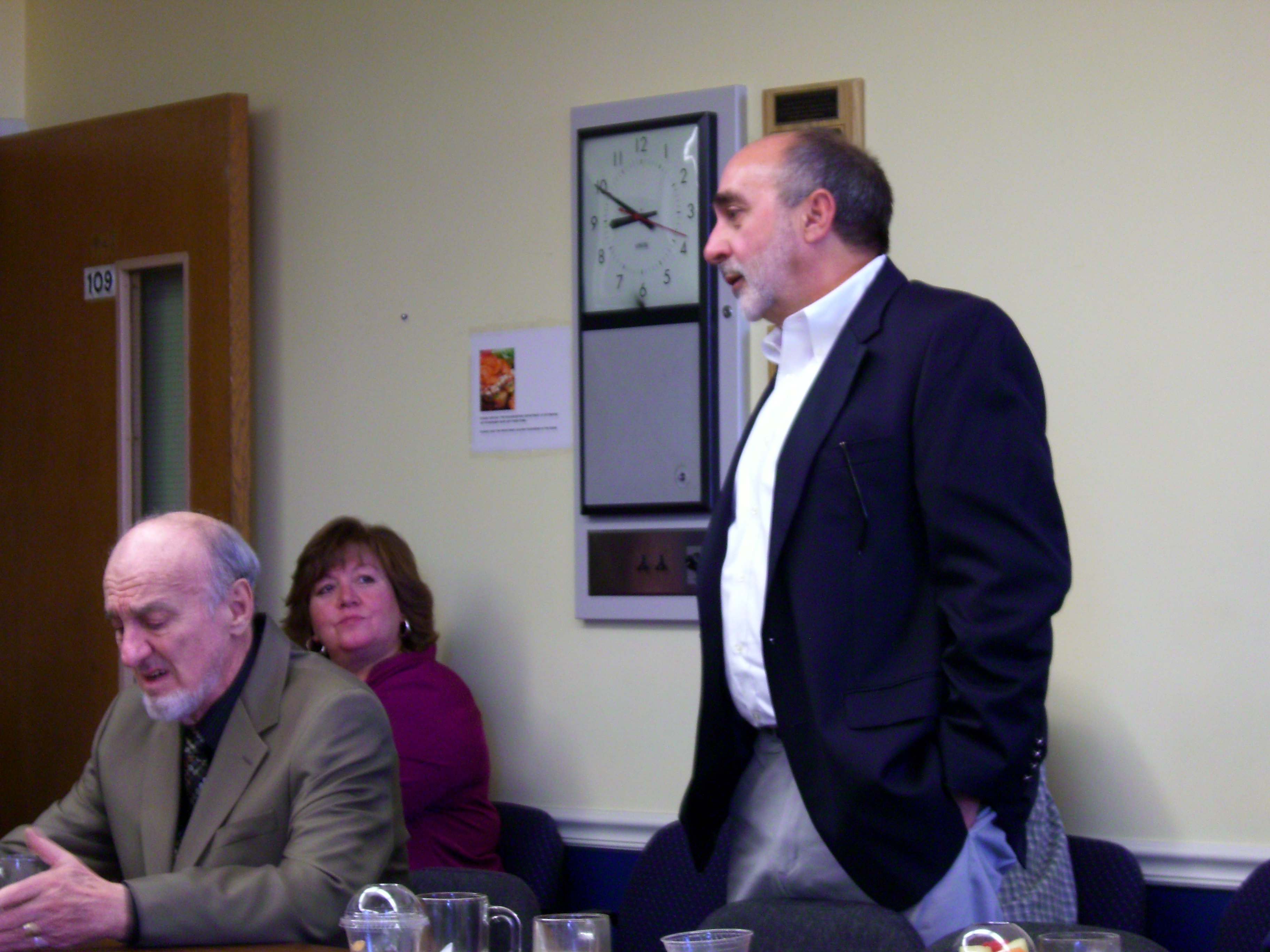
Former Glavin Director Al Bacotti (standing) speaks at breakfast. Seated to his left is Roland Charpentier, president of Friends of Glavin. Bacotti termed Glavin "cost effective" and a "safety net."
“There are actually more freedoms here (at Glavin) than for many people in community settings,” Bacotti said. “To the argument that everyone should be in the community, my answer is it didn’t work for the people here.”
Rep. Vincent Pedone of Worcester replied at that point that he needs more data on those cost issues because “people (on Beacon Hill) are telling us the opposite is true.” COFAR delivered a set of facts and figures on developmental center and community costs directly to Rep. Pedone today (Wednesday).
During the Tuesday breakfast meeting, Wilfred Dumont told the lawmakers about his son, Stephen, 26, who has been a Glavin resident for the past four years. Stephen is intellectually disabled and is deaf and has cerebral palsy and other medical conditions. Prior to coming to Glavin, he lived in a community-based facility where he began banging his head so severely that even a helmet didn’t help.
“He opened up his head at least 30 times,” Dumont said. That behavior has ceased since he’s been at Glavin. “Now he’s smiling for the first time and he comes home on weekends,” Dumont added. He said Stephen still has some behavioral episodes, but they no longer go on for a month at at a time. “To move him to another facility won’t work. You might as well put him in a cage,” he said.

Stephen Dumont (center) with his mother, Rose, and father, Wilfred. The staff at Glavin got Stephen to stop banging his head and injuring himself.
We will tell more about Stephen’s case and about other Glavin family members’ stories in our upcoming, May issue of The COFAR Voice.
Other lawmakers attending Tuesday’s legislative breakfast included Reps. Anne Gobi of Spencer, Kimberly Ferguson of Holden, Paul Frost of Auburn, and Matthew Beaton of Shrewsbury.
Update: some progress to report in abuse case
There have been some new developments in a case we reported on here, involving the alleged assault of an intellectually disabled man by a group home staff worker.
A state investigator has recommended that John Saunders, who has been charged with assaulting John Burns during an outing from his West Springfield-based group home last June, no longer be allowed to work with Department of Developmental Services clients. Saunders was fired after the alleged assault from the group home, which is run by the Center for Human Development.
Saunders allegedly hit Burns in the face while toileting him, causing Burns to suffer two black eyes. Saunders is scheduled to appear in Falmouth District Court on Monday, March 28, at 9 a.m. for a pre-trial hearing that has already been continued several times.
Charges against Saunders were personally brought by Sheila Paquette, Burns’ sister and co-guardian, after Paquette became frustrated with the slow pace of the state’s investigation into the case. Paquette has also been frustrated that she has gotten little information about the case so far from state and law enforcement authorities, which have not released an investigative report done by DDS on the matter.
However, in an email late last week to Paquette, Gail Quinn, the deputy general counsel of the Disabled Persons Protection Commission, did provide Paquette with the investigator’s recommendations. In addition to the recommendation against allowing Saunders to work with DDS clients, the investigator’s report cites the group home for failing to “identify” Burns’ injuries before sending him to his day program the morning after the alleged assault, and recommends retraining of staff in that regard.
Quinn also said the DPPC is changing its policy as a result of this case of withholding investigative reports from guardians of victims of alleged abuse pending the outcome of criminal investigations. She stated that the agency will notify district attorneys’ offices of its intention to send out investigative reports to guardians within a specified time frame unless the district attorney objects. Quinn wrote that the DPPC has issued such a notification to the district attorney in Burns’ case.
Quinn added in her email that, “The delay in getting (investigative) Reports out has been very concerning to us. Your case has brought the issue to the fore, and we have been able to deal with it in a manner that we think represents everyone’s interests in the content of the Report.”
Paquette, who is president of the Advocacy Network and a COFAR member, termed the DPPC’s new policy “encouraging,” but said she still isn’t convinced the system is fully on the victim’s side in these types of cases. Nevertheless, she said she is appreciative of Quinn’s comments.
Instances of assault and abuse of persons with intellectual disabilities often don’t get prosecuted by law enforcement authorities, and other state agencies tend to function slowly and inefficiently in these cases. Paquette said she was told by an investigator that had she not personally pressed charges in this case, it could have taken as long as two years for the matter to reach criminal court.
I talked about that today with Emil DeRiggi, deputy executive director of the DPPC, who said the agency supports decisions of individual family members or guardians to personally press charges in abuse cases. “We generally support anyone who learns something happened and believes filing charges is the right thing to do,” DeRiggi said. “I would encourage people to do whatever they think is best in these instances.”
DeRiggi said that in the case of Paquette’s brother, the State Police Unit assigned to the DPPC referred the matter to the district attorney’s office on Cape Cod, where the alleged assault took place. While that implies the case would have gone to criminal court without Paquette’s intervention, it does appear that her decision to press charges on her own may have, at the very least, speeded up the wheels of justice in this instance.
One other note: We have recieved the police report in the case from the Falmouth Police Department, where Paquette initally filed the assault charges. The report states that the alleged assault was witnessed by Burns’ roommate, who “reported seeing Mr. Saunders hand covering the mouth of Mr. Burns…and then witnessed Mr. Saunders strike Mr. Burns in the face with an open hand.” Saunders has denied the charge, according to the police report.
More on the ‘miracle’ of Templeton
[NOTE: Last month, we first posted an article here about the importance of the Templeton Developmental Center to three men living there and to their families. Below, I’ve posted some more information about those men and their experience, which didn’t make it into that first blog and which we weren’t able to include in the just-released March issue of The COFAR Voice.]
Jimmy Holdsworth kept getting thrown out of community-based group homes and sheltered workshops because his behavior was too volatile and his size and strength were too much for the staff to handle.
For Tony Welcome, community-based programs were ineffective in getting him to stop stealing cars.
Bobby Shepherd’s habit of wandering and trying to make friends with strangers frequently got him into trouble, and community-based programs didn’t provide the structure and supervision he needed.
In each of those cases, the Templeton Developmental Center turned out to be the solution to years of pain and struggle, not only for the men, but for their families. But it’s a solution that will no longer be available to those families or the families of the 103 other remaining residents of Templeton as of the end of Fiscal Year 2013.
The Templeton Center is one of four state-run Intermediate Care Facilities in Massachusetts that the Patrick administration has targeted for closure. The others slated to be closed are the Fernald, Glavin, and Monson developmental centers.
Families and guardians of the residents of the facilities have protested the planned closures and, in the case of Fernald, have filed administrative appeals of the transfers of the residents.
But as many guardians see it, it’s not the closures of the buildings that make up the developmental centers that are at issue; the problem lies in the planned elimination of the federally prescribed level of care provided in them.
At Templeton, for instance, the administration plans to continue to operate three existing residences for persons with intellectual disabilities as community-based programs and to build two additional duplex homes on the grounds. Those residences, however, will no longer be subject to federal ICF regulations governing staffing and care.
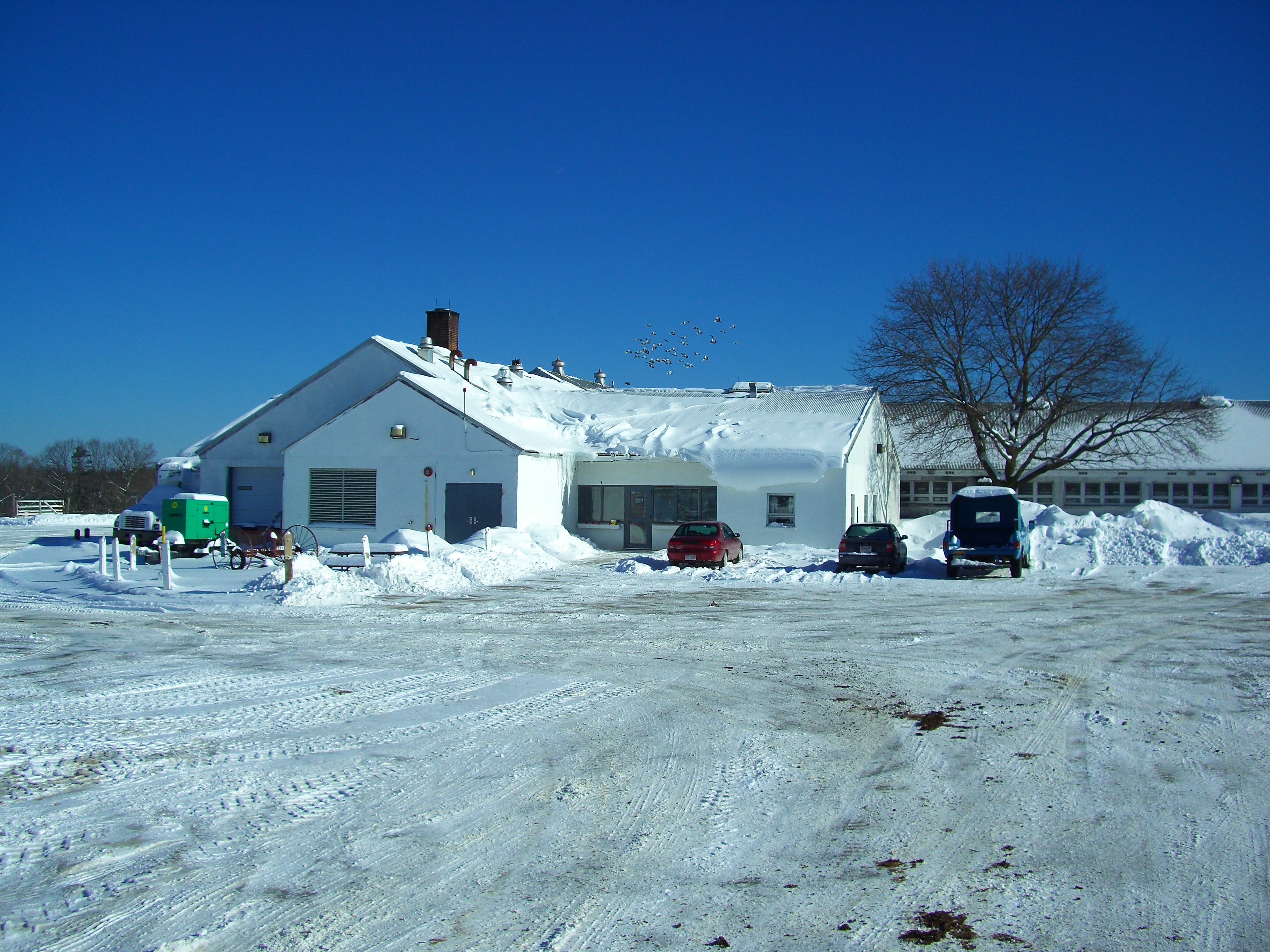
The dairy barn at Templeton
Bonnie Valade, Tony Welcome’s mother and guardian, was only able to get her son admitted to Templeton after a long struggle with the then Department of Mental Retardation (now Developmental Services), which had continually contended that Tony was not intellectually disabled.
By the time Tony was 19, he had already been placed in a number of mental health facilities, which had failed to control his impulse to steal cars. His IQ had continually been measured in the 50s, which is well below the DMR requirement that a person have a maximum IQ of 70 in order to receive services.
But when Tony was tested by DMR at at the age of 19, his IQ was found to be 75, making him ineligible for DMR care. Two years later, DMR rejected him again after measuring his IQ at 71, just one point over the cut-off for eligibility. As a result, Tony was placed in a Department of Mental Health facility with eight emotionally disturbed females, which turned out to be inappropriate for him, and later in a homeless shelter.
At one point, with eight different car theft charges pending against him, Tony spent six months in the Worcester County Jail, where he was beaten so badly by another inmate that he had to be placed in solitary confinement for his own protection. Since Tony was accepted at Templeton in 1989 at the age of 24, he has not had any further behavioral incidents, Valade says.
When Tony was in the community system, he had alcohol problem. Today, he suffers a low red blood cell count because anti-psychotic drugs had been improperly administered to him in the community-based system while he was drinking alcoholic beverages. The licensed nursing staff at Templeton understand this, Valade says; but Valade is concerned that once he is back in the community system, drugs will be administered to Tony by direct-care workers with minimal training.
As far as Tony Shepherd is concerned, it will no longer be beneficial for his brother, Bobby, to continue living in his residence at the Templeton Center following a change from ICF-level care there to community-based care. Shepherd, who is Bobby’s guardian, is concerned that under the community-based care model, the intensive clinical and medical supports that have sustained Bobby for more than 50 years will be greatly reduced.
Shepherd said, for instance, that he is grateful for quick action by Templeton’s nursing staff when he was visiting Bobby last fall and noticed while they were having lunch in the cafeteria that he seemed to be feeling unwell. Shepherd asked if a nurse was available, and one arrived within two minutes, checked Bobby’s color and vital signs and then returned with a wheelchair and took him to the nurse’s station.
There, according to Tony Shepherd, further examination showed that Bobby was experiencing a drop in his oxygen level. He was administered oxygen and kept overnight at the nurse’s station for observation. Had he been living in a community-based group home, it is unlikely that a nurse would have been available to respond to the emergency, Shepherd believes.
Shepherd notes that at Templeton, nurses, doctors, and other trained medical personnel are available on a full-time basis to monitor Bobby’s health and administer his medications. A clinical board meets quarterly to evaluate the effectiveness of his prescriptions.
Bobby Shepherd’s intellectual disability stems from low oxygen levels that he experienced at birth. He is verbal, Tony says, but can’t read or write. He has always been nonviolent, but was never easy for his parents to control because of his habit of wandering away from his house. He has a trusting and friendly nature, and has always tried to make friends with total strangers. That would sometimes get him into trouble.
At Templeton, Bobby lives with four other men in a two-story, white farmhouse called Waite Lodge. He’s free to come and go on the Templeton campus, but lately his breathing problems have kept him from venturing out.
Tony Shepherd is worried about Bobby’s future after Templeton closes. At 73, Tony is seven years older than Bobby. “What’s going to happen to him and who is going to look after him if he’s still around after I’m gone?” Shepherd asked. Bobby, he adds, is a “genuine ‘babe in the woods’” who would become “a target of ridicule and abuse [in a less supervised environment] because of his natural but naive belief that everyone is his friend.”
Had the administration not planned to eliminate the ICF model of care at Templeton, Shepherd said he would be a lot less worried about his brother. “The staff is simply not going to be here once this place is switched over to state-operated group homes,” he said. “We’ll be lucky if there are any clinical people left here at all.”
For Jimmy Holdworth’s parents, a social life proved impossible because no community-based residence or program could handle their son, and because he couldn’t be left at home with caretakers other than themselves.
It was only when his parents were in their 60s that Jimmy was finally admitted to Templeton, according to his sister, Judy Holdsworth, who is now his guardian. “At Templeton, he learned for the first time to control himself. It was amazing to me,” she said.
Holdsworth said that in addition to intensive behavioral therapies, the clinical staff at Templeton placed Jimmy on medications to control his impulsiveness and aggression. At first, she said, her parents resisted the idea of placing their son on any medications, but they were persuaded it was the right thing to do when they saw how carefully it was monitored.
“His psychiatrist and nurse always talked with us about it,” Holdsworth said. “We’ve been very satisfied with the way it has worked.” She said her brother is active, alert, and healthy, and “everyone at Templeton can tell when something is bothering him. That’s part of the miracle that occurred with my brother.”
Update: We just received some cost records from DDS…but
On Friday, I received a letter and some short spreadsheets from the Department of Developmental Services in response to our Public Records request for documents supporting the administration’s cost analysis in closing three developmental centers in Massachusetts
The administration’s cost analysis, which was submitted to the Legislature last summer, concluded that closing the Templeton, Monson, and Glavin developmental centers would save tens of millions of dollars in state funds. As readers of our posts know, we’ve long questioned that claim.
It took two and a half months to get a total of six pages from DDS on Friday, and it only happened after we filed an appeal for the documents with the State Supervisor of Records. The problem now is that these six pages do not appear to be responsive even to our pared-down documents request in January. We will probably have to file another Public Records request with DDS and we may continue our appeal with the state Public Records Division.
Still, the documents we’ve received so far do shed a little light on how the administration came up with its projected savings in closing the Templeton, Monson and Glavin Centers and transferring a projected 274 of their residents to community-based residences and to the Wrentham Developmental Center. As we suspected would be the case, the documents indicate that many important costs of community-based care were left out of the administration’s analysis. And, as we’ll explain below, at least part of the analysis is based on an inappropriate apples-to-oranges comparison of developmental center and community-based residents.
First, I’d note that the administration appears to have submitted two entirely separate analyses in the same report to the Legislature on the cost of closing the centers. The first analysis primarily used DDS budget costs and came up with a $14.7 million annual savings in closing the centers; and the second analysis used what were described as “fully loaded costs,” meaning they included some additional fringe benefit and other costs that DDS factored in. That analysis came up with a $20.3 million annual savings in closing the centers.
The records I received on Friday indicate that the administration’s first analysis was based largely on what the records stated is a $150,000-per-person, yearly cost of operating a group home for eight former residents of the Fernald Developmental Center. (This appears to be a group home in Bedford, although the DDS letter I received on Friday doesn’t identify it as such.) The analysis multiplied the $150,000 cost of the group home by 97 Monson, Templeton, and Glavin residents projected to be transferred to new community-based residences, and came up with a total cost of care in new community-based residences of $14.5 million.
(We had specifically asked DDS for documents supporting that $150,000 cost. The only thing DDS provided us was a one-page budget sheet, which the DDS letter stated was a budget for the group home for Fiscal Years 2008 through 2011. It’s unclear from this budget sheet, though, how the $150,000 cost was calculated.)
As part of the same analysis, the administration also determined that it would cost $95,000 per resident to place a projected 76 former Monson and Templeton residents in existing community-based homes (total $7.2 million), and $135,000 per person to place 42 Glavin residents in existing community-based homes ($5.7 million). The administration also determined that it would cost $70,000 per resident to place a projected 59 residents at the Wrentham Center ($4.1 million). The total cost of closing the three developmental centers was therefore determined to be $31.6 million.
(Despite our request, the DDS provided no backup documents showing how those figures for placing Monson, Templeton, and Glavin residents in existing homes or in the Wrentham center were derived. Why was the Wrentham center cost only $70,000 per resident, for instance, if developmental centers are supposed to be so expensive?)
The analysis then used the Fiscal Year 2009 bugets of the Templeton, Monson, and Glavin centers to determine costs per person in each, and multiplied those figures by the number of residents projected to be transferred from each facility to determine a cost of keeping the three centers open ($46.3 million).
The analysis concluded that closing the developmental centers will therefore result in an annual savings of $14.7 million.
Unlike the first analysis, the second analysis appeared to be based on the average cost of care in the community-based system as a whole. The administratation appears to have first calculated a fully loaded community residential cost in Massachusetts in FY 2009, which was listed as $603.2 million for vendor-operated homes and $163.8 million for state-operated homes. It’s not clear where those numbers came from, but they appear to track line items in the FY 2009 state budget for community residential and state-operated group homes. The numbers are a little higher than the budgetary line items possibly because they are fully loaded figures.
This cost analysis then added $19.2 million for day services and $16 million for transportation services to the other two amounts for vendor and state-operated residential care to derive a total community-based cost of care that could be compared with the cost of operating the Templeton, Glavin, and Monson centers. (Again, it’s unclear where the day services figure came from, in particular, because the Day Program line item in the budget in FY 2009 was around $128 million.)
The DDS documents show that the administration then calculated yearly, per-person costs for residential care, day services, and transportation in the community system, which were then added together. That sum was multiplied by the 215 residents projected by DDS to be transferred from Templeton, Monson, and Glavin to both new and existing homes in the community system. The total annual cost of community-based care for those residents was projected to be $30.3 million.
Next, the administration calculated a fully loaded cost of transferring a projected 59 residents from Templeton, Glavin, and Monson to the Wrentham Center, and came up with a figure for that of $13.9 million. So the grand total of placing 274 Templeton, Glavin, and Monson residents in both the community system and Wrentham came to $44.3 million per year.
Finally, the administration used the Glavin, Templeton, and Monson budgets for FY 2009 to calculate a total, fully loaded cost of serving the same 274 residents, and came up with a figure of $64.6 million. The administration concluded that there would therefore be a savings of $20.3 million in closing the developmental centers.
Here are some of the questions we have about both analyses:
First analysis: The budget sheet for the group home for former Fernald residents lists certain staffing and other costs for the group home in Fiscal Years 2008 through 2011, but it doesn’t break those staffing costs down in any way. As a result, it’s impossible to judge whether the costs listed for the group home are comparable to the developmental center costs cited by the administration.
For instance, does the $818,224 listed as employee compensation in the group home budget in FY 2009 include staffing for day programs outside the home? Does it include the cost of transportation and medical care for the residents? Does it include day habilitation costs, and service coordination costs? We don’t think it does; yet, all of those costs are included in one way or another the budgets of the developmental centers.
It was also unclear how the numbers on the budget sheet relate to the claimed $150,000 cost of operating the group home. And does that $150,000 include housing subsidies and food stamp costs, which help pay for housing and meals in the community system? Again, we don’t think those costs are included.
Also, we would question the validity of basing an analysis of the cost of care in new community-based homes on the cost of care of just one group home. Among other questions, are the particular Fernald residents in the Bedford home representative of all residents in the facilities slated for closure?
Second analysis: How were the figures for community residential, state-operated residential, day, and transportation costs derived in the fully loaded cost methodology?
Do the Bedford group home costs factor in any way into this fully loaded cost analysis?
Also, is the methodology of this analysis based– as it appears to be– on a comparison of the average cost of care in the community with the average cost in the three developmental centers? If so, this is the apples-to-oranges comparison we’ve been talking about all along. The developmental centers serve older, more medically involved, and more intellectually disabled persons than does the community system on average. As a result, transferring those people from the developmental centers to the community will not necessarily result in a savings.
As is the case with the first analysis, do the community-based costs in the fully loaded cost analysis include medical care, day habilitation, service coordination, housing subsidy, and food stamp costs? We don’t think those costs are accounted for here either.
In both analyses, is the relatively small number of people projected to be transferred to Wrentham realistic? Using the administration’s figures, if more people were transferred to Wrentham, the projected savings in closing the Templeton, Monson, and Glavin centers would drop.
Finally, do either of these analyses include the cost of further renovations at Wrentham that would have to be done to accomodate the additional residents projected to be sent there? We don’t think they do.
The bottom line is that in our view, numerous questions surround the administration’s claimed savings in closing the Templeton, Monson, Glavin AND Fernald developmental centers (Fernald wasn’t even included in the cost analyses submitted to the Legislature). We therefore have a couple of questions for the members and staff of the House and Senate Ways and Means Committees and the Children, Families, and Disabled Persons Committee, which received the administration’s cost analyses last summer:
Has anyone on these committees actually reviewed these analyses, and, if so, do they have any of the same questions we do? Last fall, we wrote to the three committees, raising some preliminary concerns about the cost analyses. We’ve still not heard back from them.
We’re still waiting for the administration’s cost documents
Almost two and a half months ago, we asked for public documents from the administration to support its claim that the state will save money in closing four developmental centers in Massachusetts for persons with intellectual disabilities.
We’re still waiting.
Our December 3 request was for specific documents backing up a cost analysis submitted by the administration to the state Legislature last summer. The cost analysis claims that the closures of the four developmental centers — Fernald, Templeton, Glavin, and Monson — will save the state $40 million a year.
Lest you think our request was overly broad, we offered last month to narrow it to a request for documents primarily supporting a specific projection in the administration’s analysis that it would cost $150,000 per person to place residents in new community-based homes. That figure compares with $172,900 per resident that the analysis contends is the average cost of operating three of the developmental centers targeted for closure. The difference of $22,900 is part of the savings claimed by the administration in closing the centers.
So far, we’ve received no documents. In fact, the last I heard from the administration on this matter was a December 21 letter from the general counsel of the Department of Developmental Services, stating that the agency would have to search for the records we were requesting and that the cost of the search was likely to exceed $100. The letter stated that the general counsel would contact me as soon as she determined the precise cost of searching for and copying the documents.
It’s interesting that DDS would have to search at all for documents used to back up a major cost analysis that was submitted to the Legislature only last summer. One would think DDS officials would know where these records are.
One would also think that by now, the general counsel would have at least determined the actual cost of such a search. After all, the state’s Public Records Law [M.G.L. Chap. 66, Section 10 (b)] states that custodians of public records must comply with public records requests within 10 days. The regulations accompanying the law [950 CMR 32.05(2)] further state that requested public records should be provided “without unreasonable delay.” Nearly two and a half months since we first submitted our Public Records request, we haven’t even been told what the cost of searching for those records might be.
On Feb. 4, not believing that DDS was in compliance with either the letter or spirit of the Public Records law or regulations, I contacted the state Supervisor of Records, who can ultimately refer these matters to the atorney general or a district attorney. As of Feb. 11, a staff person in the Supervisor’s office told me that DDS had not responded to a fax she had sent to them, asking about our records request, and that she was going to send them a letter.
We asked for these documents for a number of reasons.
First of all, we believe the administration’s methodology in comparing developmental and community-based costs is flawed. The cost analysis appears to be based on a comparison of the average cost per resident of community-based care and the average cost of care in the Tempton, Monson, and Glavin centers. The problem is that the residents of the developmental centers are older and have higher levels of intellectual disability and greater medical needs than the average community-based resident. The average age of residents in those three facilities is 57.5, according to the cost analysis itself. In other words, the administration appears to be making an apples-to-oranges comparison.
Secondly, we believe that the $150,000 community-based cost figure projected in the administration’s analysis may not include at least some charges that have been shifted to the state’s Medicaid budget. Day Habilitation services, for instance, which are a key element of the care of persons who have been transferred from the developmental centers to the community system, are paid from Medicaid. Similar services, which are provided in the developmental centers, come from the DDS budget. The administration appears to be comparing costs only within the DDS budget of developmental centers and community-based care.
We don’t feel as though we’re grasping at straws here in trying to demonstrate that the cost of community-based care is not necessarily less expensive than developmental-center care for comparable residents. As we’ve previously reported, the State of Connecticut has projected that closing that state’s remaining developmental center would result in higher costs, not savings.
After we sent out a press release late last year expressing our concern about the apples-to-oranges comparison of costs, a spokesperson for the administration claimed to The Springfield Republican that the administration’s projections “have been accurate so far.” If that’s the case, then the administration should be eager to provide the documents we’ve requested, which would show what those projections are based on. The administration, however, seems to have shown a notable lack of eagerness to provide those documents.
Where, again, are those savings in closing the developmental centers?
The Patrick administration has repeatedly assured the public that it intends to plow tens of millions of dollars in projected savings in closing four state developmental centers back into the community system of care.
But now, even the staunchest advocates of the developmental-center closures appear to be starting to question whether the community system is deriving any fiscal benefits from the planned shutdowns of the Fernald, Monson, Glavin, and Templeton centers.
In the current and coming fiscal years, Day Habilitation services, a key community-based budgetary line item is getting hammered by the administration. And the Association of Developmental Disabilities Providers and the Arc of Massachusetts, which have pushed hard for closures of the developmental centers, are up in arms about the cuts. Day habilitation involves a coordinated system of speech language therapy, occupational therapy, physical therapy, behavioral management, developmental skills training, and other programs for persons with intellectual disabilities.
In a series of press releases and emails to their members over the past week, the ADDP and Mass Arc have decried cuts of $1.6 million in the current fiscal year and $5 million in the coming year in Day Habilitation services.
That may not sound like a lot of money being cut, but in an email to members, dated Feb. 4, the ADDP describes Day Habilitation services as a key component of the administration’s “Community First” initiative, which is centered around the closures of the developmental centers. Day Habilitation should be one of the prime beneficiaries of the money supposedly being saved in closing the centers. But it’s not deriving any benefit at all.
As the ADDP email states:
Over the last several years, the Commonwealth has turned to Day Habilitation programs to provide the day activity for state owned and operated group homes, as well as hundreds upon hundreds of people with disabilities who have moved from state institutions into community settings.
In fact, the Administration’s Community First, Institutional Closure and Olmstead Plans make heavy use of Day Habilitation services by moving former residents of Fernald and other closing state institutions into state owned and operated group homes and private provider day habilitation programs for non-residential supports and services (the state doesn’t operate similar day activity programs).
The proposed Mass Health Day Hab cuts means that there will be less staff on hand to serve many frail individuals who have a variety of challenging health concerns, as well as cognitive impairments.
In 2008, Health and Human Services Secretary JudyAnn Bigby claimed to The Boston Globe that the administration would be plowing $45 million a year back into the community system as a result of the shutdowns of the developmental centers. As of today, it doesn’t appear, however, that the administration is even able to prevent further cuts in one of the key components of its community-based approach.
It’s worth noting here is that Day Habilitation services are funded out of the state’s massive Mass Health budget, and not from the budget of the Department of Developmental Services. Yet, similar habilitation programs in the developmental centers are funded under the developmental center line item in the DDS budget. So, once again, while the administration may be claiming that closing the developmental centers will save money, what it is really doing is shifting DDS costs to other budgets and not adequately funding those budgets.
Bottom line: Rather than saving money, the administration has compounded its problems by both closing developmental centers and cutting the Day Habilitation line item. The line item cut is a huge and scary loss and a problem for those who currently use Day Hab programs and those for whom it is proposed as they leave the developmental centers. It is not solved by closing the centers, and in fact adds even more people into this overburdened system.
Three men and their home at Templeton
On a freezing cold morning last month, the fields of snow shone in the sunlight as Tony Shepherd drove through the Templeton Developmental Center campus in Baldwinville in central Massachusetts, pointing out the sights.
“It’s God’s country,” he said, of the 1,400-acre campus that stretched around us in all directions. Directly ahead of us loomed the peak of Mount Monadnock in New Hampshire.
At the top of the much smaller hill on which we were driving, a group of cottages, farm houses, and small brick buildings was scattered. Those buildings are home to the 106 residents of the Templeton Center, which has been targeted by the Patrick administration for closure by Fiscal Year 2013.
If you talk to Tony Shepherd and other guardians of the Templeton residents, you’ll often hear the word “miracle” used to describe this facility for persons with intellectual disabilities, with its working farm and dairy operation. I talked to three of those guardians, and each described how Templeton turned out to be the solution to problems that, in some cases, had brought them or other members of their family to the brink of despair.
Here is a brief account of the stories of three of Templeton’s residents. An expanded version of these three stories will be included in the upcoming March issue of our newsletter, The COFAR Voice.
Jimmy Holdsworth
Jimmy Holdsworth, 59, is autistic and nonverbal, and has been at Templeton for more than 20 years.
When he was young, Jimmy’s parents tried to keep him at home, but his behavior was so volatile and unpredictable that they had to be with him constantly, says Judith Holdsworth, his sister and guardian.
Jimmy’s mother and father couldn’t go anywhere without him, and yet they couldn’t leave him at home either. They had almost no social life and no relief. When his parents were finally able to get him into Templeton, they were already in their 60s. “That was the first positive time I remember for my brother and my parents,” Holdsworth said.
At Templeton, Jimmy gets 24-hour supervision and learned for the first time how to control his impulsive behavior. The staff developed a plan for dealing with his behavioral issues and for other related problems, including his need to lose weight.
Jimmy has participated in a wide range of activities at Templeton, from horseback riding to woodworking. Both of those activities have been discontinued in recent years due to budget cuts. Jimmy’s current job at the center is keeping the soda machines stocked.

Jimmy Holdsworth (seated in front) with family members on Cape Cod. Jimmy’s sister and guardian, Judith Holdsworth, is in center.
Tony Welcome
Before he was admitted as a resident at Templeton in 1989, Tony Welcome had been in various group homes and programs, including a homeless shelter. Nothing worked for him, says his mother, Bonnie Valade.
Tony, who has a mild intellectual disability, was constantly in trouble. He particularly liked to steal cars and was once coaxed into lighting a fire in an apartment building. Another time, someone persuaded him to stick a piece of burning paper in the gas tank of a vehicle, which luckily didn’t blow up.

Tony Welcome
“It’s hard to understand how vulnerable he was, that he would do anything anyone wanted him to do,” Bonnie Valade says. ”It was his way of fitting in with the so-called normal people.”
In 1987, Tony spent three months in the Worcester County Jail, where he was beaten badly by another inmate, and had to be placed in solitary confinement for his own protection.
Templeton accepted him two years later, and Tony, now 46, has been there ever since. Since his admission to Templeton, he has not had one instance of troublesome behavior, his mother says. She attributes the turnaround to the tight supervision at Templeton combined with the center’s relatively remote location, which eliminates many of Tony’s previous sources of temptation.
The doors are unlocked in the residence on the Templeton grounds in which Tony lives. Yet, he’s never attempted to run away, Bonnie Valade says.
Valade notes that her son has impulse disorder and psychotic tendencies. “In the community system (of care), he would see a psychologist less than once a week,” she said. ”He needs that on a daily basis. Here (at Templeton) he meets with two different psychologists two to three times a week.”
Valade said that the staff at Templeton has gotten Tony to understand the necessity of behaving appropriately. ”When he starts to slip, they’re on it before it gets out of hand. A lot of people don’t understand,” Valade continued, ”that there are a lot of Tonys out there in the community. They don’t realize that these people have other issues in addition to their intellectual disability.”
At Templeton, Tony works in the dairy barn, where he cleans up, feeds the cows, and helps in the pasteurization process.
Bobby Shepherd
Bobby Shepherd is 66 and first came to Templeton when he was 15.
Bobby has always been a wanderer, his brother, Tony, says. When he was seven or eight years old, he climbed into a fenced-in area in the neighboring farmer’s yard and was found petting his bull, normally a very dangerous thing to do.

Bobby Shepherd (right) with Tony, his brother and guardian, in front of the dairy barn at Templeton
Bobby is verbal and has a moderate intellectual disability. He can’t read or write and doesn’t understand the rules of adult social interaction. As he grew older, he would try to make friends with people he’d see on the street, sometimes putting his arm around women he’d never met. As might be imagined, his attentions often got him into trouble.
He’s been at Templeton for more than 50 years and has lived at the Waite Lodge, a two-story farmhouse on the campus, for the past eight to 10 years. There he shares a room on the second floor with a roommate. On the wall by his bed are photos of horses and one of John Wayne, along with framed sketches of him and one of his brothers, done by their mother when they were young.
Food is prepared and Bobby’s special dietary needs are monitored by the staff at the Lodge, Tony says. Bobby’s medications are administered by a nurse on site.
Tony maintains that at Templeton, Bobby can wander around wherever he likes, in safety. “Everyone knows him here,” he says.

The Waite Lodge at Templeton
At the dairy barn, Bobby puts his arm around Lori Aldrich, his advocate at Templeton. Lori takes him to see movies and takes him horseback riding in the town of Orange, at least 10 miles away, on her own time. ”You’re my honey,” he says to her.
Bobby is also involved with a number of other residents in a can and bottle recycling program at Templeton, and sorely misses it whenever any of his friends are not available to particpate.
Tony Shepherd is concerned about Bobby’s health. He has been experiencing shortness of breath lately and sometimes needs oxygen. If Templeton closes, Tony said, the only place he would consider placing Bobby is in the Marquardt Skilled Nursing facility, which is slated to remain open at the Fernald Developmental Center in Waltham.
One day last fall, Tony said he went to visit Bobby, who seemed out of sorts at lunch in the cafetaria at Templeton. Tony said he asked if the nurse was available, and she was there within two minutes. She checked Bobby’s color and vital signs and returned with a wheelchair and took him to the nurses’ station. There, more examination showed Bobby had low oxygen and stomach pain. He was treated and kept overnight for observation at the nurses’ unit.
Tony Shepherd says he is sure that kind of immediate medical attention is not readily available in the community system, and will no longer be available to his brother when the high level of care provided at Templeton is eliminated.
It’s also unclear what will become of Templeton’s extensive farm operation, in which many of the center’s residents participate. Shepherd notes that during the summer, feed corn is grown on 1,000 acres of the campus. The milk produced by the cows is processed and packaged in the dairy barn and provided to the center’s residents, with the surplus going to local dairy companies. Templeton residents also raise vegetables for the center’s dietary department.
As Bonnie Valade sums it up: “I always thought they would keep this place open, that no one could ever be cruel enough to close it. I still can’t even believe it.”
We need an independent cost analysis in closing developmental centers
It has become apparent to us that the state Legislature needs to commission an independent analysis of the costs and benefits of closing developmental centers for persons with intellectual disabilities in Massachusetts.
We have just reviewed a purported cost-benefit analysis that was submitted to the Legislature last July by the Executive Office of Administration and Finance regarding the planned closures of the Monson, Templeton, and Glavin Centers.
For one overriding reason, which I will explain below, we consider this analysis to be meaningless. Yet, the Legislature is relying on it in making the decision to approve the closures of these critically important state facilities. (The Legislature has already given its okay to the closure of the Fernald Center without even requiring the administration to submit any cost numbers whatsoever.)
First, a bit of background about the EOAF cost analysis. The submission of the report to the House and Senate Ways and Means Committees and the Joint Committee on Children, Families, and Persons with Disabilities was required by language in the Fiscal Year 2010 state budget. While the Legislature was considering that budget, the administration was lobbying heavily against including Fernald in the cost analysis, and ultimately got its way. But it’s a puzzle as to why Department of Developmental Services Commissioner Elin Howe, in particular, fought so hard to exclude Fernald, because the cost analysis produced by the administration for closing the three other facilities is so self-serving.
Here’s the key flaw in the analysis: The EOAF analysis compares what it terms “fully loaded” costs of operating the Monson, Templeton, and Glavin Centers with community-based costs (plus alternative facility costs reflecting “anticipated placement decisions.”) “Fully loaded” simply means the costs include health benefits and other indirect personnel costs paid for by agencies other than the DDS.
The EOAF report concludes that the community-based and alternative facility costs are lower, and, thus, closing the Monson, Templeton, and Glavin Centers will save $20.3 million a year, based on FY09 rates. But the comparison is meaningless because the populations being compared are different.
The Monson, Templeton, and Glavin costs were calculated by dividing their total FY09 budgets by the number of residents in each facility. The community-based costs were calculated by dividing community-based line items in the FY09 budget by the number of residents in the community system.
The problem is that the Monson, Templeton, and Glavin residents are, on average, older, more intellectually disabled, and more medically involved than are residents on average in the community system. (One of the charts in the EOAF report lists the average age as 62.3 at Monson, 59.2 at Templeton, and 51.1 at Glavin.)
For that reason, the developmental center residents require more care on average than do community-based residents, which means that more staffing is needed per developmental center resident, which means the cost is higher. But that does not mean that there will be a savings if the Monson, Templeton, and Glavin Centers are closed. The reason is that when those residents are transferred from the developmental centers to community-based residences, their higher staffing needs will remain. If, as the administration promises, former developmental center residents will receive equal or better care in the community system, the staffing needed to serve them will need to be higher than what is needed for the average community-based resident.
For that reason, we contend that a more valid approach to the analysis required by the Legislature would involve taking a statistically valid sample of residents in the community system who have the same average age and level of intellectual disability and medical issues as the residents at the Monson, Glavin, and Templeton Centers, and only then comparing the services, staffing levels, and cost of care in the two settings.
In fact, an analysis of 250 cost studies in the journal Mental Retardation concluded that when equivalent populations were compared, cost savings were relatively minor when institutional settings were closed; and, if there were any savings at all, they were likely due to staffing costs when comparing state and private caregivers. (Kevin K. Walsh, Theodore A. Kastner, and Regina Gentlesk Green, Mental Retardation, Volume 41, Number 2: 103-122, April 2003.)
There are numerous other flaws and misstatements in the EOAF analysis. Here are just a few:
- The EOAF report lists projected capital expenditures that it contends would be necessary if the Monson, Templeton, and Glavin Centers were to remain open. However, the report fails to list corresponding capital expenditures that will be needed to develop new community-based residences for the Monson, Templeton, and Glavin residents. The EOAF report projects that a total of 213 residents of those facilities will be transferred to new and existing community and state-operated group homes.
- The EOAF report states that there is “virtually no new demand for facility beds” due to expanded community-based options for individuals created through legislation. This claim ignores the vast majority of the residents of the Fernald Center who have chosen facility beds rather than to be transferred to community-based housing, and it ignores the 59 residents of the Monson, Templeton, and Glavin Centers, who are projected in the EOAF report itself to chose beds in other developmental centers. The report also fails to mention that the developmental centers have been essentially closed to new admissions since the 1980s and that people waiting for DDS supports and services have been largely prevented from choosing the centers as residential options.
- The EOAF report implies that community-based options are sufficient for everyone who wants or needs them. The administration has never explained how it can promise comparable or equal or better services in a community system in which strict Medicaid requirements that apply to the developmental centers have been waived, and which is admittedly under-funded. The report also neglects to mention that the people waiting for community services in Massachusetts may number in the thousands.
- The EOAF report claims that the DDS’s Quality Management and Improvement System (QMIS) has been “effective in creating safe and healthy environments” in the community system. What the report doesn’t say about the QMIS licensure system is that it fails to cover the entire group home system in a comprehensive or systematic way. The House Post Audit and Oversight Committee has reported that only 20 percent of community-based group homes are surveyed for licensing each year.
In short, the Legislature asked the administration for a comprehensive analysis of the costs and benefits in closing the Monson, Templeton, and Glavin Centers and for information about the quality of care in the developmental centers and the community, among other issues. What the administration provided was a public relations document, which attempts to justify the administration’s ideology that all institutional care is bad and should ultimately be supplanted by privatized care in community-based settings.
In our view, it is imperative that an independent auditing agency conduct an unbiased and comprehensive analysis of costs and benefits subject to legislative approval prior to closing any developmental center in Massachusetts.
 COFAR blog