Archive
Families tell legislators that work opportunity bill for the developmentally disabled is about choice
A few days ago (on June 12), Barbara Govoni and Patty Garrity took their case to Beacon Hill for passage of H. 4541, a bill that would ensure that developmentally disabled individuals get work opportunities in their community-based day programs.
Also testifying at the June 12 public hearing of the Legislature’s Children, Families, and Persons with Disabilities Committee in support of the bill was Robin Frechette, a legislative aide to Representative Brian Ashe, who had filed the bill on Govoni’s behalf.
As we noted earlier this month, time is running out in the current legislative session to pass this critically important bill. And many legislators appear to have misconceptions about the legislation.
Govoni, Garrity, and Frechette all pointed out that H. 4541 is needed to fill a gap in work activities for the developmentally disabled — a gap that opened up after all sheltered workshops were closed in Massachusetts in 2016.
We too submitted testimony, and I spoke on behalf of COFAR to the four legislators present on the panel — Senator Joan Lovely, Senate co-chair of the committee; Representative Kay Khan, House co-chair; and Representatives Carolyn Dykema and Shaunna O’Connell.

Supporters of H. 4541 on June 12 following the Children and Families Committee hearing. They are (from left) Patty Garrity, Robin Frechette, Danny Morin, Barb Govoni, and John Govoni.
The bill is Govoni’s vision and was filed after she had spent months advocating for it.
“I would not be here had there been a realistic decision to incorporate a community-based support program (when the sheltered workshops were closed),” Govoni testified. That program, she said, should have included a work activity option at day program facilities across the state.
Frechette testified that not all developmentally disabled persons are able to work successfully in mainstream work environments. Garrity pointed out that her brother, Mark, is one of those DDS clients who is “not able to compete in a competitive market for a job.”
Garrity said that when Mark participated in a sheltered workshop at his same day program location in Braintree prior to the workshop’s closure, “the work would come in and Mark would get a paycheck at the end of the week that provided him with self-esteem.” That is no longer the case, and not only is Mark bored with his current day program activities, he tends to let everyone he meets know he misses the work he used to do.
It is not clear yet whether the Children and Family Committee co-chairs are in support of H. 4541. An aide to Representative Khan said on Friday (June 15) that Khan and Lovely were “having a discussion” on all bills still in the committee as formal business in the current legislative session winds down, and would make a decision this week on which bills to report favorably.
Misconceptions persist about the workshop closures
During the June 12 committee hearing, comments from some legislators implied that they may not fully understand the intent of H. 4541 or the problems that have occurred as a result of the workshop closures.
Senator Lovely said that a developmentally disabled client of a DDS provider in her district worked as an intern for her and went on to work successfully at a CVS pharmacy. Lovely added, though, in addressing Govoni, that, “We do recognize that CVS may not be a good match for you,” meaning Govoni’s son, Danny Morin.
We want the legislators to know that the promises made that people would be able to move easily from the sheltered workshops and into mainstream employment have not materialized.
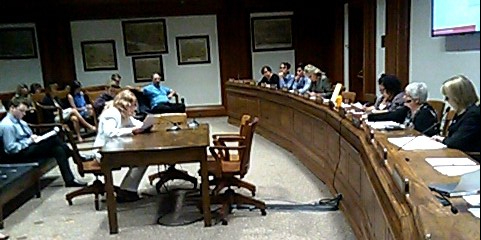
Barbara Govoni testifies during June 12 public hearing on H. 4541
As we reported in 2016, the number of participants in sheltered workshops dropped by 1,166 between August 2014 and August 2015 — a 61 percent reduction — while the workshops were being closed. In that same period, the number of developmentally disabled persons in corporate-run, community-based day programs increased by 1,116, almost the same number as the number of participants who had left the workshops.
Yet, the number of developmentally disabled people in “integrated employment” settings increased from August 2014 to 2015 by only 337, or about 6 percent. Placing people in integrated or mainstream employment was supposed to be the reason for closing the sheltered workshops!
Studies in other states have found similar outcomes from sheltered workshop closures.
We also want the members of the Children and Families Committee to understand that while H. 4541 is intended to address that unkept promise of access to mainstream employment, the bill isn’t intended to bring the actual workshops back.
DDS providers pushed for the workshop closures
We further want the legislators to know that while the closures of the sheltered workshops in Massachusetts was a policy of the administrations of then Governor Deval Patrick and later of current Governor Charlie Baker, the closures were supported by corporate providers to the Department of Developmental Services as well. The providers stood to gain financially from the closures to the extent that the closures would mean more funding for the provider-run day programs.
We have pointed out that organizations representing corporate DDS providers in Massachusetts co-authored at least two reports with DDS in the period leading up to and during the closures of the sheltered workshops in the state. The reports both called for the closures of the workshops and for more funding for day programs.
It seemed to us at the time, and still does, to be inappropriate for DDS to have allowed the providers to co-author a document that called for a public policy intended to ensure more funding for those same providers, particularly given that the policy was opposed by individuals and families who were benefiting from the workshops.
Misconceptions about the federal role in closing the workshops
As the then Patrick administration began closing the workshops in Massachusetts, the administration argued that the closures were mandated by the federal government and that Massachusetts had no choice but to comply with the federal order.
But the federal government was actually telling the states at the time that sheltered workshops were permissible for those who wanted to remain in them; the problem, according to the U.S. Department of Justice, was that some states were “over-relying” on the workshops. It also appears that unlike Massachusetts, many, if not most other states did not view the federal government as having issued a clear directive to close their workshops.
In remarks in late 2016, in fact, then DDS Commissioner Elin Howe stated that Massachusetts was only the fourth state in the country to have closed all of its sheltered workshops.
In comments made during the June 12 hearing of the Children and Families Committee, some of the legislators appeared to have the impression that the federal government had required the closure of all sheltered workshops around the country, and that the workshops no longer existed.
However, sheltered workshops are continuing to operate in other states, and there have been successful legislative efforts in some of those states to preserve the workshops as an option for those who desire them.
In Missouri, families mounted a successful effort last year to protect the workshops in that state, and that movement has reportedly spread to other states. State legislators in New Jersey similarly passed legislation last year to preserve the state’s sheltered workshops.
As things currently stand, the federal government has not ordered sheltered workshops to close and has extended a deadline for removing Medicaid funding for them until 2022.
We hope the state Legislature will recognize that H. 4541 is in line with federal guidelines because it doesn’t prevent anyone who wishes to do so from seeking employment in the mainstream workforce. The bill simply ensures that work opportunities exist for those who don’t choose to participate in mainstream employment.
In the end, H. 4541 is about choice.
Mother wages uphill battle for work opportunity bill for her developmentally disabled son
[Update: The Legislature’s Children, Families, and Persons with Disabilities Committee has scheduled a public hearing at the Statehouse on Tuesday, June 12, at 1 p.m. on H. 4541]
Barbara Govoni personally lobbied for months before a bill was finally filed in the state Legislature that would ensure that developmentally disabled individuals who are unable to function in mainstream work environments are provided with employment opportunities within their existing community-based day programs.
Govoni would now love to see H. 4541 move forward in the current legislative session. She believes it would ensure that meaningful activities are provided for her son, Danny Morin, and for many others like him.
But even though the bill has close to two dozen co-sponsors, time does not appear to be on Govoni’s side.
With the current two-year legislative session drawing to an end, a staff aide to Representative Brian Ashe, who filed the bill on Govoni’s behalf, acknowledged that the chances for passage of H. 4541 this year are slim. The bill was referred last month to the Children, Families, and Persons with Disabilities Committee.
Last September, we reported on Govoni’s efforts to reintroduce steady piecework activities in day programs for those who desire it. Danny had enjoyed the work he did in his Agawam-based sheltered workshop before that program and all other remaining workshop programs in the state were eliminated in 2016. After that, Danny was offered only day program activities in the same location, most of which he couldn’t relate to.
In recent months, Danny has been working once a week for about two hours at a time at an assembly and packaging company in Holyoke. It is a pale substitute for the steady work he enjoyed when he participated in the sheltered workshop.
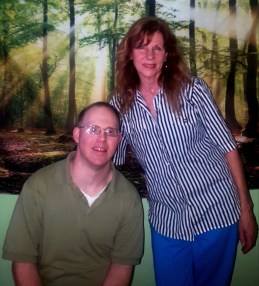
Barbara Govoni and her son Danny Morin
“People are suffering with not having enough work,” Govoni said. “This bill would have a monumental impact on the lives of these people if it were to pass.”
In addition to people such as Danny, there are many Department of Developmental Services clients who are either unable to function in mainstream work environments or are unable to work at a rate that those mainstream employers require.
H. 4541 specifies that the work program would be optional for day program participants and would allow them “an opportunity to work in a supportive employment environment which enhances productivity, safety and self-esteem.”
The work would be offered through the DDS-funded day programs for up to four hours a day. All participating individuals would receive a sub-minimum wage permissible under the federal Fair Labor Standards Act.
The Children and Families Committee had 30 days to act on the bill after it was referred there on May 21. But even if the committee were to act favorably on it within that time frame, the bill would probably still have to go through at least two additional committees including the House Ways and Means Committee before reaching the House and Senate floors. After July 31, formal business in the current two-year legislative session comes to an end.
A staff aide to Representative Kay Khan, House chair of the Children and Families Committee, said the committee will schedule a public hearing on the bill this month. But the aide said there is only “a very low chance” that bill will reach the floor of the House prior to the July 31 deadline.
We strongly support this legislation and hope it doesn’t lose the momentum it has gained so far if, as seems likely, it has to be reintroduced when the new legislative session begins next January.
We understand the Baker administration and previous Patrick administration objected to sheltered workshops as “segregated” settings because they offered work activities solely to groups of developmentally disabled persons.
What should make H. 4541 acceptable to people with those objections is that the employment program would be voluntary. In that sense, the bill mirrors language that was inserted in the state budget in Fiscal Years 2015 and 2016 that stated that sheltered workshops would remain open for those who wanted to remain in them. That language, however, did not prevent the Baker administration from closing all remaining sheltered workshops in 2016.
The voluntary nature of the employment program under H. 4541 may be why the bill has garnered co-sponsors from across the state. We hope more legislators begin to realize that the closures of the sheltered workshops has caused problems for many DDS clients, and that this bill is a good first step in addressing those problems.
Even though the bill’s chances are slim in the current session, we encourage people to call the Children and Families Committee to urge them to act quickly on the measure. You can reach the office of Rep. Khan, House chair, at (617) 722-2011, and Senator Joan Lovely, Senate chair, at (617) 722-1410.
Things ‘sliding backwards’ for two men after closure of their sheltered workshops (an update)
Makeshift solutions that were adopted in recent months to help two men cope with the closures last year of their sheltered workshops have not been successful, members of their families say.
“It’s sliding backwards,” Patty Garrity, the sister of Mark Garrity, said in an interview last week. She said a paper shredding experiment that was tried with Mark in March worked only temporarily. Mark soon lost interest in the activity and is bored in his day program, which replaced his sheltered workshop.
In a separate day program, Danny Morin’s temporary work came to an end a few months after it began. In addition, the clients in Danny’s program are now scheduled to be moved into smaller, separate day programs, and Danny’s mother is concerned he could be separated from his long-time girlfriend, another client in his program. The director of the program said that clients’ preferences would be considered in the relocation decisions.
While sheltered workshops were operating for both Mark Garrity and Danny Morin, piecework was always available and both men were satisfied and fulfilled by it, their family members say.
Barbara Govoni, Danny Morin’s mother, is trying to interest state lawmakers in her idea to reintroduce steady piecework activities in day programs for those who desire it. Govoni has proposed legislative language that would require the state to provide a “supportive work environment” to disabled persons who “cannot be comfortably be mainstreamed into a vocational community setting.”
In May, we first reported on the impact of the closures of their sheltered workshops on Mark and Danny and their families.
We noted that paid piecework and assembly work that had been given to Mark and Danny to do in their sheltered workshops were taken away last year and replaced by day program activities that they couldn’t relate to. In each case, their provider agency managed to come up with a makeshift solution to the problem that allowed the men to continue doing work similar to what they had done before.
Now it appears that those makeshift solutions haven’t solved the underlying problems created by the workshop closures for the two men and potentially others.
Sheltered workshops may have closed prematurely in Massachusetts
All sheltered workshop programs were closed in Massachusetts as of last summer as a result of requirements by the federal Centers for Medicare and Medicaid Services (CMS) that developmentally disabled people work in “integrated employment” settings in which a majority of the workers are not disabled.
But while sheltered workshops have been deemed “segregated” settings because they are offered solely to groups of developmentally disabled persons, many clients and their families and guardians have argued that the programs provide fulfilling, skill-building activities and do not preclude community integration. Moreover, it is not clear that the CMS has necessarily required the shutdown of all sheltered workshops.
In Massachusetts, the Baker administration and former Patrick administration claimed they had no choice but to close all of the workshops in the state, or else the federal government would bring a lawsuit against them. But many other states have apparently not acted in the haste that Massachusetts did in shutting the programs down. Last year, DDS Commissioner Elin Howe, who has since retired, stated that Massachusetts was one of the first states in the country to close all of its workshops.
Paper shredding activity for Mark Garrity didn’t last
At the Road to Responsibility (RTR) day program in Braintree, which Mark Garrity attends, Mark was frustrated for months after his sheltered workshop at the site was closed in September of 2016. Piecework activities that Mark enjoyed doing came to an end and were replaced by nature walks, cooking classes, and a money management class, none of which interested Mark.
After COFAR contacted DDS about Mark’s situation in early March of this year, RTR staff found a paper shredding activity for Mark to do. The activity received verbal approval from the DDS southeast regional director, who determined that it was in compliance with federal regulations.
The paper shredding seemed at first to be a good solution for Mark, and he even got paid for it. But Mark’s sister, Patty Garrity, said that Mark soon sensed a lack of structure and purpose in the activity. Mark is also sometimes asked to use the copy machine and to take the copied documents to staff offices; but Patty says that activity usually occupies only a few minutes of his day.
“I think he’s bored,” Patty said. “Every day I would pick him up and ask how’s it going with the shredding. It didn’t hold his interest.”
Patty said that despite the fact that funding was earmarked to pay Mark for doing the paper shredding, he recently stopped doing it. “Now he’s unproductive, and it’s not fair to him,” she said.
RTR officials have said that they did recently offer Mark an employment opportunity at a company outside of his day program; but Patty did not approve that offer for Mark, contending that Mark is not a suitable candidate for outside or mainstream employment. She said he is not able to produce at a rate that employers require in paying a minimum wage.
While his sheltered workshop was operating, Mark was paid by the piece, so the rate at which he was able to produce was not an issue. Moreover, jobs at the sheltered workshop would rotate. Mark was constantly busy then, Patty said, but now he is chafing under the lack of structure.
In addition, Mark appears to fall outside of at least one work category that still exists at his day program for clients who have been determined to be unable or too high-risk to function in the community outside the program. While those clients have been given work to do each day folding t-shirts, Mark has not been offered that work because he has not been ruled unsuitable for community interaction.
“They’re (the RTR staff) trying to do the best they can,” Patty said, “but the people are bored.”
Work at Work Opportunity Center site is intermittent
At the Work Opportunity Center day program in Agawam which Barbara Govoni’s son, Danny, attends, some piecework has been available intermittently from a company that is located in the same building in the center.
The company, Millennium Press, used to supply piecework activities to the Work Opportunity Center when the Center operated as a sheltered workshop. Now the company rents a portion of the Work Opportunity Center’s building.
The work offered by the Millennium Press to clients of the Work Opportunity Center since the closure of the sheltered workshop complies with federal regulations because non-disabled people also work for that company. Danny Morin and other clients of the Center signed an agreement to be paid a sub-minimum wage for doing the work.
However, Barbara said that the Millennium Press work is not steady. Danny and other clients in the Center were kept busy recently for three to four months putting stickers on envelopes and boxes for the company, but they finished ahead of schedule, she said, and the work came to an end.
Pushing for legislation to bring back workshop activities
Govoni has been trying to interest legislators and her congressman in filing legislation at either the federal or state level that would ensure the legality in Massachusetts and potentially other states of a steady supply of piecework activities for persons who desire them. She met last week with state Representative Brian Ashe, a Democratic legislator who represents her hometown of Hampden, to discuss her proposal.
Such legislation would be similar to language that was inserted in the state budget in Fiscal Years 2015 and 2016 that stated that sheltered workshops would remain open for those who wanted to remain in them. Unfortunately, that language did not prevent the Baker administration from closing all remaining sheltered workshops last year.
Govoni’s proposed legislative language would require the state or states (if her language was enacted by Congress) “to provide a supportive work environment, separate from the mainstream community, to enhance productivity, safety and self-esteem.” The language states that the separate work environment is not meant to exclude “other forms of integration or inclusion.”
We emailed Ashe’s legislative aide last month with our support of Govoni’s proposed legislation, but have not heard back. Govoni said Ashe told her he would bring her idea to the attention of “the proper legislative committee” in the Massachusetts Legislature.
Clients at the Work Opportunity Center will be split into groups
Govoni said the clients in her son’s day program will be split into three groups and that each group will be sent to a different day program location based on where they live. She was told at first that the decisions on the new locations would not be based on any existing preferences the clients had expressed such as preferences for maintaining relationships they may have formed in the Agawam center.
DDS regulations state that the Department must provide services that promote “self‑determination and freedom of choice to the individual’s fullest capability.” If clients are being moved to different locations without regard to their personal preferences, it would appear that they are not being allowed to exercise self-determination or freedom of choice in that respect.
Bob MacDonald, executive director of the Work Opportunity Center, said that after discussing the issue with DDS, he has received clarification that the relocations should take client preferences into account. MacDonald said each relocation decision will take into consideration 1) where the individual lives, 2) the “consumer’s preference,” and 3) the recommendation of the individual’s clinical care (ISP) team.
Without discussing specific people, MacDonald said that if two clients are known to have a relationship or a preference for staying together, that would or should be taken into consideration in the relocation decision.
We hope that Representative Ashe and others in the Legislature will make a sincere effort to promote legislation that will ensure the restoration of steady and meaningful work activities for those in DDS day programs that desire them.
Even if someone believes that DDS-centered work activities tend to segregate or exploit those individuals (and we don’t believe that to be the case), we think everyone should respect the wishes of those individuals and their families and guardians who want to engage in those activities. That is what self-direction and freedom of choice are all about.
A look at the struggles of two families to cope with closures of sheltered workshops in Massachusetts
When Massachusetts closed its remaining sheltered workshops for people with developmental disabilities last summer, deeming the programs “segregated,” the impact of the closures on workshop participants Mark Garrity and Danny Morin was pretty much the same.
The two men continued to go every day to their respective facilities where their sheltered workshops had formerly been operated by providers funded by the Department of Developmental Services. But while the providers continued to manage the same facilities, each provider now began offering their clients traditional, DDS-funded day program activities instead.
Paid piecework and assembly work that had been given to Garrity and Morin to do in their sheltered workshops were taken away and replaced by day program activities that they couldn’t relate to. In each case, their provider agency managed to come up with a makeshift solution to the problem that allowed the men to continue doing work similar to what they had done before.

Patty Garrity and her brother, Mark Garrity
But in each case, the solutions were implemented despite a lack of clear, written standards or guidance from the federal and state governments on the type of work and activities that were now permitted for the men. Their family and guardians were confused as well, often having to rely on information passed along from program staff or family of other clients.
Even some providers acknowledge that the system functioned more smoothly for everyone when the providers were operating their programs as sheltered workshops. At that time, participating companies would ship materials to the providers, and everyone at the workshop sites would have work to do — usually simple assembly jobs or packaging or labeling tasks.
Now, those providers must either send their clients to companies that offer to provide “integrated” work for them, or must try to continue to provide some on-site work under unclear rules that sometimes result in work arrangements that are adopted verbally and on a case-by-case basis. Moreover, most of their clients are now offered only day program activities that do not involve productive work and do not pay anything.
For Barbara Govoni, the mother of Danny Morin, and for Patty Garrity, the sister of Mark Garrity, the sheltered workshops were not only easier for them to deal with, they provided meaningful and satisfying activities for their respective loved ones.
“My argument is whether it was federal or state, they should not have taken away the workshops for those who can’t function in the community and disrupted their lives,” Govoni said. “I’m not opposed to finding jobs in the community or expanding day programs. I get it all has to do with money, but I feel that a group of people are being discriminated against based on the fact they had no voice or vote. They have been taken out of their element where they were comfortable.”

Barbara Govoni and her son, Danny Morin
Govoni views the policy of providing integrated employment to all developmentally disabled people as a “misguided one-size-fits-all” approach to a complex social need.
State cites federal pressure to close workshops
All sheltered workshop programs were closed in Massachusetts as of last summer as a result of requirements by the federal Centers for Medicare and Medicaid Services (CMS) that developmentally disabled people work in “integrated employment” settings in which a majority of the workers are not disabled, and that they be paid the minimum wage in those settings. Sheltered workshops were deemed “segregated” settings because they were offered solely to groups of developmentally disabled persons, and the clients were often paid only a nominal amount for the work they did.
In Massachusetts, the Baker administration claimed it had no choice but to follow the CMS rules and close all of the workshops in the state, or else the federal government would bring a lawsuit against them. But many other states have apparently not acted in the haste that Massachusetts did in shutting the programs down. DDS Commissioner Elin Howe stated late last year that Massachusetts was one of the first states in the country to close all of its workshops.
DDS and its major policy advisors, the Arc of Massachusetts and the Association of Developmental Disabilities Providers (ADDP), had actually wanted to close all of the sheltered workshops in Massachusetts as early as June of 2015. But in the wake of strong protests by families of workshop participants, the state Legislature temporarily slowed the closure process by inserting budget language in fiscal years 2014 and 2015, stating that DDS must continue to make sheltered workshops available for those clients who continued to want them.
But at the same time, the Legislature approved funding for the transfer of the participants out of the workshops and into day programs or employment programs. That move ultimately allowed the workshops to close while enabling legislators to claim they had acted to save the programs.
The closures of the sheltered workshops in Massachusetts resulted in the removal from those programs of close to 2,000 participants, but those closures do not appear to have translated into a steady flow of people into integrated employment.
Verbal permission given for on-site work
At the Road to Responsibility day program site in Braintree, which Mark Garrity attends, I met in late March with Patty Garrity and with senior staff of the provider and DDS officials to discuss Mark’s experience in making the transition from his sheltered workshop to the new system.
Like Barbara Govoni, Patty Garrity said the transition from the sheltered workshop has been difficult. Before RTR ceased operating as a sheltered workshop, Mark did a range of activities there, including collating, packaging, and other production work.
For months, after the workshop was closed in September of 2016, Mark was frustrated and angry, Patty said. RTR provided day program activities for him, but, as Patty put it, they “went over his head.” He wasn’t interested in nature walks or painting or cooking. In particular, he didn’t understand the class on money management.
In addition to his intellectual disability, Mark Garrity had suffered a traumatic brain injury in 1995 after having been hit by a car. He underwent years of rehabilitation from that accident, which had nearly killed him.
In a letter written before Mark’s sheltered workshop program was ended, Mark’s neurologist, Dr. Douglas Katz, a member of the Department of Neurology at Boston Medical Center and a professor at the Boston University School of Medicine, stated that participating in the workshop had been “an important part of his (Mark’s) rehabilitation effort…and…his life before his injury. It is an activity that is highly rewarding for Mark. He looks forward to it on a daily basis.”
Katz added that, “I understand this program is …likely to close because of new rules passed by the CMS. I think this would be a big loss for my patient Mark. I would support efforts to maintain this structured workshop for Mark and others that benefit from this service.”
As of March 2 of this year, when I first talked to Patty, RTR still had no work for Mark to do that was similar to the work he had done prior to RTR’s changeover from a sheltered workshop to a day program site. But as of March 20, RTR officials said they had found paper shredding work for Mark for two out of the four hours a day that he attended the program.
The paper shredding arrangement at RTR was done after DDS southeast regional director Richard O’Meara determined that it would not violate the CMS rules. O’Meara said the permission he gave to RTR to offer paper shredding to Mark was purely verbal. There was nothing placed in writing about it.
Hearsay information on piecework eligibility requirement
In January 2016, Govoni said, the Agawam-based Work Opportunity Center, her son’s former sheltered workshop provider, temporarily operated day programs in a function room in a local church after having closed its sheltered workshop program. “I walked in there one day (the temporary day program site),” she said, “and it appeared chaotic, with no structured activities.”
All of the Work Opportunity Center’s clients are now back at the agency’s facility. Govoni’s son gets sent out occasionally to integrated work sites and has some piecework to do at the Work Opportunity site as well. But the work is intermittent. She said she has also heard that those who want to do piecework at the Work Opportunity location will have to take a class explaining what piecework involves.
However, once again, Govoni said she has received nothing in writing about the reported class. She heard about it “through the grapevine.”
In the meantime, Govoni’s son receives a schedule of activities every month at the Work Opportunity Center. “I’m not saying it’s bad,” Govoni said, “but it’s not what he is interested in.” She said many of the activities are educational, such as lectures on geography or cooking demonstrations. Volunteer work is available as well at a local homeless shelter, and residents are taken on walks to the local library and other locations. “Danny doesn’t want to do that,” she said. “He wants to work.”
Both Govoni and Patty Garrity said Danny and Mark respectively didn’t care about making the minimum wage, and would rather work at their day program sites than get sent out to jobs in the community.
Disagreement over client and family satisfaction
If, like Barbara Govoni and Patty Garrity, family members are confused or dissatisfied by the current situation, O’Meara said, they aren’t letting him know about it. O’Meara said that he and DDS Area Director Colleen Mulligan, who was also in attendance at the March 20 meeting at RTR, are generally the first people whom family members and guardians call when there are problems with DDS care.
“I haven’t gotten a lot of complaints (about the closures of the sheltered workshops in his region),” O’Meara said. “Generally, if people are not happy, we know about it. These issues are addressed through the ISP (Individual Support Plans). I haven’t had many calls.”
Mulligan added that if problems were occurring like the ones Garrity has described, “I’m not hearing about it.”
But Garrity and some other advocates believe there may be few complaints now because the vocal protests that did occur when the workshop closures were first announced largely died down when families and guardians saw that their protests were having little effect.
A debate over integrated employment
At RTR, Chris White, the agency’s chief executive officer, maintained that even if the CMS requirements have been difficult to comply with, the requirements make sense because he believes that “everyone is capable” of working at integrated employment sites.
White’s viewpoint is in line with an August 2010 DDS policy document that states that “it has now been clearly demonstrated that individuals who were previously considered unemployable in integrated community settings can work successfully.”
But Govoni and Garrity maintained that the ideological viewpoint that the workshops segregated their participants and that integrated employment is feasible for everyone does not apply in their cases. “My son couldn’t wait to go to work (at his former sheltered workshop),” Govoni said. “He was not discriminated against. It was not a sweatshop for him, but the opposite. He doesn’t thrive in integrated sites. He would much prefer staying at the workshop where he was more comfortable. He doesn’t care what he gets paid.”
Govoni said that efforts to place her son in integrated work settings often did not work. In one case, she said, Danny was not able to do the work fast enough to satisfy the employer, and was terminated from the job. The speed of his work did not matter in the sheltered workshop.
Moreover, Govoni and Garrity maintained that even if integrated employment arrangements were feasible for everyone, there are not enough such jobs available to fulfill the demand now that the sheltered workshops are no longer available.
White said there were about 109 clients at RTR who were involved in “integrated group employment” at various job sites. That number was expected to rise this spring to about 120, he said.
At the same time, some 200 clients remained in RTR’s day program. White maintained, however, that those clients were happy with the activities they were doing, and that some were “on a retirement track.”
But it may be an open question whether all or most former workshop clients are really happy in day programs, or whether they simply have no choice but to remain in them.
Even DDS Commissioner Elin Howe appears to acknowledge that the state and its providers have been unable to find mainstream workforce jobs for a significant number of former workshop participants. While Howe made public remarks last year that we believe painted an overly rosy picture of the integrated employment situation, she did acknowledge that “many people transitioned (from sheltered workshops) to Community Based Day Support programs,” although she did not say how many.
Meanwhile, the Legislature has slowed funding for the transition to integrated employment. In order to carry out the administration’s integrated employment policy, the Legislature initially increased funding of the community-based day program line item in the state budget, and created a new line item to fund the transfers from the sheltered workshops. The idea was to increase both day program and job development staffing and training.
The new sheltered workshop transfer budget line item was initially funded in Fiscal 2015 with $1 million. That amount was raised to $3 million in Fiscal 2016, and the governor proposed to boost it to $7.6 million in Fiscal 2017. But the House and the Senate did not go along with the governor’s plan. The Legislature level-funded the line item for Fiscal 2017. The line item was not included in the governor’s budget for Fiscal 2018.
We agree with Garrity and Govoni that the case has not been made that integrated employment is suitable for all people with developmental disabilities, and it is apparent that not enough integrated work opportunities even exist for all of those that could benefit from it.
We think the federal government needs to rethink its flawed ideology regarding sheltered workshops, particularly the questionable claim that they are discriminatory and segregate their participants. The experience of Mark Garrity and Danny Morin provide further evidence that that claim is untrue.
DDS commissioner paints overly rosy picture of employment for developmentally disabled
In opening remarks at a conference on employment opportunities for the developmentally disabled late last year, Department of Developmental Services Commissioner Elin Howe gave what appears to be an overly rosy assessment of the likelihood of mainstream jobs for those people.
In her written remarks delivered to the November 30 conference, which was hosted by DDS and the UMass Institute for Community Inclusion, Howe appeared to imply that former participants in sheltered workshops, which the administration has worked to close, have been placed in mainstream jobs at a record rate.
“There are now more people working in individual jobs in the community than ever before,” Howe stated.
But while the numbers Howe cited show an increase in the number of people placed in mainstream jobs since 2013, it appears that most of that increase occurred between 2013 and 2014, before the workshop closures took place. Since 2014, DDS data indicates that the number of people finding mainstream jobs declined rapidly.
Howe noted that all remaining sheltered workshops in the state were closed as of last July 1, and that Massachusetts was only the fourth state in the nation to do that. But the loss of those workshops should not be a cause for concern, Howe contended, because, there were now more than 3,300 individuals working in “group supported employment” in the state – an increase of over 1,300 people since June 2013.
An increase of 1,300 disabled people in group supported employment would work out to a 65 percent increase in the number of people in that category since 2013, which sounds like a major success story.
But of that total increase cited by Howe of 1,300 individuals, 998 — or nearly 77 percent of them — appear to have entered group supported employment between 2013 and 2014, according to data provided by DDS.
The DDS numbers show there was an increase of only 146 people in group supported employment between August 2014 and August 2015. Between August 2015 and November 2016, when all remaining sheltered workshops were closed, there was an increase of only 156 people in group supported employment.
So, while the number of people in group supported employment appears to have increased by almost 50 percent between 2013 and 2014, the increase in the two-year period from 2014 to 2016 dropped to about 10 percent.
Group supported employment is defined by DDS as “a small group of individuals, (typically 2 to 8), working in the community under the supervision of a provider agency.” In contrast to sheltered workshops, supported employment places an “emphasis…on work in an integrated environment,” which means that developmentally disabled persons work in the same location as non-disabled individuals.
The closures of the sheltered workshops in Massachusetts has resulted in the removal from those programs of close to 2,000 participants since 2013; but those closures did not appear to have translated into a steady flow of people into supported employment. Even Howe appears to acknowledge that a significant percentage of those former workshop participants have not found mainstream workforce jobs.
In her remarks, Howe stated that “many people transitioned (from sheltered workshops) to Community Based Day Support programs,” but didn’t say how many. Day programs are often really just daycare programs that do not offer work-based or skill-building activities to the people in them.
The Massachusetts Developmental Disabilities Council, which is part of the Baker administration, appears to acknowledge the problem of employment in its State Plan for 2016, noting that:
…there are fewer people being placed in successful employment due to staff layoffs and the current fiscal environment. In order for more services to be made available, it is important to create partnerships and work with various state agencies in order to address this significant issue that is and will continue to be of concern. (my emphasis)
Last year, however, the Legislature failed to provide funding sought by Governor Baker for the transition from workshops to supported employment.
Rather than touting the supposed good news about the closures of the workshops, Howe should have acknowledged ongoing concerns about the apparent difficulty of finding mainstream work for people with developmental disabilities.
House and Senate not following their own funding plan for employment of the developmentally disabled
For the past three years, the state has been carrying out a policy of closing sheltered workshops for people with developmental disabilities and subsequently placing those people in mainstream workforce jobs.
Yet the Legislature, which bought into this policy, is failing to provide the necessary funding for it.
As the Department of Developmental Services and its corporate service providers jointly proclaimed in 2013, the policy has been to move developmentally disabled people out of sheltered workshops and into community-based day programs and ultimately to the mainstream workforce.
Sheltered workshops are settings in which developmentally disabled people work together on simple assembly-line tasks and are usually paid a small wage. The workshops have gone out of favor because they are viewed as “segregating” their participants from their non-disabled peers in the community.
Since 2013, the majority of the remaining sheltered workshops in Massachusetts have reportedly been closed. All are scheduled to be closed as of June 30 of this year.
But the problem is that the Legislature, and to some extent the administration itself, aren’t following through on the policy, which calls for beefing up funding for DDS day programs and job development staffing. Last week, the Senate joined the House in rejecting higher funding levels considered by the policy planners to be needed by both day programs and employment programs for Fiscal Year 2017.
The irony is that the Democratic-run House and Senate have proposed even less funding for these line items for Fiscal ’17 than Republican Governor Baker has.
A likely result of this apparent under-funding is that relatively few people will be placed in mainstream jobs, but rather will be sent to potentially overcrowded day programs with inadequate staffing.
Day and employment accounts were initially increased, but will now be under-funded or cut
In order to accomplish the policy for “integrated employment” of the developmentally disabled, the Legislature initially increased funding of the community-based day program line item in the state budget, and created a new line item to fund the transfers from the sheltered workshops. The idea was to increase both day program and job development staffing and training.
The new sheltered workshop transfer budget line item (5920-2026) was initially funded in Fiscal ’15 with $1 million. That amount was raised to $3 million in the current fiscal year, and the governor proposed to boost it to $7.6 million in Fiscal ’17. But the House and now the Senate are not going with the governor’s plan.
As the House did last month, the Senate last week approved a budget plan for Fiscal ’17 that will eliminate Governor Baker’s proposed $4.6 funding increase for the sheltered workshop transfer line item. Amendments proposed in both the House and Senate to restore the governor’s increase for the line item were rejected by the House and Senate leadership. As a result, the account will be level-funded next year, which amounts to a cut when adjusted for inflation.
Yet, even the governor’s proposed $4.6 million increase in this line item was $1 million too low, according to the Massachusetts Association of Developmental Disabilities Providers (ADDP). The ADDP lobbies on behalf of corporate DDS providers, which operate day and work programs throughout the state.
In addition, the Senate budget approved last week would provide $700,000 less in spending for the community day and work line item (5920-2025) than the amount the House and the governor proposed. The governor and the House proposed a 4.9 percent increase in that account for Fiscal ’17.
In an email sent to members in early May, the ADDP contended that even the 4.9 percent increase in the day and work line item was $9.8 million less than the what was needed to maintain existing services. As a result, according to the ADDP, DDS was already planning to cut 5 percent in funding for contracts with all day and employment providers.
Should the Senate’s budget plan prevail regarding the day and work line item, it would seem the cut in contract funding for day and employment providers would have to be even deeper than 5 percent.
ADDP urged higher funding and staffing for day care and employment programs
Both the ADDP and the Arc of Massachusetts have become virtual partners with DDS in the operation of the department. The Arc and the ADDP co-authored a report with DDS in 2013 that called for the closures of the sheltered workshops as of June 2015. While that goal wasn’t met, DDS is continuing to work for those closures as of this June of this year.
In comments submitted to EOHHS Secretary Marylou Sudders late last year, the ADDP maintained that funding for both the community day and work line item and sheltered workshops transfer line items needed to be boosted significantly in order to fulfill the plans to close the workshops and transfer clients to mainstream jobs. A failure to boost that funding could put the state in violation of requirements issued by the federal Centers for Medicare and Medicaid Services (CMS), according to the ADDP.
The ADDP comments also noted that as of October 2015, the number of individuals receiving community based day services more than doubled from 2,656 individuals as of June 2013, to 5,422. While noting that this increase was directly related to the closures of the sheltered workshops, the ADDP stated that the majority of those persons were not receiving any other DDS-funded employment services.
The ADDP comments also pointed out that DDS day programs require significantly higher levels of staffing than the sheltered workshops did.
As we pointed out in a blog post in January, DDS records show that the number of participants in sheltered workshops dropped by 61 percent between August 2014 and August 2015, and the number of persons in corporate-run community-based day programs increased by 27 percent. Yet, the number of developmentally disabled people in “integrated employment” settings rose during that same period by only about 6 percent.
It appears that the only policy the Legislature and the administration have pursued with a real level of commitment has been closing the sheltered workshops. But that’s only half the plan. The problem with the Legislature, in particular, is that while it bought into the first half of the plan, it now has seemingly abandoned the critically important second half.
Thousands of people have or will be removed from their sheltered workshops, and the Legislature appears to be leaving an unknown number of them in the lurch.
Few people moving from sheltered workshops to “integrated” jobs
While the Baker administration appears to be moving ahead with a policy of closing all remaining sheltered workshops for developmentally disabled persons in Massachusetts, records show that relatively few people so far have been transferred from the workshops to the “integrated employment settings” that are supposed to replace them.
Confirming our concerns, the data from the Department of Developmental Services show that most of those people have been transferred to community-based day programs funded by DDS or MassHealth.
This has financially benefited corporate DDS providers that run the day programs and that have been among the most vocal proponents of shutting down the sheltered workshops. In what we consider to be an example of the inappropriate influence of private interests in DDS policy, two of those provider organizations actually helped draft a key DDS document that called for the workshop closures.
According to DDS records, the number of participants in sheltered workshops dropped by 1,166 between August 2014 and August 2015 — a 61 percent reduction from the 1,913 people who had been in those programs. The number of sheltered workshop providers dropped from 39 to 14.
In that same period, the number of developmentally disabled persons in corporate-run, community-based day programs increased by 1,116, or 27 percent.
In contrast to the increase in day program use, the number of developmentally disabled people in “integrated employment” settings increased from August 2014 to 2015 by only 337, or about 6 percent. DDS said it had no records on the number of integrated workplaces that exist in Massachusetts.
Community-based day programs actually cost considerably more to run than do sheltered workshops, according to an expert in the field.
A DDS document in November 2013, titled “Blueprint for Success,” stated that it was the department’s goal to close sheltered workshops to new participants as of January 2014 and to close all remaining workshops as of June 30, 2015. The closure of all of the workshops has not yet occurred, but it appears to be likely to happen despite protective language placed in the state budget for the workshops.
The title page of the Blueprint states that the document was prepared by DDS and by the Massachusetts Association for Developmental Disabilities Providers (ADDP) and the Arc of Massachusetts. Both the ADDP and the Arc are largely supported by DDS-funded providers, which have benefited from higher DDS funding for the day programs to which most of the former sheltered workshop participants have been transferred.
The Blueprint called for a total of $26.7 million in state funding over a four-year period for the transition from sheltered workshops to mainstream work settings. But the document did not offer specifics as to how those mainstream jobs would be found.
A 2014 Blueprint Progress Report, drafted by DDS and the ADDP, stated that $3 million allotted in the Fiscal Year 2015 budget for the transition from the sheltered workshops fell short of $5.5 million that DDS and the corporate providers had requested. Nevertheless, the report stated that 31 of 39 provider agencies would receive funding to transfer participants out of the workshops.
It now appears most of the funding has gone toward community-based day programs. The expert we talked to suggested that it would have been more effective had the funding been earmarked for subsidies for employers for hiring developmentally disabled workers.
Sheltered workshops provide developmentally disabled persons with a range of assembly jobs and other types of work, usually for a small wage. But the programs have become targets of a political ideology that holds that any type of congregate care setting is institutional in nature and therefore bad for those involved. Sheltered workshops allegedly “segregate” developmentally disabled people from their peers in the wider community or in the mainstream workforce.
“Integrated individual employment” is defined by DDS in a 2010 policy directive as “taking place in a workplace in the community where the majority of individuals do not have disabilities.” In addition, the policy directive states that the “optimal employment status is earning the prevailing wage.”
Many families of the sheltered workshop participants have countered that those programs are fully integrated into the surrounding communities and provide the participants with meaningful activities and valuable skills. Those families have also raised concerns that there are relatively few integrated or mainstream workforce jobs available for people with developmental disabilities; and that absent a sufficient number of such jobs, former sheltered workshop participants are likely to be transferred permanently to community-based day programs that do not offer the same activities or skills as the workshops did.
The contrast between the percentages of people who have been transferred to day programs and those placed in integrated employment is not alluded to in a September 2015 progress report submitted by DDS to the Legislature’s House and Senate Ways and Means Committees and to the Children, Families, and Persons with Disabilities Committee. The data noted above on the numbers of people in sheltered workshops and other programs in 2014 and 2015 can be found in tables in the report; but there was no analysis in the report of the data and no conclusions drawn based on that data.
In that five-page report, DDS Commissioner Elin Howe stated that DDS was offering training and consultation services to day program providers on the “delivery of quality, inclusive community based services…” Howe also said DDS was working “to assure that all individuals have access to and integration in the community…”
But Howe did not explain in the report how or when that access to integration in the community would be achieved by DDS. Howe’s report also provided no data or information on the types of services offered in community by day program providers or how successful those programs might have been.
The DDS’s 2010 policy directive similarly did not contain a plan for placing former sheltered workshop participants in mainstream jobs; but the policy directive did take a strong ideological stance against the workshops, going as far as to state that mainstream employment had been shown to be “a viable option… even for those individuals with the most significant level of disability…” No evidence or source was cited for that statement.
The disappearance of sheltered workshops appears to be yet another example of the erosion of cost-effective care for the developmentally disabled due to the influence of corporate interests that stand to benefit financially from it. At the very least, this case shows that a public agency should not develop policies jointly with the corporate contractors that it funds.
Sheltered workshops being closed in MA despite protective budget language
Despite the passage of protective language in the state budget last year and this year, the Department of Developmental Services appears to be moving rapidly to shut down all remaining sheltered workshops in the state for people with developmental disabilities.
“Can’t believe after all the hard work so many people put in, it (the workshop closures) is still happening,” one workshop supporter wrote in an email, referring to grassroots lobbying efforts mounted in the past two years to keep the workshops open.
The protective language that was inserted by State Representative Brian Dempsey in the past two years into the DDS community day line item in the budget seemed to be definitive. The language states that DDS “shall not reduce the availability or decrease funding for sheltered workshops serving persons with disabilities who voluntarily seek or wish to retain such employment services.”
At the same time, however, Dempsey’s House Ways and Means Committee supported the appropriation of $1 million last year and $3 million this year in a separate DDS line item to fund the transfer of people from sheltered workshops to community-based day or employment programs. So, even while the language in one line item has appeared to protect the workshops for those who want to remain in them, the other line item has funded the removal from the workshops of everyone whose guardians haven’t formally objected to moving them to the day programs.
Sheltered workshops around the country have become an ideological target of the federal government and of many states, which contend that the workshops “segregate” people with developmental disabilities from their peers in the mainstream workforce. But many families of the sheltered workshop participants have countered that the programs are fully integrated into the surrounding communities and provide the participants with meaningful activities and valuable skills.
Sheltered workshops provide developmentally disabled persons with a range of assembly jobs and other types of work, usually for a small wage.
In 2013, the Massachusetts DDS and the state’s major lobbying organizations for corporate DDS providers issued a plan to close all sheltered workshops as of last June, and to transfer all of the participants to either DDS day programs or to “integrated individual or group employment at minimum wage or higher.”
Sheltered workshops are defined by the Social Security Administration as “a private non-profit, state, or local government institution that provides employment opportunities for individuals who are developmentally, physically, or mentally impaired, to prepare for gainful work in the general economy. These services may include physical rehabilitation, training in basic work and life skills…”
Integrated employment is defined by the federal Labor Department as “jobs held by people with disabilities in typical workplace settings where the majority of persons employed are not persons with disabilities, where they earn at least minimum wage, and where they are paid directly by the employer.”
Our concern regarding the DDS/corporate provider plan to close sheltered workshops is that there appears to be a limited number of opportunities in Massachusetts for persons with developmental disabilities to find jobs in “typical workplace settings” where the majority of the people employed are not disabled. Unless and until these integrated workforce opportunities exist in sufficient quantities, we don’t think sheltered workshops should be eliminated as options.
Unfortunately, the state’s attitude concerning care for the developmentally disabled has long been to close facilities that are considered expensive or that otherwise don’t fit an ideological mold, without having a plan or sufficient resources to adequately replace those facilities.
The director of one sheltered workshop program I talked to said that while there hasn’t actually been a directive from DDS to transfer everyone out of his workshop by a particular date, DDS recently indicated that transfer funding had become available and that his workshop should “determine who would move at this time.”
The workshop director said he planned to transfer more than half of the program’s current participants out between next month and March of next year. While the protective language in the budget would appear to allow the guardians of the workshop participants to object to the transfer plans, the workshop director said no one had yet voiced an objection. It’s possible, he said, that people will begin to object once the transfers start. But he said he sensed less resistance among families and guardians to the prospect of leaving his workshop program than was the case two years ago.
One of the existing integrated work settings in Massachusetts is MicroTek in Chicopee, an electronic cable manufacturer. The company employs 130 people, 15 of whom have disabilities, according to Cynthia Piechota, the company’s program director. Piechota said she knew of only a handful of other integrated work programs in the state.
A workplace program that is smaller than MicroTek, but similar to it, is Interface Precision Benchmarks (IPB) in Orange, where six people are employed in manufacturing electronic cables. The IPB workforce is currently divided evenly between disabled and nondisabled employees (3 disabled and 3 nondisabled); thus it’s not clear that IPB actually fits the Labor Department’s definition of an integrated workplace.
Ed Orzechowski, whose sister-in-law, Carol Chunglo recently retired as an IPB employee, said he and his wife, Gail, “can’t say enough about what a positive experience it was for Carol to work at IPB. There should be more places like it.” Ed Orzechowski is a COFAR Board member and president of The Advocacy Network, an affiliated advocacy organization for people with developmental disabilities in Massachusetts.
A University of Massachusetts report noted that in 2010, there were 3,700 people with intellectual disabilities in sheltered workshops in Massachusetts and about 3,500 people in “integrated employment.” However, there were about 9,500 people in “non-work” settings, which appear to include DDS day programs.
COFAR has filed a Public Records Law request with DDS to try to determine how many people the Department anticipates will be transferred over the next five years to integrated workplaces, and how many will be transferred over that time to DDS day programs.
It’s unfortunate that sheltered workshops appear to be going the way of so many other previous high-quality programs and services for people with developmental disabilities in Massachusetts. The potential elimination of these services is usually vigorously opposed by families and guardians who understand how critically important they are. But DDS has long perfected a wait-them-out strategy.
The Department understands that grassroots resistance to new, untried policies, can be worn down over time.
The HW&M budget has great news for sheltered workshops, not so good news for state care in general
The great news is the House Ways and Means Committee re-inserted protective language last week in the proposed Fiscal Year 2016 state budget that would protect vital sheltered workshops from closure.
Representative Brian Dempsey, chair of the committee, who was instrumental last year in keeping the workshops open, has renewed his commitment to those facilities in this year’s budget go-round with the administration.
The bad news is that the House Ways and Means budget continues to squeeze state-run programs for the developmentally disabled and maintains the administration’s disproportionate increase in proposed funding for the corporate, provider-run group home system. But let’s look at the good news first.
Last spring, after a lobbying campaign by advocates of the workshops, Dempsey placed language in the House Ways and Means version of the current-year budget, stating that DDS “shall not reduce the availability or decrease funding for sheltered workshops serving persons with disabilities who voluntarily seek or wish to retain such employment services.” The protective language survived a House-Senate conference committee in June, largely due to Dempsey’s support.
While that protective language in the budget appeared to offer the workshops an indefinite reprieve, the proposed fiscal 2016 budget submitted by Governor Charlie Baker in March removed the language. As a result, the workshop supporters went to work once again in the past month, calling Dempsey’s office and urging their local legislators to reinstate his language.
Dempsey did reinstate the language; and in a conference call last week concerning the House Ways and Means budget plan, DDS Commissioner Elin Howe indicated that the administration did not intend to file any amendments to remove the language from the budget legislation. It also appears that organizations representing corporate DDS providers, such as the Association of Developmental Disabilities Providers, have not filed amendments to close the workshops.
It is now up to the Senate and specifically to Senator Karen Spilka, the chair of the Senate Ways and Means Committee, to follow Rep. Dempsey’s lead and insert the same protective language in the Senate budget.
The workshops first came under attack from the administration of then Governor Deval Patrick, which targeted them for closure as of this coming June, arguing that they were “segregating” disabled persons from their peers in the mainstream workforce. But families of the workshop participants fought back. They maintain that the facilities are fully integrated into the surrounding communities and provide the participants with meaningful activities and valuable skills.
Sheltered workshops provide developmentally disabled persons with a range of assembly jobs and other types of work, usually for a small wage.
Meanwhile, the bad news we were talking about largely concerns funding for DDS group homes, remaining developmental centers, and service coordinators. The House Ways and Means budget proposal would cut the developmental center line item even deeper than Governor Baker has proposed and would reduce the service coordinator line item below the amount proposed by the governor. It would also fund the state-operated group homes at a level below what DDS considers a “maintenance level.”
While the state has closed three of six existing developmental centers since 2008 and is in the process of closing a fourth, funding appropriated to run the remaining three centers may have dropped too fast to maintain existing services in those facilities. As we recently noted, years of cuts in the developmental-center line item have lately resulted in the closing of several cottages at the Wrentham Developmental Center, requiring residents to be moved from long-time residential locations.
The Wrentham Center has become a major destination for persons transferred from the developmental centers that have been closed in recent years.
While Governor Baker’s fiscal 2016 budget would cut the developmental center line item by about $375,000 from projected spending, the House Ways and Means budget would cut it by $1 million beyond that.
DDS-operated group homes would get the same amount in fiscal 2016 under the House Ways and Means budget as under the governor’s version of the budget, which amounts to a $2 million reduction from what DDS considers a “maintenance budget.”
Also, the House Ways and Means budget would fund the DDS line item that pays service coordinators at a level $538,000 less than what Baker has proposed. In March, DDS Commissioner Howe had said Baker’s budget would fund the service coordinator line item at $1.8 million below what DDS had requested. So the House Ways and Means budget further reduces that proposed funding for the service coordinators next year by more than half a million dollars.
The service coordinators, whom Howe has referred to as “the heart and soul” of DDS, are responsible for ensuring that clients throughout the system are receiving services to which they are entitled. The service coordinators have seen their caseloads rise dramatically in recent years.
In last week’s conference call, Howe noted the shortfalls in funding under the House Ways and Means budget for the developmental centers, DDS-operated group homes, and service coordinators. But in what may be a sign of the priority that this administration places on these services, Howe said the Department did not plan to seek amendments to the House budget to increase that funding.
At the same time, the House Ways and Means budget preserves a major funding increase to the corporate providers in the coming fiscal year. The Ways and Means plan provides for the same $35 million increase from the current year for the DDS corporate residential line item that Baker has proposed. As of July, this line item will have been increased by more than 28 percent since the filing of a lawsuit by the corporate providers in June 2014 against the then Patrick administration.
While we understand that direct-care workers in corporate, provider-operated group homes are woefully underpaid, it’s not clear how much of the additional funding being sent to the providers is, or will be, going to those workers. As we have noted, the hundreds of executives working for those provider agencies in Massachusetts have been making out quite well.
The Baker administration is apparently fine with that state of affairs. Terming the House Ways and Means plan “a very reasonable budget,” Howe pointed out that it would add $17 million to the DDS bottom line compared to the governor’s budget. Under the House Ways and Means budget, the Community Day and Work line item would be almost $10 million higher than what the governor proposed.
The House Ways and Means budget also would provide $12.4 million under a new DDS line item to implement the expansion of DDS eligibility to people with autism, Prader-Willi, and Smith-Magenis Syndrome.
While that expansion of eligibility funding is certainly needed, the Senate has a lot of other work in store for it as well. We hope that in addition to protecting the sheltered workshops, the Senate begins to address the imbalance in the budget between corporate and state-run DDS care.
Sheltered workshops for the disabled win big reprieve in Massachusetts
A major effort by advocates of sheltered workshops in Massachusetts to persuade state legislators and the Patrick administration that the workshops provide invaluable skills and activities for their loved ones with intellectual disabilities has paid off.
Last week, Governor Patrick signed the Fiscal Year 2015 state budget, which contains language protecting the workshops from closure. The language states that the state must not “reduce the availability or decrease funding for sheltered workshops serving persons with disabilities who voluntarily seek or wish to retain such employment services.”
The passage of this language appears likely to cause at least a slowdown in the administration’s plans to close all remaining sheltered workshops in the state as early as next June. The administration has contended that sheltered workshops “segregate” people with developmental disabilities from their non-disabled peers in the mainstream workforce. Supporters of the workshops, and we are among them, argue that the workshops provide needed skills and fulfilling work for people with intellectual disabilities, and do not prevent them from contact with peers in the community.
The protective workshop language survived a House-Senate conference committee late last month, and Gov. Patrick had until last Friday to line-item veto it, and chose not to do so. So, it’s now the law.
The legislative victory is largely due to an intensive effort by workshop supporters to get the word out to key legislators — particularly to Rep. Brian Dempsey, chair of the House Ways and Means Committee — of the value of the workshops, and of the contention that the administration and corporate provider-based organizations such as the Arc of Massachusetts were spreading misinformation about them. Dempsey, in particular, has turned out to be a strong supporter of the workshops, particularly in the budget conference committee.
It remains to be seen whether the protective language will help people like Tom Urban, a 55-year-old man with Down Syndrome, who had been employed in a sheltered workshop for the bulk of his adult life, according to his brother and guardian, Richard. Richard said that last December, he was informed that all sheltered workshops were being closed and that Tom would no longer be employed, as of the very next day, in his workshop, operated by Work, Inc., a Department of Developmental Services provider.
“To put it mildly, this was a rather disruptive change in Tom’s life with no opportunity to prepare him for this shocking development,” Richard Urban wrote in an email to Rep. Dempsey in late May. “Moreover,” he said, “no chance was provided for me, as his brother, guardian and caretaker, to voice any opposition, or input, to this policy change imposed by (DDS).”
Richard said that although Tom “has limitations in a variety of areas, his work ethic and paycheck (from his sheltered workshop program) were two constants that allowed him a place on a playing field of equality with his peers, family and friends.” Since his “forced exit from his workshop,” Richard added, Tom “has grown distant, is very confused, and expresses continued sadness over his job loss. His identity, and work community, have been lost, through no fault of his own but by virtue of a policy shift for which I am at a complete loss to understand.”
The effort to close the workshops has been driven by an extreme anti-congregate care ideology that the Patrick administration subscribes to. Simply because a group of disabled people work together in sheltered workshops, the administration considers it to be a “segregated setting.” As a result, we are concerned that despite the budget language allowing those who are currently in workshop programs to remain in them, people like Tom Urban, who have lost their workshop programs or are seeking for the first time to get into one will find not be able to do so. Last year, the administration announced it would no longer allow new referrals to sheltered workshops in the state as of this past January.
In addition, the FY 2015 budget contains at least two reserve funds totaling $3 million to support the transfers of persons from sheltered workshops to provider-run day programs and unspecified job training programs. While the administration contends that intellectually disabled people will all be able to reach their potential in mainstream or “integrated” work environments, there is uncertainty over how many mainstream jobs really exist for most people with developmental disabilities, and many questions about what integrated employment really means.
Sheltered workshops have won a welcome reprieve in Massachusetts, but their future still remains uncertain; and also uncertain are the long-term prospects of fulfilling work activities for thousands of people with developmental disabilities in the state.
 COFAR blog