Archive
Volunteer advocates meet with state senators’ staffs in start of effort to preserve Wrentham and Hogan centers
The fight to preserve the Wrentham and Hogan care centers in Massachusetts began this past Friday with a visit to the State House of a dozen advocates and family members of persons with intellectual and developmental disabilities.
Our group, which included several COFAR members, held meetings with legislative aides to State Senators Paul Feeney and Rebecca Rausch. Rausch’s district includes the Wrentham Developmental Center.
Jim Durkin, legislative director for AFSCME Council 93, a state-employee union in Boston, spoke to us prior to the Friday meetings, noting that AFSCME is currently deeply involved in fighting to save the Pappas Rehabilitation Hospital.
“AFSCME is fully behind your efforts to preserve Wrentham and Hogan, which are vital to the fabric of care in this state,” Durkin said. “Right now, we are fighting the battle for the Pappas Hospital, but we will be working with you to make sure that the ICFs are protected as well.”
The Healey administration’s move to close Pappas and allow Wrentham and Hogan to die by attrition are all part of the same effort to eliminate state-run care under what we have long argued is a faulty assumption that it will save the state money.
The first meeting we had on Friday was with Shane Correale, legislative director for Senator Feeney. We have asked Feeney to draft legislation that would open the doors at Wrentham and Hogan to new admissions and establish housing on the campuses of the facilities for elderly family members of the residents.
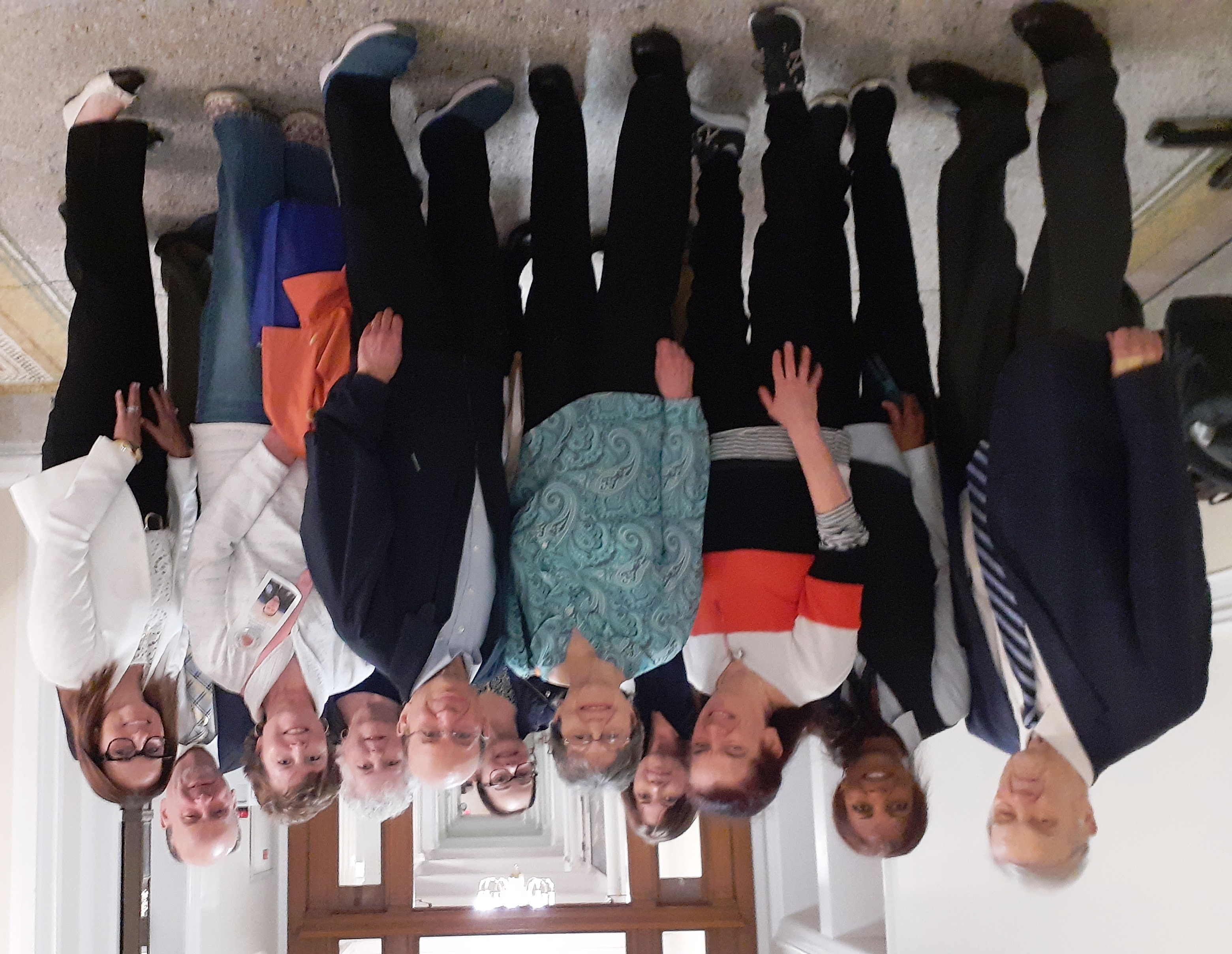
Wrentham and Hogan advocates at the State House — (Left to right) Mitchell Sikora (COFAR Board member), Marsha Hunt, Shiri Ronen-Attia, Laurie Noland, Ilene Tanzman, Ana Paula Meehan, Allan Tanzman, Mary Dias, Elaine Strug, Jim Durkin (AFSCME Council 93), and Kim Meehan. (Photo by David Kassel)
During that meeting, COFAR member Irene Tanzman stressed the importance of Intermediate Care Facility (ICF) settings, such as Wrentham and Hogan, which meet federal standards that are stricter than the state standards for group homes. “Not everyone thrives in the community,” Tanzman said, adding that the state is “denying us the opportunity” for ICF-level care.
“We want choice,” Tanzman added. “The community is a legal fiction. People coming in get nothing. They get so-called self-directed services with inadequate or no budgets.”
Kim Meehan, a COFAR member, talked about her successful effort last year to gain admission to Hogan for her legally blind and quadriplegic sister Kristen. But Kristen’s admission came only after a lengthy battle that included blog posts by COFAR in support, and coverage by Fox 25 news.
“There was no place for Kristen to go,” Kim said, explaining the situation her sister was facing while being kept for two months at Faulkner Hospital. “DDS kept using the verbiage that the community would be the ‘least restrictive’ setting for her. It didn’t matter to DDS that her doctor said she needed an ICF.”
Mitch Sikora, a COFAR Board member, recounted the landmark Ricci v. Okin litigation in the 1970s and 1980s that led to major improvements in state-run facilities that serve people with intellectual disabilities. Many aging people with intellectual disabilities, he noted, are in particular need ICF-level care because facilities such as Wrentham and Hogan are equipped and staffed to serve people with complex medical needs.
Sikora also discussed the comprehensive care his brother Stephen has received at Wrentham.
Both Shiri Ronen-Attia and Marsha Hunt pointed out that their sons are nonverbal, don’t socialize, and have no interest in group activities — characteristics that make them different from most people with developmental disabilities who are suitable candidates for community-based settings. “Group homes can’t meet their needs,” Ronen-Attia said. “They have no voice.”
Hunt said that her son “sits day after day with nothing to do.” He is not provided in his group home with the occupational, physical, or speech therapy that might enable him to make progress in those areas, she said.
As I noted, many group homes have become the new warehouses in which intellectually disabled people are now largely placed.
We also discussed the proposed legislation that Senator Feeney has agreed to draft. As Irene noted, the legislation was proposed some five months ago.
Correale said Feeney’s staff was still working on our legislative proposals, and was “trying to bring them to the Senate as an institution.” He said Feeney’s office has begun discussing the legislation with the co-chairs of the Children, Families, and Persons with Disabilities Committee.
COFAR has specifically asked Feeney’s office to draft language to be added to the ICF line item in the state budget, stating that persons who qualify for community-based care from DDS have a right to ICF care.
In sum, Friday’s meetings convinced us that if state-run ICF care is to be preserved in Massachusetts, advocacy efforts must continue, and should be combined, if possible, with the ongoing effort to save the Pappas Hospital. We recognize that this will be an uphill battle.
But the good news is that we got what seemed to be a sympathetic hearing on Friday from the staff members of the two legislators. What is needed going forward is for the lawmakers themselves to attend the advocacy sessions, and to publicly support the preservation of state-run care.
 COFAR blog