Archive
Federal government moves to preserve subminimum wages
In what we consider to be very good news for people with intellectual and developmental disabilities (I/DD) who are seeking work opportunities, the federal Department of Labor announced this month that it has ended an effort started by the Biden administration to phase out the payment of subminimum wages.
Subminimum wages have been permitted under federal law since 1938 to ensure that people with I/DD are not denied work opportunities.
While opponents of subminimum wages argue that they are discriminatory, we and a number of other advocates maintain that those wages have helped many people who would otherwise be unable to find work in the competitive, mainstream workforce.
The Trump administration’s decision to keep subminimum wages in place comes as the administration has also offered the public an opportunity to propose the elimination of federal regulations considered burdensome or unnecessary.
In response, we have joined other advocates in calling for the termination of the federal “Settings Rule.” The Settings rule sharply restricts congregate programs for persons with I/DD, including sheltered workshops.
Massachusetts had previously eliminated subminimum wage payments and sheltered workshops
We hope the latest federal action on subminimum wages will change the dynamic in Massachusetts, which had previously adopted a policy of eliminating those wages for clients of the Department of Developmental Services (DDS).
In April 2023, DDS announced it was no longer allowing the payment of subminimum wages to anyone entering a DDS-funded employment program. Previously, as of 2016, Massachusetts had eliminated all remaining sheltered workshops in the state. That policy resulted in an erosion of work opportunities for people with I/DD, according to data analyzed by COFAR.
The Healy administration has adopted an “Employment First” policy framework under which it has made it a priority to place DDS clients in jobs in “integrated settings,” with wages at or above the state’s minimum wage of $15 per hour.
Closing workshops did not lead to more integrated employment in the state
But those policies have not been successful in getting DDS clients into mainstream or integrated employment, according to the data we have reviewed.
In 2021, we reported DDS data showing that total integrated employment hit a peak of 7,180 DDS clients in October 2019, and then declined to 7,090 as of October 2020.
The data were contained in a DDS 2021 “progress report,” which also showed that the number of clients being placed in day programs after the closure of the state’s remaining sheltered workshops had far outpaced the number entering integrated employment.
The 2021 Progress Report acknowledged that the state was experiencing “difficulty obtaining job opportunities for individuals with significant disabilities who require customized work.”
There don’t appear to have been any further Progress reports since 2021. However, we were able to locate a DDS “Statewide Employment Snapshot” for 2024.
The Snapshot report contained data indicating that the elimination of the subminimum wage paid to clients of DDS providers increased the average wage received by DDS clients. However, according to the data, 547 fewer people overall were working in integrated employment in 2024 than in 2019. That was a drop of more than 11%.
The Snapshot acknowledged that the total number of people in integrated jobs still did not return to pre-COVID levels. The Snapshot, however, didn’t discuss whether the decrease may have been due to the minimum wage requirement.
Family advocate wants Massachusetts to revisit its elimination of the subminimum wage
As we have previously reported, Patty Garrity’s brother Mark, 54, used to participate in a sheltered workshop in Braintree run by Road to Responsibility (RTR), a provider to DDS. When the workshop closed, Mark’s program, like others throughout the state, was converted into a day program.
Patty said this week that she still takes Mark to the day program once a week for two hours. When it was a workshop, Mark worked 25 hours a week there and would perform simple tasks such as placing stickers on packaging or assembling simple products. He took pride in that work and found fulfillment in it, Patty said. Now he has nothing to do other than occasional paper shredding.
“Mark can contribute, learn, and work to his capacity, but he’s not learning now,” Patty said. “He hasn’t learned a new skill in 10-plus years.”
Mark, as Patty has pointed out, is not a viable candidate for integrated employment. He cannot produce at the rate necessary to earn the minimum wage. “He deserves to be protected by this (subminimum wage) law,” she said. “It’s time to revisit it (the elimination of the subminimum wage in Massachusetts). Eliminating the subminimum wage is not working.”
Patty added that the lack of viable activities in Mark’s day program has led to increased anti-social behaviors by many of the participants there. “They are bored there,” she said.
We hope the Healey administration ultimately takes a cue from the federal government and revisits its subminimum wage policy, as Patty suggested.
In our view, the data showing that integrated employment actually declined in Massachusetts since the closures of the workshops and the restrictions on the subminimum wage are evidence that those policies have failed.
We still need the subminimum wage and work opportunities in day programs for people with intellectual disabilities
We are hoping we can help the members of the Massachusetts congressional delegation understand the severity of the problem caused by the lack of meaningful employment opportunities for people with intellectual and developmental disabilities (I/DD) in this state.
On June 27, we held a Zoom meeting with an aide to Senator Elizabeth Warren to discuss that problem and the decline of the state’s two remaining Intermediate Care Facilities (ICFs) as options for residential services. That latter issue will be a subject for another blog post.
Among those attending was Jim Durkin, legislative director for AFSCME Council 93 in Boston. Also attending was Patty Garrity, whose brother Mark, is one of potentially thousands of clients of the Department of Developmental Services (DDS) who are facing a lack of meaningful work activities in their day programs.
Unfortunately, when it comes to providing employment for people with I/DD, most members of Congress appear to be heading in the wrong direction. For years, members of the state delegation have supported legislation that we think would effectively discourage such opportunities.
While Senator Warren, in particular, has been a strong voice for workers, she has also unfortunately been out front in mistakenly opposing the payment of subminimum wages to people with disabilities in congregate and other work settings.
We strongly support the payment of at least a $15-per-hour minimum wage to all persons, including disabled persons, who want to be paid that amount or more. We have, in fact, called for a minimum $25-an-hour wage for direct-care workers in the DDS system.
But what even many advocates for the disabled don’t realize is that there are some people with I/DD who don’t seek or choose payment of a minimum wage even though they do want to work. Those people cannot perform the level of work necessary in most mainstream job settings to receive a minimum wage; and therefore, they face the prospect of having no work at all if employers are not allowed to pay them a subminimum wage.
As Patty Garrity told Senator Warren’s aide in our Zoom meeting, the lack of viable work opportunities for Mark began after his then sheltered workshop was closed along with the rest of the remaining workshops in Massachusetts in 2016. Mark was one of thousands of people whose workshops became day programs, which no longer provided them with the piecework that they used to do.
Patty maintained that Mark had taken pride in that previous work. The fact that he wasn’t paid at the minimum wage rate was immaterial to him because he doesn’t understand the value of money.
“My brother lost out with the closure of his sheltered workshop, and he is continuing to lose out,” Patty said. “He’s not a minimum wage candidate. There is now a big gap in Mark’s life.”
Staffing shortage in day programs making the problem worse
That gap for Mark is only likely to get worse because of the ongoing staffing shortage in day and other programs funded by DDS. Many of these programs offer few activities of any kind.
Even the Arc of Massachusetts, a key proponent of the closures of the sheltered workshops, now acknowledges that the staffing shortage is a cause of a “systemic failure” in the DDS system in providing services. Maura Sullivan, a senior Mass Arc official, was quoted in April as saying:
There are thousands of adults with developmental disabilities that are not being served or we consider them underserved — very, very few services…
I think of it as really a systemic failure. And we’re really waking up to the fact that, you know, human services is a workforce that has been neglected in terms of rate increases.
As Sullivan acknowledged, the underpayment of staff is a key cause of the staffing shortage. It is not DDS clients who choose subminimum wages who are underpaid; rather it is their caregivers who should be paid more.
Two bills in Congress would promote work opportunities
We are urging members of the Massachusetts delegation to sign onto two bills, which would promote work opportunities for persons with I/DD. So far, no member of the Massachusetts congressional delegation has signed onto either bill.
Subminimum wage bill
The first bill (H.R.1296) would give an individual a choice whether to accept employment at a subminimum wage.
As Patty Garrity noted, her brother Mark cannot perform at the level most employers are looking for in providing a minimum wage. Patty maintains that it is also not Mark’s choice to work in an integrated environment.
We think an intellectually disabled client’s choice is key in this matter as it is in virtually all aspects of their care. In fact, DDS regulations state that programs and services are intended “to promote self determination and freedom of choice to the individual’s fullest capability…” (115 CMR 5.03) (my emphasis).
In seeking to eliminate subminimum wages, lawmakers would take away a choice for clients such as Mark in addition to taking away employment opportunities for them. Those lawmakers are effectively arguing that it is better for those clients to have nothing to do than to take a job that pays less than the minimum wage. Yet doing nothing all day long is clearly not Mark’s preference or choice.
Integrated employment bill
The second bill we are supporting (H.R. 553) states that a location in which an individual is able to interact with “colleagues, vendors, customers, and superiors…” would be considered to be a “competitive, integrated employment” setting.
This legislative proposal runs counter to a long-held but misinformed ideology that all persons with I/DD can successfully participate in employment activities alongside persons without cognitive disabilities. That ideology has also been a basis for the closures of sheltered workshops in Massachusetts and other states.
According to the ideology, the workshops were segregated settings because most or all of the participants generally had I/DD. That label, however, makes little sense in our view because most clients in sheltered workshops were there by choice.
Current federal law, which H.553 would change, states that an integrated employment location must be one in which the disabled employee “interacts with other persons who are not individuals with disabilities (not including supervisory personnel or individuals who are providing services to such employee)…” (my emphasis).
H.R. 553 would allow interactions with those supervisory personnel and service providers to count as integrated interactions.
The current federal law prevents work activities from being reintroduced to day programs because those settings are not considered to provide opportunities for competitive, integrated employment. As a result, people like Mark languish in them.
While we understand that the payment of a minimum wage stems from an important principle of social equity, we hope the members of our congressional delegation would agree that not all individuals will necessarily benefit from the universal implementation of every such principle.
Individual choice is also a principle of social equity. If it is possible to give individuals a choice among wage policies without harming others, it can be a win-win situation for all.
We have questions for a legislative subcommittee reviewing employment of the developmentally disabled
A special legislative subcommittee’s review of barriers to employment of persons with intellectual and developmental disabilities (I/DD) is long overdue, but it is unclear what direction the subcommittee will take on this important issue.
The “Workability Subcommittee” of the Massachusetts Legislature’s Children, Families, and Persons with Disabilities Committee has scheduled a public hearing on October 22 at 10:30 a.m. at the State House in Room B-1.
The hearing notice states that the Subcommittee is seeking to identify “solutions to promote opportunities for individuals with disabilities to participate and succeed in the workforce.”
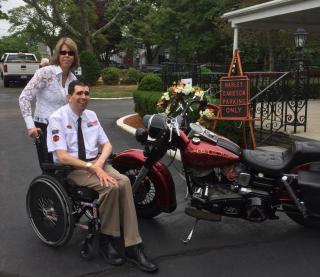
Patty Garrity and her brother Mark. After Mark’s sheltered workshop closed in 2016, meaningful work activities came to an end for him. Mark is not capable of participating in a mainstream work environment, Patty says.
COFAR and our members plan to testify at the hearing. We haven’t been consulted by the Subcommittee as part of its review, which began last spring and involved meetings with “disability advocates, employers, employees, and other stakeholders,” according to the hearing notice.
So on October 4, when we heard about the hearing, we posed questions in an email to the office of Representative Josh Cutler, chair of the Subcommittee and vice chair of the Children and Families Committee. Those questions were the following:
- Does the Subcommittee recognize that there are some persons who do not have the capability to succeed in the mainstream workforce, or does the Subcommittee take the position that all persons, no matter how profoundly intellectually disabled, can handle jobs in the mainstream workforce?
- Is the Subcommittee also looking to promote work opportunities for individuals in their community-based day programs funded by the Department of Developmental Services?
- Does the Subcommittee have data on the availability of mainstream workforce jobs for persons with I/DD? We have long been concerned that not nearly enough of those jobs exist even for those who are capable of doing them.
- Is the Subcommittee aware that the Legislature has apparently never appropriated the level of funding sought by the Baker administration for training and other services to help prepare former sheltered workshop participants for mainstream work settings? If so, has the funding for that transition so far been adequate?
- Does the Subcommittee support the continued payment of subminimum wages to persons with I/DD in order to enable them to get work opportunities either in mainstream or DDS settings?
In an email in response to us, Rep. Cutler declined to respond to our questions; but he did say they were “great questions” and that he would be interested in meeting with us. We are in the midst of scheduling a date for that meeting.
We have discussed employment issues involving people with I/DD in numerous blog posts and in legislative testimony since 2014 when the administration of then Governor Deval Patrick began closing sheltered workshops for persons with I/DD throughout the state.
The sheltered workshops were settings in which DDS clients did small assembly jobs and other piecework activities provided by area businesses. The participants usually received a nominal wage.
Many family members and guardians strongly supported the workshops; but the Patrick and then Baker administrations held to an ideology that the workshops “segregated” the participants from non-disabled workers, and that the participants would all be better off in mainstream, “integrated” job settings.
Here are some of our findings from our involvement with these issues over the past five years:
- Starting in 2013, the Patrick administration worked closely with corporate DDS providers to close the sheltered workshops over the objections of the families of many of the participants. In doing so, the providers falsely claimed that the workshops did not allow for “community inclusion.” The providers also falsely claimed that the federal government was forcing all sheltered workshops to close in the state.
- The Legislature rejected the Baker administration’s proposed funding increase in Fiscal Year 2017 to fund the transition from sheltered workshops to mainstream employment for former sheltered workshop participants.
- As of 2014, DDS was placing fewer and fewer clients in mainstream, integrated employment even as the sheltered workshops were closing.
- As of 2018, it was clear that the promise of the replacement of sheltered workshops in Massachusetts with mainstream integrated employment was not being realized. An unknown number of former sheltered workshop participants were being left without work of any kind in their DDS-funded day programs.
- The position of Senator Elizabeth Warren and many others against the payment of subminimum wages to people with I/DD has made it even harder for those persons to find the kind of work they had previously enjoyed doing.
Patty Garrity is the sister of one of those former workshop participants who has been left without work opportunities. Her brother Mark is not able to work in a competitive, mainstream setting.
Garrity said she plans to testify at the October 22 Subcommittee hearing. “I want to explain that there are individuals like my brother Mark and his peers who are not minimum wage candidates,” she wrote in an email. “There is still a huge void in Mark’s day and it is not going well…..going on 4 years now that I have been waiting for them to improve upon this and it is not happening. Mark is happy to be with his peers, but all he is doing is shredding paper and he is bored.”
We hope the Subcommittee will pay close attention to the experience of Mark Garrity and others who have been left behind in the wake of the sheltered workshop closures.
Moreover we hope the Subcommittee does or will recognize that, as with so many other issues involving persons with I/DD, one size doesn’t fit all when it comes to employment.
There are many people for whom the mainstream, competitive workforce is not suitable. Their choices and the choices of their families and guardians should be respected.
Gifts of the Sheltered Workshop
Guest post
Note: This post was written and sent to us from Thomas Spellman and Dona Palmer of Delavan, WI. Although all sheltered workshops were closed in Massachusetts as of 2016, we are still pushing for a resumption of work opportunities for clients of the Department of Developmental Services in this state.
As a result, we think Thomas Spellman’s and Dona Palmer’s points about sheltered workshops remain applicable to Massachusetts, just as they are applicable to work opportunities programs provided to developmentally disabled people across the country.
________________________________________________________________________________
Introduction
Before we present the gifts of the “Sheltered Workshop,” let us take a step back and look at the big picture. What we see among Sheltered Workshop participants is a continuum, from mild to severe brain impairment.
While these individuals are all disabled, their NEEDS differ significantly. A major contributing factor is behavior. While behavior is not a disability in and of itself, it can be a complicating factor in the employment of a disabled individual and in their life in general.
While the ability to “work” varies significantly among persons with brain impairment, behavioral issues and physical disability, those persons must do work that is meaningful to them. Whether it is just a smile or it is working for General Motors, the work must be meaningful to the person doing it.
As we all know, each person with a disability (or their guardian) has the right to choose where they “work” and where they live. This is a foundation of the Americans with Disability Act (ADA).
While the right of each person to choose is important, it is EQUALLY IMPORTANT that a variety of work experiences be available that address the varied needs of all of those individuals who are disabled. Sheltered Workshops MUST BE AVAILABLE to those with disability(ies), cognitive impairment, physical challenges and behavioral issues.

A sheltered workshop in New Jersey, which, unlike Massachusetts, has so far kept its sheltered workshops open
We know of the benefits of a Sheltered Workshop because our daughter Rosa has been working at VIP Service, a Sheltered Workshop in Elkhorn, Wisconsin, for fifteen years.
We use the term “Sheltered Workshop,” which in the past was accepted as a very good description of a safe place for people with disabilities to work. As we know, today it clearly is used by some in a derogatory manner, as in “You work at a Sheltered Workshop, and not in the community!! Poor you!”
Gifts of the Sheltered Workshop
First and foremost is the gift that the Sheltered Workshop exists!! (See note above about Massachusetts.) Without its existence, NONE of the rest of the Gifts WILL EVER BE REALIZED by the tens of thousands of disabled individuals who realize some or all of the Gifts every day!!!
Second is that there is WORK to do. While WORK is a human experience, and there is much written about WORK by others, we know from our own experience that WORK is fulfilling. Rosa has said that about the WORK that she has done at VIP.
While a person’s production rate may seem important, the more important issue is accuracy in order for WORK to be of economic value. Is the product that is being completed done exactly the way that it needs to be done? That is a challenge, and in some cases a major challenge to providing work to those who are disabled.
Third is the 1986 amendment to the Fair Labor Act of 1938, which provides for a “Special Minimum Wage” for persons with disabilities.
This is NOT a “Sub-minimum Wage. Sub-minimum Wage is a term that was coined by the National Disability Rights Network to negatively describe the “special minimum wage” as described by Section 14 (c)(A)(5) of the Fair Labor Standards Act of 1938 as amended.
New terms such as prorated wages or commensurate wages are used, but it is the CONCEPT and not the name that is critical to the existence of Sheltered Workshops.
The logic underlying the “Special Minimum Wage” is simple and clear. If Rosa produced half what a full-time worker would produce, then she will receive half of the financial benefit for doing that specific job. It may need to be audited from time to time, BUT THERE IS NOTHING THE MATTER WITH the concept.
If we want significant meaningful WORK for people who have mild to moderate brain impairments and or physical impairments, then we MUST HAVE the Special Minimum Wage. If the Special Minimum Wage is ELIMINATED, Rosa and tens of thousands of others whose disabilities limit their ability to work WILL HAVE NO WORK AT ALL.
Fourth is The VARIETY of JOBS that an individual can experience. We have only recently realized the importance of this. Rosa has learned over 100 jobs in the fifteen years that she has worked at VIP. Each of those jobs required her to trust Pam, her supervisor; to listen to Pam, to comprehend what Pam is saying, and when necessary ask Pam for help on how to do something.
Having been with Pam for 15 years, Rosa is proficient at each of those tasks. The hardest thing for her was asking for help. The VARIETY of job experiences has allowed her to grow to become more independent.
It needs to be noted that while some individuals may be able to do a two or three-step assembly job, they may not be able to collate a ten-page letter. Some may be able to put labels correctly on a bottle while others cannot. This variety of JOBS is very, very important to the growth and health of all those who work at a Sheltered Workshop.
Fifth is that besides the variety of jobs, there is the allowance to work at different speeds. It makes no difference in a Sheltered Workshop if an assembly job takes a minute or ten minutes. To know that what you are doing, and the speed that you are doing it, is OK is very important. It is one of those things that one might not see as a Gift, but surely it is.
Sixth is the Stability of the Sheltered Workshop. The schedule stays the same. The workers are the same. There is a place to go to WORK and be with FRIENDS. There is a stability of workers and supervisors. For Rosa and, we assume, many others, KNOWING what tomorrow will bring is VERY, VERY important in their lives. She “implodes” emotionally when the “activities” (as she calls them) of the day are not known.
For Parents and Guardians, KNOWING that the Sheltered Workshop WILL BE THERE WHEN THEY are NO LONGER CAPABLE OF caring for their loved one, is of even GREATER IMPORTANCE! It is to know that the Social Contract to take care of a son or daughter who is disabled WILL BE HONORED by the community of the next generation.
Seventh is Family. For many individuals with disabilities, their personal living situation can be disrupted by a change of ownership of the residential facility that they call home. The “home” can be too expensive or it can be too big or not big enough, and of course it can close. When an individual is forced to change households, they lose that “family,” and so the stability of the people at a Sheltered Workshop becomes their family. As I was preparing this, I realized that Rosa will grieve our deaths with her Sheltered Workshop family.
Eighth is Safety. Both physical and personal safety are priorities at Sheltered Workshops. That extra caution is reassuring to both the workers and their parents and/or their guardians.
Ninth is Friends and Community. What is special about the Sheltered Workshop is that with time, true friendships do develop with both the other workers as well as with the supervisors.
Fifteen years ago, Rosa bonded with Pam, a PAID STAFF member at VIP Services. Rosa has shared with Pam the births of Pam’s girls, hearing the baby stories, and now watching the girls show their goats at the County Fair.
And now Pam has accepted the role of guardian if both of us become unable to be Rosa’s guardian. It is despicable to use the term PAID STAFF in a derogatory manner, which some disability rights individuals do. They imply that because someone is a paid staff member, there is not a real bond.
What is CRITICAL TO UNDERSTAND HERE is that our personal individual associations are part of what defines us as INDIVIDUAL HUMAN BEINGS. These relationships, in large part, will be with OTHERS much like ourselves. These relationships are our very essence. There must be an ACKNOWLEDGEMENT OF THIS MOST BASIC HUMAN FACT.
Tenth is that transportation is made available. A few Sheltered Workshop participants may be able to drive, but the vast majority of workers at Sheltered Workshops need a ride to work. In those cities with bus service and a Sheltered Workshop on the bus line, a few more individuals are able to catch the bus to get to work, but there still are a significant number, who without affordable transportation being provided, will NOT BE ABLE TO WORK.
Eleventh is the Staff. Yes, the staff of the Sheltered Workshop is a gift. Some disparagingly call them PAID STAFF, but they are a group of highly trained individuals giving of themselves in many ways that would not be easy for many of us to deal with on a daily basis. To imply that these tens of thousands of staff members can be replaced in the for-profit workforce now being called “community integrated employment” is beyond absurd.
Twelfth is that Sheltered Workshops allow participants to take extended vacation time, in turn allowing parents who are retired to take longer vacations without endangering their son’s or daughter’s job when they return. Will a Walmart allow a 6-week vacation? That’s the amount of time our family spends in Florida in March and April of each year.
Thirteenth is that Sheltered Workshops are also a backup for those persons who are having a hard time at their public employment place of work. It may be for a few weeks or it may be a permanent change, but it is critical that the Workshops be there. The alternative to not being successful at Public Employment Work CANNOT BE SITTING AT HOME WATCHING TV!!
Thomas Spellman and Dona Palmer can be contacted at tmspell@execpc.com
Senator Warren’s concern about payment of subminimum wages to developmentally disabled people is misplaced
Massachusetts Senator Elizabeth Warren has proven to be one of the nation’s most effective advocates for workers and their financial security; but we think she’s wrong in charging that persons with intellectual and other developmental disabilities are being exploited by work programs that pay them a subminimum wage.
Warren is leading an effort in Congress to eliminate waivers that have allowed employers to pay a subminimum wage to disabled persons who are hired by employers in mainstream work settings. Warren alleges that payment of subminimum wages under the so-called 14(c) certificates or waivers is exploitative and discriminatory.
We would agree that for disabled people with normal intellectual functioning, payment of subminimum wages is exploitative and unnecessarily discriminatory; but a distinction needs to be made in the case of persons who have intellectual or other developmental disabilities that severely limit cognitive functioning.
In not making this distinction in calling for the elimination of the subminimum wage waivers, Warren is making the same well-intentioned mistake that many people in the advocacy community have made. That mistake is to assume that all developmentally disabled people are exactly the same as non-disabled people in terms of their employment potential and, even more importantly, their employment aspirations.
Those assumptions overlook a number of realities, including the fact that virtually all developmentally disabled persons who are placed in those work programs receive government assistance in some form for residential care, day care, or other services. Unlike non-disabled persons, most, if not all, individuals with significantly impaired cognition are not seeking to support themselves financially through work. They are seeking to occupy their time with activities that are meaningful and satisfying to them.
As the brother of an intellectually disabled person noted to me, his brother has no understanding of the concept of money, and wouldn’t know or be able to appreciate whether he was paid a minimum wage rate or not.
In an April 23 letter to U.S. Labor Secretary Alexander Acosta, Warren and six other senators attempted to link payment of subminimum wages to problems of abuse and poor work conditions in work settings for people with developmental disabilities. The letter cited four instances in which disabled persons were forced to work in sweatshop-like conditions, including a case in Iowa in which intellectually disabled men were working in a turkey processing plant for little or no wages and were subjected to verbal and physical abuse and unsanitary conditions.
But as is the case with abuse or poor conditions in any care-related or work setting, the instances cited in Warren’s letter appear to be the result of poor governmental oversight of those programs. Those problems could have been avoided or could be rectified with proper oversight. The problems were not necessarily the result of payment of subminimum wages.
Moreover, citing isolated instances of abuse in specific work settings doesn’t prove it is a problem in all work settings. In fact, we have not heard of any instances of such exploitation or abuse occurring in sheltered workshops or other work activity programs in Massachusetts.
We have made a number of attempts to contact Warren about this issue. I left separate voicemail messages since Monday of this week with Warren’s Washington and Boston Senate offices. On Monday, I also posted what was essentially this blog post on her website contact page, and asked if she or her staff would respond. To date, I’ve gotten no response and no call back.
The unfortunate impact of the effort to prohibit employers from paying subminimum wages to developmentally disabled people is that rather than paying them higher wages, most employers choose not to employ them. So the end result is that these disabled individuals miss out on satisfying and meaningful ways to occupy their time.
As we have reported, DDS data show that the number of developmentally disabled persons being placed in integrated or mainstream employment paying at least the minimum wage in Massachusetts has been steadily dropping in the past few years.
During Fiscal Year 2016, a high of 509 clients in the Department of Developmental Services system newly started working in mainstream jobs. That number dropped to 127 clients entering integrated employment during Fiscal 2017, and to a net increase of only 98 clients during Fiscal 2018.
We are assuming that demand for these mainstream jobs remains high, possibly in the thousands. That there was a net increase of less than 100 developmentally disabled persons in integrated employment in Fiscal 2018 appears to show that the administration has been unable to find jobs for people who want them.
Promises in closing sheltered workshops haven’t been kept
In 2014, the administration of then Governor Deval Patrick began closing sheltered workshops in Massachusetts that provided developmentally disabled persons with piecework activities because those facilities supposedly segregated those persons from their non-disabled peers and paid them less than minimum wage. The Baker administration followed that same policy, ultimately closing all remaining workshops as of the fall of 2016.
The plan of both administrations was to provide training to those former workshop participants and place them in mainstream workforce settings along with supports that would help them to function in those settings.
We expressed concerns at the time, however, that the workshop closure policy was being pursued without knowing, among other things, whether sufficient jobs existed in the private sector for all of those former workshop participants and others who want jobs.
Unfortunately, our concerns have proved to be well founded. Instead of being placed in mainstream or integrated jobs, the vast majority of the former sheltered workshop participants have ended up in DDS-funded Community Based Day Supports (CBDS) programs, which offer little or no work opportunities, and have left many of those people frustrated and bored.
DDS data also show that the DDS day program population increased by 81% from Fiscal 2014 through 2018 in Massachusetts while integrated job placements increased by only 19%. The chart below reflects this trend and illustrates the fact that the total day program population in the DDS system has caught up with and even surpassed the total number of departmental clients in integrated employment since Fiscal 2014.

Barbara Govoni, the mother of one former sheltered workshop participant, is continuing to advocate for legislation that would allow for the return of piecework activities in her son’s CBDS program.
Direct care workers are the ones who are exploited
Ultimately, Senator Warren’s concern about exploitation is misplaced. It is not the developmentally disabled who are exploited by subminimum wages. Rather, it is the people who are hired by DDS-funded providers to care for them who are usually the victims of systematic exploitation in this field.
As we have noted, direct-care workers in the DDS system, who do have to work in order to feed themselves and their families, are the ones who Senator Warren and other advocates for the disabled should be concerned about.
When direct-care workers are underpaid, it is not only they and their families who suffer, but the very people who depend on their services who suffer as well from substandard care. Paying developmentally disabled people less than minimum wage as part of their work programs doesn’t harm them. Paying their caregivers less than a living wage does.
 COFAR blog