DDS finally acknowledges it doesn’t keep track of whether there are vacancies in state-operated group homes
For almost a year, we had been trying to clarify with the Department of Developmental Services (DDS) whether there are – and we suspect there are – continuing vacancies in the Department’s network of state-operated group homes.
Finally, in a clarification issued earlier this month in an appeal we filed with the state public records supervisor, a DDS attorney stated flatly that, “DDS does not track state-operated group home vacancies.”
While it’s helpful to know it would be a waste of time to continue to ask DDS for information it clearly says it doesn’t have, the Department’s clarification still raises a number of questions. First, why doesn’t DDS track what appears to be basic information about its state-operated group home network?
Secondly, even though thousands of people with intellectual and developmental disabilities are waiting for residential placements and other services from DDS, why would the Department not have any interest in knowing whether its state-run network has available beds for them?
One troubling answer to those questions is that the Healey administration does not view state-run residential services as a viable option for those thousands of waiting clients. This is borne out by evidence that DDS is letting the state-run system die by attrition.
DDS does not generally inform people seeking residential placements of the existence either of its network of state-run group homes or of its two remaining state-run congregate residential centers – the Wrentham Developmental Center and the Hogan Regional Center. Instead, the Department directs those people to its much larger network of state-funded group homes that are run by corporate providers.
In many cases, families have told us that when they have asked about placements in state-operated group homes, DDS has stated that there are no vacancies in such homes in their area. That is despite the now-apparent fact that DDS doesn’t actually know whether there are vacancies or not.
Ambiguous statements about information on vacancies
For close to a year, DDS provided ambiguous responses to requests we made under the Public Records Law for information on the number of vacancies in the state-operated group home network in recent years.
In September 2023, I first filed a Public Records request with DDS, asking for “the number of vacancies in the state-operated group homes each year from Fiscal Year 2019 to the present.” I also asked for data on the census, or number of residents in the state-run group-home system, and the capacity, or total number of available beds in the system.
DDS responded that it did not have “any responsive records pertaining to the number of vacancies in the state-operated group homes each year from Fiscal Year 2019 to the present.” However, the Department added in that same response that, “The Department can provide the number of vacancies in state-operated group homes as of June 30, 2023, which is 91.”
Given that the Department was both saying it didn’t have information on the number of vacancies each year, but did have that information with regard to a specific date, I appealed to the public records supervisor. The public records supervisor agreed that it was unclear whether DDS did or did not have information about those vacancies.
DDS then responded with a statement that only appeared to add to the confusion. The Department stated:
Vacancies are not tracked by the Department independently from the capacity and census data provided above. Vacancy numbers are more complicated as they are dependent on a number of real time factors, including but not limited to the temporary placement needs of individuals, staffing, and other group home demographics.
Finally, this past July 10, after I had requested information on the number of vacancies through April of this year, DDS issued the following clarification:
DDS does not have in its possession, custody, or control the state-operated group home vacancies on the specific dates requested because DDS does not track state-operated group home vacancies. (my emphasis)
One-time “exercise” to determine vacancy number
In its July 10 response, the Department also sought to explain how it had come up with the number of 91 vacancies as of June 30, 2023, despite not tracking vacancies.
DDS stated that prior to my original Public Records request in September 2023, “DDS employees participated in an exercise which resulted in identifying the approximate number of state-operated group home vacancies as of June 30, 2023.”
However, since then, “no similar exercises have been conducted,” the DDS response stated.
That explanation, however, only appears to raise further questions.
Why, for instance, did DDS attempt on one occasion, but never again, to determine the number of vacancies in its group-home network?
Based on questions like that, I filed a new Public Records Request with DDS on July 12, seeking all documents relating to the Department’s exercise, which resulted in identifying the approximate number of state-operated group home vacancies as of June 30, 2023.
DDS stated that it will provide a response to my request as of Friday of this week (August 2).
DDS data on census and capacity raise further questions about possible vacancies
Despite the lack of data about vacancies, the data DDS has provided about the census and capacity of the state-operated homes implies to us that vacancies do exist in the group-home network.
As the chart below shows, the capacity in the state-operated group home system was close to 1,150 in the just-ended Fiscal Year 2024 (as of June 30). But the total census was only 986.
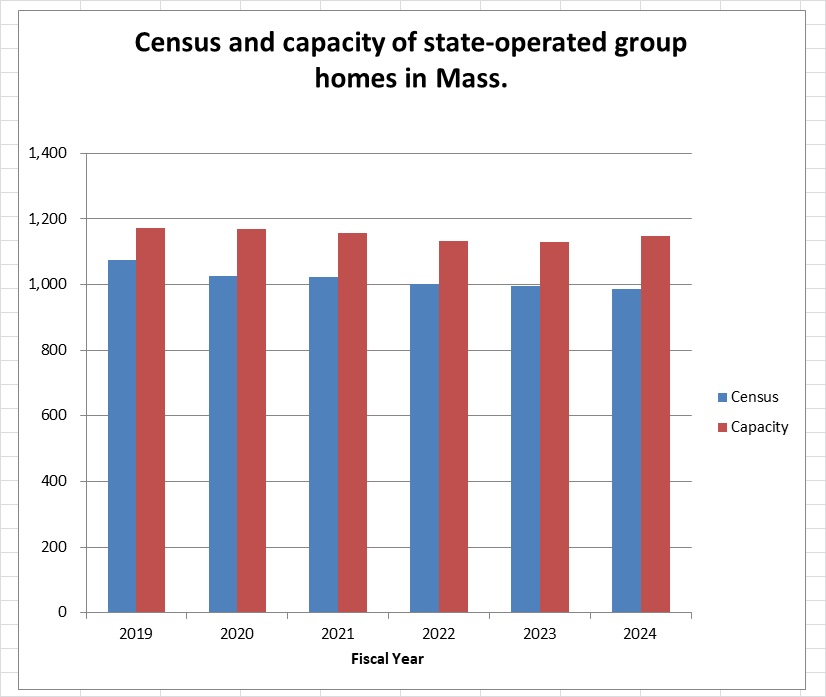
Source: DDS
The capacity as of June 30 was 16.4% higher than the census, implying that there were as many as 162 vacant beds in the state-run group home system that year.
The chart further shows that while the census (depicted by the blue columns) has steadily declined in the homes since Fiscal 2019, the capacity (red columns) declined through Fiscal 2022, and then began to rise in 2023 and 2024.
The gap between the census and capacity of the homes since Fiscal 2019 can be seen in the differences in the heights of the blue (census) and red (capacity) columns in the chart. That data appear to imply that the number of vacancies in state-operated homes has been rising since Fiscal 2022.
DDS, however, states, as noted, that it cannot confirm the number of actual vacancies in the homes because it doesn’t track them. The Department also maintains that vacancy numbers are “more complicated” than the difference between a group home’s census and its capacity.
DDS stated that the number of vacancies in group homes is “complicated” because it is “dependent on a number of real time factors, including but not limited to the temporary placement needs of individuals, staffing, and other group home demographics.”
It’s not clear to us what DDS actually means by that statement. It is not clear why the number of vacancies, for instance, would depend on staffing in the homes. In that case, it would seem that capacity would also depend on staffing. Yet, DDS was able to provide us with data on that capacity.
DDS’s reference to the temporary placement needs of individuals would appear to imply that the total census in the homes also changes over the course of the year due to temporary placements of certain individuals. Yet in that case as well, DDS was able to provide us with data on the census in the group homes.
It is unclear why DDS is able to track both the census and capacity of the homes, yet can’t or doesn’t track the number of vacancies. All three of those variables – census, capacity, and vacancies – would appear to depend on either staffing or temporary placements. Why are vacancy numbers more complicated than either census or capacity numbers?
The DDS data on the state-operated group homes raise many questions, as we’ve said. Unfortunately, DDS has repeatedly declined to answer our questions about the data.
We hope that the additional records DDS is scheduled to provide us about the one-time exercise it conducted will shed a little more light on the important vacancy question.
 COFAR blog
Dave,
This information that you have just posted on the State’s lack of knowledge or caring about the group home vacancies is truly disturbing. Another item to consider with the group home situation relates to what type of contract was signed with the Corporate providers of group homes. Does their contract with the State provide billing by total rooms/beds utilized? If so, how would the State effectively audit those invoices without the knowledge of monthly or quarterly occupancies.?
During the past years you have continued to write and communicate with elected State Representatives and State Senators. You have also communicated with the committee members that are directly involved in family support legislation. Many times these direct contacts are not even capable of confirming your communication. In fact, many times there isn’t even a form letter acknowledgement.
I also must wonder just what the citizens of the State care about in voting for their elected officials that can’t even respond to positive contacts and the factual data that is presented. At this point, the entire State Government, elected and non-elected officials continue to demonstrate a significant level of incompetency.
Robert Pasek
LikeLiked by 1 person
the last federal information from states on waiting lists and how they are handled was handled in 2023 by KFF, Massachusetts did not submit the requested information. They were not the only state who refused to provide answers. The community rule requires states to provide and track this very information by July of 2026. Why they give them two years is beyond me. But from looking at current requirements that Mass still doesn’t implement and are also required, I wouldn’t hold out hope they will follow that requirement either.
LikeLiked by 1 person
The current administration in Massachusetts is not transparent we need a complete overhaul of all. these tax payer funded services and they need to be more family friendly by treating parents and other family members with the respect they deserve and not use the power they are given to strip parents of their God given rights to Guardianship because the parents of sons and daughters of our most cherished intellectually disabled loved ones might not agree with their format is complete nonsense and a total disregard of our God given parental rights.
LikeLiked by 1 person
I find this very hard to believe. Of course DDS knows how many vacancies they have. They don’t want anyone to know because those placements would be requested.
LikeLike
Thank you for sharing this. DDS is not only shutting down the state run homes, they appear determined to decrease the group homes that they run through contracts with private agencies. In addition, their oversight and support for existing group homes is woefully insufficient. DDS response to requests for adequate oversight and effective support has been to shame and blame parents/guardians and create the false narrative that our expectations are unreasonable. When pressed to clarify which expectations are above or beyond the fundamental principles of the guidelines and regulations for the rights of dignity, respect, meaningful community connections etc.- DDS has no response. DDS goal is to shift from group home model to either Shared Living or Self Directed models. It seems that DDS wants parents/guardians to assume responsibility of care and custody of all individuals with disabilities, while they, and the private agencies, continue to profit from generous salaries and benefits. As they decrease their availability of residential placements, DDS and the private agencies do less and less work, and incredulously, their salaries and benefits continue to grow at increasing ratesg as they gobble up the increases in the state budget. DDS and the state agencies continue to market their fascade and hold lavish galas as they pretend to be changing lives and promoting independent meaning inclusion programs in the community. Many parents/guardians are fearful of retaliation and are overwhelmed by the complexities of the system. Intimidation is the tool that DDS and the agencies use to keep the most vulnerable of our society silent and compliant. Further, DDS executives will often quote their compliance reviews, as evidence that they are fulfilling their responsibilities. However, these reviews are largely completed by self assessment. It is a rigged system and their power is seldom questioned or challenged.
The most powerful tool that DDS uses is to keep individuals, parents/guardians, isolated so that we are not ‘talking to each other’ and understanding that we are not alone. Does anyone have a suggestion for how we can form a more robust network of parents/guardians so that the legislators and agency executives cannot ignore us?
LikeLiked by 1 person
Not surprised that DDS is playing the “button, button, who’s got the button” game. They don’t WANT to track vacancies because then they’d have to admit they’re critically short staffed and don’t have the staff available to cover any new clients admitted to fill those vacant beds.
LikeLike