Intelligent young woman with cerebral palsy trapped in DDS group home
When one speaks with Ann Macdonald, one gets an impression of her as articulate, no-nonsense, and yet cheerful and friendly.
Ann, 23, came to the U.S. from China when she was 16. She has cerebral palsy, a medical condition that keeps her confined to a wheelchair and limits her ability to fulfill basic functional needs such as showering and dressing without help.
A psychiatrist concluded last year that Ann has normal intellectual functioning and “has demonstrated remarkable functional independence.” But she has been trapped for the past year in a Department of Developmental Services (DDS)-funded group home run by Eliot Community Human Services in Stoughton.
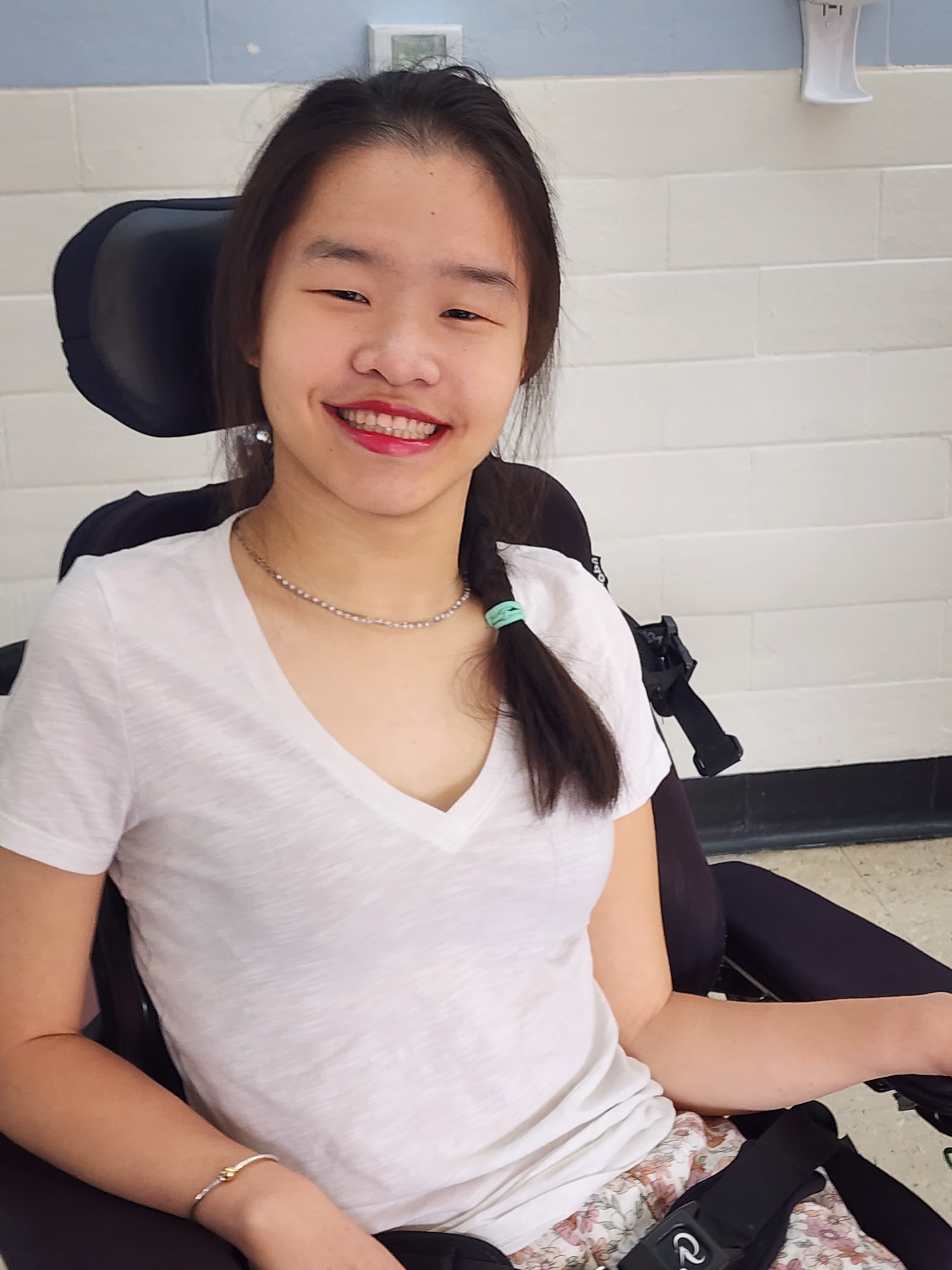
Ann Mcdonald
Ann has remained there apparently based on a mistaken assertion and diagnosis that she has a brain injury and an intellectual disability.
Ann and two nurses who cared for her in her previous residential placement at the Pappas Rehabilitation Hospital, maintain that her DDS Individual Support Plan (ISP) contains a mistaken departmental activity code that characterizes her as having an Acquired Brain Injury (ABI).
That code has enabled Eliot to receive funding for Ann from DDS under an ABI Home and Community Based Services (HCBS) Medicaid waiver. But Ann says she doesn’t have a brain injury, and that claim is backed up by the nurses.
Also, Kaveh Ghaedi, a Boston-based psychiatrist, maintains that, “Ms. Macdonald’s presentation, history, and accomplishments do not align with the criteria for Intellectual Disability.”
Dr. Ghaedi last year provided testimony in probate court in Ann’s successful effort to terminate a guardianship of her that was held by an aunt. Her aunt willingly stepped down, agreeing that Ann didn’t need a guardian.
Nancy Silva, who is retired as a nursing assistant at the Pappas center, had this to say about Ann:
If I had a company, I would hire Ann to work there. She’s very smart and knows exactly what she is doing. When she first got here from China, she didn’t speak English, but learned it by watching TV. She’s like a sponge. She absorbs everything and goes with it.
Ann wants her own place to live where she can receive services from Personal Care Attendants (PCAs). That, she says, will enable her to live an independent life, which is something DDS contends it wants for everyone in its care.
Ann maintains that it’s not that DDS and the provider are opposing her wish to live on her own. It’s that they have done little or nothing over the past year to enable her to find a new place. They haven’t, as promised, identified any specific suitable residential settings for her.
In the meantime, Ann says, she feels her life is on hold in the current residence.
“It’s not a comfortable or safe place for me,” she said. “I’m not doing the things a 23-year-old girl should be doing. I don’t have independence. No freedoms.” She said that when she first told her previous DDS service coordinator last June that she wanted to leave, “she (the service coordinator) told me I was not capable of making my own choices or doing things myself. But that’s not true.”
“She (Ann) shouldn’t have been placed in that (Eliot) home,” said Janette Packard, a registered nurse, who cared for Ann at the Pappas center. “She doesn’t have cognitive deficits. She has no learning deficits.”
Dr. Ghaedi found that, among other things, Ann has shown that she can independently navigate the state’s healthcare system, can manage her own finances, and was able to arrange for her own disability-accessible transportation to community events.
Silva says the decision to place Ann in the Eliot home originated with the management at Pappas when Ann turned 22 and was transferred to the DDS system. She contends it was the wrong decision, and one she had urged the Pappas administrators not to make.
Both Packard and Silva have maintained friendships with Ann and are advocates for her. Silva contends that the Eliot group home staff did not react well to Ann from the start because she was much more active in speaking up for herself and her needs than were the other residents of the home.
“They (the staff) didn’t like it that she could speak up,” Silva said, “that she could articulate what she needed.”
The other clients in Ann’s group home are very nice, Silva says, but they are in their 50s and have nothing in common with her. “This group home is a horrible place to put a kid in.”
Not following the ISP
Ann and the two nurses contend that the staff are not following many of her ISP requirements such as one which states that Ann is capable of standing up from her wheelchair with help from the staff. Instead, Ann said, the staff insist on using a Hoyer lift at all times with her. A Hoyer lift is an electronic or hydraulic device that helps mechanically transfer patients from one surface to another.
In a recent email to her service coordinator, Ann expressed her frustration at that, writing, “I weigh 100 lbs. give or take and can help with standing, at least I could before I got here. This really bothers me that I may lose some of my function and ability because staff can’t or won’t follow the care plan.”
Ann’s ISP also discusses her desire to get a job, and states that DDS will submit a job referral for her. But Ann said that hasn’t happened. Ann has been applying on her own for jobs, but keeps getting turned down by prospective employers.
Silva maintains that DDS should be helping Ann in that job-finding effort, but isn’t. Ann particularly needs a DDS Community Based Day and Work (CBDW) program, which could provide training and other employment-related services, but DDS has not provided such a program for her. In her ISP, Ann mentions her desire for a CBDW program.
There are other problems with the group home.
Ann notes in her ISP that one of her strengths is cooking Chinese food. But she and Nancy say that the staff rarely let her cook the meals she prefers. She has an air fryer, for instance, but says the staff rarely allow her to use it.
Meanwhile, Ann says, some of her belongings from her four years at Pappas remain packed in boxes in the Eliot residence. A year after her move to the group home, the staff haven’t unpacked all of the boxes.
In an April 10 email to her new service coordinator, Ann said that while Silva helped her unpack most of her belongings, that “should not be left for my visitors or my therapists as they are not hired by Eliot to do (that).”
Wrong disability code
Ann’s current ISP lists her services in her group home as “3751-Residential Habilitation.”
A DDS document describes this number as an “activity code” for “Acquired Brain Injury Residential Services.” It isn’t clear who first selected this code and placed it in her ISP, but Ann maintains there is no evidence in her medical records that she has a brain injury. As a result, she hasn’t signed the ISP.
Packard contends that Ann’s ISP should list the activity code as 3153 for “Adult Long-term Residential Services.” Unless the code is changed, Ann and Packard say, DDS may continue in the future to place her in inappropriate settings and provide the wrong services for her.
 Faulty psychological testing
In his assessment of Ann, Dr. Ghaedi noted that in 2021, Ann was tested and determined to have a moderate intellectual disability. However, Ghaedi stated that based on his own assessment of her, “this (psychological testing designation) doesn’t align with her observed abilities.”
Ghaedi noted that individuals with moderate intellectual disability “typically exhibit significant deficits in abstract reasoning, learning, and problem-solving, often requiring caregiver support for basic tasks. In contrast,” he wrote, “Ms. MacDonald has demonstrated remarkable functional independence.”
Ghaedi maintained that psychological testing can be unreliable when administered to certain populations, particularly individuals with cerebral palsy. Such testing, he said, should take into account the impact of physical and speech limitations associated with that condition. However, he said, there was no evidence to suggest that this was done in Ann’s case.
Ann added that the psychological testing was done just a couple of years after she arrived in the U.S. and before she became as proficient as she is now with the English language.
In sum, there appears to be no question that Ann has been done a disservice by DDS in placing her in an inappropriate residential setting based on a mistaken departmental activity code and based on potentially flawed psychological testing.
DDS should act immediately to rectify the situation, and find an appropriate residential placement for Ann in which she can reach her potential for a happy, independent, and productive life.
 COFAR blog
Ann’s situation reminds me a bit of the late Ruth Sienkewicz-Mercer, another individual with cerebral palsy who told her story in her book I Raise My Eyes to Say Yes. Ann needs appropriate residential placement where she can live more independently.
LikeLike
And yet there are so many with real intellectual disability that they find ineligible.
LikeLike
falsifying care needs and refusing to change them. Sounds familiar. It’s fraud. Not letting the individual be part of planning their needs and oppressing their rights and voice in order to keep the records falsified. Sounds familiar. Excluding the individual and their full ISP team from building their services to accommodate their actual disabilities, not the made up care needs, is unfortunately common. Controlling someone and holding them hostage…. Maybe DDS needs to read Olmstead and learn what rights every individual has, including those with disabilities. They disgust me.
LikeLike
This is really a terrible situation. Ann deserves an appropriate placement. It sounds like she really got lost in the shuffle of hurrying to place young people outside of the Pappas Center. I hope her friends and family as well as staff and clinicians continue to advocate with her and for her.
LikeLike