Archive
Correction to previous post on the Duzan case
On December 17, I published a post on this site, which referred to a proposed contract with Lynne Turner, a court-appointed guardian for Sara Duzan.
Turner, who was appointed Sara’s guardian in December 2011, proposed a contract for her guardianship services for Sara that specified fees to the Duzan family of $200 per hour for services from Turner, $200 per hour for services from another unnamed attorney in her firm, and $75 per hour for a paralegal and $25 per hour for a clerk in the firm. The proposed contract was signed by Turner. It was incorrect of me to have added those hourly charges together to state that the total proposed hourly charge to the Duzans was $500. I regret the error. The post has been corrected.
The politically incorrect idea of bringing congregate and community care together
Two initiatives in two separate states call for something that would seem to make perfect sense — expand the missions of congregate care facilities for the developmentally disabled, and merge them with their surrounding communities.
In one case, the State of Delaware is proposing to expand services available at the Stockley Developmental Center by offering medical and dental care now available there to developmentally disabled and under-served persons living in the community. A Delaware state task force has also called for considering an indoor community sports center or outdoor playing fields at the Stockley facility; and opening up a therapeutic horseback riding program and a therapeutic pool at Stockley to the surrounding community as well.
Like most of the developmental centers in Massachusetts, the Stockley Center sits on hundreds of acres of largely unused land, and currently serves only a small fraction of the hundreds of people who lived there four decades ago.
In the second initiative, the Arc of Jacksonville in Florida has been awarded state funding and tax credits to help construct a “planned neighborhood” in that state for adults with intellectual and developmental disabilities, according to The Florida Times Union. The newspaper reported that the “Arc Village” will house about 120 adults – ages 18 and older – in 97 one- and two-bedroom apartments. The $17.7 million project will allow residents to “live, work, shop, recreate, and socialize,” in one place.
Unfortunately, neither of these innovative initiatives would be likely to move forward in the “progressive” state of Massachusetts, and neither may get the backing of the Obama administration. That’s because each of the proposals envisions providing services to a large number of people in one location — a non-starter to the ideological opponents of “congregate care.”
Congregate care, you see, is “institutional,” and therefore bad by definition for people with developmental disabilities. It’s apparently better that they live in small group homes or apartments dispersed throughout the state. We happen to think that placing everyone in dispersed group homes or apartments is actually a recipe for isolation and a new form of warehousing of people with developmental disabilities, all the while lining the pockets of the executives of hundreds of state-funded, corporate providers. (More about that in a coming post.)
But the Patrick administration in Massachusetts has voiced its opposition to congregate care and has moved to close four out of six remaining developmental centers in this state. Two of those centers have now been shut and most the residents have moved either to one of the two remaining centers or to group homes throughout the commonwealth. Longstanding proposals by advocates of those developmental centers to more effectively merge them with their surrounding communities — similar to the Delaware proposal for the Stockley Center — were all rebuffed by the Patrick administration.
Meanwhile, the federal Centers for Medicare and Medicaid Services (CMS) are moving to change their definition of federally reimbursable community-based care to exclude even group homes that happen to be located on the grounds of, or even near to, a public institution such as a developmental center. And the National Council on Disability has declared that an “institution” is a “facility of four or more people who did not choose to live together.” The NCD’s definition, which applies even to many group homes, was contained in a report in 2012 that states in its first sentence that closure of all such “institutions” should be “a top public policy priority in every state where such institutions exist.” The NCD advises the president and Congress on disability issues.
It’s hard to imagine the NCD supporting the Arc of Jacksonville’s proposal, in particular, which would establish a single setting, albeit a “neighborhood,” which would house 120 clients. And the Stockley Center proposal would not appear to conform to the CMS’s proposed definition of community-based care.
It seems to us, though, that the inclusive approaches being proposed in Delaware and Florida represent the future of care of the developmentally disabled in this country. Both proposals appear to recognize that congregate care is a valid option for people who want and need it, and that it can coexist with, and even be a part of, community-based care. Note that we’re not saying congregate care is right for everyone or that it should replace care in smaller settings.
The administration of Delaware Governor Jack Markell certainly appears to recognize that a congregate care center such as Stockley, which meets federal Intermediate Care Facility ICF/DD) standards, is worth maintaining as a residential option for its current residents. The Delaware state task force report states among its “general principles” that its proposal for the Stockley Center would include “a commitment to maintain and build upon a peaceful environment that the people at Stockley Center currently enjoy.”
Rita Landgraf, secretary of the Delaware Department of Health and Social Services, was quoted in The Wilmington (DE) News Journal as saying: “We do have individuals who still live here on site. It is critically important that we bring inclusion to them. This was not a discussion of closing Stockley. Sometimes I hear that, out in the public. But we are not closing Stockley.”
Among the specific task force proposals for the Stockley Center that would establish the center as a critical component of community-based care in Delaware are the following:
- Creation at the Stockley facility of a “Center for Excellence,” which would offer “integrated health support and disease prevention services to communities for which health services are hard to access.”
- Creation of a facility at Stockley to support respite care, both for individuals with disabilities in the community system and caregivers.
- Expanding the use of the Stockley pool or other therapeutic facilities for individuals with disabilities “first in Sussex County (DE) and beyond, as feasible.”
- Creating an “intergenerational multi-use center for wellness that supports active living and wellness, including classes for smoking cessation, fitness, nutrition, behavioral health, obesity, cardiovascular disease and stress management.”
- Developing fully accessible community vegetable gardens for an “integrated community” of county residents, including low income families; and hosting a farmers’ market.
- Creating a “model of mixed-use development”on the Stockley campus site, including affordable housing, stores, restaurants, dental and medical, and recreational facilities.
- Creating a training center to provide professional development for medical and care providers.
- Encouraging schools to use the Stockley property for nature and science instruction.
- Providing education, support, life skills and vocational or job training programs for people with disabilities.
- Creating a center for volunteer and nonprofit groups.
- Creating an outdoor trail system for users of all ages and abilities.
Contrast the excitement and vision of that approach with Massachusetts where we’ve seen only the systematic dismantling of congregate care for people with developmental disabilities. We will soon be down to two remaining ICF-level care centers, and what remains of state-operated care is under siege as facilities and services continue to be privatized. It’s refreshing to know that not all state administrations have that mindset, and that in some places, new ideas are being tried by people who are not blinded by outdated ideologies. We, however, are being left in their dust.
Questions surround care of Sara Duzan in group home
Sara Duzan has been placed in physical restraints in a group home 37 times since she was moved there on July 24, and the restraints continued through the month of November, according to staff records provided to the Duzan family.
A “baseline behavioral data” report on Sara’s care, dated December 11, states that there were 7 restraints imposed on Sara over a 7-day period in July; 10 restraints in August; 5 in September; 7 in October; and 8 in November. The report also indicates that behavioral episodes leading to the seclusion of Sara in her room in the Westminster residence also continued to take place each month. There were 7 such episodes in July; 16 in August; 9 in September, 15 in October, and 12 in November.
The report of the clinical staff at the state-funded Becket Family of Services residence appears to raise questions as to whether Sara has made progress since she was placed there on July 24. Since then, contact with her family was sharply restricted and then cut off entirely by the provider and her current guardian. The Duzan family, who lost their guardianship of Sara in 2009, is fighting to regain their guardianship and to bring her back to their home.

Sara’s bedroom in her family home in Westwood, where she lived for over 18 years of her life. She was at home until 2008, and later from November 2011 until January 2013. In her current group residence run by Becket Family of Services, she is living in a room with only a bed, box-spring, and some personal items. She destroyed many of the other furnishings in the room in what her mother believes have been repeated attempts to escape.
In a report filed December 13 with the Norfolk County Probate Court, Sara’s current guardian, Lynne Turner, contended that Sara was improving at the Becket residence and her behavior was becoming “calmer and less agitated.” But that assessment seems to be at odds with the staff report showing that episodes leading to restraints and seclusion have been continuing.
Sara has a rare genetic disorder called Smith-Magenis Syndrome (SMS), which is characterized by behavioral outbursts and intellectual disability. Parents of children with SMS from around the world have commented on this blogsite that using restraints to control behavioral outbursts of persons with SMS is counter-productive and usually makes the behaviors worse.
Court-appointed guardian has not visited the residence
Turner indicated in her report to the court that she has never visited Sara in the Becket residence where Sara has lived since July. Turner stated that she intended to visit her on one occasion but was ill, and that she planned a visit “within the next few weeks.” Turner also stated in the report that Sara was not taking any ant-psychotic medications. Yet the staff records indicate that Sara has been taking anti-psychotic or psychotropic medications, noting that she had refused them on 14 occasions since July.
Questions linger over cut-off of family contact
The latest records also appear to raise questions about the reasons given for the complete cutoff in family communication and contact with Sara.
Turner stated in her report to the court that family communication with Sara had been terminated because Sara became so agitated after calls from the family members she acted out and had to be restrained “on more than one occasion.” It was determined, Turner wrote, that Sara’s reaction to family phone calls caused a safety problem to Sara and staff. Turner added that “parental contact refers to visits, phone calls, gifts, and any other attempt to contact Sara.” The family was therefore not even permitted to send Christmas gifts to Sara this month.
A staff clinician’s report, however, indicated only one instance in which Sara allegedly became violent after a family call; and that clinician’s assessment that Sara was acting violently at that time appears to be contradicted by a statement in a police report that Sara appeared shy and timid.
Robin Thompson, a Becket clinician, stated that following a call with her parents on November 19, Sara “exhibited violent behavior over a span of hours” and had to be restrained. Thompson stated that no further calls from the family have been permitted since that incident, at her recommendation.
A phone call with Sara’s father, however, appears to have taken place on November 18, the day prior to the date noted by Thompson, according to a Westminster Police report. According to the police report, Sara told her father she had been hit in the mouth by a staff member, and the family then called police to the house. The police report stated that when the officers arrived, Sara was “shy and was hanging on with a friend,” another client. The report indicated that the police were not able to establish that Sara was assaulted by anyone on the staff, although she did have small scabs on her lip and toe.
According to the police report of the incident, Sara said she had been hurt about a week previously after the staff had broken down the door to the bathroom. Another client told police Sara had locked herself in the bathroom and was threatening at the time to jump out the window.
Thompson’s clinical report stated that in calls to her mother and father, “Sara focuses on the negative.” Thompson speculated that Sara was “conditioned” to do this because she has stated that “ if she is ‘bad’ she can tell her family and she can go home because ‘Becket won’t keep me.’” As a result, Becket initially set rules that the family would be allowed to make one 15-minute call a week to Sara, and that no one was allowed to discuss visits home or whether Sara was unhappy at the facility or its treatment of her. All calls were to be monitored by staff, and the family was to give a two-minute warning to Sara after 13 minutes that the call was coming to an end. Sara was specifically prohibited from talking to her family about any “dislikes about staff, residence, Becket,” or about restraints.
In her report to the court, Turner maintained that it was Sara’s parents who were failing to abide by the telephone call “protocol,” and that this was causing Sara to become agitated.
Maryann Duzan, Sara’s mother, denied that the family’s phone calls with Sara were causing her to become agitated. She said she believes the cause of Sara’s agitation has been her “imprisonment” in the Becket residence, and possible abuse that she has suffered there. She said the phone calls were discontinued because Sara had made statements during the calls about being assaulted, restrained, and living in poor conditions. In those instances, Maryann said, the phone was disconnected shortly after Sara began making those claims.
Lack of a transition before placement in program
It appears that Sara was placed by Turner in the Becket residence without an adequate transition period, which Maryann maintains should have involved her family. The sudden placement appears to have resulted in a violent episode of self harm and property destruction on Sara’s second day in the residence that necessitated a call by the staff to the police.
In her clinician’s report, Thompson described the episode on Sara’s second day at Becket, saying Sara barricaded herself in the room, ripped out the light fixtures, and attempted to electrocute herself.
Maryann Duzan maintains that Sara was “dumped” at the Becket residence with no advance notice to her on her 22nd birthday. “She thought she was coming home for good on her birthday,” Maryann said. “They didn’t tell her she was going there (to the Becket residence), nor were we allowed to talk to her.” Since then, Maryann said, the family’s requests to visit Sara on Mother’s Day, Father’s Day, and her birthday have all been denied.
Maryann also said most of the furnishings in Sara’s room in the Becket residence have been removed. A report filed by the police in September stated that Sara’s room consisted of a “bed and box-spring and linens and a few personal items.” Maryann maintains that Sara had “destroyed other furniture in the room as she has fought to get out of this imprisonment.”
Since July, Thompson said, “Sara has exhibited some progress,” including some success in community outings, and widening her choice of foods; but her assessment appeared to stop short of Turner’s more positive assessment that “Sara’s behavior is becoming more appropriate and less assaultive.”
Thompson stated in her report that Sara engaged in “severe self harm” and property damage after a dental visit on Sept. 11. That episode does not appear to have been related to contact with her family.
Community outings
The Becket baseline behavioral data report indicates that Sara earned 10 weekly outings from the Becket residence due to good behavior since July. According to Thompson’s clinical report, the outings have consisted of Sara’s being taken to a Burger King drive-thru; “short hikes in a local park”; a visit to “Michelle’s” in November to purchase items that were pre-ordered; and a visit to a mall in December and to a drive-through at a Dunkin’ Donuts. She had been “successful in all community outings,” the report noted.
Maryann Duzan maintained that the community outings described by Thompson appear much more restricted than the access Sara had in the community when she lived at home. Sara had volunteered at Animal Rescue League of Boston from 2004 to 2006, and never had any behavioral problems there, according to a letter of reference from the organization. She also participated in a special needs religious education program at St. Catherine’s Catholic Church in Norwood. Maryann said Sara also enjoyed volunteering with her at Rosie’s Place in Boston and serving dinner to abused and homeless women there. “Now (as a resident of the Becket residence) she gets to drive through a Burger King,” Maryann contended.
Turner’s guardianship report stated under the heading “future arrangements,” that over the next 18 months, “Sara will continue to settle in the program and expand her ability to access the advantages this program can provide her.” Nothing is stated in the report about restoring family contact with Sara. Yet, Sara’s separate individual care plan at Becket, dated July 24 and revised September 18, states that restrictions on family contact were not meant to last for more than three months.
Despite the negative assessment of the family’s impact on Sara held by Turner and Thompson, Ronald Ebert, a psychologist hired to evaluate Sara earlier this year, described the family as “concerned and active”; and Gail Quinn, Deputy General Counsel for the Disabled Persons Protection Commission, reportedly stated that she believed the Duzans to be “caring and loving parents who are very involved in their daughter’s life in order to provide her the best.” Even though he ruled the family as unfit to be guardians to Sara because they allegedly did not cooperate with certain providers, Probate Court Judge George Phelan stated in 2010 that the family had an “undeniable love” for Sara. Phalen concluded that “it would be inappropriate for the Court to exclude them completely in decisions affecting Sara.”
Guardian removed Sara’s mother as Social Security rep. payee
Turner stated in her guardianship report that she had terminated Maryann Duzan, Sara’s mother, as Sara’s Social Security representative payee in October because Duzan allegedly never provided an accounting to the court or to Turner of Sara’s funds, and because she allegedly refused to compensate a former residential provider and a Friendly’s restaurant in Hyannis for damage Sara caused to property there while on a community outing. Turner said she has applied to become Sara’s representative payee.
Maryann Duzan responded that she did pay the Friendly’s restaurant $275 in compensation for the damage. She said she filed accountings of Sara’s funds with the Social Security Administration, and was told she did not have to file similar accountings with the probate court because she was not appointed as a conservator for Sara.
We would question whether the Duzans should have been required to compensate the former provider and the restaurant for damage since all family members had been removed as Sara’s guardians and had no control over her by that time.
COFAR is continuing to advocate for Sara’s immediate return to her family. We urge readers to sign COFAR’s petition on change.org, asking Governor Deval Patrick and Department of Developmental Services Commissioner Elin Howe to allow Sara to return home to her family immediately.
Duzan family forced to pay in case that led to cutoff in contact with daughter
The Duzan family has found their four-year battle to regain custody of their intellectually disabled daughter, Sara, and bring her back home, to be extremely expensive.
In arrangements that raise some troubling questions, the family has been required by probate court orders to pay over $13,000 so far to three professionals in the case. Among those payments is $5,000 so far to a Special Master, even though the family was never provided with a written agreement or invoices by the Special Master for her charges.
In addition, the family was required as a result of a probate court order to pay $5,750 to a psychologist to evaluate Sara last May, even though the evaluation was never done and Sara had previously been evaluated by a different psychologist. And the family was required to pay $2,500 for a report on the case in 2010 from an attorney who had been appointed as a guardian ad litem in the case. The attorney made recommendations to the judge regarding a dispute among parties in the case, but the charge for the attorney’s services was given to the family to pay.
Maryann Duzan, Sara’s mother, said the probate court left it up to the three professionals themselves to determine the amounts the family should pay for their services. “It was just a given that our checkbook was theirs,” she said.
The Duzans have refused to sign a proposed contract for guardianship services submitted to them by Sara’s current court-appointed guardian, which specified charges of $200 per hour each for the guardian and another attorney in her law firm in addition to charges for other personnel. “That would have bankrupted us,” Maryann said.
Despite the payments they have made and what they say is their life savings paid in legal fees, the family has seen increasing restrictions placed on their contact with Sara. They are currently forbidden from even contacting her by telephone in her residence. Sara, who has a rare genetic disorder called Smith-Magenis Syndrome (SMS), has been living in a residence run by Becket Family of Services, a state-funded, corporate provider, since July. The family has not been allowed to see her since June.

A photo of Sara taken with Santa at the mall, when Sara was last living at home. She was last at home between November 2011 and January 2013.
SMS is a disorder characterized by intellectual disability and behavioral outbursts. The Duzan family maintains that SMS is poorly understood by many care providers, who often place persons with SMS in confining restraints when their behavior becomes aggressive. The Duzans contend restraints are counter-productive in those cases because they tend to make the behavior worse.
SMS is also poorly understood by the probate court, the family maintains. The court ruled the family unfit as guardians in 2010 because they were allegedly being uncooperative with providers and acting as if they “know best” about Sara’s care. But in the past several days, the family has received an outpouring of support from friends and members of a network of families of children with SMS. More than two dozen members of the SMS network submitted comments to this blog, backing up the Duzans’ contention that restraints should not be used with persons with the disorder, and calling for Sara’s immediate return to her family.
The Duzans say they never used restraints when Sara lived at home, but they are concerned that Sara is being subjected to excessive restraints in her current residence. They also claim Sara was abusively restrained in at least two previous residences run by state-funded providers. In one of those cases, the family’s claims were corroborated by a disability rights center attorney who found that Sara was subjected to excessive and unnecessary restraints between 2008 and 2010 at the Spaulding Youth Center in Northfield, NH.
In a December 28, 2011 letter to attorney Lynne Turner, Sara’s current guardian, Aaron Ginsberg, a staff attorney for the New Hampshire-based Disabilities Rights Center, Inc., stated that there were “at least a couple hundred incident reports (most involving restraints) completed on Sara while at Spaulding.” Ginsberg stated that while the use of restraints may have been appropriate in some of those cases, there were “many instances” where the use of restraints appeared to be inappropriate because the restraints caused physical injury to Sara or “because the threshold of risk of injury to self or others was not met.”
Maryann and her husband, Paul, first relinquished their guardianship of Sara in 2009 after the Massachusetts Disabled Persons Protection Commission (DPPC) began investigating allegations that the Duzans themselves had been abusive toward Sara. However, none of those allegations were substantiated other than an admission by Maryann that she once slapped Sara on the cheek while Sara was acting aggressively on a home visit. The probate court judge, who ruled the family unfit to be Sara’s guardians, concluded in 2010 that the Duzans were a loving family toward her.
Andrea Barnes, the Special Master in the probate court case, was appointed by the court in July to resolve impasses between the family and Turner, Sara’s current guardian. Two days before Thanksgiving, Turner informed the Duzans by email that all further contact either by phone or in person was being “suspended indefinitely” and that the police would be called if anyone from the family or “an agent of the family” attempted to enter the Becket Family of Services residence. Turner stated that this cutoff in contact was being instituted “as per agreement between the program staff and me.”
In his July 17 ruling appointing Barnes as Special Master, Probate Court Judge Patrick Stanton required the Duzans to “come to a mutually agreeable private fee arrangement” with Barnes. Maryann said the family has no written agreement or contract with Barnes to whom they have paid $5,000 since June. Records show the Duzans sent a $3,000 check to Barnes in June and and an additional $2,000 check to her in September. Maryann said the amounts were requested by Barnes, who asked for the initial $3,000 as an “upfront payment.”
Thus far, the family says, Barnes has done nothing to resolve their dispute with Turner over contact with Sara or to act on their request that she be returned home. They also say Barnes has refused to show the family records of Sara’s treatment at the Becket residence. When Maryann Duzan emailed Barnes on November 24 to ask her to remove Sara from the residence because she felt she was being harmed there, Barnes responded only that she had no reason to believe Sara was being harmed, but that she would check in on her “sometime in the next few weeks.”
I sent Barnes an email yesterday, asking whether she supported the decision to cut off all communication between the family and Sara, and whether she was confident that Sara was not being subjected to possibly excessive restraints or otherwise being harmed in the current residence. I also asked if Barnes would comment on her fee arrangement with the family. I had previously left a phone message with her. I haven’t heard back from her.
Turner, who was appointed Sara’s guardian in December 2011, proposed a contract for her guardianship services for Sara that would have required the Duzan family to pay fees of $200 per hour to Turner, $200 per hour to another unnamed attorney in her firm, and $75 per hour to a paralegal and $25 per hour to a clerk in the firm. The proposed contract was signed by Turner, but the Duzans refused to sign it. The contract refers to a court order that the family pay for Turner’s guardianship services, but Maryann maintains there was never a court order to that effect.
I also sent Turner an email yesterday, asking if she supported the cutoff in communication between the family and Sara, and whether she was confident that Sara was not being subjected to possibly excessive restraints or otherwise being harmed in the current residence. I also asked whether she had a justification for what seemed a high proposed fee for her guardianship services. I haven’t yet heard back from her either.
The family paid a total of $5,750 in May of this year to psychologist Ronald Ebert as per a probate court order even though Ebert never evaluated Sara because she refused to meet with him. Nevertheless, the family was billed by Ebert for the research, travel, and other work in connection with the proposed evaluation.
A February 22 memo written by a clinician at the Latham Centers, where Sara was placed from January to July, states that Ebert arrived that day to interview Sara, but never evaluated her because she refused to come out of her room. A May 5 invoice from Psychological Services, Inc., Ebert’s firm, specified a fee of $250 an hour for research into the case, interviewing the family, travel from Newton to the Brewster location of the Latham Centers facility, and preparation of a report. Maryann contends Ebert’s evaluation wasn’t actually necessary because another psychologist had evaluated Sara a year previously.
In his report, Ebert described the family as “concerned and active,” and noted they were frustrated in their attempts to get adequate services for Sara.
Nadell Hill was appointed guardian ad litem by then Probate Court Judge Angela Ordonez in January 2010 to review the co-guardianship of Sara by both Erin Hachey, Sara’s sister, and Daniel Smith, the executive director of the Arc of Greater Fall River. The family was required to pay Hill for his report, which concluded that both Hachey and Smith should remain as Sara’s guardians. Hill’s report concluded that “it is important that Sara’s family should remain involved in Sara’s life and in the decisions being made about her life.”
Much of Hill’s 9-page report concerned allegations from providers and two school system officials that Hachy was not sufficiently independent of her mother, Maryann, to make effective decisions as co-guardian. Maryann was described as being uncooperative with professionals and an “obstruction.” Hachey denied she was controlled by her mother, and said Smith was making decisions without her input. Hill noted in the report that Sara herself said she wanted her sister to remain as her guardian.
During a trial in July and August 2010 on the family’s fitness for guardianship, Smith testified that he probably would have slapped Sara himself under the same conditions that Maryann faced when she admittedly slapped her, according to a brief filed by Suzanna Urukalo, who served as an attorney for Hachey during the trial. Urukalo’s brief added that Gail Quinn, Deputy General Counsel for the DPPC, stated that she believed the Duzans to be “caring and loving parents who are very involved in their daughter’s life in order to provide her the best.” Quinn nevertheless filed motions with the court to remove all of the Duzan family members as Sara’s guardians.
We have already said we believe Sara should be returned to her parents. After examining the lengthy record in this case, we see no reason why Sara is being kept isolated in the Becket residence without any contact with her family. As many of the people who commented on our previous post have noted, this situation is an outrage and a human rights violation. The fact that the family has been forced to pay many of the parties in the case out of their own pocket — and that they have only seen the restrictions on their contact with their daughter tighten — compounds the terrible wrong done to them.
Please sign COFAR’s petition on change.org, asking Governor Deval Patrick and Department of Developmental Services Commissioner Elin Howe to allow Sara to return home to her family immediately.
Family is shut out of contact with special needs daughter
Maryann Duzan and other members of her family lost their guardianship of Maryann’s intellectually disabled daughter, Sara, in 2009, based on an admission by Maryann that she once slapped her daughter on the cheek, and the apparent perception that the family has been too aggressive in advocating for her.
As a result, a series of increasingly restrictive limits has been placed by court-appointed guardians and residential providers on family communication with Sara. Since June, the family has not been allowed to see Sara, who is currently living in a group residence in Westminster, MA, run by a state-funded, corporate provider.
As of late November, the family was prohibited even from talking with Sara over the phone. The family is afraid she is being subjected to what they consider abusive “restraints” by the group residence staff, but they have no way of determining what is actually going on.
Maryann contends her daughter, who is now 22, has been kept a virtual prisoner in the residence run by Becket Family of Services since late July. Sara has a condition known as Smith Magenis Syndrome, a genetic disorder characterized by intellectual disability and behavioral outbursts. The family maintains that the use of restraints to control those behaviors actually makes them worse.
According to the family, the restrictions on their contact with Sara and the removal of their guardianship occurred because they called attention to what they termed abusive restraints placed on Sara in previous residential programs in Northfield, NH, and New Marlborough, MA. Their claims about the New Hampshire facility, the Spaulding Youth Center, were corroborated by an attorney for the federally funded Disabilities Rights Center in that state, who found that Sara was repeatedly restrained by staff in the facility between 2008 and 2010.
According to Aaron Ginsberg, the DRC attorney, Sara was often restrained at the Spaulding Youth Center while naked or partially clothed for hours at a time, and male staff were often involved. She frequently suffered bruises and other injuries from what are known as prone restraints, and was subjected to hours of enforced seclusion, Ginsberg stated in an internal DRC memo. In addition, staff at the facility joked about Sara and other residents of the facility on Facebook, Ginsberg wrote.
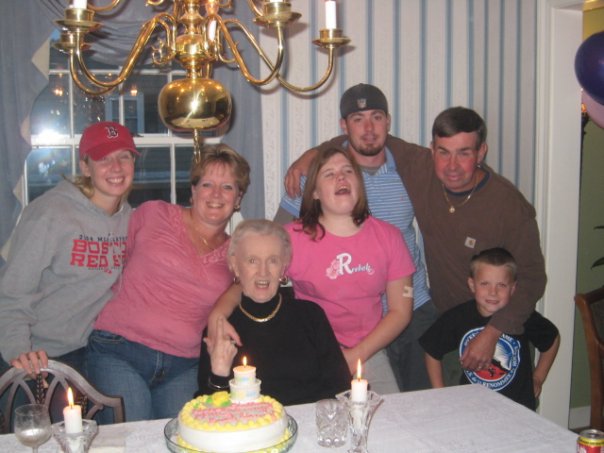
Sara Duzan (fourth from left) celebrates a birthday for her grandmother with her family. Pictured are (from left) Erin Hachey, Sara’s sister; Maryann, her mother; Virginia Herrity, her grandmother; Sara; David, her brother; Paul, her father; and Tyler, her nephew. The family has not seen Sara since June and is currently not permitted even to communicate with her by phone.
Ginsberg further noted in the memo, dated November 8, 2010, that Sara’s behavioral outbursts appeared to be largely in response to physical restraints or the threat of their use from the staff at Spaulding. In his memo, Ginsberg stated: “In most incidents, Sara would not become aggressive until staff approached her or became physical with her.” Her family believes her aggressiveness in those situations was an attempt to protect herself.
A full investigation of Ginsberg’s findings was apparently never done by the DRC, however. Now, the family is concerned staff in Sara’s current residence run by Becket Family of Services are once again using excessive restraints on her.
The use of restraints to control behavior has become increasingly controversial. In an online paper written for the Minnesota Governor’s Council on Developmental Disabilities, attorney David Ferleger maintained that there “is a proven risk of death and other injuries” from the use of restraints, and that “programmatic and planned restraint is not therapeutic or educational.” He noted that prone restraints involve “the prone positioning of a patient, following which their wrists are secured behind their back, their ankles are tied, and their wrists and ankles are subsequently secured together by pulling the shoulders back and bending the legs towards them.” In a series of 214 cases of people subjected to prone restraints while in agitated delirium, death occurred in nearly 12 percent of the cases, Ferleger stated. Ferleger contended that only vertical person-to-person restraints should be allowed, and only for “a very limited time.”
Excessive restraints as well as communication and visitation restrictions could violate Massachusetts state regulations that require that people with intellectual disabilities receive humane and adequate care and treatment as well as the “least restrictive” level of care, and that they have the right to be visited. There may be violations as well of regulations governing the use of restraints.
For the Duzan family, all communication with Sara was cut off on November 26, two days before Thanksgiving, when Maryann received an email from attorney Lynn Turner, Sara’s current guardian, announcing that all further contact either by phone or in person was being “suspended indefinitely” and that the police would be called if anyone from the family or “an agent of the family” attempted “to come onto the program,” meaning the Becket Family of Services residence. Turner stated that this cutoff in contact was being instituted “as per agreement between the program staff and me.”
A few months earlier, a document provided to the Duzan family from Sara’s current residential program stated that the family would be allowed to make one 15-minute call a week to Sara, and that no one was allowed to discuss visits home or whether Sara was unhappy at the facility or its treatment of her. All calls were to be monitored by staff, and the family was to give a two-minute warning to Sara after 13 minutes that the call was coming to an end. Sara was specifically prohibited from talking to her family about any “dislikes about staff, residence, Becket,” or about restraints.
Maryann contends the family was allowed seven phone calls with Sara since the end of July, and during five of these phone calls, Sara made statements about being assaulted, punched, restrained and living in poor conditions. In those instances, Maryann said, the phone was disconnected shortly after Sara began making those claims.
Similar restrictions on family contact were imposed while Sara was at the Spaulding facility. The latest restrictions on family contact were put into effect despite the fact that a probate court judge in 2010 described the family’s “undeniable love” for Sara. The family’s apparent problem, as characterized by Norfolk County Probate Judge George Phelan, was that the family as a whole was uncooperative with providers and appointed guardians, and felt “only they know what’s best for Sara.” Phelan termed the family “ill-suited” for guardianship and “inartful.”
Colleen Lutkevich, COFAR Executive Director, maintains that the Duzan case illustrates the danger a family can face in caring for a disabled loved one if they lose guardianship of the person. Not only has the Duzan family lost all contact with their daughter, but they say they have spent their life savings on legal costs in their so-far unsuccessful effort to regain their guardianship. Their legal battle has been a byzantine one that has involved a succession of guardians and even a Special Master in July who is supposed to resolve disputes between the family and Sara’s current guardian. During this time, the state has paid at least three attorneys to fight the family efforts to regain guardianship, Maryann said.
Andrea Barnes, the Special Master, wrote in July to Maryann that she agreed that “it is important for Sara to know that contact with her family will be a normal part of her life…” But it does not appear that Barnes has acted on the family’s behalf to restore that family contact. Maryann wrote to Barnes on November 24 to ask her to get Sara out of the current residence because she thought she was being harmed there, but Barnes responded the next day that she had no reason to believe Sara was being harmed. Barnes promised only that she would visit the residence to check on Sara “sometime in the next few weeks, and will certainly let you know if I have concerns.”
Maryann Duzan and other family members initially gave up their guardianship of Sara in the wake of a December 2009 investigation by the Massachusetts Disabled Persons Protection Commission (DPPC) into allegations of abuse of Sara against the Duzans themselves, including an admitted instance in which Maryann slapped Sara on the cheek. Maryann contends Sara was browbeaten by the Spaulding staff to implicate her family in abuse.
Maryann said she slapped Sara on one occasion because Sara was acting aggressively while at home and was threatening to throw a radio at her. She said Sara was acting out because she was due to be returned to Spaulding the next day following a weekend visit home. Maryann said Sara did not want to go back to the New Hampshire facility because she was being physically abused there, but did not communicate that verbally to her family at the time.
The eventual DPPC report noted that aside from the slap by Maryann, the allegations of beatings of Sara by one or more members of the family were all the result of a statement given on one occasion by Sara to staff at Spaulding. The report concluded that the DPPC could not substantiate the allegations of abuse other than the slap by Maryann, and that Sara had never spoken negatively of any of her family members until the single occasion on Sept. 1, 2009.
While the abuse allegations against the family were under investigation, Maryann and her husband, Paul, agreed on the advice of their then attorney to temporarily relinquish their guardianship of Sara. The DPPC then filed numerous motions for co-guardianship arrangements in probate court that would limit the family’s involvement with their daughter. In October 2010, Judge Phelan ruled that none of the family members were suitable to be either guardians or co-guardians, and that Daniel Smith, the executive director of the Arc of Greater Fall River, should be Sara’s sole guardian. Phelan noted in his ruling that Smith had served as guardian for 24 other persons.
The major concern Phelan raised in his ruling regarding the family was not any alleged abuse by Maryann or other family members, but the difficulty that provider staff, guardians, attorneys and others allegedly had in dealing with the family as a whole. But despite the judge’s criticism of the family for acting as if they knew best about Sara’s treatment, the federal Developmental Disabilities Assistance and Bill of Rights Act states that families shall be the “primary decision-makers” in the care of their loved ones with developmental disabilities.
Meanwhile, in September 2009, allegations of excessive restraints used by Spaulding were reported by the Duzans to the Massachusetts DPPC. Maryann contends the family has tried for four years to report abuse and neglect of their daughter to the state. She says she sent graphic photos of injuries of Sara while at Spaulding to the DPPC’s deputy general counsel.
But, unlike the attorney for the New Hampshire DRC, no one from the Massachusetts DPPC investigated the family’s claims of abuse at Spaulding, Maryann and other family members maintain. “They (the DPPC) have made it clear they simply don’t care (about the alleged abuse of Sara by Spaulding staff),” Maryann’s son David, who was temporarily a co-guardian of Sara, stated in a detailed timeline that he wrote about Sara’s treatment from 2006 through 2010.
In June 2011, the Duzans’ new attorney, Michael Turner, alleged the use of excessive restraints on Sara at the Kolbourne School in New Marlborough, MA, where Sara was sent after Spaulding. Turner’s motion alleged that Smith did nothing about either the alleged abuse at Kolbourne or the previous alleged abuse at Spaulding, and that Smith cut off the family’s contact with Sara while she was at Kolbourne. Turner then proposed his wife, Lynne, as Sara’s new guardian. The family wanted other “options” for guardianship examined, but that apparently never happened.
In December 2011, Smith stepped down as Sara’s guardian and the Duzans agreed on Turner’s advice to accept Lynne Turner as Sara’s sole guardian and to sign a stipulation in probate court that they would never sue the DPPC, DDS, Smith, or their previous state-appointed attorney, George Marlette. They further agreed to sign a stipulation that no family member would even apply for guardianship of Sara for five years. Maryann said the family felt forced into signing the agreement to hold the parties harmless out of a fear that the family would never see Sara again otherwise. To avoid the appearance of a conflict of interest, Michael Turner stepped down at that point as the family’s attorney.
Today, the family considers Lynn Turner to be acting contrary to their and Sara’s best interests because she has upheld the Becket program’s restrictions on their communication with Sara. Once again, the family is unable to contact Sara, despite the assessment by a probate judge that they are a loving family to her. And once again, they fear Sara is being subjected to abusive restraints.
“All we want is Sara safely back home, never to be hurt again, and state agencies to stop retaliating against our family,” Maryann says.
We share the Duzans’ concerns about the situation Sara may be facing in her current residence. We hope the probate court will act quickly to return her to her home. We urge people to call their legislators to ask for their help in getting Sara back home. And we think this case merits an independent legislative investigation of all of its aspects.
The phone numbers for the Legislature’s Children, Families, and Persons with Disabilities Committee are (617) 722-1572 (Senate staff), and (617) 722-2011 (House staff). You can email the co-chairs of the Committee: Senator Michael Barrett at Mike.Barrett@masenate.gov and Representative Kay Khan at Kay.Khan@mahouse.gov.
In addition, you can contact: Governor Patrick constituent services at constituent.services@state.ma.us; DDS Commissioner Elin Howe at elin.howe@state.ma.us; and Attorney General Martha Coakley at ago@state.ma.us.
A ‘thank you’ from Patrick Costa
A funeral mass was held November 26 for Patrick Costa, a longtime resident of the Fernald Developmental Center, who died on November 19 at the age of 49. Below is a letter written in Patrick’s voice by his guardian, Ann Witham, who read it at the mass for Patrick. Ann is a former Fernald employee who agreed to be Patrick’s guardian after his mother died. She also managed the Fernald chapel for the Rev. Bill Leonard, who has been the pastor at St. Jude Parish in Waltham in addition to his Fernald Chaplin duties.
My Dear Family and Friends,
During my time on earth, I could not talk; I never learned how to read or write or spell; or how to type or use a computer. But my life has changed. I’m with God now and as long as He’s ok with it, I can do almost anything, including writing this thank you letter.
The first thing I want to say is a big thank you to all the folks at Fernald for caring for me for almost forty years. They gave me the best they could and I am truly grateful for their efforts. It was not easy for me to leave that home, but in the end, it turned out to be a very good thing for me. When the time came for me to move here to the Wrentham Developmental Center, you went to a lot of trouble to make sure that Heffron “B” was really ready for my friends and me. You even took extra time to fix the few little things that somehow got overlooked the first time around.

Patrick Costa
My friends and I were warmly welcomed into our new home. It seemed as though everyone involved in our care – from direct care staff to clinicians and everyone in between, took the time to get to know each of us as individuals and to learn first-hand what each of us liked and disliked. You saw abilities and possibilities, not just disabilities; potential, not just limitations.
You found out that I liked to walk and made sure that I got to join a walking program and participate in Special Olympics where I won a medal. How proud and happy that made me feel! I really liked that special green suit I wore for the occasion and showing off the medal to my friends. I enjoyed going to the pool and you made sure that I had enough swimming trunks for these outings. I am so grateful for your supporting me in all my athletic endeavors, and for finding alternative activities when exercise was no longer possible for me.
Thank you for taking the time to make sure I ate my meals slowly so I would not choke. Sometimes it was a real challenge just to be sure I chewed before I swallowed, or, to make sure I did not snitch something from another’s plate. I must admit though, I did manage to succeed a couple of times and thoroughly enjoyed it.
You learned to read the visual ways and sounds I used to tell you what I wanted or what was wrong. Somehow, you knew that when there was a lot of commotion in the apartment, I would need to “get away from it all;” and spend some quiet time in my room. You even made sure that I had a special chair to use for relaxation.
Going to Adult Ed was a favorite activity for me. I was thrilled when I could sign a card with assistance. When I could no longer get to the program, you made it happen right in my apartment. That’s what the world would call “really great customer service.”
Van trips were also very special to me. I especially liked going to the restaurants that went the extra mile and texturized our food so we could eat our meals there. Thank you for taking the time to plan and organize those special “nights on the town.”
To all who stayed with me while I was in the hospital and at The May Center and back at my apartment, I owe so much. Your presence gave me more comfort than I can tell. It was wonderful to wake up and see a familiar face there with me and to hear your voices reassuring me that all was well. You knew the severity of my condition, but never let it discourage you from being upbeat with me. Special thanks go to Keith, my long-time friend and companion. During the last days of my life, Keith watched out for me, protecting me from “strangers” he did not know, keeping things where he thought they should be and making sure staff was always paying attention to me. A special thank you to new friends from Steward Hospice. Their care, compassion and concern for me as a person went far beyond what I expected. Even Keith could not prevent their welcomed presence in my life during my final days.
Mark, I know distance and family matters made it very difficult for you and Beth to travel to visit. I know you were in constant contact throughout the years, and that the distance did not separate me from your thoughts and affection. I tried so hard to wait for you, but Jesus came to bring me to my forever home and I had to go with him. Please take care of yourself. Your wife and your children need you.
I owe a very special debt of gratitude to Jim Devin for bringing Ann, and sometimes Marilyn, to visit with me. Jim and Ann, I knew you were both there shortly before I died, and I felt your love and took it with me when Jesus came to bring me home. And, last but not least, thank you to Father Bill for coming here on his day off to lead you all in prayer. Father Bill, I’m going to ask God to bless your ministry and to let you have calm seas, fair skies and a string of “keepers” for all the coming fishing seasons.
My friends, I hope you do not grieve too long for me. My spirit lives on and is oh so happy now with Jesus and my mother and all my friends and relatives who went before me. I will never forget you and will always pray for you. I pray God will wipe the tears from your eyes and hearts and that his peace will console, bless and always be with each of you.
With much love and gratitude,
Patrick
DDS challenge to mother’s guardianship of her son dismissed
The mother of an intellectually disabled man, who has been locked in a dispute with the Department of Developmental Services for several years over her son’s medical needs, will be able to remain as his guardian, according to a probate court agreement reached last week.
A Middlesex County Probate Court judge last week signed off on the dismissal of a year-long effort by the DDS to remove Patricia Feeley as guardian of her 27-year-old son, Michael. DDS had filed a petition in probate court in November 2012 to appoint James Feld, an attorney, as Michael’s guardian, even though Feld had never met Michael.
The DDS’s long-running dispute with Feeley, a COFAR Board member, has centered around Feeley’s contention that Michael, who has type 1 diabetes, needs a residential care setting with 24-hour nursing. Feeley has been trying for years to find a suitable residential placement for her son, who has lived at home his entire life. DDS has taken the position that Michael doesn’t need round-the-clock nursing.
DDS signed a stipulation to dismiss its challenge to Feeley’s guardianship during a probate court hearing last week, according to Stephen Sheehy, an attorney representing Feeley. Sheehy said he believed that DDS “came to the hearing prepared to dismiss the case because they recognized that Pat (Feeley) was doing a good job as Michael’s guardian and this was not a proper forum to deal with a dispute over a (residential) placement.”
In filing its original petition to remove Feeley as guardian, DDS had argued that Feeley was not acting in her son’s best interest in rejecting residential placements for him that the Department had offered. The Department’s petition also cited excessive “clutter” in Feeley’s home as a reason for removing Feeley as guardian. However, DDS did not allege any neglect or abuse on Feeley’s part, and even acknowledged she is devoted to her son.
Feeley said this week that she was glad of the dismissal of the guardianship challenge and hopeful “that somehow Michael will be offered a placement appropriate to his needs. He has been waiting for six years.” She added that, “I hope DDS will realize and take this (dismissal of the guardianship petition) as an affirmation that Michael’s needs are Michael’s needs. That’s what this is all about, not what DDS wants.”
Feeley added that DDS has never produced a clinical document to back up its contention that Michael does not need 24-hour nursing care. Feeley, however, did provide the court with a May 28, 2010 letter from a physician at Children’s Hospital in Boston, who wrote that Michael’s blood glucose spikes at times “for no apparent reason,” and that “it is not possible to predict when that might occur.” The doctor’s assessment continued that, “A nurse needs to be present and able to attend to Michael’s needs at any time to avoid a delay in Mike receiving appropriate medical intervention.”
Feeley said her son requires as many as seven injections of insulin per day. He also has a profound intellectual disability, is non-verbal and is unable to dress or bathe himself. Feeley, 65, who works as a part-time clinical lab technician and is a certified nurse assistant, currently administers the injections herself, monitors Michael’s blood glucose, and personally provides all other care at home for him. Michael’s extensive care needs have prevented her from working full time.
We are happy that DDS has finally realized it brought its dispute with Pat Feeley over the care of her son to the wrong judicial forum. Why DDS subjected Feeley to a frightening, year-long battle to retain guardianship and why the Department subjected taxpayers to the expense of an unnecessary probate court battle are troubling questions.
Based on what is apparently the only clinical document submitted in the case — the letter from the Children’s Hospital doctor — Michael does appear to need 24-hour nursing. We hope the outcome of this guardianship challenge finally spurs DDS to do the right thing and find a placement appropriate to Michael’s needs.
The system continues to fail the most vulnerable in the Templeton case
It seems that as events unfold in the wake of the alleged fatal assault of an intellectually disabled man at the Templeton Developmental Center in September, the system continues to fail everyone it was intended to protect.
Last week, Anthony Remillard was found competent to stand trial in connection with the death of Dennis Perry whom Remillard allegedly assaulted while both were in the Templeton Center’s dairy barn. As of this week, Remillard was being held without bail in the Worcester County House of Corrections.
We’ve already written here a number of times about our concern that Remillard was inappropriately placed at Templeton due to his apparently high level of dangerousness, and was not under sufficiently close supervision while there. However, given that Remillard is himself intellectually disabled, it seems to us that the Worcester County House of Corrections is an equally inappropriate place for this 22-year-old man.
Bonnie Valade is the mother of Tony Welcome, a Templeton resident who has himself had some previous scrapes with the criminal justice system and spent time at the same county jail facility now housing Anthony Remillard. She maintains that jail was wrong for her son, who she said was abused there, and will be equally wrong for Remillard. In an email, Valade had this to say:
My son was badly beaten (at the Worcester County House of Corrections) simply because he put his arm around an inmate saying ‘hello.’ The other inmates took everything we brought for him including his radio. He was sexually abused. They put him in a suicide cell just to keep him away from the population. If anyone knows about a suicide cell…it contains nothing not even clothes, only their underwear.
People with intellectual disabilities need clinical and other therapeutic services. They don’t tend to receive those services when they end up in correctional facilities. And they do end up in correctional facilities more often, it seems, than people of normal intelligence.
A recent article on the website Disabled-World.com notes that intellectually disabled people constitute “a small but growing percentage” of suspects and offenders within the American criminal justice system. While they comprise between 2 and 3 percent of the general population in the country, they represent between 4 and 10 percent of the population in prison and an even larger portion of the population in juvenile facilities and jails.
Intellectually disabled people like Anthony Remillard and Tony Welcome need to be in places that provide them with supportive supervision, structure, and security. In many key respects, prisons provide none of those things. It’s hard to imagine that the behavioral issues that Anthony Remillard apparently had that led to the alleged assault on Dennis Perry are going to be dealt with in a positive way where he is now. And the fact that he has been found competent by a judge to stand trial in the alleged fatal assault means he could end up in prison for the rest of his life.
As has been pointed out by others in this case, the system failed Dennis Perry, and now it is failing Anthony Remillard. In both cases, it does not appear that sufficient supportive supervision, structure, or security were or are being provided.
Unfortunately, we see the potential for more of these systemic failures as Massachusetts and many other states continue to cut staffing at facilities such as Templeton, which currently meet strict federal standards of care. We’ve asked for a legislative hearing to examine, among other things, whether a major phase-down in staffing at Templeton in recent years resulted in the apparent failure to adequately supervise Remillard there.
Templeton and countless other facilities like it are being closed around the country in the name of deinstitutionalization. The closure process has not resulted in better lives for everyone, however. We are creating a largely privatized system of care in this country that in many respects provides less supervision, structure, and security than before.
Even the most ardent proponents of privatized, community-based care acknowledge that the community system isn’t working very well. In a recent op-ed piece, the president of the Massachusetts Association of Developmental Disabilities Providers, referred to the “funding disaster that has governed private programs” that now serve most of the people with disabilities in the state. The quality of the care provided by these private programs reflects that funding disaster. The programs are rife with poorly trained and poorly compensated staff and with the consequent problem of abuse and neglect.
And what then happens to the Anthony Remillard’s who are caught up in a system of care that cannot adequately serve them or protect others from them? In more and more instances, they end up in a much worse institutional system — the prison system.
It is now well known that deinstitutionalization of the mentally ill since the 1960’s has led to a continued increase in the population of mentally ill people in the nation’s prison system. We are only starting to realize that the same thing is happening with respect to people with intellectual disabilities.
Update: new claims cast doubt on a cover-up of alleged assault at Templeton
Many concerns have been raised about the state’s oversight of care of the developmentally disabled in the wake of the alleged fatal assault of Dennis Perry on September 16 at the Templeton Developmental Center.
But a failure to notify investigating authorities about the incident may not be one of those issues.
It seems there is some disagreement between the Worcester County DA’s office and the Disabled Persons Protection Commission as to when and by whom the DA was notified of the alleged assault. The assault was allegedly committed by Anthony Remillard, a resident at Templeton who had been admitted there despite an apparent record of previous assaults and other crimes.
As you may know, The Worcester Telegram reported on October 27 that the DA’s office was never notified by Templeton Center officials about the alleged assault of Perry, and only learned of it from the chief state medical examiner’s office. Paul Jarvey, a spokesman for the DA’s office, confirmed that account to me after the Telegram & Gazette story broke and again when I spoke with him on November 6. He said it was only after Perry died on September 27 that the chief state medical examiner contacted Templeton Police who then contacted the state police detective unit attached to the DA’s office.
As a result, I posted here on October 30, asking whether the Patrick administration covered up a serious crime at a Department of Developmental Services facility.
However, Emil DeRiggi, DPPC deputy executive director, emailed me on November 6 that the DPPC was in fact notified of the alleged assault on September 17, one day after the incident occurred. DeRiggi later contended that according to the DPPC’s database, the DPPC’s state police unit notified the Worcester DA’s office that same day – September 17 – about the alleged assault.
Sgt. Timothy Grant of the DPPC state police unit said to me yesterday that he has a copy of a September 17 email that his office sent to the DA about the alleged assault, along with a copy of the DPPC intake form regarding the incident. Thus, according to the DPPC’s account, the Worcester DA was notified about the alleged assault one day after it occurred, and at least 10 days earlier than the Worcester DA claims to have been notified. DeRiggi said he could not reveal who notified the DPPC about the alleged assault.
So, while it is not absolutely clear who reported the case, it would seem that if the DPPC’s account of the manner and timing of the notification is correct, it would have been impossible for DDS to have covered the matter up.
On November 6, Jarvey had told me he could not comment on the DPPC’s assertion that the DPPC had been notified of the incident on September 17th. When I called him yesterday morning to discuss Sgt. Grant’s claim that the DPPC’s state police unit notified the DA of the alleged assault on September 17, Jarvey said he would “double check” the DA’s records and get back to me.
I sent an email yesterday to DDS Commissioner Elin Howe, asking whether she would comment on whether and when DDS notified either the DPPC or the DA, or both, about the alleged incident.
I would note that none of this addresses the DA’s additional claim that Templeton administrators also failed to report the alleged assault directly to the DA, as required by law. And it does not address an alleged failure by DDS to report an incident eight months earlier in which Remillard allegedly assaulted a Templeton staff worker. That incident was supposed to have been reported to the district court judge who had ordered Remillard sent to Templeton.
In any event, as we’ve said before about this case, there are many other questions and concerns about DDS’s management and oversight that are raised by this case — in particular, why Remillard was admitted to Templeton and whether the supervision of him there was adequate.
In a November 7 letter sent to Bonnie Valade, the mother of a Templeton resident, Howe said the circumstances surrounding the assault of Perry and the process under which Remillard was admitted to Templeton are under review by DDS. Howe maintained in the letter that while staffing at Templeton has been reduced in recent years as the residential population there has been phased down, the ratios of staff-to-residents are currently at “the highest level they have ever been.”
Howe’s letter added that: “(Templeton) has been an excellent program and has supported individuals with challenging behaviors successfully for many years.” She maintained that the center’s residential admissions practices “have remained consistent historically including throughout the closure period.”
All of that may be the case, but, as Valade has pointed out, many of the best and most experienced staff at Templeton have left the center since it was marked for closure by the administration in 2008. Despite the rosy cast that Howe’s letter has placed on the staffing and admissions situation at Templeton, the fact that an intellectually disabled man was assaulted and killed, allegedly by a resident at the center who was supposedly under close supervision, indicates that something is wrong there.
We believe an independent and comprehensive review of the circumstances surrounding Dennis Perry’s death is needed, and have asked the Legislature’s Children, Families, and Persons with Disabilities Committee to conduct that review and hold a hearing as part of it.
Did the administration cover up an alleged fatal assault at the Templeton Center?
Did the Patrick administration cover up a serious crime last month at a Department of Developmental Services facility?
That question is certainly raised by a story on Sunday in The Worcester Telegram & Gazette about the death of Dennis Perry, an intellectually disabled man, who was allegedly assaulted at the Templeton Developmental Center.
In what has been described by witnesses as an unprovoked attack, Anthony Remillard, 22, allegedly shoved Perry, 64, into a boiler on September 16 while the two men were working at the Templeton facility’s dairy barn. Perry suffered a head injury in the incident and died at UMass Memorial Medical Center on September 27.
We’ve raised a number of questions about the admission and supervision of Remillard at Templeton, but Sunday’s Telegram & Gazette article reveals many new facts about the case, based on court records. Among them was that Templeton administrators never reported the alleged attack on Perry by Remillard to police or the district attorney.
According to the newspaper, investigators learned of the alleged assault from the state medical examiner. When state police arrested Remillard on October 2 — more than two weeks after the alleged assault — he was still living at the Templeton Center.
In failing to report the alleged assault on Perry, the administration appears to have violated a state law (M.G.L. Chapter 19B, Section 10), which requires the superintendent of any DDS facility to report any serious crime at that facility to the district attorney within a week. It seems questionable that the superintendent of a state facility should be given even that much time to get around to reporting a serous crime to police. But, in this case, more than two weeks apparently went by with no report.
Moreover, as a spokesman for the Worcester County District Attorney’s Office confirmed to me, by the time investigators learned of the alleged assault, Dennis Perry was already dead, meaning this case involves a potentially unreported homicide. It seems unlikely that top administrators at DDS were not informed about both the alleged assault when it happened and Dennis Perry’s death 11 days later. Why did they not report either one?
But that’s not the only thing the administration apparently failed to report about this case.
According to the Telegram & Gazette story, a Worcester Superior Court judge had set conditions in sending Remillard to Templeton last year, one of which was that any incidents involving him be reported to the court. Eight months before he allegedly shoved Perry in the barn, Remillard allegedly punched a Templeton staff member in the chest and had to be restrained. Templeton never reported that incident, the newspaper reported, quoting investigators. (The D.A. spokesman confirmed to me that alleged reporting failure as well.)
As the newspaper previously reported, Remillard had been charged prior to his admission to Templeton in a May 2012 arson in a vacant building in Worcester. At his arraignment on that charge, the Worcester County D.A. had recommended that he be evaluated at either Bridgewater State or Worcester State Hospital. But the recommendation was rejected by the judge, and Remillard was allowed to enter a “pre-trial release commitment” at Templeton, a less secure facility.
On Sunday, The Telegram & Gazette reported that Remillard was developmentally disabled and repeatedly found not competent to stand trial in previous criminal cases. His history includes charges that he hit his 12-year-old brother in the face with a baseball bat in May 2011, and that four months later he threatened someone with a knife and punched him in the face. In addition, in June 2012, one month after he allegedly set fire to the vacant building in Worcester, Remillard was admitted to a psychiatric facility due to a “psychotic break,” and cut off a GPS bracelet.
Remillard did have a treatment plan at Templeton, which required that he be monitored by staff at all times except when in his room with his door alarm on, the newspaper reported. Among the many questions raised by this case is how he could have been in a position to allegedly assault and fatally injure Perry if he was under close staff supervision.
“My concern is that a man is dead, and there were things that were supposed to happen that could have prevented this, and they didn’t happen,” District Attorney Joseph Early told the Worcester paper.
Thomas Frain, COFAR’s president, is quoted in the article as noting that the administration is moving to close and privatize intermediate care facilities such as Templeton. As a result, most of the residents remaining in these state facilities are elderly. “This population is old, frail and medically needy,” Frain said. “Why were they holding someone violent and dangerous with a docile 64-year-old man? Someone is dead for no apparent reason. If you’re going to take someone like that, you have an obligation to keep everyone safe. I think they should answer for what happened there.”
The only answer the Telegram & Gazette was able to get from the administration in response to all of these questions is the same one-paragraph response we received when we asked for DDS’s policies and procedures regarding admissions and supervision of people with behavioral problems at Templeton. That response reads as follows:
In response to your basic questions about admission criteria and policies at Templeton Developmental Center, all individuals referred to TDC for admission must be eligible for supports by the Department of Developmental Services. Staffing and clinical services are individualized for each person and DDS works to promote the health and safety of all residents.
At the very least, we hope that state legislators will hold a hearing on the apparent administrative failures that allowed this tragedy to happen and the alleged failure on the part of the administration to report a serious crime to police.
It would be one thing if Dennis Perry’s death had happened out of the blue. But Remillard was well known to be dangerous and prosecutors were concerned enough about him that they didn’t want him sent to Templeton. DDS knew about Remillard’s background and apparently did not do enough to protect those around him. Coupled with this is the fact that the administration has been steadily downsizing staffing in facilities like Templeton and exposing remaining residents there to increasingly dangerous conditions.
On top of all of that, it appears there may be a policy in place of not reporting violent incidents even to police, and it’s hard to believe that policy does not come from the top at DDS and perhaps even at the Executive Office of Health and Human Services.
It looks an awful lot to us like a cover-up was put in place in this case. Certainly, so far, no one at DDS or in the administration as a whole is publicly accepting any responsibility for what happened to Dennis Perry. There seems to be no accountability.
 COFAR blog