Archive
Rep. Haddad endorses independent study for Glavin Center
House Speaker Pro Tempore Patricia Haddad, who just spearheaded a successful effort to block the immediate closure of Taunton State Hospital, supports undertaking an independent study prior to the closure of the state-run Glavin Regional Center in Shrewsbury for persons with intellectual disabilities.
Speaking at a meeting Tuesday at the State House attended by Glavin family members, legislators and their staffs, and officials of the Department of Developmental Services, Haddad said the independent study should cover “the entire DMH (Department of Mental Health) and DDS system.”
“Someone has to be the first to say we’re not afraid to have an outside study done to tell us what’s wrong and what’s right,” Haddad said. She maintained that internal studies done by the administration that showed a savings in closing Glavin and other developmental centers in Massachusetts “are asking people to trust the results.”
The Tuesday meeting was organized by Republican Representative Matthew Beaton, whose Shrewsbury-based district is home to Glavin. In 2008, the Patrick administration targeted the Glavin, Fernald, Monson, and Templeton developmental centers for closure as of the end of the current fiscal year.
Fernald has remained open pending the outcome of appeals filed by the guardians of 14 remaining residents. The Monson center was officially closed last month.
During the Tuesday meeting, I pointed out on behalf of COFAR that the planned closures of the four developmental centers will leave only two locations in Massachusetts for federally regulated Intermediate Level Facility (ICF) care. Those remaining facilities are located in Danvers in the northeastern corner of the state, and Wrentham in southeastern Massachusetts. The administration has deferred a decision on whether to close the Danvers facility.
During the meeting, Will Dumont of Brookfield, the father of a resident of the centrally located Glavin Center, said it would be much more difficult to regularly visit his son if he were transferred hours away to Wrentham.
Sheila Bailey, another family member, said her brother had suffered abuse in a facility that he had lived in prior to coming to Glavin. “It was like a cloud was lifted when he got to Glavin,” Bailey said. “He finally had a life there.”
Beaton maintained that Al Bacotti, a former director of the Glavin Center, who has taken an active role in opposing its closure, maintained to him that in the next 10 to 15 years, the loss of the ICF-level care provided by facilities such as Glavin will force the state to rebuild them.
DDS Deputy Commissioner Larry Tummino said he did not dispute that the services at Glavin are excellent. He contended that “we can structure that clinical expertise in the community.” Tummino also maintained that guardians of some 31 residents at Glavin have agreed thus far to move those residents to other locations.
That latter claim from Tummino brought a sharp rebuke from Roland Charpentier, the president of the Glavin family association. Charpentier said the guardians who agreed to leave Glavin did so “because they were scared to death that Glavin is going to close.”
Haddad also was critical of the administration’s contention that the services provided by facilities such as Glavin and Taunton state can be replicated in the community system. “There are more horror stories than good stories in the private sector,” Haddad said. “You’re asking people to trust a system that has a lot of flaws,” she said to Tummino and a second DDS official who attended the Tuesday meeting.
“This is not something you can just say ‘it’s going to be okay,” Haddad added.
Haddad said she was nervous about what the independent study approved for Taunton State Hospital might conclude, but that she believes the outcome will be support for “a continuum of care” in the mental health system that would include Taunton State.
Speaking specifically about the plan to close Glavin, Haddad maintained that it is harmful to remove intellectually disabled people from their longtime homes. “People cling to the people and things that they know,” she said.
Trial in DDS abuse case caps two years of frustration
Sheila Paquette’s two-year quest to obtain justice in the alleged assault of her intellectually disabled brother came to a crushing end on July 30 as a jury in Falmouth District Court took less than half an hour to acquit the alleged assailant.
We have no desire to use the media to convict the man who was found innocent in this case. What we do want to point out here is how this case illustrates the nonstop frustration that intellectually disabled victims of crimes and their advocates are likley to encounter as they deal with a bureaucratic system that is supposedly intended to help them. In reality, it does nothing of the sort.
Here is a reprint of my op-ed on this case, which ran on Sunday in The Springfield Republican:
Viewpoint: State must protect its most vulnerable
By David Kassel
The jury did its job on July 30 in a trial of a care giver in a West Springfield group home who was alleged to have assaulted an intellectually disabled man more than two years ago in Falmouth on Cape Cod.
But did the government do its job? After less than half an hour of deliberation, the jury acquitted John Saunders of assaulting John Burns while they were on a weekend trip to the Cape from the group home operated by the Center for Human Development.
Burns suffered two black eyes and other injuries in the alleged assault.
Certainly, this was a difficult case to prove. The key witness was an intellectually disabled man who is Burns’ roommate in the West Springfield residence. When the case finally did come to trial on July 30, the witness’s account of the alleged assault had substantially changed.
What concerns us about this case is not the outcome, however, but rather the overall performance of the District Attorney’s office and other agencies entrusted with the protection of some of the most vulnerable members of our society.
Those agencies did not appear to demonstrate a strong commitment to working together in pursuit of justice for the alleged victim.
For instance, Sheila Paquette, of Westfield, Burns’ sister and guardian, ultimately ended up filing the assault charge against Saunders herself in July 2010 when she became convinced no law enforcement agencies were going to do so.
It was only after she filed the charge that the state Disabled Persons Protection Commission sent a state trooper to her house to investigate, she said.
After that, the case languished for months at a time, beset by bureaucratic snafus and witness no-shows that caused the trial to be postponed four times.
When the trial finally took place, the D.A.’s prosecution effort seemed half-hearted. Among other questions we have was why no one from the DPPC or its state police unit was called to testify at the trial.
The DPPC had issued a comprehensive report on the incident in February 2011, which found sufficient evidence to conclude that Burns was “seriously injured” by Saunders.
Assistant Cape & Islands District Attorney Kerry Whalen, who headed the criminal investigation of the case, contended to us that any testimony given by either the DPPC or state police investigators in the trial would have been considered hearsay because those investigators had not interviewed Saunders.
The DPPC report, however, stated that a DPPC investigator did interview Saunders by telephone. It is concerning to us that there appears to be no communication process in place to ensure that DPPC investigators testify in criminal proceedings such as this case.
Moreover, even if testimony from the DPPC would have been considered hearsay, that would raise a further question about the D.A.’s performance.
Why did none of the staff of Burns’ group home testify at the trial, other than Saunders and one other caretaker who had been on the Cape Cod trip?
The DPPC report stated that other staff in the West Springfield residence had observed Saunders to be “speaking in a derogatory manner” about Burns in his presence later on the day of the alleged assault. This never came out at the trial either.
If nothing else, this case has shown that there is a potentially serious lack of communication and cooperation between the key agencies that are charged with protecting the safety of some of our state’s most vulnerable citizens.
It also raises the question for us whether prosecutors take criminal cases involving abuse and neglect of disabled persons seriously enough.
We hope lawmakers and other policy makers will consider changes that are badly needed to ensure that the disabled in Massachusetts have adequate access to justice when crimes are committed against them.
(More information about the July 30 trial in this case and the questions it raises can be found in the August 2012 issue of The COFAR Voice newsletter and a special August edition of The Advocacy Network News, the newsletter of the Advocacy Network, a COFAR member organization.)
What do the academic studies say about community-based care?
A review of the literature
Introduction
In the past two decades, there has been a major shift around the country in care for the intellectually disabled, as tens of thousands of people have been moved from larger congregate facilities to community-based group homes.
(Since congregate facilities, also known as Intermediate Care Facilities for the developmentally disabled (ICFs/DD), are generally referred to as institutions, I will use that latter term here, despite its negative connotations.)
This shift in care, accompanied by a large-scale privatization of residential and other services, has engendered much debate among policymakers and advocates for the disabled.
That debate has played out for close to two decades in Massachusetts, as governors from Weld to Romney to Patrick have moved to close state developmental centers and place their residents in a mix of public and privatized facilities. While the Patrick administration has, in many cases, moved people from facilities slated for closure to the Wrentham Developmental Center, the administration has stated that its ultimate goal is to move people to community based care.
In a statement in 2007 announcing the decision to close the Fernald Developmental Center, the first of four such centers that the administration has targeted for closure, Secretary of Health and Human Services JudyAnn Bigby stated the following:
The state’s decision (to close Fernald) is consistent with a national shift away from institutional care in favor of community living. Decades of research indicate that community settings offer people with mental retardation the best care available and the highest quality of life. The Patrick Administration believes that community living is the best environment in which to ensure family connections, service access, education, training employment and full inclusion for people with mental retardation.
Has the deinstitutionalization effort been an unqualified success, and does academic research support that claim?
I reviewed academic research on the topic of deinstitutionalization of the intellectually disabled. Much has been written in scholarly journals on this topic in the past 20 years, and I think it would be safe to say that the writers of those articles have given out both good and bad grades on the impact of deinstitutionalization on the well-being, health and longevity of the people involved.
Specifically, the studies I reviewed found that:
- Many people who were deinstitutionalized did indeed experience improvements in the quality of their lives and adaptive skills after being transferred to community-based group homes.
However, many of those same studies reported that:
- Many deinstitutionalized people have encountered a lack of adequate medical care in the community system, and quality of life and adaptive skills often did not improve for those who had the most profound levels of disability or who were older.
I’ll first discuss the studies I reviewed on the well-being of deinstitutionalized persons and then will discuss an academic controversy over a study that found a higher death rate among people who were deinstitutionalized in California than what would have been expected in the institutions they were moved from. (A list of the articles I reviewed can be found at the end of this post.)
Quality of life studies on deinstitutionalized persons
One of the more comprehensive reviews I was able to find of well-being or quality-of-life studies of deinstitutionalized persons was a 2011 article by Monali Chowdhury and Betsey Benson in The Journal of Policy and Practice in Intellectual Disabilities.
Chowdhury and Benson reported that their review indicated that relocation from institutions to community-based settings had a “general positive impact on life quality of participants.”
At the same time, Chowdhury and Benson stated that many of the studies they reviewed found that “improvements were most prominent shortly after the move and plateaued after a year.” While some studies showed gains in adaptive behavior in former institutional residents who had been moved to the community, they wrote, other studies “have shown neither significant increase in adaptive skills nor the maintenance of modest gains when moving to community group homes.”
Chowdhury and Benson also reported that in a number of studies, “participants continued to have low levels of community integration,” and there was “some evidence that healthcare needs might not be adequately met in the community.”
A 2007 article in Current Opinion in Psychiatry by J. Beadle-Brown et al. contained the following summation of the academic literature on deinstitutionalization of the intellectually disabled:
Work on deinstitutionalization continues to show that outcomes are better in the community than in institutional care, but recent papers highlight that there is more to deinstitutionalization than just hospital closure. Just moving people out of institutions into community settings does not bring about automatic improvement in quality of life in terms of choice and inclusion as well as self-identity and access to effective healthcare and treatment. This is especially true for people with more severe intellectual disabilities as well as complex needs such as challenging behaviour.
Among the other studies I reviewed that drew similar conclusions that transfers from institutional to community care were often but not always successful was a 2010 overview of research by Patricia Noonan Walsh et al. in The Journal of Policy and Pratice in Intellectual Disabilities.
Citing what they termed “post-deinstitutionalization” studies that they had reviewed, Noonan Walsh and her colleagues stated that these studies provided “consistent evidence for greater choice, self-determination, and participation in community-based activities in smaller settings, but no evidence for greater physical health or material well-being…”
In addition, a 1998 study in the journal Mental Handicap Research by Andrew Bratt and Rob Johnston of five intellectually disabled adults who had left a hospital to live in a “bungalow” in Exeter, England, concluded that while the staff considered the group as whole to be better off after the move:
…little evidence of integration being achieved within the local community was recorded; and there was little or no evidence of individuals being supported in ways that increased their competence, particularly in relation to participating at a simple level in routine domestic tasks.
Perhaps one of the reasons for the discordant findings among many researchers over the impact of deinstitutionalization is the difficulty in measuring that impact. That difficulty may have contributed to the disagreement among many policymakers and advocates as to whether deinsitutionalization has been beneficial or not.
Chowdhury and Benson noted that many of the studies they reviewed on deinstitutionalization relied on interviews with intellectually disabled persons to determine quality-of-life differences between institutions and group homes. However, other studies have found, they stated, that these interviewing techniques can be compromised by “response biases,” which “can seriously damage the reliability and validity of self-report data on subjective QoL (Quality of Life) in individuals with ID (intellectual disabilities).”
One 2000 study, for instance, by Jonathan Perry and David Felce in Mental Retardation, reported that two thirds of the respondents in a sample of 154 adults with intellectual disabilities were either unable to respond to questions in a structured interview about their quality of life or exhibited response bias. The authors noted that the most common form of response bias among people with intellectual disabilities is “the tendency to acquiesce, that is, to say yes to questions regardless of their content” (emphasis in the original).”
Chowdhury and Benson further noted that given those problems with response bias, “a knowledgeable proxy,” such as a staff member or parent, is often asked to respond on behalf of an intellectually disabled person to quality-of-life survey questions. However, they stated using such proxies is “usually not seen as an accurate substitute” for measuring QoL of people with ID.”
The California mortality study controversy
A major area of disagreement among academic researchers appears to center around attempts to determine whether moving intellectually disabled persons out of institutions causes them to die earlier than they would have had they stayed in those facilities. This disagreement as well has spilled out into the policymaking and advocacy worlds.
I was was recently criticized, for instance, by a leading opponent in Massachusetts of developmental centers for the intellectually disabled for citing a one such mortality study on deinstitutionalization that had been done on residents who were moved from institutions to community group homes in California in the 1990s.
In a recent post calling for saving the Glavin Regional Center in Massachusetts from closure, I wrote that a 2005 paper by Robert Shavelle, David Strauss, and Steven Day in The Journal of Data Science, reported that the authors had analyzed data on more than 1,800 children and adults who had been dinstitutionalized in California between 1993 and 1996. The authors found that as of 1999, there were 81 deaths among those who had been transferred from institutions to community-based group homes. Using statistical regression, Shavelle et al. reported that the the death rate represented a 47 percent increase in mortality over that expected in institutions.
Shavelle and Strauss concluded that the increase in deaths appeared to reflect less intensive medical care and supervision available in the community.
I wrote the post on behalf of COFAR, a nonprofit organizaton that I consult for and that advocates on behalf of the intellectually disabled and their families.
COFAR, along with Strauss and Shavelle, were criticized by Gary Blumenthal, president of the Massachusetts Association of Developmental Disabilities Providers (ADDP), who wrote in a comment (under the user name “dcjayhawk”) to my post that:
COFAR…attempts to frighten families by telling them of higher mortality rates in community programs versus ICF (Intermediate Care Facility) programs by citing a flawed 1993-1998 California mortality study whose methodology and findings have been discredited by multiple expert researchers…
Blumenthal went on to cite four studies that he claimed discredited the work of Shavelle and Strauss. (More about that below.) The ADDP, which represents nonprofit operators of group homes in Massachusetts that contract with the state Department of Developmental Services, supports the closure of all remaining developmental centers in Massachusetts and the transfer of all of their residents to community-based group home programs.
The California mortality research of Shavelle and Strauss was also criticized by Connecticut Department of Developmental Services Commissioner Terrence Macy, who has stated that he wants to move residents out of the state-run Southbury Training School in Connecticut and into privately run group homes. In a recent letter to another client of mine, The Southbury Training School (STS) Home & School Association, Macy maintained that:
The California study is well over twenty years old. Its research methodology of contrasting deaths that occurred in the community to “those expected in institutions” is no longer a viable research methodolgy. I would doubt this research design would even be accepted for publication in today’s research periodicals. That study has been replaced with a large number of studies that have been conducted throughout the country over a long period of time. Many of these studies are longitudinal so by design they follow persons who have moved over extended periods. This significant body of rigorous studies has consistently concluded that persons who have transitioned out of institutions in fact have benefited from placement in the community.
But have the Shavelle study and earlier versions of it by Strauss really been discredited and are they really over 20 years old?
In answer to that second question, I would note that Strauss and co-author, Theodore Kastner, first published findings of a higher mortality rate among deinstitutionalized persons in California in 1996 in The American Journal on Mental Retardation. The article by Shavelle and Strauss, which I cited in my BMG blog post, was an update of the original study, and was published in 2005 in The Journal of Data Science. Thus, even Strauss’s earliest findings do not appear to be more than 16 years old, and the work done by him and his colleagues on this topic was accepted by a peer-reviewed periodical only seven years ago.
Strauss’s research website lists a total of 10 studies and one commentary on mortality issues associated with deinstitutionalization that he co-authored with a total of eight colleagues. Strauss himself is professor emeritus of statistics at the University of California, while Shavelle has been a visiting assistant professor at the University of California and has a Ph.D. in statistics. Kastner, a physician, has held associate professorships at the New Jersey Medical School and the Columbia University College of Physicians and Surgeons.
I reviewed all four of the studies cited by Blumenthal of the ADDP as having discredited Strauss’s methodology and findings. What I found is that, as with the studies on the quality of life of intellectually disabled persons, studies on mortality rates of people who have been deinstitutionalized often reach differing conclusions.
I also found that while three of the four studies cited by Blumenthal did dispute the mortality findings of Strauss and his colleagues in the 1990s in California, two of those three were largely respectful of Strauss’s work. (More about the exception below.) Strauss and his colleagues, as far as I can tell, have not been discredited. The fourth study cited by Blumenthal as having discredited Strauss’s California mortality studies actually did not directly address that topic at all.
I would also note that each of the studies cited by Blumenthal that did dispute the mortality findings of Strauss and his colleagues was done by researchers who disclosed consulting relationships with state agencies that had or were seeking to close developmental centers. In my view, those relationships raise questions about the independence of those studies.
As noted, only one of the articles cited by Blumenthal was actually overtly critical of Strauss et al. and their methodology. That critical article, titled “Commentary on the mortality issue,” by James Conroy and Miriam Adler, was published in the journal Mental Retardation, in October 1998.
In the commentary, Conroy and Adler cited a 1995 study they undertook on the transfers of residents from the Pennhurst Developmental Center in Pennsylvania, and stated that they had found a “sharply decreased risk of death when people moved from institution to community.” They termed Strauss’s 1996 finding of a higher death rate in the community system “utterly false” and compared it to the discredited discovery of cold fusion.
It should be noted that Kastner returned the favor, critiquing Conroy’s methodology in a number of papers, including a 2000 article in Mental Retardation concerning Conroy’s Pennhurst closure study. Kastner also co-authored a 2006 article with Kevin Walsh in the same journal, titled “The Hissom Closure in Oklahoma: Errors and Interpretation Problems in Conroy et al. (2003).”
In that 2006 article, Walsh and Kastner charged that the research of Conroy and his colleagues had been “seriously compromised by data collection problems and discrepancies between reported findings and those obtained when the analyses were replicated.”
Several of Conroy’s reports were also criticized in the 1990s by former staffers of the California Department of Developmental Services, according to the May 1996 issue of Outreach, a publication of the California Association of Psychiatric Technicians. The journal article, titled “Conroy Reports Controversy,” also stated that Philip Bondy, who is a former chair of Yale’s Department of Internal Medicine and a Southbury Training School Home & School Association Board member, was critical of a study done by Conroy on the outcomes of the closure of the Mansfield Training School in Connecticut.
Bondy emailed me that his criticism was based on Conroy’s reliance in the Mansfield study on quality-of-life interviews with attendants as proxies for former Mansfield residents who had been moved to community-based group homes. “There is no reason to believe that the attendants were unprejudiced,” Bondy wrote, “since they were employed in providing community care and might reasonably expect to give favorable answers. Although Conroy quoted statistics in support of his conclusions, I believe that they were based on faulty data,” he added.
Bondy is a former editor in chief of both The Journal of Clinical Investigation and The Yale Journal of Biology and Medicine.
Conroy’s resume indicates that he authored or co-authored hundreds of reports on the well-being of deinstitutionalized residents, most of which appear to have been submitted to state agencies running ICFs and community-based facilities or to entities such as the Institutional Closure Commission of Ohio. I think that may raise some questions about his independence in researching this issue.
A second article cited by Blumenthal as having discredited the work of Strauss and his colleagues on mortality rates in California was a 1998 study by Kevin O’Brien and E.S. Zaharia. The study, titled “Recent mortality patterns in California,” was published in the same issue of Mental Retardation in which the Conroy commentary was published.
The O’Brien and Zaharia study found no increased risk of death in the community for the same population that Strauss and his colleagues had studied. But far from discrediting Strauss’s results, O’Brien and Zaharia stated that the reasons for the discrepancies between the two studies were “unclear.” They acknowledged that due to validity prolems with databases used to analyze the number of deaths, “there may have been quite a bit of contamination in all of our analyses.”
In a separate commentary in the same issue of the journal (titled “Is it Life Threatening to Live in the Community?”), O’Brien and Zaharia stated: “We believe that the suggestions made by Strauss et al. (1998) (about closely monitoring initial placements of residents in community settings) should receive thoughtful debate.”
O’Brien and Zaharia disclosed in their papers that they were consultants to the California Department of Developmental Services.
A third study cited by Blumenthal as discrediting the Strauss studies was done by Paul Lerman, Dawn Hall Apgar, and Tameeka Jordan and published in in Mental Retardation in August 2003. This study did not find evidence that moving residents out of a developmental center in New Jersey and into the community caused more deaths. However, the authors concluded that the difference between their results and Strauss’s findings could be due to variations in policies in the two different states on deinstitutionalization or to differences in population characteristics.
Lerman et al. also noted several limitations to their own study, including limitations on the reliability of their behavioral variables. The study was hardly an effort to discredit Strauss and his colleagues.
The Lerman study, by the way, was funded by the New Jersey Division of Developmental Disabilities.
The final study cited by Blumenthal as discrediting the Strauss studies was actually concerned with the well-being of people transferred from nursing homes to community residences. The 1998 study, by Tamar Heller, Alan Factor, and Kelly Hsieh, in The American Journal on Mental Retardation, mentioned Strauss’s research in passing and was not in any way critical of it.
In a defense of their work, published in the same 1998 issue of Mental Retardation as the Conroy and O’Brien and Zaharia articles, Strauss and Shavelle maintained that they were not attempting to evaluate “the merits of institutional versus community living,” and were not arguing that persons living in the community should move or return to a state institution.” Instead, they said, “[o]ur concern was with the quality of health care and supervision currently available in the community.”
In that commentary, Strauss and Shavelle cited a Congressional subcommittee report, newspaper reports on avoidable deaths in California group homes, and a critical report on the community system in California by the federal Health Care Finance Agency as buttressing their findings.
Conclusion
This review of the academic literature on institutional versus community-based care for the intellectually disabled is admittedly far from exhaustive. But I think most researchers in this field would probably agree that I’m correct in concluding at least one thing about the research that has been done on this topic: That is that there is no clear consensus among scholars that either system of care is better in all respects for all intellectually disabled people.
Both of the advocacy organizations that I work for believe that the community-based system is appropriate and beneficial for the majority of people with intellectual and developmental disabilities. At the same time, both organizations also maintain that for a portion of this population with severe and profound levels of disability as well as those who who are older or have complicated medical conditions, institutions continue to play a vital role in their care.
Both COFAR and the Southbury Training School Home & School Association are nonprofit organizations that advocate for families and guardians of intellectually disabled residents of state-run facilities. Many of those facilities have been targeted for closure by state administrators who, in many cases, appear to believe that all intellectually disabled persons should live in the community system.
I hope this survey of the literature on this topic will persuade at least some of those administrators as well as legislators, policymakers, and others that those in the academic community, who have looked at this issue objectively and scientifically, have not reached a consensus that the community is better for everyone. Instead, the scholarly literature on this topic appears to support the contention that “one size doesn’t fit all.”
References for this post:
Beadle-Brown, J.; J. Mansell; and A. Kozma, “Deinstitutionalization in intellectual disabilities. Current Opinion in Psychiatry, 2007, 20(5):437-42.
Bratt, A. and R. Johnston, “Changes in life style for young adults with profound handicaps following discharge from hospital care into a ‘second generation’ housing project,” Mental Handicap Research, 1998, 1(1): 49–74.
Chowdhury, M., and B. Benson, “Deinstitutionalization and Quality of Life of Individuals With Intellectual Disability: A Review of the International Literature,” Journal of Policy and Practice in Intellectual Disabilities, 2011, 8(4): 256–265.
Conroy, J., and M. Adler, “Commentary on the mortality issue,” Mental Retardation, 1998, 36(5).
Cullen, C.; M. Whoriskey, K. Mackenzie, W. Mitchell, K. Ralston, S. Shreeve, and A. Stanley, “The effects of deinstitutionalization on adults with learning disabilities,” Journal of Intellectual Disability Research, 1995, 39(6): 484–494.
Heller, T.; A. Factor, and K. Hsieh, “Impact of age and transitions out of nursing homes for adults with developmental disabilities,” The American Journal on Mental Retardation, 1998, 103(3).
Kastner, T., “On the Need for Policy Requiring Data-Sharing Among Researchers Publishing in AAMR Journals: Critique of Conroy and Adler (1998),” Mental Retardation, 2000, 38(6): 519-529.
Lerman, P.; D. Apgar, and T. Jordan, “Findings of a Controlled Research Design in New Jersey,” Mental Retardation, 2003, 41(4): 225-236.
Noonan Walsh, P.; E. Emerson, C. Lobb, C. Hatton, V. Bradley, R. Schalock, and C. Moseley, “Supported Accommodation for People With Intellectual Disabilities and Quality of Life: An Overview,” Journal of Policy and Practice in Intellectual Disabilities, 2010, 7(2): 137–142.
O’Brien, K., and E.S. Zaharia, “Recent mortality patterns in California,” Mental Retardation, 1998, 36(5).
O’Brien, K., and E.S. Zaharia, “Is it life threatening to live in the community? Commentary,” Mental Retardation, 1988, 36(5).
Perry, J. and D. Felce, “Subjective and Objective Quality of Life Assessment: Responsiveness, Response Bias, and Resident: ProxyConcordance,” Mental Retardation, 2002, 40 (6): 445–456
Shavelle, R.; D. Strauss, and S. Day, “Deinstitutionalization in California: Mortality of Persons with Developmental Disabilities After Transfer Into Community Care, 1997-1999,” Journal of Data Science, 2005, 3(4): 371-380.
Strauss, D. and T. Kastner, (1996). “Comparative mortality of people with mental retardation in institutions and the community,” American Journal on Mental Retardation, 1996, 101(1): 26-40.
Strauss, D. and R. Shavelle, “Policy Implications of Mortality Research: What Can We Learn From the California Mortality Studies?” Mental Retardation, 1998, 36(5).
Walsh, K., and T. Kastner, “The Hissom Closure in Oklahoma: Errors and Interpretation Problems in Conroy et al.,” Mental Retardation, 2003, 44( 5).
Weismann, C., and K. Hearn, “Conroy Reports Controversy,” Outreach, May 1996.
DDS IQ score regulations ruled invalid
Some cautions about the ‘Real Lives Bill’
We strongly support giving intellectually disabled individuals and their families and guardians as much choice as possible in the care and services they receive.
We’re not convinced, though, that proposed legislation dubbed “The Real Lives Bill,” does that. The bill (H. 4167) is scheduled to reach the House floor for debate this week.
The language of the bill is intended to promote “self-direction” by persons with disabilities, which is a laudable goal. In a Globe column yesterday, Joan Vennochi maintained that The Real Lives bill is about:
…recognizing the rights of people with disabilities to make choices about how and where to live — and not limiting them to choices made by someone else.
Vennochi made the following point in arguing that there is a need for the bill. She stated:
The current system leaves decisions about how money will be used and for what purpose with providers. If a specific program doesn’t work out for a particular individual, it’s difficult to get out of it. Providers are not eager to lose the revenue stream represented by an unhappy user.
We respect Ms. Vennochi as an excellent columnist. But we are concerned that while this bill might appear to give clients of the Department of Developmental Services the power of choice in providers, it is vaguely drafted and might well have the opposite effect of giving the providers more control over people’s services and over state funding than they currently possess.
At the very least, the bill doesn’t appear to provide for sufficient oversight of its proposed components, including something called “service brokers” and an ill-defined “contingency fund” that would be partly managed by the providers themselves.
Also, we would disagree that the current system leaves it up to the providers about how money will be used and for what purposes.
On that latter point, we would note that decisions about uses and purposes of funding for services are supposed to be specified in an individual’s Individual Support Plan (ISP), which is developed with the input of the individual and his or her guardian, family members, and clinicians. ISPs are required to be rigorously overseen by the DDS. In that sense, therefore, we’re not sure why this bill is needed.
Secondly, before getting to the service brokers and the contingency fund, we would note that while the bill talks about “self direction” for DDS clients, it doesn’t define that term very clearly. For instance, one of the definitions given in the bill of self-direction is:
…the individual is central to and directs the decision making process that will determine which supports are utilized
All well and good, but once again, that is already the function of the ISP process, which is much more carefully spelled out in DDS regulations.
It is also a little puzzling that this bill speaks almost exclusively in terms of the individual DDS client as “directing” services, with almost no mention of family members or guardians. The bill goes as far as to say that individuals with “profound intellectual impairments” are “eligible for self-direction.”
We would note that the courts have in most cases determined that persons with profound intellectual impairments require guardians. It is hard to conceive of people with profound levels of intellectual disability as planning and directing their own services.
As noted, we have some concerns about the language in the bill directing the hiring of “service brokers” who would “assist in the development of a plan of service” and “in the purchase of services” for participating individuals. The bill doesn’t specify who these service brokers would be or how much they would be paid. The bill does state that the individual client can choose a service broker; but, once again, the bill doesn’t appear to give that choice to guardians or family members.
Would these service brokers, by the way, be hired in addition to service coordinators, who are already employed by DDS to help plan, manage, and coordinate services to clients in the DDS community system? That would seem to be a needless duplication of services and attendant costs.
In addition, the bill states that DDS will establish a “contingency fund” to “assist individuals in need of services,” among other purposes. It doesn’t specify how much would be in this fund, but states only that it must contain “sufficient funds for individuals utilizing self-determination and provider mitigation throughout the fiscal year.”
This particular language about the contingency fund strikes us as overly vague, and we are not clear what is meant by “provider mitigation.” It’s not defined in the bill.
Moreover, the bill leaves it up to DDS to develop policy regarding the contingency fund with the assistance of a Self-Determination Advisory Board. That Board would be comprised of, among others, members of the Massachusetts Association of Developmental Disabilities Providers (the ADDP) and the Massachusetts Arc, whose funding comes, to a significant degree, from state contracts. Ms. Vennochi reported that the ADDP is on board with this bill. That is not surprising, considering the key role they would apparently play in setting up this funding source.
We would note that while the bill does contain language that would allow individuals to change service providers if they aren’t happy with their care, we’re not sure that language represents a change from the current situation in Massachusetts.
If an individual or his or her guardian isn’t satisfied with a residence that person is living in, they can ask for a change right now. The bill says DDS must make a good faith effort to assist the individual in finding a suitable alternative, but we would hope that’s the case now.
In sum, we would agree DDS clients need to have more choice in their care and services. But this bill would appear to set up a system that lacks sufficient definition and oversight. We would urge legislators to go back to the drawing board.
The Telegram & Gazette makes the case for Glavin and Taunton State
We often feel that we are alone in the battle to preserve the existing fabric of care in Massachusetts for the developmentally disabled; but every so often, we hear words of encouragement from people with no personal stake in the outcome.
Today’s editorial in The Worcester Telegram & Gazette is a heart-warming case in point. We’re admittedly biased in favor of maintaining the long-time homes of residents of places such as the Glavin Regional Center in Shrewsbury, the Fernald Center in Waltham, the Templeton and Monson Centers, and Taunton State Hospital. We think the Telegram & Gazette editorial makes one of the best cases we’ve seen yet for preserving both Glavin and Taunton State, both of which have been targeted by the administration for closure.
Thus far, the Legislature has come through for Taunton State, having approved funding to keep that facility running pending completion of an independent analysis of the cost of operating it. Unfortunately, the Legisature hasn’t approved the same thing for the Glavin Center. We think the Telegram & Gazette editorial should be sent to every legislator. It’s reproduced below:
Wednesday, July 11, 2012
Worcester Telegam & Gazette
Compassion and the state
The disagreement over the closing of Taunton State Hospital and the effort to reverse closure of the Glavin Regional Center in Shrewsbury might seem to matter to only a few.
But such facilities ably serve some of our most needy individuals. They are staffed with gifted professionals. Most especially, they are places where hope pours in daily from family members and others who cherish their special someone who lives there.
No place that serves people with mental retardation or other serious developmental difficulties is or can possibly be perfect. But despite the holdover label of “institutionalized,” these facilities are alive with love.
Lawmakers should work to override Gov. Patrick’s Sunday veto of $5.1 million to keep Taunton open. And, in the case of Glavin, the Massachusetts Coalition of Families and Advocates Inc. is right to fight to keep the remaining 28 residents of the 63-bed center in their home. State officials intend for all Glavin’s residents to relocate by June 30.
Glavin, which opened 37 years ago, has enjoyed a strong reputation for being a good home and a good neighbor.
During a recent meeting with the Telegram & Gazette’s editorial board, the families of some residents joined other knowledgeable spokesmen in attesting to the appropriateness and cost-effectiveness of the care the Glavin Center provides.
Mr. Patrick envisions residents of Glavin and Taunton being served in group homes. For some, group homes work. For these residents, they do not. The reality is that development disability will never adapt to a one-size-fits-all solution. Medium and larger facilities where patients are more closely guarded have a vital role.
The administration argues that group homes will save money, but the money — which amounts to a tiny fraction of the state budget — is not the chief concern.
Rather, that must be the lives of needy individuals and the families who cherish them. The challenge is how to provide appropriate care, case by case. And the answer is that the Glavin Center and Taunton State Hospital are facilities that meet a need that will always exist, conferring dignity, safety and love on the most developmentally needy among us.
If these options cost a bit more than state officials, auditors, and some taxpayers would like, well, they are exactly what our tax dollars should be used for.
Massachusetts claims to be a caring state, a model for the health, education and welfare of its citizens. This is a moment for Mr. Patrick and lawmakers to prove that. Keep Glavin, Taunton and other such places open — welcoming places that work to care for those individuals and their families who need their services so desperately.
The fight for Glavin is winnable, Senator Brewer
Despite the Patrick administration’s determination to close the Glavin Regional Center by next June, families of residents in the facility are prepared to wage a legal battle to save it, The Worcester Telegram & Gazette reported on Sunday.
The families are planning to use the same administrative and court appeal process to stay at Glavin that guardians of 14 residents of the Fernald Developmental Center have used to keep that facility operating more than two years past its scheduled closure date.
The appeal process is based on a state law, which says that the state must prove that a resident’s services and quality of life will be improved if he or she is to be transferred to another location.
“We’re not going to leave here without a fight,” Wilfred Dumont, the father of 28-year-old Stephen Dumont, a Glavin resident, told The Telegram & Gazette. Dumont and his wife, Rosemary, are among several Glavin guardians who are actively opposing the transfers of their loved ones from the facility.
Not only has Glavin provided a high level of care that these families have not been able to find in the Department of Developmental Services community-based system, but Glavin has also provided a range of medical, dental and other services to community-based DDS clients.
As COFAR Executive Director Colleen Lutkevich stated in a letter submitted yesterday to the editor of the Telegram & Gazette:
…the reality is that Glavin is a wonderful community of residents, families, and staff. Instead of closing this innovative state-of-the-art residence, built with such hope and promise not that long ago, we call on Governor Patrick and DDS Commissioner Howe to admit their mistake and cancel Glavin’s closure. It is not only the morally right thing to do, it is good economics.
Ironically, the Glavin families, like their Fernald counterparts, have been forced to adopt the administrative appeal strategy because key state legislators have never supported proposals for either an independent cost study prior to closing those facilities or for legislative approval of the closures.
Senator Stephen Brewer, chairman of the Senate Ways & Means Committee, is quoted in the Sunday Telegram & Gazette story as saying he wouldn’t support an independent cost study for Glavin this year because the fight to preserve the center “is unwinnable.” He also raised a perennial red herring about the $10 million cost of operating Fernald for 14 residents (more about that below).
All along the way, however, Brewer has tried to play both sides of the fence, telling The Springfield Republican in May 2010 that he did support a cost study prior to closing Glavin and three other facilities, and saying: “We’re in this to try to help the people stay in the places they call home. Some of those people have been there 60 years.”
It’s now clear that Brewer himself has personally played a major role in bringing about the closures of Fernald, Glavin, and the Monson and Templeton centers. Meanwhile, he’s still trying to have it both ways. In the debate over the current-year budget, Brewer supported an independent cost study prior to the closure of Taunton State Hospital, a Department of Mental Health facility.
As to the contention that Fernald and the other DDS centers have become too expensive to continue to operate, here’s what we’ve said many times: confirm that with an independent study. No one in Massachusetts has done a comprehensive and independent study of the relative cost of care in the developmental centers versus community-based group homes. That’s why COFAR began calling in late 2011 for such a study to be done by an accounting firm or other entity selected by the Inspector General.
If Senator Brewer and other opponents of the DDS developmental centers are convinced it is more expensive to continue to operate them than to move everyone in them to community-based group homes, why do they oppose an independent study of that issue?
It is true that the cost per resident at Fernald, in particular, is currently very high. But as DDS Commissioner Elin Howe herself has noted, the cost per resident of any institution that is being closed spikes as fixed costs are spread over a shrinking base of residents. Let’s not forget, it was the administration’s choice, not the families’ and guardians’ choice, to move residents out of Fernald, Glavin, Monson, and Templeton.
The fact is that state funding for the four developmental centers has dropped by close to $70 million in the past four years. Yet, funding for community-based programs such as transportation services, family supports, and day programs remains well below what it was in Fiscal Year 2009. That the $70 million in so-called savings hasn’t helped those community line items should be of more concern to Senator Brewer than the temporary cost of continuing to operate Fernald or Glavin while guardians there exercise their lawful appeal rights.
Meanwhile, Brewer and other legislators should also be concerned about the loss of the intensive Intermediate Care Facility (ICF) model that is occurring as Fernald, Glavin, Templeton, and Monson are shut down. ICF care conforms to federal standards that are much more stringent than the standards that govern community-based care. This has real implications for care.
In their study of a major deinstitutionalization in California in the mid-1990s, Robert Shavelle, David Strauss, and Steven Day found that as of 1999, there had been 81 deaths among residents transferred from institutions to community-based group homes — a 47 percent increase in mortality over that expected in the institutions. (The results were significant at the 95% confidence level.)
The California study concluded that the reasons for the higher mortality rate in the community system were the less intensive medical care and supervision available in the community than in the institutions in that state.
We should also respond to statements made by DDS Commissioner Howe in the Telegram & Gazette story on Sunday. Howe said, among other things, that closing the developmental centers in Massachusetts follows a New England and national trend; that Connecticut has only one institution for people with developmental disabilities, and that none of the other New England states have any such facilities.
First of all, Connecticut currently has a total of six state-run ICFs that provide care under the same federal standards as Glavin, Fernald, Monson, Templeton and two other facilities in Massachusetts. The Connecticut public ICFs include the Southbury Training School and five regional centers.
In addition, Connecticut has 69 privately operated ICF facilities, and private ICFs also exist in Maine, New Hampshire, Rhode Island, and Vermont. Massachusetts, however, has no ICFs outside of six state-run facilities, four of which are targeted for closure.
While the national trend has been to move people from large, state-run institutions to smaller, privately run facilities, the ICF model is not being phased out nationally as it is in Massachusetts. More than 7,000 public and private ICFs operate nationwide, according to the American Health Care Assocation. For the record, we have long supported the downsizing or “rightsizing” of the remaining developmental centers in Massachusetts. What we oppose, as noted, is the phase-out of the ICF model.
We also prefer that the ICFs continue to be state-operated because state workers tend to receive better pay and benefits, and consequently have less turnover, than those in privately run facilities.
Howe also maintained that the community system and two remaining developmental centers in Massachusetts “are strong enough to meet all of the individuals’ needs.”
Tell that to Wilfred and Rosemary Dumont, who were unable to find a community-based facility that could successfully treat Stephen, who had a habit of opening up a permanent wound on his head by repeatedly banging his head on hard objects. Tell that to Brad and Joan Douty, whose daughter Anna hit herself in the head so often while living in a group home that she eventually detached the retinas in both eyes and is now blind.
Both Stephen Dumont and Anna Douty have been living successfully at Glavin for several years.
Or tell that to Roland Charpentier, who moved his brother Richard out of Glavin and into a non-ICF group home on the Glavin grounds a few years ago. After his brother contracted pneumonia four times, Roland had him moved back into Glavin.
“My intention is to keep Richard here (at Glavin) no matter what the state wants to do,” Roland Charpentier told The Telegram & Gazette. “I’m going to stand and fight for Richard’s rights.”
Music therapy transforms an evening at a group home
On a warm Wednesday evening this week, Kathleen Downey handed a maraca to each of two men who were seated in chairs in a sunny lounge in a group home operated by the Department of Developmental Services in Clinton.
Downey next handed a set of small bells to an elderly woman seated nearby and then took a ukulele out of its case. She tuned it, and with a big smile on her face launched into “You Are My Sunshine.”
Melody and rhythm immediately worked a change on the room. Where there had been silence and stillness, everything now seemed to pulse with movement and sound. A little ukulele can have big effect on a small room.
For the past 15 years, Downey, a music educator and therapist, has been playing and singing to residents of the Templeton Developmental Center in Baldwinville and in both state and privately operated group homes for the intellectually disabled, including the Clinton facility.
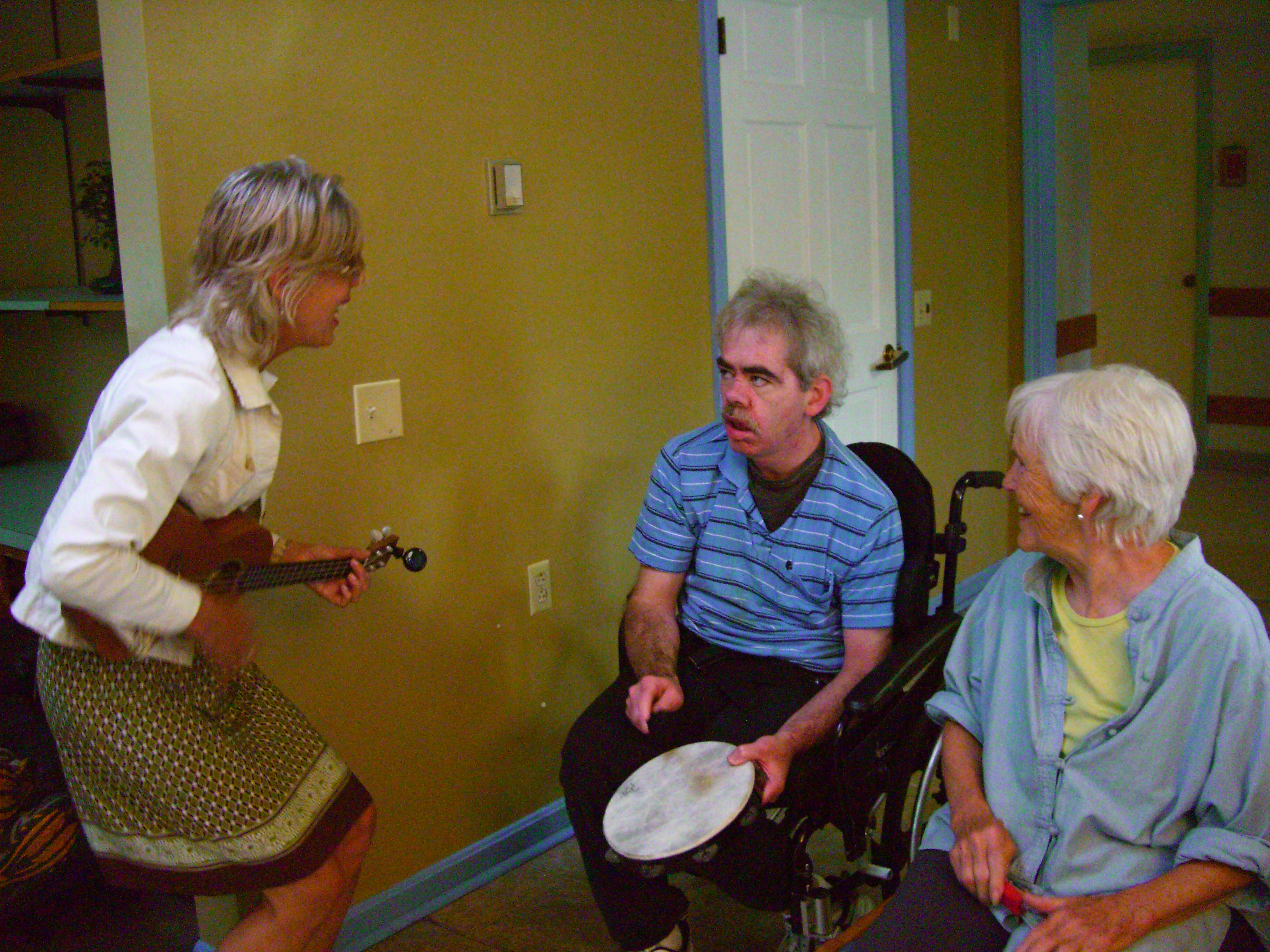
Paul Frain (center), a resident of a DDS group home in Clinton, helps out with the rhythm as music therapist Kathleen Downey (left) sings “Sugar in the Morning” Wednesday. At right is Paul’s mother, Maryalice Frain.
From Downey’s first song onward on Wednesday, one of the men with the maracas shook it and smiled. Maryalice Frain, the mother of Paul Frain, a resident who had not yet arrived from his bedroom, tapped a set of spoons. Another resident waved his arms to the beat. A member of the group home staff danced in the middle of the seated circle of residents and engaged them one by one.
For Downey, the tapping, singing, and waving was a sign that her music was having its intended effect.
A man named Walter didn’t want to participate in the music session at first. “I want to go to bed,” he said. Downey, walked up to him while strumming the ukulele and gave him a big smile. “Welcome, Walter,” she said. Immediately, his frown softened and he started waving his arms in time. “I do it with compassion,” Downey says of her work.
Trained in music education at the Berklee College of Music in Boston, Downey also works with Alzheimer’s patients in nursing homes. She is about to launch a program, called AlzAlive, that uses music, movement and touch to improve the lives of people battling that disease. No matter the setting, she says, the music has a similar effect.
“People become more communicative, more relaxed, more self confident,” Downey says. “Their stress level goes down.” The change is noticeable over the course of the hour, but it is also noticeable over a longer period of months and years. Paul Frain, who arrived in a wheelchair pushed by an attendant about five minutes into the session in Clinton, is a case in point.
“Initially, Paul was not interested in coming” to the twice-a-month sessions that she holds at the group home, Downey says. “Now, he’s the most active participant. And he’s really improved his drumming and listening skills.”
Paul Frain, who is the brother of Tom Frain, the president of COFAR, was seated next to his mother, Maryalice. Downey handed him a tambourine and a stick to beat it with. She began a folk song called “Sugar in the Morning,” and Paul sang along, beating the tambourine. Then she did the Beatles’ “Love Me Do.”
“It’s Lenny’s turn to sing,” Downey said next, turning toward one of the men to whom she had handed a maraca, but who had at first shown no reaction to it. “Do you want to do ‘I’ve Been Working on the Railroad,’ or ‘Take Me Out to the Ball Game?’” she asked him.
“Ball game,” Lenny answered. And the song began.
Downey next reached for a guitar and started singing “If I Had a Hammer” and then “Working on the Railroad,” and it was as if a loud party had been going on in the small room. She strolled across the middle of the circle as she sang. “Someone’s in the kitchen with Walter,” she sang to him. Walter started clapping in time.
One of the staff members then proclaimed that it was Downey’s birthday. That launched a quick round of “Happy Birthday to Me.” “How old are you now?” another staff member ribbed her. “I’m 39 and holding,” she retorted. “You don’t look it,” Paul Frain said. “You look younger.”
Guitar still in hand, Downey next sang “This Land is Your Land,” then “Jambalaya,” and then a soulful rendition of “Good Evening Blues,” which Paul helped bring to an end with some strong drumming on the tambourine. “We should take this on the road,” Downey said to him.
As the hour wound, down, Downey switched to a silver alto flute and quieted things down with solo versions of “Love Me Tender” and “Over the Rainbow.”
Afterwards, Paul pronounced it to have been a good session. What was his favorite tune? “This Land is Your Land,” he said.
More information about Downey’s music therapy for the intellectually disabled and people with Alzheimer’s can be found on her website at www.miracle-moments.com. Her email contact is justgrand@msn.com.
DDS proposes to reduce services and family rights in care plans
The state Department of Developmental Services is proposing changes to its regulations that we believe will take away guardian and family rights and water down the scope of services that are listed in individual clients’ care plans.
We at COFAR view these proposed changes as an attempt to reverse critically important gains made by the intellectually disabled and their families and guardians in Massachusetts from the 1970s through the 1990s.
We’re joined in our concerns by the Wrentham Association, a COFAR member organization and one of the original plaintiffs in the landmark Ricci v. Okin federal consent decree case that upgraded care of the intellectually disabled in Massachusetts. In written comments submitted to DDS last week, the Wrentham family group maintained (and we concur) that the proposed changes to the regulations would violate the historic 1993 Disengagement Order in the Ricci case of U.S. District Court Judge Joseph Tauro.
As the Wrentham Association letter noted, the Disengagement Order requires DDS “to continually evaluate the needs of each individual class member and to develop strategies to address those needs.” Several of the proposed changes to the DDS regulations “would substantially dilute” client care plans, known as Individual Support Plans or ISPs, and would exclude or limit family participation in the ISP process, the letter stated.
As we noted in our own comments on the proposed regulations:
The ISP process is fundamental to the provision of adequate supports and services to some of the most fragile and vulnerable members of our society…The protection of the rights of the individuals, family members, and guardians involved is central to the ISP process and the Disengagement Order. We therefore strongly oppose efforts to begin chipping away at those rights, as the proposed regulations appear to do.
Among the key proposed changes by DDS is the elimination of the requirement that services be listed in each client’s ISP “without regard to the availability” of such services. A second proposed change would take away the current requirement that the ISP contain strategies to address the “unmet support needs” of clients.
These were key concerns of Judge Tauro’s Disengagement Order — that the ISPs be drafted first and foremost to identify the needs of the client and that the Department then come up with funding strategies to meet those needs. The proposed changes would eliminate that dynamic.
In addition, DDS is proposing to change its regulations to take away rights of family members to participate in the ISP process and even to schedule a meeting with a DDS service coordinator to have the ISP explained to them.

Diane Booher, a Fernald guardian, testifies against proposed DDS regulations changes during a sparsely attended public hearing at the Worcester Public Library on June 15.
In our comments submitted to DDS, we added that the proposed changes would also appear to violate a key provision of the federal Developmental Disabilities Assistance and Bill of Rights Act, which states that individuals with developmental disabilities and their families are the “primary decision-makers” regarding the services and supports they receive.
On Friday of last week (June 15), DDS held a public hearing on the proposed regulations, which, to my surprise, attracted few attendees. I arrived at the scheduled start of the hearing at the Worcester Public Library at 10 a.m. and was the only person in the audience when DDS Commissioner Elin Howe opened the proceedings. Soon after, two other people arrived to testify — Diane Booher, a Ricci class representative from the Fernald Developmental Center and the guardian of three men who still reside there; and a representative of Vinfen, a major nonprofit operator of group homes in Massachusetts and other states.
Booher maintained in her written testimony that “there is no question” that the proposed changes to the regulations would violate Judge Tauro’s Disengagement Order.
The Vinfen representative appeared to have some technical issues with the proposed changes, but no major objections — a position I didn’t find surprising. Vinfen and other group home providers will get the same state funding whether the ISPs contain strategies for unmet needs or not.
I looked around for someone from the Arc of Massachusetts. Surely, they would be rallying to defend the rights of families and DDS clients? I guess not.
At about 10:45 a.m., Commissioner Howe called a recess in the hearing, after the three of us had testified and no one was left to speak. I left shortly after that. If a flood of people arrived anytime after I left and before the scheduled close of the hearing at 3 p.m., I haven’t heard about it.
In addition to the proposed changes that would water down the scope of services in ISPs, here are some of the other proposed changes to the regulations (115 CMR 6.20-6.25), which we find the most troubling:
- Addition of language giving guardians and individuals the authority to exclude family members from participating in ISP planning and the ISP process. This is particularly concerning to us in cases in which corporations or attorneys are appointed as guardians of individuals and are paid by DDS.
- Exclusion of family members from the list of persons receiving periodic updates from group home providers regarding the implementation of the ISP.
- Removal of language stating that families and guardians have a “right” to a meeting with the service coordinator to have the ISP explained to them within 10 days of its receipt.
- Removal of language requiring the service coordinator to explain ISP appeal rights to individuals, guardians, and family members.
- Removal of language that a service coordinator must have the approval of the family to waive a meeting to discuss changes to the ISP.
Update: Assistant D.A. blames trial delays on administrative mistakes
Three of the four postponements in the scheduled trial of a former West Springfield group home care worker charged with assaulting an intellectually disabled man were due to separate scheduling mistakes by court personnel, the prosecutor in the case said last week.
In a phone call on Thursday, Kerry Whalen, an assistant district attorney in Falmouth District Court, who is prosecuting the case against John Saunders, took responsibility for one of the scheduling mistakes and contended that the court clerk’s office was responsible for two others.
We reported that Saunders’ trial had been delayed last week for the fourth time since January, resulting in several fruitless trips from western Massachusetts to the Cape for several prosecution witnesses. Among those witnesses is Sheila Paquette, the sister and co-guardian of the alleged victim, John Burns. Paquette has expressed growing frustration with the delays and had gotten seemingly conflicting answers to her questions about them. The trial has now been scheduled for July 30.
Paquette has been pursing the case against Saunders since June 2010, when Saunders allegedly hit Burns in the face while toileting him during an outing on the Cape. Burns suffered two black eyes and other injuries in the alleged assault. Paquette, who is president of the Advocacy Network, a COFAR member organization, personally filed charges against Saunders in July 2010.
For nearly two years, Paquette has dealt with a state and court system whose progress in bringing about justice in a case involving a disabled victim has seemed glacial. The case has finally reached the trial stage, but the trial never seems to start. The trial was originally scheduled for January 9, but was postponed until March 27 when Saunders failed to appear on the January 9 date, and then was postponed for the second time until June 4 when a defense witness failed to appear on the March 27 date. It was postponed for the third time until June 5, and for the fourth time until July 30.
Whalen said the postponement in March was due to the fact that the defense witness had not been properly notified of the March 27 trial date. She said she personally caused the third postponement in the case when she mistakenly assumed there would be jurors available in the court on June 4th to hear the case. There were no jurors convened that day, requiring a one-day postponement until June 5.
Whalen blamed the fourth postponement in the trial until July 30 again on the court clerk’s office, saying that this time the office failed to issue new summonses to witnesses for both the prosecution and the defense with the new June 5 trial date.
“The clerk’s office failed to do this (notify the witnesses in that instance). I don’t think it was intentional,” Whalen said. The result was that one witness for the defense and one for the prosecution later said they never received any notice of the new trial date and that they wouldn’t be available that day.
I left a message with the court’s clerk magistrate last week to ask if he had a response to Whalen’s account. I haven’t received a call back.
Whalen contended it would be impossible to schedule a new trial date earlier than July 30. I asked her if this case will now be treated as a priority on July 30 because three of the four postponements were the result of the court personnel’s own mismanagement; and I asked whether anyone could guarantee that the trial will go forward at that time.
Whalen’s response was that the Saunders case “will take precedence over other cases,” but there is no way to guarantee it will go forward in July. Because Saunders is out on bail, she said, his case could be subordinated to another case on July 30 if the defendant in that other case happened to be in custody. That is due to rules limiting the length of time defendants can be kept in custody prior to their trials.
Whalen did not apologize for any of the mistakes leading to the postponements of the trial.
Paquette was angry when told of the reasons given by Whalen for the postponements in the case. “This is gross incompetence, a waste of taxpayer dollars,” she said. “I feel like I’m in a foreign country trying to get justice.”
 COFAR blog