Archive
Donald Vitkus presented posthumously with Benjamin Ricci award
Donald Vitkus, who survived a traumatic childhood at the former Belchertown State School and then went on to earn an associate’s degree and to become a direct caregiver, was posthumously presented with the 2018 Benjamin Ricci Commemorative Award late last month.
The presentation was made by Department of Developmental Services Commissioner Jane Ryder at a March 28 ceremony at the State House in Boston. The annual award celebration recognizes the accomplishments of individuals served by DDS, and the dedication of caregivers and advocates.
Ryder will attend Vitkus’s memorial service, which is planned for June 23 at the Warner Pine Grove Cemetery Belchertown, where many of the school’s former residents are buried.
Benjamin Ricci, who died in 2006, had been the lead plaintiff in Ricci v. Okin, the historic federal consent decree case in Massachusetts in the 1970s and 1980s, which resulted in major upgrades in care at Belchertown and other institutions for the developmentally disabled around the state.
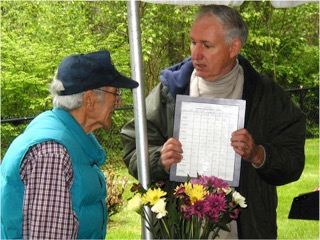
Donald Vitkus (right) presents Ben Ricci with a copy of an actual report card that Vitkus received while he was a child at the Belchertown State School in the 1950s.
Vitkus died last January at the age of 74. His life at Belchertown and afterwards was chronicled in a 2016 book, You’ll Like it Here, by Ed Orzechowski, vice president of COFAR and a founding member of the Advocacy Network, an organization for persons with developmental disabilities and their families in western Massachusetts.
Orzechowski accepted the award on Vitkus’s behalf at the March 28 State House event.
Among those attending the event were Benjamin Ricci’s son, Bobby, who was a Belchertown resident, and Bobby’s brothers, Jim and Tom.
“Without Ben (Ricci) and the other original plaintiffs, ceremonies like this very likely would never have come to pass,” Orzechowski said following the award ceremony.
Orzechowski noted, in accepting the award for Vitkus, that he had originally met him in 2005, a year before Ricci’s death, at a book signing at Holyoke Community College for Ricci’s book, Crimes Against Humanity. The book chronicled the Ricci legal case and the conditions at Belchertown in the 1950s and 1960s.
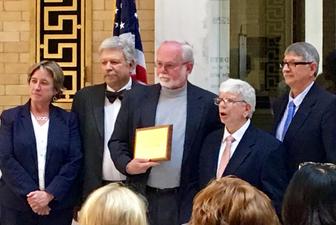
Ed Orzechowski (center) holds a plaque commemorating Donald Vitkus’ posthumous receipt of the Banjamin Ricci award on March 28 at the State House. From left are DDS Commissioner Jane Ryder and Ricci’s sons, Jim, Bobby, and Tom.
After Ricci’s presentation at the book signing, Vitkus approached Orzechowski, who had been assisting Ricci at the event, and asked if he would help him write his life story. At the time, Vitkus was a 62-year-old human services student at HCC, the oldest student enrolled at the school. Orzechowski said he later learned that it was Vitkus, as president of the college’s psychology club, who had invited Ricci to speak.
Orzechowski also recounted that Vitkus was a six-year-old foster child when he arrived at Belchertown in 1949, where he was labeled a “moron” in an age when “idiot,” “imbecile,” and “moron” were clinical terms.
While Vitkus was growing up at Belchertown, “he stood up not only for his own rights, but also for other residents who were being abused or neglected,” Orzechowski said. “This ‘moron’ earned his associate’s degree and became a uniquely qualified direct caregiver, one who knew what it was like to be treated as less than human. Donald wanted his story told, ‘… so people wouldn’t forget—so it wouldn’t happen again.’”
Orzechowski maintained that “despite the scars of his upbringing, Donald persevered.” After Belchertown, he was drafted into the United States Army and served in Viet Nam. He married, raised a family, and held a job in the printing industry for more than 30 years.
Orzechowski said Vitkus told him that, initially, he resented Ben Ricci and what was originally the Belchertown Friends Association because the precedent-setting lawsuit brought changes long after Vitkus had left the institution. But, said Orzechowski, Vitkus “harnessed that bitterness, eventually became vice president of Advocacy Network, and a passionate spokesperson for the rights and care of developmentally disabled individuals.”
In recent years, Vitkus said he wanted to be buried in the Belchertown State School cemetery that had been known to the residents of the facility as Turkey Hill. “I want to be with the others because those people are my brothers and sisters,” he said.
Orzechowski said that while at HCC, Vitkus shared his experiences with the much younger students, “who had little or no idea about what conditions in state institutions used to be like—the squalor, the beatings and molestation, the regimented, de-humanizing environment.”
Orzechowski noted that Vitkus spoke to high school students about self-advocacy and spoke to newly hired DDS employees at orientation sessions in Northampton, always introducing himself: “Hello, my name is Donald Vitkus. I’m a former retard of Belchertown State School.”
“These were heart-filled, gut wrenching talks, always with the dignity of the individual uppermost in Donald’s mind,” Orzechowski said. “It wasn’t unusual to see tears in the eyes of those who heard his story.” Vitkus also traveled to Washington, D.C., to speak at annual VOR conferences with attendees from across the country. He was a panelist in a discussion of “The R Word.” He visited Congressional offices to lobby for supportive legislation and funding.
After earning his degree, Vitkus worked for Sullivan Associates in Springfield, providing direct care. “He wanted to help individuals make their own decisions, learn how to handle money, how to cross the street, how to shop, how to behave in restaurants—practical day-to-day living skills,” Orzechowski said. “He never talked down to them. He always sat with them at mealtimes, and beside them in transportation vans. He was firm when he had to be, but always mindful of their dignity, always kind in his words.”
Orzechowski said many of those who attended Vitkus’s book events had aunts, uncles, and cousins who also had been Belchertown patients. Others had worked or volunteered there.
At one bookstore, he said, “I watched an elderly woman seated in the crowd, trying to hold back tears. Donald liked to ask people what had brought them there, and when he asked this particular woman, she was so emotional that words wouldn’t come. The room was silent. Donald walked over and embraced her with an empathy that didn’t need words to convey—this from a man who had shunned physical contact because of the beatings and physical restraints he had endured in the institution. It was a powerful moment.”
On another occasion, according to Orzechowski, a mother brought her middle-school son who was afflicted with autism. “The boy locked onto Donald’s comments,” Orzechowski said.
The next day, the boy’s mother told Orzechowski that her son, who is ordinarily non-communicative, couldn’t stop talking about Vitkus in the car on their way home. He told his mother “that he wanted to grow up to be like Donald, to stand up for others with intellectual disabilities, that Donald was his inspiration.”
Alleged union bashing by CEO of DDS provider confirms the plan is keep direct-care wages low
We hope a federal investigation of Triangle, Inc., a corporate provider to the Department of Developmental Services for alleged anti-union activity brings public attention to the potential for privatization of DDS programs to result in low pay for provider staff and poor care.
In our view, the alleged efforts by Malden-based Triangle’s management to block staff from unionizing imply an implicit acknowledgement by the management that it wants to keep direct-care wages low. Low wages, in turn, result in lower-quality care.
In preventing their workers from organizing, providers like Triangle appear to be pitting themselves against the growing movement in Massachusetts for a $15 living wage for workers.
The Boston Globe reported earlier this month that the National Labor Relations Board has issued a formal complaint against Triangle after at least three former employees of the provider were allegedly fired for helping organize the agency’s staff to unionize with SEIU Local 509. The union represents both state workers and staff of state-funded providers to agencies such as DDS.
Triangle’s chief executive, Coleman Nee, allegedly stated that anyone in the agency who even voiced support for the union could be fired. Nee is a former Cabinet secretary under then Governor Deval Patrick.
The relatively low level of pay and benefits to direct-care staff in human services has been a long-standing issue in Massachusetts and elsewhere around the country.
“Nonprofit DDS providers do not want to pay a living wage to their direct care workers because their CEOs are keeping the money for themselves,” COFAR Executive Director Colleen Lutkevich wrote in a comment on the Globe site. “It can only benefit people with developmental disabilities if unions help these workers to earn more money. The management is a disgrace and it’s not the people they serve that benefit, it is their own pocketbooks.”
COFAR and SEIU Local 509 have tracked both corporate provider executive and direct-care compensation in recent years. Last May, the SEIU released a report charging that major increases in state funding to corporate human services providers during the previous six years had boosted the providers’ CEO pay to an average of $239,500, but that direct-care workers were not getting a proportionate share of that additional funding.
As of Fiscal 2016, direct-care workers employed by the providers were paid an average of only $13.60 an hour, according to the SEIU report.
The SEIU further noted that the increases in funding to the providers, known as “Chapter 257” rate setting reforms, had actually allowed the providers to earn $51.8 million in net or surplus revenues (over expenses) in Fiscal 2016. As the report stated, those surplus revenues would have more than covered the estimated $34 million cost of boosting all direct-care workers’ wages to $15 per hour.
Based on that report, state Senator Jamie Eldridge filed a budget amendment last year to require human services providers in Massachusetts to spend some of their surplus revenues on raising direct-care wages to $15 per hour. The measure was rejected, however, by a House-Senate conference committee on the budget.
It was not clear whether Eldridge intends to refile his amendment this spring. The SEIU as well has turned its attention away from that proposal and toward proposed legislation and a proposed ballot question in November that would raise the minimum wage for all workers in Massachusetts to $15 per hour.
While we support the legislation and ballot question aimed at all workers, we would also hope that Eldridge’s amendment would be reintroduced given that the funding apparently already exists to fully fund a $15 per hour living wage for human services workers.
Privatized human services reflect larger inequities
The privatized human services system in Massachusetts, in fact, reflects income inequities and other problems with privatized services in other areas of the economy.
As state funding has been boosted to corporate providers serving DDS and other human services departments, a bureaucracy of executive-level personnel has arisen in those provider agencies. That executive bureaucracy appears to be suppressing wages of front-line, direct-care workers and is at least partly responsible for the rapidly rising cost of the human services budget.
Ironically, a key reason for a continuing effort by the administration and Legislature to privatize human services has been to save money. However, we think that privatization is actually having the opposite effect.
Triangle executives are lavishly compensated
Triangle Inc. appears to be a microcosm of the human services system in Massachusetts, and to reflect many of its problems.
The Globe reported that Triangle had some 3,900 people enrolled in various programs and services during Fiscal 2017. The agency received $10.2 million in revenue in Fiscal 2017, including $6.9 million in funding from DDS, according to the state’s online UFR database.
Coleman Nee, the Triangle CEO, is listed on the UFR database as having received $223,570 in total compensation in Fiscal 2017. That may not cover an entire year with the agency.
It appears Nee started with Triangle sometime in 2016. Prior to him, the CEO was Michael Rodrigues, who made $257,442, according to IRS Form 990 for Fiscal 2016. That year’s Form 990 lists six executives, including Rodrigues, as making over $100,000 at Triangle.
It is unconsionable that executives of nonprofit agencies who are making six-figure incomes paid for with state funds are engaging in efforts to supress the pay of their direct-care employees. The fig leaf offered by a nonprofit moniker does not protect those executives from either charges or the appearance of profiting inappropriately off the taxpayers.
Its’s time for the Legislature to take steps to reform the DDS system, starting with a concrete action to raise direct-care wages.
Wrentham Center supporters want you to to know: ‘It’s a community’
As is the case with many of the staff at the Wrentham Developmental Center, John Maxell, supervisor of adapted physical education, sees his job as serving both the center’s residents and the surrounding community.
Maxell noted, for example, that he has been working at WDC with a man from the community who originally weighed more than 500 pounds and came to him for help in losing weight.
That man’s weight is now close to 300 pounds, Maxell said, and it is continuing to drop. Maxell made the comments to state legislators and others who were on a tour of WDC following a legislative breakfast there this past Tuesday.
The breakfast was hosted by State Senator Richard Ross of Wrentham and was co-sponsored by the WDC Board of Trustees and by a range of family-based groups including the Friends of Wrentham, COFAR, the WDC Family Association, and the SpeakEasy Advocacy Group at WDC.
“I invite you to look at WDC with new eyes,” Colleen Lutkevich, COFAR executive director, told the lawmakers, staff of the Department of Developmental Services, and family members who attended the legislative breakfast. “WDC is a true community.”
Lutkevich noted that she was speaking on behalf of her sister, Jean Sullivan, who has been a WDC resident for more than half a century.
In addition to Ross, legislators who attended the breakfast included Senator Paul Feeney of Attleboro; and Representatives Shawn Dooley of Medfield, Elizabeth Poirier of Attleboro, and Jeffrey Roy of Franklin.

State Senator Richard Ross (at podium) speaks during legislative breakfast at WDC.
Maxell pointed out that other people and groups from the surrounding community also use the fitness center at WDC, including members of local high school and community basketball, volleyball, and badminton teams. In return, those groups provide the center with monetary donations, which are used to buy exercise equipment for use by the center’s residents.
Similarly, community-based groups and individuals, including senior citizens, regularly use the therapeutic swimming pool at WDC, according to Peter Cutting, the lifeguard there.

Peter Cutting, lifeguard at the WDC therapeutic pool. The pool is used regularly by members of the surrounding community.
Joanne Cummings, a member of the WDC Board of Trustees, who spoke at the breakfast, listed the services that are provided to the 263 residents at WDC, including clinical, medical services, nursing care, occupational and physical therapy, speech and language therapy, recreation therapy, and psychological counseling. The center also houses an acute care medical facility and a dental clinic.
Yet, while that array of centrally located services cannot be found in any community-based group homes in the commonwealth, WDC doesn’t necessarily have an institutional feel to it. The campus has a mix of larger buildings housing apartments and smaller, multi-bedroom homes.
As Cummings noted, “The facility of today is not the institution of the past.”
And yet, WDC and its community-based orientation are a “well-kept secret” by DDS, Lutkevich pointed out. Many family members and guardians have waited for residential placements from DDS for years without being informed that places like WDC, the Hogan Regional Center, and a network of state-operated group homes exist.
Lutkevich discussed the case of Alexa Horn, who was admitted to WDC only after the Marquardt skilled nursing facility on the grounds of the former Fernald Developmental Center, in which she had been living, closed. Prior to being admitted to the nursing facility, Alexa had suffered an unexplained broken leg and arm in a corporate-run group home funded by DDS.
Lutkevich recounted how Alexa’s parents, Pat and Michael Horn, told DDS while Alexa was at Marquardt that they did not want her sent back to the group home. But instead of promising to address and rectify the situation, a DDS official threatened the Horns with removing their daughter from DDS care and sending her back home. Luckily, that never happened. Pat Horn has described the care Alexa has received at WDC as “exquisite.”
Other parents have been able to get family members into WDC or into state-operated group homes only after hiring attorneys and engaging in legal action, Lutkevich said.
Since 2008, four of six remaining developmental centers in Massachusetts have been closed, leaving only WDC and the Hogan Regional Center in Danvers operating. A number of current WDC residents were transferred there from the closed centers, including Tom Doherty, who was on hand for Tuesday’s breakfast.
Doherty, who is 67, moved to WDC from the former Templeton Developmental Center in 2011. He now lives with four other men in a group home on the WDC campus.
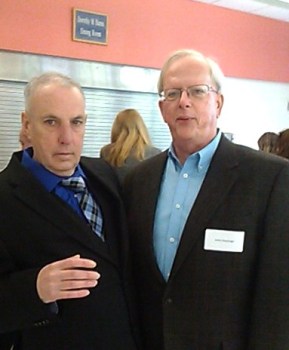
Tommy Doherty (left), who became a resident of WDC in 2011, with his cousin, John Hastings, at Tuesday’s legislative breakfast.
The developmental centers, which are also referred to in federal regulations as Intermediate Care Facilities (ICFs), are required to comply with more strict federal requirements for staffing and treatment than are community-based group homes. As a result, WDC and Hogan tend to have residents who are older and have more severe developmental disabilities and medical conditions on average than those in the community-based system.
The average age of the residents at WDC is 66. More than 90 percent of the residents there are over 55. Eighty-five percent of the residents at WDC are listed as having either a severe or profound level of intellectual disability as compared with 15 percent who have either a moderate or mild level of disability.
Due to that relatively old residential population and the fact that new residents are not routinely admitted to WDC or Hogan, the residential census in those facilities is dropping. At WDC, the residential census dropped from a peak of 323 in Fiscal 2013 to 272 at the start of the current fiscal year last July. Since July, that number has dropped by an additional 9 residents to 263 as of this month.
As Lutkevich stated in a message to the legislators who attended the breakfast this week, the push is on to change attitudes within the Legislature and administration about the continuing need for WDC, Hogan, and the state-operated group homes as part of DDS’s overall continuum of care. “Ultimately, we hope to find a way to persuade DDS and other policy makers to make WDC and other state-run programs available once again as options for care for people waiting for DDS services,” Lutkevich said.
Our March issue of The COFAR Voice discusses a plea from DDS families: ‘please listen to us’
The theme running through our new March newsletter is the continuing struggle by families to be listened to by state policy makers, legislators, service providers, probate court judges, and the media as those families work to ensure the wellbeing and safety of their loved ones in the Department of Developmental Services system.
It is a struggle that families must engage in constantly. And as a number of the articles show, the system is often not willing to listen. Families frequently encounter significant pushback from DDS, the courts, the providers, and other quarters.
David and Ashley Barr have been subjected to an outright ban for more than two years on contact with David’s daughter who is being kept isolated in a group home in an undisclosed location. The prohibition seems to us to clearly violate DDS regulations that give clients the right to be visited.
When the Tillys filed complaints about abuse and neglect of their son in a corporate-run group home, both the provider and DDS turned against the parents instead of putting their focus on investigating and addressing their complaints. The Tillys, too, faced restrictions and then bans on visits to their son.

David (left) and Richard Buckley circa 1970
When Richard Buckley and his family tried to seek justice and get answers from DDS and the Essex County District Attorney’s Office after Richard’s brother, David, was scalded to death in a DDS group home in 2001, they got only silence. Richard is still waiting for someone to listen.
The state Legislature’s Children and Families Committee, recently held an oversight hearing to consider DDS’s responses to these types of incidents and issues. But it seemed the committee wasn’t really interested in hearing from the families either.
Verbal testimony was permitted at the committee’s January 17 hearing only from DDS commissioner Jane Ryder and from Nancy Alterio, executive director of the Disabled Persons Protection commission. To date, the co-chairs of the Children and Families Committee have not given any indication when, if ever, they will listen to the families.
But it’s not only the Children and Families Committee that does not appear to be listening. We report in the March issue on the continuing failure of the Judiciary Committee to act on a bill that would boost family rights in guardianship cases.
We believe there is a connection between these issues and the continuing priority the administration and Legislature have placed on privatizing the DDS system. The March newsletter also reports on the governor’s budget for the coming fiscal year and how it continues to short-change state-operated group homes and other state-run DDS programs.
And we have a report on our concerns about new regulations proposed by the state auditor that might weaken the Pacheco Law, a state statute that requires state agencies to demonstrate a cost savings and quality improvement prior to privatizing existing services.
We do appreciate that at least one legislator has been listening to a constituent about the problems her developmentally disabled son has had since his sheltered workshop was shut down in 2016. As we report, Representative Brian Ashe’s staff is drafting a bill that would bring back work opportunities to day programs for DDS clients who are not able to function in mainstream work environments.
Finally, we discuss the passing of two key figures in the history of care for the disabled in Massachusetts — Donald Vitkus and Edward Stefaniak. Donald was a survivor of the former Belchertown State School who went on to become a committed advocate for persons with intellectual disabilities.
Ed Stefaniak, who served as COFAR’s treasurer for many years, was instrumental in the Ricci v. Okin class action lawsuit, which resulted in major upgrades to developmental centers in the state and opened the way to community-based care.
You can find all of this and more in the newsletter, which you can access on the home page of our website at www.cofar.org. Your feedback and comments are much appreciated.
Father and sister now told they must wait for long-delayed trial before they can visit disabled woman
The state’s story keeps changing as to why the father and sister of a developmentally disabled woman have been banned for more than two years from having any contact with her.
The woman, whose name we are withholding, has been kept in virtual isolation by the Department of Developmental Services since her mother’s alleged boyfriend was charged in 2014 with sexually assaulting her. The woman’s mother has also been charged in connection with the alleged assault.
However, since November 2015, both David and Ashley Barr, the woman’s father and sister, have been prohibited from having any contact with her and have not even been told where she is living. Neither Ashley nor David has been charged with any crime. David has been divorced from the woman’s mother since 2003.
As of this past week, Ashley Barr was being told she and her father would not be able to visit the woman until her mother and her mother’s alleged boyfriend are tried in connection with the alleged sexual assault. The trial, which has apparently been delayed at least once, is now scheduled for May 15, according to the office of Essex County District Attorney Jonathan Blodgett.
Ashley said the reason given her for waiting for the trial was unclear. She said DDS General Counsel Marianne Meacham told her last week that there was concern on someone’s part that a visit from her father and her would somehow make her sister “lose focus” in preparing for the trial.
Ashley said Meacham had initially told her the trial would be held in April.

David and Ashley Barr
In an email this week, Carrie Kimball-Monahan, director of communications for the Essex District Attorney’s Office, said the district attorney was not responsible for the ban on family contact. Kimball-Monahan said the ban was ordered by Dorothy Wallace, the woman’s DDS-paid guardian.
Kimball-Monahan added that the district attorney was not in a position to try to resolve the visitation issue with DDS. “We are prosecuting a criminal matter and that is our focus,” she stated.
In previous comments in probate court, Wallace stated that she was imposing restrictions on contact between the woman and her father and sister because David and Ashley became overly emotional when they had been allowed to visit her. Wallace made no mention during the probate court hearing, which was held in August 2015, to the ongoing criminal prosecution involving the woman’s mother and alleged boyfriend.
Ashley said she is not convinced anyone in the system cares whether she and her father ever see her sister again.
Wallace received $20,100 from DDS for guardianship services for an undisclosed number of persons in Fiscal Year 2016, according to DDS records. Yet, Wallace appears to have had relatively little contact with the disabled woman in this case over the past year, according to records and other information reviewed by COFAR.
A violation of DDS regulations
The continued isolation of the woman in this case appears to involve a violation of DDS regulations, which state that people in the Department’s care have the right …“to be visited and to visit others under circumstances that are conducive to friendships and relationships…” The only limitation on this right is if the individual “is ill or incapacitated to the degree that a visit would cause serious physical or emotional harm.”
Also, the right to visitation is a key aspect of family integrity in international human rights law. As an article in the Berkeley Journal of International Law states, “Sufficient consensus exists against particular types of family separation…to constitute customary international law.”
In an email sent February 10 to Meacham, Lutkevich asked whether DDS would provide a letter stating that Ashley “will in fact be able to see her sister after the trial…I truly hope there is a full intention of allowing these visits to occur,” Lutkevich added, noting that the probate court has not issued any orders barring visitation with the woman.
Meacham had not responded to Lutkevich’s message as of today (February 13.)
The Barrs have been unable to afford the cost of hiring a lawyer to pursue their case in probate court. As we have reported in another case, it is extremely difficult to prevail in any probate court proceeding in Massachusetts if you are not a legal guardian or appear without a lawyer.
David and Ashley have asked their local state legislators to intervene with DDS to allow visits, but have gotten little or no help from them. Despite requests from the Barrs and from COFAR, mainstream media outlets have not reported on the ban on family contact in the case.
As we reported in January 2017, the Boston-based Disability Law Center temporarily intervened in the case that month to ask a state-appointed attorney, who is representing the woman, to support family visits if the woman wished that. However, the attorney didn’t agree to do so.
The attorney, Melissa Coury Cote, told COFAR in March 2017 that she would not support court permission for visits to the woman by David or Ashley Barr, despite the DLC’s request. She provided no reason to us for opposing family visits other than to say that the woman had not specifically asked her to allow visits from her father and sister.
Ashley said, however, that her sister has, on occasion, surreptitiously tried to call her and her father from her undisclosed location.
17 years later, a man hopes some good will come of his brother’s scalding death in a DDS group home
Richard Buckley desperately wanted an explanation as to how it was possible that his older, intellectually disabled brother could have received injuries in his group home that were serious enough to cause his death.
But no one, it seemed, wanted to listen to him, much less offer any answers to his questions.
On the morning of March 30, 2001, Richard’s brother, David, received second and third degree burns to his buttocks, legs, and genital area while being showered by staff in a West Peabody-based group home run by the Department of Developmental Services. The temperature of the water in the residence was later measured at over 160 degrees.
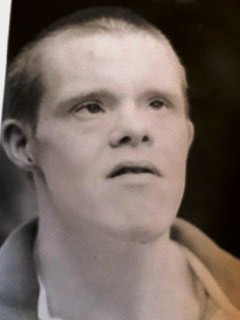
David Russell Buckley
David died from complications from the burns some 12 days later, yet no one was ever charged criminally in the case, and the DDS (then Department of Mental Retardation) report on the incident almost unbelievably did not substantiate any allegations of abuse or neglect.
Before that shower incident, David had endured a series of incidents of alleged abuse and neglect in a corporate-provider-run group home in Hamilton, including an alleged sexual assault by a caregiver. That incident had been witnessed by another staff member of the home. Yet, the witness failed to report the alleged abuse for two weeks, and, as a result, no one was ever criminally charged in that case either.
David, who was 39 years old when he died, had Down Syndrome and Obsessive Compulsive Disorder. He stood only 4 feet, 10 inches tall and weighed about 95 pounds. He is described by his family as a loving man who enjoyed collecting harmonicas and Snoopy items from the Peanuts comic strip.
Richard Buckley attended last month’s oversight hearing on DDS care, which was held by the Legislature’s Children, Families, and Persons with Disabilities Committee. He had put his brother’s case aside for nearly 17 years. But when he heard that the committee was scheduled to hold the hearing, he decided he would attend and possibly testify, if only to help others in similar situations.
Yet the committee would not accept verbal testimony from Richard or any other families with similar stories of abuse and neglect. “It felt like the committee pretty much put on a dog and pony show, with the invited officials stating their policies and processes and no one really questioning them on any level,” Richard said. “There seemed to be a lack of willingness (on the part of the committee) to bring up important issues.”
But while Richard was disappointed in the hearing, he says he nevertheless remains inspired by those other families that have continued fighting for answers. In particular, he said, he is inspired by Anna Eves, who has been fighting relentlessly for changes in the DDS system in the wake of the near death of her son, Yianni Baglaneas, in a group home last April.
“The same types of abuse just keeps happening,” Richard said, “but Anna spearheaded a response to it that may create change. After hearing about that, I thought if they (Anna and the other families) can use my brother’s story in any way, I would send as much information about it as I could find. I want to do what I can do to follow up Anna’s work, which is phenomenal.”
For years following David’s death, Richard said, he and his family were too discouraged to do anything.
David’s father and sister, who were David’s co-guardians at the time, sued the state for $100,000, which is the maximum state liability under the Massachusetts Tort Claims Act. The state settled for that amount; but the state then kept all but $2,000 of the settlement as charges for David’s medical care.
Richard, who was not a party to the lawsuit, said what the family really wanted were answers, and they wanted those directly responsible for David’s death to be held accountable.
Initially, there was word that the Essex County District Attorney’s office was investigating the case; but months went by, and the family could not get any information about it. In a letter to David’s father in July 2001, then state Representative Anthony Verga said he had been assured by the D.A.’s office that “the case was on track and still under investigation.” Verga promised “to continue to help push for prosecution of the case.”
But the case was never prosecuted. The family was told by their attorney that the prosecution was ultimately called off after September 2001 because much of the D.A.’s resources had been diverted toward the investigation of the 9/11 terror attacks. The two airliners that hit the World Trade Center in those attacks had originated in Boston.
“I understand the logic behind putting their resources into the 9/11 case, that but doesn’t help our family’s closure. We were left in the dark,” Richard said. He said the family was also told by their attorney that the D.A. never actually wanted to investigate David’s case because “this was a case of the state prosecuting the state. It was considered a lose-lose situation.”
Then in February 2002, the family received a copy of the DDS investigation report, which failed to substantiate any allegations of abuse. “The final finding was basically ‘we can’t prove anything, and therefore nothing happened,'” Richard said. “I was stunned by that conclusion.”
As time went on, the family received less and less information about David’s death.
“I remember calling people from various departments and getting some information that would give us glimmer of hope, and then we would not hear anything,” Richard said. At one point, he said, he was told to contact a DDS official who was located at Danvers State Hospital. “I sat in her office for eight hours waiting for her to come out, and she never appeared. I also left multiple messages with her. She didn’t want to talk to me.”
Richard said that he gradually lost hope that anything would be done about the case. “We finally had to walk away from it,” he said. “There was no need killing ourselves trying to be heard by people who didn’t want to hear us.”
Then when he heard last month about the Children and Families Committee hearing and about Anna Eves’ efforts to bring her son’s case to light, he said he began to revisit David’s case for the first time in all those years.
David (left) and Richard Buckley circa 1970 when David was about 10 years old and Richard was about 4.
Details of scalding case
(Please be advised that some of the details listed below are graphic.)
According to the DDS investigation report, David had woken up in his group home at 6:15 on the morning of March 30, 2001, and had defecated in his bed. When one of two overnight-shift staff members, who were identified in the report as alleged abusers, tried to guide him to the shower, he reportedly resisted.
One of the alleged abusers told the DDS investigator that she used one hand to hold David and used the other hand to spray him with a hand-held shower attachment in a tub in the bathroom. She said the second alleged abuser held David’s other arm to keep him still.
The first alleged abuser stated that after the second staff member suggested the water might be too hot, she noticed that David’s legs looked red and immediately took him out of the tub and sat him down in bathroom where she noticed his legs peeling. At that point, she said, she applied cold compresses to David’s legs and notified a nurse about the situation via a beeper. She estimated that she had sprayed David with the attachment for about 30 seconds.
The DDS report states that the beeper nurse asked the first alleged abuser whether she had checked the water temperature prior to showering David, and that the beeper nurse stated that the alleged abuser “did not really provide an answer.”
Two maintenance workers, who were called to the residence on the morning of the incident, noted that the water temperature in the bathroom initially read as high as 162 degrees and then dropped to 150 degrees. One of the workers further stated that the bottom cover to controls on a water tank in a back room of the residence was on the floor.
The American Society of Sanitary Engineering states that at a water temperature of 154 degrees or above, scalding of the skin is immediate. Scalding would occur in 30 seconds at a temperature of 126 degrees.
The DDS report stated that departmental regulations require that the water temperature in residential facilities must read between 110 and 130 degrees. The report noted that the water temperature in David’s group home had been found the previous December to be 158 degrees. Three maintenance reports prior to the shower incident indicated that the temperature was over the DDS limit.
According to the DDS report, no issues regarding the water temperature were identified in any DDS licensure reports for the group home.
The DDS investigative report stated that both alleged abusers in the shower incident left the residence after their shift ended at 7 a.m., and a new staff member arrived. That first-shift staff member stated that he thought David’s injuries looked serious and that he was shivering as if he might be in shock. The staff member notified an on-call nurse who came to the residence.
The on-call nurse stated that she observed reddened and peeling areas on David’s upper thighs, genital area, and buttocks, and that he screamed in pain when she tried to apply a compress to those areas. The nurse called 911 at 7:20 a.m., which was approximately an hour after David was first exposed to the hot water in the shower.
According to the DDS report, a physician at Massachusetts General Hospital, whose name was redacted, stated that he did not believe the one-hour delay in calling the ambulance “could have a significant effect on outcome” of David’s injuries.
The DDS report noted a number of inconsistencies between the accounts given by the two alleged abusers. For instance, while the first alleged abuser stated that that second alleged abuser had stayed in the bathroom during the entire incident and had held David’s other arm, the second alleged abuser denied that he had done so.
David was taken by ambulance to Massachusetts General Hospital and was transferred from the burn unit to the intensive care unit on the same day because he was having seizures and suffered respiratory arrest.
Richard said that while David was at Mass General, the family had to fight for adequate care for him even there. The family didn’t feel the doctors were willing to give David sufficient medication to reduce his pain.
Richard said, though, that the nurses did what they could. “They were phenomenal,” he said.
The death certificate stated that David died from “complications from a thermal injury.” Those complications included a sepsis infection and pneumonia.
The DDS report ultimately concluded that while evidence showed that the burns David received in the shower directly led to his death, there was not sufficient evidence that his injuries were “linked to an act or omission by caretakers.”
The report also concluded that while it was “concerning” that the water temperature of the shower exceeded DDS regulations, neither the landlord of the group home nor the maintenance staff are considered caretakers under state law, and therefore none of them could be found negligent. There was insufficient evidence, the report added, to determine whether the staff or house manager of the group home had knowledge of an ongoing problem with spiking water temperature in the residence.
After David’s death, anti-scalding devices were placed on showers in the residence and the staff was instructed to monitor the water temperature prior to giving showers. The landlord, whose name was redacted in the report, was unwilling, according to the report, to replace the electric water heater in the residence with an oil-fired hot water heater even though the water temperatures were continuing to spike.
The report recommended that maintenance staff get training in adjusting water tanks and that additional staff including the house manager review maintenance records.
Despite the report’s conclusion that there was insufficient evidence to substantiate abuse or neglect in David’s death, Richard believes his death was the result of inadequate care if not intentional abuse.
The DDS investigative report appears to leave many questions unanswered
A review of the DDS report raises a number of questions, not only about the circumstances surrounding David’s death, but about the thoroughness of the investigation itself.
For instance, the DDS report noted that the Mass. General doctor had said that an hour delay in calling an ambulance in the case was likely not a factor in David’s death. As a result, the investigator concluded that the delay was not an omission in care.
Among our questions are: Did the investigator really press the doctor on his or her assessment that the delay in calling the ambulance was not an issue? David reportedly went into shock while waiting for the ambulance. Is it really possible that an hour delay in calling an ambulance wouldn’t make a difference in that case?
Who was the Mass. General medical expert consulted by the DDS investigator, and why was his or her name redacted in the report? Other names of staff, nurses and officials involved weren’t redacted.
Also, it seems there were a number of other questions that should have been asked of the medical expert, but weren’t. For instance, it doesn’t appear the medical expert was asked what the temperature of the water would have had to have been to have resulted in the degree of skin damage that David suffered.
Other questions that appear to have gone unanswered by the report include the following:
- How is it possible that one person could have held a person under scalding water for 30 seconds using only one arm? Wouldn’t it have taken two people to hold someone under those conditions?
(As noted, at least one of the alleged abusers said both of the staff members had held David while she showered him with a hand-held shower attachment. The second alleged abuser denied that was the case. The report acknowledged inconsistencies between the two alleged abusers’ accounts, but the investigator didn’t seem to press them to determine who was lying.)
- Did the investigator ask the staff about David’s strength, agility, or ability to get away from one person holding him by one hand?
- Why were there burns only on David’s legs, buttocks and genital area? Doesn’t that indicate those areas may have been intentionally targeted?
- What does the report mean in stating that the first alleged abuser “didn’t really provide an answer” to the question whether she checked the water temperature prior to showering David? If she refused to provide an answer to a question like that from a nurse, isn’t that, in itself, evidence of possible negligence?
- Was everyone in the house questioned about the removal of the cover on the controls to the water heater at the time of the incident?
- Had there been any other instances in the home of David or any other residents getting burned or complaining that the water was too hot? Were there any other injury complaints filed with the Disabled Persons Protection Commission about the home in that regard?
- Is it possible that the reason David always resisted getting showered, and resisted that morning, was because the water was always too hot?
- Is it really possible that David’s resistance or yelling did not intensify, as both alleged abusers claimed, when the scalding water was sprayed on him, thus warning the staff about a problem?
Previous allegations of abuse in provider-run group home
David was subjected to at least five previous alleged instances of abuse or neglect in a group home in Hamilton run by Turning Point, A DDS corporate provider, between 1996 and 1998.
In one incident in August 1998, a witness reported an alleged sexual assault of David by a caregiver in a bathroom of the group home. However, the witness did not report the incident to investigators until some two weeks after it allegedly occurred.
Due to the two-week delay in reporting the incident, a medical examination of David did not find evidence of sexual assault. No one was criminally charged in the case.
In an incident in February 1997, DDS did uphold allegations of mistreatment and abuse. The alleged abuser, a probationary employee, allegedly initiated the incident by drinking a milkshake in front of David and telling him he couldn’t have any of the drink.
According to the DDS report, David became upset and agitated over the denial of the milkshake, and threw a telephone across the room and then refused an order from the alleged abuser to pick it up. The alleged abuser at one point dragged David into the living room and put his foot on his chest, according to a witness. David received a small cut on his forehead in the incident.
Recalling the incident, Richard said his brother, who was largely mute, would often pick up a telephone when the two of them got into childhood spats with each other, and would indicate he was calling the police on Richard. “When he threw the phone (in the incident in the group home), he was telling on his caretaker,” Richard said. “But no one listened to him. No one took the time to know his language.”
The alleged abuser was found to have violated David’s treatment plan, which called for positive reinforcement, not force. Allegations of mistreatment and abuse were substantiated by DDS, although emotional abuse was unsubstantiated. The alleged abuser in that case was subsequently terminated from employment with the provider.
In a third incident in December 1996, David came home for Christmas with a temperature of 103 degrees and a bad cough. His weight was down to 80 pounds.
The DDS report on the incident stated that the group home staff claimed to be unaware that he was sick. On December 27, David was brought to a doctor and diagnosed with pneumonia.
Staff and employees interviewed said David did not appear to be ill. Allegations of neglect of care were found to be unsubstantiated.
“The closest person I know in life”
In an email sent to friends and family members while David was dying from the burns inflicted in the showering incident, Richard wrote that his older brother “is the closest person I know in life, and we grew up fairly inseparable. He has Down Syndrome, Autism, and various other challenges. But that is irrelevant in how much he means to me.”
Richard added, “My brother is just an innocent, a vessel of love. He only reacts to the outside world in kind. If he loves, it is because he has felt love. If he hurts, it is because someone has hurt him…”
Once again, we are calling on the Children and Families Committee to hold another hearing to listen to Richard and the many other families who have had similar experiences in the DDS system.
For far too long, few, if anyone, in positions of authority in the state have been willing to listen to these families.
Donald Vitkus, inspirational survivor of the Belchertown State School, dies at 74
Donald Vitkus, a survivor of the former Belchertown State School, whose life became an inspiration to many in the disabled community, died Wednesday of complications from a brain tumor.
Vitkus was the subject of a book published in 2016 by Ed Orzechowski, vice president of COFAR and a founding member of the Advocacy Network, an organization for families and persons with developmental disabilities in western Massachusetts.
Orzechowski’s book, “You’ll like it here,” chronicled Vitkus’s childhood at Belchertown in the 1950s, and his life afterwards in which he dealt with lasting emotional effects of his experiences in the institution. After an initial failed marriage and a literal search with his son for his past among Belchertown records, he found his calling in recent years as an advocate for persons with developmental disabilities.
Vitkus’s wife, Patricia, said there will be a memorial service in Massachusetts at a later date.
Vitkus was sent by a foster family to Belchertown in 1949, when he was six years old. He had a tested IQ of 41 and was labeled “a moron” in the state school records, according to Orzechowski’s book. In fact, that assessment of Vitkus cognitive ability and similar assessments of many of his peers at Belchertown proved to be wrong. He and many of his fellow “inmates” had to use their wits to survive there.

Donald Vitkus speaking at a recent event in his role as an advocate for people with developmental disabilities
In his book, Orzechowski described how Vitkus first approached him in 2005 following a book signing for “Crimes Against Humanity,” a detailed account by the late Benjamin Ricci of conditions at Belchertown and the other institutions prior to the 1970s. Ricci launched the class action lawsuit, Ricci v. Okin, in that decade that resulted in major improvements in the care and conditions in the facilities.
In a post yesterday on Facebook, Orzechowski said that when he first met Vitkus at that book signing, Vitkus was then a 62-year-old student at Holyoke Community College, earning a degree in human services.
Vitkus told Orzechowski that he had grown up at Belchertown and was looking for someone to help him write his story. “I had no idea how important this man would become in my life,” Orzechowski wrote yesterday.
“You’ll like it here” describes what were at the time horrifying conditions at Belchertown, and the treatment of the residents as prison inmates who could be abused with impunity.
When Vitkus refused at one point to take antipsychotic medication that was then routinely given to everyone, an attendant tried to jam the pills down his throat. Vitkus bit off the attendant’s finger and was placed in solitary confinement for 34 days as punishment. He noted to Orzechowski that the medication was used to keep the residents docile.
Orzechowski also described how the introduction of a television set, donated by a parents’ group, opened Vitkus’s mind to the outside world, but also raised troubling questions for him, particularly about things such as the civil rights struggles of the late 1950s. From the book:
“Why were colored people treated like that?” he wondered. “Why was anyone treated like that? Why did places like Little Rock, Montgomery, and Belchertown exist? Where was justice?”
In 1960, Vitkus was “paroled” from Belchertown at the age of 17, after graduating from the sixth grade at the school. He was sent to a program run by the Catholic Church called Brightside. Later, he enlisted in the Army and was sent to Vietnam where he lost a buddy who was killed in a firefight.
After his return from Vietnam, Vitkus got married to a young woman whom he’d met while he was a resident at Brightside. He also took night classes at a local high school and received a high school diploma.
But while Vitkus and his wife had two children, he found that he was incapable of expressing affection for her or for his children. Eventually, his wife filed for divorce.
Vitkus later reconnected with his son, Dave, who became a police officer in Northampton, and the two of them went on an exhaustive hunt together for information about Vitkus’s past. That search took them to Belchertown, which was then in the final process in the early 1990s of closing.
At the age of 52, Vitkus remarried, earned an associate degree in human services at Holyoke Community College, and began a new career in caregiving to people with developmental disabilities.
Orzechowski offered some remembrances of his experiences with Vitkus in just the past year during a series of book signing events in western Massachusetts. One of those events was at Whole Children, an agency established in Hadley by mothers of developmentally disabled kids.
As Orzechowski described it:
It was a terrible stormy night last January—i thought it might be cancelled—but a sizeable crowd still showed. I saw one woman in the audience sitting with her son, probably middle school age. She later told me that her son is seldom communicative, but on the way home in the car he couldn’t stop talking about Donald and that he wanted to grow up to be like him, speaking out and advocating.
I had watched a woman in the audience, clearly moved. When Donald called for questions following our presentation, he asked, “What brought you here, ma’am?” — a question he often asked. The woman was so emotional she couldn’t speak. There was a long silence, and Donald went to her and embraced her. This from a man who at one time couldn’t stand to be hugged because it reminded him of abuse and restraints.
Donald and I had dropped off some books to be sold at Gail’s (my wife) hairdresser’s shop. Donald and I went next door for coffee, and were at a table talking. A woman (Darlene) who had been sitting near us (she was wearing an apron, on break) said she couldn’t help overhearing, and introduced herself. She had also been a patient at Belchertown as a child. She and Donald started reminiscing, and I went out to my car to get a book to give to her. We continued talking after I gave her the book, and before she left I told her that there were several pictures in the back of the book. She was still standing at our table, and when she opened to those pages, her hands started to tremble. It was extremely moving.
In his Facebook post yesterday, Orzechowski described Vitkus as “a man of courage, justice, integrity, resiliency, humor, and humility. He was a remarkable advocate for the rights and care of people with mental disabilities.”
Orzechowski added that, “I am both privileged an honored to have shared his life story, and to have become a very close friend. We had quite a journey together.”
Children and Families Committee needs to show it’s serious about investigating the DDS group home system
At the start of a legislative hearing last week on the Department of Developmental Services, state Representative Kay Khan made what seemed to be a major announcement about a new federal report on problems in group home care in Massachusetts and two other New England states.
Khan, who is House chair of the Children, Families and Persons with Disabilities Committee, said the committee will be guided by the report in whatever review or investigation her panel undertakes of the DDS system in Massachusetts.
But if that’s the case, it doesn’t look as though the Children and Families Committee will be doing much of an investigation because there wasn’t much in the report, which was issued by the Inspector General for the federal Department of Health and Human Services.
I first developed the pessimistic assessment that the committee wasn’t going to do much of an investigation after listening to an hour of listless questioning by Khan and other legislators of the heads of DDS and the Disabled Persons Protection Commission during last Wednesday’s hearing. Reading through the HHS IG’s report only strengthened that assessment.
The committee scheduled last week’s hearing in the wake of a case last year in which Yianni Baglaneas, a young man with Down Syndrome, nearly died in a DDS-funded group home after aspirating on a piece of cake.
Although the committee hearing room last week was filled with family members of DDS clients, including Yianni’s mother, Anna Eves, those family members were not permitted to testify verbally. The Children and Families Committee wanted to hear only from Acting DDS Commissioner Jane Ryder and from Nancy Alterio, executive director of the DPPC, an agency charged with investigating abuse and neglect of disabled persons.
We hope the committee gets more serious about this investigation. We have submitted written testimony (here and here) to the panel and have read the written testimony from Anna and from many other family members and guardians who detailed harrowing experiences in a dysfunctional system.
During last week’s hearing, Ryder, in particular, painted a rosy picture of DDS’s role in managing and overseeing the group-home system. None of the Children and Families Committee members challenged Ryder’s assertions or asked any particularly probing questions of her.

Senator Joan Lovely, Senate chair of the Children and Families Committee, talks following last week’s committee hearing with Michael Horn, the father of Alexa, who suffered unexplained injuries while living in a group home. At left is Anna Eves, the mother of Yianni Baglaneas, who nearly died in his group home after aspirating on a piece of cake. Neither Eves nor Horn were allowed to testify verbally before the committee about those cases.
We have been calling for years for a comprehensive legislative review of the system of care for persons with developmental disabilities in Massachusetts. The last such review was done in the late 1990s by the House Post Audit and Oversight Committee, which found problems of abuse, neglect, and financial irregularities throughout the system.
When I first glanced through the latest federal IG report, I thought that agency had finally produced a report on the level of that Post Audit Committee report in Massachusetts. The IG report looked comprehensive. But I was admittedly seduced by the color and graphics. After actually reading the report, my assessment of it changed.
First, it turns out the findings in the IG’s report about failures to report abuse and neglect incidents in Massachusetts were simply repeated from an earlier report issued by the IG in July 2016.
That previous report found that abuse and neglect incidents in Massachusetts were not being reported regularly to investigators. But that report was limited to that single issue about incident reporting. The IG had also previously issued a similar report about Connecticut.
Moreover, the new material in the latest IG’s report consists of a series of vague recommendations that don’t seem to fully address a request in 2013 by U.S. Senator Chris Murphy of Connecticut for a major investigation into abuse and neglect in privatized group homes throughout the country.
Sen. Murphy’s letter in 2013 to the IG concluded by stating:
Privatization of care may mean lower costs but without the proper oversight and requirements for well-trained staff. While individuals with developmental disabilities may not be able to speak for themselves, we are not absolved of the responsibility to care for them in a humane and fair manner. … Again, I respectfully request that you conduct an investigation into this issue. I believe that it would be able to shed light on the trend towards privatization and the impact that has on the care of the individuals. (my emphasis)
The IG’s report, however, doesn’t appear to address issues related to privatization such as low wages paid to direct-care staff, high turnover, denial of family rights to visitation, violations of federal law requiring that DDS provide state-run services and other care options to persons desiring them; or violations of federal law stating that families are the key decision-makers in the care of the intellectually disabled.
There is no reference anywhere in the IG’s report to problems accompanying the increasing privatization of services or to the resulting elimination of state-run programs, or the resulting lack of meaningful activities for participants in day programs, or the excess funding of salaries of nonprofit executives. Murphy specifically stated in his letter to the IG that he hoped the IG’s investigation “would be able to shed light on the trend towards privatization and the impact that has had on the care of the individuals.”
One has to wonder if anyone from the IG’s office has read any of a number of media reports in recent years of the deeply troubling problems plaguing group home systems around the country.
Those reports include exposes in 2013 by The New York Times and The Hartford Courant, (here and here) and more recent exposes by papers such as The Chicago Tribune. That latter newspaper reported last year that while officials in Illinois continued to issue rosy accounts of the process of transferring clients from developmental centers being closed in that state to group homes, many of those group homes were “underfunded, understaffed and dangerously unprepared for new arrivals with complex needs.”
We reported that the HHS IG first produced a virtual joke of a report in 2015 on the group home system in New York State. That report had no critical findings and was a total of six pages long.
As noted, at least part of last week’s IG report was a rehash of those previous findings on incident reporting in Massachusetts and Connecticut. The latest report does purport to go further than the previous reports by including “suggestions for ensuring group-home beneficiary health and safety.”
For instance, the latest IG report includes recommendations on “quality assurance mechanisms” for community-based services.
But while those recommendations seem intended to get to the larger issues inherent in care in the provider system, they are still vague. The recommendations are presented in an appendix to the report, but little explanation and few specifics are provided even there.
Under a heading in the appendix on the “quality assurance mechanisms,” the report recommends “person-centered planning.” But there is no explanation provided of person-centered planning, which is an approach being promoted in Massachusetts by DDS. We’ve expressed concerns that person-centered planning has the potential to marginalize families and guardians in helping develop individual support plans or ISPs.
The same appendix in the HHS IG report also calls for audits done by providers that:
- Include assessments of staff training (There are no specifics provided about this.)
- Include assessments of performance evaluation (Again, no specifics.)
An additional category in the appendix is labeled “Assessment of the fiscal integrity of (provider) service billing and reimbursement.” This would appear to be a key recommendation regarding financial integrity, but it consists only of the following two statements, with no specifics or explanation:
- Includes ongoing State desk audits
- Includes periodic on site audits of select service providers and support coordination agencies
Finally, the report states that the federal Centers for Medicare and Medicaid Services should form a “SWAT team” in order to address “serious health and safety findings involving group homes.” But while that sounds impressive and urgent, the report provides no details about what such a SWAT team would consist of or do.
We hope the Children and Families Committee develops an investigative scope that goes well beyond that of the HHS IG. We also think the committee can demonstrate its seriousness by scheduling another hearing in which families would be invited to provide verbal testimony.
Last week, Senator Joan Lovely, the Senate chair of the committee, told some family members that she would speak to Rep. Khan about scheduling that additional hearing. We hope that happens soon.
Families want legislative committee to know the value of places like the Wrentham Developmental Center
As a legislative committee prepares for an oversight hearing Wednesday on the Department of Developmental Services system, several family members of residents of the Wrentham Developmental Center said they hope the committee will recognize the Center’s value and that of facilities like it.
In a COFAR membership meeting on Saturday, family members described harrowing accounts of their experiences in privatized, DDS-funded group homes, and the arduous paths they had to take in order to get their loved ones into either the Wrentham Center or state-run group homes.
Many of those family members, such as Pat and Michael Horn, plan to submit written testimony about those experiences to the Legislature’s Children, Families, and Persons with Disabilities Committee, which has scheduled an oversight hearing on DDS on Wednesday. (As we have noted, the committee announced that family members would not be allowed to testify before the committee in person, but could only submit written testimony.)
“The care here (at Wrentham) is exquisite,” said Pat Horn, whose daughter, Alexa, had suffered broken bones and other unexplained injuries in a corporate provider-run group home before they got her to Wrentham. “We’re so happy here.”

Pat Horn (at right) and her husband, Michael, describe their experience in getting their daughter, Alexa, to the Wrentham Developmental Center. At left is Susan Tucker, a physician, whose brother, Danny, is also a Wrentham Center resident.
COFAR Executive Director Colleen Lutkevich, whose sister, Jean, is a Wrentham Center resident, said the legislators and others may not fully understand the true nature of the problems that afflict the DDS system today.
In recent decades, Lutkevich said, it has been the rapidly growing, privatized group home system that has exhibited serious problems with care and with abuse and neglect. State-run facilities such as the Wrentham Center and an existing network of state-run group homes have been relatively free of those problems.
Yet, the Wrentham Center has been “terribly misrepresented” in the media and by opponents of congregate care, who characterize it as an institution or as a warehouse, Lutkevich said. “What the media and many others don’t understand is that the care today is state of the art at Wrentham and Hogan (the second of the state’s two remaining developmental centers, also known as Intermediate Care Facilities or ICF’s).”
At Saturday’s COFAR meeting, some families expressed concern about rumors that DDS intends to close Wrentham and Hogan through attrition if not sooner. DDS data show that the residential population in each facility has leveled off and begun to drop. And despite the high level of care available in each, most clients waiting for care in the DDS system are not offered placements at either Wrentham or Hogan even if they ask for them.
Families waiting for residential care for loved ones are routinely offered placements only in DDS-funded, privatized group homes. The families are usually not informed even about the state-operated group homes even though those facilities have staff that tend to be better trained and better paid that than direct-care staff in the corporate-run homes.
Lutkevich and COFAR President Thomas Frain, who both attended Saturday’s membership meeting, discussed a DDS document that families waiting for residential care are required to sign, waiving their loved ones’ legal right to care in the state’s two remaining ICFs. Frain and Lutkevich maintain the document is coercive and possibly violates federal Medicaid law, which requires the state to offer all available residential facilities as care options to people who request them.
Frain went through a lengthy battle with DDS to get his brother, Paul, out of a provider-run group home, where he had been badly mistreated, and into a state-operated group home.
Families such as the Horns have been able to get their family members into Wrentham only because those family members were either literally facing life-and-death situations or because they were members of the original class-action lawsuit (Ricci v. Okin) that resulted in major upgrades to the Massachusetts DDS system in the 1980’s.
A disturbing litany of mistreatment
In the Horns’ case, their daughter, Alexa, who has Rett Syndrome, a neurological disorder, had lived at home until she was 16 and a half. At that time, the Horns explored the possibility of getting Alexa into the Fernald Developmental Center, but they were told Fernald was closing.
Pat Horn said they found a special needs residence for Alexa, but she developed a urinary tract infection and a subsequent sepsis infection there. The infections occurred after direct-care staff failed to tell the facility’s nursing staff that Alexa had not eaten or drunk anything for almost 24 hours. Alexa was cared for in the intensive care unit at Boston Children’s Hospital for two weeks and was transferred to Franciscan Children’s Hospital for six weeks of rehabilitation.
When she turned 22, Alexa was placed in a DDS-funded group home near her family home in Watertown in which the care was quite good for a number of years. After five years, however, the residence started to experience a high degree of turnover of house managers, and new direct care staff were hired with little apparent training or qualifications.
Pat said the residence became dirty, clinician appointments were missed, protocols for administering Alexa’s medications and her feeding tube were not followed, and her personal hygiene degraded to the point that she had to be treated for ringworm, a type of fungal infection of the skin, on numerous occasions.
In 2014, Alexa fell out of her shower chair while a staff member was showering her because the staff member had undone her safety belt in order to wash her back. Her injuries required a trip to the emergency room and an MRI. Miraculously, Alexa did not sustain any serious injury in that incident, but she did suffer a significant amount of soft tissue damage to her face and broken blood vessels in her eye.
In another incident, the same caregiver failed to check the rate of the feeding pump when setting up her g-tube feed, and Alexa received 12 hours worth of food in a two-hour period, causing her to vomit and aspirate.
Early 2015, Pat said, she was informed by staff during a weekly Saturday visit that Alexa’s leg had been hurting her since the beginning of that week, but that the house manager had not taken her to be assessed by her doctor. The Horns called the manager on duty that weekend, who finally took Alexa to a hospital emergency room where an x-ray confirmed that Alexa had a fracture of the tibia.
Pat said the DPPC did a three-month investigation of the incident and substantiated a charge of mistreatment, but was unable to determine how the injury had happened. The DDS “action plan” recommended only staff retraining.
During the three-month period in which the family was waiting for the results of the investigation, Alexa suffered a fracture of her upper left arm. That injury was investigated by DDS, which concluded that she had broken her own arm as her medical record showed that she had osteoporosis. The Horns consider it highly improbable that Alexa broke her own arm.
The Horns then arranged to have Alexa sent to the Marquardt skilled nursing facility at the former Fernald Center rather than to have her discharged back to the group home.
A few weeks later, Pat said, she and Michael met with the DDS area director, Alexa’s DDS service coordinator, and administrators from the group home provider during which the Horns recounted six months worth of mistreatment that their daughter had endured. At the end of this meeting, the DDS area director said that since Alexa would “‘undoubtedly be difficult to place,'” she might have to be sent back home to her parents. According to Pat, that “sounded very much like a threat.”
During her first months at the Marquardt, as she was recovering from her broken arm, Alexa contracted pneumonia and respiratory failure. After two weeks on a respirator at Mt. Auburn Hospital, she was transferred to a rehabilitation hospital where she contracted a ventilator-acquired pneumonia and a “C. difficile” gastrointestinal infection, and suffered from serious seizures because of the medications given to combat the infection. After two and half months, she was finally well enough to be transferred back to Marquardt.
In August of 2016, the Horns learned that the Marquardt center was going to be closed, and Alexa finally became a resident of the Wrentham Center in February of 2017.
Yianni Baglaneas’s parents attend COFAR meeting
Also attending Saturday’s meeting were Anna and James Eves, the parents of Yianni Baglaneas, whose case sparked the Children and Families Committee hearing.

Attendees at Saturday’s COFAR meeting.
In her own written testimony to the Children and Families Committee, Anna Eves said that since the news got out that Yianni had nearly died in his group home after aspirating on a piece of cake, other people began contacting her about similar cases involving their loved ones. “As I looked further, I was shocked and saddened and outraged that this truly is an epidemic – the DPPC receives 10,000 calls a year – 10,000. And they only have five investigators, which tells you how much we as society care about this epidemic of abuse.”
During Saturday’s COFAR meeting, Kathleen MacKechnie described a difficult, eight-month process of getting her brother, Tom, into the Wrentham Center. In her written testimony to the committee, she suggested that the committee “consider better funding
and monitoring (of DDS care) rather than budgetary cuts, and stop turning a blind eye to the problem.”
Also attending the Saturday meeting was Pat Feeley, who was nearly removed as guardian of her son, Michael, by DDS after she advocated for full-time nursing care for him.
Other attendees of Saturdays’ meeting who have family members at Wrentham included Mitch Sikora, whose brother has been at the Center for many years, and Mary McNamara, whose uncle has been a long-time resident there.
Lutkevich said she is organizing a legislative breakfast at the Wrentham Center for early March. The breakfast will be sponsored by COFAR and its affiliated family-based organization, the Wrentham Association.
Committee won’t allow DDS clients and families to speak at oversight hearing on DDS care
On Wednesday (January 17), the Legislature’s Children, Families, and Persons with Disabilities Committee will hold what may be the first oversight hearing in its history to examine problems with care of persons with developmental disabilities in Massachusetts.
The bad news is that those individuals and their families and guardians will not be allowed to speak during the hearing.
A news release issued by the committee states that “verbal testimony” will be taken only from representatives of DDS and the Massachusetts Disabled Persons Protection Commission (DPPC). (The DPPC is an independent but seriously understaffed agency that is charged with investigating allegations of abuse and neglect in the DDS system, but which refers the vast majority of those cases to DDS itself for investigation.)
I confirmed the details of the news release today with the committee and asked a staff member to convey our disappointment in it to Representative Kay Khan and Senator Joan Lovely, the committee co-chairs.
The news release notes that DDS clients, family members, guardians, and members of the public are “invited” to attend the hearing and listen to the testimony, and are even “encouraged” to submit written testimony to the committee. But the committee isn’t interested in hearing about their experiences directly.
This explains why the committee has devoted only half a day to this critically important issue of abuse and neglect in the DDS system. The hearing is scheduled to begin on Wednesday at 1:30 p.m. in Room A2 of the State house. It shouldn’t take long if the committee intends only to ask questions of selected officials from DDS and the DPPC.
What we are hoping is that people will submit written testimony and request in their testimony that the committee hold another hearing so that they can testify in person. That written testimony can be submitted via email to Kay.Khan@mahouse.gov, or mailed to: Joint Committee on Children, Families, and Persons with Disabilities c/o Representative Kay Khan, State House, Room 146, 24 Beacon Street, Boston MA, 02133.
The committee scheduled the hearing in the wake of a case last year in which a young man nearly died in a DDS-funded group home after aspirating on a piece of cake.
We have been calling for years for a comprehensive legislative review of the system of care for persons with developmental disabilities in Massachusetts. The last such review was done in the late 1990’s by the Post Audit and Oversight Committee, which found problems of abuse, neglect, and financial irregularities throughout the system.
The Post Audit report stated that DDS’s oversight of privatized care, in particular, raised “grave doubts about (DDS’s) commitment to basic health and safety issues and ensuring that community placements provide equal or better care for (DDS) clients.”
Some 20 years later, as we have previously noted, it does not appear that much has changed. The association of poor oversight with increased privatization and abuse and neglect is still the case, and inadequate care and conditions remain all too common in group homes and other state-funded facilities in Massachusetts and around the country.
Unfortunately, since the Post Audit Committee’s report was issued in 1997, it doesn’t appear as if the Legislature has committed itself to grappling with these problems in a serious way. Unless and until Representative Khan and Senator Lovely agree to listen directly to the families and guardians affected by the DDS system, we don’t see much to indicate that the Legislature has gotten serious about that.
 COFAR blog