Archive
Yet another frustrating morning in probate court for Stan and Ellen McDonald
Stan and Ellen McDonald spent a morning last week in probate court, and the outcome, as usual, was frustration and disappointment for them.
If any case illustrates the absolute necessity of maintaining guardianship over a person with developmental disabilities, this case is it.
Stan and his wife, Ellen, are trying to overcome a devastating court ruling from a decade ago in which a judge concluded that their son, Andy, an intellectually disabled man, is so dangerous that he must be banned for life from ever returning to his hometown of Sherborn, where Stan and Ellen still live.
We have pointed out that the 2006 ruling by former Probate Judge Edward Rockett contains factual misrepresentations about both Andy and Stan, and that the decision does not take into account changed circumstances in the case, including greatly improved behavior on Andy’s part. That ruling, however, was supported by Andy’s previous court-appointed guardian and by DDS; and Stan and Ellen have found that their opinion of the ruling doesn’t count for much.

Stan and Ellen outside a probate courtroom where they encountered yet another round of frustration and disappointment last week.
In 1986, Stan and his former wife agreed to the appointment of a guardian for Andy as part of the settlement of a longstanding custody battle over him. Since then, Stan has learned the hard way that once you agree to the appointment of a guardian from outside of the family, it can be difficult if not impossible to regain guardianship rights. And if you are not a legal guardian, you have little or no standing in probate court.
Andy is now 48 and Stan is now 80; and Stan isn’t sure how much longer he and Ellen will be able to make the trip to visit Andy in his group home in Northborough.
Lately, though, Stan and Ellen have found themselves repeatedly making an even more arduous trip — to the Middlesex Probate Court building in East Cambridge, where they have been fighting what has been a more than frustrating battle to convince the court that there would be virtually no risk in supervised home visits for Andy. But just getting up the two flights of outside and inside steps in the court building to where the elevator is located now presents a major challenge for Stan.
To say the system is stacked against Stan and Ellen would be an understatement, particularly since, at this point in their lives, they can’t afford to hire an attorney to represent them. I accompanied them to a scheduled hearing last Thursday in the courthouse. The purpose of the hearing was to appoint a new permanent guardian for Andy — needless to say another guardian from outside the family. Stan and Ellen have never met the new guardian, who was appointed on a temporary basis last October.
I can tell you that other than the clerk to the probate court judge in the case, no one at the court house appeared to be particularly helpful let alone nice to Stan or Ellen. The DDS attorney on the case, in fact, repeated a threat she first made last fall to seek contempt of court charges against Stan if he were to mention to the judge his desire for home visits from his son.
It’s strange because it is apparently perfectly okay for Andy himself, or his court-appointed attorney, to say in court that Andy desires home visits. Why Stan could end up getting sent to jail for saying the same thing is beyond me.
Last October, there seemed to be a ray of encouragement for the McDonalds. The probate judge at the time, Megan Christopher, seemed to be open to considering home visits for Andy. Andy did testify at that hearing and politely asked that he be granted a supervised visit home for a couple of hours. Christopher said she would take it under consideration.
But shortly after the October hearing, Christopher was re-assigned to another courthouse, and all of her cases went to another judge, Randy J. Kaplan. It’s not that we have any reason to believe Judge Kaplan will be less sympathetic to the McDonalds, but it’s as if the whole ordeal of the October hearing never happened, and the McDonalds had to begin again with a new judge.
Last week, when Stan and Ellen arrived at the probate court, Andy wasn’t there. Andy’s attorney told Stan that Andy had said he didn’t want to make the trip to the court that day. And then Andy’s attorney let Stan know that she was resigning from the case as of that day. So, as far as we know, no one in the McDonald family has legal representation in the case right now.
When Stan and Ellen’s case was finally called at close to noon, there was a short conversation between the DDS attorney, Andy’s attorney, and Judge Kaplan at the bench. The court officer then announced that the hearing would be closed, and all non-parties had to leave. That included me, but it also included Ellen, who has no legal standing in the case. This was not the case with Judge Christopher, who had let Ellen, myself, and another advocate for the McDonalds remain in the hearing she presided over last fall.
In last week’s hearing, Stan alone was allowed to stay, apparently because he is on record as having objected to the appointment of the new, non-family guardian for Andy. So, Stan was by himself in there, without legal representation and being threatened with contempt of court if he said the wrong thing as far as the DDS attorney was concerned.
The hearing itself was over in minutes. It was essentially continued until June 2.
At this point, we think the only hope for home visits for Andy lies in having an independent clinical evaluation done to determine whether he really is dangerous. Actually, we have been calling for this for two years.
We don’t think Andy is dangerous and we don’t think anyone who knows or cares for him regularly believes he is. But whether to have an independent evaluation is a decision that can only be made by Andy’s new guardian.
As usual, Stan and Ellen, the people most directly involved and affected, have no say in it.
Sen. Brownsberger and Rep. Fernandes once again order family rights bill sent into legislative black hole
More than a year after an important family rights bill (H. 1459) for persons with developmental disabilities was sent to the Legislature’s Judiciary Committee, the committee co-chairs have decided it’s time to study the measure.
Yes, we understand that as of yesterday, three days before the Thursday drop-dead date for bills that have not been voted on in committees in the current legislative session, Senator William Brownsberger and Representative John Fernandes ordered H. 1459 sent to yet another legislative study.
Of course, we know what a study really means in Massachusetts Legislature-speak. It’s a euphemism for a legislative graveyard, or to use another metaphor, a legislative black hole from which nothing ever emerges. No study will ever be done on H. 1459. It will have to be refiled as a new bill next year if it is ever to see the light of day again.
Since the bill is only technically still alive, but is in actuality dead, I think we can refer to it in the past tense. The bill proposed that a spouse or parent be presumed in probate court to be the proper person to be a guardian of a developmentally disabled or otherwise incapacitated person unless competent evidence is introduced to the contrary.
We consider H. 1459 to have been a critically important rights measure for family members of people with disabilities — particularly developmental disabilities — who are routinely overruled in decisions about the care of their loved ones in probate court proceedings by medical and clinical “experts,” state agencies, probate court judges, and service providers.
In many of those cases, developmentally disabled people are viewed as valuable funding sources, particularly by privatized group home providers who get billions of dollars in taxpayer money to provide those people with residential services. That is why the Department of Developmental Services, which is intent on further privatization of its services, is particularly eager to get attorneys and corporate providers appointed in probate court as guardians. Those non-family guardians are much more likely than are family members to cooperate with DDS’s privatization agenda.
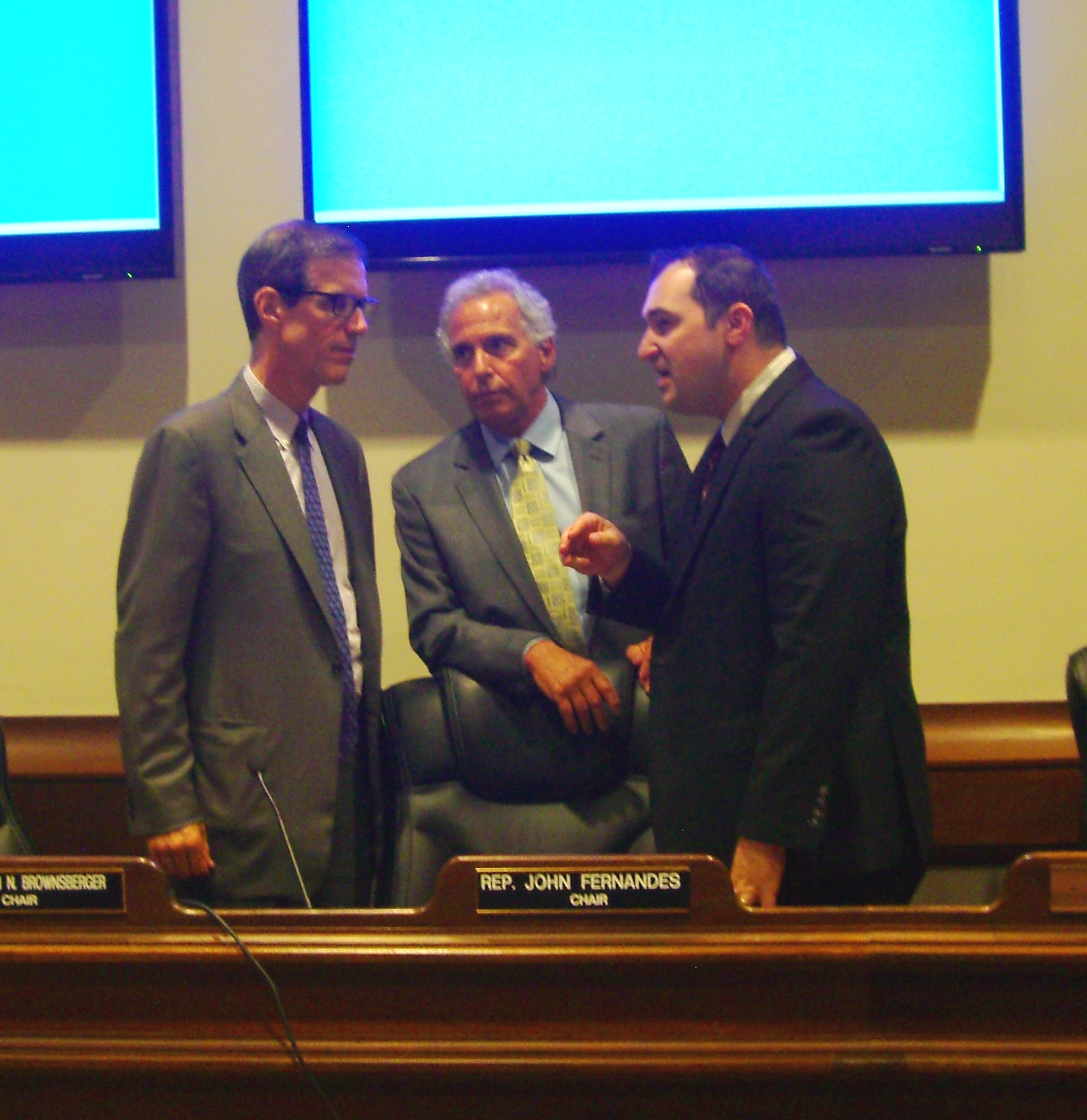
State Sen. William Brownsberger (left) and Rep. John Fernandes (center), co-chairs of the Judiciary Committee, confer with a legislative aide during a committee hearing in June 2015 on H. 1459 and related bills. It now appears they were probably discussing their legislative “black hole” strategy for many of those bills.
If Brownsberger and Fernandes and other members of the Legislature really cared about the issues that H. 1459 is concerned with, they would have acted on the bill by now. In fact, they had 17 years to study it, including the entire year and two months that the bill sat in the Judiciary Committee in the current session with no action on it. This bill has been repeatedly filed since 1999, and we know it has been sent to similar “studies” in past legislative sessions. But apparently, no one has learned a thing about the bill in those past studies, and we’re sure that will be the case yet again.
As we reported last month, this legislative session initially appeared to be different with regard to H. 1459. While COFAR has long supported the measure, it garnered the support last year for the first time of other major advocacy organizations for the developmentally disabled, including the Massachusetts Developmental Disabilities Council, which is technically part of the Baker administration. The MDDC listed H. 1459 as one of its legislative priorities for 2015-2016.
The Judiciary Committee did hold a public hearing on H. 1459 last June. COFAR, the MDDC and other organizations submitted testimony in support of the measure. As far as we know, the bill was not controversial, and no one raised any opposition to it at the hearing.
But the months dragged on and the Judiciary Committee did nothing about the bill. In January, State Sen. Richard Ross and Rep. David Linsky sent a letter to Brownsberger and Fernandes, urging them to finally pass the bill and saying it had their full support. Their letter noted that in light of continuing budget cuts to service coordinators in the DDS system, “family guardians are particularly crucial in managing their child’s transition and medical decisions.” But the letter apparently had no effect.
Ross and Linsky are the local legislators of Stan McDonald, who has been fighting unsuccessfully against DDS for years to gain guardianship of his developmentally disabled son, Andy. It is Linsky who has repeatedly filed the guardianship bill since 1999 on behalf of McDonald and an unknown number of other people who are in similar positions.
We may never find out the real reason that the guardianship bill can never get through the legislative process. But it’s my guess that DDS, for reasons discussed above, does not like the legislation. And experience has taught us that legislators on Beacon Hill rarely, if ever, challenge the authority of agencies like DDS or their lobbyists and corporate providers.
HHS IG’s Office defends 6-page report on abuse and neglect of disabled in NY State
The Inspector General’s Office for the U.S. Department of Health and Human Services has responded to our questions about the methodology underlying their report on abuse and neglect in residential facilities for the developmentally disabled in New York State.
As a spokesperson for the Office put it, in an email accompanying the Office’s responses, “I think you will see we were quite thorough in our work.”
I’ll summarize the Office’s responses below. But we have to disagree with the suggestion that this report was thorough. A six-page report (actually four pages if you leave out the methodology section) that contains no recommendations concerning a subject as serious and complex as abuse and neglect in a system with thousands of residential facilities and tens of thousands of program recipients cannot by definition be thorough.
As we noted previously, Senator Chris Murphy of Connecticut had asked HHS Inspector General Daniel Levinson in 2013 to investigate the privatized group home system around the country in the wake of exposes in both The Hartford Courant and The New York Times that revealed horrendous cases of abuse and neglect in group homes in their respective states.

A group home in Hudson Falls, NY, where a worker allegedly sexually assaulted a developmentally disabled woman, according to a New York Times report
The report released by the IG on New York State’s residential system is the first of three reports that the Office plans to issue in response to Murphy’s request. Two additional reports are expected to be released, based on similar reviews in Massachusetts and Connecticut.
What the IG actually did in the first report was to conduct a review of the outcomes of hospital emergency room visits by residents of a selected sample of 12 Intermediate Care Facilities (ICFs) in New York State. Those 12 ICFs were selected because more than 70 percent of the residents in each of the facilities had had an ER visit in 2012 and 2013.
While some of the ER visits were due to alleged abuse and neglect, the IG concluded that the incidents were reported to the appropriate agencies, and that the “vast majority” of the ER visits were due to underlying medical conditions of the residents. The report noted that it contained no recommendations, and essentially concluded that the IG had found nothing wrong in the system.
Senator Murphy has not responded to queries from us as to whether he is satisfied with the IG’s work so far in response to his call for the investigation.
Below are the key questions we posed to the IG about the New York report and a summarization of the IG’s responses (not necessarily in the order we posed the questions):
1. What about deaths?
As we previously stated, the IG’s review appears to have been limited to outcomes of persons sent to ERs from a sample of ICFs. Sen. Murphy’s letter to the IG in 2013 specifically requested that Levinson investigate preventable deaths in group homes. In limiting his review to persons taken to ER’s, didn’t Levinson’s study miss deaths in which no one was taken to an ER?
The IG’s response stated that they reviewed all reported deaths involving the 109 residents of the facilities examined during the audit period. There were a total of 12 reported deaths among the residents in seven of the 12 ICFs. All 12 reported deaths were from natural causes, the IG stated.
This response demonstrates to us just how limited the selected sample of facilities was that the IG chose to review. The New York Times reported in 2011 that 1,200 deaths in group homes in the past decade “have been attributed to either unnatural or unknown causes.”
In 2013, The Courant reported “dozens of developmentally disabled people who died in public and private group homes, institutions and nursing homes from 2004 through 2010 in cases where investigators cited abuse, neglect or medical error as a factor.”
2. Why was the IG review limited to ICFs, when, in fact, many group homes in New York State are not ICFs?
As we noted, ICFs are a distinct category of residential facility for the developmentally disabled. They are required to meet strict federal standards for care under the federal Medicaid statute, and tend to serve profoundly disabled and medically involved people.
Also, it’s not clear how many, if any, of the ICFs examined by the IG actually were group homes. Many group homes operate under the Home and Community Based Settings (HCBS) waiver to the federal Medicaid statute, which exempts those homes from ICF requirements.
In their response, the IG’s Office stated that they first used a state computer database to identify Medicaid claims submitted by more than 1,100 residential providers for close to 41,000 intellectually disabled Medicaid beneficiaries in New York State.
The IG then determined that close to 23,000 of those beneficiaries had some 146,000 ER visits charged to Medicaid totaling $1.6 million.
The IG next determined that those beneficiaries resided in 33 state-operated and 395 privately operated ICFs. Of that total of 428 ICFs, the IG selected 12 for which more than 70 percent of the residents had had an ER visit. The review involved 109 residents of those 12 ICFs.
But it still isn’t clear to us how many, if any, of the facilities reviewed were actual group homes, which tend to have 6 residents or fewer in them, or why the IG appears to have limited their review to ICFs.
In their response, the IG stated that four of the 12 ICFs in their sample were actually “HCBS Waiver ICFs.” I sent the IG’s Office a follow-up email to try to clarify this. As I noted, it is our understanding that a group home or other facility that operates under the HCBS waiver is not considered an ICF, but is an “alternative” to an ICF. I haven’t yet received a response to that request for a clarification.
The IG’s Office also hasn’t responded to a second follow-up question as to how many, if any, of the 12 ICFs reviewed were actual group homes. Senator Murphy had asked for an investigation of group homes.
3. Could there be an overlooked variable biasing the results as a result of the IG’s methodology? For instance, might a group of ICFs have a high percentage of patients admitted to ERs because those are the ICFs with the most medically fragile patients?
The IG’s response to this was that “the entire population in ICF’s is a fragile population,” and that “no bias was involved” in their method of selecting the 12 ICFs for review.
But this answer doesn’t respond to the question, which assumes that there are some differences in the average degree of medical fragility of residents in different ICFs. Our guess is the IG’s sample is likely to have consisted of the ICFs housing the sickest residents on average. Those residents would be the most likely to die of “natural causes” rather than abuse or neglect. So that might provide one reason why the IG did not find evidence of abuse or neglect in the deaths of the residents in those facilities.
3. Why did the IG look at data for only two years — 2012 and 2013? Shouldn’t the IG have examined data over at least a 10-year period?
The IG’s response was that the process of identifying the Medicaid claims for 41,000 beneficiaries over two years took “a great deal of time and manpower,” and that the Office didn’t have the time or resources to do more.
5. Did the investigators interview staff, families etc. in any of the facilities?
The IG responded that all 12 ICFs were visited and that staff and beneficiary records were reviewed. Apparently no staff or family members were interviewed.
In critiquing this report, we’re not trying to criticize the IG’s other investigations or audits of the health and human services system. We think the IG took the wrong approach to this particular investigation. It was an approach that took them nowhere, and the report reflects that. To that extent, it was a huge missed opportunity. As we noted in our last post, federal investigations of the privatized group home system have been few and far between.
Rather than using a questionable methodology to try to come up with their own data on abuse and neglect, the IG could have reviewed existing records on abuse and neglect that are available in state agencies in New York State. At the very least, the IG could have tried to confirm the findings of the Times and the Courant. Better yet, they could have looked at what actions have been taken in each state to address the newspapers’ findings, and whether those actions have resulted in any improvements that might have been reflected in the state agency data.
It probably goes without saying that the IG should have interviewed families of residents of the facilities they examined.
Despite any implications that might be drawn from the IG’s New York report, we’re sure the problem of abuse and neglect in the group home system has not gone away. A systematic federal investigation of this problem is still sorely needed.
Is Senator Chris Murphy really just fine with this IG’s report on abuse of the disabled?
It’s hard to believe the Inspector General for the U.S. Department of Health and Human Services has come up with a report about abuse and neglect of the developmentally disabled in New York State that doesn’t have any recommendations in it.
And it’s hard to believe that U.S. Senator Chris Murphy of Connecticut, who had asked for the IG investigation, is okay with this report. Well, we don’t really know how he feels about it. We have been unable so far to elicit a comment from his office about it.
The IG took two and a half years to do this report, which was released last September (although we have only now seen it), and the results seem cursory to say the least. Moreover, the methodology the IG used in the 6-page report (that page count includes an appendix on that methodology) seems questionable.
Based on that methodology, the IG essentially found no problems in New York’s group home system. Well, it’s not clear exactly what types of residential facilities were actually examined. More about that and the IG’s methodology below.
We understand that the IG has not yet released additional reports done on Connecticut and Massachusetts, also in response to Murphy’s request. But if those latter reports have employed the same methodology and lack of apparent rigor as the report on New York, we would expect to see similar non-findings and non-recommendations in them.
In March 2013, Sen. Murphy had asked the IG to investigate the privatized group home industry around the country in the wake of major newspaper exposes in both his state of Connecticut and in New York State about poor care and worse in those facilities.
Both The Hartford Courant in Connecticut and The New York Times had found numerous instances of horrendous abuse and neglect (here and here) in the group home systems in those states that resulted in many cases in deaths of disabled people and serious injuries. In case after case, vulnerable and disabled people were found to have been subjected to sexual and other types of assaults, inadequate care, and substandard conditions in facilities with underpaid and poorly trained staff.
As the Times noted in one of its articles, while the staff of these group homes may have been poorly compensated, the executives of the state-funded companies running the homes were often generously paid.
While the privatized group home industry sprang up in response to reports of abuse and neglect in large institutions in the 1970s, the Courant and Times articles, and many similar media exposes in other states, have more recently raised the question whether group homes have become the new warehouses for developmentally disabled people.
To give Murphy credit, he was one of the few prominent elected officials to express public concern about the group home industry in the wake of the Courant and Times exposes. In 2013, shortly after he was elected a senator in Connecticut, he seemed to be outraged by the Courant’s findings, in particular. He wrote a strong letter to Daniel Levinson, the HHS IG. Murphy’s letter opened by stating:
I write to you today to request that you undertake an immediate investigation into the alarming number of deaths and cases of abuse of developmentally disabled individuals in group homes. In particular, I would like you to focus on the prevalence of preventable deaths at privately run group homes across this nation and the widespread privatization of our delivery system.
Citing accounts of abuse and neglect in Connecticut, New York, Massachusetts, Virginia, Louisiana, and Texas, Murphy’s letter added:
These examples and countless others from across the nation are indicative of a larger problem of the race to he bottom in our health care system. Privatization of care may mean lower costs but without the proper oversight and requirements for well-trained staff.
Murphy’s letter to Levinson noted that prior to his becoming a U.S. senator, he had led the charge in the Connecticut Legislature in 2005 to enact a moratorium on conversations of state-run group homes into privately run residences, which are nevertheless publicly funded.
Since 2013, however, Murphy seems to have gone silent on this issue. His office has never responded to queries from us in the past two years about his call for the IG investigation, and we’ve received no response to a call to Murphy’s office last week and to an email this week, asking if Murphy is satisfied with the IG’s work so far.
Our questions and concerns about the IG’s report primarily have to do with the IG’s apparent decision to conduct a much more limited review than what Senator Murphy had asked for. Coupled with the sharply limited nature of the review is what appears to be a vagueness about what was examined. The report doesn’t appear to fully specify, for instance, which types of residential facilities were included in the review.
The report says that the review was limited to Intermediate Care Facilities (ICFs) in New York State in which at least 70 percent of their intellectually disabled Medicaid beneficiaries had an ER visit from 2012 through 2013. This resulted in a review of cases involving 109 persons at 12 ICFs.
ICFs are a distinct category of residential facility for the developmentally disabled. They are required to meet strict federal standards for care under the federal Medicaid statute, and tend to serve profoundly disabled and medically involved people.
The IG’s report stated that New York State has both state-run and privately run ICFs, and that the privately run facilities have less than 30 beds. All that is stated in the report is that the sample of ICFs selected by the IG included two state-run ICFs and 10 privately run ICFs. The report, however, doesn’t say whether any of the ICFs were actual group homes, which tend to have far fewer than 30 beds.
Here is the single finding or conclusion of the IG’s report:
ICFs in New York with high rates of ER visits by intellectually disabled Medicaid beneficiaries under their care reported … these visits, as required, and potential neglect or abuse was reported and investigated (by the appropriate state agencies). However, the vast majority of ER visits we reviewed resulted from circumstances associated with the Medicaid beneficiaries’ underlying medical conditions—not from neglect or abuse. Accordingly, this report contains no recommendations…
In written comments on our draft report, the health department stated that it was pleased that we had no recommendations.
While it’s not surprising the health department is pleased by the lack of recommendations in the report, we would think that, at the very least, taxpayers, who paid for this two-and-a-half-year investigation would have preferred the investigation to have resulted in recommendations. But more importantly, how is it possible that an investigation of a topic of this magnitude and complexity could essentially find nothing wrong? Particularly, when we know there is a lot wrong with the system.
Here are some of the questions we’ve posed to the IG regarding the methodology used in the report: (We’re still waiting for their reply.)
1. Why was the IG review limited to ICFs, when, in fact, many group homes in New York State are not ICFs?
As noted above, it’s not clear how many, if any, of the ICFs examined by the IG actually were group homes. Moreover, the report doesn’t appear to mention the Home and Community Based Settings (HCBS) waiver to the Medicaid statute under which most group homes operate. The waiver exempts those homes from ICF requirements.
New York State does appear to have privately run group homes that operate under the HCBS waiver. Were group homes, which do not operate under ICF rules, included in the review? If not, why not?
2. Could there be an overlooked variable biasing the results as a result of the IG’s methodology? For instance, might a group of ICFs have a high percentage of patients admitted to ERs because those are the ICFs with the most medically fragile patients?
3. Why did the IG look at data for only two years — 2012 and 2013? Shouldn’t the IG have examined data over at least a 10-year period?
4. What about deaths? The review appears to have been limited to outcomes of persons sent to ERs from a sample of ICFs.
Sen. Murphy’s letter to the IG in 2013 specifically requested that Levinson investigate preventable deaths in group homes. In limiting his review to persons taken to ER’s, didn’t Levinson’s study miss deaths in which no one was taken to an ER?
5. Did the investigators interview staff, families etc. in any of the facilities?
One of the reasons we’re so disappointed in the IG’s New York report is that it appeared to be one of the few instances in which the federal government had undertaken an investigation of privatized healthcare. In recent years, state-run care has been a persistent focus of federal investigations, while privatized care appears to have gotten a free pass. Between 2009 and last year, the U.S. Justice Department had filed more than 45 legal enforcement actions in 25 states to limit or shut down state care.
The reason for that apparent bias against state-run care appears to be, in part, an ideology held by the the current and previous administrations against institutional or congregate care, which is primarily state-run. That ideology has become so fervent, in fact, that only the smallest group-home settings are considered acceptable by federal organizations such as the National Council on Disability.
But there has been a persistent drumbeat of information about poor care in these smaller, privatized settings, and a lack of oversight of them. But all the HHS IG has produced so far in response to this drumbeat is a six-page report that has no recommendations. We have to hope Senator Murphy isn’t satisfied with that.
Gov. Baker’s FY ’17 budget continues race to the bottom in care of the developmentally disabled
In his proposed Fiscal 2017 budget, which he filed last week, Governor Baker is continuing to boost funding for privatized care for the developmentally disabled at the expense of state-run care.
This continues a pattern that has crossed party lines — the Patrick administration did the same thing — of reducing both the available choices and the quality of care for people with developmental disabilities.
Privatization of human services reduces the quality of care because it reduces money spent on direct-care staffing. Direct care workers of corporate providers get lower pay and less benefits than their counterparts in state-run facilities.
Privatization reduces choice in care because it results in the closures of state-run facilities and consequently eliminates them as an option for people who might want that higher level of staffing and care.
Of course, as the linked New York Times article points out, privatizing services doesn’t necessarily result in long-term fiscal savings for state taxpayers. The money saved in hiring lower-paid workers is usually offset by higher costs such as unemployment insurance and by Medicaid and other public assistance for workers earning low incomes. We also believe any savings in privatization is also offset by the often inordinately high compensation provided to executives of the corporate providers.
Yet it appears the Baker administration still believes it will save money in using lower-paid direct-care workers. That seems to be the case with the administration’s proposal to privatize mental health services in southeastern Massachusetts. In that case, the administration appears to be implicitly backing a reduction in wages to direct-care workers after an initial contract period.
Governor’s FY ’17 DDS budget numbers
Here are some of the key numbers in Baker’s Fiscal 2017 budget proposal for the Department of Developmental Services. Note: All numbers below are adjusted for inflation using the Mass. Budget and Policy Center’s CPI index numbers. The CPI numbers show inflation running at about 1.8 percent for Fiscal 2016.
We believe that in order to gauge the level of the administration’s commitment to privatization of services for the developmentally disabled, it’s necessary to compare what has happened and is happening to the corporate provider line item with what happens to other DDS line items.
Here’s how it looks graphically, with more detailed explanation below.

Corporate provider residential line item (5920-2000): This is the main DDS line item supporting privatized services. It has become by far the largest line item in the DDS budget — funding under this line item exceeded $1 billion for the first time in Fiscal 2015.
The governor’s Fiscal 2017 budget would increase the corporate provider line item by $5.9 million, or 0.5 percent, over current-year funding. If the governor’s Fiscal 2017 budget is adopted, this line item will have been increased by $309 million, or 38.6 percent, since Fiscal 2012.
Chapter 257 Reserve 1599-6903: This is a reserve fund created to last year to provide even more funding for corporate providers. The governor’s budget would increase this fund by $5.7 million or 18.6 percent, to $36.2 million.
The following three line items are key indicators of the administration’s commitment to state-run services.
State-run developmental centers budget line item (5930-1000): The governor’s Fiscal 2017 budget would cut this line item by $3.18 million or 2.8 percent from the current-year appropriation. If the governor’s proposal for Fiscal 2017 is adopted, this line item will have been cut by $41.6 million, or 27.5 percent, since Fiscal 2012.
That $41.6 million cut reflects the closures since 2008 of three of six remaining developmental centers.
State-operated Residential line item (5920-2010): The governor’s Fiscal 2017 budget would cut this line item by $212,800, or 0.1 percent, from current-year funding. (In nominal dollars, the governor has proposed a $3.7 million increase in this line item, but it’s a cut when adjusted for inflation.) If the governor’s Fiscal 2017 budget is adopted, this line item will have been increased by $42.8 million, or 24.4 percent, since Fiscal 2012.
That 24.4 percent increase since Fiscal 2012 for state-operated residential care can be compared to the 38.6 percent increase in the corporate provider residential line item. Moreover, that funding increase in the state-operated residential line item is actually a result of the underlying dynamic of privatization.
As we have noted before, there has been a net increase of 40 state-run group homes over the total number in 2008; but the state has closed state-run residences even as it has built new ones. It appears the new state-run residences and the additional funding for those residences have been intended to accommodate the more than 250 people who have been transferred since 2008 from the closed developmental centers and the closed state-run homes. Those are apparently the only people who have been admitted to the new state-operated homes.
As we’ve also pointed out, the administration does not even offer state-run residential facilities as options for developmentally disabled people waiting for residential care. Privatized, corporate-run care has become the only “choice” available those people despite the fact that the federal Medicaid Law requires that developmentally disabled individuals and their guardians be informed of the available “feasible alternatives” for care.
DDS administration (5911-1003): In addition to administrative functions, this line item funds DDS service coordinators, who are responsible for ensuring that clients throughout the system are receiving services to which they are entitled. The service coordinators have seen their caseloads rise dramatically in recent years, but funding under this line item has never kept up with the caseload increases.
The governor’s Fiscal 2017 budget would cut the DDS administrative line item by $977,000, or 1.4 percent. (In nominal dollars, the governor is proposing a slight increase in this line item, but it’s a cut when adjusted for inflation.) Since Fiscal 2012, this line item will have been increased by 8.1 percent if the governor’s Fiscal 2017 budget is approved.
Other line items that demonstrate the administration’s commitment to increased DDS privatization include the following:
Community day and work 5920-2025: The governor’s budget would increase this line item by $5.6 million or 3 percent. Since Fiscal 2012, this line item will have been increased by 45 percent if the governor’s Fiscal 2017 budget is approved. It appears that some of the increase proposed for this line item reflects the transfers of people from sheltered workshops to day programs.
Employment pilot program 5920-2026: The governor’s Fiscal 2017 budget would increase this line item by $4.6 million, which is a major increase, given that the current year appropriation is just over $3 million. That proposed 150 percent increase reflects the transition from sheltered workshops to supposed integrated employment.
The pattern of privatization in Massachusetts state government has become almost permanently established even though the benefits of privatization are highly debatable. Many questions have been raised about the privatization of prisons and the privatization of education in Massachusetts and elsewhere around the country. The privatization of human services may be the biggest prize of all for government-funded contractors. We need to preserve what’s left of state-run services.
Bill that would give guardianship rights to parents of disabled remains stalled
The Massachusetts Legislature has rightly drawn criticism for getting little accomplished in the past year, and the following is yet another example of that apparent failure to go ahead and just do the right thing.
The right thing would be to enact H. 1459, a bill that would make it easier for parents of individuals with developmental disabilities to become their guardians. It’s not among the more visible pieces of legislation that lawmakers have had to deal with; yet, it’s potentially important to all family members of developmentally disabled people, and we’ve heard of no reason why it should be controversial.
The bill, which was last filed more than a year ago with the Judiciary Committee, proposes that a spouse or parent be presumed in probate court to be suitable as a guardian of a developmentally disabled or otherwise incapacitated person unless competent evidence is introduced to the contrary.
State Sen. William Brownsberger (left) and Rep. John Fernandes (center), co-chairs of the Judiciary Committee, confer during a committee hearing last June on H. 1459 and related bills. The committee has subsequently taken no action on H. 1459.
The bill has the support of major advocacy organizations for the developmentally disabled, including COFAR, and even of the Massachusetts Developmental Disabilities Council, which, while federally funded, is yet technically part of the Baker administration. The MDDC listed H. 1459 as one of its legislative priorities for 2015-2016.
Yet while the Judiciary Committee did hold a public hearing on H. 1459 last June, at which COFAR and other organizations testified in support of the measure, the committee has taken no action on the bill.
State Representative David Linsky has actually repeatedly filed the bill since 1999 at the request of Stan McDonald, a constituent of his, who has been involved in a seemingly endless and infinitely frustrating battle to gain guardianship of his son, Andy.
The bill, however, never gained any traction in the Legislature from 1999 on. This past year appeared to be different, particularly given that the bill was labeled a priority by the MDDC. But now it’s not clear that anything really is different than in those past years.
Earlier this month, both Linsky and Senator Richard Ross, McDonald’s state senator, sent a letter to the co-chairs of the Judiciary Committee, Senator William Brownsberger and Representative John Fernandes, urging their committee to approve the bill and send it to the full House for a vote.
I spoke last week to aides to both Ross and Linsky who said they didn’t know of any reason that the bill has not moved in the committee. An aide to Linsky said Linsky had met “more than once” with Fernandes to urge his support for the bill.
I then spoke last week with the legislative counsel to Senator Brownsberger, who said she too knew of no reason that the bill has not yet come up for a vote in the committee. She said I should talk with Fernandes’ office because the measure is technically a House bill.
So I called Fernandes’ office on Friday and was forwarded to a legislative aide’s voice mail. So far, no one has called me back.
To be fair, the Judiciary Committee has also taken no action on a related bill (H. 1469), which would prohibit state or other authorities from charging a parent or legal guardian with abuse or neglect, based on the type of medical care the parent or guardian has chosen for an individual in their care.
That bill, dubbed “Justina’s Law,” was also filed more than a year ago on behalf of the family of Justina Pelletier. Justina, a teenager, spent nearly a year in a locked ward in Boston Children’s Hospital after doctors there disagreed with the family’s belief that she was suffering from mitochondrial disease.
The outcome so far for these two bills shows how difficult it is to get even uncomplicated and uncontroversial legislation passed by the Massachusetts Legislature, and how much power the chairs of these committees have to stall or block legislation.
Holding a bill for a year in a committee without taking action on it might not seem that long a time, but for the guardianship bill, there has been no action since 1999. Seventeen years is a long time to wait for a man like Stan McDonald, who is now 80 years old, to right the wrongs that have been done to his son and himself.
It’s not that there has ever been any publicly stated opposition to the guardianship bill. As far as we know, no committee has ever actually voted not to approve it. It’s just that no one in power in the Legislature has apparently ever cared enough to do the right thing and enact the bill.
This, in our view, is what is really wrong with the Legislature. It’s not that the leadership specifically won’t pass “progressive” bills; it’s that the leadership can and does block anything that it doesn’t like for whatever reason. And often we never find out what that reason is.
Few people moving from sheltered workshops to “integrated” jobs
While the Baker administration appears to be moving ahead with a policy of closing all remaining sheltered workshops for developmentally disabled persons in Massachusetts, records show that relatively few people so far have been transferred from the workshops to the “integrated employment settings” that are supposed to replace them.
Confirming our concerns, the data from the Department of Developmental Services show that most of those people have been transferred to community-based day programs funded by DDS or MassHealth.
This has financially benefited corporate DDS providers that run the day programs and that have been among the most vocal proponents of shutting down the sheltered workshops. In what we consider to be an example of the inappropriate influence of private interests in DDS policy, two of those provider organizations actually helped draft a key DDS document that called for the workshop closures.
According to DDS records, the number of participants in sheltered workshops dropped by 1,166 between August 2014 and August 2015 — a 61 percent reduction from the 1,913 people who had been in those programs. The number of sheltered workshop providers dropped from 39 to 14.
In that same period, the number of developmentally disabled persons in corporate-run, community-based day programs increased by 1,116, or 27 percent.
In contrast to the increase in day program use, the number of developmentally disabled people in “integrated employment” settings increased from August 2014 to 2015 by only 337, or about 6 percent. DDS said it had no records on the number of integrated workplaces that exist in Massachusetts.
Community-based day programs actually cost considerably more to run than do sheltered workshops, according to an expert in the field.
A DDS document in November 2013, titled “Blueprint for Success,” stated that it was the department’s goal to close sheltered workshops to new participants as of January 2014 and to close all remaining workshops as of June 30, 2015. The closure of all of the workshops has not yet occurred, but it appears to be likely to happen despite protective language placed in the state budget for the workshops.
The title page of the Blueprint states that the document was prepared by DDS and by the Massachusetts Association for Developmental Disabilities Providers (ADDP) and the Arc of Massachusetts. Both the ADDP and the Arc are largely supported by DDS-funded providers, which have benefited from higher DDS funding for the day programs to which most of the former sheltered workshop participants have been transferred.
The Blueprint called for a total of $26.7 million in state funding over a four-year period for the transition from sheltered workshops to mainstream work settings. But the document did not offer specifics as to how those mainstream jobs would be found.
A 2014 Blueprint Progress Report, drafted by DDS and the ADDP, stated that $3 million allotted in the Fiscal Year 2015 budget for the transition from the sheltered workshops fell short of $5.5 million that DDS and the corporate providers had requested. Nevertheless, the report stated that 31 of 39 provider agencies would receive funding to transfer participants out of the workshops.
It now appears most of the funding has gone toward community-based day programs. The expert we talked to suggested that it would have been more effective had the funding been earmarked for subsidies for employers for hiring developmentally disabled workers.
Sheltered workshops provide developmentally disabled persons with a range of assembly jobs and other types of work, usually for a small wage. But the programs have become targets of a political ideology that holds that any type of congregate care setting is institutional in nature and therefore bad for those involved. Sheltered workshops allegedly “segregate” developmentally disabled people from their peers in the wider community or in the mainstream workforce.
“Integrated individual employment” is defined by DDS in a 2010 policy directive as “taking place in a workplace in the community where the majority of individuals do not have disabilities.” In addition, the policy directive states that the “optimal employment status is earning the prevailing wage.”
Many families of the sheltered workshop participants have countered that those programs are fully integrated into the surrounding communities and provide the participants with meaningful activities and valuable skills. Those families have also raised concerns that there are relatively few integrated or mainstream workforce jobs available for people with developmental disabilities; and that absent a sufficient number of such jobs, former sheltered workshop participants are likely to be transferred permanently to community-based day programs that do not offer the same activities or skills as the workshops did.
The contrast between the percentages of people who have been transferred to day programs and those placed in integrated employment is not alluded to in a September 2015 progress report submitted by DDS to the Legislature’s House and Senate Ways and Means Committees and to the Children, Families, and Persons with Disabilities Committee. The data noted above on the numbers of people in sheltered workshops and other programs in 2014 and 2015 can be found in tables in the report; but there was no analysis in the report of the data and no conclusions drawn based on that data.
In that five-page report, DDS Commissioner Elin Howe stated that DDS was offering training and consultation services to day program providers on the “delivery of quality, inclusive community based services…” Howe also said DDS was working “to assure that all individuals have access to and integration in the community…”
But Howe did not explain in the report how or when that access to integration in the community would be achieved by DDS. Howe’s report also provided no data or information on the types of services offered in community by day program providers or how successful those programs might have been.
The DDS’s 2010 policy directive similarly did not contain a plan for placing former sheltered workshop participants in mainstream jobs; but the policy directive did take a strong ideological stance against the workshops, going as far as to state that mainstream employment had been shown to be “a viable option… even for those individuals with the most significant level of disability…” No evidence or source was cited for that statement.
The disappearance of sheltered workshops appears to be yet another example of the erosion of cost-effective care for the developmentally disabled due to the influence of corporate interests that stand to benefit financially from it. At the very least, this case shows that a public agency should not develop policies jointly with the corporate contractors that it funds.
Most of the mainstream media skipped class last week on privatization and the Pacheco Law
It’s amazing how little real understanding the mainstream media has of the issue of privatization and of legislative responses to it such as the Pacheco Law.
You only have to read this Boston Globe editorial from 2011 to begin to realize how many misconceptions supposedly savvy journalists have about these issues. (More about that below.)
Privatization is one of the most important and controversial aspects of state and federal policy. When I googled the phrase “privatization and public policy,” I got 2.7 million results. The state auditor’s administration of the Pacheco Law has become a key item of controversy in Massachusetts politics as well.
In that light, the State Auditor’s Office and the Boston Bar Association organized a forum directly across the street from the State House this past Thursday afternoon to discuss and debate the Pacheco Law and its impact on privatization, and invited the media to attend.
I was invited to present the pro-Pacheco Law side in the discussion, and Charlie Chieppo, a senior fellow at the Pioneer Institute, presented the anti-Pacheco Law side. A number of top people from the Auditor’s Office presented information on how the law works, highlights of its 23-year history, and key areas of litigation involving the law. Michael LaGrassa of UMass Dartmouth discussed the university’s experience with the Pacheco Law in privatizing the campus bookstore operations in 2014.
In addition to the lineup of speakers, the State Auditor’s Office had put together three-ring binder notebooks filled with helpful information on the Pacheco Law and what it actually does and requires, in addition to materials we had submitted stating our positions on the law. (Included in the binder was our report, “Setting the record straight about the Pacheco Law.” I’ll post that report here this week.)
As I understand it, two members of the media showed up at the Thursday forum — a reporter from Massachusetts Lawyer’s Weekly and a reporter from The Boston Business Journal. I haven’t yet seen anything published from them, but at least they were there.
Neither the Globe nor Herald sent anyone to the event. Notably absent was Globe columnist Scot Lehigh, who has been described as someone who “has been the most consistent and vociferous critic of the (Pacheco) law…”
From my vantage point, there appeared to be some 50 to 60 people in attendance at the forum.
Among the little-known and discussed facts about the Pacheco Law that I tried to point out during the forum were that:
- The Pacheco Law was based on federal policy (OMB Circular A-76)
- The law never barred or banned the award of bus contracts by the MBTA, and the law has not stopped privatization of most human services in Massachusetts
Chieppo of the Pioneer Institute argued that the Pacheco Law is different than A-76 because A-76 requires a binding letter of obligation if the public employees win the bid competition with the private sector. (I disagreed with his assertion that no such obligation binds state employees under the Pacheco Law.)
LaGrassa of UMass said the Pacheco Law review that the university did to privatize their bookstore helped them to better understand the costs involved in running it. He said that the process involved a lot of work and back-and-forth with the auditor’s office; but in his words, “you should do a lot of work” if you are going to privatize a public service.
Regarding the 2011 Globe editorial referred to above:
Memo to Globe editorial writer: Contractors bidding to privatize services don’t have to pay public sector wages under a Pacheco Law review. They can pay the lesser of the lowest public sector wage or the average private sector wage for the equivalent position.
And no, a privatization initiative doesn’t have to “produce savings” over what the state employees could achieve under ideal conditions. The privatization initiative must project such savings, but no one has to — or is expected to — actually produce them. The Pacheco Law requires a competition between private and public sector bids, both types of which are based on projected results that might be achieved under ideal conditions.
The bottom line, it seems to me, is that people in the mainstream media still occupy influential positions as opinion makers regarding politics and government, in particular. As such, they have an obligation to get their facts straight on these matters. The state auditor’s “Primer” on privatization last week presented a convenient opportunity to do that.
But with two exceptions, the mainstream media blew their opportunity by missing the class.
Baker administration interpreting Pacheco Law to potentially benefit private company
In what may be one of the first tests of the Pacheco Law in the privatization of human services, the Baker administration is seeking to contract out existing emergency mental health services in southeastern Massachusetts.
What concerns us about this situation is that the administration is reportedly interpreting the Pacheco Law to allow a for-profit company, the Massachusetts Behavioral Health Partnership (MBHP), to cut its proposed wage rates within roughly a year after starting to provide those services and potentially to pocket the extra profits.
This is not surprising given that a key executive from MBHP was appointed to a new position in the Baker administration that appears to have at least a supervisory role over contracts with the company. (More about that below.)
The administration’s interpretation of the Pacheco Law has drawn a rebuke from the law’s author, state Senator Marc Pacheco.
First, however, a bit of background: The Pacheco Law requires a state agency seeking to privatize services to submit to the state auditor a comparison of a bid or bids from outside contractors with a bid from existing employees based on the cost of providing the services in-house “in the most cost-efficient manner.”
If the state auditor concurs that the outside bidder’s proposed contract is less expensive and equal or better in quality than what existing employees have proposed, the privatization plan will be likely to be approved. If not, the auditor is likely to rule that the service must stay in-house.
Two key provisions of the Pacheco Law that potentially apply here are:
-
- Under the law, an outside contractor’s proposed bid must specify wages at the lesser of either the average private-sector wage for the equivalent position or the lowest public-sector wage level for the position. In other words, the law establishes a minimum wage rate that the outside contractor must propose.
- The Pacheco Law does not apply when contracts for privatized services are renewed. In other words, if a private bidder wins a contract under the Pacheco Law process, that contractor does not have to undergo another review by the auditor in order to renew the contract.
The reason that Provision 2 above is pertinent to this case is that MBHP currently has an ongoing Primary Care Clinician (PCC) contract with MassHealth for separate clinician services that is scheduled to run through June 30, 2017.
As we understand it, the administration intends that the current PCC clinician services contract with MBHP will become the overall contract for the emergency services that the administration is now seeking to privatize. And the administration’s interpretation of Provision 2 above is that if the privatization plan is approved by the auditor, all of the contract provisions in the contract bid will cease to exist when the current PCC contract is renewed.
Thus, it is reportedly the administration’s position that after the MBHP’s PCC contract with MassHealth officially ends in June 2017, MBHP will be legally free to cut the wage levels it is stipulating in its bid. If so, we believe it is unlikely that the company would pass along the savings in cutting wages to state taxpayers, but would instead pocket those savings as profit. As a for-profit, MBHP has an incentive to pocket any operating cost savings as retained earnings.
The administration’s interpretation of the Pacheco Law is ironic because one of the main objections to the law from the law’s most vocal opponent, the Pioneer Institute, is that the bidding contractor in a privatization proposal is required to stick to the terms of its bid whereas there is nothing in the law to ensure that the terms of a state employee bid are enforced.
As Pioneer stated in an influential report last year (linked above):
The Pacheco Law does not contain any requirement that agency employees subsequently provide service in the most cost efficient manner or in an improved manner if the proposed privatization contract is rejected.
But in fact, it appears that it is the administration’s interpretation that it is the outside contractor that doesn’t have to stand by its bid once its contract is renewed.
Sen. Pacheco himself has warned that the administration’s interpretation of the law that was named for him would “undermine” the intent of the law. In a letter sent to Attorney General Maura Healey in November, Pacheco stated that:
Although renewal contracts for validly privatized work do not need to be resubmitted to the Auditor (for a Pacheco Law review), it was never my or the other supporters’ intent that wages and health benefits could sink lower than the “minimum wage” established by the Taxpayer Protection Act (the Pacheco Law) once the initial contract expired. If that is permitted, the statutory purposes of preserving the quality of publicly funded services and providing minimum protections for private sector and public workers would be completely undermined.
Moreover, it seems to us that the Pacheco Law does prevent the state employees from submitting an artificially low bid and then subsequently ignoring it. The Pacheco Law states that if the employees want to submit a bid with wage costs that are lower than what are in a collective bargaining agreement, they must negotiate a change in that agreement with the applicable state agency. That new collective bargaining agreement is binding on the state employees and cannot be changed unless the state agency agrees.
A potential decline in service quality
As we understand it, the Baker administration is projecting a savings of $5 million a year in privatizing the emergency mental health services in Southeastern Massachusetts.
SEIU Local 509, a state employee union, has put in a bid on behalf of the state employees currently providing the emergency services that envisions saving about $500,000 per year. So, the state auditor may well determine that there would be a greater savings in privatizing the services. However, the union is arguing that the quality of those services is likely to decline under the privatization plan because the financial savings will depend on major cuts in staffing.
The administration’s reported interpretation of the Pacheco Law’s contract renewal provision appears to bear out the SEIU’s concerns about a potential drop in the quality of the privatized services offered by MBHP. If MBHP or its subcontracting firms are legally free as of mid-2017 to cut the wage rates proposed in MBHP’s bid for the emergency services, it seems to us to be very likely that the quality of those services will suffer.
Political connections appear to have played a role in the MBHP case
It’s hard to overstate how politically connected MBHP is. There appear to be a number of close relationships between the company and the Baker administration and with previous administrations — and in particular with the Executive Office of Health and Human Services, which will oversee the privatized mental health services.
Last April, Scott Taberner, previously the chief financial officer at MBHP, was named Chief of Behavioral Health and Supportive Care in MassHealth, the division of EOHHS that administers Medicaid and healthcare for low income and disabled persons. Taberner’s position in Masshealth was created by the Baker administration. MassHealth is seeking the privatized mental health services contract with MBHP.
Prior to that, in late May 2014, Beacon Health Strategies (Beacon) announced its plan to merge with ValueOptions, the parent company of MBHP. Under the arrangement, Beacon will be 50 percent owned by Bain Capital and 50 percent owned by Diamond Castle Holdings.
Bain Capital was formed by former Massachusetts Governor Mitt Romney. Last April, the same month that Taberner joined the Baker administration, former Massachusetts Governor Deval Patrick joined Bain as a “social impact” investment advisor. That doesn’t appear to have any direct connection to the proposed MBHP privatization contract, but I thought I’d throw that in.
According to the Mass. Psychological Assn. (MPA), ValueOptions and Beacon both hold a large market share in programs in Massachusetts that are paid for through public funds. As noted, MBHP manages benefits for the PCC program. The MPA estimated that once the merger was finalized, Beacon would manage the behavioral health benefits of 78 percent of the Massachusetts Group Insurance Commission members and of 70 percent of MassHealth members.
A coalition of health care advocacy groups signed onto an MPA letter in August 2014 to the Mass. Health Policy Commission, expressing concern about the proposed merger of Beacon and ValueOptions. The letter stated that the merger “will limit the already narrow choices offered to insured individuals whose primary diagnosis is related to behavioral health…”
It does appear that the merger went through. Now it appears that MBHP is being primed by the administration to run the privatized emergency mental health contract via MassHealth; and Taberner, a former MBHP executive, appears to be involved in that effort or is at least in a position to oversee it.
The administration itself has described Taberner’s new position at MassHealth as follows:
…Taberner will lead reforms to better coordinate and integrate care for behavioral health, physical health and long-term services and supports for elders and persons with disabilities.
The Baker administration wants to make the emergency mental health services part of the MassHealth PCC contract with MBHP. A former MBHP executive is now in a high-level position in the state agency contracting with his former company. And now the administration is interpreting the Pacheco Law in MBHP’s favor by indicating that if the privatization plan is approved, MBHP will be legally free to cut wage levels as of June 2017 when its PCC contract up for renewal.
 The Pacheco Law has borne the brunt of much bad press and political criticism over the years; but we have argued that most of that criticism has been based on misinformation about the intent of the law and what it actually does. The proposed privatization of the Southeastern Massachusetts emergency mental health services demonstrates why the auditor’s scrutiny is needed of such privatization proposals and consequently why the Pacheco Law provides critically important protections for taxpayers and the quality of public services.
I’ll be defending the Pacheco Law at a Boston Bar Assn. forum next month
Based on our blog posts earlier this year defending the scrutiny of the privatization of state services that is provided under the Pacheco Law, I’ve been asked to present a defense of the law at an upcoming forum sponsored by the Boston Bar Association.
Arguing in opposition to the Pacheco Law at the January 7 forum will be Charles Chieppo, a senior fellow at the Pioneer Institute, one of the state’s leading proponents of privatization and leading critics of the Pacheco Law.
Also participating in the forum will be two presenters from the State Auditor’s Office, which administers the law, and Michael LaGrassa, assistant vice chancellor for administrative services at at UMass Dartmouth.
The Pacheco Law has borne the brunt of much bad press and political criticism over the years; but we have argued that most of that criticism has been based on misinformation about the intent of the law and what it actually does.
The law requires a state agency seeking to privatize services to compare bids from outside contractors with a bid from existing employees based on the cost of providing the services in-house “in the most cost-efficient manner.”
If the state auditor concurs that the proposed contract is less expensive and equal or better in quality than what existing employees have proposed, the privatization plan will be likely to be approved. If not, the auditor is likely to rule that the service must stay in-house.
Earlier this year, in the wake of a critical report about the Pacheco Law by the Pioneer Institute, the state Legislature suspended the law’s provisions for three years with regard to the MBTA.
While the Pacheco Law does not appear to have had a role in preventing the past privatization of human services, which we are primarily concerned with, we are concerned that the Baker administration’s next step might well be to exempt future privatization of human services from the law.
At Blue Mass Group, where we often cross-post our blog posts, I and other commenters have already engaged in quite a bit of online debate (here and here) over the Pacheco Law with Greg Sullivan of the Pioneer Institute. I’m looking forward to continuing to set the record straight about this important law at next month’s forum.
 COFAR blog