Archive
State auditor has proposed regs that could weaken the Pacheco Law
The Pacheco Law has over the years been one of the more effective available checks on the runaway privatization of state services.
But the law, which has been the target of continual attacks from privatization proponents, is facing a new challenge, and this time it’s from an unlikely source — the office of State Auditor Suzanne Bump herself.
Bump’s office is charged with overseeing the law, which requires that state agencies seeking to privatize services first make the case to the auditor that doing so will both save the taxpayers’ money and maintain or improve the quality of the services. Given the prominent role her office plays, it isn’t surprising that Bump has been one of the law’s most effective and vocal defenders.
But COFAR is now joining with state employee unions in opposing a number of provisions in a set of regulations, which Bump’s office has recently proposed to govern the continued implementation of the law. Although the Pacheco Law, also known as the Taxpayer Protection Act, has been in effect since 1993, it is only now that the auditor’s office has proposed regulations regarding the law. The comment period on the regulations ends October 31.
We are in agreement with the unions that a number of provisions in the proposed regulations, as they are currently drafted, would appear to make the Pacheco Law less effective in ensuring that when agencies privatize services, they do so for the right reasons.
In recent years, the Pacheco Law has been embroiled in political battles over the privatization of services and functions at the MBTA. The law has also played a more limited, but still contentious, role in the ongoing privatization of human services in Massachusetts.
Last year, Bump’s office approved a proposal under the Pacheco Law to privatize mental health services in southeastern Massachusetts after the for-profit Massachusetts Behavioral Health Partnership (MBHP) claimed it could save $7 million in doing so.
Prior to the auditor’s decision in the MBHP case, we joined the SEIU Local 509 and the AFSCME Council 93 state employee unions in raising concerns about that privatization proposal. We saw some potentially troubling aspects of the proposal that we thought might be realized due to existing loopholes and ambiguities in the Pacheco Law. But we think the solution to that situation should be to strengthen the law, not weaken it.
The first and fourth objections below to the proposed Pacheco Law regulations have been raised by us in written comments sent last week to the state auditor. The second and third objections were raised in preliminary testimony submitted to the auditor last month by SEIU Local 509, and the fifth objection was raised in testimony submitted by AFSCME Council 93:
1. A provision in the proposed regulations would appear to give state agencies an incentive to boost the actual cost of their in-house services if a Pacheco Law review determined that those services should not be privatized.
As part of the review process under the Pacheco law, a state agency seeking to privatize services must demonstrate to the auditor that contracted services would cost less than an In-House Cost Estimate, which is described as “a comprehensive written estimate of the costs of regular agency employees’ providing the subject services in the most efficient and cost-effective manner.”
That requirement lies at the heart of the Pacheco Law because it is meant to ensure that if services are privatized, taxpayers will indeed save money.
The proposed regulations appear at first glance to bolster that cost-saving purpose in stating that if the work is retained in-house after a Pacheco Law review, the state agency is expected make sure the actual work stays within the In-House Cost Estimate.
But the regulations then go on to state that if the agency fails to keep the actual in-house costs down, the agency may issue another request for bids or reopen negotiations with the contractor that would have been the successful bidder under the earlier request for bids.
This provision in the regulations is not in the language of the Pacheco Law itself. And rather than ensuring that costs of in-house services would stay below the In-house Cost Estimate, we think the provision might actually have the opposite effect.
That is because the penalty on the agency for failing to keep the in-house costs down is actually something that the agency would consider to be beneficial to it, i.e. the agency would now be free to privatize the service. It could either issue another request for bids or reopen negotiations with the contractor that lost out to the state employees in the previous review by the auditor.
The regulations do not state that a subsequent review by the auditor would be required under the Pacheco Law if the agency decided to reopen negotiations with the contractor.
In any event, the same state agency that filed under the Pacheco Law to privatize a service would be allowed to keep getting further bites of the privatization apple if it failed to keep in-house costs under control. Thus, this provision would appear to give the agency an incentive to allow in-house costs to rise or even to actively boost those costs in order to do what it wanted in the first place – privatize the service.
Further, there is no provision in the proposed regulations that would require the agency to restore the in-house provision of the service if the service were privatized and the agency was unable to keep the contracted service costs from rising. Thus, our concern is that this provision in the proposed regulations may actually encourage higher costs of both contracted and in-house services rather than serving, as the Pacheco Law intended, to keep those costs low.
2. The proposed regulations appear to weaken provisions in the Pacheco Law that are meant to ensure continuing quality of services.
The Pacheco law, as noted, requires that in addition to demonstrating a cost savings, a state agency seeking to privatize services must demonstrate to the auditor that the quality of the services provided by the private bidder will equal or exceed the quality of services done by state employees.
The proposed regulations state that the agency’s privatization proposal must include a Written Scope of Services that relies on one or more of six performance measures including quality, timeliness, quantity, effectiveness, cost and/or revenue.
Those enumerated performance measures are not in the actual language of the Pacheco Law. But that’s not the problem. The problem lies in the “one or more” statement regarding the performance measures.
As SEIU Local 509 notes, the regulatory provision implies that an agency could choose just one of the performance measures listed in the Written Statement of Services and ignore the rest, and still potentially be certified by the auditor as having satisfied the requirements of the statement.
For instance, a company might provide services that are provided in just as timely a manner as they are provided by state employees, but that does not mean that the private company will provide the services as effectively as state employees or provide the same quantity of services as the state employees provide.
We agree with Local 509 that the regulations should be reworded to require the vendor to demonstrate that it will either equal or exceed all six of the performance measures in the Written Statement of Services.
3. The proposed regulations fail to ensure that contractors will not cut wage rates or health benefits of staff after the contract is renewed.
Under the Pacheco Law review, an outside contractor’s proposed bid to privatize a service must specify a minimum level for wages and health care benefits for its employees.
However, the Pacheco Law does not require a new review by the auditor when a privatization contract expires after five years, and is renewed. As a result, the SEIU and COFAR have raised the concern that a contractor that wins a contract under the Pacheco Law could cut its wage rates and health benefits once the contract was renewed at the end of its minimum five-year term.
According to the SEIU, the Pacheco Law, however, is written in such a way that regulations could be drafted that would require the contractor to maintain existing wage levels and health care benefits when the contract is renewed. The regulations, as drafted, however, do not address that potential outcome.
As the SEIU noted, the language in the regulations related to minimum wages and health insurance benefits of a successful bidder for privatized services avoids stating that these requirements continue on after the expiration of the original privatization contract.
We raised a concern along with the SEIU last year in the mental health service privatization case that the Baker administration was interpreting the Pacheco Law to allow MBHP, the for-profit company, to cut its proposed wage rates within roughly a year after starting to provide those services and potentially to pocket the extra profits. Citing that and other issues, the SEIU ultimately appealed auditor’s approval of the privatization case to the state Supreme Judicial Court, which upheld the auditor’s position.
The SEIU later noted that neither the auditor nor the SJC addressed the concern about potential cuts in wages and benefits under renewed contracts. We believe the regulations should state that a contractor cannot attempt to evade the intent of the Pacheco Law by reducing wages and benefits of employees when the contract expires or is renewed.
4. The proposed regulations require the In-house Cost Estimate to include equipment depreciation, which inappropriately reflects a sunk cost
The proposed regulations state that in determining the in-House Cost Estimate as part of a privatization submission to the auditor, the state agency must consider equipment depreciation, among other things, as a direct cost of in-house services.
The regulations state that depreciation is a calculated cost based on the acquisition cost of equipment or other assets plus transportation and installation costs.
It would seem that requiring depreciation to be included in the In-house Cost Estimate would make it easier for the contractor to beat that cost estimate. At the same time, an acquisition cost is a sunk cost. As such, we do not believe it is relevant in any price comparison going forward.
As Investopedia notes in an article on sunk costs, a sunk cost is:
… a cost that cannot be recovered or changed and is independent of any future costs a business [or public agency] may incur. Since decision-making only affects the future course of business, sunk costs should be irrelevant in the decision-making process. Instead, a decision maker should base her strategy on how to proceed with business or investment activities on future costs.
It seems to us that the acquisition cost of a piece of equipment is a cost that cannot be recovered or changed and is independent of any future costs the agency may incur. More importantly, the depreciation expense associated with an asset cannot be avoided in the future through the privatization of a service.
Say an agency buys a van to transport clients as part of a service that it wants to privatize. Once the van is purchased, it’s a sunk cost even if that cost is depreciated for accounting purposes over the useful life if the vehicle.
As we understand it, the purpose of the Pacheco Law is to compare contractor bids with in-house costs that are considered likely to be avoided in the future if a service is privatized. As the auditor’s Guidelines for Implementing the Commonwealth’s Privatization Law (June 2012) state:
When determining the potential cost savings associated with the contracting out of a service, the appropriate in-house costs to use in the comparison are the avoidable costs (P. 13). (my emphasis)
Even if the agency privatizes the service for which the van is used, the sunk cost incurred in purchasing that van cannot be avoided even if the agency might avoid the cost of directly paying the driver, for instance.
The Pacheco Law itself does not specify which costs must be considered in calculating the in-house cost of providing services other than stating that those costs should include, but not be limited to, pension, insurance, and other employee benefit costs. For that reason, we believe that equipment depreciation costs should not be included in developing the In-House Cost Estimate.
5. The proposed regulations fail to define “permanent employee,” and therefore provide a loophole for circumventing the Pacheco Law
Both the Pacheco Law and the proposed regulations define a “Privatization Contract” that is subject to the law as an agreement “…by which a non-governmental person or entity” provides services that are “substantially similar to” services provided by “regular employees” of the agency.
The problem here is that the law itself doesn’t define the term “regular employee,” and the regulations do not make things much clearer. In fact, the regulations simply state that a “regular employee” is a “permanent employee.” The regulations do not offer any further definition of “permanent employee.”
AFSCME Council 93 notes that the definition of “regular employee” as simply a “permanent employee” creates a potential loophole that could allow agencies to privatize services without a Pacheco Law review.
In fact, it appears that is exactly what happened earlier this year. AFSCME claims the lack in the Pacheco Law of a clear definition of a “regular employee” allowed the state Department of Conservation and Recreation to privatize parking fee collections at state beaches without a Pacheco Law review because the work supposedly involved short-term seasonal workers and not permanent employees.
AFSCME points out, however, that the DCR’s short-term workers are hired on a regular schedule each year in the same way as the department’s long-term seasonal employees who are covered by a collective bargaining contract.
Moreover, even though the contractor chosen by DCR sweetened the privatization deal by offering the department an upfront payment of $1.2 million, AFSCME stated that the privatization deal was still projected by the department to cost taxpayers $500,000 more than keeping the service in-house.
We support AFSCME’s suggestion that at the very least, the regulations should define regular or permanent employees as including any state or public higher education worker covered under a collective bargaining agreement.
In sum, we support the auditor’s efforts to clarify the Pacheco Law as much as possible through the issuance of regulations. We would just urge the auditor to make the changes that we and the unions are suggesting in this case.
Things ‘sliding backwards’ for two men after closure of their sheltered workshops (an update)
Makeshift solutions that were adopted in recent months to help two men cope with the closures last year of their sheltered workshops have not been successful, members of their families say.
“It’s sliding backwards,” Patty Garrity, the sister of Mark Garrity, said in an interview last week. She said a paper shredding experiment that was tried with Mark in March worked only temporarily. Mark soon lost interest in the activity and is bored in his day program, which replaced his sheltered workshop.
In a separate day program, Danny Morin’s temporary work came to an end a few months after it began. In addition, the clients in Danny’s program are now scheduled to be moved into smaller, separate day programs, and Danny’s mother is concerned he could be separated from his long-time girlfriend, another client in his program. The director of the program said that clients’ preferences would be considered in the relocation decisions.
While sheltered workshops were operating for both Mark Garrity and Danny Morin, piecework was always available and both men were satisfied and fulfilled by it, their family members say.
Barbara Govoni, Danny Morin’s mother, is trying to interest state lawmakers in her idea to reintroduce steady piecework activities in day programs for those who desire it. Govoni has proposed legislative language that would require the state to provide a “supportive work environment” to disabled persons who “cannot be comfortably be mainstreamed into a vocational community setting.”
In May, we first reported on the impact of the closures of their sheltered workshops on Mark and Danny and their families.
We noted that paid piecework and assembly work that had been given to Mark and Danny to do in their sheltered workshops were taken away last year and replaced by day program activities that they couldn’t relate to. In each case, their provider agency managed to come up with a makeshift solution to the problem that allowed the men to continue doing work similar to what they had done before.
Now it appears that those makeshift solutions haven’t solved the underlying problems created by the workshop closures for the two men and potentially others.
Sheltered workshops may have closed prematurely in Massachusetts
All sheltered workshop programs were closed in Massachusetts as of last summer as a result of requirements by the federal Centers for Medicare and Medicaid Services (CMS) that developmentally disabled people work in “integrated employment” settings in which a majority of the workers are not disabled.
But while sheltered workshops have been deemed “segregated” settings because they are offered solely to groups of developmentally disabled persons, many clients and their families and guardians have argued that the programs provide fulfilling, skill-building activities and do not preclude community integration. Moreover, it is not clear that the CMS has necessarily required the shutdown of all sheltered workshops.
In Massachusetts, the Baker administration and former Patrick administration claimed they had no choice but to close all of the workshops in the state, or else the federal government would bring a lawsuit against them. But many other states have apparently not acted in the haste that Massachusetts did in shutting the programs down. Last year, DDS Commissioner Elin Howe, who has since retired, stated that Massachusetts was one of the first states in the country to close all of its workshops.
Paper shredding activity for Mark Garrity didn’t last
At the Road to Responsibility (RTR) day program in Braintree, which Mark Garrity attends, Mark was frustrated for months after his sheltered workshop at the site was closed in September of 2016. Piecework activities that Mark enjoyed doing came to an end and were replaced by nature walks, cooking classes, and a money management class, none of which interested Mark.
After COFAR contacted DDS about Mark’s situation in early March of this year, RTR staff found a paper shredding activity for Mark to do. The activity received verbal approval from the DDS southeast regional director, who determined that it was in compliance with federal regulations.
The paper shredding seemed at first to be a good solution for Mark, and he even got paid for it. But Mark’s sister, Patty Garrity, said that Mark soon sensed a lack of structure and purpose in the activity. Mark is also sometimes asked to use the copy machine and to take the copied documents to staff offices; but Patty says that activity usually occupies only a few minutes of his day.
“I think he’s bored,” Patty said. “Every day I would pick him up and ask how’s it going with the shredding. It didn’t hold his interest.”
Patty said that despite the fact that funding was earmarked to pay Mark for doing the paper shredding, he recently stopped doing it. “Now he’s unproductive, and it’s not fair to him,” she said.
RTR officials have said that they did recently offer Mark an employment opportunity at a company outside of his day program; but Patty did not approve that offer for Mark, contending that Mark is not a suitable candidate for outside or mainstream employment. She said he is not able to produce at a rate that employers require in paying a minimum wage.
While his sheltered workshop was operating, Mark was paid by the piece, so the rate at which he was able to produce was not an issue. Moreover, jobs at the sheltered workshop would rotate. Mark was constantly busy then, Patty said, but now he is chafing under the lack of structure.
In addition, Mark appears to fall outside of at least one work category that still exists at his day program for clients who have been determined to be unable or too high-risk to function in the community outside the program. While those clients have been given work to do each day folding t-shirts, Mark has not been offered that work because he has not been ruled unsuitable for community interaction.
“They’re (the RTR staff) trying to do the best they can,” Patty said, “but the people are bored.”
Work at Work Opportunity Center site is intermittent
At the Work Opportunity Center day program in Agawam which Barbara Govoni’s son, Danny, attends, some piecework has been available intermittently from a company that is located in the same building in the center.
The company, Millennium Press, used to supply piecework activities to the Work Opportunity Center when the Center operated as a sheltered workshop. Now the company rents a portion of the Work Opportunity Center’s building.
The work offered by the Millennium Press to clients of the Work Opportunity Center since the closure of the sheltered workshop complies with federal regulations because non-disabled people also work for that company. Danny Morin and other clients of the Center signed an agreement to be paid a sub-minimum wage for doing the work.
However, Barbara said that the Millennium Press work is not steady. Danny and other clients in the Center were kept busy recently for three to four months putting stickers on envelopes and boxes for the company, but they finished ahead of schedule, she said, and the work came to an end.
Pushing for legislation to bring back workshop activities
Govoni has been trying to interest legislators and her congressman in filing legislation at either the federal or state level that would ensure the legality in Massachusetts and potentially other states of a steady supply of piecework activities for persons who desire them. She met last week with state Representative Brian Ashe, a Democratic legislator who represents her hometown of Hampden, to discuss her proposal.
Such legislation would be similar to language that was inserted in the state budget in Fiscal Years 2015 and 2016 that stated that sheltered workshops would remain open for those who wanted to remain in them. Unfortunately, that language did not prevent the Baker administration from closing all remaining sheltered workshops last year.
Govoni’s proposed legislative language would require the state or states (if her language was enacted by Congress) “to provide a supportive work environment, separate from the mainstream community, to enhance productivity, safety and self-esteem.” The language states that the separate work environment is not meant to exclude “other forms of integration or inclusion.”
We emailed Ashe’s legislative aide last month with our support of Govoni’s proposed legislation, but have not heard back. Govoni said Ashe told her he would bring her idea to the attention of “the proper legislative committee” in the Massachusetts Legislature.
Clients at the Work Opportunity Center will be split into groups
Govoni said the clients in her son’s day program will be split into three groups and that each group will be sent to a different day program location based on where they live. She was told at first that the decisions on the new locations would not be based on any existing preferences the clients had expressed such as preferences for maintaining relationships they may have formed in the Agawam center.
DDS regulations state that the Department must provide services that promote “self‑determination and freedom of choice to the individual’s fullest capability.” If clients are being moved to different locations without regard to their personal preferences, it would appear that they are not being allowed to exercise self-determination or freedom of choice in that respect.
Bob MacDonald, executive director of the Work Opportunity Center, said that after discussing the issue with DDS, he has received clarification that the relocations should take client preferences into account. MacDonald said each relocation decision will take into consideration 1) where the individual lives, 2) the “consumer’s preference,” and 3) the recommendation of the individual’s clinical care (ISP) team.
Without discussing specific people, MacDonald said that if two clients are known to have a relationship or a preference for staying together, that would or should be taken into consideration in the relocation decision.
We hope that Representative Ashe and others in the Legislature will make a sincere effort to promote legislation that will ensure the restoration of steady and meaningful work activities for those in DDS day programs that desire them.
Even if someone believes that DDS-centered work activities tend to segregate or exploit those individuals (and we don’t believe that to be the case), we think everyone should respect the wishes of those individuals and their families and guardians who want to engage in those activities. That is what self-direction and freedom of choice are all about.
Developmentally disabled man nearly dies after group home fails to respond to severe food aspiration symptoms
Yianni Baglaneas, who has Down syndrome, had a great time at a Special Olympics bowling tournament in Peabody on April 9, the day after his 29th birthday.
But later that night in his group home, he apparently aspirated on a piece of birthday cake and nearly died of pneumonia almost a week later because the staff in the residence allegedly did not react to his constant coughing.
“It was like Yianni was drowning while surrounded by people, and no one gave him a hand,” his mother, Anna Eves, said.
Aspirating or inhaling food into the lungs is a particularly serious danger among people with intellectual disabilities, and caretakers are normally trained to take measures to prevent it from happening and to recognize the symptoms when it does happen.
However, the staff of the group home in Peabody run by Bass River, Inc., a Beverly-based provider to the Department of Developmental Services, allegedly failed to take Yianni to a doctor for three days while his coughing continually got worse. In addition, a nurse practitioner at the Cape Ann Medical Center, who finally saw Yianni, apparently misdiagnosed his condition as bronchitis.

Yianni Baglaneas (center) at his Special Olympics bowling tournament on April 9. Hours later, he aspirated on a piece of cake in his group home.
The nurse practitioner prescribed cough and cold medicine for Yianni and sent him back to his group home. She did not do a chest x-ray even though his blood oxygen level was low and his white blood cell count was high, indicating the presence of an infection due to the aspiration.
It was two days after the doctor’s office visit that Anna, who had no idea of the seriousness of her son’s condition, saw him for the first time since the bowling tournament. She was so concerned about how ill he looked that she took him to Addison Gilbert Hospital in Gloucester where he was immediately admitted in critical condition. That was on April 15, six days after he had apparently aspirated on the piece of cake.
No one from the group home had informed Anna or her husband of Yianni’s worsening condition during that week. The house director had only emailed Anna at one point that Yianni was being taken to the doctor with a cough and a runny nose, and later told her the doctor said her son was suffering from allergies.
“I will never forget the ICU doctor telling me he was in critical condition and asking me if I wanted him to do everything he could to save his life,” Anna said. A nurse told her that her son had been hours away from dying when he was admitted to the hospital.
COFAR emailed Larry Lusignan, executive director of Bass River, Inc., to ask whether he would comment on the case and whether his agency was taking steps to better train staff in how to recognize and react to symptoms of aspiration pneumonia and other illnesses among group home clients.
Lusignan declined to comment, stating in a reply email that “…issues of confidentiality prevent me from disclosing information of any kind regarding our service delivery to individuals, or even the identification of any individuals served.”
Anna said the episode has made her “distraught about the level of abuse and negligence that happens in group homes in Massachusetts.” She said she has begun looking for other parents “to join with to shine a spotlight on this and change things so that these things stop happening.”
COFAR has long sought a state investigation of group home conditions in Massachusetts – particularly in privatized group homes. Abuse and neglect in the DDS system is a topic that now and then appears on the political agenda, but rarely attracts sustained legislative attention.
In 2013, after The New York Times and The Hartford Courant both ran separate series on abuse and neglect in privatized group homes in their respective states, Senator Chris Murphy of Connecticut called for a federal investigation of deaths and injuries in privatized care. But Murphy later appeared to back off his call for a comprehensive federal review.
“The bottom fell out”
Anna Eves described her son as a “sweetheart of a guy” and a beloved figure in his hometown of Rockport. He was so popular in high school that he was named the school’s prom king, and he attended graduation and received a standing ovation there even though he didn’t receive a diploma.
But the “bottom fell out” of his care after he turned 22, his mother says. That was when his eligibility for special education funding ended and he became eligible for DDS services.
For several years after turning 22, Yianni lived at home with his parents. But even though he is nonverbal, he wanted independence and was lonely after most of his siblings moved away to start their lives, his mother said. He was excited when in June 2016, he moved into the DDS-funded group home operated by Bass River.
But after what happened in April, less than a year into his residence in the group home, his parents have taken him back home.
A timeline of inattention
Anna had to piece together what had happened to her son in April by talking to caregivers, doctors, and others. She filed a complaint with the Disabled Persons Protection Commission (DPPC) on April 17, and was still waiting as of today (August 23) for the results of the investigation of the matter. That investigation was actually referred by the DPPC to DDS.
Based on Anna’s account, we have pieced together the following timeline of events involving her son before and after he developed symptoms of apparent aspiration:
Saturday, April 8: Yianni’s 29th birthday. He spent most of the day with his parents.
Sunday, April 9: Yanni’s parents took him to a Special Olympics bowling tournament in Peabody. He showed no sign of illness.
Back in his group home later that night, Yianni is believed to have aspirated on a piece of birthday cake, which he had gotten out of bed to eat. His roommate, who had made the cake, was concerned about him.
Anna said her son has had a history of putting too much food in his mouth and not chewing it sufficiently before swallowing. She said the group home staff was aware of that. Yet, to his mother’s knowledge, no one in the group home was aware that he had gotten the cake out of the refrigerator that night.
Monday and Tuesday, April 10 and 11: Yianni was continually coughing in his group home. His roommate, who is verbal, was worried enough that he told his mother he thought Yianni was very sick and that it had been caused by the cake he had made. But no one from the group home apparently made that connection, took any action, or called Yianni’s parents.
Wednesday, April 12: Yianni was sent as usual to his day habilitation program in Beverly, run by EMARC, a DDS provider. He was coughing so much that the day program nurse sat with him at lunch because she was afraid he was going to choke on his food. The nurse reportedly later suggested to the Bass River group home staff that Yianni be taken to a doctor, but the nurse did not arrange for that herself.
Anna said the nurse later changed her story and told her Yianni had been coughing only moderately at his day program.
Thursday, April 13: Anna received an email that morning from the group home director, stating that Yianni had woken up that morning not feeling well and that he was being taken to see a nurse practitioner at his doctor’s office that afternoon.
The email from the house director said that Yianni had congestion, a cough and “a bit of a runny nose,” so Anna was not overly concerned. The email did not indicate that Yianni’s coughing had been going on for days or that it was getting worse. It was the first time anyone in the group home had sent any message to Anna that week indicating that her son was not well.
The house director added that the medical appointment was at 1:30 p.m. and that she would update Anna with the results. A staff member did finally take Yianni to his primary care doctor’s office at the Cape Ann Medical Center in Gloucester.
Anna said she learned that the group home staff member told the nurse practitioner falsely that Yianni had started coughing only that day. The nurse practitioner took a blood sample, but did not do a chest x-ray.
According to Anna, the blood test showed a high white blood cell count consistent with an infection, and a potentially low blood oxygen level of 90. She said the blood oxygen level should be 99 or 100.
The nurse practitioner diagnosed Yianni’s condition as bronchitis and an upper-respiratory infection. She performed a nebulizer treatment on him and prescribed cough syrup and Mucinex and Robitussin, which are over-the-counter decongestants. Despite the results of the blood test and the low blood oxygen count, the nurse determined that Yianni could return to his residence.
Anna said she later learned that the group home staff had removed her name and phone number as her son’s primary medical contact and substituted the group home phone number without her permission even though she is her son’s legal guardian. As a result, no one at the medical center had any means of contacting her regarding her son.
That same afternoon, Anna said, the house director called her, but it was actually by accident. The director had meant to call Yianni’s roommate’s mother. But Anna pressed her during the phone call about her son’s doctor’s visit. The house director appeared to be rushed, she said, and told her only that her son had allergies.
Friday, April 14: The group home director took Yianni as usual to meet with his job training coach at Community Enterprises, Inc., a DDS provider, in Salem. The job coach later told Anna she was alarmed at how sick Yianni appeared. However, the job coach did not take any action or contact anyone about him at the time.
Saturday, April 15: A group home staff member dropped Yianni off at a Special Olympics track practice in Gloucester. His parents were there to meet him, and it was the first time they had seen him since Sunday, April 9, the day after his birthday.
Anna said that when she first saw the group home staff member at the Special Olympics event, her son was in the bathroom. “She (the staff member) didn’t say anything,” Anna said. “She just handed my husband, James, his overnight bag and drove away.” When her son emerged from the bathroom, Anna said, she and her husband were shocked at how ill he appeared. “He was coughing and his eyes were sunken,” she said. A Special Olympics coach approached her and said her son did not appear well enough to participate in the practice.
Anna took her son home and tried to give him lunch, but he wouldn’t eat. Then she looked into his overnight bag and saw the Mucinex for congestion. “I thought he just had allergies, but when I saw the Mucinex, I thought right away something was not right.” At that point, Yianni appeared lethargic and didn’t want to move.
Anna thought about calling an ambulance, but then drove him to the emergency room at Addison Gilbert Hospital in Gloucester. There, his blood oxygen was measured at 50, which is not compatible with long-term survival. His right lung was completely filled with fluid. He was admitted directly to the ICU in critical condition.
Monday, April 17: Yianni was placed on a ventilator on which he would remain for 11 days. Anna called the group home in the morning and left a voice message that Yianni was in the hospital ICU in critical condition on a ventilator with severe pneumonia.

Yianni in the ICU at Addison Gilbert Hospital in Gloucester
Tuesday, April 18: The group home director returned Anna’s call from the previous day. “She said she heard Yianni was sick and was sorry to hear it,” Anna said.
Anna said she asked the house director why she had not informed her during the previous week that her son was sick and why she had told her falsely that he only had allergies. She said the director responded by saying she didn’t know why she had not told her the truth about the situation. She said the director then said to her, “’It’s all my fault.’”
Thursday April 20: Larry Lusignan, executive director of Bass River, Inc. called Anna “to ask what happened,” she said. She said she told him her son would not be returning to the group home and that she had made arrangements to pick up his belongings from the residence. She said Lusignan never acknowledged any wrongdoing.
Sunday, April 23: Yianni was moved from Addison Gilbert to the ICU at Mass General Hospital.
Sunday, April 30: Yianni was moved out of the ICU at Mass General and into the hospital’s Respiratory Acute Care Unit.
Anna said that Yianni spent about a week in the Respiratory Care Unit at Mass General and then spent about three weeks at Spaulding Rehabilitation Hospital.
Thursday, May 25: Yianni was released from Spaulding Rehab and went home to his parents’ house in Rockport.
The ordeal is not over for Yianni. Anna said she was told it could take six months to a year for him to fully recover. His parents are not sure, in fact, that he will ever completely recover. Since his hospitalization, he has continued to need an inhaler and gets out of breath from walking. He needs to sleep at night with supplemental oxygen.
Anna is not sure what is next for her son or what type of residential care would be appropriate for him. “He’ll be home with us until I am 100 percent confident in any placement,” she said.
We think Yianni might be a good candidate for a state-operated group home in which the staff is more highly trained than is largely the case in privatized residences. As we have noted, however, the administration appears to be phasing out state-operated residential options for people.
We hope this case will demonstrate the continuing need for state-run residential programs and that it will lead to better training of staff in all DDS residential facilities. Unfortunately, however, incidents like this seem to continue to happen with regularity in the DDS system.
We would also hope this case will finally spark a hearing by the Legislature’s Children, Families, and Persons with Disabilities Committee into issues surrounding oversight of privatized human services.
Living wage in Massachusetts suffers a setback
In an apparently little-noticed setback to the effort to raise the minimum wage in Massachusetts, the legislative conference committee on the state budget rejected a living wage for direct-care workers in human services earlier this month.
The conference committee tossed out language that would have required corporate human services providers to boost the pay of their direct-care workers to $15 per hour.
That language had been proposed by Senator Jamie Eldridge and had been adopted in the Senate budget, but it wasn’t in the House budget, so it went to the conference committee. The conference committee chose not to include Eldridge’s language in its final budget even though the inclusion of the language would not have affected the budget’s bottom line.
In a press release issued in May when the Senate adopted his measure, Eldridge termed a $15-per-hour wage for direct-care workers “part of a growing movement to provide a living wage to every worker in Massachusetts.”
An aide to Eldridge said last week that the direct-care wage boost had been requested by SEIU Local 509, the state-employee union that represents human services workers. The aide said, however, that Eldridge had no immediate plans to file legislation to keep the momentum going for that living wage.
We have urged Senator Eldridge to keep the living wage movement going. In the human services arena, the lack of a living wage for direct-care workers appears to be closely related to the rapidly increasing privatization of care.
As state funding has been boosted to corporate providers serving the Department of Developmental Services and other human services departments, a large bureaucracy of executive-level personnel has arisen in those provider agencies. That executive bureaucracy is suppressing wages of front-line, direct-care workers and is at least partly responsible for the rapidly rising cost of the human services budget.
Ironically, a key reason for a continuing effort by the administration and Legislature to privatize human services has been to save money. However, we think that privatization is actually having the opposite effect.
In May, the SEIU released a report charging that major increases in state funding to corporate human services providers during the past six years had boosted the providers’ CEO pay to an average of $239,500, but that direct-care workers were not getting a proportionate share of that additional funding. As of Fiscal 2016, direct-care workers employed by the providers were paid an average of only $13.60 an hour.
Eldridge’s budget language stated that providers must spend up to 75 percent of their state funding each year in order to raise the wages of their direct-care workers to $15 per hour.
While the conference committee enacted deep cuts in DDS and other state-run programs as a result of a growing projected budget deficit, the Senate language on direct-care pay would have only required that providers direct more of the funding they were already getting from the state to their direct-care workers.
The SEIU’s report on the compensation disparity confirmed our own concerns in that regard. A survey we did in 2015 found that more than 600 executives employed by corporate human service providers in Massachusetts received some $100 million per year in salaries and other compensation.
Along those lines, we are concerned that the ongoing privatization of human services is having a devastating impact on state-run programs, particularly within DDS. As we recently reported, funding for critically important state-run programs, such as state-operated group homes and service coordinators, is being systematically cut while funding is rapidly boosted to corporate providers.
This additional disparity in human services funding is resulting in the elimination of choices to individuals and families in the system and perpetuating a race to the bottom in care.
There appear to be few if any people in the Legislature who are questioning the runaway privatization of human services much less who are willing to buck the trend. An effort to require providers to offer a living wage to their direct-care workers would be a start in that direction.
We hope Senator Eldridge will continue to push for the direct-care living wage, and that he and others will begin to examine the connections that exist between low wages for direct-care workers and the ongoing, unchecked privatization of human services.
State’s system of paying guardians and attorneys for the developmentally disabled appears secretive and poorly overseen
State payments to attorneys and corporate providers to serve as guardians of developmentally disabled clients are rising rapidly, yet the payment system appears to be secretive and subject to spotty oversight.
An investigation by COFAR shows the system in Massachusetts and regulations that support it also appear to give professional guardians an incentive to do little work representing individual clients while taking on as many clients as possible.
In addition, the fact that professional guardians are paid by the Department of Developmental Services appears to interfere with their legal obligation to act in the best interest of their disabled clients. We have found in a number of cases that both professional guardians and attorneys appointed to provide legal representation to disabled clients have sided with DDS when family members have gotten into disputes with DDS over the care of those clients.
In one case on which we have reported, a developmentally disabled woman’s state-appointed attorney has sided with a DDS-paid guardian in not allowing any family visitation of the woman for an indefinite period of time. In that case, David Barr, the father of the woman, and Ashley Barr, the woman’s sister, have been banned from all contact with her, and even from knowing her whereabouts, for more than a year and a half.
We believe this and similar cases raise questions whether DDS-paid guardians and state-paid attorneys consistently act in the best interests of their clients.
COFAR examined probate court documents and payment data involving attorneys and corporate entities paid by DDS to provide guardianship services to persons in which family members are not available or have been removed as guardians.
COFAR has also sought information on the payment of attorneys who are hired under the probate system to provide legal representation to incapacitated persons. In those cases, the court approves attorneys as counsel, and the attorneys are paid by a state agency called the Committee for Public Counsel Services (CPCS). As noted below, the CPCS did not respond to COFAR’s request for that information.
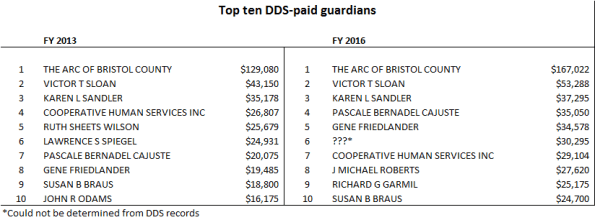
The following chart shows the top-paid DDS guardians in Fiscal Years 2013 and 2016:
COFAR considers becoming a guardian to be a critically important step for family members when loved ones with intellectual and incapacitating developmental disabilities reach the age of 18. After an individual reaches that age, only that person or a guardian acting on their behalf has legal standing to make decisions about their care in the DDS system.
Anyone wishing to become a guardian of a developmentally disabled or otherwise incapacitated person must apply to the probate court to do so. When DDS wishes to pay an attorney to serve as a professional guardian of an individual, it recommends to the court that the attorney be appointed as the guardian.
Under probate law, there are no specific qualifications required of professional guardians such as expertise in mental health issues.
Information about professional guardians and attorneys difficult to obtain
Information about what professional guardians and attorneys do for the clients they are paid to represent in the probate system can be difficult or prohibitively expensive to obtain from DDS and particularly from the CPCS.
Because the CPCS is technically a part of the judicial branch of government, it is not subject to the state Public Records law, according to an attorney we consulted with the state’s Public Records Division. The CPCS would not provide COFAR with any information about the attorneys they employ or the amounts paid to them.
DDS did provide us with a list of guardians it employs and payments made to them, in response to a Public Records request (see chart above showing the top 10 highest paid guardians in Fiscal 2013 and 2016). However, the Department said it would have to pull records from “multiple offices” in order to determine what those guardians do for their payments and how many clients they represent. That information would cost us $3,000, a department attorney wrote.
The DDS payment data also raised a number of questions that the Department did not answer. For instance, there was no guardian listed as the recipient of payments totaling $30,295 on the DDS list in Fiscal 2016. DDS stated that it had no records indicating who those payments may have gone to. (See payment chart above with “???” notation.)
DDS’s response indicates that the department does not have a centralized accounting system to keep track of invoices submitted by guardians for payment. (It appears that this money comes from the clients’ individual Medicaid accounts, but is paid through DDS.)
Independent guardianship office proposed to address accountability issues
In one apparent effort to address at least some of the accountability issues with the current system, a bill in the Legislature (H. 3027) would establish an independent agency called a “Public Guardian,” which would have centralized authority over the hiring and payment of guardians in cases in which family members are not available to serve as guardians of incapacitated people. Under the bill, the Public Guardian would take over the responsibility from agencies such as DDS of recommending and paying guardians.
While COFAR supports the concept of an independent public guardian, we are concerned that H. 3027 specifies that the public guardian would not actually be a public agency, but rather would be a nonprofit agency. We believe the public guardian should be a public agency, which would be subject to the state Public Records Law and other legal requirements that apply to public agencies.
COFAR also strongly supports a second reform measure (H. 887), which would boost the rights of families in the DDS/probate system. The bill would require probate court judges to presume that the parents of incapacitated persons are the suitable guardians for those persons. The measure, however, has never gotten out of the Judiciary Committee.
Payments to guardians on the rise
The list provided by DDS of guardians it employs shows that the department’s total payments to guardians increased between Fiscal 2013 and 2016 from $602,474 to $800,476 – a 33% hike. The number of paid guardians rose from 68 to 80.
The highest-paid guardian was actually a corporate provider – The Arc of Bristol Country — whose total payments rose from $129,000 to $167,000 from Fiscal 2013 to 2016, a 29% increase. The payments to the Arc constituted more than 20%, or one fifth, of the total payments to all guardians in Fiscal 2016.
The second highest-paid guardian in both years was Victor Sloan, an attorney in Uxbridge. His payments from DDS rose from $43,150 in Fiscal 2013 to $53,288 in Fiscal 2016. Sloan’s website lists him a practicing attorney who does criminal defense cases and estate planning in addition to guardianships.
In email messages to Sloan and Michael Andrade, the CEO of the Arc of Bristol County, COFAR asked how many developmentally disabled clients they represented as guardians and how often they were able to visit those clients. In the case of the Arc, we asked how large their staff of guardians was and whether there was a maximum number of persons for whom each member of their staff was allowed to provide services.
Neither Sloan nor Andrade responded to our email or to a follow-up message left with each of them.
The DDS records show that payments to some guardians actually dropped between Fiscal 2013 and 2016, implying that they had lost wards. However, other guardians saw large increases in their payments, which sometimes doubled or even tripled or more in that period. For instance, payments to a Patrick Murray rose from $3,025 to $15,860 from 2013 to 2016 – a 424% increase.
In the Barr case (noted above), payments to the guardian, Dorothy Wallace, rose from $13,000 in Fiscal 2013 to $20,100 in Fiscal 2016 — a 55% increase.
The system appears to reward professional guardians with multiple clients
State regulations governing payments to guardians cap payments per client at $50 per hour, and cap the number of hours that guardians can spend serving individual clients at 24 hours per client per year [130 CMR 520.026 (E)(3)(d)]. Yet, the regulations do not appear to limit the number of clients an individual guardian can represent.
While the regulatory caps would appear to be intended to limit the amount of funding that professional guardians can receive per client, they also appear to provide an incentive to guardians to increase the number of clients they provide services to.
Based on those regulatory caps, we have calculated that Sloan was paid for providing guardianship services to at least 44 clients in Fiscal 2016. The Arc of Bristol County would have had at least 139 clients in that year. When guardians represent large numbers of clients, the ability of those guardians to act in their clients’ interest would appear to decline.
Moreover, the guardianships for which DDS has paid Sloan appear to be only a portion of the probate-court-related work that Sloan does.
Court records show that Sloan has been involved as a guardian, guardian ad litem, attorney, or as a “Rogers Monitor” for incapacitated persons in 118 cases in four separate counties between a seven-year period from Fiscal 2009 to 2015. That includes 14 persons for whom he was appointed as a Rogers Monitor, 75 persons for whom he was appointed as an attorney, 19 cases in which he was appointed as a guardian ad litem, and six cases in which he was appointed as a guardian.
Those six cases in which Sloan was appointed as a guardian appear to be in addition to our estimated 44 cases in which Sloan has been paid by DDS to be a guardian.
An annual client care plan filed in Worcester Probate and Family Court by Sloan does appear to raise questions about the amount of time Sloan spent representing a DDS client from May 2016 to May 2017.
Sloan described the client in the care plan as mildly developmentally disabled and as residing in a group home. Asked on the form to describe the “nature and frequency” of his visits with the client and his caregivers, Sloan stated only that he visited the client and his care givers “at least regularly, and have regular phone and email contact with his residential and day program staff.”
However, stating that he had visited his client “at least regularly” does not either specify the frequency of the visits nor describe their nature.
Sloan’s care plan report contained no critical remarks about the client’s care. He stated that the man’s needs “are being met in his current residential placement,” and that he was attending “an appropriate day program.”
DDS appears to have no centralized accounting system for paid guardians
In a May 10 Public Records law request, we asked DDS for information on the number of clients each paid guardian in its system had and the number of hours the guardians spent with their clients. In a response later that month, a DDS assistant general counsel stated that providing information on the number of clients and hours spent by guardians would require DDS to collect invoices from “multiple DDS offices,” which would take at least 30 hours of “search and collection time” for each of four regional offices. At a cost of $25 per hour, that would cost us at least $3,000, the assistant general counsel’s letter said.
In a subsequent letter sent to us in June, the assistant general counsel stated that it would take an estimated 14 hours of staff time to identify the invoices submitted in Fiscal 2016 from just one guardianship entity — the Arc of Bristol County.
The apparent difficulty that DDS has in locating invoices for payment from guardians in its system raises questions about the adequacy of its internal financial controls, in our view. The DDS central office does not even keep a record of the number of clients each of its guardians represents, according to the assistant general counsel’s May letter.
PriceWaterhouseCoopers notes the importance of centralized, or at least standardized internal controls in large nonprofit institutions such as colleges and universities. We believe a large public agency such as DDS should also have a centralized internal control system, and DDS may lack that with regard to the guardians it employs.
No response from the CPCS
On May 10, we also filed a request with the Committee for Public Counsel Services (CPCS) for a list of attorneys who are selected for appointment to represent clients of the DDS who are subject to guardianship, from Fiscal Year 2013 to the present.
As part of our information request, we asked for a list of the total annual payments made the attorneys from Fiscal 2013 to the present, and the total hours spent each year by those attorneys representing and visiting their clients.
We did not receive a response from the CPCS to our information request. We contacted the state Supervisor of Public Records with regard to the matter and were told that the CPCS is considered to be a part of the judicial branch of state government, which is not subject to the Public Records law.
DDS/Probate system needs reform
As noted, we see a potential conflict of interest in allowing DDS to recommend and pay guardians to represent people in the agency’s care. Along those lines, we are concerned that DDS has in a number of cases recommended attorneys, corporate providers, and other unrelated parties as guardians of individuals over the objections of family members of the individuals.
Also, in light of the increasing amounts paid to guardians by DDS, we are concerned that there is a potential for inadequate representation when paid guardians have large numbers of clients. Yet the payment system for guardians, in particular, appears to encourage those professional guardians to take on more and more clients.
We are also concerned that the system encourages DDS-paid guardians and CPCS attorneys to side together against the interests and wishes of families and individuals caught up in that system.
We think reform of the DDS/probate system is sorely needed, particularly with regard to payment of guardians and other financial practices. Those reforms should make the system more responsive to families, more transparent, and more accountable.
A public guardian may be the answer to many of these issues and problems, but, as noted, we think the public guardian should be just that — public. In the meantime, we urge the Judiciary Committee to finally vote to approve H. 887, which would boost the rights of families in the system by requiring probate judges to presume parents to be suitable guardians.
We will look further into these issues as we advocate for reform of the DDS/probate system.
Isolation of developmentally disabled woman continues after more than a year and a half
It has been a year and seven months since David Barr and his daughter, Ashley, were last informed by the Department of Developmental Services of the whereabouts of David’s other daughter, a young woman with a developmental disability and mental illness.
The 29-year-old woman, whose name is being withheld for privacy reasons, is being kept in an undisclosed residence. All contact with her by her father and sister was cut off for unclear reasons by a DDS-paid guardian in November of 2015.
Although Dorothy Wallace, the DDS guardian, said in August 2015 that her goal was to allow the woman to have family contact, it still hasn’t happened for reasons that have never been revealed to David or Ashley. For unknown reasons, the only family member who has been allowed to visit the woman is an aunt who has apparently agreed not to reveal the woman’s location to the woman’s father or sister.
In an email last week, Ashley Barr told COFAR that her father has personally filed in the Essex County Probate and Family Court to intervene in the case and to seek permission to visit his daughter. But to date, he has not heard from the court.
The probate court has not issued any orders barring visitation with the woman. The denial of virtually all family contact appears to be a decision of the woman’s guardian and possibly DDS.
The Barrs have been unable to afford the cost of hiring a lawyer to pursue their case in probate court. As we have reported in another case, it is extremely difficult to prevail in any probate court proceeding in Massachusetts if you are not a legal guardian or appear without a lawyer.
David and Ashley have contacted their local state legislators, but have gotten little or no help from them. COFAR has attempted to intervene with mainstream media outlets and the legislators in support of visitation for David and Ashley, also to no avail.

David and Ashley Barr
As we reported in January, the Boston-based Disability Law Center temporarily intervened in the case that month to ask a state-appointed attorney who is representing the woman to support family visits if the woman wished that. However, nothing apparently resulted from that effort.
The attorney, Melissa Coury Cote, told COFAR in March that she would not support court permission for visits to the woman by David or Ashley Barr, despite the DLC’s request. She provided no reason to us for opposing family visits other than to say that the woman had not specifically asked her to allow visits from her father and sister.
However, Ashley Barr said that her sister recently called her father on two occasions and said she missed her family and wanted to see them. The calls were apparently unauthorized. Ashley and David don’t know whose phone the woman used to contact them. They are concerned the woman may have gotten in trouble for making the calls.
Coury Cote had previously been appointed by the state Committee for Public Counsel Services (CPCS) to represent the woman on guardianship matters. Under state probate law, incapacitated adults are entitled to free legal representation although their family members are not entitled to that.
COFAR has reported on a number of cases in which DDS-paid guardians have imposed severe restrictions on family contact with persons in the DDS/probate court system; but the Barr case may be the most extreme of those cases in that in none of the other cases has a DDS client been kept in isolation for such a long period of time, and in no other case has their family not been informed of their whereabouts.
COFAR first appealed to DDS Commissioner Elin Howe last October to seek permission for the Barrs to visit their family member, but Howe declined to do so. In early April, COFAR sent an email to Howe, asking whether a timetable existed for ever reuniting Ashley and David with the woman. Howe did not respond to the query.
According to a transcript of an August 2015 court hearing on the case, Wallace and other DDS officials complained that David Barr was excessively combative in dealing with them and that David and Ashley became overly emotional when they had been allowed to visit the woman prior to the cutoff of all contact with her.
While being combative with DDS over the care provided to a loved one can occasionally result in restrictions placed on family contact, we know of no other case in which all such contact was removed for this long a period of time.
CPCS attorney was reportedly told to keep the family informed
John Byron, a friend of David Barr’s, who attended a probate court hearing on the case with David in March, said the probate court judge seemed to be moved when David said he had been prevented from any contact with the young woman and that no one was providing him with any information about her. According to Byron, the judge then told Attorney Coury Cote that she should communicate with the family and that she (the judge) didn’t want the family “kept in the dark” about the case.
Coury Cote told COFAR the judge had asked her during the hearing only to “take a few minutes to speak with father.” She denied that the judge had ordered her to keep David Barr informed about the case. At one point, Coury Cote also said that the Barrs were “not entitled to information” about their family member’s whereabouts.
We believe, however, that in light of a Supreme Judicial Court ruling last year involving the guardianship of a woman known as B.V.G. , David and Ashley Barr should be considered by the probate court to be “interested persons” in the welfare of their family member. As such, they are entitled to information about her whereabouts and to be afforded visitation and other rights.
CPCS declines to review the attorney’s conduct
In March, we appealed to Mark Larsen, director of mental health litigation with the CPCS, asking for an investigation of Coury Cote’s conduct in the case. Larsen responded within two days of our appeal to state that the attorney had no obligation “to follow your directions, those of your client (apparently Ashley and David Barr) or of the DLC. Her only obligation is to her client and her client’s wishes.” He stated that “if the family wants a change in visitation, they should consult counsel of their choosing.”
For the record, neither David nor Ashley Barr are clients of COFAR. COFAR is advocating on behalf of them, but our organization does not charge for such advocacy. Our funding comes strictly from donations made by affiliated organizations and from families.
Larsen also stated that it “appears” that Coury Cote “consulted with her client” in the case.
I wrote back to Larsen to clarify that I had not suggested, or meant to suggest, that Coury Cote should follow our or the DLC’s directions, but that it appeared to us that she “may not have fully ascertained the wishes of her client.” I also stated that Larsen’s comments implied that he did not know for a fact that the Coury Cote had consulted with her client, and that he was only assuming that to be the case.
I noted further that while the CPCS’s Assigned Counsel Manual states that an attorney should “act as a zealous advocate for the client,” the manual also states the attorney should insure “that proper procedures are followed and that the client’s interests are well represented” (my emphasis).
Larsen emailed back a two-sentence reply, badly misspelling my name and saying he had nothing to add to his prior response.
It is frustrating to us, although perhaps not surprising, that the DDS/probate court system seems so often to function against the interests of individuals and families caught up in it. One key reason for this appears to be that there is little or no accountability when professionals in the system act contrary to the interests of people who are powerless and vulnerable.
We always thought the role of legislators and the press was to represent the powerless in society. I think we’re all learning that is no longer the case.
We can only hope that when the Barrs finally do get their day in court, the judge will acknowledge the rights they have been denied and will consider the apparent wish of the young woman involved to see her family again.
In the meantime, we would urge people to call either the governor’s office (617-725-4005) or the DDS commissioner’s office (617-727-5608), and ask them to re-establish family contact in this case. If you do so, please let us know about it.
John Sullivan, founder of COFAR, dead at 97
John L. Sullivan, a founding member of COFAR and a tireless advocate for persons with developmental and intellectual disabilities, died peacefully on Thursday.
Sullivan was also a founding member of the Arc of Massachusetts and was a central figure in class action litigation in the 1970s in Massachusetts that led to improvements in the care of what is now the Department of Developmental Services. Those improvements resulted in upgrades in care and conditions in developmental centers and in the creation of a community-based system of group homes that now serves the vast majority of persons in DDS care.
In March 2012, Sullivan was presented with a lifetime achievement award by the
Department of Developmental Services.
One of Sullivan’s daughters, Jean Sullivan, is intellectually disabled and has been a resident of the Wrentham Developmental Center since 1959. Another daughter, Colleen Lutkevich, has carried on Sullivan’s work on behalf of the developmentally disabled, and has served for many years as the volunteer executive director of COFAR.

John Sullivan
“My dad worked and fought his whole life to make the system work for the least fortunate among us,” Colleen Lutkevich said. “His advice was always, ‘never be afraid.'”
When Sullivan’s daughter, Jean, was a toddler, he and his wife, Gladys, helped found a preschool for disabled children. Gladys died last year after a 71-year marriage to John.
Sullivan later fought for the passage of Chapter 766, the state’s special education funding law, and petitioned local school committees for special education services within area towns.
In the 1970s, while Jean was living in the Wrentham center, Sullivan became a plaintiff in the landmark Ricci v. Okin lawsuit, which was brought to challenge conditions in large institutions in Massachusetts that then housed thousands of individuals.
During that time, Sullivan became a member and then president of the Wrentham Parents Association. He also helped found the Charles River Arc, the Charles River Workshop, and later, three group homes.
Sullivan was a founding and executive board member of the Arc of Massachusetts, and organized one of the organization’s first state conventions. However, he opposed the Arc’s decision to advocate for closure of the developmental centers, contending those facilities should remain as a residential option to individuals and their families needing care.
Sullivan’s disagreement with the Arc’s direction led him to drop his membership in that organization and to found COFAR in 1983.
As he accepted his lifetime achievement award in 2012, Sullivan said he wanted to “pay tribute to the wonderful people that work day in and day out (on behalf of the intellectually disabled). They are the saints on earth.”
He was a veteran of the US Navy, and served for four years in the Pacific during World War II on a minesweeper, the USS Searle, and on a minelayer, the USS Monadnock.
Sullivan grew up in Dorchester and West Roxbury, and spent several years in school at Miramar Seminary in Duxbury, before graduating from Roslindale High School. After the war, Jack and Gladys were married, and moved to Jamaica Plain, then Dedham.
In addition to Jean Sullivan and Colleen Lutkevich, John Sullivan is survived by two other daughters, Joyce Wise and Laura Bradley.
A funeral Mass will be held on Wednesday morning, July 5 at 9:30 a.m. at St. Mary’s Church in Mansfield, with a reception to follow at the Parish Center. Donations in John’s memory can be sent to either the Wrentham Family Association or to COFAR, both c/o Colleen Lutkevich, 3 Hodges St., Mansfield, MA 02048. Donations can also be made online on COFAR’s website at www.cofar.org.
State law that boosted human services funding has helped provider CEOs more than direct-care workers
A 2008 state law, which substantially raised funding to corporate agencies running group homes for people with disabilities, has resulted in only minimal increases in wages for direct-care workers in those facilities, according to a new report from the SEIU Local 509, a Massachusetts state employee union.
Since the law known as Chapter 257 took effect, the average hourly wage for direct-care workers rose by about 14.8 percent to just $13.60 in Fiscal Year 2016, according to the SEIU report, which was released last week (and got little media coverage, btw).
In contrast, the report noted, the law helped boost total compensation for CEOs of the corporate providers by 26 percent, to an annual average of $239,500.
According to the SEIU, raising wages of direct-care workers employed by provider agencies was a key goal of Chapter 257, and yet those workers “are still struggling to earn a living wage” of $15 per hour. The union contended that the funding increases made possible by Chapter 257 “did not come with any accountability measures, leaving it up to the private agencies to determine their own spending priorities.”
The SEIU report found that human services providers in the state received a total of $51 million in net or surplus revenues (over expenses) in Fiscal 2016, which would have been more than enough to raise the wages of all direct-care workers to the $15-per-hour mark. Yet, the providers have chosen not to do so.
Last week, the state Senate approved a budget amendment that would require human services providers to spend as much as 75 percent of their state funding each year in order to boost the pay of their direct-care workers to $15 per hour. The amendment had not been approved in the House, so it will now go to a House-Senate conference committee.
The SEIU report provides confirmation of a report by COFAR in 2012 that direct-care workers in the Department of Developmental Services’ contracted system had seen their wages stagnate and even decline in recent years while the executives running the corporate agencies employing those workers were getting double-digit increases in their compensation.
In January 2015, a larger COFAR survey of some 300 state-funded providers’ nonprofit federal tax forms found that more than 600 executives employed by those companies received some $100 million per year in salaries and other compensation. By COFAR’s calculations, state taxpayers were on the hook each year for up to $85 million of that total compensation.
The SEIU report stated that during the past six years, the providers it surveyed paid out a total of $2.4 million in CEO raises. The highest total CEO compensation in the union’s survey was that of Seven Hills Foundation’s CEO who received a total of $797,482 in Fiscal 2016. Seven Hills received $125 million in state funding that year, with most of that funding coming from DDS.
The SEIU report stated that the average direct-care employee at Seven Hills makes just $12.47 per hour, more than a dollar less than the average wage for workers across all the organizations analyzed in its report.
Vinfen, the third largest provider in the state, provided its CEO with a total of $387,081 in compensation in Fiscal 2016. Vinfen spent a total of $1.7 million on compensation for its top five executives in that fiscal year.
The potential for double-digit increases in CEO compensation was not mentioned by provider-based advocacy organizations that actually sued the then Patrick administration in 2014 to speed up the implementation of higher state funding under Chapter 257.
According to the plaintiffs in the lawsuit, the higher state funding was needed quickly in order to keep up with the rising costs of heat, rent and fuel, and to increase wages to direct-care staff in order to reduce high staff turnover.
In comments in support of the provider lawsuit in 2014, one key provider lobbyist contended that time was of the essence in boosting provider funding. “…Every day that full implementation (of Chapter 257) is delayed, the imbalance and the unfairness grows,” the lobbyist said.
Yet, according to the SEIU, the providers made 3.2 percent, 2.7 percent and 2.3 percent respectively in surplus revenues on average in the Fiscal 2014, 2015 and 2016 fiscal years. The imbalance that existed was actually between executive-level salaries and direct-care wages in those provider organizations.
As a result of the lawsuit, both the Patrick administration and the incoming Baker administration approved major funding increases to the provider-run group-home line item in the DDS budget, even as it was becoming clear the state was facing major budget shortfalls in the 2015 fiscal year.
“This all suggests,” last week’s SEIU report concluded, “that the amount of state funding is not at issue in the failure to pay a living wage to direct care staff, but rather, that the root of the problem is the manner in which the providers have chosen to spend their increased revenues absent specific conditions attached to the funding.”
A look at the struggles of two families to cope with closures of sheltered workshops in Massachusetts
When Massachusetts closed its remaining sheltered workshops for people with developmental disabilities last summer, deeming the programs “segregated,” the impact of the closures on workshop participants Mark Garrity and Danny Morin was pretty much the same.
The two men continued to go every day to their respective facilities where their sheltered workshops had formerly been operated by providers funded by the Department of Developmental Services. But while the providers continued to manage the same facilities, each provider now began offering their clients traditional, DDS-funded day program activities instead.
Paid piecework and assembly work that had been given to Garrity and Morin to do in their sheltered workshops were taken away and replaced by day program activities that they couldn’t relate to. In each case, their provider agency managed to come up with a makeshift solution to the problem that allowed the men to continue doing work similar to what they had done before.

Patty Garrity and her brother, Mark Garrity
But in each case, the solutions were implemented despite a lack of clear, written standards or guidance from the federal and state governments on the type of work and activities that were now permitted for the men. Their family and guardians were confused as well, often having to rely on information passed along from program staff or family of other clients.
Even some providers acknowledge that the system functioned more smoothly for everyone when the providers were operating their programs as sheltered workshops. At that time, participating companies would ship materials to the providers, and everyone at the workshop sites would have work to do — usually simple assembly jobs or packaging or labeling tasks.
Now, those providers must either send their clients to companies that offer to provide “integrated” work for them, or must try to continue to provide some on-site work under unclear rules that sometimes result in work arrangements that are adopted verbally and on a case-by-case basis. Moreover, most of their clients are now offered only day program activities that do not involve productive work and do not pay anything.
For Barbara Govoni, the mother of Danny Morin, and for Patty Garrity, the sister of Mark Garrity, the sheltered workshops were not only easier for them to deal with, they provided meaningful and satisfying activities for their respective loved ones.
“My argument is whether it was federal or state, they should not have taken away the workshops for those who can’t function in the community and disrupted their lives,” Govoni said. “I’m not opposed to finding jobs in the community or expanding day programs. I get it all has to do with money, but I feel that a group of people are being discriminated against based on the fact they had no voice or vote. They have been taken out of their element where they were comfortable.”

Barbara Govoni and her son, Danny Morin
Govoni views the policy of providing integrated employment to all developmentally disabled people as a “misguided one-size-fits-all” approach to a complex social need.
State cites federal pressure to close workshops
All sheltered workshop programs were closed in Massachusetts as of last summer as a result of requirements by the federal Centers for Medicare and Medicaid Services (CMS) that developmentally disabled people work in “integrated employment” settings in which a majority of the workers are not disabled, and that they be paid the minimum wage in those settings. Sheltered workshops were deemed “segregated” settings because they were offered solely to groups of developmentally disabled persons, and the clients were often paid only a nominal amount for the work they did.
In Massachusetts, the Baker administration claimed it had no choice but to follow the CMS rules and close all of the workshops in the state, or else the federal government would bring a lawsuit against them. But many other states have apparently not acted in the haste that Massachusetts did in shutting the programs down. DDS Commissioner Elin Howe stated late last year that Massachusetts was one of the first states in the country to close all of its workshops.
DDS and its major policy advisors, the Arc of Massachusetts and the Association of Developmental Disabilities Providers (ADDP), had actually wanted to close all of the sheltered workshops in Massachusetts as early as June of 2015. But in the wake of strong protests by families of workshop participants, the state Legislature temporarily slowed the closure process by inserting budget language in fiscal years 2014 and 2015, stating that DDS must continue to make sheltered workshops available for those clients who continued to want them.
But at the same time, the Legislature approved funding for the transfer of the participants out of the workshops and into day programs or employment programs. That move ultimately allowed the workshops to close while enabling legislators to claim they had acted to save the programs.
The closures of the sheltered workshops in Massachusetts resulted in the removal from those programs of close to 2,000 participants, but those closures do not appear to have translated into a steady flow of people into integrated employment.
Verbal permission given for on-site work
At the Road to Responsibility day program site in Braintree, which Mark Garrity attends, I met in late March with Patty Garrity and with senior staff of the provider and DDS officials to discuss Mark’s experience in making the transition from his sheltered workshop to the new system.
Like Barbara Govoni, Patty Garrity said the transition from the sheltered workshop has been difficult. Before RTR ceased operating as a sheltered workshop, Mark did a range of activities there, including collating, packaging, and other production work.
For months, after the workshop was closed in September of 2016, Mark was frustrated and angry, Patty said. RTR provided day program activities for him, but, as Patty put it, they “went over his head.” He wasn’t interested in nature walks or painting or cooking. In particular, he didn’t understand the class on money management.
In addition to his intellectual disability, Mark Garrity had suffered a traumatic brain injury in 1995 after having been hit by a car. He underwent years of rehabilitation from that accident, which had nearly killed him.
In a letter written before Mark’s sheltered workshop program was ended, Mark’s neurologist, Dr. Douglas Katz, a member of the Department of Neurology at Boston Medical Center and a professor at the Boston University School of Medicine, stated that participating in the workshop had been “an important part of his (Mark’s) rehabilitation effort…and…his life before his injury. It is an activity that is highly rewarding for Mark. He looks forward to it on a daily basis.”
Katz added that, “I understand this program is …likely to close because of new rules passed by the CMS. I think this would be a big loss for my patient Mark. I would support efforts to maintain this structured workshop for Mark and others that benefit from this service.”
As of March 2 of this year, when I first talked to Patty, RTR still had no work for Mark to do that was similar to the work he had done prior to RTR’s changeover from a sheltered workshop to a day program site. But as of March 20, RTR officials said they had found paper shredding work for Mark for two out of the four hours a day that he attended the program.
The paper shredding arrangement at RTR was done after DDS southeast regional director Richard O’Meara determined that it would not violate the CMS rules. O’Meara said the permission he gave to RTR to offer paper shredding to Mark was purely verbal. There was nothing placed in writing about it.
Hearsay information on piecework eligibility requirement
In January 2016, Govoni said, the Agawam-based Work Opportunity Center, her son’s former sheltered workshop provider, temporarily operated day programs in a function room in a local church after having closed its sheltered workshop program. “I walked in there one day (the temporary day program site),” she said, “and it appeared chaotic, with no structured activities.”
All of the Work Opportunity Center’s clients are now back at the agency’s facility. Govoni’s son gets sent out occasionally to integrated work sites and has some piecework to do at the Work Opportunity site as well. But the work is intermittent. She said she has also heard that those who want to do piecework at the Work Opportunity location will have to take a class explaining what piecework involves.
However, once again, Govoni said she has received nothing in writing about the reported class. She heard about it “through the grapevine.”
In the meantime, Govoni’s son receives a schedule of activities every month at the Work Opportunity Center. “I’m not saying it’s bad,” Govoni said, “but it’s not what he is interested in.” She said many of the activities are educational, such as lectures on geography or cooking demonstrations. Volunteer work is available as well at a local homeless shelter, and residents are taken on walks to the local library and other locations. “Danny doesn’t want to do that,” she said. “He wants to work.”
Both Govoni and Patty Garrity said Danny and Mark respectively didn’t care about making the minimum wage, and would rather work at their day program sites than get sent out to jobs in the community.
Disagreement over client and family satisfaction
If, like Barbara Govoni and Patty Garrity, family members are confused or dissatisfied by the current situation, O’Meara said, they aren’t letting him know about it. O’Meara said that he and DDS Area Director Colleen Mulligan, who was also in attendance at the March 20 meeting at RTR, are generally the first people whom family members and guardians call when there are problems with DDS care.
“I haven’t gotten a lot of complaints (about the closures of the sheltered workshops in his region),” O’Meara said. “Generally, if people are not happy, we know about it. These issues are addressed through the ISP (Individual Support Plans). I haven’t had many calls.”
Mulligan added that if problems were occurring like the ones Garrity has described, “I’m not hearing about it.”
But Garrity and some other advocates believe there may be few complaints now because the vocal protests that did occur when the workshop closures were first announced largely died down when families and guardians saw that their protests were having little effect.
A debate over integrated employment
At RTR, Chris White, the agency’s chief executive officer, maintained that even if the CMS requirements have been difficult to comply with, the requirements make sense because he believes that “everyone is capable” of working at integrated employment sites.
White’s viewpoint is in line with an August 2010 DDS policy document that states that “it has now been clearly demonstrated that individuals who were previously considered unemployable in integrated community settings can work successfully.”
But Govoni and Garrity maintained that the ideological viewpoint that the workshops segregated their participants and that integrated employment is feasible for everyone does not apply in their cases. “My son couldn’t wait to go to work (at his former sheltered workshop),” Govoni said. “He was not discriminated against. It was not a sweatshop for him, but the opposite. He doesn’t thrive in integrated sites. He would much prefer staying at the workshop where he was more comfortable. He doesn’t care what he gets paid.”
Govoni said that efforts to place her son in integrated work settings often did not work. In one case, she said, Danny was not able to do the work fast enough to satisfy the employer, and was terminated from the job. The speed of his work did not matter in the sheltered workshop.
Moreover, Govoni and Garrity maintained that even if integrated employment arrangements were feasible for everyone, there are not enough such jobs available to fulfill the demand now that the sheltered workshops are no longer available.
White said there were about 109 clients at RTR who were involved in “integrated group employment” at various job sites. That number was expected to rise this spring to about 120, he said.
At the same time, some 200 clients remained in RTR’s day program. White maintained, however, that those clients were happy with the activities they were doing, and that some were “on a retirement track.”
But it may be an open question whether all or most former workshop clients are really happy in day programs, or whether they simply have no choice but to remain in them.
Even DDS Commissioner Elin Howe appears to acknowledge that the state and its providers have been unable to find mainstream workforce jobs for a significant number of former workshop participants. While Howe made public remarks last year that we believe painted an overly rosy picture of the integrated employment situation, she did acknowledge that “many people transitioned (from sheltered workshops) to Community Based Day Support programs,” although she did not say how many.
Meanwhile, the Legislature has slowed funding for the transition to integrated employment. In order to carry out the administration’s integrated employment policy, the Legislature initially increased funding of the community-based day program line item in the state budget, and created a new line item to fund the transfers from the sheltered workshops. The idea was to increase both day program and job development staffing and training.
The new sheltered workshop transfer budget line item was initially funded in Fiscal 2015 with $1 million. That amount was raised to $3 million in Fiscal 2016, and the governor proposed to boost it to $7.6 million in Fiscal 2017. But the House and the Senate did not go along with the governor’s plan. The Legislature level-funded the line item for Fiscal 2017. The line item was not included in the governor’s budget for Fiscal 2018.
We agree with Garrity and Govoni that the case has not been made that integrated employment is suitable for all people with developmental disabilities, and it is apparent that not enough integrated work opportunities even exist for all of those that could benefit from it.
We think the federal government needs to rethink its flawed ideology regarding sheltered workshops, particularly the questionable claim that they are discriminatory and segregate their participants. The experience of Mark Garrity and Danny Morin provide further evidence that that claim is untrue.
Data show a recent decline in the developmentally disabled population in state-run residential care
Data provided by the Baker administration show that the number of residents in remaining state-run residential programs for the developmentally disabled has begun to decline, raising questions about the state’s policy for the future of state-run services.
The data, which were provided under a Public Records Law request, indicate that the previous fiscal year (2016) may have been the peak year for the residential population in state-operated group homes and the Wrentham and Hogan developmental centers.
The graph below, which is based on the DDS data, shows the number of residents living in state-operated group homes each year since Fiscal Year 2008:

As we have frequently pointed out, the administration appears to have placed a priority on funding privatized residential services offered by corporate providers to the Department of Developmental Services. A question remains, however, as to whether the administration’s policy also entails phasing out state-operated care.
While Governor Baker’s Fiscal 2018 budget proposes $59.9 million in additional funding for privatized group homes, his budget proposes a $1.8 million cut in the state-operated group home account. That would amount to a $6.9 million cut in that account when adjusted for inflation.
Similarly, the governor is proposing a $2.4 million cut in the state-run developmental centers line item. That’s a $4.9 million cut when adjusted for inflation.
DDS operates or manages both state-run and privatized systems of residential care in Massachusetts. The state-run system, which is now much smaller than the privatized system, includes the two remaining developmental centers and the state-operated group homes.
The ultimate elimination of state-run residential services would take away a key element of choice for individuals and families in the DDS system. State-run residential centers and group homes provide residential care to some of the most profoundly disabled persons in the commonwealth, and they tend to employ staff with higher levels of training and lower rates of turnover than do corporate-run facilities.
COFAR has sent a follow-up Public Records request to DDS, seeking any policy documents that concern the future of state-operated care in Massachusetts.
The administration of then Governor Deval Patrick began closing the remaining developmental centers in Massachusetts in Fiscal 2008, reducing the number of those federally overseen facilities from six to two. Most of the residents in the now-closed developmental centers were transferred either to the Wrentham center or to state-operated group homes, leading to an initial surge in the residential populations in those facilities. But those residential population numbers now appear to be dropping.
According to the DDS data, the number of residents in state-operated group homes rose from just over 1,000 in 2008, when four of the six developmental centers were targeted for closure, to roughly 1,150 in Fiscal 2016. As of the current fiscal year, that number had dropped to about 1,130.
As the graph below shows, both a population surge and drop-off have also occurred at the Wrentham Developmental Center since Fiscal 2008:

The DDS data appear to provide further confirmation of COFAR’s contention that state-run residential facilities are not being offered as residential choices to persons waiting for residential care in the DDS system. We believe that if those facilities were routinely offered as choices, the number of residents in them would either continue to rise or remain steady, but would not be declining.
If DDS is failing to offer state-run group homes and developmental centers as options to people waiting for residential care, that situation would appear to be in violation of federal laws, which require that all available services be offered as options.
The Home and Community Based waiver of the Medicaid Law (42 U.S.C., Section 1396), requires that intellectually disabled individuals and their guardians be informed of the available “feasible alternatives” for care. In addition, the federal Rehabilitation Act (29 U.S.C., Section 794) states that no disabled person may be excluded or denied benefits from any program receiving federal funding.
We think the DDS data closely track the closures of the Fernald, Monson, and Glavin developmental centers, starting in Fiscal 2008, and the transfer of the residents of those facilities primarily to the state-operated group homes and the Wrentham center.
But as we reported in 2014, while 49 new state-operated group homes were built between 2008 and 2014, 28 state-operated homes were closed during that period. The new state-operated homes appear to have been intended to accommodate only the residents of the homes that were being closed and the residents transferred from the developmental centers.
Nevertheless, an undisclosed number of disabled individuals are reportedly waiting for residential services in Massachusetts, although the state does not maintain an official waiting list that would publicly identify the number of people waiting. The Massachusetts Developmental Disabilities Council has continued to cite a 2010 survey indicating that some 600 people were waiting for residential services in the state, and up to 3,000 people were waiting for family support services.
As noted, the administration appears to be attempting to meet the demand for residential care by boosting funding to corporate residential providers. While that hasn’t prevented the budgets of state-run developmental centers from increasing, those budgets may be leveling off.
The DDS data, which includes information about the Wrentham and Hogan developmental center budgets, shows increases in those budgets between Fiscal 2008 and 2015. Wrentham’s budget, in particular, appears to have leveled off, starting in Fiscal 2015.
It is unclear if or when the administration intends to phase out state-run DDS residential care, but the initial data are cause for concern. If you have a loved one in a state-run facility or are seeking care in a state-run setting, please let your local legislators know about this situation.
You can find your legislators at this link.
 COFAR blog