Archive
Committee airs testimony on sexual abuse of the disabled, but offers little indication of its next steps
While members of a legislative committee heard testimony on Tuesday about sexual abuse of the developmentally disabled in Massachusetts, the state lawmakers on the committee gave little indication as to what they plan to do with the information.
COFAR was one of several organizations invited by the Children, Families, and Persons with Disabilities Committee to testify. The committee members asked no questions of any of the three members of COFAR’s panel, who testified about serious and, in one case, fatal abuse of their family members in Department of Developmental Services-funded group homes.
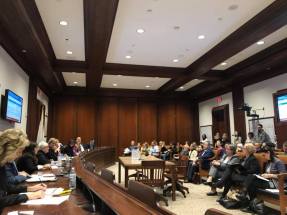
Tuesday’s hearing on sexual abuse in the DDS system. The committee members asked no questions of COFAR’s panel.
COFAR President Thomas Frain, Vice President Anna Eves, and COFAR member Richard Buckley also offered recommendations to the committee, including establishing a registry of caregivers found to have committed abuse of disabled persons, and potentially giving local police and district attorneys the sole authority to investigate and prosecute cases of abuse and neglect.
The hearing drew some mainstream media coverage (here and here); but, while COFAR had alerted media outlets around the state to the hearing, most of the state’s media outlets, including The Boston Globe, did not cover it.
Committee asks no questions
Following the hearing, Frain said he was glad to get the opportunity to testify, but frustrated that the members of the committee seemed to lack interest in what he and COFAR’s other panel members had to say.
“It crossed my mind, were the committee members told not to ask any questions?” Frain said. “How divorced and disengaged is the Legislature that they can hear this testimony and not even have a follow-up question about an agency they’ve voted to fund?”
The hearing was the second since January involving testimony invited by the Children and Families Committee on the Department of Developmental Services system. The general public was allowed to attend, but not permitted to testify publicly before the committee in either hearing. The committee has given no information regarding the scope of its review of DDS.
COFAR has continued to ask for information from the committee as to the full scope of its review, and whether the committee intends to produce a report at the end of that review.
COFAR panel describes abuse and neglect
On Tuesday, Richard Buckley testified about his 17-year quest for answers to his and his family’s questions about his brother’s death in a group home in West Peabody in 2001. Buckley’s developmentally disabled brother, David, had previously been sexually abused in a group home in Hamilton, and was ultimately fatally injured in the group home in West Peabody.
David Buckley received second and third degree burns to his buttocks, legs, and genital area while being showered by staff in the West Peabody residence run by the Department of Developmental Services. The temperature of the water in the residence was later measured at over 160 degrees.
David died from complications from the burns some 12 days later, yet no one was ever charged criminally in the case, and the DDS (then Department of Mental Retardation) report on the incident did not substantiate any allegations of abuse or neglect.
Richard Buckley urged the committee to take action to reform the DDS system. “If nothing is done, the next rape, assault or death, will be on you,” he said. “And we will remember that.”
Buckley also read testimony from another COFAR member, Barbara Bradley, whose 53-year-old, intellectually disabled daughter is currently living in a residence with a man who has been paid by a DDS-funded agency to be her personal care attendant. In her testimony, Bradley said the man initiated a sexual relationship with her daughter, and later brought another woman, with whom he also became sexually involved, to live in the same residence.
Anna Eves discussed the near-death of her son, Yianni Baglaneas, in April 2017, after he had aspirated on a piece of cake in a provider-operated group home. The group home staff failed to obtain proper medical care for Yianni for nearly a week after he aspirated. He was finally admitted to a hospital in critical condition and placed on a ventilator for 11 days.
DDS later concluded that seven employees of Yianni’s residential provider were at fault in the matter. Nevertheless, at least two of those employees have continued to work for the provider, Eves said.
“The systems that are in place are not working and we are failing to protect people with intellectual and developmental disabilities in Massachusetts,” Eves testified. “We have to do better.”
Eves urged the committee to support a minimum wage of $15 an hour for direct care workers, more funding for the Disabled Persons Protection Commission, and passage of “Nicky’s Law,” which would establish a registry of caregivers found to have committed abuse or neglect. Such persons would be banned from future employment in DDS-funded facilities.
Eves also noted that licensing reports on DDS residential and day program providers that she reviewed — including the provider operating her son’s group home — did not mention substantiated incidents of abuse or neglect. She said Massachusetts is falling behind a number of other states, which provide that information to families and guardians.
In his testimony, Frain also urged the committee to support more funding for the Disabled Persons Protection Commission, the state’s independent agency for investigating abuse and neglect of disabled adults. Because the agency is so grossly underfunded, he suggested that the committee consider either “fully funding” the agency or “partnering with the local police and district attorneys’ offices and let them investigate” the complaints.
Frain maintained that staffs of corporate providers, in particular, face pressure not to report complaints to the DPPC, and that the agency, in most cases, has to refer most of the complaints it receives to DDS. That is because the DPPC lacks the resources to investigate the complaints on its own.
Moreover, Frain maintained, the current investigative system is cumbersome. It can sometimes take weeks or months before either the DPPC or DDS begins investigating particular complaints, whereas police will show up in minutes and start such investigations immediately.
Frain also contended that “privatization of DDS services has been at the root of many of these problems.”
Other persons and organizations that testified Tuesday included DDS Commissioner Jane Ryder, the Arc of Massachusetts, the Massachusetts Disability Law Center, and the Massachusetts Developmental Disability Council.
COFAR is continuing to urge the Children and Families Committee to hold at least one additional hearing at which all members of the public to testify publicly before the panel. COFAR has also been trying to obtain a clear statement from the committee as to the scope of its ongoing review of the Department of Developmental Services.
For a number of years, COFAR has sought a comprehensive legislative investigation of the DDS-funded group home system, which is subject to continuing reports of abuse, neglect and inadequate financial oversight.
Connecticut has moved ahead of Massachusetts on direct-care worker wages
It apparently took the threat of a major strike, but the Connecticut Legislature passed a bill and the Connecticut governor signed it earlier this year to raise the minimum wage of direct-care workers in that state’s Department of Developmental Services system to $14.75 an hour, starting January 1.
A similar effort fell short last year in Massachusetts when a budget amendment to raise direct-care wages to $15 was killed in a budget conference committee in the Massachusetts Legislature.
While Governor Charlie Baker signed separate legislation in June to raise the minimum wage across the board in Massachusetts to $15, that wage level won’t actually be reached until 2023. The minimum wage will rise to only $12 next year, whereas it will be close to $15 in Connecticut for human services workers as of January 1.
It seems that even though legislators and the administration of Governor Dannel Malloy in Connecticut are equally as tolerant of runaway privatization as they are here in Massachusetts, the Connecticut Legislature and governor have shown a greater recognition that increased privatization has resulted in low wages for direct care human service workers, and that low wages have had a negative impact on services.
In May, after the Connecticut Senate voted overwhelmingly in favor of setting the minimum direct-care wage at $14.75, Malloy made a statement that we have yet to hear Governor Baker make:
“For far too long,” Malloy said, “the people who provide care to our most vulnerable neighbors have been underpaid for their critical work.”
In fairness to Baker, Malloy made that statement only after 2,400 employees of nine corporate provider agencies in Connecticut voted in April to authorize a strike that was set to begin in early May. The workers in Connecticut are represented by the SEIU 1199 New England union.
Clearly hoping to avert that strike, the Malloy administration proposed raising the minimum wage for human services workers to $14.75 an hour and providing a five-percent raise for workers earning more than $14.75 an hour effective January 1.
The Malloy administration’s proposal, which was endorsed by the SEIU union and ultimately signed into law, applies to 19,000 union and non-union caregivers that staff some 170 group homes and other nonprofit agencies that receive Medicaid funding in Connecticut, according to The Connecticut Mirror.
As Connecticut Senate President Pro Tempore Martin Looney noted:
The work (those caregivers) do is among the most important in our state in terms of humanity. If we are to consider ourselves a humane and caring society, at long last we should begin at least to recognize the value of that work.
In Massachusetts, SEIU Local 509 helped organize a five-day strike for a living wage in July at CLASS, Inc., a DDS-funded day program provider based in Lawrence. The workers there were getting paid about $13 an hour and wanted a $1 increase. The company was offering an increase of only 40 cents.
The president of CLASS, meanwhile, was making about $187,500 a year, according to the state’s online UFR database.
In July, workers at CLASS, Inc. reached a settlement with management to raise the workers’ wages by 60 cents an hour. That would still leave the average worker there well below what direct-care workers will be earning in Connecticut.
The Massachusetts strike, moreover, didn’t have the impact on legislators and other policy makers here that the threat of the Connecticut strike apparently did in that state. Thus far, it isn’t apparent that there is any political will in Massachusetts to raise the minimum wage of direct-care workers to Connecticut’s level.
That is concerning because five years is a long time to wait for the minimum wage for direct-care workers to reach $15. Due to inflation alone, that $15 will be worth less to Massachusetts workers in 2023 than it would be if they were to receive it starting this January.
Has the Globe just shown a newfound, if inadvertent, support for the Pacheco Law?
Although we are an advocacy organization that focuses on human services, we have at times waded into the ongoing controversy over the operation of the MBTA in Boston.
The reason for that has to do with a now decades-long debate over privatization of public services and the implications of the Pacheco Law in that regard.
On Sunday, The Boston Globe reiterated its support for the privatization of T functions with an editorial that defended the current contracted operation of the T’s problem-plagued commuter rail system.
As a supporter of privatization, the Globe has, in recent years, been at the forefront of the long-running criticism in political and journalistic arenas of the Pacheco Law. But in calling on Sunday for a cost-benefit analysis prior to any proposed move to bring the T’s commuter-rail system in house, it seems to us that the Globe is also endorsing, if inadvertently, the principles and intent of the law.
The Pacheco Law requires state agencies seeking to privatize existing operations to do a cost-benefit analysis that demonstrates that the cost of privatizing the service would be lower than continuing to do the service in-house, and that the quality of service would be equal or better if it were privatized.
The Pacheco Law, which was enacted in 1993, has been a lightning rod for political criticism and controversy over the years. Much of the state’s political establishment and prominent journalistic institutions have been harshly critical of it.
We have supported the law because we see it as providing a potentially important layer of oversight and analysis in the ongoing privatization of services for the developmentally disabled in Massachusetts.
In a 2011 editorial, the Globe called the Pacheco Law “an affront to common sense,” and charged that it was allowing public employee unions to place their “demands” above “the obligation to run government efficiently.”
But in its editorial on Sunday, the Globe actually put forth an argument that appears, without directly admitting to it, to endorse the precepts of the Pacheco Law. In criticizing calls by Democratic candidates for governor for in-house operation of commuter rail when the current contract with Keolis expires in 2022, the editorial states:
Whoever is in charge in 2022, though, here’s a suggestion: Since in-house management is an idea that refuses to die, [and I would add, so is privatization, for that matter!] the state should ask the T to submit a plan showing what it would entail. If nothing else, that would clarify for the public the costs and benefits, and bring some specifics to what is now little more than a vague applause line for Democrats. (my emphasis and insertion in brackets)
That is exactly what the Pacheco Law calls for when state agencies seek to privatize services. What the Globe is calling for is the same type of cost-benefit analysis, only in reverse — from privatized services to in-house. To me, it actually sounds like a good idea.
The Sunday editorial further states that while the state “can definitely do a better job with commuter rail after its current contract with Keolis expires in 2022…the goal of better service, not adherence to ideological precepts, should guide the next governor.” (my emphasis)
Agreed, and that is also the goal of the Pacheco Law, which is to ensure better service and lower cost rather than privatizing based on ideological precepts.
The editorial contends that:
…the T doesn’t have — and never has had — the in-house ability to operate the commuter lines itself, and dumping the commuter rail system directly into an already overburdened agency risks disruption. It could also raise thorny union issues, probably raising labor costs. And there’s no reason to expect running the commuter rail in-house would result in better service. (my emphasis)
Maybe not, but in-house operation of commuter rail might actually result in cost savings.
We reported in 2015 that the annual cost to the MBTA of contracting for commuter rail services had risen by 99.4 percent since 2000, compared with a 74.9 percent increase in the annual cost of the agency’s in-house bus operations, according to cost information we compiled from public online sources.
Finally, the Globe editorial suggests that rather than bringing management of commuter rail in house, the T should consider offering the next contractor “a longer-term deal, to better align the incentives of the contractor and the state and potentially bring in private-sector money for capital investments.”
I would note here that long-term contracts are not necessarily better deals for the state or consumers. It is difficult if not impossible to project financial risks over long periods of time. As a result, long-term contracts tend to have provisions that protect private contractors from those risks while transferring the risks to the public.
Also, private investments for capital improvements must be repaid by taxpayers and riders, and those deals can be very expensive to the public. Often there is little transparency in the terms and provisions of private investment arrangements in public infrastructure.
All of these are reasons why the Pacheco Law is necessary and important to the continued efficient and effective operation of government. The law provides for an open and detailed analysis and discussion of costs and benefits when public and private services and functions come together.
Direct-care human services workers fight inch by inch for better wages and conditions
Two ongoing cases involving human services workers are illustrative of the challenges those workers face in getting decent wages and working conditions, particularly in privatized facilities funded by the state.
In both cases, the SEIU Local 509 human services union has either represented the workers or has tried to organize them to join the union.
In an interview, Peter MacKinnon, the president of the local, discussed the cases and the implications they have for care throughout the Department of Developmental Services system.
Earlier this month, workers at CLASS, Inc., a DDS-funded day program provider based in Lawrence, engaged in a five-day strike at the facility for a living wage.
MacKinnon said that although the CLASS strike ended on July 13, the contract dispute had not been resolved. The workers there are getting paid about $13 an hour and wanted a $1 increase. The company is only offering an increase of only 40 cents.
The president of CLASS made about $187,500 a year in Fiscal Year 2017, according to the state’s online UFR database. The CFO made $132,900 that year.
Last month Gov. Baker signed a bill into law that would establish a $15 an hour living wage as of 2023.
In a second ongoing case, the National Labor Relations Board filed a complaint against Triangle, Inc., another DDS day program provider, over allegations that the provider had fired some of its workers for trying to organize a vote to join the SEIU.
MacKinnon said that Malden-based Triangle recently agreed to a settlement of that case under which the fired workers will be either reinstated or provided with financial compensation, and a vote to unionize will be held early next month. He said the union is satisfied with the settlement.
We published a blog post in March noting that Triangle had received $10.2 million in revenue in Fiscal 2017, including $6.9 million in funding from DDS, according to the state’s online UFR database. Coleman Nee, the Triangle CEO, was listed on the UFR database as having received $223,570 in total compensation in Fiscal 2017. That may not have covered an entire year with the agency.
That year’s tax filing listed six executives as making over $100,000 at Triangle.
MacKinnon noted that human services workers:
…do some of the hardest work in the human service field, and these are folks who are getting paid the least…When you have pay that low and work that difficult, it causes difficulties in retaining and recruiting staff.
Both COFAR and the SEIU have reported on the huge disparity in pay received by provider executives and direct-care workers in the DDS system. We reported in 2012 that workers for DDS-funded providers had seen their wages stagnate and even decline in recent years while the executives running the corporate agencies employing those workers were getting double-digit increases in their compensation.
In January 2015, a larger COFAR survey of some 300 state-funded providers’ nonprofit federal tax forms found that more than 600 executives employed by those companies received some $100 million per year in salaries and other compensation. By COFAR’s calculations, state taxpayers were on the hook each year for up to $85 million of that total compensation.
Nevertheless, much of the mainstream media still does not appear to understand this dynamic. The Lawrence Eagle Tribune quoted a spokesperson for CLASS, Inc. three days after the CLASS, Inc. strike began as saying the state had reduced rates to the providers to pay workers.
In fact, as the SEIU has reported, a 2008 law known as Chapter 257 enabled human services providers in the state to garner some $51 million in net or surplus revenues (over expenses) in Fiscal 2016. Yet, while raising wages of direct-care workers was a key goal of Chapter 257, those workers were still struggling to earn a living wage” of $15 per hour as of 2016, according to the SEIU.
The SEIU report, which got minimal news coverage, noted that Chapter 257 helped boost total compensation for CEOs of the corporate providers by 26 percent, to an annual average of $239,500.
The struggle to make headway in bringing about better pay and conditions for human services workers is a painstaking one. “If you want to attract and retain qualified experts in direct care, you need education, training, and in some cases advanced degrees, so you have to compensate these people fairly,” MacKinnon noted. “The old adage that a bad boss is the best organizer really holds true.”
MacKinnon said Local 509 now represents about 6,700 human services workers in Massachusetts working for about 40 providers of DDS and the departments of Mental Health, Children and Families, and Elder Affairs. That’s a good number, but still only a small fraction of the providers out there.
Next month, we’re scheduled to meet with state Senator Joan Lovely, the Senate chair of the Legislature’s Children, Families, and Persons with Disabilities Committee. Among the messages we hope to convey in the meeting are that the Legislature needs to get involved in helping fight for better pay and conditions for those caring for some of the most vulnerable members of our society.
Channel 5 uncovers tip of the DDS system iceberg
A Channel 5 investigative report earlier this week disclosed that group homes and other providers of services to the developmentally disabled are often not informed about substantiated abuse allegations against individuals they hire as caregivers.
The TV news report also made the important point that abusers of disabled persons in Massachusetts are rarely prosecuted for those crimes.
In no way are we criticizing Channel 5 in saying they have uncovered the tip of an iceberg with their findings. Their report revealed more to the public about the Department of Developmental Services system than the rest of the media in the state and most state and legislative investigative authorities have revealed in recent years.
At the same time, it is important to keep in mind that abuse and neglect are only the most outward and visible signs of an overall breakdown in DDS’s largely privatized system.
It is a system that is not adequately monitored by DDS, that underpays and provides inadequate training to direct-care staff, and that overpays a padded layer of corporate provider executives. Moreover, when family members and guardians attempt to question the care and conditions in the system, they are ignored, or worse, intimidated and subjected to retaliation by both the providers and DDS.
One of those family members who has suffered apparent retaliation is Susan Fernstrom, who we just wrote about last week. Susan was banned by her daughter’s provider agency from entering her daughter’s group home after she raised concerns about poor care and conditions in the residence. The provider then sought to evict Susan’s daughter from the home.
In cases in which family members do not have guardianship rights, those persons can find themselves restricted from all contact with their loved ones, apparently indefinitely.
In the past several months, we have tried to make the Legislature’s Children, Families, and Person’s with Disabilities Committee aware of these interrelated issues. In January, the Committee did hold a brief hearing on DDS; but, as we have noted, family members and other members of the public were not allowed to speak before the panel.
We continue to hope that the Children and Families Committee will show that it is taking this situation seriously. If the Committee were serious, it would get behind legislative reforms.
One of the first pieces of legislation that we think needs to be enacted is the guardian rights bill (H. 887), which has been stuck in the Judiciary Committee, effectively since 1999. The bill would require that probate judges presume that parents of developmentally disabled individuals are the proper guardians for them. That bill, if it ever passed, would give basic rights to family members that are not currently extended to them.
We think that proposed legislation to impose fines on providers that provide substandard care or that otherwise fail to adequately respond to instances of abuse could follow from that.
The Channel 5 report discussed the need for an additional piece of legislation (S. 2213), which would establish a registry containing the names of individuals who have had abuse or neglect allegations substantiated against them by the Disabled Persons Protection Commission or other agencies that investigate those issues.
As Channel 5 noted, persons applying for caregiver positions in the DDS system currently must undergo criminal background checks, which disclose previous convictions for abuse and other crimes in Massachusetts and other states.
However, even when abuse against persons with developmental disabilities is substantiated by agencies such as the DPPC, it does not usually result in criminal charges. As a result, those findings of substantiated abuse are not made known to providers or other agencies seeking to hire caregivers. That’s why an abuse registry is needed in Massachusetts.
We would note that such a registry needs to be designed to take into account the larger issue of the dysfunctionality of the system. Most if not all abuse occurs because upper management in both provider agencies and DDS itself doesn’t care enough about the problem to ensure that staff are properly trained and supervised.
Until executives within provider agencies are held accountable for the abuse that occurs by low-level agency employees, those low-level employees will simply continue to be replaced by other equally bad personnel.
One other thing to keep in mind is that even though the DPPC does have a backlog of abuse investigations, as the Channel 5 report pointed out, the Commission refers the vast majority of its complaints to DDS for investigation. This creates a conflict of interest for DDS, which is also supposed to be overseeing the same providers that it is now investigating.
We think the DPPC needs to be given the resources necessary to allow it to serve as a truly comprehensive and independent investigatory agency. The DPPC also needs to make its investigative process more transparent and, in that vein, make its reports available to the public.
The Channel 5 report this week demonstrates that at least one media outlet in the state recognizes that there is a serious problem with the oversight of care for a large segment of the disabled population in Massachusetts. We hope the report serves to wake up the rest of the media, the Legislature, and the Baker administration to this problem.
Advocating for her daughter’s care got a woman banned from DDS-funded group home; and her daughter got an eviction notice
When Susan Fernstrom got her developmentally disabled daughter, Holly Harrison, into a group home in Danvers in June of 2015, she thought it would lessen some of the growing burden on her of caring for members of her family.
Susan’s husband, Patrick, was terminally ill with a brain tumor and needed his own intensive care. He died in December of that year.
Holly, who is now 39, had been born with Galactosemia, a rare genetic disorder, that causes intellectual disability and other complications, including coordination issues, and requires a controlled diet.
The group home is run by Toward Independent Living and Learning, Inc. (TILL), a corporate, nonprofit provider funded by the Department of Developmental Services. The residence was brand new and beautiful, and centrally located in the downtown in Danvers, near the mall.
But almost immediately, Susan became concerned when she realized there were no meal plans for any of the five women in the house. Two of the women are diabetics, and, like Holly, require special diets.

Susan Fernstrom and her late husband, Patrick. They arranged for their daughter, Holly’s, admission to the TILL-operated group home six months before Patrick died.
Beyond that, Holly wasn’t getting fed regularly. She was not fed or given water for up to nine hours at a time, Susan said. On many occasions, the staff forgot to give her lunch, particularly on weekends. In one instance, Holly was given a sandwich by the staff to eat that contained uncooked bacon.
The home wasn’t kept clean. There was clutter left outside Holly’s bedroom door and mold on the bathroom shower curtain and on the floor of the shower. “The bathroom was often filthy,” Susan said. “The staff would clean it when they knew investigators were coming, mostly due to complaints from me,” she said. Raw meat was often left in the sink.
In addition to the mold and clutter, it took months to hook up a shower curtain rod to the bathroom wall.
There was only one working light in the basement even though that was an area set aside for storage of extra clothing for Holly, which Susan frequently had to retrieve. Also, there was furniture and a large carpet roll placed in way of the clothing bins.
But when Susan raised these issues, she never anticipated the push-back she would receive, not only from the staff, but from Dafna Krouk-Gordon, the president of TILL. As of last August, Susan found herself banned under a written directive from TILL from entering the group home and therefore from being able to check directly on the care there.
We believe that ban violates DDS regulations, which give DDS clients the right to receive visitors, and which specifically state that family members and guardians shall be permitted private visits “to the maximum extent possible.”
The regulations add that clients and their family members and guardians must be allowed to meet “under circumstances that are conducive to friendships and relationships,” and that the location must be suitable “to confer on a confidential basis.”
However, under the ban imposed by TILL, Susan has been required to wait outside the house to meet with Holly, even in the dead of winter. She said the situation has made her feel “humiliated and like a criminal.”
Then, on March 20, Krouk-Gordon notified Susan in writing that her daughter would have to move out of the residence as of the end of April. The written notice did not accuse Susan or Holly of causing any disruption in the operation of the residence, but rather stated that Holly must move because the group home could not accommodate her need for assistance during nighttime fire drills.
Susan believes the real reason for the eviction notice was that she had raised issues of inadequate care and poor conditions in the residence.
We believe the eviction notice violates additional DDS regulations, which require a 45-day notice and the guardian’s consent to any move.
“I feel sick all the time and can’t sleep or eat,” Susan said.
I attempted to contact Krouk-Gordon both by telephone and by email. My email message, which I had sent on April 16 to her email address listed on the TILL website, was blocked. I then resent my query to other officials at TILL, but to date, no one has responded to it.
Throughout the ordeal, Susan said she has felt a lack of support from DDS officials whom she believes have allied themselves with Krouk-Gordon. She contends that rather than addressing her concerns, Kelly Lawless, DDS northeast regional director, has appeared to support Krouk-Gordon’s intention of evicting Holly from the residence.
Susan said that Holly has a strong emotional attachment to the other women in the group home, and that she does not feel, as her guardian, that it would be in Holly’s best interest to be moved to a place she is not familiar with and in which many of the same problems might reappear. What she would like to see happen is strong pressure put on TILL by DDS to fix the problems in Holly’s current residence.
We have heard of no evidence that Susan ever acted in a disruptive way either inside the home or in any other location. It appears that the only reason for TILL’s prohibition against her from entering the home and subsequent notice of eviction of Holly is that Susan has pointed out deficiencies in the care and conditions in the residence on a number of occasions.
Susan said she has both met and had a conference call with DDS Commissioner Jane Ryder, and that Ryder seemed sympathetic, particularly to her concern about being banned from the residence and Holly’s potential eviction. She said Ryder assured her early this month that she would issue a directive to Lawless “to work on these issues,” and that the directive would address the ban on entering the residence.
However, Susan said that in a subsequent phone conversation she had with Lawless, Lawless told her that she wanted only to discuss moving Holly out of the residence, and referred several times to Susan’s relationship with TILL management and staff as “broken.”
Susan said that at one point in that conversation, Lawless stated that an alternative residence for Holly had been located in Gloucester. Susan told her that as Holly’s guardian, she wanted to live close to her and that the Gloucester location was more than an hour away.
But Susan said Lawless not only appeared unsympathetic to her concern, she admonished her for voicing it, saying she was “‘appalled that this is all about you, Susan, not wanting to drive.'” Susan responded that it was not about her, but about her need, as Holly’s guardian, to be near Holly.
Last Tuesday (April 17), I emailed Ryder, asking if she would respond to those and other concerns and questions we have raised about this case. To date, I’ve received no response from Ryder.
On Wednesday, April 18, the day after my email to Ryder, Susan received an email from Lawless in which Lawless stated that in response to concerns Susan had raised about the TILL residence, Lawless and other DDS officials have directed DDS’s human rights officer “to make an unannounced visits (sic) to the house, and asked the Area Office to increase their visits to the house.”
Lawless said she and other DDS officials have “also asked our Office of Quality Management to conduct a review of the home to determine whether conditions in the home meet DDS quality standards.”
In a response to Lawless, Susan said she was pleased to hear about the planned visits and review by DDS. But she told Lawless she remained concerned that many of the issues she has raised, such as the staff’s failures to feed Holly adequately and regularly provide water to her, may not be observed by the inspectors.
In her email, Lawless appeared to walk back Krouk-Gordon’s eviction notice, at least partially. Her email stated that, “as I previously reported, DDS staff have worked with TILL and there is no plan to discontinue Holly’s services with TILL as of April 30, 2018.”
But Krouk-Gordon has not rescinded the March 20 eviction notice to Susan, and Lawless’s email made no mention of that notice. Lawless’s message also appeared to imply that DDS is continuing to push for Holly’s ultimate removal from the home. Lawless stated that, “I encourage you to work with DDS and TILL on coming to an agreement as to how appropriate services can be provided to Holly going forward, including exploring other options available, such as the Gloucester residence.”
Lawless’s email also appeared to suggest that even further restrictions on Susan’s access to Holly in the TILL residence might be imposed. While acknowledging that Susan has “concerns” regarding “the current guidelines in place around your visitation with Holly,” Lawless stated that she had reviewed the TILL directive banning Susan from the residence and had determined that the directive was “reasonable and compliant with DDS regulations concerning visitation.”
Lawless’s email, however, did not mention that the directive from TILL prohibits Susan from entering the home (see details of the directive below). Lawless described the directive as simply requiring “coordination and notice of any visits to the home and that the scheduled visits are to be at a mutually agreeable time.”
Lawless then indicated that she would seek to enact restrictions on visitation times for Susan. “I would like to suggest establishing a set time each week for the visits,” Lawless stated. “Having a set time, or times, each week will minimize the challenges around scheduling and allow for consistent visits with Holly. I’m happy to coordinate with TILL a standing schedule if you would send me your preferred days and times.”
Lawless’s email did not state that Susan would be allowed inside the residence during those visits.
Visitation ban appears to violate DDS regulations
The written directive banning Susan from entering Holly’s residence was presented to Susan following a meeting she had with the group home staff last August 11. The directive was headed “Ash Street (group home) Family Communication Guidelines.”
While labeled “guidelines,” the document’s provisions were presented as binding policy on Susan. Among the statements in the directive were the following:
- You (Susan) will not go into the residence to bring items to Holly’s bedroom or go into the kitchen. Anything you need to deliver to the residence must be given to the staff or the manager and they will see that it is properly put away.
- We ask that you not go inside the home unless there is a planned event or meeting that has already been established with the manager ahead of time.
- Susan and the Residence Manager will communicate by telephone once per week at a time that is mutually agreed upon.
- It is essential that you speak to the manager rather than speaking to staff directly. Only the manager can make house plans and follow through with scheduling needs.
- All supervision of Holly’s diet will be handled by the residence LPN and Nutritionist. All changes to the menu and/or grocery list will be made through the nutritionist and LPN for the house. (The LPN never has had anything to do with Holly’s diet, Susan said.)
- We ask that you only communicate with the nutritionist by email given that the time is limited and she receives multiple calls daily from the house as needed.
Since receiving the directive, Susan said she has been banned even from waiting for Holly in the foyer of the house, and must stand outside, even in the winter. In addition, the weekly phone calls with the house manager have been canceled, she said. And she has been told not to contact the nutritionist at all.
As Holly’s guardian, it is Susan’s legal duty to oversee her care and advocate in her best interest. Blocking her from having contact with her daughter inside her residence impedes her ability to carry out her legal duties as guardian.
Also, contrary to Lawless’s contention, we believe the ban on entering the group home violates DDS regulations governing the rights of DDS clients, which include “the right to be visited and to visit others under circumstances that are conducive to friendships and relationships…”
The DDS regulations further state that a DDS client’s guardian or family members “shall be permitted to visit at all times, unless the individual objects, and shall be provided with a suitable place to confer on a confidential basis…” (My emphasis)
The same DDS regulations state that:
Reasonable restrictions may be placed on the time and place of the visit in order to protect the welfare of the individual or the privacy of other individuals and to avoid serious disruptions in the normal functioning of the provider. Arrangements shall be made for private visitation to the maximum extent possible. (my emphasis)
Susan said she thinks the real reason for the draconian restrictions placed on her is that TILL’s management is “trying to keep me from knowing anything about what is going on in the home.”
Susan said she was told that her presence in the residence was making residents uncomfortable, but Susan doesn’t believe that is the case. “That’s a lie,” she said. “The other girls (in the house) gave me hugs and asked how I am. I would make them omelets, and I showed staff how to make fresh fish. Of course, I’m not allowed to do any of that anymore.”
Susan added that she personally purchased needed cooking equipment for the entire house, and brought the residents and staff fresh corn on the cob, strawberries and apples from a farm over the summer.
In other cases that we have investigated, we have found that the statement that a family member was making residents uncomfortable was often used as an excuse for restricting their access to persons living in provider residences.
Susan said that the directive banning her from the residence appeared to follow directly from checks she had been doing under an agreement with the staff of the cabinets and the refrigerator in the kitchen “to make sure the food they were buying for Holly was dairy free.” After doing the checks “for about three weeks and informing the staff that there was dairy in multiple food products, including food bought specifically for Holly,” Susan said she received the directive denying her access to the kitchen and entire house.
With regard to the requirement that she communicate directly with the house manager, Susan said she usually attempted to phone or email the house manager, particularly in instances in which Holly had missed appointments, but her emails were often not answered and the manager’s voicemail was often full. She said she once talked to the house staff during a weekend visit because she found that no lunch had been given to Holly that day. “Our conversation was very polite,” she said. “There is no one you can reach in management on weekends. My daughter needed to eat.”
The ban on allowing her into the house has made it particularly difficult to get Holly ready for outings and trips home, Susan said. The staff would frequently forget to pack needed items such as underwear, pants, pajamas, and medication.
Recently, despite the visitation ban, Susan said she requested to be allowed into the basement to see what clothing Holly now has. “ I haven’t been allowed in so long I can’t remember,” she wrote in an email to us. “I know Holly is missing things and I know the staff doesn’t know everything she has. Do I sound frustrated?”
In her email response to Lawless’s April 18 message, Susan stated that:
I want the ability to visit Holly on any day of the week or (at any) time as long as it is not disrupting the functioning of the home, and set visitation times will not allow that flexibility nor does that allow for visitation to the maximum amount extent possible.
My daughter is not in a prison, this is her home and Holly has the right to visit with friends and family as the regulations clearly state. I also want the ability to sit in the living room with Holly or if we choose or walk into the kitchen with her as any other house guest would do and as other family members are permitted to do.
When I drop Holly off after a visit outside the home I want to walk inside the front door and stand in the foyer area, as any other parents are allowed to do. I think it’s also important to note that as Holly’s guardian, I have a legal duty to see Holly’s living conditions to ensure her wellbeing.
One-hour visit allowed in April
Susan said that on April 1, she was given permission to enter the residence for an hour because she needed to help pack Holly’s clothes for a trip to Florida. After being given a time for the visit that she couldn’t meet, she finally won approval for one hour on that Sunday.
Susan said she pushed back and said she needed two hours because Holly needed to try on clothes to see what fit. She also needed to check to make sure Holly’s medication was correct.
Susan said that when she arrived that Easter Sunday at the residence, Krouk-Gordon arrived as well, and then spent some of her time right outside Holly’s room. Susan said Krouk-Gordon’s close presence made her feel uncomfortable and that she believes it was meant to intimidate her.
Eviction notice cites a fire drill policy that does not comply with regulations
Krouk-Gordon’s notice to Susan that Holly must leave the residence as of April 30 did not include any allegations that either Holly or Susan had acted in a disruptive manner. Instead, the March 20 eviction letter stated that Holly must leave because the home could not accommodate her need for assistance during nighttime fire drills at the residence.
Susan said that Holly needs assistance because her blood pressure drops significantly if she is woken up suddenly. As a result, she can suddenly faint and fall unless she is given water immediately after waking up.
Last November, Holly did fall after having been suddenly woken by the fire alarm, which had signaled a middle-of-the-night fire drill. She suffered a concussion and a black eye in the fall.
Susan said the staff made Holly finish the drill immediately after she regained consciousness, and did not take her to the emergency room. The incident and injury were not reported by the staff to the Disabled Persons Protection Commission, as required by law. And Susan wasn’t notified about the injury until mid-morning the following day.
Susan contends that the danger posed by the fire drills could be solved either by adding a staff member to the group home at night to assist Holly, or by moving her bedroom to a currently empty room on the first floor in which she would have time to quickly drink a small bottle of water and still be able to exit with assistance within the required 2½ minutes. The front door to the residence is right outside that downstairs room.
Susan said, however, that neither TILL nor DDS have expressed support for her suggestions.
In failing to alter the existing fire drill policy, DDS and TILL would appear to be in violation of DDS regulations, which state that “providers of group homes “shall assure that …strategies are developed for meeting the specific and unique safety needs of each individual” (my emphasis).
In addition, the regulations state that “for sites where residential supports…are provided, safe evacuation is defined as assuring that all individuals can get out of the home in 2½ minutes, with or without assistance...” (my emphasis).
The implications of the regulations in this regard seem clear and unambiguous to us. The provider management cannot legally evict a resident because the home is not able to serve that resident in compliance with the regulations. The management instead needs to take steps to comply with the regulations.
Eviction notice did not comply with DDS transfer regulations
It also appears to us that Krouk-Gordon’s March 20 letter notifying Susan of Holly’s pending eviction did not comply with DDS transfer regulations, which require that Susan be provided with an official 45-day notice of a proposed transfer out of the group home.
Under the regulations, the written notice must include a statement explaining how the proposed move would result in improved services and supports and quality of life for Holly. The notice must also specify the location of the proposed home, include a statement that the parties may visit and examine the proposed home, and must further include a request for consent by Susan, as Holly’s guardian, to the proposed transfer.
None of those statements was included in the March 20 letter. As such, the letter does not, in our view, constitute a legal notice under the regulations to Susan of a pending transfer from the residence.
TILL never committed to addressing nutrition issues
Susan said that despite her efforts to work with TILL and with DDS to address the nutrition issues in the residence, TILL staff and management have not shown a consistent willingness to work with her.
Susan said that while the staff initially voiced agreement with her requests to improve Holly’s nutritional regimen, there was no follow-through. She personally developed recipes, grocery lists, and menus for all the residents covering six-periods. Yet, the items were often not purchased, and the recipes were not followed.
The group home at first agreed to allow a DDS nurse to work with Susan to put menus together. But then TILL management suddenly objected, and the nurse was taken off the project. “TILL didn’t like that she was doing the menus,” Susan said.
DDS then assigned a nutritionist to work with Holly, but the nutritionist’s approved hours were limited. Even with the system of checks that Susan and the nutritionist provided, the staff on more than one occasion bought a type of cheese for Holly that is strictly prohibited from her diet. “They weren’t following the recipes,” Susan said.
Susan said the staff recently took Holly to her primary care doctor for an exam, but had given her nothing to eat or drink that day. The doctor was so concerned, she recorded it in Holly’s medical record.
In another incident, the group home staff gave Holly a sandwich for lunch that included raw bacon. The manager at her work site, which is operated by The Northeast Arc, was so concerned, she wrote up a report of neglect, Susan said.
The September 5, 2017, report, which was provided to Susan by the work site, stated that, “During lunch, Holly had a BLT sandwich and she pulled the bacon from it ‘to save the best for last,’ and we noticed that it was raw.” The worksite staffer who wrote the report stated that the worksite staff cooked the bacon in a microwave and monitored Holly for illness. Other than notifying Susan and the group home manager, the worksite took no further action in the matter.
Susan noted that she has been told that the families of the other residents in the group home are largely happy with the care there. But that may be, she said, because the other residents are higher functioning than Holly. The parents of one of the residents lives out of state, while another resident was working toward getting her driver’s license. Another resident is capable of using Boston’s MBTA system.
Unfortunately, this is the kind of case we hear about all too often. As we have said many times, the DDS group home system is broken. It is long overdue that the Legislature and its Joint Children, Families, and Persons with Disabilities Committee begin to address these issues.
In January, the Children and Families Committee held a hearing in which committee members gently queried Ryder about reports of widespread abuse and neglect in the DDS system. A large group of families and guardians attended the hearing, but none of those people were allowed to testify publicly.
We have to wonder what it will take to bring about needed action in this and so many similar cases.
Alleged union bashing by CEO of DDS provider confirms the plan is keep direct-care wages low
We hope a federal investigation of Triangle, Inc., a corporate provider to the Department of Developmental Services for alleged anti-union activity brings public attention to the potential for privatization of DDS programs to result in low pay for provider staff and poor care.
In our view, the alleged efforts by Malden-based Triangle’s management to block staff from unionizing imply an implicit acknowledgement by the management that it wants to keep direct-care wages low. Low wages, in turn, result in lower-quality care.
In preventing their workers from organizing, providers like Triangle appear to be pitting themselves against the growing movement in Massachusetts for a $15 living wage for workers.
The Boston Globe reported earlier this month that the National Labor Relations Board has issued a formal complaint against Triangle after at least three former employees of the provider were allegedly fired for helping organize the agency’s staff to unionize with SEIU Local 509. The union represents both state workers and staff of state-funded providers to agencies such as DDS.
Triangle’s chief executive, Coleman Nee, allegedly stated that anyone in the agency who even voiced support for the union could be fired. Nee is a former Cabinet secretary under then Governor Deval Patrick.
The relatively low level of pay and benefits to direct-care staff in human services has been a long-standing issue in Massachusetts and elsewhere around the country.
“Nonprofit DDS providers do not want to pay a living wage to their direct care workers because their CEOs are keeping the money for themselves,” COFAR Executive Director Colleen Lutkevich wrote in a comment on the Globe site. “It can only benefit people with developmental disabilities if unions help these workers to earn more money. The management is a disgrace and it’s not the people they serve that benefit, it is their own pocketbooks.”
COFAR and SEIU Local 509 have tracked both corporate provider executive and direct-care compensation in recent years. Last May, the SEIU released a report charging that major increases in state funding to corporate human services providers during the previous six years had boosted the providers’ CEO pay to an average of $239,500, but that direct-care workers were not getting a proportionate share of that additional funding.
As of Fiscal 2016, direct-care workers employed by the providers were paid an average of only $13.60 an hour, according to the SEIU report.
The SEIU further noted that the increases in funding to the providers, known as “Chapter 257” rate setting reforms, had actually allowed the providers to earn $51.8 million in net or surplus revenues (over expenses) in Fiscal 2016. As the report stated, those surplus revenues would have more than covered the estimated $34 million cost of boosting all direct-care workers’ wages to $15 per hour.
Based on that report, state Senator Jamie Eldridge filed a budget amendment last year to require human services providers in Massachusetts to spend some of their surplus revenues on raising direct-care wages to $15 per hour. The measure was rejected, however, by a House-Senate conference committee on the budget.
It was not clear whether Eldridge intends to refile his amendment this spring. The SEIU as well has turned its attention away from that proposal and toward proposed legislation and a proposed ballot question in November that would raise the minimum wage for all workers in Massachusetts to $15 per hour.
While we support the legislation and ballot question aimed at all workers, we would also hope that Eldridge’s amendment would be reintroduced given that the funding apparently already exists to fully fund a $15 per hour living wage for human services workers.
Privatized human services reflect larger inequities
The privatized human services system in Massachusetts, in fact, reflects income inequities and other problems with privatized services in other areas of the economy.
As state funding has been boosted to corporate providers serving DDS and other human services departments, a bureaucracy of executive-level personnel has arisen in those provider agencies. That executive bureaucracy appears to be suppressing wages of front-line, direct-care workers and is at least partly responsible for the rapidly rising cost of the human services budget.
Ironically, a key reason for a continuing effort by the administration and Legislature to privatize human services has been to save money. However, we think that privatization is actually having the opposite effect.
Triangle executives are lavishly compensated
Triangle Inc. appears to be a microcosm of the human services system in Massachusetts, and to reflect many of its problems.
The Globe reported that Triangle had some 3,900 people enrolled in various programs and services during Fiscal 2017. The agency received $10.2 million in revenue in Fiscal 2017, including $6.9 million in funding from DDS, according to the state’s online UFR database.
Coleman Nee, the Triangle CEO, is listed on the UFR database as having received $223,570 in total compensation in Fiscal 2017. That may not cover an entire year with the agency.
It appears Nee started with Triangle sometime in 2016. Prior to him, the CEO was Michael Rodrigues, who made $257,442, according to IRS Form 990 for Fiscal 2016. That year’s Form 990 lists six executives, including Rodrigues, as making over $100,000 at Triangle.
It is unconsionable that executives of nonprofit agencies who are making six-figure incomes paid for with state funds are engaging in efforts to supress the pay of their direct-care employees. The fig leaf offered by a nonprofit moniker does not protect those executives from either charges or the appearance of profiting inappropriately off the taxpayers.
Its’s time for the Legislature to take steps to reform the DDS system, starting with a concrete action to raise direct-care wages.
Children and Families Committee needs to show it’s serious about investigating the DDS group home system
At the start of a legislative hearing last week on the Department of Developmental Services, state Representative Kay Khan made what seemed to be a major announcement about a new federal report on problems in group home care in Massachusetts and two other New England states.
Khan, who is House chair of the Children, Families and Persons with Disabilities Committee, said the committee will be guided by the report in whatever review or investigation her panel undertakes of the DDS system in Massachusetts.
But if that’s the case, it doesn’t look as though the Children and Families Committee will be doing much of an investigation because there wasn’t much in the report, which was issued by the Inspector General for the federal Department of Health and Human Services.
I first developed the pessimistic assessment that the committee wasn’t going to do much of an investigation after listening to an hour of listless questioning by Khan and other legislators of the heads of DDS and the Disabled Persons Protection Commission during last Wednesday’s hearing. Reading through the HHS IG’s report only strengthened that assessment.
The committee scheduled last week’s hearing in the wake of a case last year in which Yianni Baglaneas, a young man with Down Syndrome, nearly died in a DDS-funded group home after aspirating on a piece of cake.
Although the committee hearing room last week was filled with family members of DDS clients, including Yianni’s mother, Anna Eves, those family members were not permitted to testify verbally. The Children and Families Committee wanted to hear only from Acting DDS Commissioner Jane Ryder and from Nancy Alterio, executive director of the DPPC, an agency charged with investigating abuse and neglect of disabled persons.
We hope the committee gets more serious about this investigation. We have submitted written testimony (here and here) to the panel and have read the written testimony from Anna and from many other family members and guardians who detailed harrowing experiences in a dysfunctional system.
During last week’s hearing, Ryder, in particular, painted a rosy picture of DDS’s role in managing and overseeing the group-home system. None of the Children and Families Committee members challenged Ryder’s assertions or asked any particularly probing questions of her.

Senator Joan Lovely, Senate chair of the Children and Families Committee, talks following last week’s committee hearing with Michael Horn, the father of Alexa, who suffered unexplained injuries while living in a group home. At left is Anna Eves, the mother of Yianni Baglaneas, who nearly died in his group home after aspirating on a piece of cake. Neither Eves nor Horn were allowed to testify verbally before the committee about those cases.
We have been calling for years for a comprehensive legislative review of the system of care for persons with developmental disabilities in Massachusetts. The last such review was done in the late 1990s by the House Post Audit and Oversight Committee, which found problems of abuse, neglect, and financial irregularities throughout the system.
When I first glanced through the latest federal IG report, I thought that agency had finally produced a report on the level of that Post Audit Committee report in Massachusetts. The IG report looked comprehensive. But I was admittedly seduced by the color and graphics. After actually reading the report, my assessment of it changed.
First, it turns out the findings in the IG’s report about failures to report abuse and neglect incidents in Massachusetts were simply repeated from an earlier report issued by the IG in July 2016.
That previous report found that abuse and neglect incidents in Massachusetts were not being reported regularly to investigators. But that report was limited to that single issue about incident reporting. The IG had also previously issued a similar report about Connecticut.
Moreover, the new material in the latest IG’s report consists of a series of vague recommendations that don’t seem to fully address a request in 2013 by U.S. Senator Chris Murphy of Connecticut for a major investigation into abuse and neglect in privatized group homes throughout the country.
Sen. Murphy’s letter in 2013 to the IG concluded by stating:
Privatization of care may mean lower costs but without the proper oversight and requirements for well-trained staff. While individuals with developmental disabilities may not be able to speak for themselves, we are not absolved of the responsibility to care for them in a humane and fair manner. … Again, I respectfully request that you conduct an investigation into this issue. I believe that it would be able to shed light on the trend towards privatization and the impact that has on the care of the individuals. (my emphasis)
The IG’s report, however, doesn’t appear to address issues related to privatization such as low wages paid to direct-care staff, high turnover, denial of family rights to visitation, violations of federal law requiring that DDS provide state-run services and other care options to persons desiring them; or violations of federal law stating that families are the key decision-makers in the care of the intellectually disabled.
There is no reference anywhere in the IG’s report to problems accompanying the increasing privatization of services or to the resulting elimination of state-run programs, or the resulting lack of meaningful activities for participants in day programs, or the excess funding of salaries of nonprofit executives. Murphy specifically stated in his letter to the IG that he hoped the IG’s investigation “would be able to shed light on the trend towards privatization and the impact that has had on the care of the individuals.”
One has to wonder if anyone from the IG’s office has read any of a number of media reports in recent years of the deeply troubling problems plaguing group home systems around the country.
Those reports include exposes in 2013 by The New York Times and The Hartford Courant, (here and here) and more recent exposes by papers such as The Chicago Tribune. That latter newspaper reported last year that while officials in Illinois continued to issue rosy accounts of the process of transferring clients from developmental centers being closed in that state to group homes, many of those group homes were “underfunded, understaffed and dangerously unprepared for new arrivals with complex needs.”
We reported that the HHS IG first produced a virtual joke of a report in 2015 on the group home system in New York State. That report had no critical findings and was a total of six pages long.
As noted, at least part of last week’s IG report was a rehash of those previous findings on incident reporting in Massachusetts and Connecticut. The latest report does purport to go further than the previous reports by including “suggestions for ensuring group-home beneficiary health and safety.”
For instance, the latest IG report includes recommendations on “quality assurance mechanisms” for community-based services.
But while those recommendations seem intended to get to the larger issues inherent in care in the provider system, they are still vague. The recommendations are presented in an appendix to the report, but little explanation and few specifics are provided even there.
Under a heading in the appendix on the “quality assurance mechanisms,” the report recommends “person-centered planning.” But there is no explanation provided of person-centered planning, which is an approach being promoted in Massachusetts by DDS. We’ve expressed concerns that person-centered planning has the potential to marginalize families and guardians in helping develop individual support plans or ISPs.
The same appendix in the HHS IG report also calls for audits done by providers that:
- Include assessments of staff training (There are no specifics provided about this.)
- Include assessments of performance evaluation (Again, no specifics.)
An additional category in the appendix is labeled “Assessment of the fiscal integrity of (provider) service billing and reimbursement.” This would appear to be a key recommendation regarding financial integrity, but it consists only of the following two statements, with no specifics or explanation:
- Includes ongoing State desk audits
- Includes periodic on site audits of select service providers and support coordination agencies
Finally, the report states that the federal Centers for Medicare and Medicaid Services should form a “SWAT team” in order to address “serious health and safety findings involving group homes.” But while that sounds impressive and urgent, the report provides no details about what such a SWAT team would consist of or do.
We hope the Children and Families Committee develops an investigative scope that goes well beyond that of the HHS IG. We also think the committee can demonstrate its seriousness by scheduling another hearing in which families would be invited to provide verbal testimony.
Last week, Senator Joan Lovely, the Senate chair of the committee, told some family members that she would speak to Rep. Khan about scheduling that additional hearing. We hope that happens soon.
Families want legislative committee to know the value of places like the Wrentham Developmental Center
As a legislative committee prepares for an oversight hearing Wednesday on the Department of Developmental Services system, several family members of residents of the Wrentham Developmental Center said they hope the committee will recognize the Center’s value and that of facilities like it.
In a COFAR membership meeting on Saturday, family members described harrowing accounts of their experiences in privatized, DDS-funded group homes, and the arduous paths they had to take in order to get their loved ones into either the Wrentham Center or state-run group homes.
Many of those family members, such as Pat and Michael Horn, plan to submit written testimony about those experiences to the Legislature’s Children, Families, and Persons with Disabilities Committee, which has scheduled an oversight hearing on DDS on Wednesday. (As we have noted, the committee announced that family members would not be allowed to testify before the committee in person, but could only submit written testimony.)
“The care here (at Wrentham) is exquisite,” said Pat Horn, whose daughter, Alexa, had suffered broken bones and other unexplained injuries in a corporate provider-run group home before they got her to Wrentham. “We’re so happy here.”

Pat Horn (at right) and her husband, Michael, describe their experience in getting their daughter, Alexa, to the Wrentham Developmental Center. At left is Susan Tucker, a physician, whose brother, Danny, is also a Wrentham Center resident.
COFAR Executive Director Colleen Lutkevich, whose sister, Jean, is a Wrentham Center resident, said the legislators and others may not fully understand the true nature of the problems that afflict the DDS system today.
In recent decades, Lutkevich said, it has been the rapidly growing, privatized group home system that has exhibited serious problems with care and with abuse and neglect. State-run facilities such as the Wrentham Center and an existing network of state-run group homes have been relatively free of those problems.
Yet, the Wrentham Center has been “terribly misrepresented” in the media and by opponents of congregate care, who characterize it as an institution or as a warehouse, Lutkevich said. “What the media and many others don’t understand is that the care today is state of the art at Wrentham and Hogan (the second of the state’s two remaining developmental centers, also known as Intermediate Care Facilities or ICF’s).”
At Saturday’s COFAR meeting, some families expressed concern about rumors that DDS intends to close Wrentham and Hogan through attrition if not sooner. DDS data show that the residential population in each facility has leveled off and begun to drop. And despite the high level of care available in each, most clients waiting for care in the DDS system are not offered placements at either Wrentham or Hogan even if they ask for them.
Families waiting for residential care for loved ones are routinely offered placements only in DDS-funded, privatized group homes. The families are usually not informed even about the state-operated group homes even though those facilities have staff that tend to be better trained and better paid that than direct-care staff in the corporate-run homes.
Lutkevich and COFAR President Thomas Frain, who both attended Saturday’s membership meeting, discussed a DDS document that families waiting for residential care are required to sign, waiving their loved ones’ legal right to care in the state’s two remaining ICFs. Frain and Lutkevich maintain the document is coercive and possibly violates federal Medicaid law, which requires the state to offer all available residential facilities as care options to people who request them.
Frain went through a lengthy battle with DDS to get his brother, Paul, out of a provider-run group home, where he had been badly mistreated, and into a state-operated group home.
Families such as the Horns have been able to get their family members into Wrentham only because those family members were either literally facing life-and-death situations or because they were members of the original class-action lawsuit (Ricci v. Okin) that resulted in major upgrades to the Massachusetts DDS system in the 1980’s.
A disturbing litany of mistreatment
In the Horns’ case, their daughter, Alexa, who has Rett Syndrome, a neurological disorder, had lived at home until she was 16 and a half. At that time, the Horns explored the possibility of getting Alexa into the Fernald Developmental Center, but they were told Fernald was closing.
Pat Horn said they found a special needs residence for Alexa, but she developed a urinary tract infection and a subsequent sepsis infection there. The infections occurred after direct-care staff failed to tell the facility’s nursing staff that Alexa had not eaten or drunk anything for almost 24 hours. Alexa was cared for in the intensive care unit at Boston Children’s Hospital for two weeks and was transferred to Franciscan Children’s Hospital for six weeks of rehabilitation.
When she turned 22, Alexa was placed in a DDS-funded group home near her family home in Watertown in which the care was quite good for a number of years. After five years, however, the residence started to experience a high degree of turnover of house managers, and new direct care staff were hired with little apparent training or qualifications.
Pat said the residence became dirty, clinician appointments were missed, protocols for administering Alexa’s medications and her feeding tube were not followed, and her personal hygiene degraded to the point that she had to be treated for ringworm, a type of fungal infection of the skin, on numerous occasions.
In 2014, Alexa fell out of her shower chair while a staff member was showering her because the staff member had undone her safety belt in order to wash her back. Her injuries required a trip to the emergency room and an MRI. Miraculously, Alexa did not sustain any serious injury in that incident, but she did suffer a significant amount of soft tissue damage to her face and broken blood vessels in her eye.
In another incident, the same caregiver failed to check the rate of the feeding pump when setting up her g-tube feed, and Alexa received 12 hours worth of food in a two-hour period, causing her to vomit and aspirate.
Early 2015, Pat said, she was informed by staff during a weekly Saturday visit that Alexa’s leg had been hurting her since the beginning of that week, but that the house manager had not taken her to be assessed by her doctor. The Horns called the manager on duty that weekend, who finally took Alexa to a hospital emergency room where an x-ray confirmed that Alexa had a fracture of the tibia.
Pat said the DPPC did a three-month investigation of the incident and substantiated a charge of mistreatment, but was unable to determine how the injury had happened. The DDS “action plan” recommended only staff retraining.
During the three-month period in which the family was waiting for the results of the investigation, Alexa suffered a fracture of her upper left arm. That injury was investigated by DDS, which concluded that she had broken her own arm as her medical record showed that she had osteoporosis. The Horns consider it highly improbable that Alexa broke her own arm.
The Horns then arranged to have Alexa sent to the Marquardt skilled nursing facility at the former Fernald Center rather than to have her discharged back to the group home.
A few weeks later, Pat said, she and Michael met with the DDS area director, Alexa’s DDS service coordinator, and administrators from the group home provider during which the Horns recounted six months worth of mistreatment that their daughter had endured. At the end of this meeting, the DDS area director said that since Alexa would “‘undoubtedly be difficult to place,'” she might have to be sent back home to her parents. According to Pat, that “sounded very much like a threat.”
During her first months at the Marquardt, as she was recovering from her broken arm, Alexa contracted pneumonia and respiratory failure. After two weeks on a respirator at Mt. Auburn Hospital, she was transferred to a rehabilitation hospital where she contracted a ventilator-acquired pneumonia and a “C. difficile” gastrointestinal infection, and suffered from serious seizures because of the medications given to combat the infection. After two and half months, she was finally well enough to be transferred back to Marquardt.
In August of 2016, the Horns learned that the Marquardt center was going to be closed, and Alexa finally became a resident of the Wrentham Center in February of 2017.
Yianni Baglaneas’s parents attend COFAR meeting
Also attending Saturday’s meeting were Anna and James Eves, the parents of Yianni Baglaneas, whose case sparked the Children and Families Committee hearing.

Attendees at Saturday’s COFAR meeting.
In her own written testimony to the Children and Families Committee, Anna Eves said that since the news got out that Yianni had nearly died in his group home after aspirating on a piece of cake, other people began contacting her about similar cases involving their loved ones. “As I looked further, I was shocked and saddened and outraged that this truly is an epidemic – the DPPC receives 10,000 calls a year – 10,000. And they only have five investigators, which tells you how much we as society care about this epidemic of abuse.”
During Saturday’s COFAR meeting, Kathleen MacKechnie described a difficult, eight-month process of getting her brother, Tom, into the Wrentham Center. In her written testimony to the committee, she suggested that the committee “consider better funding
and monitoring (of DDS care) rather than budgetary cuts, and stop turning a blind eye to the problem.”
Also attending the Saturday meeting was Pat Feeley, who was nearly removed as guardian of her son, Michael, by DDS after she advocated for full-time nursing care for him.
Other attendees of Saturdays’ meeting who have family members at Wrentham included Mitch Sikora, whose brother has been at the Center for many years, and Mary McNamara, whose uncle has been a long-time resident there.
Lutkevich said she is organizing a legislative breakfast at the Wrentham Center for early March. The breakfast will be sponsored by COFAR and its affiliated family-based organization, the Wrentham Association.
Parents continually frustrated by DDS and group-home provider in advocating for adequate care for their son
Ryan Tilly, who has Down Syndrome, had been living in his provider-operated group home in Haverhill for only four months in March of 2016 when he was allegedly assaulted by a staff member of the residence.
It was only the beginning of what would turn out to be a nightmare for Ryan, who turns 24 this month, and for his parents, Deborah and Brian.
The Tillys maintain that in addition to the assault, Ryan was subjected to neglect in the group home, which is operated by the NEEDS Center, a Department of Developmental Services provider. He was also harassed by another resident of the group home so severely in 2016 that he has continued to isolate himself in his room there and was afraid for a period of time to take showers in the residence.

Ryan Tilly
Yet, rather than working with the family to address those problems, both NEEDS and DDS initially turned against the parents, according to the Tillys and to documents in the case. The Tillys were accused of being “volatile and unpredictable,” and of fabricating a charge that the staff was failing to clean clothing that Ryan had soiled.
Ryan’s father, Brian, was banned for months from visiting Ryan in the NEEDS residence, while Deborah had to make appointments in order be able to see him.
A DDS investigation of the Tillys’ charge regarding Ryan’s clothing determined that there wasn’t sufficient evidence to charge the group home with neglect in the matter; but the report did not refute the parents’ allegations. In September 2016, DDS recommended that NEEDS and DDS meet regularly with the Tillys to “foster cooperation,” and that DDS explore possible new residential options for Ryan.

Deborah Tilly
But neither NEEDS nor DDS appear to have fostered that communication, at least initially. The restrictions against the Tillys on visiting Ryan in the group home continued through at least October of 2016, according to emails from the provider.
In response to an email query from COFAR last week, Jim Sperry, NEEDS President and CEO, declined to comment on the overall case.
While the Tillys ultimately filed three abuse complaints against NEEDS involving their treatment of Ryan, DDS consistently maintained that there was a lack of evidence to support the complaints. Yet it appears that DDS failed to interview key witnesses in at least two of those cases.
In the assault case, the DDS report disclosed that the investigator never interviewed a witness who had also originally reported the incident. In the neglect case, DDS also found a lack of evidence to support the charge, yet never interviewed Deborah herself.
We have seen that dynamic many times in which parents and other family members have raised issues or made allegations about care; but rather than thoroughly investigating those allegations, DDS has turned against the family members and branded them as volatile or overly emotional. In those cases, family members are made by DDS and its providers to feel as though they are to blame for the providers’ own failures in care.
For the Tillys, things began to improve only after they hired a lawyer to press their case to improve their son’s care and to overturn the restrictions on visiting Ryan. Their attorney, Thomas J. Frain, is COFAR’s Board president.
Nevertheless, the situation remains unpredictable, Deborah said, and the improvements could be reversed at any time. The Tillys have requested another residential placement for Ryan, including a possible state-operated residence, but DDS has so far not found one for him.
“We had to fight for Ryan’s rights to have us visit him at his residence without the restrictions the NEEDS and DDS placed on us, especially on his father,” Deborah said in an email to us. “We also had to get counsel to insure that the abuse, and neglect Ryan was subject to ended.”
Deborah’s email added that, “We as his parents know our son and can read his behaviors and actions very well….(Yet) the district DDS office continued to side with the providers, leaving parents and guardians fighting to keep their loved ones safe and cared for with dignity.”
Abuse neglect issues: 3 major cases
The following are details about the three complaints filed by the Tillys, based on interviews and documents provided by Deborah. A NEEDS meeting minutes document from that period of time referred to a staff shortage in Ryan’s group home and to “a good deal of turnover” there.
Alleged assault by staff member
Deborah said Ryan had been living at the NEEDS residence for four months when Sperry, the NEEDS president and CEO, called her on March 31, 2016, to inform her that a report had been filed by an anonymous person to the Disabled Persons Protection Commission (DPPC) about an alleged assault on Ryan by a staff member.
The alleged assault had actually occurred on March 17, two weeks earlier, while Ryan was being directed to a van to take staff and residents to a weekly community-based dinner. Ryan, who did not enjoy going on these outings, hit a female staff in the face when she got close to him. He was already agitated because of a previous dental appointment and because the staff member would not let him enter the home after the dental visit, but instead directed him to the van.
Deborah said that Ryan should not be seated near anyone within striking distance while riding in a vehicle. “He becomes very anxious and will hit those who are too close,” she said. This particular day, a male staff had seated another individual very close to Ryan. The female staff member whom Ryan had just hit, reminded the male staff that Ryan needed to sit by himself due to anxiety.
The male staff moved the individual, but the staff member himself sat next to Ryan even though there was room for him to sit elsewhere. Ryan struck the male staff and the male staff became angry. According to Deborah, a witness who was in the van said the male staff stood in front of Ryan and then punched Ryan in the face. The witness reported that Ryan had a swollen lip and a black right eye.
Deborah, who talked to the witness, said the witness had intended to report the incident the next day to the group home manager when she overheard the manager tell the male staff that he needed to “cover his tracks” in regards to a report about a prior incident the week before with a different victim. The witness decided not to talk to the manager at that time, and reported it instead to the DPPC, which referred the investigation to DDS.
According to the DDS report of the incident, staff and supervisors at NEEDS stated that they never saw any visible injuries on Ryan. Yet, at the same time, the report stated that a witness said Ryan suffered a black eye and swollen lip, and that the alleged abuser later stated that Ryan “had given himself a black eye.”
The DDS report also described the witness to the alleged assault as having “thought she saw ALAB (the alleged abuser) hit ALV (the alleged victim, Ryan).”
Despite that assertion, the DDS report stated that the reporter of the incident was never contacted because he or she was anonymous.
Deborah, who interviewed the witness herself, said the witness was the same person who reported the incident to the DPPC. If that is the case, it is unclear how the DDS investigator could seemingly identify this witness and report what she thought she saw, yet not contact her for an interview because the reporter was supposedly anonymous.
“The NEEDS administration knew who the reporter was, as I gave them the information,” Deborah said. “DDS also knew who she was because I gave the information to Ryan’s (DDS) service coordinator. So the investigation was one-sided since the only people who were interviewed were the (remaining) staff from NEEDS.”
Although the assault allegedly took place on March 17, 2016, Deborah and her husband were not informed of it until March 31. In an April 10, 2016, email to Sperry, Deborah wrote: “We have entrusted NEEDS and NEEDS staff to take care of our son in our absence. If we are not being informed about injuries, how can we trust those who are with him on a daily basis?”
In an email response the next day, Sperry maintained that he had not been informed of the assault allegation until March 31. He stated that his agency had “interviewed all staff” who had worked during the time in question and none of them had said they observed an assault or that Ryan had a black eye. Yet, Deborah said Sperry had told her in a phone call that Ryan’s day program staff had reported the black eye.
Sperry added that if the abuse complaint was substantiated by DDS, the alleged abuser would be terminated, and that he would be transferred to another group home even if the alleged abuse was not substantiated. The alleged abuser was reportedly terminated by the provider even though the abuse allegation was not substantiated by DDS.
Alleged neglect
Deborah said that on June 13, 2016, she reported neglect charges against the NEEDS staff to the DPPC because of disturbing changes in his behavior when he came home every other weekend for visits.
She said that during the months leading up to that point, she had noticed that Ryan was afraid to use the shower at his home. He was also urinating and defecating in his room, in his clothing, and in his closet. There were several incidences where Deborah was finding soiled clothing at the residential home in his bureau.
Deborah sad she made several unannounced visits to the group home and found many times he had clothing rolled up in his laundry basket full of feces. Each time, she said, she alerted staff about those problems and followed up with emails to the NEEDS CEO, supervisor and house manager as well as the DDS service coordinator.
While plans were put into place to deal with the situation, the plans were not being followed by the staff, Deborah said. Things came to a head one weekend when Ryan came home smelling of body odor and very dirty. He refused to take a shower claiming he was afraid to go in the bathroom. “This is a young man who would take two showers a day and enjoyed being clean,” she said.
Deborah and her husband took him back to the group home on June 12, 2016. “We were very agitated and wanted to get to the bottom of the issue, and Brian at one point used profanity in suggesting that the “place should be closed down.”
Following the contentious meeting with the house manager, Deborah said, “they began accusing me of bringing the dirty feces into the NEEDS residences. Those accusations were outrageous and I had no alternative but to file abuse and neglect charges.”
However, a July 25, 2016, DDS decision letter found insufficient evidence to support the Tillys’ allegations of neglect, and stated that Sperry claimed Ryan was not exhibiting those behaviors at the group home and that he claimed the parents “are very volatile and unpredictable.”
Deborah said she was never contacted by the DDS investigator. But despite the lack of substantiation of the neglect charge, a DDS action plan called for regular meetings between the Tillys and the NEEDS staff “to foster communication” and to “address any areas of concern that may arise.”
Unexplained head injury
Deborah said Ryan’s NEEDS Center day staff supervisor phoned her on September 29, 2016, to let her know that Ryan had a self injurious episode three days before in which he suffered a laceration on his forehead. She said the supervisor said he was concerned that Ryan might need medical attention to the injury because he believed it was infected.
Deborah said the day staff supervisor could not explain why no one from the day program nor the residential program had notified her of the injury at the time it happened.
On November 15, 2016, Deborah filed a complaint with DDS about the injury and the apparent failure of staff to treat it. On July 21, 2017,the investigation was concluded. Again the charges came back as not substantiated. The only recommendation from the investigator was for NEEDS staff to report any injury to the parents/guardians on the date they occur.
Restrictions imposed on visitation. Family hires lawyer.
Deborah said that after she and Brian held the contentious meeting on June 12, 2016, with the NEEDS house manager over the staff’s alleged failure to clean Ryan’s soiled clothing, both NEEDS and DDS imposed severe visitation restrictions on the Tillys.
Brian was banned from the residence entirely and told that if he showed up at the house, the staff would call the police and that he would be arrested for trespassing. Although a DDS official stated that the ban would last 30 days, it actually lasted for months, Deborah said.
Deborah said that during that time, she was told she would need to make appointments to go to the house to visit Ryan.
Emails in October of 2016 from a group home staff member stated that Brian was still banned from the residence as of that time. On October 12, Deborah asked for clarification of the restriction because Brian had constructed a new bed for Ryan to replace one that was broken, and there was apparently no one else able to put the new bed together in the residence. No such clarification was forthcoming.
The visitation restrictions were lifted only after the Tillys hired Frain as their attorney.
Improvements and continuing issues
As a result of the legal intervention in the case, there have been notable improvements in Ryan’s care, Deborah said. Ryan now regularly sees a psychologist and has a clinical team. The team has started a program to address Ryan’s isolation and to control his behavioral issues with medication.
The staff at the residence has changed and are more open with Deborah about the events in Ryan’s day, she said. Ryan’s behaviors have improved dramatically to the point where his behavioral issues have almost disappeared. “We feel we brought to light the many injustices Ryan was subjected to,” Deborah said. “Things have improved but we still have a wary eye on them.”
Things still happen every now and then, she said. She still occasionally finds dirty clothing in Ryan’s room, and the staff still never seem to fully explain it.
Ryan is still afraid of the resident who had been harassing him and is still reluctant to leave his room. He now must be sedated just to go to the doctor or dentist, and he requires two staff to bring him.
Deborah said she continues to be in daily contact with her son and will often visit unannounced.
Case should be considered by Children and Families Committee
This is one of the cases that we hope the Legislature’s Children, Families, and Persons with Disabilities Committee looks into. The committee has scheduled an oversight hearing on the DDS system for January 17 at 1:30 p.m. at the State House in Boston.
A careful review of this case and DDS’s handling of it should provide much valuable information as to how DDS’s policies and procedures might be improved.
 COFAR blog