Archive
Family members support subminimum wages at federal online hearing
Last week, at least 17 people testified in an online hearing hosted by the U.S. Department of Labor in favor of work programs that pay subminimum wages to persons with intellectual and other developmental disabilities.
Those 17 people were primarily mothers of children with severe or profound levels of intellectual disability or autism. They were from states all over the country, and they outnumbered the five people, most of them policy analysts or corporate provider employees, who spoke against subminimum wages.
Speaker after speaker said their son or daughter, or sometimes sibling, is not able to produce at the level necessary to earn a minimum wage. Consequently, those cognitively disabled individuals are unable to get work in integrated or competitive employment settings.
I also testified on behalf of COFAR at the November 1 hearing, arguing that disabled individuals and their families have a right to choose programs that pay subminimum wages. Yet, I had the feeling that the apparent majority support for subminimum wage programs during the hearing made no difference, and that minds in DOL have been made up on this matter.
The November 1 hearing was the second of three such DOL hearings regarding subminimum wages or “Section 14(c)” programs. The first hearing was held on October 26, and the final hearing will be on November 15 at 5:30 p.m. Information about registering for the November 15 hearing is available here.
There is no question that the payment of subminimum wages has been under attack. Most, if not all, of the members of the Massachusetts congressional delegation oppose subminimum wages.
Michelle Diament of Disability Scoop wrote last month that the DOL is “reviewing” subminimum wage programs at the request of a wide range of disability advocates and policymakers, including the Government Accountability Office, the National Council on Disability, the U.S. Commission on Civil Rights and the Labor Department’s Advisory Committee on Increasing Competitive Integrated Employment.
The U.S. Department of Justice appears to have summed up the federal position last month regarding subminimum wages and congregate employment settings, stating that:
In many sheltered workshops, for example, people with disabilities perform highly repetitive, manual tasks, such as folding, sorting, and bagging, in shared spaces occupied only by other people with disabilities. They also often earn extremely low wages when compared to people with disabilities in integrated employment, resulting in stigmatization and a lack of economic independence.
It doesn’t seem to have occurred to the DOJ or the other organizations listed above that that not all people with developmental disabilities are capable of achieving economic independence. There is no recognition by these organizations that there are individuals with developmental disabilities for whom highly repetitive, manual tasks are appropriate and fulfilling.
I wish at least one of the lawmakers in the Massachusetts delegation could have listened to the parents testifying during the November 1 hearing instead of listening only to lobbyists and the corporate providers on this issue.
Carol Skelly of Fairfax, VA, for instance, said her son Patrick, 36, has an intellectual disability and autism, and “really likes doing repetitive tasks.”
Carol said her son has “no notion of money,” so a minimum wage would mean nothing to him. No one will hire him at a competitive wage, she said. “Restrictions on subminimum wages have taken important work away from people at the more severe end of the disability spectrum,” she added.
Erica Royale, the parent of a 35-year-old man with a developmental disability, maintained that eliminating subminimum wages “will be the death of sheltered workshops.” She said her son “is thrilled at the jobs he accomplishes” in his sheltered workshop, and that the work “has brought meaning to his life.”
Carissa Ross of Warren County, NJ, spoke about her own experience in a sheltered workshop. She said that when she turned 19, she suffered a stroke that left her in a coma for 27 days. She underwent rehabilitation and had to relearn how to walk and eat.
Today, she said, she is legally blind and epileptic. Because of her disabilities, she was repeatedly denied employment in competitive workplaces. But in May 2015, a nonprofit accepted her into a 14(c) day program. “The 14(c) work program saved me,” she said. “The amount of money I made didn’t matter. The purpose of life matters.”
Elizabeth Steinleitner of Allentown, PA talked about her son John who was fired from several jobs. His 14(c) program “has been a Godsend for him,” she said.
Similar assessments of the benefits of subminimum wage programs were given by Mary Miller of Wisconsin about her 30-year-old son; Stacy of Boston regarding her sister Brenda; Susan Burke about her 22-year-old son; Kenneth Eisenhower of Texas about his 22-year-old daughter; Beth Lambert of Connecticut about her 40-year-old son; Darlene Borre about her son; Jacob Caplan of New Jersey about his brother; Carol London of California about his 26-year-old son; and Karen Rubel from Chester County, PA, about her daughter.
As the federal Developmental Disabilities Assistance and Bill of Rights Act states, “Individuals with developmental disabilities and their families are the primary decision makers regarding the services and supports such individuals and their families receive.”
Policy makers at all levels of government must begin to recognize that it is those individuals with disabilities and their families who know what is best for them. They need to understand that the wishes of individuals and their family members should be paramount with regard to the care and services that government provides and funds.
We still need the subminimum wage and work opportunities in day programs for people with intellectual disabilities
We are hoping we can help the members of the Massachusetts congressional delegation understand the severity of the problem caused by the lack of meaningful employment opportunities for people with intellectual and developmental disabilities (I/DD) in this state.
On June 27, we held a Zoom meeting with an aide to Senator Elizabeth Warren to discuss that problem and the decline of the state’s two remaining Intermediate Care Facilities (ICFs) as options for residential services. That latter issue will be a subject for another blog post.
Among those attending was Jim Durkin, legislative director for AFSCME Council 93 in Boston. Also attending was Patty Garrity, whose brother Mark, is one of potentially thousands of clients of the Department of Developmental Services (DDS) who are facing a lack of meaningful work activities in their day programs.
Unfortunately, when it comes to providing employment for people with I/DD, most members of Congress appear to be heading in the wrong direction. For years, members of the state delegation have supported legislation that we think would effectively discourage such opportunities.
While Senator Warren, in particular, has been a strong voice for workers, she has also unfortunately been out front in mistakenly opposing the payment of subminimum wages to people with disabilities in congregate and other work settings.
We strongly support the payment of at least a $15-per-hour minimum wage to all persons, including disabled persons, who want to be paid that amount or more. We have, in fact, called for a minimum $25-an-hour wage for direct-care workers in the DDS system.
But what even many advocates for the disabled don’t realize is that there are some people with I/DD who don’t seek or choose payment of a minimum wage even though they do want to work. Those people cannot perform the level of work necessary in most mainstream job settings to receive a minimum wage; and therefore, they face the prospect of having no work at all if employers are not allowed to pay them a subminimum wage.
As Patty Garrity told Senator Warren’s aide in our Zoom meeting, the lack of viable work opportunities for Mark began after his then sheltered workshop was closed along with the rest of the remaining workshops in Massachusetts in 2016. Mark was one of thousands of people whose workshops became day programs, which no longer provided them with the piecework that they used to do.
Patty maintained that Mark had taken pride in that previous work. The fact that he wasn’t paid at the minimum wage rate was immaterial to him because he doesn’t understand the value of money.
“My brother lost out with the closure of his sheltered workshop, and he is continuing to lose out,” Patty said. “He’s not a minimum wage candidate. There is now a big gap in Mark’s life.”
Staffing shortage in day programs making the problem worse
That gap for Mark is only likely to get worse because of the ongoing staffing shortage in day and other programs funded by DDS. Many of these programs offer few activities of any kind.
Even the Arc of Massachusetts, a key proponent of the closures of the sheltered workshops, now acknowledges that the staffing shortage is a cause of a “systemic failure” in the DDS system in providing services. Maura Sullivan, a senior Mass Arc official, was quoted in April as saying:
There are thousands of adults with developmental disabilities that are not being served or we consider them underserved — very, very few services…
I think of it as really a systemic failure. And we’re really waking up to the fact that, you know, human services is a workforce that has been neglected in terms of rate increases.
As Sullivan acknowledged, the underpayment of staff is a key cause of the staffing shortage. It is not DDS clients who choose subminimum wages who are underpaid; rather it is their caregivers who should be paid more.
Two bills in Congress would promote work opportunities
We are urging members of the Massachusetts delegation to sign onto two bills, which would promote work opportunities for persons with I/DD. So far, no member of the Massachusetts congressional delegation has signed onto either bill.
Subminimum wage bill
The first bill (H.R.1296) would give an individual a choice whether to accept employment at a subminimum wage.
As Patty Garrity noted, her brother Mark cannot perform at the level most employers are looking for in providing a minimum wage. Patty maintains that it is also not Mark’s choice to work in an integrated environment.
We think an intellectually disabled client’s choice is key in this matter as it is in virtually all aspects of their care. In fact, DDS regulations state that programs and services are intended “to promote self determination and freedom of choice to the individual’s fullest capability…” (115 CMR 5.03) (my emphasis).
In seeking to eliminate subminimum wages, lawmakers would take away a choice for clients such as Mark in addition to taking away employment opportunities for them. Those lawmakers are effectively arguing that it is better for those clients to have nothing to do than to take a job that pays less than the minimum wage. Yet doing nothing all day long is clearly not Mark’s preference or choice.
Integrated employment bill
The second bill we are supporting (H.R. 553) states that a location in which an individual is able to interact with “colleagues, vendors, customers, and superiors…” would be considered to be a “competitive, integrated employment” setting.
This legislative proposal runs counter to a long-held but misinformed ideology that all persons with I/DD can successfully participate in employment activities alongside persons without cognitive disabilities. That ideology has also been a basis for the closures of sheltered workshops in Massachusetts and other states.
According to the ideology, the workshops were segregated settings because most or all of the participants generally had I/DD. That label, however, makes little sense in our view because most clients in sheltered workshops were there by choice.
Current federal law, which H.553 would change, states that an integrated employment location must be one in which the disabled employee “interacts with other persons who are not individuals with disabilities (not including supervisory personnel or individuals who are providing services to such employee)…” (my emphasis).
H.R. 553 would allow interactions with those supervisory personnel and service providers to count as integrated interactions.
The current federal law prevents work activities from being reintroduced to day programs because those settings are not considered to provide opportunities for competitive, integrated employment. As a result, people like Mark languish in them.
While we understand that the payment of a minimum wage stems from an important principle of social equity, we hope the members of our congressional delegation would agree that not all individuals will necessarily benefit from the universal implementation of every such principle.
Individual choice is also a principle of social equity. If it is possible to give individuals a choice among wage policies without harming others, it can be a win-win situation for all.
Seven years after the closure of his sheltered workshop, Mark Garrity is still waiting for something to replace it
It has always been his work that has motivated Mark Garrity, his sister Patty says.
When he participated in his sheltered workshop, Mark was productive and social. He derived meaning from the tasks he was given, and he had fun with his friends.
Mark, 52, who has an intellectual disability, doesn’t need or care about being paid a minimum wage for it, Patty says. What is important to him is completing an assigned task.
“If Mark sees a pen without a cap, he’ll put it on with a twist and be proud of it,” Patty says.
But since 2016, when all remaining sheltered workshops were closed in Massachusetts, Mark has faced a void as far as work is concerned.

Mark Garrity (lower right) at a fundraiser for Road to Responsibility with his mother Helen (lower left). In upper row is Mark’s sister Marybeth Garrity (left), his sister Patty Garrity, and John Gregory, a staff member at the time in Mark’s group home.
Mark’s community-based day program is run by the Road to Responsibility (RTR), a provider to the Department of Developmental Services (DDS). The day program offers a cooking class in the kitchen, but that doesn’t interest Mark.
“He just stays in one room where he eats lunch,” Patty says. “When they took away his workshop, they took away his meaning. He’s not like you and me.”
Can’t function in the community
In his sheltered workshop, Mark packaged and assembled things such as car door locks. He took pride in that work.
The purpose in closing the workshops, according to the successive administrations of then Governors Deval Patrick and Charlie Baker, was to place people with intellectual and developmental disabilities in mainstream or integrated work settings that pay at least minimum wage. But Patty says that approach doesn’t work for Mark.
“He can’t produce at the minimum wage level,” she said. And now with the minimum wage in Massachusetts having risen to $15 an hour, she says, it would be even more difficult to find a suitable job for Mark in the community.
Moreover, if Mark were to go off-site and into the community to work, he would need 1-to-1 staffing assistance, Patty said. His day program doesn’t have sufficient staffing for that.
A few years ago, Patty proposed to Mark’s day program staff that the clients be given objects to pack into gift bags that the clients could then deliver to homeless shelters. She said she was told, though, that the program didn’t have the funds to purchase the gift bag items.
“Now his work is long gone,” she said, “and we continue to wait, and nothing is showing up.”
Federal and state lawmakers need to be informed about the value of work activities
We need to let our state legislators and members of Congress know about the lack of meaningful work activities in day programs, which is not unique to Mark’s program.
In the just-ended session of Congress, every member of the Massachusetts delegation, with the exception of U.S. Rep. Richard Neal, co-sponsored legislation (H.R. 603 and S.53), which would eliminate remaining sheltered workshops throughout the country and require that all clients be paid minimum wages in “integrated” work settings. Fortunately, the bills were not approved in that session, but the legislation will no doubt be reintroduced.
You can find your members of Congress here and state legislators here. Please let them know that if they support the elimination of sheltered workshops, they need to find ways to replace the work the shelters provided, particularly for those persons who can’t function in the community.
Sheltered workshop closures left thousands with little to do
All sheltered workshop programs were closed in Massachusetts as of 2016 after the federal Department of Justice had stated two years earlier that developmentally disabled people should work in integrated employment settings in which a majority of the workers are not disabled.
But while sheltered workshops have been deemed “segregated” settings because they are offered solely to groups of developmentally disabled persons, many clients and their families and guardians argued that the programs provided fulfilling, skill-building activities and did not preclude community integration.
Ever since the closures of the workshops, thousands of DDS clients have been transferred to day programs with little or nothing to replace the work opportunities they previously had.
For a potentially significant number of DDS clients such as Mark, mainstream work settings have never been a viable option. Those persons aren’t able to function in those settings or don’t desire to do so.
Neurologist said sheltered workshop was important for Mark
While Mark has had an intellectual disability since birth, his cognitive functioning was further impaired when he suffered a traumatic brain injury after being hit by a car in 1995. In a letter written before Mark’s sheltered workshop program was ended, his neurologist, Dr. Douglas Katz, a member of the Department of Neurology at Boston Medical Center, stated in that Mark began a long course of rehabilitation after the accident, and that his sheltered workshop activities were an important part of that rehabilitation effort.
Katz added that, “I understand this (sheltered workshop) program is …likely to close… I think this would be a big loss for my patient Mark. I would support efforts to maintain this structured workshop for Mark and others that benefit from this service.”
Day program found a partial solution
In some cases, day programs have tried to find ad hoc solutions to the lack of available work activities. After COFAR contacted DDS about Mark’s situation in early 2017, RTR staff found a paper shredding activity for Mark to do at the day program site. The activity received verbal approval from the DDS southeast regional director, who determined that it was in compliance with federal regulations.
The paper shredding seemed at first to be a good solution for Mark. But Patty said that Mark soon sensed a lack of structure and purpose in the activity and became bored with it.
In 2016, we first urged state legislators to recognize that like Mark, not every DDS client is capable of or desires to participate in the mainstream workforce.
In 2019, we asked those lawmakers to support H.88, a bill which would have required that meaningful work activities be provided in DDS community-based day programs. But the language in the bill was subsequently removed by the Children, Families, and Persons with Deisabilities Committee and replaced with language establishing a Permanent Commission on the Status of Persons with Disabilities.
Day program staffing shortages have made problems worse
Day programs around the state are currently struggling with staffing shortages, which have made it even more difficult for them to provide meaningful activities to clients.
Mark’s day program is no exception. Mark, who stayed home from the program during the height of the COVID pandemic in 2020, is now back attending the program only one day per week due to the insufficient staffing.
Mark is still doing the paper shredding activity there, Patty says. But for most of the four-hours he spends at the day program site, “he’s mostly a spectator,” she said.
Patty herself takes Mark out of his group home on Mondays for coffee and errands. On Tuesdays and Thursdays, she takes him to the YMCA where he works with a personal trainer. On Wednesdays, after his day program ends, Patty takes him to a weekly bowling program. And on Fridays, Saturdays, and Sundays, she takes him out for coffee and to visit friends.
“As far as the community goes, Mark has a very balanced life,” she said. “It’s his work piece that is missing.”
Patty is planning to introduce Mark to her local legislators. She thinks that may help them to understand “what Mark can and cannot do.”
“I sometimes feel defeated,” Patty said, “I but will never give up the fight for Mark. “He’s capable of so much more, but the system needs to respond.”
DDS reports drop in integrated employment of clients in the state from 2019
The Progress Report describes the past year as “incredibly challenging for day and employment providers and the individuals and families they serve.” The report notes that in March 2020, on-site day programs were shut down as a result of the pandemic, and were reopened in July under strict social distancing rules.
The DDS day program line item in the state budget is used, in part, to fund job skills training and other activities to help clients make the transition to the mainstream workforce.
The Progress Report states that mainstream workplaces also shut down or operated at reduced capacities during Fiscal ’20 and ’21, and stated that those shutdowns and reductions limited the number of individual and group-supported employment opportunities available.
Nevertheless, the Progress Report data indicate that after the day programs were reopened in July 2020, the numbers of clients entering integrated employment showed virtually no increase.
The report does not make specific projections regarding integrated employment in the coming fiscal year, but says that “it is expected that a similar number of adults will transition to these services in FY2022.”
Numbers entering day programs outpaced integrated employment
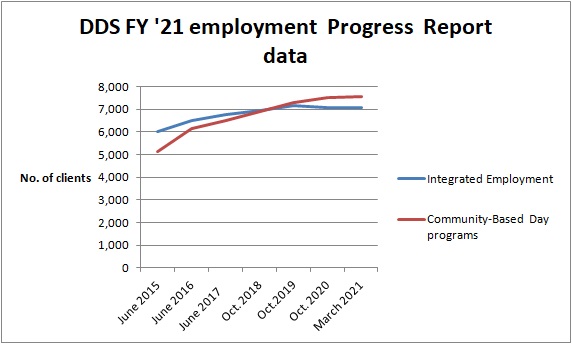
As noted, the Progress Report indicates that the numbers of clients being placed in day programs after the closure of the sheltered workshops has exceeded the numbers entering integrated employment.
While the numbers of clients placed in integrated employment rose by 20% from 2015 to October 2019, the number of clients in DDS day programs increased by 43% over that same period—a percentage more than twice as high—and those numbers continued to increase though March of this year. (See graph below)
Difficulty in finding jobs acknowledged
The Fiscal ’21 Progress Report acknowledges the state has experienced “difficulty obtaining job opportunities for individuals with significant disabilities who require customized work.” The report further notes:
- Transportation challenges for people seeking or working at integrated jobs in the community, especially in geographic areas where there are limited public transportation and/or para-transit options.
- Individual concerns with the impact on Social Security and other public benefits when individuals earn more income.
In addition, the report states that many day program providers are experiencing “workforce challenges … which result in higher vacancies and turn-over that have an impact on access to and continuity of services.”
Despite those problems, the governor and Legislature have so far proposed cuts in the Fiscal 2022 state budget for both DDS day program and transportation funding. We are continuing to advocate for a restoration of funding to the day and transportation accounts.
Equally importantly, we believe work activities are needed in the day programs to make up for the lost opportunities resulting from the closures of the sheltered workshops.
DDS numbers show pre-COVID drop in mainstream employment of DDS clients
Despite continuing clams by the state that people with developmental disabilities are finding jobs and thriving in the mainstream workforce, newly provided state data show a steep drop in “supported” or “integrated employment” for those persons as of early 2020.
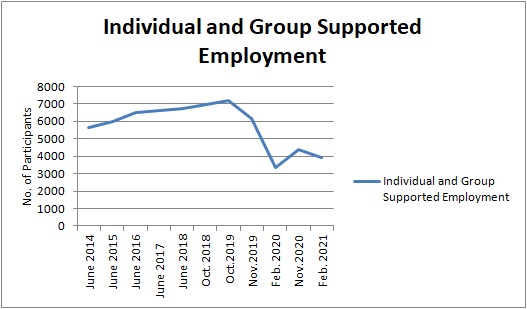
A comparison of the new data from the Department of Developmental Services (DDS) with data previously available from the Department reveals a 53% drop-off in “group and individual supported employment” between October 2019 and February 2020. (See graph below)
As the graph shows, the employment numbers actually rebounded a little bit as of November 2020, which was during the COVID period, but then dropped again as of February 2021.
Source: DDS
The employment numbers starting from November 2019 were provided by DDS to COFAR on March 9 in response to a Public Records Request. The previous numbers from June 2014 through October 2019 are from an online DDS December 2019 “Employment First Progress Report.”
The drop in the number of DDS clients in “individual and group supported employment” positions is prior to the COVID crisis, so COVID-19 and its impact could not be the cause.
The DDS data raise further questions about the state’s claims in closing all sheltered workshops as of 2016 that DDS clients would find better and more fulfilling work opportunities in the mainstream workforce.
Baker administration officials since 2016 have attempted to put a positive spin on the situation, with then DDS Commissioner Elin Howe maintaining that year that “there are now more people working in individual jobs in the community than ever before.” But even then, it appeared the administration was gaming the numbers.
The DDS 2019 “Employment First Progress Report” continued to try to cast mainstream employment prospects for developmentally disabled persons in the most positive light. While recognizing a “difficulty in obtaining job opportunities for individuals with more significant disabilities,” the progress report nevertheless touted:
An increase in the total number of individuals now employed, earning minimum wage or higher, and receiving the same benefits as other employees;
An increase in the number of individuals earning minimum wage or higher in small Group-Supported employment services to 71%; and
Continued evolution of Community-Based Day Support programs that support individuals on their pathway to future employment via skill-building and other meaningful activities.
But COFAR and a number of family members have pointed out that what actually occurred in the wake of the closures of the sheltered workshops was the transfer of thousands of clients to day programs where there was little or nothing for them to do. It appeared early on that the numbers of available job opportunities in “integrated” or or mainstream settings was extremely limited.
DDS does not yet appear to have published a further progress report on integrated employment since the December 2019 report.
DDS day programs continue to draw clients, but more than a third began attending remotely
As we have previously noted, the numbers of Massachusetts DDS clients placed in Community-Based Day and Work (CBDW) programs since the closures of the sheltered workshops has outpaced the number of clients who have been given integrated employment opportunities.
The newly provided data from DDS show a 22% drop in overall CBDW participation during the initial months of the COVID crisis — from February 2020 through November 2020. But the numbers began to rise after that; and as of February of this year, the number of day program participants hit an all-time high of 7,569 clients.

Source: DDS
Nevertheless, the COVID crisis resulted in a major shift to remote attendance in the day programs via platforms such as Zoom. As of November 2020, 36% of day program clients were attending remotely only, according to the March 9 DDS data. DDS did not provide figures after November 2020 on the number attending remotely.
Due to that remote attendance rate, CBDW programs are now being subjected to proposed funding cuts by Governor Baker in his Fiscal Year 2022 budget.
That is apparently further bad news for integrated employment prospects because the CBDW line item in the DDS budget is used, in part, to fund job skills training and other activities to help DDS clients make the transition to the mainstream workforce.
No response from Commissioner Ryder
On March 16, I sent an email query to DDS Commissioner Jane Ryder, asking for a comment on the apparent drop in client participation in integrated employment, and for her assessment of possible reasons for it. Ryder so far has not responded to my request.
DDS said it does not possess records relating to the future of CBDW programs
In its March 9 response to our Public Records Request, DDS stated that the Department does not possess any records concerning projections of the number of clients who will be enrolled in CBDW programs in FY22 and beyond, or concerning the number of such programs that will exist, the financial viability of such programs, or the number of clients who will attend remotely.
One question the DDS response leaves us with is whether it implies that DDS does not engage in planning regarding CBDW programming.
Need is greater than ever for work opportunities in day programs
It seems clear that the administration’s integrated employment promises for persons with developmental disabilities were not being realized even prior to the COVID crisis.
Recognizing that problem, we had supported a bill in 2019 (H.88), which would have required that meaningful work activities be provided in CBDW programs themselves. Unfortunately, the language in the bill was subsequently replaced by the Children, Families, and Persons with Disabilities Committee with language establishing yet another Commission on the Status of Persons with Disabilities.
What the latest DDS data confirms, in our view, is that the administration and Legislature need to rethink the ideology that led to the closures of the sheltered workshops, and take substantive action to provide work opportunities to people with developmental disabilities.
Legislative report misses an opportunity on employment of the developmentally disabled
Even before the COVID crisis, people with intellectual and developmental disabilities (I/DD) in Massachusetts were facing daunting problems in finding meaningful opportunities for employment.
Ever since the closures of all remaining sheltered workshops in the state in 2016, hundreds if not thousands of clients of the Department of Developmental Services (DDS) have been left in DDS day programs with little or nothing to replace the work opportunities they previously had.
For a potentially significant number of DDS clients, mainstream work settings have never been a viable option. They aren’t able to function in those settings or don’t desire to do so.
But even for those people with I/DD who can function in mainstream settings, it has always been difficult to find jobs. Now with unemployment a major problem in the state as a whole due to the pandemic, competing for opportunities in that workforce is an even more daunting prospect for people with I/DD.
For those reasons, we were glad to see a legislative subcommittee undertake a review of the subject of employment of the disabled in Massachusetts, although we were somewhat skeptical that the review would be unbiased and thorough.
Unfortunately, our concerns appear to be well-founded based on the report that has now been released by the “Workability Subcommittee” of the Children, Families, and Persons with Disabilities Committee. We think the Workability Subcommittee missed a major opportunity to address the problems described above.
Report buys in to anti-congregate care ideology
While the subcommittee’s 33-page report has some good recommendations regarding persons with disabilities in general, it unfortunately seems to have largely missed the challenges faced by people with I/DD.
A key reason for that is that the report subscribes to the ideology behind the privatization of DDS services and against congregate work programs for people with I/DD such as sheltered workshops. The report is a cheerleader for the view that everyone can function in the mainstream workforce, no matter what type or level of disability they have.
The report even termed the sheltered workshop closures “a necessary and important step.” Yet there is no supporting analysis behind that statement in the report.
That isn’t surprising given that the Arc of Massachusetts, a key opponent of sheltered workshops, played an “instrumental” role in assisting the Subcommittee in its work, according to the report’s acknowledgements.
What the closures of the workshops did was take away a choice that was available to people and their families and guardians to continue to participate in settings in which they were comfortable and could function.
There has been nothing adopted to replace that choice, and the report doesn’t offer anything.
Vague recommendation on accommodating those who can’t handle the mainstream workforce
In November 2019, Patty Garrity, a COFAR member, and I met with Rep. Josh Cutler, the subcommittee chair, to discuss the employment problems noted above. Patty’s brother, Mark, is one of the former sheltered workshop participants who has been left with little or no meaningful work activities.
The subcommittee’s report does contain one mention and one recommendation regarding that concern.
Unfortunately, the report’s recommendation is overly vague. The recommendation states that the Legislature should ensure that providers “have the capacity to serve these individuals so they, in turn, can have meaningful work opportunities.”
That’s it. There is no specificity in the recommendation as to how those providers could or should serve those persons.
Even prior to COVID, Patty had to fight on a daily basis for activities for Mark in his day program after his sheltered workshop program closed. As Patty noted in a recent email conversation, Mark can’t handle mainstream settings. He can’t meet productivity standards. He can’t even attend his day program right now because he doesn’t understand social distancing.
“At the moment,” Patty wrote, “I am back to visiting Mark through the window (of his group home), and everyday he will ask me, “work tomorrow?”
In our October 2019 testimony to the Subcommittee, we urged it to recognize that like Mark, not every DDS client is capable of or desires to participate in the mainstream workforce. We urged the Subcommittee to support H.88, a bill which would have required that meaningful work activities be provided in DDS community-based day programs.
But no mention is made in subcommittee’s report of that bill or anything like it.
The language in the bill was subsequently removed by the Children and Families Committee and replaced with language establishing a Permanent Commission on the Status of Persons with Disabilities that the subcommittee recommended. Yet the Commission’s charge does not appear to include any effort to address the lack of work opportunities for people like Mark.
No acknowledgement of the lack of work opportunities due to COVID pandemic
There is a lot of boosterism in the subcommittee report regarding companies that have adopted hiring programs for persons with disabilities. But despite the delay in issuing the report until well into the COVID crisis, there is virtually no acknowledgement in it of the huge challenge the pandemic has posed to employment in general in the state.
As noted, if it was difficult for people with I/DD to get jobs pre-COVID, it is even more daunting now that thousands of people are out of work. You wouldn’t know that from reading the report, however.
The only employment stats mentioned in the report are from 2019 when the commonwealth’s average unemployment rate was 2.9%. There is no follow-up on the impact of the COVID-19 pandemic on that unemployment rate, which now stands at 7.4%.
This kind of incomplete analysis may be partly why the report fails to acknowledge the monumental difficulty of placing developmentally disabled persons in mainstream work settings, particularly now.
The report includes what the Subcommittee obviously considered hopeful numbers on mainstream or integrated employment of the disabled, again from 2019. But other than printing the numbers in a chart on Page 11, the report didn’t analyze them. Had the Subcommittee done so, it might not have characterized the numbers in such hopeful terms.
The chart shows the number of DDS clients in integrated or supported employment rose by 1,297 between 2014 and 2018. But the chart also shows the number of clients in day programs, which provide little or no employment activities, rose by 3,159.
In other words, the numbers show the promise of integrated or mainstream employment hasn’t materialized. More than twice as many former sheltered workshop participants had been transferred to day programs as had been placed in integrated employment.
In testimony submitted to the subcommittee in October 2019, we noted that the Legislature never provided adequate funding for the transition from sheltered workshops to mainstream employment. After 2014, it appears DDS was placing fewer and fewer clients in mainstream employment even as the sheltered workshops were closing.
The subcommittee report seems to be primarily concerned with disabled people with normal cognitive abilities
Overall, there seems to be little focus on people with I/DD in the report. Even the finding that mentions our concern about individuals with little to do following the closures of the sheltered workshops doesn’t specify that the people involved have I/DD.
There is no distinction made between high and low-functioning persons. The main focus of the report seems to be on how mainstream employers need to do more to hire people with disabilities in general.
Report acknowledged it did not deal with subminimum wage issue
In our October 2019 testimony, we urged the Subcommittee to recognize that it is necessary to allow employers willing to hire persons with I/DD to pay them a subminimum wage in order to ensure that those work opportunities are not reduced further.
The report acknowledged that it did not examine that issue.
As noted, we think this report is a missed opportunity. In an email exchange with us yesterday, Rep. Cutler defended the report, saying, “we don’t have a solution for every challenge presented.”
But this is not a matter of having a solution for every challenge presented. Rather it is a matter of recognizing the problems that exist and being open to addressing them.
We have questions for a legislative subcommittee reviewing employment of the developmentally disabled
A special legislative subcommittee’s review of barriers to employment of persons with intellectual and developmental disabilities (I/DD) is long overdue, but it is unclear what direction the subcommittee will take on this important issue.
The “Workability Subcommittee” of the Massachusetts Legislature’s Children, Families, and Persons with Disabilities Committee has scheduled a public hearing on October 22 at 10:30 a.m. at the State House in Room B-1.
The hearing notice states that the Subcommittee is seeking to identify “solutions to promote opportunities for individuals with disabilities to participate and succeed in the workforce.”
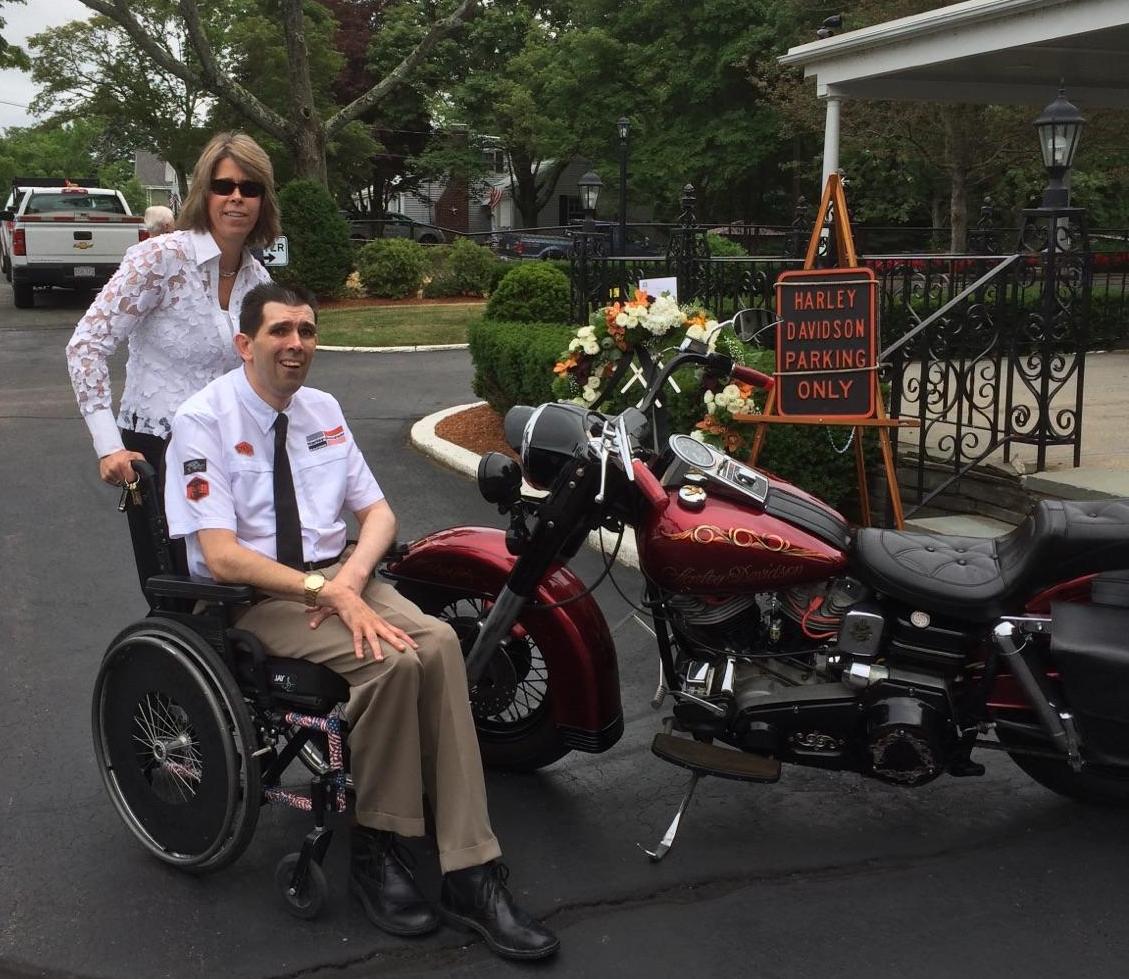
Patty Garrity and her brother Mark. After Mark’s sheltered workshop closed in 2016, meaningful work activities came to an end for him. Mark is not capable of participating in a mainstream work environment, Patty says.
COFAR and our members plan to testify at the hearing. We haven’t been consulted by the Subcommittee as part of its review, which began last spring and involved meetings with “disability advocates, employers, employees, and other stakeholders,” according to the hearing notice.
So on October 4, when we heard about the hearing, we posed questions in an email to the office of Representative Josh Cutler, chair of the Subcommittee and vice chair of the Children and Families Committee. Those questions were the following:
- Does the Subcommittee recognize that there are some persons who do not have the capability to succeed in the mainstream workforce, or does the Subcommittee take the position that all persons, no matter how profoundly intellectually disabled, can handle jobs in the mainstream workforce?
- Is the Subcommittee also looking to promote work opportunities for individuals in their community-based day programs funded by the Department of Developmental Services?
- Does the Subcommittee have data on the availability of mainstream workforce jobs for persons with I/DD? We have long been concerned that not nearly enough of those jobs exist even for those who are capable of doing them.
- Is the Subcommittee aware that the Legislature has apparently never appropriated the level of funding sought by the Baker administration for training and other services to help prepare former sheltered workshop participants for mainstream work settings? If so, has the funding for that transition so far been adequate?
- Does the Subcommittee support the continued payment of subminimum wages to persons with I/DD in order to enable them to get work opportunities either in mainstream or DDS settings?
In an email in response to us, Rep. Cutler declined to respond to our questions; but he did say they were “great questions” and that he would be interested in meeting with us. We are in the midst of scheduling a date for that meeting.
We have discussed employment issues involving people with I/DD in numerous blog posts and in legislative testimony since 2014 when the administration of then Governor Deval Patrick began closing sheltered workshops for persons with I/DD throughout the state.
The sheltered workshops were settings in which DDS clients did small assembly jobs and other piecework activities provided by area businesses. The participants usually received a nominal wage.
Many family members and guardians strongly supported the workshops; but the Patrick and then Baker administrations held to an ideology that the workshops “segregated” the participants from non-disabled workers, and that the participants would all be better off in mainstream, “integrated” job settings.
Here are some of our findings from our involvement with these issues over the past five years:
- Starting in 2013, the Patrick administration worked closely with corporate DDS providers to close the sheltered workshops over the objections of the families of many of the participants. In doing so, the providers falsely claimed that the workshops did not allow for “community inclusion.” The providers also falsely claimed that the federal government was forcing all sheltered workshops to close in the state.
- The Legislature rejected the Baker administration’s proposed funding increase in Fiscal Year 2017 to fund the transition from sheltered workshops to mainstream employment for former sheltered workshop participants.
- As of 2014, DDS was placing fewer and fewer clients in mainstream, integrated employment even as the sheltered workshops were closing.
- As of 2018, it was clear that the promise of the replacement of sheltered workshops in Massachusetts with mainstream integrated employment was not being realized. An unknown number of former sheltered workshop participants were being left without work of any kind in their DDS-funded day programs.
- The position of Senator Elizabeth Warren and many others against the payment of subminimum wages to people with I/DD has made it even harder for those persons to find the kind of work they had previously enjoyed doing.
Patty Garrity is the sister of one of those former workshop participants who has been left without work opportunities. Her brother Mark is not able to work in a competitive, mainstream setting.
Garrity said she plans to testify at the October 22 Subcommittee hearing. “I want to explain that there are individuals like my brother Mark and his peers who are not minimum wage candidates,” she wrote in an email. “There is still a huge void in Mark’s day and it is not going well…..going on 4 years now that I have been waiting for them to improve upon this and it is not happening. Mark is happy to be with his peers, but all he is doing is shredding paper and he is bored.”
We hope the Subcommittee will pay close attention to the experience of Mark Garrity and others who have been left behind in the wake of the sheltered workshop closures.
Moreover we hope the Subcommittee does or will recognize that, as with so many other issues involving persons with I/DD, one size doesn’t fit all when it comes to employment.
There are many people for whom the mainstream, competitive workforce is not suitable. Their choices and the choices of their families and guardians should be respected.
Senator Warren’s concern about payment of subminimum wages to developmentally disabled people is misplaced
Massachusetts Senator Elizabeth Warren has proven to be one of the nation’s most effective advocates for workers and their financial security; but we think she’s wrong in charging that persons with intellectual and other developmental disabilities are being exploited by work programs that pay them a subminimum wage.
Warren is leading an effort in Congress to eliminate waivers that have allowed employers to pay a subminimum wage to disabled persons who are hired by employers in mainstream work settings. Warren alleges that payment of subminimum wages under the so-called 14(c) certificates or waivers is exploitative and discriminatory.
We would agree that for disabled people with normal intellectual functioning, payment of subminimum wages is exploitative and unnecessarily discriminatory; but a distinction needs to be made in the case of persons who have intellectual or other developmental disabilities that severely limit cognitive functioning.
In not making this distinction in calling for the elimination of the subminimum wage waivers, Warren is making the same well-intentioned mistake that many people in the advocacy community have made. That mistake is to assume that all developmentally disabled people are exactly the same as non-disabled people in terms of their employment potential and, even more importantly, their employment aspirations.
Those assumptions overlook a number of realities, including the fact that virtually all developmentally disabled persons who are placed in those work programs receive government assistance in some form for residential care, day care, or other services. Unlike non-disabled persons, most, if not all, individuals with significantly impaired cognition are not seeking to support themselves financially through work. They are seeking to occupy their time with activities that are meaningful and satisfying to them.
As the brother of an intellectually disabled person noted to me, his brother has no understanding of the concept of money, and wouldn’t know or be able to appreciate whether he was paid a minimum wage rate or not.
In an April 23 letter to U.S. Labor Secretary Alexander Acosta, Warren and six other senators attempted to link payment of subminimum wages to problems of abuse and poor work conditions in work settings for people with developmental disabilities. The letter cited four instances in which disabled persons were forced to work in sweatshop-like conditions, including a case in Iowa in which intellectually disabled men were working in a turkey processing plant for little or no wages and were subjected to verbal and physical abuse and unsanitary conditions.
But as is the case with abuse or poor conditions in any care-related or work setting, the instances cited in Warren’s letter appear to be the result of poor governmental oversight of those programs. Those problems could have been avoided or could be rectified with proper oversight. The problems were not necessarily the result of payment of subminimum wages.
Moreover, citing isolated instances of abuse in specific work settings doesn’t prove it is a problem in all work settings. In fact, we have not heard of any instances of such exploitation or abuse occurring in sheltered workshops or other work activity programs in Massachusetts.
We have made a number of attempts to contact Warren about this issue. I left separate voicemail messages since Monday of this week with Warren’s Washington and Boston Senate offices. On Monday, I also posted what was essentially this blog post on her website contact page, and asked if she or her staff would respond. To date, I’ve gotten no response and no call back.
The unfortunate impact of the effort to prohibit employers from paying subminimum wages to developmentally disabled people is that rather than paying them higher wages, most employers choose not to employ them. So the end result is that these disabled individuals miss out on satisfying and meaningful ways to occupy their time.
As we have reported, DDS data show that the number of developmentally disabled persons being placed in integrated or mainstream employment paying at least the minimum wage in Massachusetts has been steadily dropping in the past few years.
During Fiscal Year 2016, a high of 509 clients in the Department of Developmental Services system newly started working in mainstream jobs. That number dropped to 127 clients entering integrated employment during Fiscal 2017, and to a net increase of only 98 clients during Fiscal 2018.
We are assuming that demand for these mainstream jobs remains high, possibly in the thousands. That there was a net increase of less than 100 developmentally disabled persons in integrated employment in Fiscal 2018 appears to show that the administration has been unable to find jobs for people who want them.
Promises in closing sheltered workshops haven’t been kept
In 2014, the administration of then Governor Deval Patrick began closing sheltered workshops in Massachusetts that provided developmentally disabled persons with piecework activities because those facilities supposedly segregated those persons from their non-disabled peers and paid them less than minimum wage. The Baker administration followed that same policy, ultimately closing all remaining workshops as of the fall of 2016.
The plan of both administrations was to provide training to those former workshop participants and place them in mainstream workforce settings along with supports that would help them to function in those settings.
We expressed concerns at the time, however, that the workshop closure policy was being pursued without knowing, among other things, whether sufficient jobs existed in the private sector for all of those former workshop participants and others who want jobs.
Unfortunately, our concerns have proved to be well founded. Instead of being placed in mainstream or integrated jobs, the vast majority of the former sheltered workshop participants have ended up in DDS-funded Community Based Day Supports (CBDS) programs, which offer little or no work opportunities, and have left many of those people frustrated and bored.
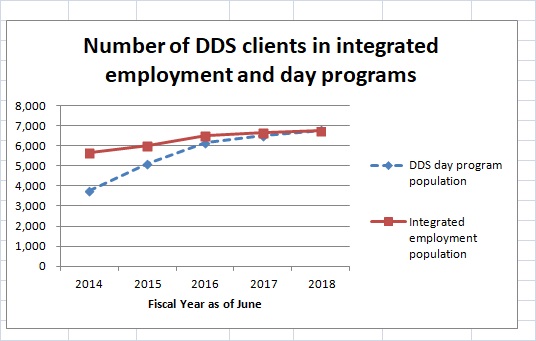
DDS data also show that the DDS day program population increased by 81% from Fiscal 2014 through 2018 in Massachusetts while integrated job placements increased by only 19%. The chart below reflects this trend and illustrates the fact that the total day program population in the DDS system has caught up with and even surpassed the total number of departmental clients in integrated employment since Fiscal 2014.
Barbara Govoni, the mother of one former sheltered workshop participant, is continuing to advocate for legislation that would allow for the return of piecework activities in her son’s CBDS program.
Direct care workers are the ones who are exploited
Ultimately, Senator Warren’s concern about exploitation is misplaced. It is not the developmentally disabled who are exploited by subminimum wages. Rather, it is the people who are hired by DDS-funded providers to care for them who are usually the victims of systematic exploitation in this field.
As we have noted, direct-care workers in the DDS system, who do have to work in order to feed themselves and their families, are the ones who Senator Warren and other advocates for the disabled should be concerned about.
When direct-care workers are underpaid, it is not only they and their families who suffer, but the very people who depend on their services who suffer as well from substandard care. Paying developmentally disabled people less than minimum wage as part of their work programs doesn’t harm them. Paying their caregivers less than a living wage does.
Confusion reigns over employment of the developmentally disabled in Massachusetts
When it comes to the crucial issue of employment of people with developmental disabilities in Massachusetts, the policies of both the federal government and the Baker administration appear to be unclear, confusing, and to contain a number of contradictions.
Yet, neither the Baker administration nor the Massachusetts Legislature, in particular, seem to be showing much interest in clearing things up.
Consider these facts:
- Although the Patrick and Baker administrations stated that they were closing all sheltered workshops in Massachusetts in order to place developmentally disabled people in so-called “integrated” or mainstream work, those mainstream jobs have proven to be difficult for many, if not most, of those people to find.
- An unknown number of former sheltered workshop participants, some of whom do not want mainstream work, have been left without work of any kind in their Department of Developmental Services-funded day programs.
- It is unclear what work arrangements are considered by both the federal and state governments to be legal. In one case, DDS has resorted to a creative, if jerry-rigged arrangement under which a developmentally disabled man has been placed on the staff of his day program so that he can continue to do piecework there in compliance with federal rules.

Barbara Govoni (right) with state Senator Joan Lovely, Senate chair of the Children, Families and Persons with Disabilities Committee, this week. The Committee did not approve a bill Govoni proposed that would ensure work opportunities for her son and other developmentally disabled persons. But Lovely says she wants to work with Govoni on the issue.
Let’s look at each of these issues a little more closely:
Integrated work is apparently still unavailable for many who want it in the mainstream workforce
In 2014, the administration of then Governor Deval Patrick began closing sheltered workshops that provided developmentally disabled persons with piecework activities because those facilities supposedly segregated those persons from their non-disabled peers and paid them less than minimum wage. The Baker administration followed that same policy, ultimately closing all remaining workshops as of the fall of 2016.
The plan of both administrations was to provide training to those former workshop participants and place them in mainstream workforce settings along with supports that would help them to function in those settings.
We expressed concerns at the time, however, that the workshop closure policy was being pursued without knowing, among other things, whether sufficient jobs existed in the private sector for all of those former workshop participants and others who want jobs. We also expressed concern that the Legislature wasn’t following through with funding needed for training.
Since 2014, data appear to have borne out our concerns.
DDS data provided to us last month show that despite the workshop closures, smaller and smaller numbers of people have actually entered the integrated or mainstream workforce in Massachusetts since Fiscal 2016. During that fiscal year, a high of 509 clients in the DDS system newly started working in mainstream jobs. That number dropped to 127 clients entering integrated employment during Fiscal 2017 and a net increase of 98 clients during Fiscal 2018.
We are assuming that demand for these mainstream jobs remains high, possibly in the thousands. That there was a net increase of less than 100 developmentally disabled persons in integrated employment in Fiscal 2018 appears to show that the administration has been unable to find jobs for people who want them.
Fiscal years 2015 and 2016 were apparently the years in which most of the population of the sheltered workshops left those programs and in which most of the increases in integrated employment programs took place. The problem is that the numbers of clients entering integrated employment in those years were much smaller than the numbers entering DDS-funded day programs.
Overall, the DDS day program population increased by 81% from Fiscal 2014 through 2018 while integrated job placements increased by only 19%. The chart below reflects this trend and illustrates the fact that the total day program population in the DDS system has caught up with and even surpassed the total number of departmental clients in integrated employment since Fiscal 2014.
Source: DDS
When we asked DDS for any records indicating whether the Department is having a problem providing suitable work opportunities for those who want them, DDS referred us to two policy documents dated 2010 and 2013. But those documents obviously do not provide any information about the situation today.
One of those policy documents is the Department’s 2010 “Employment First” policy statement, which called for “integrated employment as a goal for all” DDS clients. The policy statement also called for a “consistent message” and an “infrastructure including prioritizing and directing of resources, that supports this effort.” (my emphasis)
To date, however, neither a consistent message nor an adequate infrastructure appear to exist to support that goal of universal integrated employment.
The DDS’s 2013 document, titled “Blueprint for Success,” stated that it was the Department’s goal to close all remaining sheltered workshops as of June 30, 2015. (The last workshops were closed a little more than a year later.)
The title page of the Blueprint states that the document was prepared by DDS and by the Massachusetts Association for Developmental Disabilities Providers (ADDP) and the Arc of Massachusetts. Both the ADDP and the Arc are largely supported by DDS-funded providers, which have benefited from higher DDS funding for the day programs to which most of the former sheltered workshop participants have been transferred.
Some DDS Employment First website links don’t work
In response to our request for documents and information, DDS also referred us last month to its Employment First website. It isn’t apparent, however, that the website contains any information that indicates whether or not it is difficult for developmentally disabled persons to find mainstream employment.
In one case in which I clicked on the website and then went to the “Career Planning” section under the “Resource Library,” a link to a “Career Planning Guide” took me to an error page. Another link to a “Guide to Person-Centered Planning for Job Seekers” took me to a page with generic advice on seeking employment, but no information on current job prospects for people with developmental disabilities in Massachusetts.
Under a link called “Program Development and Management,” I clicked on another link labeled “Ensuring Excellence in Community Based Day Supports,” and got another error page message.
Barbara Govoni and Patty Garrity, two of the more active family members of former sheltered workshop residents, both said they had never been referred to the website by DDS.
Legislative committee kills work opportunities bill
Last year, state Representative Brian Ashe of Longmeadow filed a work opportunity bill (H. 4541) at the request of Govoni, the mother of Danny Morin, a former sheltered workshop participant. The bill would have required optional work activities in DDS-funded day programs for up to four hours a day.
Govoni is concerned that Danny has been provided with few activities that are meaningful to him after his workshop closed in 2016, and misses the steady work that the workshop provided. She terms this lack of available work opportunities for Danny and others a human rights issue.
But Govoni’s bill was referred to the Children, Families, and Persons with Disabilities Committee, which effectively killed the measure in June by sending it to a study. Earlier this week, Govoni and I met with state Senator Joan Lovely, the committee’s Senate chair, to discuss the bill among other DDS issues.
Lovely said the employment bill was filed late in the two-year legislative session. She noted there was little time to analyze the implications of the bill, so the committee decided to send it to a study. The problem with that is that no one in the Legislature actually does such studies. Sending a bill to a study is a euphemistic expression used for killing a bill.
But Lovely said the committee is concerned about the work opportunity issue, and said the committee has been in touch with DDS about it. One proposal being discussed is to hire an ombudsman in the Department who would help individuals and families locate existing day programs that offer work opportunities.
Another proposal under consideration is to establish new work opportunities programs in existing day programs without making such work opportunities a legislative requirement of DDS.
But it isn’t clear that DDS really is working to establish those programs or whether the Department even considers work activities in day programs to be legal.
A staff member for Representative Ashe said she was told by DDS officials that the Department is essentially hamstrung by federal rules that prevent DDS day programs from offering any work activities because such activities can only be offered in “integrated” settings.
DDS tries creative approach to comply with federal requirements
Despite that, we have heard of recent cases in which arrangements have been made to provide work activities in DDS day programs. Patty Garrity’s bother, Mark, is one of those cases.
As we reported last year, Mark, like Danny Morin, was bored in his day program after it had ceased operating as a sheltered workshop. He wasn’t interested in the classes on painting, cooking, or money management that had replaced the piecework he had enjoyed doing.
In March of 2017, Mark’s day program found paper shredding work for him that DDS determined was in compliance with federal rules.
Ashe’s aide queried DDS about Mark’s case and was told that in order to allow Mark to do the paper shredding work under the new federal rules, the provider agency running his day program has actually placed him on its staff and is paying him minimum wage. As a result, Mark is now considered to be working in an integrated setting.
Ashe’s aide told us that Mark’s work arrangement is considered a “unique circumstance.”
Federal rules regarding integrated employment are unclear
The problem with unique arrangements such as Mark’s, however, is that they don’t necessarily solve problems involving larger groups of people. And it may even be questionable whether Mark’s arrangement was actually necessary.
Despite what DDS told Ashe’s legislative aide, it does not appear clear that the federal rules strictly forbid work activities in day programs such as Mark’s.
In an informational bulletin issued in 2011, the federal Centers for Medicare and Medicaid Services (CMS) stated that federal Medicaid funding will not cover “vocational services delivered in facility based or sheltered work settings, where individuals are supervised for the primary purpose of producing goods or performing services.”
That would appear to preclude at least some work activities in DDS day programs. But it seems possible that what the CMS bulletin refers to as “pre-vocational services” do allow for at least certain work opportunities in those settings, although the guidance, as usual, is vague. It also isn’t clear which types of work activities DDS recognizes as pre-vocational services and which it considers vocational.
The CMS bulletin offers a rather vague and clunky definition of pre-vocational services as:
…services that provide learning and work experiences, including volunteer work, where the individual can develop general, non-job-task-specific strengths and skills that contribute to employability in paid employment in integrated community settings. (My emphasis).
The bulletin does state that persons doing pre-vocational activities can be paid for those activities “in accordance with applicable Federal laws and regulations.”
The bulletin implies that these pre-vocational work opportunities can be provided in “fixed-site facilities,” which we think would include DDS day programs, although this again is not clear. Also, the bulletin states that these work opportunities must occur “over a defined period of time,” which implies that the individuals are ultimately expected, as the bulletin says, to be placed in permanent integrated employment. Once again, the “defined period of time” isn’t defined!
It’s also unclear to us what the CMS bulletin means in stating (above) that while pre-vocational services can include “work experiences,” they must provide the person with “non-job-task-specific strengths and skills.” Does that mean that the individual can do work but can’t do specific tasks?
It seems that the paper shredding activity that Mark Garrity is doing could be considered a “work experience.”
As a result, it seems possible that when Govoni’s bill is refiled, as we hope it will be in the next legislative session in January, the bill should specify that all DDS day programs be required to offer pre-vocational activities to anyone who requests that.
When Govoni and I met with Senator Lovely, Lovely agreed that the current rules governing work opportunities are confusing and need to be clarified.
The federal and state models are ‘one size fits all’
The CMS bulletin recognizes that work is vitally important to people with developmental disabilities in the same way it is important to non-disabled persons. As the bulletin notes:
Work is a fundamental part of adult life for people with and without disabilities. It provides a sense of purpose, shaping who we are and how we fit into our community.
Yet, after that acknowledgement, the CMS bulletin appears willing to ensure that fundamental part of life only for those who agree to work in the mainstream workforce. The bulletin states:
…Because (work) is so essential to people’s economic self sufficiency, as well as self esteem and well being, people with disabilities and older adults with chronic conditions who want to work should be provided the opportunity and support to work competitively within the general workforce in their pursuit of health, wealth and happiness.
Neither the federal government nor the Baker administration in Massachusetts appear to recognize that at least some persons with the most profound levels of disability are not able to participate in the mainstream workforce.
The CMS bulletin states the following:
All individuals, regardless of disability and age, can work – and work optimally with opportunity, training, and support that build on each person’s strengths and interests. Individually tailored and preference based job development, training, and support should recognize each person’s employability and potential contributions to the labor market.`(my emphasis)
The DDS Employment First policy referred to above appears to go even further in that regard, stating that:
It has now been clearly demonstrated that individuals who were previously considered unemployable in integrated community settings can work successfully. Even for those individuals with the most significant level of disability, through careful job matching and support design, employment has been shown to be a viable option. (my emphasis)
These statements are unsupported by the evidence. That is probably why neither statement provides any evidence to support its claims.
Recently, however, the federal government proposed changes at least to rules that prevent developmentally disabled persons from working for less than the minimum wage.
We hope to work with the Baker administration and the Legislature to find ways to penetrate and clear up this dense thicket of confusion and contradictions that has grown up in the past several years over the vital issue of work for the developmentally disabled.
We hope Govoni’s work opportunity bill is enacted in the next legislative session. In the meantime, legislators, advocates, and policymakers need to get together to clarify and agree on what can and should be done.
Questions remain as key disabilities committee kills work opportunities bill
The Legislature’s family and disabilities rights committee has rejected H. 4541, a bill intended to ensure that developmentally disabled individuals get work opportunities in their state-funded day programs.
A staff member of the Children, Families, and Persons with Disabilities Committee said the committee understands many people cannot find those work opportunities and is therefore discussing other possible ways of providing for them. But details regarding the policies being considered by the Children and Families Committee are sketchy, and the committee hasn’t yet responded to written questions about those ideas.
Barbara Govoni, the mother of a developmentally disabled man, had pushed for months for passage of H. 4541, which would have established optional work activities in DDS-funded day programs for up to four hours a day.
Many people in community-based day programs funded by the Department of Developmental Services have not been able to find such work since all sheltered workshops were closed in Massachusetts in 2016.
H. 4541 had been referred to the Children and Families Committee in May, and the committee effectively killed the measure last month by sending it to a study. With formal business in the current two-year legislative session ending on July 31, any similar legislation will have to be re-filed next January and go through the legislative process all over again.
It isn’t clear what the committee’s objections were to H. 4541. We’ve noted that some committee members appeared to have some misconceptions about the bill, including the idea that it would bring sheltered workshops back to the state.
In fact, the bill would have simply provided work activities for individuals who continued to desire those activities in their day programs, and who either could not or did not want to work in “integrated” or mainstream work settings. As we have reported, many of these people miss the work they used to do in their sheltered workshops, and are unable to relate to most day program activities that replaced that work.
At the same time, it appears that some DDS-funded day programs are, in fact, continuing to offer work activities to some residents. It’s not clear how many such programs currently exist.
A legislative aide to Representative Kay Khan, House chair of the Children and Families Committee, said earlier this week that the committee had been in touch with the Department of Developmental Services about the work opportunity issue, and that one proposal discussed was to hire an ombudsman in the Department who would help individuals and families locate existing day programs that offer work opportunities.
Funding remains a question
Another proposal under consideration by the Children and Families Committee and DDS is to establish new work opportunities programs at additional day programs without making such work opportunities a legislative requirement of DDS.
No details are yet available, however, on the scope of the Children and Families Committee’s or DDS’s proposals. Also unknown is how funding would be appropriated for an expansion of existing work opportunities programs, and what the amount of that funding might be.
The Legislature, unfortunately, has previously shown a reluctance to fund job training and other programs as part of the effort to replace sheltered workshop programs with “integrated” or mainstream work opportunities for DDS clients.
The administration of then Governor Deval Patrick and the Legislature had set up a DDS line item in Fiscal 2015 to fund job training and other programs to help transfer clients from sheltered workshops into mainstream employment. That line item was initially funded with $1 million and was raised to $3 million the following year.
For Fiscal 2017, current Governor Charlie Baker, with the support of the DDS corporate providers, had proposed boosting the job development line item to $7.6 million; but the Legislature wouldn’t agree to the higher funding.
As of Fiscal 2018, the job development line item was eliminated and all funding for those efforts was transferred to the overall DDS Community Based Day and Work line item. It would seem the case needs to be made that additional funding is now needed for the day and work line item to fill the gap in work opportunity programs.
The solution needs to be comprehensive
Robin Frechette, an aide to Representative Brian Ashe, who filed H. 4541 on Govoni’s behalf, said she believes the Children and Families Committee co-chairs and other committee members “understand there is a gap in services to a particular group of individuals who are not able to work out in the community, and it needs to be addressed.”
But Frechette expressed a concern that simply having an ombudsman direct individuals whose day programs don’t offer work opportunities to different day programs that do offer those opportunities could be disruptive to those individuals. She also said she was concerned that there may be few such programs available in the western part of the state where Barbara Govoni and her son live.
Earlier this week, we sent email queries to both the Children and Families Committee co-chairs and DDS to try to find out more about the proposals under consideration.
We have asked for records from DDS on the number of work opportunity programs that currently exist in DDS-funded, community-based day programs, and the number of work opportunity programs that DDS plans to establish.
We are also asking for the number of DDS clients who have been placed in “integrated employment” or mainstream workforce jobs and the number of DDS clients in community-based day programs since Fiscal 2014.
And we have asked DDS for its assessment as to whether there is a problem in providing suitable work opportunities for people in the DDS system who desire it, and whether some DDS clients are unable to function in mainstream work sites.
In addition, we’ve asked the co-chairs of the Children and Families Committee what the committee’s specific objections to H. 4541 were.
Despite the rejection of H. 4541, the opportunity remains for state legislators and policy makers to address the critical work opportunity problem facing developmentally disabled people across the state in an effective way. We hope those legislators and policy makers will make a serious commitment to finding a workable solution; but we know from experience that deeds will be more important than words in that regard.
 COFAR blog