DDS and group home deny responsibility for month-long family hospital visitation ban
The Department of Developmental Services (DDS) and a department-funded group home provider are denying responsibility for having blocked a group home resident’s family from visiting him at Brigham and Women’s Hospital for more than a month, starting in January.
The hospital is not commenting on the matter and has been unresponsive to numerous attempts by COFAR to inquire on behalf of the family about the justification for the blocked visitation. The hospital has even declined to clarify its general visitation policies.
Meanwhile, the resident’s DDS-funded guardian and the Seven Hills Foundation, the group home provider, appear to be continuing to impose restrictions on family visits to the group home. Those restrictions appear to violate DDS regulations.
As we previously reported, the family of Giovanny Arias, an individual with autism spectrum disorder and other conditions, was prevented from visiting him in the hospital where he was taken after having reportedly fallen down the stairs of his group home on December 19. He suffered injuries, including a broken wrist, black eye, and numerous bruises throughout his body.
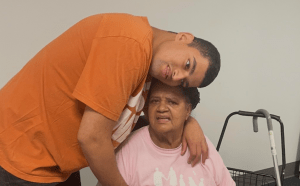
Giovanny Arias and his grandmother, Liduvina Gonzalez
Due to the visitation restrictions, the family was deprived of information about Giovanny’s well-being and whereabouts for over a month while he underwent numerous surgical operations, his great aunt, Carolina Hernandez Broomhead, said.
The ban on visiting Giovanny in the hospital followed growing communication and visitation restrictions imposed by Seven Hills management and Giovanny’s state-paid guardian, Susan Braus, in the group home, Carolina said. Carolina contended the restrictions started after the family expressed concerns about insufficient care at the group home.
Visitation restrictions appear to be a part of a pattern in which families are marginalized when they attempt to advocate for their loved ones (see here, here, here).
Previous visitation restrictions at the residence
Issues involving visitation restrictions in Giovanny’s group home first arose this past fall. Carolina contended that Seven Hills and the guardian had responded with visitation restrictions against the family for having alleged that the group home was subjecting Giovanny to poor hygiene and overmedication, and had depleted his Social Security funds. Seven Hills also prevented Giovanny’s grandmother from seeing her grandson at the residence, and, at one point, even called the police on the seventy-eight-year-old woman, Carolina said.
Moreover, in November, Seven Hills proposed a series of new restrictions that included a ban on family visits to the residence. Family visits would have to occur at other predetermined locations. There would also be a maximum of two family visits per month with a limit of two hours per visit. Additionally, the family would be required to bring a translator with them on all visits for the benefit of staff who are unable to speak Spanish. A fuller discussion of the restrictions is available here.
Withheld medical updates on the evening of the hospitalization
Existing tension surrounding mistreatment and visitation limitations appeared to escalate during Giovanny’s hospitalization, starting on December 19, at Brigham and Women’s Hospital.
That night, Carolina said, she participated in a three-way phone call with a doctor and Braus. She said she heard Braus direct hospital personnel to withhold medical information from the family, even as a doctor recommended otherwise. Consequently, the family was denied vital information about Giovanny’s welfare amid a health emergency, she said.
Family hospital visitation restrictions
Hospital visitation restrictions soon ensued after Giovanny’s admission. While the family was permitted to visit Giovanny at the hospital on December 31, visitation was suddenly restricted on January 2, Carolina said. That day, two security officers unexpectedly ushered another aunt out of the hospital after she attempted to visit Giovanny. Carolina said they did not provide any explanation for the aunt’s removal.
Family difficulties accessing information about hospital visitation restrictions
Shortly afterwards, Carolina called the hospital for more information on the incident. She said a Brigham and Women’s employee claimed to her that Braus had submitted written documentation barring family visits. Carolina said that when she followed up with Braus, however, Braus claimed the hospital was responsible for the visitation ban.
Other attempts by the family to receive clarification of the visitation restrictions in the hospital have been futile, according to Carolina. In an email dated January 13, DDS area director Jeffrey Hetrick claimed that neither DDS nor the guardian had a say in the restrictions, and placed responsibility on the hospital.
Seven Hills Area Director Caelin Scribner similarly asserted that Seven Hills was uninvolved in the decision-making process on visitation, and maintained the hospital alone made the decision to deny family visits. In their emails, both DDS and Scribner encouraged the family to contact the hospital for clarification. Yet, further family outreach to the hospital was unsuccessful, Carolina said, with the hospital hanging up the phone and not responding to emails.
COFAR difficulties assessing responsibility for hospital visitation restrictions
COFAR also experienced similar challenges while investigating the situation. Neither Braus nor Scribner replied to our emails requesting clarification on the hospital visitation restrictions. We emailed DDS Commissioner Sarah Peterson on January 8 to express concerns about the family hospital ban and were told that the DDS Area Office staff would follow up with the family directly. We reached out again on January 26 to the commissioner to highlight that the issue remained and have yet to receive a response.

Giovanny’s broken wrist, which the provider claims he suffered after falling in the group home in December.
Communication with the hospital has proven difficult as well. Despite having a seven-day response timeframe, the hospital didn’t respond to three of our emails about the restrictions. The Brigham and Women’s Patient and Family Relations Department finally replied to us in a January 26 email, stating we would need “a release of information signed by someone who has the authority to speak for the patient.”
While laws protecting health information may limit the public’s ability to receive case details, even our request for basic clarification on hospital visitation policies was not answered by the hospital.
On January 26, I called the floor where Giovanny was hospitalized and was told by a hospital staff member that they could not give me any information and that I would need to speak with Braus instead.
When I clarified that I simply had general questions about the hospital visitation policy, the staff member offered to connect me with a supervisor. After leaving me on hold for about twenty minutes, the staff member returned and said I would have to contact the Patient and Family Relations Department. When I asked if I could speak to the supervisor, the staff member responded that they did not have that person’s contact information.
Implications of the family hospital visitation restrictions
Regardless of who initiated the hospital restrictions, it is concerning that all parties have disclaimed responsibility rather than working to resolve the problem. Each entity has a duty to promote Giovanny’s best interest in partnership with the others.
Isolating an individual with disabilities from his family for over a month cannot be said to advance his best interest. For a person with autism who has limited abilities to communicate with speech, the disruption of routine and exposure to an overwhelming sensory environment in isolation could be traumatic.
The hospital family visitation restrictions seem to be inconsistent with Brigham and Women’s own Patient Rights statement. This affirms that patients have the right to “communicate with people outside of the hospital” and “participate in [their] care.”
The family visitation restrictions also appear to violate Giovanny’s legal rights. His 2024 legal guardianship decree states that Giovanny retains the right “to determine with whom to have friendships and visitation.” No one has claimed that the restrictions stem from Giovanny’s preferences, Carolina said.
Recent hospital discharge and continuing visitation limitations at the group home
In a February 6 email, Braus stated she believes that Giovanny would actually enjoy family visits.
When Giovanny was finally discharged from the hospital recently, Scribner and Braus separately reached out to the family to discuss arranging a visit at the group home. In Braus’ email she commented that she would “imagine [that Giovanny] would appreciate a family visit during his continued recuperation.” According to Carolina, this raises the question why Braus did not intervene to address the month-long hospital visitation restrictions.
Scribner, meanwhile, offered to host a two-hour-long family visit that Sunday with a maximum of two visitors so that Giovanny could “enjoy time with loved ones while still prioritizing his recovery.” She said that future group home visits could not exceed two visitors and would need to have attendees approved by Braus ahead of time. Carolina said it appears that the group home has imposed its November 2025 proposed visitation restriction agreement despite the fact that it was never signed by the family.
In our view, Braus and Seven Hills’ sudden allowance of a group home visit does not negate possible DDS regulation violations. The regulations state that “arrangements shall be made for private visitation to the maximum extent possible” and “family members shall be permitted to visit at all times, unless the individual objects.” Permitting visits sporadically and subjecting visitation to onerous terms and conditions amid growing backlash cannot be said to adhere to the spirit of the regulations.
The hospital visitation restrictions demonstrate the ease with which families can be dismissed and ultimately excluded by major players in the DDS-funded, provider-run residential system. When responsibility is diffused across state agencies, state-paid guardians, and corporate providers, accountability dissolves. Families are reduced from key team members to outsiders while their loved ones with disabilities suffer the fallout.
 COFAR blog
Restricting visits is a violation of the federal community rule, it violates the individuals right, their health and welfare as well as the DD bill of rights, where family is allowed a voice. It’s all too common that when complaints of abuse, neglect or exploitation are voiced then access is restricted.
LikeLiked by 1 person
It usually does start with unsafe care in their residential homes . Where there are secrets there is harm . Tough with nonverbal but I’ve experienced it with my son who was verbal several times . David I was wondering if you heard what Healthcare and Finance Chair Sen. Diane Freedman did to all of her bills that re: medical safety recently ? Maureen Sent from Gmail Mobile
LikeLiked by 1 person
Retaliation for advocacy. It’s not new. When Benjamin Ricci advocated for better conditions in the institutions, the state tried to transfer his son to an inappropriate psychiatric facility, interfered with his employer at UMass, and forced him to pay tuition. Nothing has change.
LikeLiked by 1 person
Sadly this family will probably really not get anywhere without an attorney. I hope they can afford one. Unbelievable what DDS is putting this family through.
LikeLike