Archive
Florida moves ahead of Massachusetts in testing group home staff for COVID-19
The administration of Florida Governor Ron DeSantis has had an abysmal record of dealing with the spread of COVID-19 in his state.
But last week, even DeSantis took a critical step in protecting persons with intellectual disabilities that the Baker administration in Massachusetts has so far refused to take.
According to the News Service of Florida, group homes and other facilities in that state will be required to start testing staff members every other week for COVID-19, under an emergency rule issued by the DeSantis administration. The administration will provide test kits free of charge to the residential providers.
Meanwhile, the Massachusetts Department of Developmental Services (DDS) has continued to allow COVID-19 testing to remain voluntary for staff working in its residential facilities. This has sparked continuing concern among guardians, family members and advocacy organizations, including COFAR, that without mandatory testing, staff will remain a source of potential infection of large numbers of DDS clients.
In addition to Florida’s decision to make staff testing mandatory, Florida’s use of testing kits could prove more efficient than the mobile testing system in Massachusetts in which a single company, Fallon Ambulance Service, has been traveling around the state in order to test residents and staff.
The testing process in Massachusetts has slowed to a virtual crawl since mid-May, and thousands of residents and staff still remain untested in the DDS group home system.
Beyond that, the Massachusetts DDS has no publicly disclosed plans or apparently even a coherent policy regarding periodic re-testing of either residents or staff.
In a statement last week accompanying the announcement of the staff testing requirement in Florida, Barbara Palmer, director of the Florida Agency for Persons with Disabilities (APD), termed the requirement “a vital step to help ensure the safety of our employees and customers.”
In a communication with us on a separate issue yesterday (August 10), DDS Commissioner Jane Ryder stated that new “testing guidance for Congregate Care settings is expected to be issued shortly.” Ryder provided no specifics regarding that guidance.
Massachusetts DDS data indicates thousands still not yet tested
A total 13,100 staff in the DDS system had been tested as of July 28, according to DDS data. But it is unclear what percentage that number is of the total number of staff working in the system.
DDS apparently doesn’t know the total number of staff in the group home system. In an April 29 response to a Public Records Request we had submitted for that information, DDS responded that there were approximately 2,664 full-time-equivalent staff working in state-operated group homes.
But the DDS response stated that the Department had no records showing the number of staff working in the much larger provider-operated group home system. In order to get that information, the response stated, DDS would have to review provider contracts, which would require “substantial expenditure of employee work time.”
We have assumed there are between 14,000 and 15,000 provider staff working in group homes — an estimate based on a ratio of about 1.6 direct care staff per resident. That number, however, does not include clinicians and other floating staff.
Based on our estimate, some 2,000 or more direct-care staff and an undetermined number of clinicians and other floating staff have still not been tested for the virus in Massachusetts. In addition, some 1,200 residents remain untested.
Despite that, based on DDS data, it appears that the testing rate by Fallon Ambulance had slowed to as low as 36 tests per day as of July 28. Between July 14 and July 28, Fallon tested only 200 residents and 300 staff.
No plans or timelines
As we have noted before, the Baker administration does not appear to have an overall plan or even a coherent policy for testing for the virus in the DDS system.
In the April 29 response to our Public Records Request, DDS stated that the Department had no records containing projected timelines for COVID-19 testing of residents and staff in DDS residential settings.
We have frequently asked DDS for their policy on testing and retesting of residents and staff, given that residents in certain group homes have been retested multiple times while others, as noted, have never been tested. DDS has never responded to those questions.
In addition, we learned in June that despite a stated intention in April to test all residents and staff in the DDS system, DDS has actually been allowing providers to opt out of the Fallon Ambulance testing program altogether.
Moreover, DDS appears to have been largely relying for the past several months on provider reports of symptomatic residents, rather than on actual testing, in determining the number of persons in the system who are currently considered to be infected with the virus.
It is unclear whether the new testing guidance that Commissioner Ryder referred to yesterday will address any of those issues.
Legislature has also failed to push for mandatory staff testing in Massachusetts
Despite paying some lip service to the importance of staff testing, the state Legislature has done little to bring it about.
State Rep. Kay Khan, the House chair of the Children, Families, and Persons with Disabilities Committee, claimed in July that she had been advocating for increased testing in the DDS system. But Khan then apparently falsely told a COFAR member that requiring mandatory testing of staff was not allowed by statute, and that the Massachusetts General Laws would need to be changed through legislation for that to become policy.
There appear, however, to be no statutes in Massachusetts that would prohibit DDS from requiring that staff be tested. In an email to Khan on July 8, I asked if she could provide a citation of the statute she was referring to. Khan did not respond to my query.
On May 18, we reported that state Senator Jamie Eldridge, who had filed a bill to make testing of staff mandatory in nursing homes, was reportedly supporting mandatory staff testing in the DDS system as well.
A redraft of Eldridge’s bill by the Public Health Committee did add language that would appear to include group homes in the measure; but the bill itself only states that the Department of Public Health “may require” that staff either be tested for “certain diseases” or have their temperature taken as a condition of reporting for work. And even that weakly worded legislation has remained in the Senate Ways and Means Committee since June.
We recognize and appreciate that Massachusetts has led the way for much of the nation in its general response to the COVID pandemic. But as we’ve said before, Massachusetts has not shown the same commitment toward protecting persons with intellectual and developmental disabilities from the virus. And we, as a state, may even be in danger of falling behind a lagging state such as Florida in that regard.
EOHHS emails show apparent consensus on reducing public reporting of COVID-19 data in congregate care facilities
Internal emails in June among the Baker administration’s top human services administrators reveal an apparent consensus to reduce public reporting of COVID-19 test results in congregate care facilities.
That consensus appears to have led to decisions to stop publicly reporting cumulative COVID testing data and not to report test data on provider staff working in group homes for persons with intellectual and developmental disabilities. For reasons that are unclear to us, the administration publicly reports only the number of staff testing positive in state-run group homes.
In one email, a senior manager at MassHealth appears to have wanted to “sunset” congregate care reporting in general. That was apparently just as Governor Baker was signing legislation into law that would increase reporting requirements about COVID-19 infection rates in congregate care facilities.
COFAR received a total of eight emails last week in response to a Public Records Request filed with the Executive Office of Health and Human Services (EOHHS) on June 25. Our request was for records bearing on an apparent decision to change the reporting in EOHHS’s online Weekly State Facility Reports from cumulative or historic COVID data to “current cases.”
As a result of that change, only a handful of DDS clients are now reported as being COVID-19 “positive” in each EOHHS weekly report, and the number of deaths is only listed for patients who died in the previous seven days. This version of the EOHHS weekly report from May listed cumulative testing data and a cumulative total of deaths.
The current EOHHS weekly reports do list numbers of clients who have “recovered” from COVID-19, but the notes to the reports indicate that this is not cumulative data. As noted below, it does not appear to be possible to compare the public EOHHS data with data provided to us directly by the Department of Developmental Services (DDS) in response to email queries.
The June EOHHS email discussion is concerning to us because it appears indicative of an overall lack of transparency by the administration in its response to the pandemic, particularly with respect to DDS clients.
On August 3, I emailed Health and Human Services Secretary Marylou Sudders, inviting her to respond to a series of questions we have about the emails. Among our questions is why, in the midst of a pandemic, would administrators at EOHHS be discussing and agreeing on ways to reduce reporting about the pandemic to the public?
Sudders has not responded to my email.
The eight emails we received covered four-day period from June 10 through 13. Sudders herself was not included in the email thread, which included close to a dozen officials in some cases.
The people on the thread include Monica Sawhney, who is MassHealth chief of staff, and Daniel Tsai, who is assistant secretary for MassHealth. Others include Catherine Mick, EOHHS undersecretary for human services, Lauren Peters, undersecretary for health policy, and Alda Rego, assistant secretary for administration and finance.
All of the EOHHS emails concern what Sawhney described as a “proposal for our public data reporting going forward.” She didn’t specify on the thread that the data reporting specifically referred to COVID information. However, we are assuming that’s what this was all about because the emails were provided to us in response to our request for internal documents concerning COVID reporting.
The emails include the following:
- A June 11 email in which Sawhney wrote the following to nearly a dozen EOHHS officials:
Thanks all for the feedback. Below is an updated list with a couple of open questions. I’m also attaching here a proposal for the dashboards starting next week. You’ll see we are moving away from cumulative data and toward snapshot/weekly. This is how we are already reporting the inpatient psych data. Please review and provide any feedback by tomorrow. We can also discuss on our call tonight. Thanks! (my emphasis)
The dashboard proposal was not included in the documents provided to us by EOHHS. There is no explanation given in the above email or any of the other emails as to why EOHHS was moving away from cumulative data.
- An email dated June 13 in which Sawhney stated that all EOHHS agencies “should continue to collect vendor staff and client-level data (outside of facilities/congregate care) internally, but do not need to report it to EOHHS” (emphasis in the original)
Both the recommendation to stop reporting cumulative data and to exempt test results of vendor staff from public disclosure appear to have been adopted.
That changeover in reporting apparently occurred sometime in late June, apparently just about the time the emails referred to above were being sent.
- An email, dated June 10, in which Sawhney stated:
I would like to clear up for each agency what data we want them to continue to report to us, what they should be collecting internally but do not need to report up, and which reports they can stop completing altogether. (my emphasis)
- A June 10 email in response to Sawhney in which Martha Farlow, ACO Policy and Contracts senior manager at MassHealth, wrote:
I have also gotten questions about whether agencies need to continue the “congregate care” report (I believe the one Joan Clowes was compiling). I think that could be sunsetted.
As noted, Governor Baker signed legislation into law on June 8 that would add requirements for reporting COVID data in congregate care facilities, although DDS group homes are not included in those requirements.
- A June 11 email In response to Farlow’s email, in which Catherine Mick, EOHHS undersecretary for human services, wrote:
In lieu of the congregate care reporting, could we ask each agency to just submit agenda topics for cross discussion?
- A June 11 email, in response to Mick, in which Sawhney stated:
I think as long as they’re still reporting the qualitative information, they don’t need to report the congregate care quantitative information through this report any more.
- The same June 13 email in which Sawhney stated that, “Agencies do not submit daily tracker to EOHHS going forward.” (emphasis in the original).
In my query on August 3 to Sudders, I also asked what the purpose is of moving away from reporting cumulative data and why the administration would not continue to present cumulative data in addition to current data.
How, I also asked, can epidemiologists draw conclusions about the progress of the state’s response to the pandemic without cumulative data?
Also, why would reporting on congregate care data need to be eliminated or sunsetted? And why is data on staff working in corporate provider or vendor-run group homes not reported?
DDS data is different from EOHHS State Facility Weekly Reports
As a result of reporting changes made and differing reporting policies within the administration, the data we have gotten as a result of direct requests to DDS is different and, in many cases, not comparable to the data provided in the EOHHS Weekly State Facility Reports.
For instance, the latest EOHHS Weekly State Facility Report, as of July 28, lists a total of 10 “current (COVID-19) positive client cases” in all DDS-funded group homes, and a total of 1,355 “current clients recovered.” It also lists zero deaths in the past seven days.
However, data provided by DDS as of the same date, July 28, lists a cumulative total of 1,606 group home residents as having tested positive for COVID-19. There is no clear way to compare the cumulative total of the 1,606 positive-testing clients in the DDS data with the 1,355 “recovered” and 10 currently positive clients in the EOHHS data.
Also, the DDS data notes that a cumulative total of 1,864 state and provider staff have tested positive in DDS-funded group homes as of July 28, and that there have been a total of 104 COVID-related deaths in the DDS system.
The EOHHS data, as noted, does not report the cumulative total of deaths or the number of positive-testing staff in provider-run DDS group homes. The July 28 EOHHS Weekly State Facility Report states only that less than five staff are currently positive in state-run group homes.
We suggest that people to call their legislators and urge them to push for better public reporting of COVID-related data in the DDS system. You can refer to our blog post here at cofarblog.com. You can find your local legislators at this site.
For too long, DDS clients have been treated as an afterthought in the administration’s response to the COVID pandemic.
Guardians and two group-home providers say no to day program re-openings due to COVID-19 risk
While Governor Baker has given the go-ahead to the reopening of day programs for persons with intellectual and developmental disabilities in Massachusetts, at least two group home providers are either declining to send residents to the programs or recommending that they not go until a COVID-19 vaccine is found.
Two guardians also told us they won’t sign a form that day programs have been issuing at the administration’s direction that would absolve the providers of liability should any of the clients become infected.
The release form has been issued by the Executive Office of Health and Human Services (EOHHS), according to a residential and day program provider to the Department of Developmental Services (DDS).
Neither DDS Commissioner Jane Ryder nor DDS Ombudsman Chris Klaskin responded to a query from COFAR last week about both the release form and the safety of reopening the day programs.
Thrive and NRS both recommending not to send residents to reopened day programs
In a July 23 email to guardians and family members, an executive officer with Thrive Support & Advocacy, a DDS residential provider, stated that they had concluded that “the day program environment poses too much of a health risk to our Thrivers and staff at this time.”
The email from Denise Vojackova-Karami, vice president of developmental services, added that the planned August 3 day program re-openings would “negate the precautions we have taken thus far. This decision was not made lightly, and we will revisit it if Massachusetts virus numbers continue to decline.”
Meanwhile, Scott Kluge, director of Northeast Residential Services (NRS), a regional DDS manager of state-run group homes, stated in a July 20 message to guardians that “it is our preference that our residents do not immediately rush back to their day programs.” Kluge said NRS “would feel more comfortable …if there is a universally accepted vaccine in place” first.
Kluge maintained that NRS has an additional concern about safely transporting residents to their day programs “as there is really no way to maintain social distance while in a van.” He added that “several families have already reached out to us expressing the same concerns.”
The release form, which was reportedly drafted by a provider trade association at the direction of EOHHS, asks that guardians:
…acknowledge the contagious nature of COVID-19 and voluntarily assume the risk that you or your loved one may be exposed to or infected by COVID-19 by attending a (provider-run day) Program, and that such exposure or infection may result in personal injury, illness, permanent disability, and possibly even death. You understand that this risk may result from the actions, omissions or negligence by you or your loved one, any employee, and/or other clients at the program.
Ryder has not commented
In a July 23 email to DDS Commissioner Ryder and Ombudsman Klaskin, COFAR posed a series of questions about the safety of the day programs and the need for the release form. Among our questions were the following:
- Do you agree that in attending day programs, DDS clients face an increased risk of contracting COVID-19?
- What is your understanding of the meaning of “voluntarily assuming the risk” of being exposed to or contracting the virus?
- Is this agreement intended to hold day program providers harmless from lawsuits and to shift responsibility to a third party?
- What happens if a guardian or family member declines to sign the agreement?
- Is the agreement a de facto admission that day programs are unsafe right now?
- Will all day provider staff be tested weekly?
- What specific transportation plans will be implemented to protect the clients?
- Will masks be mandatory in day programs? The agreement states only that masks are recommended.
- How will clients without guardianship or representatives be responsible for signing a legal document?
- Why is there an apparent rush to open day programs when clients are still largely being quarantined in their group homes?
As noted, neither Ryder nor Klaskin have responded to the July 23 query. Ryder and Klaskin have also not responded to previous questions from us about the scope of the DDS COVID-19 testing program in the DDS system.
Guardian says release form presents a false and dangerous choice
Neil Ferris, whose brother Eugene is a resident of a Thrive group home, said his brother had been attending a day program in Northborough operated by the Justice Resource Institute (JRI) for more than seven years. Ferris termed it a “well run program with good staff and a full-time nurse.”
He added that the day program provided “a very important outing each day for socializing, having relationship with others and enjoying some fun activities..” But he is concerned that the program opens up interactions with clients from many other Metro West locations, and “raises the concern of virus transmittal.”
Without a mask requirement, Ferris maintained, the day program arrangement “places all at risk. If a client cannot wear a mask for a number of reasons, that client should not attend the program.”
Ferris said that while his 66-year-old brother needs the day program to stay active mentally and enjoy a life outside of his room at his house, “JRI places us in a terrible position. If I don’t sign (the release form), I deprive my brother of a good life. If I do sign it, I place my brother at serious risk with his many underlying health issues as almost all other clients have.”
While Andy Pond, JRI’s pesident and CEO, told COFAR that JRI would provide remote activities for clients if guardians declined to sign the release form, Ferris doesn’t believe that will be the case. “JRI cannot and will not provide any ‘at-home’ resources for those who do not sign,” he wrote in an email to us.
Ferris said he believes that JRI and other day program providers are placing their financial concerns ahead of their clients’ safety. “They should not open day programs until such time as they can safely protect their clients, and they should eliminate the legal release absolving them of any responsibility.”
Ferris said he believes Thrive has determined that their clients should not attend day programs “because it is way to soon, safety protocols at JRI are insufficient, and some clients lack the capability to follow safety guidelines.”
Pond maintained that “our (day program reopening) process has been careful and deliberative, and we have proceeded according to the best information we have access to.”
Mother says daughter would be at risk
The mother of an NRS group home resident said she agrees with NRS that it will only be safe for her daughter to go back to her day program after a vaccine is developed. She said she is not only concerned about safe distancing at the day program and on the transportation van, but her daughter could not tolerate a mask for that amount of time.
“I think asking parents and guardians to sign a waiver is ridiculous,” the client’s mother said. “That waiver would absolve them of any responsibility.”
We fully support the positions of those residential providers and guardians who think it would be best to wait for the development of a vaccine before opening day programs for DDS clients. And we support those guardians who are refusing to sign a form absolving the day program providers of liability.
What does DDS think about all of this? We don’t know. As far as we can tell, Commissioner Ryder has not even put any information for guardians and family members about the day program situation on the Department’s website.
What families and guardians need right now is information and leadership from DDS and the administration in general, and it doesn’t appear they’re getting it.
Release form sent to guardians to protect DDS day program providers from COVID-19 liability
As day programs for persons with intellectual and developmental disabilities open as scheduled in coming weeks, guardians are being asked to sign a release form that would absolve day program providers of legal liability if a client contracts COVID-19.
The release form has been issued by the Executive Office of Health and Human Services (EOHHS), according to the Justice Resource Institute (JRI), a provider contacted by COFAR.
COFAR reviewed the form, which was provided by a guardian of a JRI client, and contacted Department of Developmental Services Commissioner Jane Ryder with questions about the form on Thursday. Ryder has not responded to our query.
According to Andy Pond, JRI president and CEO, guardians can opt not to sign the form. In that case, day program services will be provided remotely, Pond said. He said that while the form was issued by EOHHS, it was actually drafted by a provider trade association.
COFAR President Thomas J. Frain, an attorney, said he would advise guardians not to sign the form. He also maintained that he does not believe on-site day program services can be denied even if a guardian declines to sign the form.
The release form appears to be part of a trend among government agencies and providers of all types to gain immunity from lawsuits stemming from the pandemic.
But as one advocate put it, “How can we give all providers an incentive to oversee staff and provide adequate staffing when there is no potential liability for simple negligence or even gross negligence? Some will do the right thing regardless, and some may not.”
And as one guardian stated, the form is “a legal protection document for the providers, not the clients. It forces clients and families to take unneeded risks for services.” The guardian added that he knows of no services “that can be performed remotely, as they are all group centered.”
Among other things, the release form states that:
(The day program provider) cannot guarantee that an Individual will not be exposed to, contract, or spread COVID-19. Further, attending a Program for in-person services increases an Individual’s risk of contracting COVID-19.
In addition, guardians or clients are asked to sign the form and to assert that they:
…acknowledge the contagious nature of COVID-19 and voluntarily assume the risk that you or your loved one may be exposed to or infected by COVID-19 by attending a (provider-run day) Program, and that such exposure or infection may result in personal injury, illness, permanent disability, and possibly even death. You understand that this risk may result from the actions, omissions or negligence by you or your loved one, any employee, and/or other clients at the program.
Finally, in signing the form, the guardian or client states that they “…freely and knowingly assume the risk as described above.”
The following are some of the answers to COFAR’s questions that were provided by Pond, the CEO of JRI. We asked these same questions of DDS Commissioner Ryder, who, as noted, hasn’t responded:
Is the release form a de facto admission that day programs are unsafe right now?
JRI is following all requirements to minimize the risk of COVID transmission at the program, although it is of course true that until there is widespread access to a vaccine, no environment (other than isolation) is 100% “safe.”
Will all provider staff be tested weekly?
Staff will receive temperature and symptom checks prior to the start of each shift. Staff will be tested if they have symptoms or if they have reason to believe that they may have been exposed. As an agency, we recently hired a full time “covid nurse” who helps coordinate testing and consults on contact tracing, etc.
We understand that EOHHS is currently considering policies which may require periodic (sometimes called “survelliance”) testing of staff.
Will JRI report all infections to clients and representatives?
Yes.
What specific transportation plans will be implemented to protect the clients?
Transportation to and from dayhab services is not provided by JRI. We understand that transportation vendors will be following EOHHS Guidance when they resume services, including: screening and hand-washing for drivers and passengers before and after each trip ; distancing rules on vehicles; use of masks by drivers and preferably also by riders; and cleaning and sanitizing procedures.
We expect JRI to offer very limited transportation as part of dayhab services, such as community outings, but will be following that same Guidance. We have procedures to screen drivers and riders, for hand-washing, for mask wearing, and for enhanced cleaning and sanitizing.
The capacity of each van is limited, with a protective barrier in place between the driver and passengers, and passenger seats limited to one person in every other row.
Will masks be mandatory in day programs? The agreement states only that masks are recommended.
Masks will be mandatory for staff and recommended for clients. Some clients are not able to wear masks because of health conditions not related to COVID.
How will clients without guardianship or representatives be responsible for signing a legal document?
Under the EOHHS Guidance, they are required to sign or verbally acknowledge their acceptance.
Why is there an apparent rush to open day programs when clients are still largely being quarantined in their group homes?
Our process has been careful and deliberative, and we have proceeded according to the best information we have access to. EOHHS permitted opening sites in early July. We will be reopening in August at reduced capacity and all clients have the option to continue to receive services remotely.
Pond added that he wanted family members with questions to “reach out to the program directly.”
The fact that the Baker administration is issuing this form to guardians says some good and bad things about the administration’s continuing response to the pandemic. It’s a good thing that the administration recognizes the continuing threat that the virus poses in the DDS system even as they assert that infection levels are falling.
It continues to be troubling, however, that the administration is not taking basic precautions such as requiring mandatory testing of staff in day programs and group homes. Instead, the strategy appears to be to protect providers from liability even if infected staff are negligently admitted into DDS facilities where they then infect clients.
As usual, the process lacks accountability and transparency. The administration wants to protect itself and its providers from responsibility if clients get sick, and the administration continues to ignore basic questions from advocates and families about their policies.
Administration keeping records hidden and declining comment on COVID-19 in DDS system
The Baker administration seems to be going out of its way to avoid providing information to us regarding the impact COVID-19 has had on persons with intellectual and developmental disabilities in Massachusetts.
We have four outstanding Public Records Requests with three state agencies – the Executive Office of Health and Human Services (EOHHS), the Department of Developmental Services (DDS), and the Department of Public Health (DPH). In none of the cases have we received responsive documents.
Administration officials also don’t appear even to want to talk about their response to the pandemic. Neither HHS Secretary Marylou Sudders nor DDS Commissioner Jane Ryder have responded to our repeated questions over the past several months about the lack of mandatory testing of staff in the DDS system for COVID-19.
A key state lawmaker also declined to clarify her apparently erroneous remarks recently made to a COFAR member about why mandatory testing of staff isn’t being done. (More about that below.)
Ryder also has refused to respond to our questions about the administration’s apparently haphazard policy on retesting of persons in the system or the slow pace of testing of both residents and staff.
For instance, one parent of a resident in a state-operated group home said his daughter has been tested four times in her group home since April, and has been negative each time. Meanwhile, approximately 1,400 residents in the DDS system haven’t even been tested once.
We are concerned that if a second wave of the virus hits Massachusetts, DDS’s lack of a coherent policy on retesting could be tragic.
No mandatory testing records provided
Our longest-running Public Records request to the administration is for internal emails and other documents relating to the topic of mandatory testing of staff in the DDS system. As we have reported, DDS does not require staff to be tested even though it is likely that much of the spread of the virus in group homes has been caused by asymptomatic staff.
I first asked EOHHS, DDS, and DPH on May 26, more than a month and a half ago, for emails and other records regarding mandatory testing, and so far none have been provided. The stories keep changing from EOHHS as to whether they have any such records.
First, EOHHS said in early June that they had so many records that the cost could potentially be prohibitive to provide them to us. But after I narrowed down my request at their suggestion, they said earlier this month that they have no responsive records. I filed an appeal with the state Public Records Division on July 14.
EOHHS has also failed to provide us records I requested on June 16 relating to a contract with Fallon Ambulance Service, which is carrying out the testing in the DDS system.
Among the records I asked for were records showing how much Fallon had been paid since they started the testing work on April 10, and copies of daily reports, which the contract requires Fallon to submit to EOHHS.
We have also have not yet received any records, which I asked for on June 25, concerning the online reporting system used by DPH regarding COVID test results in the DDS system. We want to know why the reporting system has been changed from cumulative data to current data, and why the site shows only currently positive cases.
DDS itself has provided cumulative COVID testing data to us, but the Department refuses to display the data on its website where the public could access it on a daily basis.
No indication whether administration has discussed mandatory testing
To date, no one in the administration has given us a reason for the decision not to make testing of staff mandatory in the DDS system.
On May 26, I asked EOHHS, DDS, and DPH for internal emails, memos and other records relating to internal discussions of the topic.
To date, I have received zero documents in response to my request. As a result, on July 14, I filed an appeal with the state’s Public Records Supervisor.
It’s hard to believe that there have been no such internal discussions at the highest levels in EOHHS.
EOHHS story keeps changing on the records it has
On June 9, when a response was legally due under the Public Records Law to my May 26 request for documents, an EOHHS records officer told me initial searches of emails of all EOHHS personnel using the term “mandatory testing” resulted in such a voluminous number of documents that the cost of reviewing and reproducing them would be potentially prohibitive.
As a result, I agreed to the records officer’s suggestion that I narrow the requested communications to Secretary Sudders and her executive team, and narrow the time frame to a period between April 1 and June 1, 2020.
About a month went by, and I received no further word or documents from EOHHS or from DDS or DPH. On July 9, after I queried EOHHS, the records officer said he had a “responsive record” and would provide it by July 13. When no response was forthcoming by July 14, I appealed to the Public Records Division.
The next day, the EOHHS records official emailed me to say that he had been mistaken about the responsive record, and that EOHHS actually had no records that were responsive to my narrowed request.
So, in the month and a half since my original Public Records Request, EOHHS had gone from having a voluminous number of records in response to it, to having zero records after I narrowed the request according to their suggestions.
So, I asked on July 15 if EOHHS could redirect their search to the highest-level personnel in the agency whose emails did include references to mandatory testing in the agreed-upon time frame.
Secondly, I asked for an explanation as to why it had taken more than a month since our June 9 agreement on narrowing my records request to do a search of the emails of the secretary and her team, which then came up empty. To date, I have received no response to those follow-up questions.
DPH wanted to charge us for records … then did not respond to us
On June 17, DPH responded to my May 26 Public Records request regarding mandatory testing records with a letter stating that that agency had identified more than 2,700 emails that might be responsive to my request, and that providing all of them would cost us more than $1,600.
In a June 18 email to the DPH records officer, I offered to similarly narrow my request to communications involving DPH Commissioner Monica Bharel and her executive team and to a time period from April 1 through June 1. To date, I have not received a response from DPH to my offer, nor have I received any records.
State lawmaker declines to support claim that mandatory COVID testing is prohibited by statute
In a July 7 email to a COFAR member in response to a question about mandatory testing of staff, state Representative Kay Khan stated that she has been advocating for increased testing in the DDS system.
Khan, who is House chair of the Children, Families, and Persons with Disabilities Committee, said it was her understanding, however, that requiring mandatory testing of staff is not allowed by statute and that the Massachusetts General Laws would need to be changed through legislation for this to become policy.
We at COFAR are not aware of any such statute that would prevent mandatory testing. In an email to Khan on July 8, I asked if she could provide a citation of the statute she was referring to. Khan has not responded to my query.
No new records provided regarding Fallon COVID testing contract
On June 16, I asked EOHHS for documents relating to a contract with Fallon Ambulance Service to test residents and staff in the DDS system. We had previously received the contract itself from EOHHS.
Among the documents I asked for on June 16 were records showing how much Fallon had been paid since they started the testing work on April 10, and copies of daily reports, which the contract specifically required Fallon to submit to EOHHS.
In its response on July 16, a month later, EOHHS provided only the same contract it had provided earlier. The EOHHS response stated that the agency had no daily reports from Fallon, but that we should ask DPH for those.
As far as payment to Fallon, the EOHHS response stated that I should go to the Comptroller’s online database at https://www.macomptroller.org/cthru. This database, however, does not make it clear how to determine payments made to contractors.
For instance, when I did a search for Fallon Ambulance, the Comptroller’s site appeared to indicate that the last time Fallon Ambulance was paid was in Fiscal Year 2018. When I checked it, the site listed $0 paid to the company in the previous and current fiscal years.
I emailed the EOHHS records officer about the problem with his agency’s response to my Public Records request yesterday (July 20.) I have not received a reply.
DPH ignores Public Records Request regarding its reporting system
On June 25, I asked EOHHS, DDS, and DPH for documents concerning the weekly online data reporting system used by DPH for testing results in the DDS system. We wanted to know why the reporting system had been changed from cumulative data to current data, which shows only currently positive cases.
Both DDS and EOHHS stated they would provide a response by July 17. To date, however, I haven’t received that response from either agency. I have received no communication from DPH since filing my June 25 Public Records request.
As a result, I appealed to the state Public Records Supervisor on July 16, specifically regarding the lack of response from DPH.
It’s not clear to me what, if anything, the Public Records supervisor is going to do about any of these matters.
In any event, maybe it’s just us, but is anyone else sensing a pattern here? After initially seeming responsive to our information and records requests when the viral pandemic first appeared in March, the administration has become increasingly secretive.
We are at a loss to explain this apparent lack of transparency. Overall, the administration has been getting high marks for its response to the pandemic. Massachusetts is one of the few states in the nation in which the rates of infection have been declining.
But when it comes to the DDS system, the administration just doesn’t want to answer any questions.
ACLU and SEIU surprisingly and confusingly gang up on congregate care for the developmentally disabled during COVID crisis
The American Civil Liberties Union (ACLU) and the Service Employees International Union (SEIU) are usually strong advocates of accountability and transparency in government.
That’s why it is surprising that both of those organizations appear to be using the coronavirus pandemic to further a longstanding agenda, which we never knew they shared, to privatize services to people with intellectual and developmental disabilities.
It’s particularly surprising that the SEIU, a human services employee union that represents caregivers in the state’s two remaining developmental centers, would be on board with closing down state-run care facilities.
In a petition filed June 23 with the U.S. Department of Health and Human Services (HHS), the ACLU, SEIU, and a number of other advocacy organizations appear to start off on the right track in criticizing the federal government for its mismanaged response to the pandemic.
The petition identifies nursing homes, Intermediate Care Facilities for the developmentally disabled (ICFs), and group homes as sites of large numbers of COVID-19 infections and deaths that could have been prevented with better guidance for infection control, more testing, and better patient and worker protections.
But the petition then goes on to make a number of, at times, poorly conceived and even confusing claims and recommendations that ultimately appear intended to support a privatized care agenda.
At least some of the confusion centers around group homes, which the petition lumps together with ICFs as sources of “congregate care.”
The petition suggests that among the causes of the infections and deaths is the federal government’s failure “to divert people from entering nursing homes or other congregate settings” or to increase discharges from those settings “to the community.”
The argument the petition makes is that reducing the population in all of those facilities would “make social distancing possible.”
The petition defines congregate settings as including ICFs, psychiatric facilities, and group homes. Yet, group homes are considered part of the community-based system of care in Massachusetts and other states. As a result, it isn’t clear what the ACLU and SEIU mean in stating that people living in group homes would be among those in congregate settings who should move “to the community.”
The petition, moreover, calls for reducing the population of nursing homes and congregate settings by 50 percent. Should HHS neglect to act within three weeks to enact that and other suggested measures, the groups will sue, the petition states.
It is unclear whether the ACLU and SEIU mean that nursing homes, ICFs, and group homes should all be emptied of 50 percent of their residents, or where those residents would then go.
VOR, COFAR’s national affiliate, issued a statement sharply critical of the petition, maintaining that:
…the ACLU has cast its net too wide, and falsely claimed to represent the interests of everyone receiving federally funded services who is classified as elderly or who has intellectual and developmental disabilities. In doing so, it apparently assumes that all such persons look and feel alike and need the same supports and level of care.
Further confusion over the HCBS waiver
Adding to the confusion over group homes is language in the ACLU/SEIU petition calling on HHS to “provide incentives to states to redesign their Medicaid programs to expand Home and Community Based Services (HCBS) and other community-based services and supports” with the goal of the 50 percent reduction in the population in congregate settings.
Once again, that language is confusing in that group homes in Massachusetts and other states have long been recipients of federal funding under an HCBS waiver of Medicaid regulations governing ICFs. In asking for an expansion of Medicaid funding under the HCBS waiver, is the petition suggesting that the money go toward care in a setting other than group homes?
ACLU/SEIU petition misreads the Olmstead Supreme Court decision
The ACLU/SEIU petition further misreads the landmark Olmstead v. L.C. U.S. Supreme Court decision, which paved the way for expansion of privatized care. Although the 1999 decision held that community-based care should be made available for those who desire it, it nevertheless recognized the role played by institutional care for those who can’t function under community-based care.
The Olmstead ruling stated that the Americans with Disabilities Act (ADA) “does not condone or require removing individuals from institutional settings when they are unable to benefit from, or do not desire, a community-based setting.”
We have asked the SEIU’s Massachusetts affiliate, Local 509, whether it is in support of the ACLU/SEIU petition. We have not heard back yet, but we hope they are in a position to disavow it.
There is a lot to be concerned about regarding the efforts of both the federal government and the state government here in Massachusetts to protect persons with intellectual and developmental disabilities from the virus. We’ve raised a lot of those concerns over the past few months.
At the same time, and for that reason, we don’t think it is appropriate for any organization to use the pandemic to support an anti-institutional agenda.
Baker administration now relying on provider claims, not tests, to measure COVID-19 rate in DDS group home system
Since early April, the coronavirus has been found in group homes run by more than 80% of the providers to the Department of Developmental Services (DDS), and in more than 3,400 residents and staff in the Department’s system.
Yet, according to the state’s online Weekly State Facility Reporting site, only between 7 and 12 residents are currently COVID-19 positive in the entire DDS group home system. That report stated that its data was current as of June 30.
How is it possible that the virus could have infected so many people in the system on such a widespread basis since April, and yet so few people are currently infected?
Have more than 1,300 residents alone recovered from the virus, as the weekly report claims, or is the low number of residents listed as currently positive wildly inaccurate?
It may be impossible to answer that question, given what appear to be:
- a significant slowdown since May in actual testing for the virus in the DDS system,
- an apparent reliance by DDS on reporting by the providers themselves of the number of COVID-positive residents and staff in their group homes, and the number who recovered, and
- major gaps in the data reported by both DDS and the Department of Public Health (DPH) on the incidence of COVID-19 among persons in Massachusetts with intellectual and developmental disabilities.
First, there appears to have been only a minimal level of testing done in the DDS system over the past month and a half, and virtually no on-site monitoring by DDS of the group home system. As I’ll discuss below, the downturn in testing since late May appears to correlate strongly with reporting by DDS of continuously lower numbers of new positive cases during that period.
Secondly, without the testing to determine the ongoing level of infection, DDS has apparently been relying on the providers to report accurately to it. It is unclear, however, how the providers are able to determine whether residents or staff are COVID-positive if they are not being tested.
It would seem that the most the providers can report with any degree of confidence is whether residents and staff are displaying symptoms. But as has been widely reported, asymptomatic or pre-symptomatic people can still be COVID-positive and are able to transmit the virus to others.
Thirdly, with regard to gaps in the data, the weekly state facility reports do not include the number of currently positive staff in provider-run group homes, so we have no idea what the total number of positive people in the system is right now.
The latest weekly state facility report states that as of June 30, a total of seven residents in provider-run group homes and less than five residents in state-run group homes are currently positive with COVID-19. The report also states that a total of 1,346 residents in all group homes in the DDS system had recovered from the virus. No information is given of the number of staff in provider-run group homes who are positive or the number of recovered staff.
“Recovered” individuals are defined in the reports as those who “have tested negative or have met symptom and time-based recovery guidelines issued by the the state DPH and the federal CDC.” (my emphasis).
The definition of recovered individuals appears problematic because those symptom and time-based recovery guidelines state only that a staff worker can return to work if they have been symptom-free for a total of three days. The guidelines don’t ensure that the individual is not still COVID-positive or potentially capable of transmitting the virus to others.
Nevertheless, it appears DDS has been relying more and more on reports by providers of the number of people in group homes displaying symptoms, and is no longer relying on testing to determine the number who are currently positive.
DDS has never answered our repeated question as to whether and where retesting is being done throughout the group home system. The Department also stated that it keeps no records on the number of residents reported as symptomatic. And it has no records on the number of staff who have refused testing.
Positive test numbers have closely tracked the rate of testing
The level of mobile testing done in the DDS group home system by the state’s only contractor for that work, Fallon Ambulance Service, has slowed continuously since a peak of testing activity by the company in late April.
As of July 1, only 80 percent of the residents in the system appear to have been tested, leaving some 1,600 residents and an undetermined number of staff untested since Fallon began on April 10.
In addition, group home staff are not required to be tested and providers can refuse testing in their residences if they report that none of the residents are symptomatic.
All of those factors appear to raise questions whether the apparently declining level of positive COVID-19 cases in the group home system might not, in fact, be due to the lack of testing.
We used DDS data to show what appears to be a strong relationship between a sharply declining rate of testing for the virus since April and declining numbers reported by DDS of new positive cases among residents and staff in the system. In both cases, the numbers have trended downwards since a peak in late April or early May.
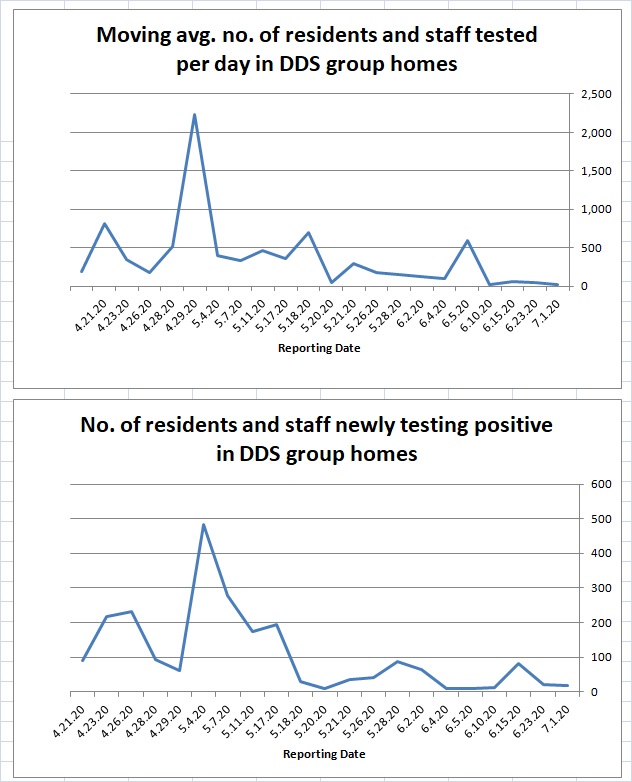
Source: DDS data reports
Both the daily rate of testing and the number of new positive cases show large spikes in late April-early May. The daily testing rate graph shows the spike occurring April 29. The positive cases graph shows the spike occurring on May 4, just five days later.
From late May onward, both graphs show lower numbers of average daily testing and positive COVID cases than had been the case in early May.
Prior to announcing a new, less restrictive policy on visitation last week, DDS Commissioner Jane Ryder stated in an email to COFAR that the number of new COVID cases “have been decreasing in DDS residential programs, much as they have across the state.” She added that DDS believed the reasons for that decline include “the visitation restrictions adopted in March…along with hand hygiene, testing, and mask use.”
Ryder didn’t note the decline in testing itself, and didn’t respond to our questions about the lower rate of testing and the possible impact it was having on the numbers of reported cases.
The administration appears to believe that if the providers are reporting fewer people showing symptoms, there isn’t a need for testing of either residents or staff. Perhaps their strategy is that if the numbers of symptomatic people start to rise, they will ramp the testing back up at that time.
In the meantime, let’s hope the providers are reporting the situation in the group homes correctly to DDS. We have no way of knowing for sure.
DDS releases provider-based data showing widespread scope of COVID-19 infections in group homes
Residents and staff have tested positive for COVID-19 in group homes in Massachusetts run by more than 80 percent of corporate providers to the Department of Developmental Services (DDS), according to data from the Department.
The data also shows that residents tested positive in all of the state-operated networks of group homes, while staff tested positive in at least three of those regional networks.
The data, which was provided last week after we had filed a Public Records request in mid-May, is the first indication of how widely the virus has spread throughout the largely provider-based DDS system.
The data also show that deaths of residents have occurred in residences operated by at least 44 corporate providers in addition to as many as three of the state-operated networks and the two developmental centers.
An undetermined number of staff have died of the virus in residences operated by three corporate-providers, although that total number is less than 15. DDS, citing privacy concerns, did not provide actual numbers in instances in which there have been less than 5 cases or deaths, but listed those as “<5” cases or deaths.
In totaling the cases and deaths, we have counted instances in the chart labeled “<5” as 1 case or 1 death, which obviously makes the totals very conservative.
For instance, while the chart shows a total of 69 deaths due to COVID-19 as of June 17, DDS has reported to us separately that the number of deaths is actually over 100. We would note that even that number may be lower than the real number of deaths due to COVID-19 because DDS has so far tested only about 75 percent of the residents in its system, and some providers have refused testing in their residences.
The chart is based on cumulative provider-based information reported to DDS as of June 17. We have ranked the providers from highest to lowest in the reported number of positive COVID-19 cases among residents of the facilities.
You can also download this DDS COVID-19 provider breakdown spreadsheet.

The data shows positive cases occurring among residents in group homes operated by at least 103 of 125 DDS corporate providers, or 82 percent of them. It also shows positive cases among staff in residences operated by at least 111 providers, or 88 percent.
A total of 22 providers reported zero positive cases among residents. However, it could be that at last some of those providers have not allowed any testing in their residences. DDS has provided separate data to us stating that since April, 1,100 out of a total of 2,100 provider-run group homes reported positive cases in those residences.
As the chart above also shows, there have been 5 deaths reported at the Hogan Regional Center, and at least one death reported at the Wrentham Regional Center as of June 17. There have also been at least one death each in networks of group homes operated by 44 out of 125 corporate providers, and by 3 or more of the state-operated networks.
Caution in interpreting the data
We would offer some words of caution in interpreting this data. One is that it is based on reporting by the providers themselves to DDS, and it is also based on what has so far been a limited amount of testing done of residents and staff. As noted, if a provider has zero positive cases on the list (as the blank cells indicate), that could mean that they are among the providers that have refused testing, claiming that no one in their group homes has shown symptoms.
Similarly, if a provider or group home network is ranked high on the list, that may not necessarily mean conditions are more dangerous in those residences. Northeast Residential Services (NRS), a state-operated group home network, is at the top of the list in the number of residents testing positive, with 82 residents and 73 state-employee staff testing positive. However, NRS is also one of the largest networks of group homes in the state.
We also know that residents have been repeatedly retested in NRS homes. It is unclear whether residents are subjected to retesting in corporate provider-based homes. We have never gotten an answer from DDS to our question whether retesting is done in more than a small number of provider residences.
Among providers, Vinfen, also one of the largest corporate DDS providers, is second highest in the number of positive cases among residents, with 78 residents and 64 staff testing positive. Bridgewell, another large provider, had 100 staff testing positive — the highest number of positive staff on the list.
As the chart shows, as of June 17, there were at least 1,520 positive total cases of the virus among residents, as reported by the providers and by the state-operated group homes, and two state-run developmental centers.
There have been at least 1,355 corporate provider staff testing positive, and at least 401 state-employee staff testing positive. (This is the first breakdown we have had of the number of corporate provider versus state-employee staff testing positive.)
NRS has had the highest number of deaths, with 10 in its group home network. Vinfen is second highest, with 8 deaths in its residences.
It’s not possible to tell from the data provided which group homes the positive cases or deaths have occurred in, or when these cases occurred.
It was notable, but not surprising, that the DDS response to our May Public Records Request stated that the Department does not have records on the number of residents showing symptoms or the number of staff refusing to be tested. We had asked for those records as well. It’s further evidence that the DDS data collection system has big gaps in it.
We would point out that this provider breakdown of COVID-19 testing data is information that a number of families in the DDS residential system have apparently asked for, but which the Baker administration has so far refused to publish online.
Information has long been available on the state’s website about COVID-19 cases and deaths in nursing homes and other long-term care facilities overseen by Department of Public Health (DPH), and even in correctional facilities. But no such detailed information is posted about DDS providers.
It took DDS more than five weeks to respond to our Public Records request for the breakdown of the testing information by provider, necessitating an appeal by us to the state Public Records Supervisor.
We will continue to ask DDS for updated information on COVID testing, broken down by provider. It still appears that we will have to either ask the Department on a periodic basis for this information or file further Public Records requests in order to obtain the latest data.
If DDS does not provide the information in a timely manner, we are reserving our rights to renew our appeal for those records.
A comparison of two contracts for COVID-19 testing shows a bias against persons with developmental disabilities
We examined two emergency contracts that the state has signed with two separate ambulance companies to test different groups of people for COVID-19 in congregate settings.
The comparison of the two no-bid contracts provides yet more evidence that the administration is less concerned about persons with intellectual and other developmental disabilities than it is about other populations.
We received both contracts from the Executive Office of Health and Human Services (EOHHS), under a Public Records Law request.
One of the contracts, signed with the Quincy-based Fallon Ambulance Service, is for testing residents and staff in group homes and developmental centers funded by the Department of Developmental Services (DDS.) The contract doesn’t mention DDS, however, which is part of the problem.
The other contract, with Weymouth-based Brewster Ambulance Service, is to test persons in nursing homes and other congregate facilities for the aged, many of which are licensed and regulated by the Department of Public Health (DPH). The contract appears technically to be an amendment to an existing contract between Brewster and EOHHS.
Lack of specifications
To start with, the Fallon contract doesn’t specify testing at DDS sites, and, as noted, doesn’t mention DDS. It says only that Fallon must “travel to sites as specifically directed by EOHHS” and test “certain individuals” for COVID-19. The contract doesn’t specify that Fallon must test either residents or staff.
DDS has told us that Fallon’s job is ultimately to test all residents and staff in the group homes and developmental centers in its system, and that Fallon is the only company currently undertaking that testing service for DDS.
The Brewster contract, in contrast, specifies that the company must test for COVID-19 in skilled nursing facilities, assisted living, rest homes, and senior housing. That contract also doesn’t specify testing of residents or staff, but the administration has required that the facilities test all staff in order to receive hundreds of millions of dollars in funding for COVID-related costs.
We have reported that staff in the DDS system, on the other hand, can opt out of testing altogether, and the Fallon contract appears to reflect that situation.
In not specifying DDS facilities, the Fallon contract casts doubt on the state’s commitment to fully test individuals in the DDS system.
No minimum daily amount of testing required
Despite the emergency nature of the COVID crisis and the emergency procurement of the Fallon services, there is no sense of emergency in the terms of the contract itself. There is no required daily rate of testing, for instance, and no timeline for testing the entire DDS system.
There is no timeline in the Brewster contract either, but that contract does require testing a minimum of 250 individuals a day, 7 days a week, and requires that the company communicate results of tests within 72 hours to those tested.
As we have reported, Fallon’s testing rate has been steadily dropping. Between June 1 and June 15, Fallon has averaged only 80 tests a day, according to DDS data. That is down from a peak on April 29, when the company performed more than 2,000 tests on that one day.
To date, based on the data, Fallon has tested about 75% of the total residents in the DDS system, leaving more than 2,000 residents and an undetermined number of staff waiting for their first test.
The Brewster contract requires the company to “prioritize” its testing services under the contract “over the provision of identical or similar services for any other entity to which it provides services.” There is no similar provision in the Fallon contract.
Contract was not signed until weeks after Fallon started
Although Fallon began testing in DDS residential facilities on April 10, according to the Department, the Fallon contract was not signed until May 19 by a Fallon senior vice president, and until May 27 by a top EOHHS official.
Thus, Fallon was doing the testing for more than six weeks before the contract was signed by both parties to it.
The contract states that it is effective from April 7 through December 31, or 60 days after the expiration of the state of emergency, whichever is earlier.
Leaving aside the legal implications of not signing the contract, the fact that the state, in particular, didn’t bother to sign it for six weeks, raises further questions about the administration’s commitment to testing in the DDS system.
Even if the contract had provisions requiring Fallon to test at a minimum rate, the state would have had no legal means of compelling the company to meet such requirements if there was no signed contract.
The Brewster contract was signed on May 4, the date that the company began working under the EOHHS testing program, according to the contract.
We first asked EOHHS for the Fallon contract on May 21, but it apparently hadn’t yet been signed by both parties to it. We didn’t receive the two contracts from EOHHS until June 15.
Both contracts contain detailed requirements regarding testing procedures, the use of Personal Protective Equipment by testing personnel, and the use of certified labs that analyze the results. The fact that no such provisions were in effect contractually in Fallon’s case for six weeks raises questions about the nature of any agreements that EOHHS had with the provider to follow testing protocols and use certified labs.
No projected total contract payment
Neither the Fallon nor Brewster contracts project a total payment amount, and each contract specifies a different level of payment per testing visit.
The Fallon contract specifies payment of $80 per hour for each EMS personnel. The testing team consists of two EMS personnel, a “tech” and a “monitor.” The contract does not appear to be clear about payment of the tech and monitor.
The Fallon contract also specifies that the company will be paid for one hour prior to the beginning of each testing visit and one hour after completion to cover planning, travel, and other tasks.
The Brewster contract refers to an administrative executive order (Administrative Bulletin 20-18), which appears to specify a flat payment of $305 per testing visit.
New contract needed for DDS testing
“It sounds like it (the DDS testing) is ending in the manner it began – an empty husk,” said COFAR President Thomas Frain. “If you apply the same criteria to DDS testing that are on display for everyone else, i.e. the importance of testing in keeping people safe, this has been a failure.
“People challenged by intellectual disabilities are treated disparately,” Frain continued. “We were made promises about testing of our loved ones that have turned out to be false and (EOHHS) Secretary (Marylou) Sudders and DPH are in the thick of it.”
Sudders, in particular, never responded to our email query in May as to why Fallon’s daily testing rate was so low in the DDS system and why no other company had been hired to supplement Fallon’s testing efforts.
We think a new contract needs to be drafted that specifies testing of residents and staff in the DDS system and sets a minimum daily testing rate that is significantly higher than what Fallon is currently doing. Moreover, DDS should seek competitive bids for that contract.
Onerous and inconsistent restrictions placed in some cases on families in post-COVID-lockdown visits
Limited visits by family members to loved ones in the Department of Developmental Services (DDS) residential system began last week, technically ending the COVID-19 lockdown.
But we have gotten reports that some of the restrictions placed on those visits have been onerous and others inconsistently applied.
While some families have reported that their first visits went very well, others have had problems. There appears to be a lack of consistency in how different providers are treating the same types of situations.
On Monday, COFAR Executive Director Colleen Lutkevich and President Thomas Frain sent an email to DDS Commissioner Jane Ryder, pointing out concerns about the process, and about highly restrictive DDS visitation guidelines that the Department issued last week to families.
When we first read the visitation guidelines, we were immediately concerned that their restrictive nature and the large amount of discretion given to providers might result in inappropriate or unnecessary bans on family contact.
We are also concerned that at the same time that DDS has begun allowing family visitation, the Department appears unconcerned that the rate of testing in the residential system for the virus has slowed down to a practical standstill.
During this past week, we have received reports that appear to bear out our concerns about the visitation restrictions.
In one case, a parent said she was told she cannot visit her son, who she hasn’t seen since the lockdown began in March, because some of the residents in his group home had tested positive after being retested. Because her son has consistently tested negative, she asked the provider if her son could have an off-site visit with her, but her request was denied. She said the provider told her DDS has forbidden off-site visits.
That reported statement by the group home provider about off-site visits appears to contradict DDS’s position as we understand it. On June 8, DDS Ombudsman Christopher Klaskin stated to us in an email that even prior to the resumption of the currently limited visitation, “group homes were not fully locked down, enabling providers to take individuals for walks or even on short outings (to parks, drive through restaurants).”
It doesn’t make sense to us that even during the lockdown, residents were taken off site to commercial establishments in which they presumably were brought into proximity with strangers who may or may not have been wearing masks. Yet now, during a resumption of family visitation, residents are not allowed to have off-site visits with their families, and some providers are not allowing family members to take residents off site even to parks or places free of other people.
Given that off-site visits to commercial establishments have been allowed all along, off-site visits with family members should be permitted as well, Frain and Lutkevich stated in their email to Ryder.
In one case, a parent got mixed messages from two different supervisors in her son’s group home. One supervisor said she could not walk with her son on the sidewalk in front of the house, while another supervisor said she could do that. She said she would love to drive her son to a park to walk, but was told she is not allowed to take him in her car.
Meanwhile, another parent said the staff of a group home took his daughter and another resident out for “a very long walk around a scenic park next to the home.”
Another parent said that prior to the lockdown in March, her daughter was used to coming home every weekend, “and is emotionally getting affected at this point severely.” She added that not only is her daughter not allowed to come home even now, “they (the group home staff) aren’t even doing outings.”
The mother of a resident at the Hogan Regional Center said she had been scheduled to visit her son on June 10 for a half hour outside with masks on. But she received a call and email the night before informing her that the visit was put on hold because a resident in a different building had tested positive for COVID-19, and that all visits were on hold.
The woman then asked if her son could be allowed out on the screened porch in his wheelchair at the facility while she stood outside on the lawn “just to see him and him hear my voice.” She was told that was not allowed.
Another parent told us her child has not had a hug and most likely little to no human touch since mid-March. She was told by her provider that she cannot bring a birthday cake to share with her daughter even while they are outside and 6 feet apart.
The woman in that case said she offered to stay 15 feet away while eating, but was told that was not allowable because she and her daughter would have to remove their masks to eat. Yet, during the lockdown, the same provider was taking the woman’s daughter to fast food restaurants and other commercial establishments.
Lutkevich and Frain suggested that DDS send guidance to the providers on how to handle the resumption of visitation. They noted that DDS has sent very restrictive guidelines only to families.
“Given the discretion that the providers have under those guidelines, we think the providers actually need to be told that families should be treated with respect in these circumstances,” Lutkevich and Frain stated.
Lutkevich and Frain added that the types of apparent inconsistencies in restrictions they described “need to be addressed, and common sense needs to prevail.”
For instance, they said, providers need to be told that families are allowed to take their loved ones off site if it can be done safely. That appears to be DDS’s position, as we understand it, but some providers apparently don’t seem to know that.
What this all seems to highlight is an ongoing pattern in which DDS places burdens on families in the stated interest of furthering the safety of the residents while avoiding anything that can be seen as burdensome on providers.
Why place difficult restrictions on visits by families to group homes while, at the same time, failing to ensure that timely testing for the virus is taking place in those facilities? What purpose does it serve other than prolonging the suffering that people have been enduring for months now?
 COFAR blog