Archive
Most of the mainstream media skipped class last week on privatization and the Pacheco Law
It’s amazing how little real understanding the mainstream media has of the issue of privatization and of legislative responses to it such as the Pacheco Law.
You only have to read this Boston Globe editorial from 2011 to begin to realize how many misconceptions supposedly savvy journalists have about these issues. (More about that below.)
Privatization is one of the most important and controversial aspects of state and federal policy. When I googled the phrase “privatization and public policy,” I got 2.7 million results. The state auditor’s administration of the Pacheco Law has become a key item of controversy in Massachusetts politics as well.
In that light, the State Auditor’s Office and the Boston Bar Association organized a forum directly across the street from the State House this past Thursday afternoon to discuss and debate the Pacheco Law and its impact on privatization, and invited the media to attend.
I was invited to present the pro-Pacheco Law side in the discussion, and Charlie Chieppo, a senior fellow at the Pioneer Institute, presented the anti-Pacheco Law side. A number of top people from the Auditor’s Office presented information on how the law works, highlights of its 23-year history, and key areas of litigation involving the law. Michael LaGrassa of UMass Dartmouth discussed the university’s experience with the Pacheco Law in privatizing the campus bookstore operations in 2014.
In addition to the lineup of speakers, the State Auditor’s Office had put together three-ring binder notebooks filled with helpful information on the Pacheco Law and what it actually does and requires, in addition to materials we had submitted stating our positions on the law. (Included in the binder was our report, “Setting the record straight about the Pacheco Law.” I’ll post that report here this week.)
As I understand it, two members of the media showed up at the Thursday forum — a reporter from Massachusetts Lawyer’s Weekly and a reporter from The Boston Business Journal. I haven’t yet seen anything published from them, but at least they were there.
Neither the Globe nor Herald sent anyone to the event. Notably absent was Globe columnist Scot Lehigh, who has been described as someone who “has been the most consistent and vociferous critic of the (Pacheco) law…”
From my vantage point, there appeared to be some 50 to 60 people in attendance at the forum.
Among the little-known and discussed facts about the Pacheco Law that I tried to point out during the forum were that:
- The Pacheco Law was based on federal policy (OMB Circular A-76)
- The law never barred or banned the award of bus contracts by the MBTA, and the law has not stopped privatization of most human services in Massachusetts
Chieppo of the Pioneer Institute argued that the Pacheco Law is different than A-76 because A-76 requires a binding letter of obligation if the public employees win the bid competition with the private sector. (I disagreed with his assertion that no such obligation binds state employees under the Pacheco Law.)
LaGrassa of UMass said the Pacheco Law review that the university did to privatize their bookstore helped them to better understand the costs involved in running it. He said that the process involved a lot of work and back-and-forth with the auditor’s office; but in his words, “you should do a lot of work” if you are going to privatize a public service.
Regarding the 2011 Globe editorial referred to above:
Memo to Globe editorial writer: Contractors bidding to privatize services don’t have to pay public sector wages under a Pacheco Law review. They can pay the lesser of the lowest public sector wage or the average private sector wage for the equivalent position.
And no, a privatization initiative doesn’t have to “produce savings” over what the state employees could achieve under ideal conditions. The privatization initiative must project such savings, but no one has to — or is expected to — actually produce them. The Pacheco Law requires a competition between private and public sector bids, both types of which are based on projected results that might be achieved under ideal conditions.
The bottom line, it seems to me, is that people in the mainstream media still occupy influential positions as opinion makers regarding politics and government, in particular. As such, they have an obligation to get their facts straight on these matters. The state auditor’s “Primer” on privatization last week presented a convenient opportunity to do that.
But with two exceptions, the mainstream media blew their opportunity by missing the class.
Baker administration interpreting Pacheco Law to potentially benefit private company
In what may be one of the first tests of the Pacheco Law in the privatization of human services, the Baker administration is seeking to contract out existing emergency mental health services in southeastern Massachusetts.
What concerns us about this situation is that the administration is reportedly interpreting the Pacheco Law to allow a for-profit company, the Massachusetts Behavioral Health Partnership (MBHP), to cut its proposed wage rates within roughly a year after starting to provide those services and potentially to pocket the extra profits.
This is not surprising given that a key executive from MBHP was appointed to a new position in the Baker administration that appears to have at least a supervisory role over contracts with the company. (More about that below.)
The administration’s interpretation of the Pacheco Law has drawn a rebuke from the law’s author, state Senator Marc Pacheco.
First, however, a bit of background: The Pacheco Law requires a state agency seeking to privatize services to submit to the state auditor a comparison of a bid or bids from outside contractors with a bid from existing employees based on the cost of providing the services in-house “in the most cost-efficient manner.”
If the state auditor concurs that the outside bidder’s proposed contract is less expensive and equal or better in quality than what existing employees have proposed, the privatization plan will be likely to be approved. If not, the auditor is likely to rule that the service must stay in-house.
Two key provisions of the Pacheco Law that potentially apply here are:
-
- Under the law, an outside contractor’s proposed bid must specify wages at the lesser of either the average private-sector wage for the equivalent position or the lowest public-sector wage level for the position. In other words, the law establishes a minimum wage rate that the outside contractor must propose.
- The Pacheco Law does not apply when contracts for privatized services are renewed. In other words, if a private bidder wins a contract under the Pacheco Law process, that contractor does not have to undergo another review by the auditor in order to renew the contract.
The reason that Provision 2 above is pertinent to this case is that MBHP currently has an ongoing Primary Care Clinician (PCC) contract with MassHealth for separate clinician services that is scheduled to run through June 30, 2017.
As we understand it, the administration intends that the current PCC clinician services contract with MBHP will become the overall contract for the emergency services that the administration is now seeking to privatize. And the administration’s interpretation of Provision 2 above is that if the privatization plan is approved by the auditor, all of the contract provisions in the contract bid will cease to exist when the current PCC contract is renewed.
Thus, it is reportedly the administration’s position that after the MBHP’s PCC contract with MassHealth officially ends in June 2017, MBHP will be legally free to cut the wage levels it is stipulating in its bid. If so, we believe it is unlikely that the company would pass along the savings in cutting wages to state taxpayers, but would instead pocket those savings as profit. As a for-profit, MBHP has an incentive to pocket any operating cost savings as retained earnings.
The administration’s interpretation of the Pacheco Law is ironic because one of the main objections to the law from the law’s most vocal opponent, the Pioneer Institute, is that the bidding contractor in a privatization proposal is required to stick to the terms of its bid whereas there is nothing in the law to ensure that the terms of a state employee bid are enforced.
As Pioneer stated in an influential report last year (linked above):
The Pacheco Law does not contain any requirement that agency employees subsequently provide service in the most cost efficient manner or in an improved manner if the proposed privatization contract is rejected.
But in fact, it appears that it is the administration’s interpretation that it is the outside contractor that doesn’t have to stand by its bid once its contract is renewed.
Sen. Pacheco himself has warned that the administration’s interpretation of the law that was named for him would “undermine” the intent of the law. In a letter sent to Attorney General Maura Healey in November, Pacheco stated that:
Although renewal contracts for validly privatized work do not need to be resubmitted to the Auditor (for a Pacheco Law review), it was never my or the other supporters’ intent that wages and health benefits could sink lower than the “minimum wage” established by the Taxpayer Protection Act (the Pacheco Law) once the initial contract expired. If that is permitted, the statutory purposes of preserving the quality of publicly funded services and providing minimum protections for private sector and public workers would be completely undermined.
Moreover, it seems to us that the Pacheco Law does prevent the state employees from submitting an artificially low bid and then subsequently ignoring it. The Pacheco Law states that if the employees want to submit a bid with wage costs that are lower than what are in a collective bargaining agreement, they must negotiate a change in that agreement with the applicable state agency. That new collective bargaining agreement is binding on the state employees and cannot be changed unless the state agency agrees.
A potential decline in service quality
As we understand it, the Baker administration is projecting a savings of $5 million a year in privatizing the emergency mental health services in Southeastern Massachusetts.
SEIU Local 509, a state employee union, has put in a bid on behalf of the state employees currently providing the emergency services that envisions saving about $500,000 per year. So, the state auditor may well determine that there would be a greater savings in privatizing the services. However, the union is arguing that the quality of those services is likely to decline under the privatization plan because the financial savings will depend on major cuts in staffing.
The administration’s reported interpretation of the Pacheco Law’s contract renewal provision appears to bear out the SEIU’s concerns about a potential drop in the quality of the privatized services offered by MBHP. If MBHP or its subcontracting firms are legally free as of mid-2017 to cut the wage rates proposed in MBHP’s bid for the emergency services, it seems to us to be very likely that the quality of those services will suffer.
Political connections appear to have played a role in the MBHP case
It’s hard to overstate how politically connected MBHP is. There appear to be a number of close relationships between the company and the Baker administration and with previous administrations — and in particular with the Executive Office of Health and Human Services, which will oversee the privatized mental health services.
Last April, Scott Taberner, previously the chief financial officer at MBHP, was named Chief of Behavioral Health and Supportive Care in MassHealth, the division of EOHHS that administers Medicaid and healthcare for low income and disabled persons. Taberner’s position in Masshealth was created by the Baker administration. MassHealth is seeking the privatized mental health services contract with MBHP.
Prior to that, in late May 2014, Beacon Health Strategies (Beacon) announced its plan to merge with ValueOptions, the parent company of MBHP. Under the arrangement, Beacon will be 50 percent owned by Bain Capital and 50 percent owned by Diamond Castle Holdings.
Bain Capital was formed by former Massachusetts Governor Mitt Romney. Last April, the same month that Taberner joined the Baker administration, former Massachusetts Governor Deval Patrick joined Bain as a “social impact” investment advisor. That doesn’t appear to have any direct connection to the proposed MBHP privatization contract, but I thought I’d throw that in.
According to the Mass. Psychological Assn. (MPA), ValueOptions and Beacon both hold a large market share in programs in Massachusetts that are paid for through public funds. As noted, MBHP manages benefits for the PCC program. The MPA estimated that once the merger was finalized, Beacon would manage the behavioral health benefits of 78 percent of the Massachusetts Group Insurance Commission members and of 70 percent of MassHealth members.
A coalition of health care advocacy groups signed onto an MPA letter in August 2014 to the Mass. Health Policy Commission, expressing concern about the proposed merger of Beacon and ValueOptions. The letter stated that the merger “will limit the already narrow choices offered to insured individuals whose primary diagnosis is related to behavioral health…”
It does appear that the merger went through. Now it appears that MBHP is being primed by the administration to run the privatized emergency mental health contract via MassHealth; and Taberner, a former MBHP executive, appears to be involved in that effort or is at least in a position to oversee it.
The administration itself has described Taberner’s new position at MassHealth as follows:
…Taberner will lead reforms to better coordinate and integrate care for behavioral health, physical health and long-term services and supports for elders and persons with disabilities.
The Baker administration wants to make the emergency mental health services part of the MassHealth PCC contract with MBHP. A former MBHP executive is now in a high-level position in the state agency contracting with his former company. And now the administration is interpreting the Pacheco Law in MBHP’s favor by indicating that if the privatization plan is approved, MBHP will be legally free to cut wage levels as of June 2017 when its PCC contract up for renewal.
 The Pacheco Law has borne the brunt of much bad press and political criticism over the years; but we have argued that most of that criticism has been based on misinformation about the intent of the law and what it actually does. The proposed privatization of the Southeastern Massachusetts emergency mental health services demonstrates why the auditor’s scrutiny is needed of such privatization proposals and consequently why the Pacheco Law provides critically important protections for taxpayers and the quality of public services.
I’ll be defending the Pacheco Law at a Boston Bar Assn. forum next month
Based on our blog posts earlier this year defending the scrutiny of the privatization of state services that is provided under the Pacheco Law, I’ve been asked to present a defense of the law at an upcoming forum sponsored by the Boston Bar Association.
Arguing in opposition to the Pacheco Law at the January 7 forum will be Charles Chieppo, a senior fellow at the Pioneer Institute, one of the state’s leading proponents of privatization and leading critics of the Pacheco Law.
Also participating in the forum will be two presenters from the State Auditor’s Office, which administers the law, and Michael LaGrassa, assistant vice chancellor for administrative services at at UMass Dartmouth.
The Pacheco Law has borne the brunt of much bad press and political criticism over the years; but we have argued that most of that criticism has been based on misinformation about the intent of the law and what it actually does.
The law requires a state agency seeking to privatize services to compare bids from outside contractors with a bid from existing employees based on the cost of providing the services in-house “in the most cost-efficient manner.”
If the state auditor concurs that the proposed contract is less expensive and equal or better in quality than what existing employees have proposed, the privatization plan will be likely to be approved. If not, the auditor is likely to rule that the service must stay in-house.
Earlier this year, in the wake of a critical report about the Pacheco Law by the Pioneer Institute, the state Legislature suspended the law’s provisions for three years with regard to the MBTA.
While the Pacheco Law does not appear to have had a role in preventing the past privatization of human services, which we are primarily concerned with, we are concerned that the Baker administration’s next step might well be to exempt future privatization of human services from the law.
At Blue Mass Group, where we often cross-post our blog posts, I and other commenters have already engaged in quite a bit of online debate (here and here) over the Pacheco Law with Greg Sullivan of the Pioneer Institute. I’m looking forward to continuing to set the record straight about this important law at next month’s forum.
Virtually no one waiting for DDS care getting into state-run DDS homes
Despite the fact that an unknown number of intellectually disabled people are waiting for residential services in Massachusetts, new data provided by the state appear to show that virtually none of those people are getting into state-operated group homes.
According to the data, provided by the Department of Developmental Services in response to a Public Records Law request, the number of people living in state-operated group homes in Massachusetts increased by a total of 144 between fiscal 2008 and 2015.
Previously, DDS had provided data showing a total of 156 persons had been transferred from state-run developmental centers to state-operated group homes between fiscal 2008 and 2014.
These numbers seem to imply that the entire increase in population in the state-operated homes since 2008 came from the developmental centers. Also, the numbers appear to imply that up to 12 of those transferred residents have either died or been transferred for a second time to some other location since 2008.
We’ve written previously that DDS data appeared to show that the Department was failing to inform people seeking residential care of the option of state-run services. Families and individuals appear to be directed almost exclusively to group homes run by corporate providers to DDS.
In addition to provider-run group homes, DDS maintains a network of group homes that are staffed by departmental employees. State workers have better training on average than do workers in privately run residences, and have lower turnover and higher pay and benefits.
There are an unknown number of people in Massachusetts waiting for residential care and services from DDS. This number is unknown because DDS doesn’t officially acknowledge a waiting list. The Massachusetts Developmental Disabilities Council has cited a 2010 survey indicating that some 600 people were waiting for residential services in the state, and up to 3,000 people were waiting for family support services.
Despite the apparent lack of sufficient housing and services for all of those who need it, DDS appears to be steadily phasing out state-run services and transferring those services to private providers. Yet, the capacity of the provider-based system is clearly inadequate to meet the entire need for services. And as we’ve recently noted, privatization of state services doesn’t automatically result in lower cost or better quality.
Some other highlights of the new DDS numbers:
- There were a total of 266 state-operated homes in Massachusetts as of April 2015, which amounted to a net increase of 40 homes over the total number in 2008. Previous data from DDS indicated that DDS had closed 28 state-operated residences since 2008.
- Virtually all the (97 out of 99) people living in the state-operated homes that were closed were transferred to the new state-operated homes.
Thus, there has been a total of 253 people who have been transferred since 2008 from the developmental centers and the closed state-operated homes, apparently all to the new state-operated homes.
This raises a further question about DDS’s priorities. Given the hundreds waiting for residential care in the state, why did DDS close 28 state-operated group homes in the past eight years?
- DDS has no projections on the number of people who will be living in state-operated homes in the next five to 10 years.
The bottom line is that it appears the state-operated DDS system has been expanded only enough to accommodate people already receiving services.
The situation may violate the federal Medicaid Law, which requires that intellectually disabled individuals and their guardians be informed of the available “feasible alternatives” for care. In addition, the situation appears to violate the federal Rehabilitation Act, which states that no disabled person may be excluded or denied benefits from any program receiving federal funding.
On July 27, I sent an email to DDS, asking for information on the number of people who have been admitted to state-operated group homes who were not transferred there from other state-operated homes or from the developmental centers. I haven’t yet received a response to that question, but I will be very surprised if the answer is more than a handful of people.
As this post attempts to demonstrate, it is virtually impossible for anyone seeking DDS services to be admitted to a state-operated group home. One of the few people who was able to accomplish it in recent years had to file a federal lawsuit to do so.
Both the administration and the Legislature have provided disproportionate increases in funding to the provider-operated residential system in Massachusetts, and have continued to short-change state-operated care. Now that it turns out that the previous fiscal year ended with a $200 million surplus and not the deficit that had been projected, we hope the Legislature will begin to consider restoring some balance to the DDS system, and begin to fund state-run care adequately.
Governor’s MBTA panel provided virtually no support for its recommendation to restrict the Pacheco Law
The Governor’s Special Panel to Review the MBTA earlier this year made some reasonable proposals to better manage the MBTA. But the Panel report’s recommendation to remove the MBTA from the Pacheco Law’s jurisdiction appears to us to have been a misstep; and the report spent less than a sentence in explaining the rationale for its recommendation.
Based in part on the Panel’s recommendation, the Legislature suspended the Pacheco Law’s provisions for three years with regard to the MBTA, thereby removing an important means of ensuring long-term cost-effectiveness in privatizing services at the T.
The Pacheco Law’s stated intent is “to ensure that citizens of the commonwealth receive high quality services at low cost.” The Special Panel’s report asserted, however, that “the MBTA is inhibited by the Pacheco Law from procuring private, cost-effective services…”
That latter statement, which appears to constitute the sum total of the Panel’s discussion of the Pacheco Law, appears to be at odds with the stated purpose of the statute. There is no additional comment in the report about the impact of the law — not even an explanation of what the law does.
Moreover, as discussed below, the Special Panel did not appear to have consulted with state agencies that oversee procurement of supplies and services in Massachusetts, in preparing its report. Possibly as a result, the Special Panel’s report also appears to be incorrect in stating (in that same sentence) that the MBTA is “strictly limited by state law in its use of many procurement processes (e.g., CM at-Risk and Design/Build).” More about that below as well.
The Special Panel has previously run into criticism from CommonWealth magazine for flawed methodology on which it based a separate finding concerning employee absenteeism at the MBTA.
What the Pacheco Law actually requires
As we’ve noted before, the Pacheco Law requires a state agency seeking to privatize services to compare bids from outside contractors with a bid from existing employees based on the cost of providing the services in-house “in the most cost-efficient manner.” The bids from both contractors and existing employees are examined by the state auditor, who must determine whether:
1. the proposed contract cost is lower than the calculated cost of providing in-house services in the most cost-efficient manner; and
2. the quality of the proposed services will be equal to or better than the quality of the services proposed by the existing employees.
What this means is that both parties — the state employees and the outside contractors — can bid to provide the services; and, if the state auditor concurs that the proposed contract is less expensive and equal or better in quality than what existing employees have proposed, the privatization plan will be likely to be approved.
The Special Panel contends that the Pacheco Law “inhibits” privatization. But State Auditor Suzanne Bump has stated that her office has approved 12 out of 15 privatization proposals presented to the office since the Pacheco Law was enacted in 1993.
The Special Panel did not consult key state agencies that regulate procurement of supplies and services in Massachusetts
Among the 38 organizations listed by the Special Panel in its report as having provided the Panel with input, most were special interest groups, ranging from the Mass. Association of Realtors to the Conservation Law Foundation to the Boston Carmen’s Union. But not on the Panel’s list was anyone from the office of the state auditor, which, as noted, administers the Pacheco Law, or either the inspector general or attorney general’s offices, which oversee state procurement laws and regulations.
That may explain why the Special Panel’s report stated, apparently incorrectly, that the MBTA “is strictly limited by state law in its use of many procurement processes (e.g., CM at-Risk and Design/Build).” In fact, this is the second half of the sentence cited above, claiming that the MBTA has been “inhibited” by the Pacheco Law. Once again, a single sentence (or rather half a sentence) constitutes the sum of the report’s discussion of an allegedly serious problem faced by the MBTA — in this case, the alleged limitations on the MBTA’s procurement options.
Construction management at-risk (CM at-risk) and design-build services are alternatives to the traditional design-bid-build approach in managing public projects. Under the traditional approach, construction contractors bid on fully completed designs. The alternative approaches allow for fast-tracking some construction activities before design is complete.
Despite the Special Panel’s assertion, the state’s bidding laws do provide permission to the MBTA and other state agencies to use CM at-risk for building construction projects (MGL C. 149A, Section 4), and design-build for public works projects, estimated in both cases to cost $5 million or more (MGL C. 149A, Section 16).
If the Special Panel’s concern was that the MBTA should be allowed to use CM at-risk and design-build on projects costing less than $5 million, it wasn’t stated in the report.
Email query to Professor Gomez-Ibanez
On January 28, I emailed Jose Gomez-Ibanez, a professor at Harvard’s Kennedy School and a member of the Special Panel, to ask whether he concurred with the Panel’s recommendation on the Pacheco Law.
Gomez-Ibanez has written compellingly about economic and political issues involved in the privatization of governmental functions and services. In a 2004 working paper, “The Future of Private Infrastructure,” he stated that:
…in retrospect it is clear that we severely underestimated the difficulties of privatization. We often failed to appreciate that the challenge of privatization was not primarily technical, but also fundamentally political.
In our view, the Pacheco Law implicitly recognizes those technical and political problems of privatization.
In my email, I stated that:
It is not surprising to us that a conservative think tank such as the Pioneer Institute might draw ideologically based conclusions about privatization. But it was surprising to me that the Governor’s Special Panel, which included faculty of Harvard and Northeastern Universities, including yourself, would support a recommendation that appears to have no written rationale to support it.
To date, I haven’t heard back from Gomez-Ibanez.
Critics of the Pacheco Law overlook the costs of privatization
In its single statement about the Pacheco Law’s impact, the Special Panel contends that privatized services are inherently more cost-effective than in-house services, and implies that even requiring a comparison between in-house and contracted services is unnecessary.
While the Special Panel provides no explanation for its assertion about the Pacheco Law, the Pioneer Institute, one of the chief critics of the law, argues that the major flaw in the cost-competition process under the law is the following: if the state employee bid is found to be lower than the contract bid, there is nothing in the law that requires the state agency to adhere to the state employees’ bid costs going forward.
But this argument overlooks the fact that there is little to prevent contract costs from rising over time as well.
As we pointed out previously, the cost of contracting at the T appears to have risen even faster than in-house services there. The T’s budget history appears to bear this out as well. The budget shows contracted commuter rail expenses rising by 122.5 percent between fiscal 2001 and 2016, compared with a 75.6 percent increase in-house wages during that same period. The budget also shows “purchased (contracted) local service expenses” rising by 336.3 percent between fiscal 2001 and 2016.
One of the reasons that privatization can be expensive is that the private sector tends to pay higher salaries than the public sector for upper-level management positions, and lower wages than the public sector for lower-level positions. So, allowing unfettered privatization of an already quasi-privatized organization such as the T would seem likely to exacerbate the problem of high executive salaries.
The Special Panel appears to have played political games with its report
I would venture to guess that at this point, some members of the Special Panel are wishing they hadn’t signed on to the product that the Panel ultimately delivered. Whenever the final report of a panel or commission is a PowerPoint presentation, as was the case with the Special Panel’s report, it may be a tipoff that the product isn’t first-rate.
I would also venture to guess that the single-sentence (or half-sentence) critique of the Pacheco Law in the Panel’s report may have been stuck in there at the last-minute — maybe at the request of the man who commissioned the report in the first place — Governor Baker — who has made the Pacheco Law a political target of his at least as far back as his first run for governor in 2010. Is it really a coincidence that Baker’s hand-picked commission came up with the very same recommendation about that particular law that Baker has espoused for years?
Politics and public policy obviously go hand in hand, and that’s as it should be. But major policy decisions should not be based solely on politics. Recent developments in the long-running saga of the Pacheco Law show how major policy decisions can, in fact, be based on ideologically biased analyses and unsupported statements from prestigious commissions.
MBTA commuter rail contracts rose by a greater percentage than in-house bus costs
While proponents of privatizing the MBTA point to the rising cost of in-house operations there, the cost to the agency of contracting out appears to have risen even faster.
The annual cost to the MBTA of contracting for commuter rail services has risen by 99.4 percent since 2000, compared with a 74.9 percent increase in the annual cost of the agency’s in-house bus operations, according to cost information we’ve compiled from public online sources (see below).
In our view, the rising cost of the commuter rail contracts since 2000 casts further doubt on the claims by the Pioneer Institute and other privatization proponents that contracting out for services will automatically save hundreds of millions of dollars at the T.
In case you missed it, the Pioneer Institute issued a report earlier this month that compared the actual cost of MBTA bus operations to a proposal based on bids from outside contractors to undertake those functions.
The Pioneer report concluded that had the state auditor allowed the planned privatization of the bus operations to go forward, the MBTA would have saved $450 million between 1997 and 2015. The report claimed those allegedly foregone savings were the fault of the Pacheco Law, which the auditor had cited in objecting to the outside contract proposal.
(As discussed below, the state auditor did not definitively reject the MBTA’s contract proposal, but rather asked the agency to resubmit its proposal after addressing concerns raised by the auditor about its cost calculations. The MBTA never did resubmit its proposal, but instead chose to sue the auditor in state superior court to reverse the auditor’s decision, and lost.)
The Pacheco Law requires state agencies seeking to privatize existing operations to show that bids from private contractors would be lower than a calculated cost of continuing to perform specified work by regular state employees “in the most cost-efficient manner.” The state agencies must submit their calculations to the state auditor, who has the final say as to whether the functions can be privatized.
Largely due to unrelenting political pressure from the Pioneer Institute and other privatization advocates, the Legislature approved a 3-year freeze earlier this month on invoking the Pacheco Law with regard to privatizing MBTA functions.
Last week, we raised a number of concerns about the methodology of the Pioneer report, including criticizing its comparison of actual in-house MBTA costs to bids. We argued that it’s meaningless to compare actual costs to hypothetical costs over a nearly 20-year period.
We think it would make more sense to compare actual in-house costs to actual contract costs over a multi-year period. An obvious candidate for an evaluation of actual contracting costs appears to be commuter rail.
The MBTA has contracted out for commuter rail service since the 1980s, according to a state audit report on the agency. Beginning in 1987, Amtrak began providing commuter rail services to the T under a cost-plus-overhead and profit contract. In 1995, this was changed to a negotiated fixed price contract with a three-year term and two one-year options.
In May 2000, according to the audit report, the MBTA was given permission by the federal government to extend the Amtrak contract without bidding for an additional three years. The total cost of the three-year contract extension, plus additional work that was in included in subsequent contracts, came to $168 million per year.
The Massachusetts Bay Commuter Rail Company (MBCR) subsequently won a competitive RFP process to operate the commuter rail system, starting in 2003. The cost per year of that fixed-price contract was $217.4 million, which amounted to a 29.4 percent increase over the cost of the Amtrak contract three years earlier. In that same period, the in-house cost of MBTA bus operations rose by just 12.8 percent, based on the Pioneer report’s figures (See chart below).

In 2008, the MBTA granted MBCR a three-year contract extension at a cost of $246 million per year, which amounted to a 46.4 percent increase in commuter rail contracting costs to the MBTA since 2000. In that same time, the in-house bus operations cost had risen 40.4 percent.
In 2011, MBCR received a final 2-year commuter-rail contract extension costing $288.5 million a year. By that time, the MBTA’s cost of contracting for commuter rail had risen by 71.7 percent since 2000, whereas the in-house cost of MBTA bus operations had risen by 55.7 percent.
Finally, the MBTA signed an eight-year contract last year with Keolis Commuter Services at an annual cost of $335 million, according to The Boston Globe. (Note: the headline on the linked Globe story appears to be wrong.) As a result, by the time Keolis began operations last July, its annual contract cost was 99.4 percent higher to the MBTA than the Amtrak contract cost had been in 2000. In contrast, the cost of in-house bus operations at the MBTA was only 74.9 percent higher in 2014 than it had been in 2000.
By the way, it may be only a matter of time before the Keolis contract cost rises above the $335 million annual amount, given that the company is reportedly already losing money operating the MBTA commuter system.
The Pioneer report characterized the in-house cost of MBTA bus operations as “inordinately expensive,” and concluded that for that reason, replacing that in-house service with contracted work in 1997 would have saved hundreds of millions of dollars. But the Pioneer report failed to consider the actual experience that the MBTA has had with contracting.
One might argue that you can’t legitimately compare the cost of commuter rail operations to bus operations. But at the same time, we think our comparison shows that entering into contracts for services doesn’t guarantee that the costs won’t rise dramatically. Since 1995, the commuter rail contracts have all been fixed-price contracts.
The Pioneer report misrepresented the state auditor’s objection to the MBTA’s 1997 privatization proposal as a “ban” on the award of the contracts
The Pioneer report referred in different places to the state auditor as having “banned” or “blocked” or “barred” the MBTA’s proposal to privatize the agency’s bus services in 1997. According to the report, this adverse decision, which was based on the Pacheco Law, not only thwarted the MBTA’s attempts to save costs and improve quality of its bus service, but the MBTA never again attempted to privatize that service.
But the actual decision by then State Auditor Joseph DeNucci did not ban or block or bar the MBTA from privatizing its bus services. Instead, DeNucci invited the MBTA to resubmit its proposal after addressing a number of issues raised in his decision letter and in a previous letter regarding the proposal. Among those issues were alleged failures by the MBTA to support specific cost savings in its bid proposal and to provide measurable indicators of service quality as a baseline for comparison, such as information about on-time performance.
It does appear that the MBTA was not happy with the issues and inquiries DeNucci’s staff was raising about the MBTA’s privatization proposal. According to DeNucci’s letter, the MBTA objected at one point to the auditor’s questions about how claimed savings in contracting out functions at garages in Charlestown and Quincy could be achieved since a third facility in Everett was providing services to support the two other garages.
When the auditor inquired as to how costs would be reduced at the Everett facility, the MBTA responded that the auditor’s inquiry was “of no significance,” and “beyond the scope” of the Pacheco Law.
DeNucci’s final letter to the MBTA stated the following:
Recommendation:
We believe that the MBTA should seriously address each of the above substantive issues disclosed
by our review. A carefully considered objective analysis of these matters, such as the Everett and
Arlington facilities, quality of service, changes and extra work, pension costs, 13(c), and bid price
changes, should be undertaken prior to privatization. A hasty, ill-considered, rather than a thorough
analysis, would not well serve the MBTA’s ridership and the taxpaying public.Conclusion:
Therefore, pursuant to Section 55(a) of Chapter 7, MGL, this office hereby notifies the MBTA of
its objection to the awarding of these contracts. In accordance with Section 55(d), this objection is final
and binding on the MBTA, until such time as a revised certificate is submitted and approved by this
office. As always, this office is available to discuss our findings and provide further assistance to the
agency. (my emphasis)
Whatever reasons the MBTA had for not answering the auditor’s questions, the fact that those questions remained unanswered was the reason that the auditor objected to the MBTA’s privatization proposal. Nevertheless, the auditor clearly invited the MBTA to try again and to resubmit a revised privatization plan that addressed the issues in the auditor’s review.
The Pioneer report implies that it is somehow the fault of the Pacheco Law and the state auditor that the MBTA never did revise or resubmit its proposal, and never again attempted to privatize its bus services. That seems to us to overlook the MBTA’s responsibility for failing to comply with the auditor’s reasonable requests for information.
If you want someone in authority to grant a request you’ve made, and they say they may well grant it, but first they would like some more information about it, do you then say “it’s none of your business?” That, in effect, appears to be what the MBTA told the auditor in the the bus privatization case.
It was the MBTA’s choice not to answer the auditor’s questions and subsequently to sue the auditor rather than resubmit its proposal. It was also the MBTA’s choice never to submit another privatization proposal to the auditor for those services.
Now, not only is the Pioneer Institute continuing to complain about the auditor’s 1997 decision, we think the Institute has failed to make the case that the decision cost the taxpayers money over the intervening years.
And one more thing about the Pioneer report’s calculation of the alleged foregone savings
As noted above, the Pioneer report’s figure of $450 million in lost savings from 1997 to the present, due to the Pacheco Law, is based on comparing the T’s actual in-house operating cost for bus service to an outside contract bid. The report stated that as a means of comparison, it escalated the proposed contract bid between the years 2002 and 2013, the last date for which in-house cost data on the MBTA was available. The Pioneer report escalated the contract bid by the same percentage rate that it escalated the in-house cost each year.
But why did the Pioneer report not escalate the contract bid for the first five years of the comparison (from 1997 to 2002)? For no readily apparent reason, the report lists the same hourly contract rate for those first five years of its comparison. Yet, the report shows in-house MBTA costs rising by over 18 percent during that same initial five-year period. Had the report applied the same escalation rate to the contract bid as it did to the actual in-house costs throughout the comparison period (1997 to 2015), it would reduce the alleged $450 million in foregone savings by about $72 million.
If there was a reason that the Pioneer report assumed the bus contract costs would remain flat for the first five years, but would escalate after that, it isn’t stated in the report, as far as I could tell. But even if the report had assumed the same escalation rate throughout the comparison period, we would still reject the entire comparison of actual to proposed numbers.
The Pioneer Institute does acrobatic logical twists re the Pacheco Law
In what has been widely viewed as a setback for state employee unions in Massachusetts, state legislators last week approved a state budget for Fiscal Year 2016 that includes a provision freezing the Pacheco Law for three years with regard to the MBTA.
The Pioneer Institute apparently had a lot of influence on the Legislature in approving the Pacheco Law suspension. The Institute and other long-time opponents of the Pacheco Law claim the suspension, or better yet, an outright repeal of the law, will allow the T to operate without “anti-competitive” restraints on privatization, and thereby improve transit service and save taxpayers millions of dollars.
We have waded through the Pioneer Institute’s report, which is filled with charts and financial analyses. You don’t have to go too deeply into the numbers, though, to see that there are a number of apparent holes in the methodology and logical conclusions drawn in the report.
The Pacheco law basically says you have to prove you will save money before you can privatize state services. The Pioneer Institute has had to twist the numbers, logic, and the facts to persuade legislators and the public to draw the opposite conclusion.
In at least one instance, which I’ll get to below, the Pioneer report appears to have misquoted the actual language of the law. It’s an unusually acrobatic performance even by the standards of the Institute.
(Note: While the Pacheco Law does not appear to have had a role in preventing the past privatization of human services, which we are primarily concerned with, the Baker administration’s next step, with the support of the Pioneer Institute and like-minded organizations, might well be to exempt future privatization of human services from the law.)
Unsupported statement
I’ll begin by noting that the Pioneer report says, without any attribution, that several “anti-competitive elements” in the Pacheco Law “combine to create the nation’s most extreme anti-privatization law.”
What the Pioneer report doesn’t say is that the Pacheco Law is based on a federal Office of Management and Budget (OMB) requirement that federal functions be subjected to a competitive cost analysis before they can be privatized (OMB Circular A-76). As I’ll discuss below, at least two of the top three supposedly anti-competitive requirements in the Pacheco Law are also requirements in Circular A-76, while a third is a requirement of the Defense Department in complying with A-76.
The Pioneer report makes no mention whatsoever of Circular A-76, which has public-private cost-comparison elements that date back to the Reagan administration and even before. That’s not surprising since an analysis of the requirements of A-76 would seem to cast doubt on Pioneer’s claim that the Pacheco Law is the nation’s most extreme anti-privatization law.
Far from complaining that the cost analysis requirements of Circular A-76 would prevent public agencies from saving money through privatization, most of the critics of A-76 have contended that its real purpose has been to encourage privatization of federal functions by introducing cost competitions for what had been publicly provided services. As a result, a moratorium has actually been placed on A-76 cost competitions at the federal level since 2009 as a means of slowing the rate of privatization of federal agency services.
It is apparently only in Massachusetts that a law setting conditions for competitions to privatize services can be seen as an impediment to privatization. We do not view the Pacheco Law as an impediment to privatization if the case has been made that privatization will save money and ensure the quality of services.
The Republican Bush administration maintained in 2003 that the competition provisions in A-76 would save taxpayers money. As an online Bush administration document noted:
At the Defense Department, a survey of the results of hundreds of (A-76 public vs. private service) competitions done since 1994 showed savings averaging 42 percent…It makes sense to periodically evaluate whether or not any organization is organized in the best possible way to accomplish its mission. This self-examination is fundamentally what public-private competition is intended to achieve.
The Pioneer Institute’s apples-to-oranges comparison
The Pacheco Law authorizes the state auditor to compare bids from private contractors to a calculated cost of continuing to perform specified work by regular state employees “in the most cost-efficient manner.” If the auditor determines that the cost of continuing to provide the services in-house would be less than the bids, or if he or she determines that the privatized service would not equal or exceed the in-house service in quality, the auditor can reject the bids and the service will stay in house.
The main complaint raised in the Pioneer report about the Pacheco Law is that the the auditor used the law’s provisions to deny a proposal by the MBTA to sign two contracts in 1997 with private companies to operate 38 percent of its bus and bus maintenance service.
The Pioneer report concludes that had the Pacheco Law not been in effect, the MBTA would have saved $450 million since 1997 through the privatization of those bus services. But in making this claim, the Pioneer report compared bids proposed by the two prospective bus service vendors with actual costs incurred by the MBTA in that and subsequent years, and applied a cost-escalation factor to the bids.
The problem in doing that is that even though the Pioneer Institute claims it is being fair in applying that cost escalation factor, it is still comparing apples to oranges.
Under the Pacheco Law, the state auditor compared the bids from the vendors with a calculated cost of in-house operation at the MBTA based on operation in the most “cost efficient manner.” Based on that comparison, the auditor found that the MBTA operation would be less expensive than the proposed bus contracts.
The Pioneer report takes great exception to the Pacheco Law’s requirement that the cost comparison be made between contractor bids and a projection of the “most cost efficient” state operation. That is a key “anti-competitive element” that the Pioneer Institute cites. But the Pacheco Law is not unique in setting the comparison up that way. Circular A-76 also states that a federal agency can base its costs in a privatization analysis on what is referred to as a “most efficient organization.”
In fact, we think the Pacheco Law and Circular A-76 establish a true apples-to-apples comparison. While calculating costs based on operating in the most efficient manner may not reflect an agency’s actual operating costs, neither do bids necessarily reflect a vendor’s true operating costs. Bids are often lowballed, as we well know. As a result, contracting out for public services can prove to be much more expensive in actuality than it appeared in the plans or bids.
The Project on Government Oversight (POGO) found in 2011 that the federal government was paying billions of dollars more annually to hire contractors than it would to hire federal employees to perform comparable services.
We think that much of the high cost of human services contracting at the state level is due to a hidden layer of bureaucracy consisting of executives of corporate providers to the Department of Developmental Services. Our own survey showed that those executives receive some $85 million a year in taxpayer funding in Massachusetts.
So, in that regard, the Pioneer’s entire calculation of a $450 million in foregone savings in rejecting the MBTA vendor contracts is suspect, in our view.
A second major complaint about the Pacheco Law in the Pioneer report is that the law requires the winning bidder to offer jobs to public agency employees whose jobs are terminated by privatization. But that requirement is also in A-76.
Apparent misquote of the language in the Pacheco Law
The Pioneer report claims that under the cost analysis requirements of the Pacheco Law, any outside bidder must offer to pay the same wage rates and health insurance benefits to its employees as the incumbent state agency. This, according to the report, “neutralizes any potential advantage the outside bidder may have based on cost of labor.”
The Pioneer report, in fact, appears to be quoting from the law verbatim in including the following statement under the heading “Restrictive Elements of the Pacheco Law”:
Every privatization contract must include compensation and health insurance benefits for the contractor’s employees no less than those paid to equivalent employees at the public contracting agency; (my emphasis)
But I could find no such language in the Pacheco Law! Regarding wages, the Pacheco Law states that the outside bidder must offer to pay the lesser of either the average private sector wage rate for the position or step one of the grade of the comparable state employee. That could mean that the bidder could stipulate a lower wage cost in its bid than the state’s wage.
Regarding benefits, the Pacheco law says the bidder must offer a comparable percentage of the cost of health insurance plans as the state agency. This is consistent with the policy of the Defense Department, for instance, which prohibits private bidders in A-76 competitions from offering to pay less for health benefits than the DoD pays for its employees.
Despite his chamber’s action last week to freeze the Pacheco law, Senate President Stanley Rosenberg has appeared to be less than enthusiastic about the efforts to discredit the law and either freeze or repeal it. “There’s an ideological-slash-political component to this,” Rosenberg said. “We ought to be driving policy based on outcomes and data and how things actually work.”
Unfortunately, the latest attacks on the Pacheco Law seem to be more about ideology and politics than about real outcomes and data.
In 2010, I wrote a defense of the Pacheco Law, noting that it was already a major political target of the Pioneer Institute and Charlie Baker, who was making his first bid for governor at the time. If anything, the hyperbole and misrepresentations used to attack the Pacheco Law have only intensified since then.
The federal government’s cruel pursuit of deinstitutionalization
When is the federal government — particularly the Department of Justice — going to recognize or admit that deinstitutionalization of the developmentally disabled hasn’t worked as planned?
The DOJ seems to have closed its eyes to the realities on the ground in continuing to file lawsuits around the country to close state-run care facilities. This has caused “human harm, including death and financial and emotional hardship,” according to information compiled by the VOR, a national advocacy organization for the developmentally disabled and a COFAR affiliate.
While the DOJ has not filed such a suit against the State of Massachusetts, that may be because the state has closed, or is in the process of closing, four out of six developmental centers that were in operation as of 2008. But with two developmental centers remaining as well as other programs that the DOJ considers to be institutional, such as sheltered workshops, Massachusetts could well become a target for a lawsuit at any time.
The VOR filed testimony last month, urging a congressional subcommittee to adopt legislative language that would require the DOJ to do two very commonsense things before filing more lawsuits to close state-run facilities:
- First consult with the residents or their legal guardians “to determine residents’ needs and choices with regard to residential services and supports,” and,
- Second, do not “impose community-based treatment on patients who do not desire it.” This second requirement is consistent with the 1999 U.S. Supreme Court decision in Olmstead v. L.C.
The DOJ’s continued pursuit of class-action litigation to close developmental centers and other facilities has led to the irony that those lawsuits are generally opposed by the families of the residents on whose behalf the suits are ostensibly filed. As U.S. District Court Judge J. Leon Holmes wrote in 2011 in dismissing a lawsuit brought by the DOJ against the State of Arkansas to close the Conway Human Development Center center there:
…the United States is in the odd position of asserting that certain persons’ rights have been and are being violated while those persons – through their parents and guardians – disagree. (U.S. v. Arkansas, June 8, 2011, dismissal order).
Judge Holmes’ decision noted that evidence in the case showed that the parents and guardians of residents of the Conway Center “are overwhelmingly satisfied with the services there and believe that the Center is the least restrictive, most integrated placement appropriate for their children and wards.” Moreover, the judge’s decision stated that the weight of the evidence in the case failed to support the DOJ’s contention that care at the Conway Center was substandard.
The VOR notes that the DOJ’s Civil Rights Division has filed more than 45 legal enforcement actions in 25 states since 2009 to limit or shut down state care. On a website listing all the litigation it has filed, the DOJ includes the heading “Olmstead: Community Integration for Everyone.”
It’s not true, though, that Olmstead requires community-based care for everyone. The Supreme Court decision established a right to community-based housing and care only when:
1. The state’s treatment professionals have determined that community placement is appropriate,
2. Transfer is not opposed by the affected individual, and
3. The placement can be reasonably accommodated, taking into account the resources available to the state and the needs of others with mental disabilities.
Despite those clear conditions, the DOJ has plowed ahead with its community-integration lawsuits under the explicit assumption that all institutional care should be ended and everyone should be sent into community-based care, whether they want to go or not.
This viewpoint by the DOJ is a misinterpretation of the Olmstead decision, and it has had tragic consequences, according to the VOR. The organization pointed out in its testimony that higher mortality rates have been documented in Virginia, Nebraska, Tennessee, and Georgia in the wake of the DOJ’s deinstitutionalization settlements.
Those problems have occurred because so many of the privatized group homes to which the people formerly in the state facilities have been transferred are poorly monitored and are afflicted by high turnover and poor training of staff. Yet, that reality does not appear to have been recognized by the DOJ.
In Virginia, a state sued by the DOJ to close its state-run developmental centers, the risk of mortality for those individuals who left those centers was double that of those who stayed.
In Tennessee, DOJ lawsuits resulted in the closure of one developmental center in 2010 and the downsizing of two others. In that state, deaths among people released from institutions nearly doubled between 2009 and 2013. In addition, according to The Tennessean, a 2013 State Comptroller’s audit reported a lack of access to adequate medical and dental care, incarcerations, and hundreds of reports of abuse, and neglect and exploitation among the transferred developmental center residents.
In Nebraska, a 2014 monitoring team report found that of 47 persons considered to be “medically fragile,” who were transferred from a developmental center in 2009 as a result of a DOJ settlement, 20 (or 43 percent of them) subsequently died.
In Georgia, a 2010 a DOJ settlement agreement required the closure of all state-operated developmental centers and the transfer of 1,000 persons with developmental disabilities as well as 9,000 persons with mental illness from facility-based care. In March, The Augusta Chronicle reported that of 499 individuals with profound developmental disabilities, who had been transferred from the state developmental centers under the DOJ settlement, 62 (or 12%) died unexpectedly.
The Augusta Chronicle article discussed the case of Christen Shermaine Hope Gordon, a 12-year-old girl who died in community-care after being transferred from the Central State Hospital in Milledgeville, GA. The article recounted a litany of poor decisions and poor care that appear to have led to Christen’s death.
In a letter to the DOJ in January of this year, Margaret Huss, president of Intellectual Disabilities Advocates of Nebraska, urged the DOJ to ask critical questions about the mortality figures and other data regarding the transfer to community-based care prior to filing further lawsuits to close state facilities. “An increased risk of death should not be the unintended consequences of the worthy goal of community integration,” Huss’s letter stated. As of May 1, the DOJ had not responded to her letter.
That an increased risk of abuse, neglect, and death exists in community-based care has long been recognized, but few policy makers or people elected to office have been willing to stem the tide of deinstitutionalization. In March 2013, U.S. Senator Chris Murphy of Connecticut did call for an investigation of abuse and neglect in privatized group homes around the country, in response to a series by The Hartford Courant detailing those problems in that state.
In a letter to the Office of the Inspector General in the U.S. Department of Health and Human Services, Murphy termed the level of abuse and neglect in group homes “alarming.” Murphy asked the IG “to focus on the prevalence of preventable deaths at privately run group homes across this nation and the widespread privatization of our delivery system.”
But more than two years after Murphy’s request, it is not clear that the HHS Inspector General ever did undertake such an investigation. The IG’s office has so far not released a report and did not respond to an email query from us on April 30, seeking information on whether an investigation has been undertaken and what its status might be.
Senator Murphy’s office also did not respond to repeated inquiries from us last week as to whether Murphy ever received a response from the IG to his call for an investigation or whether he ever followed up with the IG after his original request in 2013.
Unfortunately, lawmakers in the U.S. Senate, in particular, have also not been supportive of VOR’s proposed legislative language to require the DOJ to consult with families before filing further lawsuits against state care. While language was inserted in a House appropriations bill for the DOJ last year at VOR’s request that protections for institutional care be considered by the DOJ as appropriate for those who desire it, that language was later watered down.
We can only hope that folks begin to wake up in Washington and elsewhere to overwhelming evidence that deinstitutionalization accompanied by privatization is not working, and that someone finally steps forward to slow both of those trends.
Compensation of provider executives in MA reaches $100 million
More than 600 executives employed by corporate human service providers in Massachusetts received some $100 million per year in salaries and other compensation, according to our updated survey of the providers’ nonprofit federal tax forms.
By our calculations, state taxpayers are on the hook each year for up to $85 million of that total compensation.
We reviewed the federal tax forms for some 300 state-funded, corporate providers, most of which provide residential and day services to persons with developmental disabilities.
The following is a summary chart of our latest survey results (click on the chart to enlarge):

For the complete survey chart, click here.
We first released our survey about a year ago, when we found that more than 550 executives working for some 250 state-funded corporate providers of services to people with developmental disabilities in Massachusetts received a total of $80.5 million in annual compensation.
COFAR has also previously raised concerns that increasing amounts of money going to provider executives have not translated into higher pay for direct-care workers in Massachusetts.
The latest survey reports on 635 executives who received total annual compensation of $102.4 million and average annual compensation per employee of $161,231. The survey was based on provider tax forms filed in either the 2011 or 2012 tax years. Those tax forms are available online at www.guidestar.org.
The survey sample included 100 CEO’s and presidents, making an average of $210,227 in salaries and benefits; and 107 executive directors receiving an average of $130,835 in compensation. As the chart above shows, the survey also included 67 chief financial officers, 31 chief operating officers, 100 vice presidents, 110 directors, and 120 other officers, all earning, on average, over $100,000 a year.
A state regulation limits state payments to provider executives to $158,101, as of fiscal year 2013. Money earned by executives above the state cap is supposed to come from sources other than state funds.
Based on this regulation, we calculated that provider executives are eligible for up to $85 million a year in state funding to cover those total salary and benefits costs. Our calculation was based on identifying the companies paying executives at or above the state threshold of $158,101, and assuming that amount as the maximum state payment for each of those companies’ executives.
Among the top-paying providers in our latest survey was the May Institute, which paid two employees a total of $999,221 in the 2012 tax year. Both employees were listed as president and CEO of the provider. The May Institute’s federal tax form shows that one of the two employees, Walter Christian, worked for the company until December 2012 and received a total of $725,674 in salary and benefits in that tax year, which started on July 1, 2012. Christian was replaced as president and CEO by Lauren Solotar, who received a total of $273,547 in that same tax year, which ended on June 30, 2013.
Despite the regulation capping compensation payments by the state, the state auditor reported in May 2013 that the state had improperly reimbursed the May Institute, a corporate provider to the Department of Developmental Services, for hundreds of thousands of dollars paid to company executives in excess of that cap. COFAR had previously reported in 2011 that the state may have paid Christian and other executives of the May Institute more than the state’s regulatory limit on individual executive salaries.
The following charts show the top earning presidents/CEO’s and executive directors in our latest survey and the number of those executives holding each title in each company:
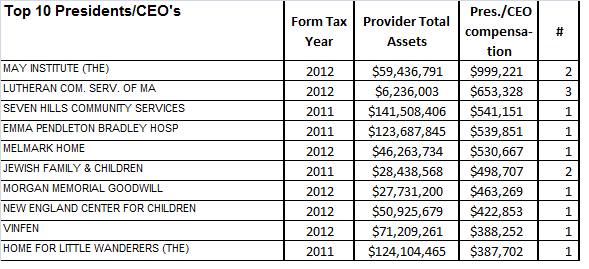

Most of the providers surveyed are under contract to the Department of Developmental Services, which manages or provides services to people with intellectual disabilities who are over the age of 22. The providers operate group homes and provide day programs, transportation and other services to tens of thousands of intellectually disabled persons in the DDS system.
As we have noted, the state’s priority has been to boost funding dramatically to corporate residential providers, in particular, while at the same time slowly starving state-operated care, including state-run group homes and developmental centers, of revenue.
Funding to DDS corporate residential providers rose past the $1 billion mark for the first time in the current fiscal year. The line item was increased by more than $140 million –or more than 16 percent—over prior-year spending in fiscal 2015 dollars. At the same time, both the former governor’s and the legislative budgets either cut or provided much more meager increases for most other DDS line items.
More financial information about nonprofit corporate providers, including compensation of executives, can be found at www.guidestar.org.
Why the Fernald land deal should include a plan for the developmentally disabled
The history of what is now known as the Fernald Developmental Center hasn’t been free of some serious blemishes or controversy. But from 1889 to the present time, Fernald’s 200-acre campus in Waltham has been the site of a facility providing residential care for persons with intellectual disabilities.
That’s all about to change permanently.
Under legislation negotiated among representatives of the Patrick administration, the City of Waltham, and local legislators, the state will sell the campus to the city for $3.7 million, which comes to 18,500 per acre — a price that has been described as “dirt cheap.” It appears there is also a requirement that the city pay the state up to half the proceeds from the re-sale of any of that land to developers.
There is just one group of people that seems to have been left out of the plans and negotiations. That group is the developmentally disabled — the very persons who had been living at Fernald all along. Other than keeping the therapeutic swimming pool open at Fernald and maintaining a 29-bed nursing home on the campus, there appear to be no plans to continue to provide care or services at the Fernald site for persons with disabilities who live in the surrounding community.
This is an unfortunate oversight, not only for the residents who have been forced to leave Fernald, but for developmentally disabled people in the community. As I’ll explain, the lack of a plan for integrated, community-based care at the Fernald site has been, and will continue to be, both a missed opportunity to help those waiting for services and a potential waste of taxpayer money.
First, I would note that the Fernald Working Group, a coalition of local organizations, had recommended that a portion of the campus remain the site of residential care and services for the intellectually disabled. Similar proposals have been made over the years by the former Fernald League and COFAR. Both of those latter groups suggested a “postage-stamp” arrangement under which existing residents would live in housing situated in a small area of the campus while the rest of the campus was converted to other uses. And Waltham Mayor Jeannette McCarthy, the chair of a Fernald Reuse Committee, also publicly supported the continued use of part of the campus for institutional, residential and health care.
But the then Romney and subsequent Patrick administrations were interested only in one thing — closing Fernald and three other developmental centers in the state, contending the state would save tens of millions of dollars a year in doing so. They never considered any of the proposed alternatives to the closures, and have never done what administrations in other states have done, which is to propose the integration of congregate care facilities for the developmentally disabled with their surrounding communities.
The result is that since 2008, two of six remaining developmental centers in Massachusetts have been closed; a third center is being converted to state-run group homes, and just two residents of the Fernald Center remain on the campus out of a total of 160 who were there at that time. Most of the residents living in the four facilities targeted for closure were dispersed around the state, with the majority going either to state-operated group homes or to the Wrentham Developmental Center. Why has all of this been a missed opportunity and a potential waste of taxpayer money?
First, with regard to the cost to taxpayers, the administration projected that Fernald would be closed by July 2010, but the closure was blocked for four years by administrative and court appeals filed by guardians on behalf of some 20 remaining residents there. The administration elected to keep Fernald open only for the remaining residents there, pending resolution of their administrative and court appeals. This turned out to be an extremely inefficient way to proceed.
Not only has there been an undisclosed cost to the state in fighting the legal battle to close Fernald over the past decade, but as the population dwindled in all four targeted facilities, the cost per resident of care there shot up due to fixed costs such as heating and other utilities in larger buildings. This was particularly true for Fernald, which has remained open for more than four years with 20 or fewer residents.
The administration could have saved millions of dollars a year since 2010 had it been willing to consider and negotiate an alternative to outright closures of the facilities. The legal battle over Fernald would have ended immediately, and instead of continuing to house the remaining residents in several locations on campus, the state could have built small, cost-efficient housing in one location for the residents. That proposed alternative to closure has rarely if ever been reported on by the media, which has instead adopted the position of the administration and its corporate providers that the high cost of continuing to operate Fernald has been solely the fault of the residents remaining there.
Moreover, dozens of the Former Fernald residents were sent, as noted, to the Wrentham Center, which amounted to transferring residents from one developmental center to another. Not only was there no real savings in doing this, but the administration was forced to undertake renovations at Wrentham in order to accommodate the former Fernald residents — a project that cost taxpayers at least $3.2 million.
There is a second, and potentially greater, cost to taxpayers in closing Fernald and the other developmental centers without planning for any continuation of care at those sites that could be integrated with their surrounding communities. As we have noted, an undisclosed number of developmentally disabled people throughout the state have been unable to access services or care from DDS due to a lack of resources. The state has tried to address this problem by expanding the provider-run residential system, which has involved building more than 150 group homes spread around the state since 2008 and substantially increasing rates paid to the providers.
But there is no centralized system of care in the provider-run system. People have to be transported to day programs and for medical and other types of care — a process that is potentially much more expensive than if all of this care were available in centralized locations. Continuing to provide centralized care at developmental center sites could both allow more people in the surrounding community to receive services and provide those services more cost-effectively than is the case in a system consisting almost entirely of disbursed group homes.
We have also pointed out the potentially high cost of privatized care in Massachusetts and elsewhere due to the thick layer of highly paid corporate executives in that system.
That there isn’t necessarily a long-term savings in transferring people from developmental centers to decentralized, provider-based care has been acknowledged even by one of the leading proponents of deinstitutionalization in the Obama administration. I’ve blogged about a law journal article written by Samuel Bagenstos, a former top litigator in the Justice Department’s Civil Rights Division, in which Bagenstos stated that any cost savings in closing developmental centers “will shrink as people in the community receive more services.” He added that a significant part of the cost difference between institutional and provider-based care “reflects differences in the wages paid to workers in institutional and community settings — differences…that states will face increasing pressures to narrow.”
All of this is why we supported the vision of the Fernald Working Group, which described “a progressive site at Fernald where open space and greenways can be matched with an equal vision of integration for individuals with disabilities.” That vision encompassed both existing residents and disabled persons in the surrounding community. The Working Group specified that this vision included new housing and the preservation of the therapeutic pool and gym at Fernald as well as the chapel and programs for physical therapy, dental and medical services. As the vision statement noted, “all of these services could become part of the community and economic life of the Fernald redevelopment.”
But as far as we can tell, the Working Group’s vision has not been adopted by either the administration or the Legislature. While the newly signed legislation to sell the Fernald land to the city provides incentives for adopting “smart growth principles” and affordable housing in the development of the site, it makes no mention of continued services or care for persons with developmental disabilities.
Last week, I emailed Senator Michael Barrett and Representatives Tom Stanley and John Lawn, the key sponsors of the land sale legislation, to ask whether the continued use of a portion of the Fernald campus for individuals with disabilities was considered in the negotiations over the bill and whether any provisions for that might be made in the future.
A staffer in Barrett’s office said that no proposals to serve the developmentally disabled at Fernald were made at a public hearing on the land sale bill that was held in July by the Legislature’s State Administration Committee, and the idea was therefore not considered. But while the Village at Fernald concept for the disabled may not have been raised at a public hearing earlier this summer, most, if not all, of the negotiating parties to the legislation have long been aware of that concept. It should have been a part of the legislation from the beginning.
 COFAR blog