Archive
Two medical specialists say physical therapy needed for man allegedly isolated in group home
John Davidson, a man with an intellectual disability, is declining physically in his group home and has not received needed physical therapy there after an extended stay last year at Tewksbury State Hospital, according to two medical specialists.
One of the physicians, Adam Harris, a specialist in spinal disorders at New England Baptist Hospital, on Wednesday (February 16) recommended an eight-week regimen of physical therapy for John at Spaulding Wellesley rehabilitation center.
In a summary of an examination of John on Wednesday, Dr. Harris wrote that John had “deconditioned” after his stay at Tewksbury. Harris’s summary stated that following that hospitalization, John was “never transferred to outpatient therapy.”
A second specialist, Steven Cohen, a gastroenterologist with Beth Israel Deaconess Medical Center, wrote in a medical progress note, dated February 3, that John was declining physically due to a lack of physical therapy and other stimulative activities.
John has been confined to a wheelchair following the stay at Tewksbury, which reportedly stemmed from a broken leg that he suffered from a fall outside his group home in 2019.
The two medical assessments corroborate a contention by John’s mother, Christine Davidson, that John has not been provided with stimulative activities at the residence, which is operated by WCI, Inc., a corporate provider to the Department of Developmental Services (DDS). She said he was not receiving physical therapy and has had no functioning day program. She also said he is depressed and wants to be allowed to visit her at her home.
Cohen also wrote in the progress note that he believes John should be living with his mother rather than in the group home.
“Overall, I’m very concerned about prognosis due to poor conditioning,” Cohen’s progress note stated. “Aggressive PT is best hope. Would be best served if living with his mother whose excellent care I have witnessed for over 20 years.”
Cohen added that, “John is terribly deconditioned and needs PT and aquatherapy.”
Cohen also stated that John was “clearly deteriorating” in terms of his mobility, and was “too weak” to be safely examined on a table in Cohen’s office. He further wrote that John was “upset over not being home.”
Breathing mask unhygienic
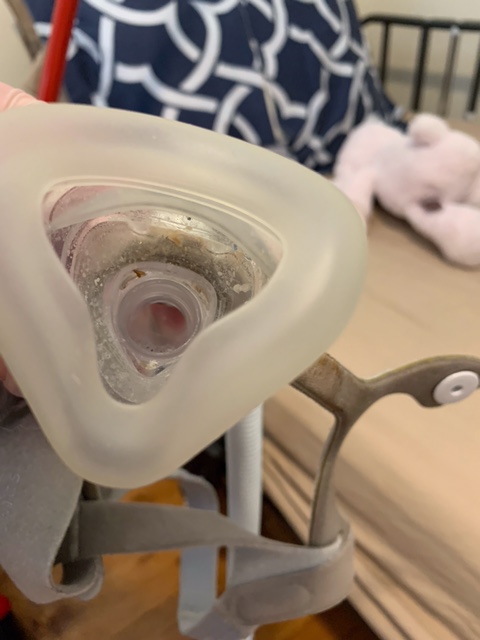
In addition to his concerns over John’s physical condition, Cohen stated in his February 3 progress note that a breathing mask that is apparently being used on John at the group home to treat sleep apnea was “apparently not hygienic.” Christine sent us the photographs below that her partner, Carmine Tocco, took on February 2 of John’s breathing mask, which is attached to a Bi-PAP machine at the WCI residence.
Christine Davidson said she has spoken to the group home staff about the breathing mask and about what she said were other poor hygienic conditions in the residence.
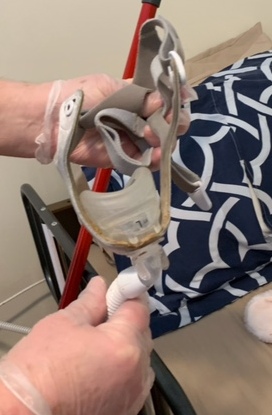
Photographs taken February 2 of a reportedly dirty breathing mask apparently being used on John in his group home.
Questionable abuse charge appealed
In a recent blog post, we reported that we have raised numerous questions about the accuracy of a report written by the Disabled Persons Protection Commission (DPPC), which concluded last October that Christine abused John after she gave him an “undetermined” amount of cough syrup and Tylenol last June. Since then, John has been subject to a prohibition on visits home.
Christine’s attorney, Thomas Frain, who is also COFAR’s president, filed an appeal with DPPC of the abuse finding. The appeal notes that the cough syrup and Tylenol that Christine provided her son had been prescribed by his primary care doctor, and that there was no evidence presented by the DPPC that Christine did not follow the prescriptions.
Christine is a co-guardian of her son. The other co-guardian, George Papastrat, is Christine’s nephew and lives in North Carolina. Under the co-guardianship agreement, Papastrat has the authority to make medical and other decisions about John’s care. Papastrat has not responded to emails I have sent him raising concerns about John’s care.
Numerous medical issues
John has Down Syndrome, “multiple gastrointestinal issues,” Celiac disease, obesity, severe osteoporosis, and several other medical conditions. He is also continuing to experience pain from the leg fracture in 2019.
In addition to the lack of physical therapy, Cohen said John was not being taken out of the residence for aquatherapy, an activity he previously enjoyed.
DPPC placed blame on mother regarding breathing mask
In accusing Christine in October of abuse, the DPPC alleged that in addition to giving him an “undetermined amount of cough syrup and Tylenol,” she had failed to provide prescribed breathing therapy support “causing (John) to lose consciousness” in the morning of June 21. The prescribed therapy was the use of the breathing mask and Bi-PAP breathing assistance machine at night.
Christine was unable to wake John up in the morning of June 21, and called 911. John was brought to the Newton Wellesley Hospital ER. He quickly recovered after being given oxygen.
Christine maintains that the Bi-PAP machine and mask were not delivered to her until June 22, the day after John’s episode of hypoxemia or low oxygen level. She also said she did not receive necessary training in how to use the machine. When she inquired of a group home staff member about receiving training, she said she was told there would be no opportunity for that.
Christine said the breathing machine was later removed from her home by a group home staff member, and that she later saw the machine’s breathing mask on the floor of John’s room and noticed that it looked dirty. She said when she brought that to the attention of the staff, they did not respond to her.
Following the DPPC’s decsion to level the abuse charge against Christine, DDS issued an “action plan” in October that recommended sharply curtailing contact between Christine and John. The DDS action plan also stated that the Bi-PAP machine “should be operated by trained residential staff.”
Attempts to contact DDS commissioner and other officials
On February 14, I sent an email to DDS Commissioner Jane Ryder, asking whether she would inform either us or Christine of what measures, if any, DDS may be taking to address the concerns raised by Dr. Cohen and Christine about John’s care.
I sent a similar email the same day to Nancy Silver Hargreaves, president and CEO of WCI. To date, I haven’t received a response from either Ryder or Hargreaves.
On January 10, I wrote to Gail Gillespie, DDS Metro Region director, and Joan Thompson, DDS area director, about John’s situation. I have not received a response from Gillespie.
On January 11, Thompson responded with a two-sentence email stating that I would need written authorization from both co-guardians in order for her to release any information about the matter.
As we have previously stated, we think DDS should conduct an investigation of the conditions under which John is living, and should take immediate steps to provide him with physical therapy and other activities – particularly those activities recommended by Drs. Cohen and Harris.
We have also urged DDS to take both John’s and Christine’s often-stated wishes into account and begin by arranging for visits home for John. We concur with the assessment that the best hope for John is to return home to live with his mother.
Judi Lydon-Ruby receives the Manuel Carballo Award for public service
By Joe Corrigan
COFAR would like to congratulate Judi Lydon-Ruby, recipient of the Manuel Carballo Governor’s Award for Excellence in Public Service.
Judi is director of the Wrentham Developmental Center (WDC). She has had a long history with WDC, starting at the age of 16 in their kitchen until becoming director in 2018.
Roughly two years ago, we all woke up to learn of a growing pandemic the likes of which haven’t been seen in 100+ years. Most of us began to take precautions in our own immediate families by masking, distancing, etc.

Judi Lydon-Ruby
Now imagine also having responsibility for an additional approximately 1,000 staff and nearly 200 very vulnerable residents with intellectual and other developmental disabilities (I/DD) and medical frailties in a campus setting. This describes the daunting task Judi was facing.
Beyond creating difficulties for staff in continuing to provide great everyday care for the residents, the pandemic created challenges that nobody was prepared for.
Throughout the pandemic, Judi has adapted to the challenges requiring masking, distancing, quarantining, isolation, testing, innoculations, vaccination mandates, resource balancing, hiring and training for infectious disease and more. She created a plan where there was none and no doubt helped people survive.
Given all that and more, the WDC Board of Trustees, along with support from the Wrentham Families Association, nominated Judi for the Manuel Carballo Governor’s Award in September 2021. The nomination was well received by the administration, and on January 10, 2022, Judi received the award.
Congratulations to Judi and her staff for a continuing job well done.
(Joe Corrigan is a COFAR Board member. His sister Patricia is a resident at WDC.)
We need a $25-per-hour minimum wage for direct care workers in the DDS system
We think it’s time for a meaningful boost in the minimum wage paid to direct-care workers in the Department of Developmental Services (DDS) system, particularly for those caregivers who are employed by corporate providers to DDS.
We’re suggesting a minimum wage rate for direct care workers of $25 per hour. Right now, the average hourly rate for these workers appears to be $16 or possibly even less. The situation is contributing to staffing shortages throughout the system and a resulting decline in the quality of care in group homes.
We think increasing the minimum wage to $25 is affordable, given that the state has a large projected budget surplus this year. Also, Gov. Baker is proposing a tax cut on capital gains and on inherited estates. We think that money could be used instead to boost direct care worker wages, which are unconscionably low.
At least some of the funding needed for a $25 minimum wage could potentially come from the providers themselves.
In 2019, Sate Auditor Suzanne Bump recognized that at least some of the continually increasing state funding to human services providers could be used to boost direct-care wages, but said that was not happening.
In her 2019 audit , Bump found that the average hourly direct-care wage was $11.92 in Fiscal 2010, and that it had risen only to $14.76 as of Fiscal 2017. That was an increase of only 24% over that eight-year period, an amount that only barely exceeded the yearly inflation rate.
According to Bump’s audit, the increased state funding to the providers provided them with a 237% increase in surplus operating revenues (total operating revenues over total operating expenses) during that same eight-year period.
Residential DDS provider revenues have grown to more than $1.4 billion
DDS corporate residential providers would receive $1.44 billion under Governor Baker’s proposed state budget for Fiscal Year 2023, which begins in July. If that amount is approved by the Legislature, the provider group homes will have gotten an increase of $563 million, or 64%, since FY 2012, when adjusted for inflation.
That increase doesn’t even appear to include appropriations to a reserve fund (line item 1599-6903) intended to further boost contractual payments by the state to the residential providers. Baker’s Fiscal 2023 budget would increase the size of the provider reserve fund from $79 million to $230 million in the coming fiscal year.
On Jan. 31, I asked the staff of the Legislature’s Children, Families, and Persons with Disabilities Committee whether Senator Adam Gomez or Representative Michael Finn, the committee co-chairs, might comment on a $25 minimum wage for direct care workers. To date, I haven’t received an answer.
Pending bill would eliminate a disparity between state and provider wages
On February 8, I called and emailed Senator Cindy Friedman, Senate Chair of the Health Care Financing Committee, for comment on our proposal.
Friedman has proposed a bill (S.105), which would eliminate a “disparity” in wages between direct care workers working for human service providers and those working in state agencies over a five-year period. The amount of that disparity has apparently only been “guesstimated,” however, and the guesstimate is that the disparity is roughly 20%.
That guesstimate came from a staff member of the Children and Families Committee. If the guesstimate is correct, it appears that even after five years, Friedman’s bill would raise the wage of a worker making $16 an hour to roughly only $19 – a level nowhere near $25.
I haven’t yet heard back from Senator Friedman or her staff.
Friedman’s bill and a companion House bill (H.237) apply to caregivers working in residences overseen by the Executive Offices of Health and Human Services and Elder Affairs, and the Department of Housing and Community Development. The bills would require that the disparity be reduced to 50% as of July 2023, and to zero by July 2027.
Average pay is about $16 per hour
Data on the average wage earned by direct care workers in the DDS system is not easy to find. The federal Bureau of Labor Statistics lists an average hourly wage for “personal care aides” in Massachusetts of $16.29.
Personal care aides, according to the BLS, include workers in both group homes and private homes, and include persons who care for individuals with all types of disabilities, not just intellectual or developmental disabilities.
The BLS does publish data on personal care aides in residential facilities for persons with intellectual and developmental disabilities; but that data is for workers throughout the country, not just in Massachusetts. The average hourly wage in that catetory is $13.49.
Wage disparity amount has not been officially projected
The BLS wage data also do not differentiate between caregivers in state-run versus provider-run facilities.
The amount or amounts of the wage disparity are not specified in Senator Friedman’s legislation either. Her bill requires the agencies involved to provide a report to the Legislature as of next July 1 listing the disparity amount. The agencies must also project the amount of the appropriation needed to achieve those disparity reductions.
No one in a hurry to pass legislation to raise wages
Despite their potentially modest impact, S. 105 and H.237 have failed to make much headway over the past year in the Legislature. Friendman’s bill was referred to the Children and Families Committee in March 2021. It was reported favorably by the committee and sent to the House and Senate Ways and Means Committee only this week (February 7.)
In 2018, Governor Baker did sign legislation to raise the minimum wage of direct-care and other workers to $15 an hour; but it won’t reach that amount until 2023.
Some federal funding to raise wages is due to be distributed next month
Gov. Baker signed legislation in December that would target hundreds of millions of federal economic stimulus dollars for human services workforce retention and recruitment as part of a $4 billion federal and state spending package. But it doesn’t appear that that money would provide for a permanent increase in direct care wages.
Some of the federal money will finally be distributed in the form of $500 checks to an estimated 500,000 low-income, direct-care workers starting in March, the State House News Service reported Tuesday (February 8).
But even when the full amount of the American Rescue Plan Act money is finally distributed, the legislation signed by Baker would set a ceiling of $2,000 on the total amount of funding per worker. A one-time payment of $2,000 will not substitute for a higher minimum wage.
Even so, Shannon Guenette, the executive director of Almadan, Inc., a DDS provider in western Massachusetts, first told us in August 2021 that her agency and other DDS providers throughout the state desperately needed the additional federal funding to retain workers in light of a worsening shortage of direct-care and clinical staff.
But Guenette said on February 1 that her agency’s wage rates would need to be at least $20 to $25 per hour “to hire the staff we need and compete with gas stations and fast-food restaurants. Many of our employees are really struggling with higher rents, higher grocery bills, higher utility costs, and increasing transportation costs,” she said.
More funding eyed for DDS state-operated group homes in governor’s budget, but less for ICFs and day programs
State-operated group homes would receive an increase in funding in the coming fiscal year roughly equal to the inflation rate, according to Governor Charlie Baker’s proposed Fiscal Year 2023 budget, which was released Wednesday (January 26).
Overall, the budget contains mixed news for Department of Developmental Services (DDS) line items. The new fiscal year starts July 1.
While the state-operated group homes would get a much needed 6.17% increase in funding, the numbers don’t look as good under the governor’s budget for the developmental centers, community-based day programs, autism services, and transportation programs.
According to the governor’s proposal, state-operated group homes would receive $256 million in Fiscal 2023. That would amount to an increase of $14.8 million from the current-year appropriation. That is an increase roughly equal to the current inflation rate for New England. We are urging a minimum increase in state-run programs at least equal to the inflation rate.
Still, even with that increase, the state-operated residences would have a long way to go to catch up to the percentage increases in funding for provider-run group homes over the past decade.
Developmental centers, day programs, and transportation continue to see cuts
The Wrentham and Hogan Developmental Centers line item would receive $109.1 million under the governor’s Fiscal 2023 budget. That would amount to an increase of $5.4 million, or 5.2%. That is less than the minimum $6.3 million increase needed to keep pace with inflation.
The developmental center or Intermediate Care Facility (ICF) line item has, moreover, been cut by $68.4 million, or 39%, over the past decade, when adjusted for inflation.
Community-based Day and Work Programs would receive $227.4 million in Fiscal 2023. That would amount to a cut of $7.6 million, or 3.6%. We are urging a minimum increase of at least $13.4 million in that account to keep it even with inflation. The account provides funding for job skills training and other activities to help clients make the transition to the mainstream workforce.
A DDS “Progress Report” last year showed a drop in total “integrated employment” of DDS clients in Massachusetts from a high in October 2019. The Progress Report indicated that the numbers of clients being placed in DDS day programs, where few meaningful work activities are available, has exceeded the numbers entering integrated employment in recent years.
Transportation funding would be cut for the second year in a row under the governor’s proposal for Fiscal 2023. The line item would receive $24.8 million in funding, which amounts to a $7 million, or 22%, cut from the current fiscal year.
The Autism Omnibus line item, which provides services and supports for people with autism and related disabilities, would also be cut. That line item would receive $36.6 million in Fiscal 2023, down $4 million, or 10%, from the current fiscal year appropriation.
Some line items would get increases
The DDS corporate residential providers would receive $1.44 billion under the governor’s budget plan. That would amount to an increase of $34 million or 2.4% from current year. While the increase would be less than the rate of inflation, the provider group homes will have gotten an increase of $563 million, or 64%, since FY 2012, when adjusted for inflation.
In contrast, funding for the state-operated group homes has been increased by about half that percentage over the past decade.
In addition, Baker has proposed a major increase in a reserve fund (1599-6903) intended to boost contractual payments by the state to the residential providers. His Fiscal 2023 budget would increase the size of the residential provider fund from $79 million to $230 million in the coming fiscal year.
The Turning 22 line item would also get a major increase under the governor’s budget plan. The line item would receive $84 million in Fiscal 2023. That would require a $59.5 million, or 242%, increase in funding from the current-year appropriation.
Respite and Family Supports would be increased by $5.2 million, or 6%, to $90.6 million.
The DDS administration line item would receive $87.8 million in Fiscal 2023, a 6.4% increase. The administrative line item includes funding for DDS service coordinators, a key departmental function.
Reasons for our funding increase requests
Flat or declining funding levels for state-run residential programs appears to be connected with an apparent policy by the administration not to offer those settings as options for people seeking residential placements.
Documents provided by DDS last September confirm that the census in the state-operated group homes has been declining since Fiscal Year 2015. We previously received information from DDS showing a decline in the census and virtually zero admissions in 2019 and 2020 to the Wrentham and Hogan Centers.
In turn, funding for these facilities has dropped or has remained flat for years.
Unless families have the money for a lawyer or are politically connected, most people waiting for residential placements are never informed that state-operated group homes or developmental centers exist. Yet, as COFAR has reported, the federal Medicaid law requires that individuals and their families and guardians be informed of all the “feasible alternatives” for placement.
State-operated group homes and the Hogan and Wrentham centers are the backbone of the DDS system because they care humanely and efficiently for even the most profoundly intellectually disabled and medically involved people. They also provide jobs.
These decreases in funding and the census in state-run residential facilities have been ongoing while funding under the DDS corporate residential line item (5920-2000) has skyrocketed over the past decade to over $1.4 billion, an amount that dwarfs the funding for state-operated group homes and the two remaining developmental centers in Massachusetts.
In a survey we conducted in 2015, we found that more than 600 executives employed by corporate human service providers in Massachusetts received some $100 million per year in salaries and other compensation. As just one example, the FY 2020 IRS filing by the Edinburgh Center, a DDS corporate provider, listed eight executives as each making over $100,000 that year, while the CEO received more than $230,000 in compensation.
Baker’s proposal to increase funding next year to the state-operated group homes, at least at the rate of inflation, is a positive step, albeit a minimal one. We hope over the next six months to see a turnaround in the declining funding trend for the developmental centers and day programs as well.
Mother, who was charged with abuse after giving son Tylenol and cough syrup, says he is being neglected and isolated in his group home
Christine Davidson, who has been charged by the state with abuse after she gave her son prescribed cough syrup and Tylenol, says the real problems her son is facing include isolation and neglect in his group home.
We have joined Christine in expressing concern to the Department of Developmental Services (DDS) about conditions in the residence and a ban on home visits from her son John.
John Davidson is a resident of a group home in Waltham, which is run by WCI, Inc., a corporate provider to DDS. Christine contends that the conditions under which John is now living violate a number of DDS regulations referred to as “standards to promote dignity” (115 CMR 5 et seq.).
Christine is a co-guardian of her son. The other co-guardian, George Papastrat, is Christine’s nephew and lives in North Carolina.
Christine wants to take John back home with her, and John has repeatedly said he wants to come home. That is not being permitted, however. She said John is effectively being confined in his group home with virtually no activities.
As we noted in a recent blog post, we have raised numerous questions about the accuracy of a report written by the Disabled Persons Protection Commission (DPPC), which concluded that Christine abused her son after she gave him an “undetermined” amount of cough syrup and Tylenol last June. Since then, John has been subject to a prohibition on visits home based on the abuse finding.
Christine’s attorney, Thomas Frain, who is also COFAR’s president, has filed an appeal with DPPC of the abuse finding.
Last November, I emailed George Papastrat, John’s other co-guardian, with an explanation of our concerns about the DPPC investigation and its apparent bias against Christine. I have not recieved a reply to my message.
Only person left in the home during the day
Christine said she visited John in his group home yesterday (January 18), and found him sitting alone in the kitchen. She said the other three residents currently living in the home are being taken to day programs.
John no longer has a functioning day program, according to Christine. An Individual Support Plan (ISP) states that he lost his previous day program activities at Jewish Family Chai Works in Waltham in March 2020 because of COVID restrictions.
The ISP states that when the day program reopened on a limited basis in August 2020, John was not alowed to return to it. The ISP does not specify the reason he was not allowed to return.
Christine also said John’s physical therapy services, which he received after fracturing his leg outside his group home in 2019, have been discontinued. Yet, she said, he is still in need of those services.
Personal hygiene allegedly neglected
Christine said she often finds John’s bedroom and the bathroom in the group home to be dirty, and John is frequently unshaven and dirty when she visits him. She provided photographs of his bed, which show several damp spots that she said are urine.
She also sent a photo of what appears to be soiled toilet paper in a waste can in the bathroom. She said the toilet paper contained fecal matter.
Christine filed a complaint with DPPC on December 7 after finding Jonn sitting alone and naked on the floor of his bedroom, apparently after he slid off his wheelchair while under the care of a staff member. The complaint has been referred to the DDS area office for an administrative review, according to a letter sent by DDS to Christine on December 8.
As noted below, many of the conditions Christine described would appear to violate DDS “standards to promote dignity,” including the “opportunity to undergo typical developmental experiences.”
Christine said she believes John is declining physically and mentally in the group home and is severely depressed. “I don’t know if he’ll ever be the same person he was — energetic and engaging,” she said.
DDS doesn’t respond to concerns
On January 10, I sent an email to Joan Thompson, DDS area director, calling her attention to the apparent violations and asking that the Department investigate them.
Thompson responded the following day with a two-sentence email that did not appear to relate to my request. Thompson’s email stated the following:
After review of your request, you would need written authorization from both (co)guardians to release any information. Without the written authorization, you do not have the authority to make such a request.
Thompson’s message wasn’t signed.
I reiterated my request in a second email on January 12 and copied Gail Gillespie, the DDS director for the Boston Metro Region. I haven’t received a response to that message from either Thompson or Gillespie.
Apparent violations of DDS regulations in group home
Christine said that after his hospitalization, John was kept for months at Tewksbury State Hospital, ostensibly for treatment of a leg injury from a fall outside his group home in 2019. But she said his leg actually got worse at Tewksbury, yet he was discharged to his group home where he now needs a wheelchair.
She said the group home staff does not appear to be encouraging John to get exercise. She added that John wants to get out of his wheelchair, but the staff are not encouraging him to do so or helping him.
When John was discharged from Tewksbury in November, the group home staff was supposed to develop a chart listing weekly activities for him. But Christine said no such chart has been developed for him.
We are concerned that this overall situation may violate a number of DDS standards to promote human dignity, including a number of the “general principles,” which state that services are supposed to be provided in a manner that promotes:
- The opportunity to undergo typical developmental experiences, provided that the person’s safety and well-being are not unreasonably jeopardized,
- The opportunity to engage in activities and styles of living which encourage and maintain the integration of the person in the community through individualized social and physical environments, and
- Opportunities for daily recreational activity and physical exercise, as appropriate to the age and interests of the individual.
The apparent confinement in the group home against John’s stated wishes appears to violate additional DDS standards and other rights that are intended to promote or include:
- Self-determination to the person’s fullest capacity,
- Least restrictive care, and
- The right to be visited and to visit others under circumstances that are conducive to friendships and relationships.
ISP specified activities
John’s Individual Support Plans (ISPs) in both 2019 and 2020 discussed his enthusiasm for his day program at Chai Works. As noted, he lost that program in 2020.
John’s 2020 ISP stated that while at the day program, which he had attended since 2012, he participated in numerous activities including dance, yoga, and martial arts. He was also taken on community outings.
The 2020 ISP stated that after the day program was initially shut down in March 2020, John was able to participate in online groups connected with the program a couple of days a week for an hour or two at a time. Accoring to the ISP, John needed help logging in to the online sessions.
Christine said she was told at both Tewksbury State Hospital and at the group home that they were too short-staffed to help him log into the day program sessions. As a result, John has not been able to participate in his day program, even online, for at least the past six months, she said.
Additional conditions in group home
Christine also said that in addition to the problems with cleanliness in the home, she discovered that other residents’ laundry is repeatedly put in John’s dresser drawers even though all of his clothing is labeled.
The overall situation appears to violate the principle specifying “freedom from discomfort, distress, and deprivation which arise from an unresponsive and inhumane environment.” There also appears to be a violation of John’s additional right to “individual storage space for personal use.”
Further, according to Christine, John’s cell phones have repeatedly gone missing, first at Tewksbury and later at the group home. As a result, he is unable to make or receive calls directly from Christine or anyone else.
Christine said she has also been told not to call the group home after 6 p.m. All of that appears to violate the right of individuals to have “reasonable access to a telephone and opportunities to make and receive confidential calls…”
John’s 2020 ISP and an August 2020 staff memo noted that John liked to talk to his mother on the phone, so much so that a protocol was established to end the calls at 10 p.m.
DDS needs to change course
In my January 10 email to DDS Area Director Thompson, I requested that DDS revisit and reverse the prohibition placed on John’s visits home. As noted, I have not received a response to that email.
We are also requesting that the area office expand its review of Christine’s complaint in December after she found her son on the floor of his room. We are urging the Department to examine the overall conditions under which John is currently living and the potential violations of the Department’s regulatory standards.
Large increase in COVID among residents in DDS provider-run group homes, but not in state-operated homes
The latest state report on COVID testing in facilities funded by the Department of Developmental Services (DDS) shows what appears to be a major increase in residents testing positive for the virus in corporate provider-run group homes.
However, there appears to have been little or no increase in COVID among residents of the smaller network of DDS state-run group homes.
According to the state data, the number of residents testing positive in DDS provider-run group homes jumped from 34 to 146 in the period from November 30 to December 28.
In the DDS state-operated group home system, the number of residents testing positive rose only from 9 to 10 in that time frame. We think this difference may reflect the fact that staff in state-run facilities are required to be vaccinated, whereas there is no similar vaccination requirement for staff in provider-run residences.
Staff testing positive in state-run group homes did rise from 20 to 66, according to the latest report. But there is no information available on the number of staff that have tested positive in provider-run group homes. For some reason, that number is not reported.
At the DDS-run Wrentham Developmental Center, the number of residents testing positive rose from zero to five or less. (Numbers under 5 are not specified.)
Staff testing positive at the Wrentham Center rose from three to 24. But that hike in positive staff does not appear to have been mirrored by a large increase in residents testing positive there. Also, as one family member of a Wrentham Center resident said, most of the staff testing positive there are either asymptomatic or have mild symptoms, apparently due to the required vaccinations.
At the Hogan Regional Center, zero residents have tested positive since January of last year. Five staff tested positive at Hogan as of December 28. Prior to that date, no staff had tested positive there since last April.
Despite the increases in residents testing positive in DDS provider homes, deaths among residents have not risen in either the provider-run or state-run networks. In the month prior to December 28, less than five residents died in the state-run and provider-run group homes. (Numbers of deaths are not reported separately for each network.)
There were zero deaths of residents at Hogan or Wrentham in the month prior to December 28. Data on deaths among staff in DDS facilities, whether state-run or provider-run, are not reported. Also, testing results are only now reported monthly, which makes analyses of trends difficult.
Vaccinations of all staff urged
Rick Glassman, director of advocacy for the Disability Law Center, was quoted by WBUR last week as saying that regardless of staffing shortages facing some DDS group homes, vaccines should be mandated for all group home workers, and there should be more frequent testing of both residents and workers.
“It is to the state’s credit that they require vaccines in nursing homes,” Glassman said, according to WBUR. “But people with intellectual and developmental disabilities are equally, and sometimes more, vulnerable.”
Inconsistencies in vaccination policies
We have similarly called for a requirement that staff in provider-run residences be vaccinated. The difference in vaccination requirements for state and provider staff has resulted in major inconsistencies in the state’s response to the virus.
For instance, Nicole Coughlin, a DDS service coordinator, was suspended without pay on December 27, according to a Mass Live report, and threatened with termination because she had not received a second Moderna shot by the October 17 vaccination deadline set by Governor Baker for state employeees. Coughlin’s first vaccine shot last February prompted a severe allergic reaction that accelerated her heart rate and made it difficult to breathe.
According to the report by Mass Live, the Baker administration denied Coughlin a medical exemption even though three medical specialists, including her doctor, recommended that she not receive a second Moderna shot. One specialist said a second shot could be fatal to her.
It makes no sense that some DDS employees are facing a vaccination requirement that apparently allows for virtually no exceptions, while a much larger group of employees in the same field face no requirement at all.
It has been fortunate that the uptick in residents testing positive in the DDS system has so far not resulted in more deaths among those residents. But there is much to be concerned about regarding the increase in COVID cases, and little information on which to evaluate those concerns.
Even though the death rate hasn’t gone up, has the rise in residents testing positive in the provider-run group homes resulted in a higher hospitalization rate or in potentially long-term health complications among those residents? Since no data are reported on hospitalizations or health impacts, we don’t know the answer to those questions.
Questions surround state’s abuse finding against mother who gave her son prescribed cough syrup and Tylenol
Christine Davidson is known by her family and friends to be devoted to her 45-year-old son John, who has an intellectual disability and numerous medical issues.
“Christine is a dedicated mother who has steadfastly kept John as her number one priority,” Pat Diianni, a friend who has known Christine for nearly 40 years, wrote in a letter of support for her last year.
Pat said Christine has consistently worked over the years to ensure the best possible care for her son in the Department of Developmental Services (DDS) system.
Christine herself says John is “the focus of my life. Everyone knows that I’d go to any lengths for him.” By all accounts, John loves her equally, and has told his caregivers that he wants to be home with his mother.

Christine and John Davidson
State alleges abuse by mother and restricts contact with son
But the state Disabled Persons Protection Commission (DPPC) and DDS concluded in October that Christine abused John because she “more likely than not gave (him) an undetermined amount” of Tylenol and cough syrup with codeine while he was home with her for a weekend visit last June.
In a 20-page report, a DPPC investigator concluded that Christine also failed to provide prescribed breathing therapy support “causing (John) to lose consciousness” in the morning of June 21. The prescribed therapy was the use of a Bi-PAP breathing assistance machine at night.
Christine was unable to wake John up in the morning of June 21, and called 911. John was brought to the Newton Wellesley Hospital ER. He quickly recovered after being given oxygen.
The DPPC is a state agency that is charged with investigating abuse and neglect of adults under 60 with disabilities.
Following the DPPC investigation, DDS issued an “action plan” that recommended sharply curtailing contact between Christine and John. All visits to Christine’s home have been suspended, and all of Christine’s visits to the group home have to be scheduled and supervised, despite the fact that Christine is John’s co-guardian. John was not even allowed to go home to visit Christine at Christmas.
Questions about accuracy and completeness of DPPC report
But following a review of the DPPC report and related documents, and an interview of Christine, COFAR is questioning the completeness and accuracy of DPPC’s investigation of the incident leading to John’s hospitalization.
Most importantly, both the cough syrup and Tylenol medications had been prescribed by John’s primary care doctor, according to Christine and to medical records, and Christine maintains that she has always followed the prescriptions.
There was no evidence presented in the DPPC report that Christine did not follow the prescribed doses in administering each medication to her son.
As for the failure to use the Bi-PAP machine, Christine says that such a machine wasn’t delivered to her house until June 22, the day after John’s episode of hypoxemia or low oxygen level. She also said she did not receive necessary training in how to use the machine. When she inquired of a group home staff member about receiving training, she said she was told there would be no opportunity for her to do that.
Christine said the machine was later removed from her home by a group home staff, and that she later saw the machine’s breathing mask on the floor of John’s room, dirty and apparently unused. She said when she brought that to the attention of the staff, they did not respond to her.
Christine’s son’s group home is run by WCI, a DDS provider.
Christine, who cooperated with the DPPC investigation, told the investigator she gave her son prescribed cough syrup over that weekend because he had a history of a chronic cough and “has a tendency to cough so much he can’t breathe.” She said she gave him Tylenol as prescribed for arthritis pain.
Following his hospitalization in June, John was admitted in early August to Tewksbury State Hospital due to continuing leg pain stemming from a fracture caused by a 2019 fall outside his group home. He was kept for months at Tewksbury State for unclear reasons, and was discharged back to his group home only at the end of November.
Since August, Christine and her partner, Carmine Tocco, have wanted John discharged home to them. John also strongly expressed his desire to the DPPC investigator to go home to his mother.
Christine and Carmine said they believe that Tewksbury State Hospital was not an appropriate setting for John, and said they have seen signs that he was neglected there and in his group home, and has suffered physical and emotional abuse.
In the 40 years of John’s life prior to his admission to the WCI group home in 2017, he had lived at home with his mother.
Mother lost sole guardianship last year
Christine said DDS petitioned in probate court in May of 2020 to remove her as her son’s sole guardian after she got into a dispute with the Department over the placement of her son in a new group home.
Christine engaged Tom Frain, who is also COFAR’s president, as her attorney, and was ultimately restored to full guardianship. Her nephew, George Papastrat, who lives in North Carolina, was later appointed as co-guardian, with the medical and residential decision making powers.
We are concerned that DDS and DPPC appear to be setting the stage to remove Christine as co-guardian. Frain assisted Christine in appealing the DPPC abuse finding.
Friends, colleagues, and family cite mother’s devotion to her son
Amelia Lawless, Christine’s sister, stated in a letter of support for Christine in June 2020, during her fight to regain her guardianship, that, “(John) and his mother are a real team – they cry, laugh, and work well together. You might say that they complete each other.”
That same month, Rachel Geller, a former behavioral specialist in the Waltham Public School District, noted in a letter that Christine had worked in the school district as a special education teacher, and described her as “enthusiastic, kind, and loving…There are many wonderful teachers. Ms. Davidson stood out,” Geller stated.
Geller added that, “I have found Ms. Davidson to be sincere, hard-working, diligent, and of high moral and ethical standards.”
Father Fred Mannara, who was Christine’s parish priest for 57 years, wrote that, “John has a person in his life, his mother, who knows him and shares his history and loves him dearly. John knows that he belongs.”
Denise Cerrati, another friend of Christine’s for more than 40 years, wrote that, “John is the remarkable, resilient young man he is because of his mother’s care and undying attention to his needs… It would be a great injustice to restrict John’s life in such a way as to not allow him to draw on the strength and love he has always known.”
Milestones in advocacy for John
A former Special Education teacher in the Waltham school system, Christine enrolled John in an Early Intervention program at the Shriver Center prior to preschool, and later enrolled him at the LABB Educational Collaborative from which he graduated in 1998.
Christine found a speech therapist and reading tutor for John when he was an adolescent. She arranged for swimming lessons for him and watched him win two gold medals in an 800-meter swimming event at the Special Olympics International Games in 1991.
Christine encouraged John’s love for dance; and John performed for several years at a local dance studio.
In addition, Christine arranged for John to work at Brandeis University in a paid job in maintenance that lasted for 13 years. And she found a volunteer position for John with Chai Works in Waltham, a program for persons with developmental disabilities. “He was very proud of that job,” she said. “He never missed a day.”
John also helped Christine in campaigning for Joe Kennedy II in his run for Congress in her Waltham district in the late 1980s.
In 2009, Christine began working with a priest to arrange for a special dispensation to have John receive the sacrament of confirmation as an adult. He was confirmed in 2014.
Christine was also a frequent speaker at family events organized by the Greater Waltham Arc. The Arc sponsored the Brandeis job that John held, starting in 1998. When that job lost funding at Brandeis, Christine contacted Waltham city officials who were able to find the funding needed to keep the job going.
No conclusive cause determined for hypoxemia
Doctors at Newton Wellesley Hospital who were interviewed by DPPC did not appear to have provided the investigator with a conclusive cause of John’s episode of hypoxemia on June 21. One doctor stated that John may actually have been aspirating when he was brought to the hospital, meaning he was actually choking on something.
We have seen a number of cases in which individuals have aspirated or choked on ingested objects for a period of a week or more before being taken to a hospital. Christine said she thinks it is possible that her son was aspirating on something he had ingested while at his group home before his visit home to her.
While the DPPC concluded that John’s hypoxemia was more likely than not caused by a combination of Tylenol, cough syrup, and lack of a Bi-PAP machine, the report specifically concluded that the amount of the two medications given to John was “undetermined.”
In an appeal filed with the DPPC on November 29 of the agency’s abuse finding, Attorney Frain stated that it is Christine’s position that “the preponderance of evidence does not support the conclusons reached by the investigation report.”
Questions about enlarged liver
One Newton Wellesley hospital official told the DPPC investigator that Christine’s son had an enlarged liver, which was likely caused by a drug toxicity. The official said, however, that John’s Tylenol levels were not elevated when he was examined at the hospital.
Nevertheless, the hospital official said that toxicity in John’s liver could be due to small amounts of Tyleol built up over time. The official stated, “I have every suspicion that (John) took too much Tylenol, but I wouldn’t go to court to testify on that.”
But given that Christine’s son had only been with her over the weekend of June 18 to June 21, when he was hospitalized, Christine said she thinks it is possible that any toxicity buildup in his liver from Tylenol use could have happened previously at the group home. The DPPC report did not mention that possibility.
Witness confirms John had chronic cough
An official from Brigham and Women’s Hospital confirmed to the DPPC investigator that John had had “a chronic intermittent cough for many years.” The hospital official also said that John’s “cough syrup prescription had not raised many concerns prior to latest hospitalization.” Christine said she knows of no concerns that were ever raised about it.
Charge that Christine didn’t know dosages lacks specifics
Much of the case for the DPPC’s abuse charge appears to rest on accounts by the unnamed Newton Wellesley Hospital personnel that Christine couldn’t remember the dosages of the cough syrup and Tylenol that she had given John.
But even if that were the case, Christine maintains it would not prove that she had given her son too much of those medications. She told the DPPC investigator that she has always followed the doctor’s prescriptions regarding medication that she has given her son.
Christine said that she volunteered information to the EMTs who answered her 911 call about the medications John was taking, and gave them a list of all of his medications. She said that she has been giving John his medications throughout his life, and has always followed the written prescriptions.
John’s cough syrup and Tylenol had been prescribed
John’s cough syrup and Tylenol had, in fact, been prescribed for him, according to medical records examined by COFAR.
Those medical records were apparently not reviewed by the DPPC investigator who indicated in the report that the only medical records reviewed were Newton Wellesley Hospital records and John’s Individual Support Plan. [DPPC regulations (Section 1(k) of 118 CMR 5.02) require “the review and obtaining of copies of all documents which are not plainly irrelevant to the matter under investigation.” (My emphasis.)]
According to the records reviewed by COFAR, Tylenol and Tussionex cough syrup containing Hydrocodone were prescribed for John going back as far as January 2020.
Frain stated in his appeal that the cough syrup with Hydrocodone had been prescribed for the past 15 years, and had been administered by Christine to John since that time without incident.
Frain also noted that the DPPC report did not make clear that there were actually two prescriptions for the cough syrup for John. One — Mucinex DM Max Strength — was used by the group home, and the other — Tussionex with Hydrocodone — was used by Christine.
Frain said the reason for the separate prescriptions was that no cough syrup with a narcotic could be safely stored or administered in the group home. But that confusion was used by the DPPC report, Frain said, “to insinuate that there was wrongdoing on Ms. (Christine) Davidson’s part.”
Bi-PAP machine was not used by the group home
The DPPC report stated that the Bi-PAP machine had been prescribed for John to use at night to help him breathe. John had been diagnosed with severe apnea, according to the report.
As noted, Christine said the Bi-PAP machine was not delivered to her home until after John’s hospitalization, and that the group home later removed it.
The report did note that while it appeared the group home did have a B-PAP machine for John, the staff rarely if ever used it. The Brigham and Woman’s Hospital official told the investigator that:
I’m not sure you can blame this (failure to use the Bi-PAP machine on (Christine). Some sleep doctor must have prescribed it years ago. (John’s) usage has been spotty forever…I don’t think the group home even used it…
John could not be awakened previously
In his appeal of the DPPC report, Frain noted that in two previous incidents in the months prior to June 21, John was found non-responsive. In those incidents, on February 17 and during the “April/May time frame,” John was in the care either of his group home or a medical provider. Yet no report of abuse was filed with DPPC or DDS.
In the February case, medical staff at the Mass General Infusion Center in Waltham noted in on a medical form that John was “very sleepy in infusion…Quite lethargic.”
The DPPC report did not mention either of those previous incidents, either or both of which Christine believes could have a bearing on the cause of the incident in June.
No reaction to Narcan
According to the DPPC report, when EMTs arrived at Christine’s home on June 21, after Christine found John unresponsive, they administered Narcan “without effect.” Narcan is a medication used to counteract decreased breathing in an opioid overdose.
The report didn’t discuss whether John’s lack of reaction to Narcan might rule out the cough syrup as a cause of his hypoxemia. Narcan will not have an effect if there is no opioid in a person’s system.
Disputed statements about leg injury and air mattress
Also in the DPPC report is a statement by John’s DDS service coordinator that John had previously broken his leg while in Christine’s care.
The report, however, stated that in a follow-up interview to “clarify” that charge, the service coordinator acknowledged that Christine’s son had broken his leg in December 2019 when he slipped and fell outside his group home after direct care staff failed to greet John as he arrived with a transportation provider. It is undisputed that John was in WCI’s care at the time, and not under his mother’s care.
The report further stated that the incident in which Christine’s son broke his leg was not reported to DPPC because “the incident was witnessed and no one appeared at fault.” The investigator didn’t question that apparent breach of DPPC’s reporting statute and regulations.
According to the report, John refractured his leg in February 2020, possibly while at Christine’s home. However, the report stated it could not be determined whether that second fracture was due to a fall or to failed hardware in his leg stemming from the repair of the first facture.
Christine and Carmine also dispute an apparently second-hand claim in the report, apparently by the service coordinator, that in February 2020, an unidentified person had seen John sitting on a deflated air mattress on the floor in her home. Christine and Carmine said that not only does her son have an upstairs bedroom with a bed in it, but they put a second bed into a downstairs bedroom for him because he was having trouble walking.
Christine said she has never had an air mattress in her home. Carmine sent us the photo below of Christine’s son’s downstairs bed.
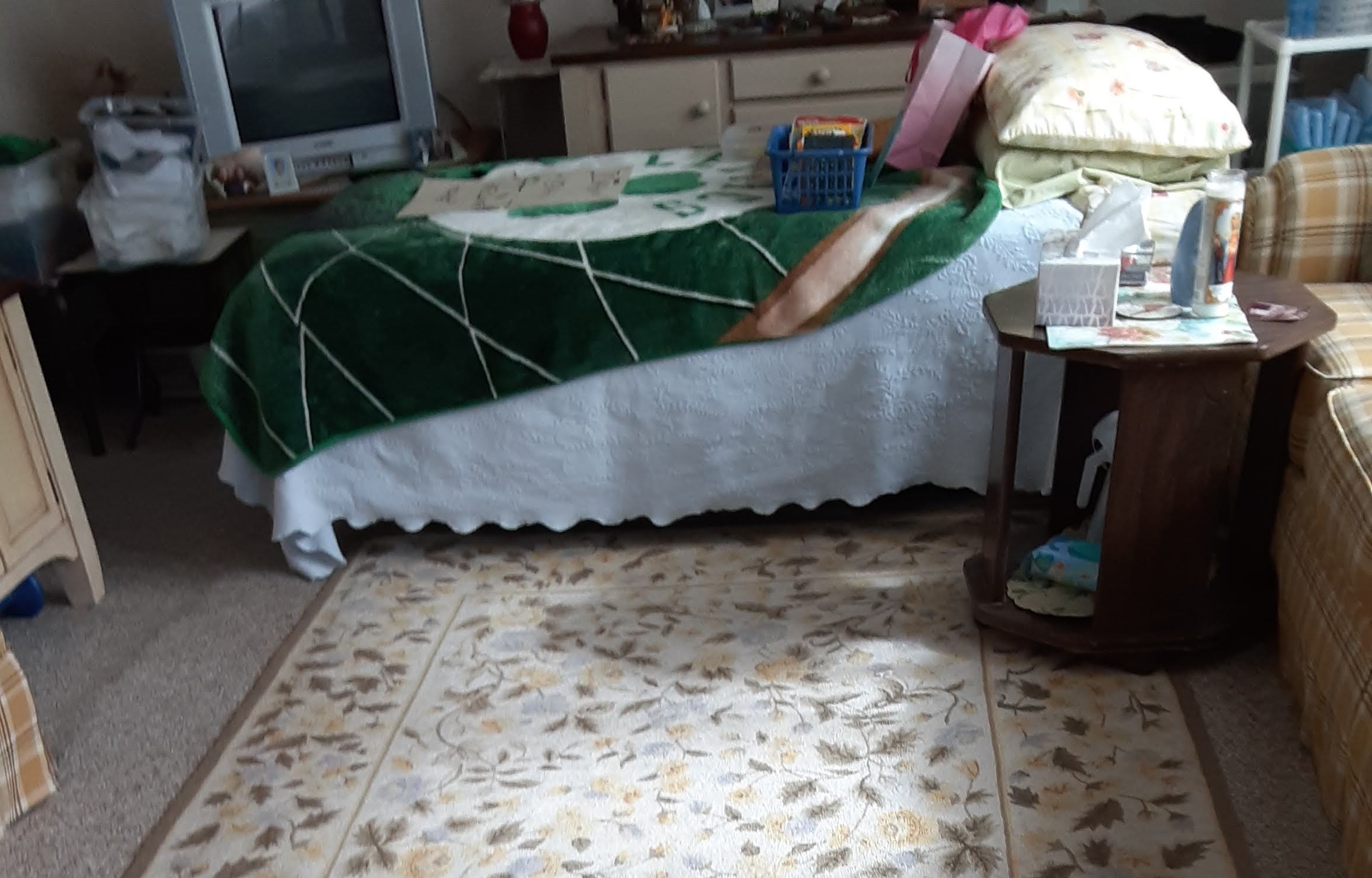
John Davidson’s downstairs bed in Christine’s home. John’s DDS service coordinator implied to the DPPC that John had been forced to sleep on an air mattress.
The investigator acknowledged in her report that she had not visited Christine’s home, citing COVID restrictions.
DPPC report relied on negative speculation about personality
In addition to accounts from the unidentified Newton Wellesley Hospital personnel, assertions about Christine’s temperament were included in the report from John’s DDS service coordinator, a DDS program monitor, and a DDS area office nurse. Only one staff member of his group home was interviewed, and that interview does not appear to have been about Christine’s alleged behavior toward the group home staff.
The service coordinator, for instance, described Christine in the report as “crafty and manipulative.” No example of that is given.
COFAR has in the past found that in investigating allegations of abuse, DPPC and DDS have discounted information provided by family members of clients. In some cases, the agencies have made negative assertions or taken punitive or even retaliatory actions against family members seen as meddlesome or too aggressive in their advocacy for their loved ones. (See here, here, here, here, here, here, here, here, here, and here.)
Assessed as frail and elderly
At least one of the Newton Wellesley Hospital personnel and Christine’s service coordinator described Christine to the DPPC investigator as “frail,” while the service coordinator also described her as “in her mid-70s and elderly.” The Newton Wellesley Hospital official also said Christine was using a wheelchair in the hospital.
Christine responded to us that she used a wheelchair temporarily in the hospital because she was recovering from back surgery at the time. She said she no longer uses a wheelchair. She added that she resents being characterized as frail, in particular. “It’s like calling someone fat or too skinny,” she said. “They don’t want me in the picture. They don’t want my involvement in John’s medical care.”
Staff actually rude to Christine
In her own contemporaneous handwritten notes, Christine wrote that on July 29, staff in John’s group home were “ rude” to her, and that one had “abruptly snatched snack from my hand.” She said she had brought the snack of yogurt and lemonade to give to John. She also wrote that the staff were giving him “no choice in (TV) channels.”
On July 30, she wrote that, “John’s bed, blanket, and pillow soaked with urine.”
In early August, she wrote in her notes that, “I would be remiss not to speak up for him — elderly and disabled have no voice.”
Christine praised staff member in notes
Despite the negative assessments of Christine’s relationship with the group home staff, her written notes from July 8, 2019, include praise for a staff member named Mohammed. In her notes, she stated after Mohammed’s name: “Humor attention to detail, kindness empathy, helped John shave.” Christine said Mohammed left the group home more than a year ago.
Visits with mother considered a negative
The DDS program monitor indicated to the DPPC investigator that both DDS and the provider thought Christine was visiting her son in his group home and taking him home for visits too often. “Weekend visits would turn into weeks,” the DDS official said. “(John) couldn’t gain a foothold in the group home.”
“We have been walking a fine line and have done everything we can do,” the DDS official said. (Christine) will always find a reason to bring (John) home.”
The DPPC report, however, includes no reasoning or discussion as to why frequent visits and contact with John’s mother would necessarily be bad for him. DDS regulations, in fact, support “least restrictive care” options, meaning options that honor the wishes of clients to interact with family, friends, and the greater community.
DDS regulations (115 CMR 5 et seq.) also state that “Arrangements shall be made for private visitation (of DDS clients) to the maximum extent possible.”
Report acknowledges son’s wish to return home
The service coordinator stated to the DPPC investigator that Christine and her “family attorney (Frain) have lost sight of (Christine’s son’s) individual rights.”
Ironically, the DPPC investigator stated that when she interviewed John, he expressed a strong desire to go home from Tewksbury State Hospital to his mother. There was no discussion in the report about taking his wish into account.
Lack of contact, communication
Christine maintains that while John was at Tewksbury State Hospital, her contact with him was sharply constrained for unclear reasons. While she was allowed to visit him there, she said the visits were supervised and she was not allowed to ask him or the staff questions.
She also said John’s cell phone went missing almost immediately after his admission to Tewksbury, and she was unable to call him. She said the DPPC investigator never asked her about that situation.
Neglect alleged at Tewksbury Hospital
Christine and Carmine said that when they initially visited John at Tewksbury, he was wearing diapers with feces in them and hadn’t been shaved for at least a week. Also his glasses and cell phone were missing. They said he appeared at times to be drugged there, and his leg pain was continuing.
Christine believes John regressed regressed mentally and was depressed at Tewsksbury and is continuing to decline mentally and physically at his group home. She said he is now in a wheelchair and is incontinent. Prior to his hospitalization, she said, he was continent and able to walk with a cane.
DPPC should reverse abuse finding
We hope the DPPC reconsiders its finding of abuse against Christine for all of the reasons discussed above. We also hope that DDS reconsiders its restrictions imposed on contact between Christine and her son. It appears to be very important to John – and witnesses have attested to this – that he be afforded the contact he desires with his mother.
We also think both DDS and DPPC should investigate the care and conditions under which John was kept at Tewksbury State Hospital. A similar investigation should be undertaken at the WCI group home.
Christine and Carmine believe that with adequate assistance from DDS and caregivers, they can care for John at home. “He will receive the love, care, and stimulation he needs that only we can provide if he is allowed to come back home,” Christine said. “Right now, I’m very concerned that he is progressing into a state of despair, which is the last stage of depression.”
We hope DDS seriously considers the option of returning John home to Christine.
DDS corporate providers and their allies once again attack the former Fernald Center with a selective account of its history
Yet again, the former Fernald Developmental Center in Waltham is being targeted politically by corporate human services providers that are selectively focusing on the Center’s dark history prior to the 1980s.
Fernald may have been closed for the past seven years, but it is still proving to be as potent a target as ever for proponents of the privatization of care in the Department of Developmental Services (DDS) system.
As was the case last year, the Arc of Massachusetts and other provider-based groups have signed a petition and letter to Waltham Mayor Jeanette McCarthy, protesting an annual holiday light show currently underway on the Fernald campus.
This year, the providers have been joined by the Mental Health Legal Advisors Committee (MHLAC), a legal advocacy entity located within the state Supreme Judicial Court.
Philip Kassel (no relation to this blog post writer), executive director of the MHLAC, wrote a letter on December 10 to a legislative commission on the status of persons with disabilities in which Kassel joined in the criticism of the light show as “disturbing and inappropriate.” Kassel described Fernald as as a place of “horrors” and “virulent dehumanization.”
Kassel’s letter further stated:
…residents with disabilities (at Fernald) were subjected to “scientific” experiments and other forms of physical and psychological abuse. Walter Fernald himself was a proponent of eugenics and forced sterilizations, which occurred at the institution. Students were fed radioactive oatmeal by esteemed Harvard and MIT professors in what they called research. And innocents were imprisoned in squalid conditions for much of their unhappy lives.
These things either occurred or were true of Fernald prior to the 1980s. But, as I stated in an emailed response to Kassel on December 16, significant changes were brought about at Fernald and in other institutions for persons with developmental disabilities from the 1980s onward. Those changes occurred as a result of class action litigation in the 1970s, which was overseen by the late U.S. District Court Judge Joseph L. Tauro.
Judge Tauro enabled the creation of a new model of care in both the institutions and the community system in Massachusetts that required the investment of hundreds of millions of dollars. After years of improvements, Tauro concluded in 1993 that this state now had “a system of care and habilitation that is probably second to none anywhere in the world.”
There is no mention in Kassel’s letter of Judge Tauro or of the changes he oversaw at Fernald and at other institutions for persons with developmental disabilities. There is similarly no mention of Tauro or those changes in the petition or letter to Mayor McCarthy.
I also noted in my message to Kassel that the experiments at Fernald on children that he referred to took place between 1946 and 1953. It is, of course, necessary to know and understand that awful period in the history of institutional care of the developmentally disabled in this country.
But, as I stated to Kassel, “focusing public attention solely on the history of Fernald from the 1940s through the 1960s, and even before that, overlooks the full history of Fernald.”
That selective focus, I noted, also overlooks the human price paid for deinstitutionalization from the 1980s onward of both persons with developmental disabilities and mental illness. That is because such a selective focus diverts discussion and inquiry from events that happened subsequent to the 1980s and from current matters affecting people with disabilities.
That is an erasure of history, I said in my message, and its effect has been the facilitation of the ongoing and unchecked privatization of care in the DDS system, in particular.
In a response to my message, Kassel said he disagreed that the reforms at Fernald from the 1908s onward should necessarily be considered in discussing “the sordid history” of the institution.
Kassel said he also disagrees with our assessment of the history of deinstitutionalization. “If there are failures (with deinstitutionalization),” he stated, “they may be attributed to inadequate efforts to replace places like Fernald with community-based alternatives.”
In a response to Kassel’s response, I said we agree that the efforts to replace Fernald and other institutions with community-based alternatives have been inadequate. I noted that in testimony in 2018 to a legislative committee, Nancy Alterio, executive director of the Massachusetts Disabled Persons Protection Commission (DPPC), stated that abuse and neglect of persons in the DDS system had increased 30 percent in the previous five years, and had reached epidemic proportions.
Alterio’s testimony came long after the state had begun to rely primarily on privatized, community-based group homes for residential care of persons with developmental disabilities, and long after the state had phased out and closed all but two state-run developmental centers comparable to Fernald.
So, in our view, I said, deinstitutionalization of people with developmental disabilities has been far from a success. And that failure hasn’t been due to a lack of funding. DDS’s corporate provider-run group home line item in the state budget (5920-2000) is now well over $1.3 billion — an amount that is 90 percent higher than what it was a decade earlier.
I added in my second response to Kassel that rather than investing that increased funding over the years in adequate wages and training of direct-care workers in the community-based system, the providers have enriched their own executives. In a survey we conducted in 2015, we found that more than 600 executives of providers in the DDS system in the state were receiving some $100 million a year in salaries and other compensation.
In fact, decades after closures have occurred of a significant portion of the institutional system for people with developmental disabilities around the country, it is now in community-based group home settings that abuse, neglect, and warehouse-like conditions appear to have become a problem of epidemic proportions. (See these multi-part exposes starting in 2011 by The New York Times, in 2013 by The Hartford Courant, and in 2016 by The Chicago Tribune.)
Our concerns remain over proposed commission on history of Fernald and other state facilities
Meanwhile, as the debate continues over the Fernald light show, legislation is pending in the Legislature that would establish a state commission (S.1257and H. 2090) to study the history of Fernald and other similar institutions. We are seeking changes in the language of the bill to ensure that the commission tells the accurate and complete story of those places.
I said to Kassel that we assume that the Mental Health Legal Advisors Committee supports this legislation, and we would hope the organization similarly desires that the story of Fernald be told accurately and completely.
In our view, the effort to revoke the permit for the light show at Fernald simply serves the purpose of those who have a vested interest in overlooking Fernald’s complete history.
DDS denial of our request for records could indicate plans exist to close state-operated group homes
In a move that may indicate plans are in the works to consolidate or close state-operated group homes in Massachusetts, the Department of Developmental Services (DDS) has denied our request for internal records concerning such plans.
In a December 13 response to our request for the records, DDS said the documents are exempt from disclosure under the state’s Public Records Law because the records relate to an “ongoing or evolving policy matter.”
At issue are eight internal emails that DDS said are responsive to our records request.
We think the fact that DDS cited that Public Records Law exemption for evolving policy matters could be an indication that the Department is developing a new policy regarding the future of its state-operated group home network. We are concerned such a policy might not be good news for those facilities; however, any documentation that might shed light on that is now being withheld.
We first asked DDS on October 15 for any and all internal records, generated since September, that concern closures or consolidations of DDS state-operated group homes due to unvaccinated staff for COVID or for other reasons.
In mid-October, we received a report from a COFAR member that up to seven state-run homes in the southeastern region of the state had been closed because staff in them had not been vaccinated. Later that month, we heard that a state-run group home in western Massachusetts was being closed and that at least one of the residents there was moved without written notice to a location in another town.
In August, Governor Baker issued an executive order requiring all state employees to be vaccinated by October 17 or ultimately be terminated.
In October, we reported that we were growing increasingly concerned that the critically important state-run DDS group home network could be facing a crisis that could threaten its long-term existence.
We often advise families whose loved ones are experiencing poor care in provider-run residences to ask for placements in available state-run group homes. Staff in the state-run network generally receive higher pay and benefits and more training than their counterparts in the provider system.
DDS initially was going to charge $1,000 fee for the records
In an initial response to our public records request on October 29, DDS stated that there were potentially 1,600 responsive emails, and that producing the documents would require us to pay a $1,000 fee.
In a Nov. 9 phone call, I talked with Brian Fleming, the DDS associate general counsel and records access officer, about narrowing our request.
In his December 13 written response to us, Fleming said the narrowed search had turned up a total of 190 emails, and that eight of those were determined to be responsive to our request. However, he said that all eight of those emails were being withheld because they relate to the Public Records exemption for “interagency or intra-agency memoranda or letters relating to policy positions being developed by the agency.”
Fleming said the Governor’s Executive Order requiring all executive branch employees to be vaccinated “is an ongoing and evolving policy matter which is subject to the deliberative exemption.”
Fleming said that in addition, an unspecified number of emails were being withheld on the basis of attorney-client privilege. He provided a log of 10 emails that he said were subject to that latter exemption.
Appeal unlikely to be successful
Unfortunately, it has been our experience that if DDS cites the evolving policy exemption or the attorney-client exemption, we would probably lose any appeal for the records that we might file with the state Supervisor of Public Records. We believe the Supervisor would claim an inability to determine whether an internal departmental policy is settled or evolving. Similarly, it is unlikely that the Supervisor would dispute a departmental claim of attorney-client privilege.
A pattern of withholding information
With this latest denial of our Public Records Request, we once agan find ourselves in the position of having to speculate as to what DDS’s plans are regarding the immediate and long-term future of care in the system.
In this case, we had initially emailed DDS Commissioner Jane Ryder and the press office at the Executive Office of Health and Human Services (EOHHS) on October 14 with questions about the reports of closures and consolidations in the state-operated group home network.
To date, Ryder has not responded to our query. A spokesperson for EOHHS said in a response to our email that we would have to file a Public Records Request for that information.
On October 15, we filed that Public Records Request with both DDS and EOHHS. EOHHS responded that same day that that agency did not have any records relevant to our query. And on December 13, DDS responded, as noted, that the records it has are exempt from disclosure.
As we’ve said many times, we think the secrecy practiced by the administration over DDS matters, in particular, is unnecessary and does not foster trust in government by the public. The administration has the discretion to be transparent about its plans and policies. It should consider doing so.
Governor signs bill to distribute federal money for direct-care worker pay, but there is still no distribution timeline set
Gov. Charlie Baker on Monday signed legislation that would target hundreds of millions of dollars for human services workforce retention and recruitment as part of a $4 billion federal and state spending package.
According to the State House News Service, the governor signed the bill (H. 4269), which earmarks both federal American Rescue Plan Act (ARPA) money and surplus state revenues for immediate needs. The bill also preserves some $2.3 billion in federal ARPA funds for future use.
There is still, however, apparently no clear timeline for distributing the funding to boost wages of direct-care and other staff in the Department of Developmental Services (DDS) system.
As of November 29, Shannon Guenette, executive director of Almadan, Inc., a DDS provider, told COFAR she still hadn’t seen any of the federal stimulus money even though Congress and the Biden administration had released $8.7 billion in federal stimulus funds to Massachusetts last March.
Guenette first told us in August that her agency and other DDS providers throughout the state desperately needed the additional federal funding to retain workers in light of a worsening shortage of direct-care and clinical staff.
The state Legislature finally voted on December 3 to enact the $4 billion bill and send it to Baker’s desk. The vote came after the House and Senate had failed to reach agreement on the legislation before starting their legislative winter break.
Baker echoes our concern about advisory panel
In signing the legislation, Baker vetoed a section of the bill that would require that an advisory panel be formed and consulted before premium pay could be awarded to frontline employees.
Accordng to the State House News Service, Baker said he was concerned the advisory panel would create “red tape” that could delay distribution of the funding. “We would rather just put a premium pay program together and get the dollars out the door to people,” Baker reportedly said.
We previously raised this same point, noting that the advisory panel sounded like a potential recipe for further delay without necessarily providing a structure for ensuring that the funding goes to the workers.
Timeline still uncertain
But Baker’s veto also apparently has had the effect of eliminating a deadline of March 31, 2022, for the advisory panel to make its recommendations on the funding distribution.
According to the News Service, House Speaker Ron Mariano said Monday he had “requested a timeline from the administration on when they would be able to get the money out to essential workers so we can make an informed decision.” That decision apparently concerns whether and when to attempt to override the governor’s veto.
The News Service stated that in his veto, Baker wrote to lawmakers that he supports the premium pay program, but said the advisory panel was “virtually guaranteed to significantly hinder disbursement of the funds.”
The governor said his veto would allow his administration to “immediately begin the process of distributing these funds.”
“We could send out $500 checks to almost 1 million Massachusetts residents as soon as possible,” Baker wrote, according to the News Service. “Reinstituting the panel-driven process envisioned by the Legislature will simply disrupt the rollout midstream. We urge you to let our administration proceed with this important program today.”
We have raised other concerns about the state’s planned distribution of the federal funding as well.
Even when the ARPA money is finally distributed, we are concerned about a potentially low $2,000 ceiling set on the amount of funding per worker under the legislation. Also of concern is a lack of clear oversight of the distribution of the funding.
And it appears at least some of the funding is intended to be used to move residents out of the state’s two remaining developmental centers and into the already overburdened privatized group home system.
In sum, we’re happy that the bill to distribute the funding has finally been signed. But a half year after the federal money was sent to Massachusetts, it seems far from certain if and when those funds will get to the people the money is supposed to help.
 COFAR blog