Archive
DDS and group home deny responsibility for month-long family hospital visitation ban
The Department of Developmental Services (DDS) and a department-funded group home provider are denying responsibility for having blocked a group home resident’s family from visiting him at Brigham and Women’s Hospital for more than a month, starting in January.
The hospital is not commenting on the matter and has been unresponsive to numerous attempts by COFAR to inquire on behalf of the family about the justification for the blocked visitation. The hospital has even declined to clarify its general visitation policies.
Meanwhile, the resident’s DDS-funded guardian and the Seven Hills Foundation, the group home provider, appear to be continuing to impose restrictions on family visits to the group home. Those restrictions appear to violate DDS regulations.
As we previously reported, the family of Giovanny Arias, an individual with autism spectrum disorder and other conditions, was prevented from visiting him in the hospital where he was taken after having reportedly fallen down the stairs of his group home on December 19. He suffered injuries, including a broken wrist, black eye, and numerous bruises throughout his body.
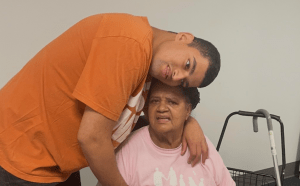
Giovanny Arias and his grandmother, Liduvina Gonzalez
Due to the visitation restrictions, the family was deprived of information about Giovanny’s well-being and whereabouts for over a month while he underwent numerous surgical operations, his great aunt, Carolina Hernandez Broomhead, said.
The ban on visiting Giovanny in the hospital followed growing communication and visitation restrictions imposed by Seven Hills management and Giovanny’s state-paid guardian, Susan Braus, in the group home, Carolina said. Carolina contended the restrictions started after the family expressed concerns about insufficient care at the group home.
Visitation restrictions appear to be a part of a pattern in which families are marginalized when they attempt to advocate for their loved ones (see here, here, here).
Previous visitation restrictions at the residence
Issues involving visitation restrictions in Giovanny’s group home first arose this past fall. Carolina contended that Seven Hills and the guardian had responded with visitation restrictions against the family for having alleged that the group home was subjecting Giovanny to poor hygiene and overmedication, and had depleted his Social Security funds. Seven Hills also prevented Giovanny’s grandmother from seeing her grandson at the residence, and, at one point, even called the police on the seventy-eight-year-old woman, Carolina said.
Moreover, in November, Seven Hills proposed a series of new restrictions that included a ban on family visits to the residence. Family visits would have to occur at other predetermined locations. There would also be a maximum of two family visits per month with a limit of two hours per visit. Additionally, the family would be required to bring a translator with them on all visits for the benefit of staff who are unable to speak Spanish. A fuller discussion of the restrictions is available here.
Withheld medical updates on the evening of the hospitalization
Existing tension surrounding mistreatment and visitation limitations appeared to escalate during Giovanny’s hospitalization, starting on December 19, at Brigham and Women’s Hospital.
That night, Carolina said, she participated in a three-way phone call with a doctor and Braus. She said she heard Braus direct hospital personnel to withhold medical information from the family, even as a doctor recommended otherwise. Consequently, the family was denied vital information about Giovanny’s welfare amid a health emergency, she said.
Family hospital visitation restrictions
Hospital visitation restrictions soon ensued after Giovanny’s admission. While the family was permitted to visit Giovanny at the hospital on December 31, visitation was suddenly restricted on January 2, Carolina said. That day, two security officers unexpectedly ushered another aunt out of the hospital after she attempted to visit Giovanny. Carolina said they did not provide any explanation for the aunt’s removal.
Family difficulties accessing information about hospital visitation restrictions
Shortly afterwards, Carolina called the hospital for more information on the incident. She said a Brigham and Women’s employee claimed to her that Braus had submitted written documentation barring family visits. Carolina said that when she followed up with Braus, however, Braus claimed the hospital was responsible for the visitation ban.
Other attempts by the family to receive clarification of the visitation restrictions in the hospital have been futile, according to Carolina. In an email dated January 13, DDS area director Jeffrey Hetrick claimed that neither DDS nor the guardian had a say in the restrictions, and placed responsibility on the hospital.
Seven Hills Area Director Caelin Scribner similarly asserted that Seven Hills was uninvolved in the decision-making process on visitation, and maintained the hospital alone made the decision to deny family visits. In their emails, both DDS and Scribner encouraged the family to contact the hospital for clarification. Yet, further family outreach to the hospital was unsuccessful, Carolina said, with the hospital hanging up the phone and not responding to emails.
COFAR difficulties assessing responsibility for hospital visitation restrictions
COFAR also experienced similar challenges while investigating the situation. Neither Braus nor Scribner replied to our emails requesting clarification on the hospital visitation restrictions. We emailed DDS Commissioner Sarah Peterson on January 8 to express concerns about the family hospital ban and were told that the DDS Area Office staff would follow up with the family directly. We reached out again on January 26 to the commissioner to highlight that the issue remained and have yet to receive a response.

Giovanny’s broken wrist, which the provider claims he suffered after falling in the group home in December.
Communication with the hospital has proven difficult as well. Despite having a seven-day response timeframe, the hospital didn’t respond to three of our emails about the restrictions. The Brigham and Women’s Patient and Family Relations Department finally replied to us in a January 26 email, stating we would need “a release of information signed by someone who has the authority to speak for the patient.”
While laws protecting health information may limit the public’s ability to receive case details, even our request for basic clarification on hospital visitation policies was not answered by the hospital.
On January 26, I called the floor where Giovanny was hospitalized and was told by a hospital staff member that they could not give me any information and that I would need to speak with Braus instead.
When I clarified that I simply had general questions about the hospital visitation policy, the staff member offered to connect me with a supervisor. After leaving me on hold for about twenty minutes, the staff member returned and said I would have to contact the Patient and Family Relations Department. When I asked if I could speak to the supervisor, the staff member responded that they did not have that person’s contact information.
Implications of the family hospital visitation restrictions
Regardless of who initiated the hospital restrictions, it is concerning that all parties have disclaimed responsibility rather than working to resolve the problem. Each entity has a duty to promote Giovanny’s best interest in partnership with the others.
Isolating an individual with disabilities from his family for over a month cannot be said to advance his best interest. For a person with autism who has limited abilities to communicate with speech, the disruption of routine and exposure to an overwhelming sensory environment in isolation could be traumatic.
The hospital family visitation restrictions seem to be inconsistent with Brigham and Women’s own Patient Rights statement. This affirms that patients have the right to “communicate with people outside of the hospital” and “participate in [their] care.”
The family visitation restrictions also appear to violate Giovanny’s legal rights. His 2024 legal guardianship decree states that Giovanny retains the right “to determine with whom to have friendships and visitation.” No one has claimed that the restrictions stem from Giovanny’s preferences, Carolina said.
Recent hospital discharge and continuing visitation limitations at the group home
In a February 6 email, Braus stated she believes that Giovanny would actually enjoy family visits.
When Giovanny was finally discharged from the hospital recently, Scribner and Braus separately reached out to the family to discuss arranging a visit at the group home. In Braus’ email she commented that she would “imagine [that Giovanny] would appreciate a family visit during his continued recuperation.” According to Carolina, this raises the question why Braus did not intervene to address the month-long hospital visitation restrictions.
Scribner, meanwhile, offered to host a two-hour-long family visit that Sunday with a maximum of two visitors so that Giovanny could “enjoy time with loved ones while still prioritizing his recovery.” She said that future group home visits could not exceed two visitors and would need to have attendees approved by Braus ahead of time. Carolina said it appears that the group home has imposed its November 2025 proposed visitation restriction agreement despite the fact that it was never signed by the family.
In our view, Braus and Seven Hills’ sudden allowance of a group home visit does not negate possible DDS regulation violations. The regulations state that “arrangements shall be made for private visitation to the maximum extent possible” and “family members shall be permitted to visit at all times, unless the individual objects.” Permitting visits sporadically and subjecting visitation to onerous terms and conditions amid growing backlash cannot be said to adhere to the spirit of the regulations.
The hospital visitation restrictions demonstrate the ease with which families can be dismissed and ultimately excluded by major players in the DDS-funded, provider-run residential system. When responsibility is diffused across state agencies, state-paid guardians, and corporate providers, accountability dissolves. Families are reduced from key team members to outsiders while their loved ones with disabilities suffer the fallout.
Family, blocked from visiting group home resident, also barred from visiting him in hospital
A resident of a group home suffered serious injuries there requiring hospitalization, and now his family is barred for undisclosed reasons from visiting him in the hospital.
Late last month, Giovanny Arias, who has autism spectrum disorder and other conditions, reportedly fell down a flight of stairs in the group home, according to his great aunt, Carolina Hernandez Broomhead. The Roslindale home is run by the Seven Hills Foundation, a corporate residential provider funded by the Department of Developmental Services (DDS).
Giovanny’s injuries included a broken wrist, black eye, and numerous bruises across his body, according to Carolina.
While Giovanny has undergone two surgical operations at Brigham & Women’s Hospital in Boston, his family has been prohibited from visiting him there and has been denied medical updates, Carolina said.
The ban on visiting the hospital follows mounting communication and visitation restrictions imposed by the Seven Hills management and by Giovanny’s state-paid guardian, Susan Braus, Carolina said. She said the restrictions began after the family complained of inadequate conditions and poor care at the residence.
Seven Hills even prevented Giovanny’s grandmother from seeing her grandson and, at one point, called police on her, Carolina said. She said Giovanny has been subjected at the residence to poor hygiene and overmedication, and to the disappearance of his Social Security funds.
Seven Hills has not provided the family with an accounting of his monthly spending, and has claimed he has no money. Carolina said her family has had to supply all of Giovanny’s clothes, blankets, mattresses, and bed linens, and has had to provide food for him on a weekly basis.
Carolina also said that in November, Seven Hills proposed a series of additional restrictions, including a complete ban on family visits to the group home. Family visits would have to take place at other agreed-upon locations. There would also be a cap of two family visits per month with a maximum duration of two hours per visit.
In addition, the family would be required to bring a translator with them on all visits for the benefit of staff who are unable to speak Spanish. We believe this requirement violates DDS regulations that establish a right of clients to have confidential communications and demonstrates a lack of sensitivity to culturally diverse communities.
As we have been reporting, staff neglect and restrictions on family visitation often go hand in hand in DDS-funded group homes (see here).
Restrictions on visits
According to Carolina, Seven Hills management, DDS, and Braus have blamed the family for failing to act in Giovanny’s best interests. Before his hospitalization, over 100 days had passed since Giovanny last saw any member of his family apart from a single cousin, Carolina said.
Carolina said the Seven Hills group home management blocked Giovanny’s grandmother, Liduvina Gonzalez, from visits and communication with Giovanny after she complained about substandard food and inadequate hygiene. The Seven Hills management called the police on the 78-year-old woman after she attempted to visit her grandson on September 21.
The restrictions appear to violate a 2024 decree naming Braus as Giovanny’s guardian. The decree states that Giovanny retains the right “to determine with whom to have friendships and visitation, with assistance if needed.”
Family response
In response to the alleged neglect and visitation restrictions, Carolina delivered what she termed a “demand letter” on behalf of the family to DDS on November 5. In the letter, she called for inspection and remedy of Giovanny’s current care conditions, his relocation to a more suitable setting, and restored family visitation and communication rights. The rights included regular, in-person visitation and private telephone or video calls at reasonable and scheduled times.
The family has yet to receive any reply to the letter, Carolina said. She said Giovanny’s DDS service coordinator, James Griffin, has ceased responding to her communications since she sent the letter.
Rather than opening a dialogue with DDS and Seven Hills about how to better support Giovanny, the demand letter sparked a wave of new visitation restrictions, according to Carolina. She also said Griffin has excluded her from all meetings related to Giovanny.
Seven Hills visitation restriction agreement
On November 14, the family received a proposed agreement that DDS, Seven Hills, and Braus requested that they sign, listing rigid requirements for family visits and communication with Giovanny. The restrictions include the following:
In-person visits:
- Family visits cannot occur at the group home and can only be scheduled for outside locations agreed upon by both parties in advance.
- Family visits may occur only twice per month on Sundays and must be planned at least a week in advance.
- Family visits are limited to a maximum duration of two hours.
- If a family member needs assistance with personal care, they cannot visit unless accompanied by someone who can provide assistance.
- The family must have an individual present at all visits to translate for the benefit of the staff if the visiting family member is unable to communicate in English. There cannot be more than two people present during any visit.
- Family members are not permitted to bring food to Giovanny under any circumstances.
- Seven Hills can terminate visits at any point they deem “appropriate.”
Phone calls:
- The family can call Giovanny only on Tuesdays and Thursdays after 3 p.m. If Giovanny declines the phone call, the family is not to call back.
- The family is not permitted to call staff or discuss problems unless they are able to speak English or have a translator on the line.
- If at any point in time, the family’s behavior is deemed “negative,” Seven Hills has the right to hang up on the call with notice and organize another time to call with DDS involvement.
Questionable provisions of the restriction agreement
Several of the provisions of the proposed agreement appear to be in violation of DDS regulations, which state that DDS clients have “the right to be visited and to visit others under circumstances that are conducive to friendships and relationships,” and that “family members shall be permitted to visit at all times, unless the individual objects.”
The regulations note that “reasonable restrictions” may be placed on the time and place of visits “to protect the welfare of the individual or the privacy of other individuals and to avoid serious disruptions in the normal functioning of the provider.” However, the regulations require that arrangements be made “for private visitation to the maximum extent possible.”
There is no indication that Giovanny’s family visits have ever adversely affected Giovanny or other residents to warrant such restrictions. The restrictions limiting the number, duration, eligible participants, and locations of visits can hardly be considered to allow for private visitation “to the maximum extent possible.”
We are further concerned by the restrictions’ failure to accommodate the needs of linguistically diverse families. The requirement that family visits occur exclusively in English not only limits meaningful expression that preserves a sense of cultural identity, but also impedes private conversations amongst family members. This also appears to violate DDS regulations, which state that DDS clients maintain “the right to communicate,” including “the opportunity to make and receive confidential communications.”
Escalating health concerns
Carolina said issues involving neglect and visitation restrictions reached a breaking point on December 19, when Giovanny was hospitalized at Brigham and Women’s Hospital.
During a three-way telephone call with a doctor and Braus on the evening Giovanny was hospitalized, Carolina said, she heard Braus instruct hospital staff to withhold medical updates from the family, even as a doctor suggested that the information be shared. As a result, the family was deprived of critical information about Giovanny’s health during a medical emergency, she said.
Family visitation restrictions amid medical crisis
Although the family was able to visit Giovanny in the hospital on December 31, they were barred after that from visiting him there, according to Carolina. On January 2, two security officers escorted another aunt out of the hospital after she attempted to see Giovanny, Carolina said.
When Carolina called to inquire about that incident, a Brigham and Women’s staff member told her Braus had submitted written documentation restricting family visitation, Carolina said. She said that when she spoke with Braus, however, Braus denied this and attributed the restrictions to the hospital.
DDS response
We emailed DDS Commissioner Sarah Peterson on December 1, asking the Department to investigate the allegations of neglect at Giovanny’s group home and to allow unrestricted family visits. We were later told that a DDS official would be reaching out to the family directly to address these issues. But Carolina said as of January 6 that no one had contacted her.
The coexistence of neglect and visitation restrictions has been an undercurrent in many of the cases brought to our attention (see here, here, and here), particularly when DDS involves itself in guardianships or co-guardianships.
There is a tendency of DDS and its providers to dismiss family members’ concerns about their loved one’s care as “overly dramatic” and to shut them out rather than investigate and address their allegations. This breakdown of the DDS-funded, provider-run residential system is especially alarming in the context of medical emergencies.
Fostering a DDS culture that acknowledges families as essential partners in collaboration is critical for improving outcomes for people with disabilities.
Families concerned they will be prevented from visiting loved ones at Christmas after having been barred on Thanksgiving
A nonprofit organization that was appointed as the guardian of at least two developmentally disabled individuals has imposed what appear to be illegal restrictions on visits to them from their families.
In each case, an employee of the corporate guardian, TLC Trust, Inc., appears to have been involved in preventing the families of Ryan Moran and Naomy Alicea from visiting them on Thanksgiving Day last month.
And in each case, Ryan’s and Naomy’s parents are concerned they will similarly be barred from visiting them in their Worcester-based group homes over the upcoming Christmas holidays.
The family members maintain in each case that the visitation restrictions have resulted from their complaints that their loved ones have been subjected to abuse or neglect in their provider-operated residences.
Naomy, 37, has an intellectual disability (ID) and cerebral palsy. Ryan, 29, has ID and is on the autism spectrum.
Hilda Natal, Ryan’s mother, said that the Department of Developmental Services (DDS) had Ryan placed in a group home run by Venture Community Services in 2020, when he was 24.
Naomy has been living in a separate group home in Worcester, which is operated by the Seven Hills Foundation. Both Venture and Seven Hills are DDS-funded residential providers.
Members of both families contend that their guardianships of their loved ones were removed for questionable reasons. DDS successfully petitioned in Worcester Probate Court to have TLC Trust appointed as the guardian of each individual instead.
It is unclear why TLC has been appointed as guardian of these clients. TLC’s website states that the organization primarily administers trusts with a minimum value of $100,000 for persons with developmental and other disabilities.
While the TLC website says the organization can also act as a corporate guardian for persons, the website further states that, “First priority for this (guardianship) service will be given to those individuals who have a trust relationship with the organization.” It does not appear that any such trust account with TLC exists in either Ryan’s or Naomy’s case.
We believe the visitation restrictions violate DDS regulations, which state that DDS clients have the “right to be visited and to visit others under circumstances that are conducive to friendships and relationships.” Also, the individual’s family members “shall be permitted to visit at all times, unless the individual objects…”
Visitation restrictions correlate with allegations of abuse or neglect
In both cases, the visitation restrictions appear to have followed from allegations by the families of neglect or abuse by the staff.
In each case, DDS and the corporate guardian appear to have blamed the families for causing problems such as allegedly causing agitation in their loved ones after their visits. But while clients may well become agitated, especially at the end of a visit, the cause of that agitation may actually be that the family member is leaving the client alone with the staff.
If there is neglect or abuse by the staff, that can be sufficient reason for a client to become agitated when the family member leaves.
Commissioner’s help sought in allowing visits
On November 25, I wrote to DDS Commissioner Sarah Peterson to urge that DDS allow Ryan’s family to visit him on Thanksgiving Day. Since then, we learned that a similar prohibition on visits was imposed on Naomy’s parents, and that TLC and its employee, Diane Parker, were involved in each case in imposing the restrictions.
As noted, neither family was allowed to visit on Thanksgiving. We are urging the Department to allow family visits during the Christmas and New Year’s holidays and to review the actions of TLC in restricting family visitation in each case.
Last week, Commissioner Peterson responded, thanking me for “reaching out with (my) concerns,” and saying she had “followed up with the local teams on the specifics of these cases. While I know you understand that I cannot comment on specific cases, please be assured that they are engaged and will follow up,” she wrote.
Peterson added that, “In terms of TLC Trust, Inc. serving as a guardian, I cannot speak to their requirements for taking private pay cases (which you identified from their website), but I can tell you that TLC Trust qualified through state procurement procedures to receive and accept appointments from DDS.”
Naomy’s case
Lizvette Rivera, Naomy’s mother, said she lost her guardianship of Naomy after a former family acquaintance made several accusations against Lizvette in 2018, which Lizvette and her other daughter, Catiria, claim were false.
DDS petitioned in Worcester Probate Court in 2018 to remove Lizvette as guardian and install TLC. Lizvette said her removal was based on the false accusations made against her, which were nevertheless presented as true in a Guardian ad Litem report to the Probate Court in 2019.
Lizvette and Catiria alleged numerous health scares at Naomy’s group home. They said that in one case, Naomy developed a urinary infection that required hospitalization because she was forced to shower by herself even though her family had repeatedly said she required support.
Naomy was subsequently prescribed medication that Lizvette and Catiria claim negatively altered her behavior. But when they questioned this, the residential staff imposed further visitation restrictions on them. They said they are frustrated by their inability to receive health information about Naomy from medical professionals, especially in light of her health complications.
Ryan’s case
Ryan’s mother and father, Hilda Natal and Jose Moran, said they have been barred from visiting him since early October because their visits were allegedly causing him emotional distress. As noted above, we strongly question whether it was the case that their visits could have caused that.
Jose said that on Thanksgiving day, he and Hilda tried to visit their son, but that the group home manager called Parker, the TLC Trust employee, who said visits were not being allowed by a DDS attorney. The house manager then threatened to call the police, and Hilda and Jose left.
Phone taken
Jose said that the group home staff also recently confiscated Ryan’s cell phone, with which he had been communicating with his parents on FaceTime. Jose said a staff member told him the phone was being kept in the group home office because the phone was not working. But Jose questions that because the phone is new. Without the cell phone, Ryan’s parents are only able to communicate with him via the group home’s landline phone in the office.
Hilda also said that when Ryan did have his phone, group home staff would stand outside his room, listening to his conversations. She said that in October, the house manager said Ryan would be required to leave his bedroom door open when he talked to his parents on his phone.
The DDS regulations cited above state that clients have the right to have reasonable access to a telephone other web-based communication, and the right “to make and receive confidential communications.” They also have the right “to keep and use personal possessions.”
Judge blames parents, but provides few details
In Ryan’s case, a probate court judge appears to have sided with DDS and TLC in finding that his parents’ visits to him were “problematic.” In a December 9, 2024, document titled, “Brief Findings and Rationale,” Worcester Probate Court Judge Roxann Tetreau stated that “visits with (Ryan’s) parents at the group home …would result in (Ryan) engaging in behaviors after they left.” As a result, the judge said, the group home and TLC restricted family visits.
Tetreau’s findings, however, provided no supporting details. The judge did state that: “It is again clear from the evidence that Jose and Hilda love their son…They do not, however, understand what (Ryan) needs…” The judge appears, however, to have accepted DDS’s and TLC’s claims about Ryan’s parents and to have disregarded the parents’ point of view.
Abuse and neglect of Ryan
There was also no mention in Tetreau’s findings of Hilda’s allegation that Ryan was repeatedly abused by staff in a day program job he had, starting in 2017. She said the abuse caused Ryan to have an anxiety crisis, and she then told him to stop working there. After that, she said, DDS petitioned in probate court to remove her as Ryan’s guardian. She said DDS made false statements in court about her and Ryan.
Neglect and restrictions on visits
Neglect and severe restrictions on family visitation imposed by group home providers seem to go together, and we have brought several of those cases to the attention of Commissioner Peterson in recent months.
When there is neglect and family members complain, the instinct of providers and DDS is often to deny families access to their loved ones in their residences. That way, the neglect itself does not have to be addressed.
We are asking that DDS investigate the allegations of abuse or neglect in each of these cases and to work with the families to find more suitable residential settings.
In the meantime, we are urging Commissioner Peterson to ensure that both of these families are allowed to visit their loved ones over the Christmas and New Year’s holidays.
As serious care issues remain under a new DDS-funded provider, a mother calls for systemic change
More than five years ago, Mary Phaneuf thought the serious neglect her foster son, Timothy Cheeks, had experienced in his group home in East Longmeadow was finally coming to an end.
In 2019, the Department of Developmental Services (DDS) took the rare step of terminating a contract with the Center for Human Development (CHD) to operate two residences, in one of which Tim was living. Among other problems, CHD, a DDS-funded corporate provider, had failed to take Tim to his doctor’s and dentist’s appointments for seven years even though Tim has a congenital heart defect.
COFAR’s blog posts in 2019 (here and here) concerning Mary’s allegations, and subsequent coverage by The Springfield Republican, led to a DDS investigation of CHD. The contract termination came after the investigation by DDS’s Bureau of Program Integrity found “potential systemic issues” of poor care throughout CHD’s residences.

Timothy Cheeks with his foster sisters, (from left) Nicole Phaneuf Sweeney, Lauren Phaneuf West, and Jessica Phaneuf Szczepanek.
DDS subsequently selected a new provider, the MHA (Mental Health Association), to replace CHD, and Tim was moved into an MHA home in 2019. Tim, 46, has an intellectual disability and Down Syndrome.
In September of this year, Mary got back in touch with us to let us know that many of the same issues that had existed under CHD began to reemerge under MHA.
In the early months, Tim’s care did improve significantly in the new residence. The new staff were communicative, attentive, and committed, Mary said. But as the COVID-19 crisis unfolded and management changes occurred, care started to slip, she said.
Nevertheless, Mary said she remains hopeful that the ongoing case will spark the systemic changes that she contends are necessary to permanently correct the problems.
“This is not to assign blame, but to advocate for change,” Mary wrote. “Many of the staff at MHA and DDS care deeply about the people they serve. The problem lies in a system that too often allows serious issues to repeat due to gaps in communication, training, and oversight.”
Since MHA has been in charge, the problems alleged by Mary include the following:
- In spring 2024, Tim’s Social Security benefits were terminated because of unreported income from his estranged biological father — a situation not caused by MHA, but requiring their timely response. However, the provider failed to meet the required federal timelines for an expedited appeal. As a result, Tim was without benefits for more than 18 months, leaving his personal funds depleted. His benefits were finally restored in October of this year.
- During the same period, Tim’s MassHealth insurance lapsed, interrupting access to medical and behavioral health services. The lapse occurred despite reminder emails from both the Behavioral Health Network (BHN), the provider of Tim’s counseling services, and DDS to MHA to renew Tim’s coverage. Coverage was only reinstated after family intervention.
- In September of this year, Mary discovered, for a second time, that Tim’s feet were red, swollen, and painful, with overgrown nails and large callouses that made it difficult for him to wear shoes. Although a podiatrist had recommended to MHA in February that Tim have follow-up visits every three months and receive prescribed twice-daily foot medication, he was not seen for seven months. Also, it appeared his medications were not being administered consistently.
- MHA staff initially falsely told Mary they stopped taking Tim to his podiatrist because the podiatrist had stopped accepting MassHealth. That claim was later refuted directly by the doctor’s office. This neglect violated Tim’s Individual Service Plan (ISP), which had specified podiatry care and weekly nursing visits for him, Mary said.
- In August 2024, over a year prior to her report in September of this year, Mary first reported to MHA and Tim’s DDS service coordinator that Tim’s feet were in bad shape. She showed them a photo of his feet with large callouses, toenails grown so long they curled over the top of his toes and a large fungal growth on the bottom of one foot. Mary said that after her 2024 report, DDS included Tim’s footcare in his ISP, and MHA committed to a weekly nurse visit to check his feet. “One year later it all fell apart,” Mary said.
- In October 2022, MHA staff gave another client’s high blood pressure and anti-psychotic medications to Tim. Although Mary was told Tim was “fine,” she arrived at the hospital to find him heavily sedated and disoriented. The Disabled Persons Protection Commission (DPPC) later substantiated the incident as abuse.
- In both 2024 and 2025, Tim’s behavioral counseling at Behavioral Health Network (BHN) was suspended due to missed appointments and unreturned calls to the group home. At one point, Mary was told Tim’s appointments were missed because his counselor was hospitalized — a statement BHN later confirmed was untrue. These missed sessions deeply affected Tim’s emotional stability and confidence, Mary said.
- In August 2024, Mary learned from Tim’s day program that MHA had failed to pay for or register him for day program activities for over a year, and that his funds for those activities had been depleted. Mary’s family covered the costs to prevent disruptions in his daily routine. MHA did fix that problem. But Mary said that if she hadn’t discovered it, MHA would have never known about it. “For a whole year those activities, so important for Tim’s quality of life, fell by the wayside,” she said.
Service coordinator supports allegations
In an email on September 3, Tim’s DDS service coordinator, suggested to Mary that she contact the DPPC regarding the alleged neglect of Tim’s feet and the lapse in his health insurance.
Having viewed the photos that Mary had sent him, the service coordinator wrote that an investigation by either the DPPC or DDS “will put a fire under the feet of MHA to ensure that they are following the podiatry/Dr’s orders, and making sure he gets the proper podiatry care. What you have sent in the pictures is unacceptable.” [Note: We are not publishing the photos due to their graphic nature.]
The service coordinator also stated, “Please don’t worry about anyone ‘getting in trouble’ at MHA. They need to do their jobs accordingly and also be truthful about the care of the people in their services.” He also referred to “Tim not having health insurance for 5 months,” saying, “That is simply not okay.”
Requests and promises of investigation of MHA
At our suggestion, Mary emailed the director of the DDS Bureau of Program Integrity on October 3 to let her know of the allegations involving MHA and to request another investigation. The Bureau had conducted the previous investigation of CHD in 2019. Mary also emailed the DDS Central West regional director and DDS Springfield area director, requesting an investigation.
Those officials responded to Mary the same day, saying they intended to look into the concerns she raised.
It is certainly both frustrating and devastating to Mary and her family to learn that even after an investigation that resulted in the termination of the provider that was neglecting Tim, similar problems have continued under the new organization selected as the replacement. It is a shame that such a vulnerable client has had to undergo this level of neglect twice, in two different residential settings.
All of this appears to show that DDS did not follow up to determine whether the problems identified by the 2019 investigation had been corrected. That investigation was, by all accounts, comprehensive. It is unfortunately more evidence that the group home system in Massachusetts is dysfunctional, and DDS does not have a handle on it.
Nevertheless, Mary said she believes that DDS and its providers are capable of providing good care and ensuring high staff morale and low staff turnover. She maintained that, “The ultimate goal is simple: to create a system where every person with a developmental disability receives consistent, compassionate, and competent care — and where families, providers, and the state work together to make that goal a reality.”
Mary noted that Tim loves music, his day program, and spending time with his family. “His laughter and resilience remind me why this work — ensuring quality care and dignity for people with disabilities — matters so deeply.” She said she remains hopeful that, “by working with MHA and DDS, we can make progress toward systemic improvement.”
We certainly hope that is the case.
State Commission vilifies institutions for people with developmental disabilities and demands an apology from the governor
A state commission established in 2023 to study the history of institutions for the developmentally disabled and mentally ill in Massachusetts has issued a final report which, as expected, almost completely vilifies those facilities.
The report by the Massachusetts Special Commission on State Institutions, which is dated May 25, paints an overwhelmingly negative and untrue picture of the history of the institutions, often couched in extreme terms. The report only briefly mentions the dramatic improvements in those centers for the developmentally disabled that occurred starting in the 1970s.
We repeatedly predicted that the Commission would examine only the history of the institutions prior to the 1980s when those facilities were notorious for abuse, neglect and poor conditions.
Our concern has been, and now remains, that opponents of the Wrentham and Hogan Intermediate Care Facilities (ICFs), the state’s two remaining congregate care centers for people with developmental disabilities, will use the report as justification for pushing for the closure of the facilities.
Notably, the report demands a formal apology from the governor, who, it claims, “must acknowledge the enormity of the legacy and harm of mass institutionalization that reverberates today.”
But what about the improvements that were made in institutional care starting in the 1970s in Massachusetts under the landmark Ricci v. Okin class action lawsuit? The late U.S. District Court Judge Joseph L. Tauro, who oversaw the consent decree in that case, said in 1993 that the care in the institutions was by then “second to none anywhere in the world.”
Isn’t that improvement also part of the legacy of institutionalization in Massachusetts? Should Governor Healey apologize for that?
What about the high federal standards that Wrentham and Hogan meet today? And what about the families that are fighting to keep Wrentham and Hogan open as the state pursues a policy of letting Wrentham and Hogan die by attrition?
Also, what about the legacy of deinstitutionalization, which the report does not criticize, but which has also caused much harm?
While the report has tried to make a positive contribution in calling for making public the historical records of the care of residents of institutions in Massachusetts, the report appears to assume that those records contain only damning accounts of that care. That is, of course, not true; but, the report implies that the purpose of providing public access to the records is to reveal “atrocities” committed in the institutions. As the report states:
By hiding a story of mass human rights abuses, the Commonwealth is preventing society from engaging in a full reckoning with the atrocities that have been inflicted on disabled people throughout our history.
Sensational claims concerning closed facilities
The report also makes a number of sensational claims that lack evidence of what it alleges are shocking activities that have taken place on the campuses of closed facilities. Among those allegations, for which the report doesn’t provide any details, are that some unidentified campuses have been used for pornographic photo shoots and “white supremacist celebrations.”
As the report puts it:
At their most offensive, (former institutional) sites have been used for pornographic photo shoots, white supremacist celebrations, community festivals, and amusement parks that would never be tolerated at similar sites of significant human rights abuses in Massachusetts or America.
I have not been able to find any references on line to pornographic photo shoots on the campuses of closed institutions. As noted, the Commission report provided no examples of it.
Brandeis University’s student newspaper, The Justice, reported that graffiti featuring markings of Neo-Nazi groups has been discovered on the walls of one of the buildings on the campus of the former Fernald Developmental Center. But the Waltham Police Department stated that “there are no known organized hate groups operating in the area.”
So, while vandalism at the former Fernald Center has been an ongoing issue, there is no information I could find that refers to white supremacist celebrations being held there. The Commission also provided no examples of amusement parks on the campuses of former institutions.
The amusement park reference might be to the development by the City of Waltham of a portion of the Fernald campus as a memorial park and “universally accessible” playground, with an electric train, a mini golf course, and a spray park “that would make it the largest disability-accessible park in New England.” The park received two awards from the Massachusetts Recreation and Parks Association in February for its design and commercial partnership.
In addition, the Commission report includes what appears to be a false claim that there is a threat of a “revival of large-scale institutionalizations” in Massachusetts. It provides no evidence for the claim.
While the report doesn’t appear to specifically recommend the closure Wrentham or Hogan, it claims institutionalization “stubbornly remains.” The statement appears to be an indirect call for the closure of facilities such as Wrentham and Hogan. If the report is referring only to institutions for the mentally ill as stubbornly remaining, it doesn’t specify that distinction.
The report’s full statement on this issue is:
Precisely because the public is largely unaware of the countless tragedies inflicted by these institutions—tragedies told in this hidden history—people with disabilities today face very-real threats by the non-disabled including the revival of large-scale institutionalizations where the practice has been abolished, and its expansion where it stubbornly remains.
Rights abuses were not ‘overlooked’
In its coverage of the Commission’s report, GBH News, a Boston-based National Public Radio affiliate and one of the more fervent critics of the former Fernald Center, quoted Alex Green, vice-chair of the Commission and one of the chief proponents of the Commission’s creation. According to GBH News, Green stated:
I think that there’s a massive ongoing act of erasure happening about one of the most significant and overlooked human rights tragedies in the history of this state and the country. It [the report] really gives us a devastatingly personal sense of how the state turned the idea of care into a much darker thing that harmed a lot of people.”
But the Ricci class action case and Judge Tauro’s involvement clearly show that those human rights abuses were not overlooked. They were addressed and corrected.
Moreover, even with regard to the early history of institutional care in Massachusetts, the Commission’s report appears to be uniformly negative when, in reality, not everything was necessarily bad about those early years.
As Ingrid Grenon noted in her book, “From One Century to the Next: A history of Wrentham State School and the Institutional Model in Massachusetts,” the 1920s was a period when the then Wrentham State School, under the direction of its first superintendent, George Wallace, had a caring staff and administration, and offered a multitude of services and activities for the residents.
Grenon’s book points out that Wrentham, like other similar institutions that sprang up in this state and around the country, entered a long decline, starting in the 1930s as it became more and more overcrowded and understaffed. The state schools in Massachusetts were finally brought back to excellence as a result of the Ricci v. Okin class action litigation.
But the Special Commission has this to say about those early years of institutional care in Massachusetts:
…Massachusetts developed, sustained, and exported many of the first legal, medical, educational, charitable, and social systems for placing people with intellectual, developmental, and mental health disabilities in institutions: practices widely understood for more than 75 years to be a violation of fundamental human rights. (my emphasis)
In sum, we would again emphasize that the report appears to have made some positive contributions with regard to the need for public access to records and for the identification of unmarked graves on the sites of the former institutions in Massachusetts.
But it is unfortunate that the report repeatedly leaps from those issues to unwarranted condemnations of the role and history of institutional care in the state. It’s clear from the report that the Commission did not closely examine the full history.
As we’ve previously noted, Green and other proponents of the Commission made statements prior to serving on the Commission that were almost uniformly negative about care at the former Fernald Center, in particular.
That negative agenda appears to have muddied the positive contribution that the report has tried to make with regard to the role of institutional care in Massachusetts.
State administrative judge dismisses mother’s appeal of termination of services in state-run apartment program
In a decision we think may set a bad precedent, a state administrative judge has dismissed a mother’s appeal of an abrupt cutoff of services last year by the Department of Developmental Services (DDS) in a staffed apartment for the mother’s intellectually disabled daughter.
In a three-page decision that took more than three months to issue, state Division of Administrative Law Appeals (DALA) Magistrate Kenneth Forton concluded on May 9 that Jeanne Cappuccio’s appeal of the then impending closure of the Andover apartment on April 1, 2024, was moot because she had taken her daughter Mia home with her shortly before the services in the apartment were terminated.
“Taking Mia home mooted any objection to her move that DALA could even possibly review,” Forton’s decision stated. “DALA is only able to order DDS to delay or stop a transfer, it cannot prevent a move that occurred a year ago.”
However, Jeanne contended that the matter was not moot because DDS had failed to allow her then timely appeal of the shutdown to proceed. Her appeal had been filed in March 2024 under DDS regulations that allow appeals to DALA of proposed transfers of clients from one residence to another.

Mia and Jeanne Cappuccio
Jeanne argued that in a violation of the regulations, DDS had declined to forward her original March 26, 2024, appeal of the impending termination to DALA for adjudication. As a result, we helped Jeanne refile her appeal directly to DALA on December 6. We also helped Jeanne in submitting a written objection to a motion filed by DDS on January 27 to dismiss her December appeal.
Jeanne maintained that due to the imminent termination of the services in the apartment as of March 2024, she had no choice but to bring her daughter home after DDS blocked her appeal from proceeding. She contended, however, that even today, DALA could order DDS to find a new, suitable location for Mia.
Since April 2024, Mia has been living at home with Jeanne and her husband Tom. But Jeanne said she and Tom are “overwhelmed with the challenges of providing Mia’s intensive supports and maintaining our commitments to our full time jobs.” She said DDS has not provided Mia with physical therapy nursing, or counseling services for the past year.
Following Forton’s May 9 dismissal of Jeanne’s December appeal, she asked Forton on May 20 for reconsideration of his decision, arguing that it contained significant factual errors. Forton denied her request for reconsideration without explanation the same day we filed it.
In both her March 2024 and December appeals, Jeanne alleged that the cutoff of services was done in retaliation for her complaint that Mia had been emotionally abused by staff in the apartment.
In Jeanne’s appeals and plea for reconsideration, she urged Forton to order DDS to provide an alternative residential location for Mia “that meets her best interest” as required by the DDS statute covering transfers. She added that, “A failure to do so simply rewards DDS for failing to comply with the statute and regulations that specified a timely process for appeal.”
Jeanne further argued that dismissing her appeal would allow DDS to evict disabled individuals from their homes by simply withdrawing all supports, without providing due process or alternative placements that provide services. This would set a precedent that would contradict the intent of the statutory framework governing the provision of services to persons with intellectual and developmental disabilities (I/DD).
Apartment program did not live up to promises
As we reported in February, DDS had initially proposed what was described as a novel residential program for both Mia and another woman who had both been subjected to poor care and conditions in a previous group home.
The Department proposed to rent an apartment in Andover for the women, and staff the new residence with direct care workers. Those workers would be employees of Northeast Residential Services (NRS), a division of DDS, which operates group homes in DDS’s northeast region of the state. It was to be an apartment where the two women could lead independent lives while still receiving Intensive Support Services from DDS.
But Jeanne maintains that far from providing better care than the previous group home had provided, DDS never appeared to be committed to making the new residential program work.
Jeanne said that in an incident on February 20, 2024, while she was talking with Mia over the phone, she overheard a staff member begin shouting at her daughter to get back in her room. Her daughter had been attempting to do her laundry, but the staff member would not let her do it. She said her daughter began crying.
Unable, after calling DDS and then visiting the apartment to get any answers, Jeanne filed a complaint with the Disabled Persons Protection Commission (DPPC).
On February 23, 2024, just three days later, NRS informed Jeanne that the residential program would be terminated in roughly a month. This was another violation of the regulations, which require a 45-day notice of proposed transfers.
Meanwhile, on the same day that NRS informed Jeanne of the termination of the program, DDS’s legal division petitioned in Middlesex Probate Court to limit or possibly eliminate Jeanne’s and Tom’s co-guardianship of Mia. That action had come out of the blue, Jeanne said. She said that DDS eventually withdraw its petition, but only after she had initiated discovery proceedings in the case.
Magistrate improperly quoted from regulatory provision by omitting a key phrase
Among the errors we cited in Forton’s decision were that he had left out five key words in citing the transfer regulations and thereby concluding that the regulations didn’t apply to Jeanne’s case.
In addition to wrongly concluding that Jeanne’s appeal was moot, Forton stated that one of the options suggested by DDS to Jeanne in March 2024 was to have Mia remain in the apartment and use a different service provider. He then stated that under the transfer regulations, “A change in the identity of the provider… involving no move, shall not be deemed a transfer.”
But while the regulations do state that a change in the identity of the provider shall not be deemed a transfer if there is no move, the provision in question specifically states that the change in the identity of the provider would have to occur “pursuant to a contract award.”
Thus, simply suggesting that a resident of a facility slated for closure can remain in the same location if the resident is able to find a new provider does not constitute compliance with the regulations. DDS, in that circumstance, must not only have identified the new provider, but must have signed a contract with that provider.
In Mia’s case, however, there was no contract awarded, and, in fact, a new provider had not even been identified.
The full regulatory provision that Forton partially quoted states the following:
…the change in the identity of the provider pursuant to a contract award involving no move, shall not be deemed a transfer…(Emphasis added)
In quoting the provision, Forton left out the critically important phrase “pursuant to a contract award.” Leaving out that phrase completely altered the meaning of the provision.
Thus, the magistrate’s finding that there was no transfer because DDS had offered Mia the option of staying in the apartment was incorrect. Jeanne ultimately took Mia home because DDS would not allow her timely appeal to DALA to proceed in March 2024, and because DDS had not identified a new provider, much less awarded a contract to one, before terminating services.
Jeanne argued that the question for DALA to decide in this case, and in all such appeals brought under the transfer regulations, is whether or not a proposed transfer is appropriate. She cited the precedent of the closure of the former Fernald Developmental Center in 2014. In that case, DDS gave notice that Fernald was going to be closed and the services there terminated.
The difference between the Fernald situation and Jeanne’s and Mia’s case is that DDS allowed the residents in the Fernald case to appeal to DALA under the transfer regulations prior to the cutoff of services.
Ultimately, this DALA decision was disappointing, not only because it went against Jeanne and Mia, but because it did not appear to seriously consider Jeanne’s arguments.
Moreover, in stating that the matter was now moot, the magistrate’s decision appears to have rewarded DDS for having violated the transfer regulations by preventing Jeanne’s timely appeal from proceeding.
Had DDS properly allowed the appeal to proceed in March 2024, it would have stopped the imminent termination of services in the apartment pending the outcome of that original appeal.
UPDATE: Second parent comes forward regarding poor care in a state-run, NRS group home
We have renewed our call for an investigation by the Department of Developmental Services (DDS) of its state-run group home system in the northeast region of the state after a second parent has contacted us with concerns about care in an NRS (Northeast Residential Services) home.
On Wednesday, the mother of a resident of a second NRS home voiced concerns similar to those of Jeannine MacKinnon, who was forced to bring her son Zachary home after three years of substandard care in an NRS home in Peabody. We first reported about Jeannine’s case on Tuesday.
NRS is a division of DDS that operates group homes in the northeast region of the state.
While state-run group homes in Massachusetts have better compensated and trained staff on average than do homes operated by corporate providers to DDS, we have found that problems can develop in any type of care facility.
In an email, the second parent, who asked that her name not be used, wrote that her son was admitted twice in recent months to hospital ICUs, first for internal stomach bleeding and later for severe asthma exacerbations. She said that in the second case, the staff had failed to seek medical attention, despite her repeated requests.
The parent also said her son has suffered multiple bruises and other injuries in the residence. The Disabled Persons Protection Commission has been contacted three times.
In addition, the parent said she has received no reply from the DDS Human Rights Office to her concerns about the situation. She said she wishes she could bring her son home, but is unable to care for him due to his aggressive behaviors.
This parent also stated in a subsequent message to me that DDS has not provided her with any other placement options, and that her son has been living in the facility for 18 months.
We originally contacted DDS Commissioner Sarah Peterson on behalf of Jeannine MacKinnon and her son on May 6, and asked that DDS conduct an investigation of the NRS system. Peterson responded that while she could not comment on individual cases, she had reviewed our email and “followed up with the team and will continue to do so.” She did not explicitly say that she would order an investigation.
In a follow-up email yesterday (May 29) to Peterson, I noted that the account from the second parent “deepens our concerns, and bolsters our call for DDS to carry out a comprehensive investigation into the NRS system.”
State-run group homes in Massachusetts have continued to lose residents under an administration policy that is letting them die by attrition.
As with the Wrentham and Hogan Intermediate Care Facilities (ICFs), DDS does not offer state-run residences as an option to persons seeking residential placements, but rather seeks placements for those individuals primarily in corporate provider-run group homes. As a result of this policy, many people with developmental disabilities end up waiting for months or years for such placements.
We hope it isn’t the case that the administration is also allowing conditions in its state-run group homes to deteriorate.
DDS failed to act on concerns about care in a state-operated group home
We have seen substantial evidence over the years that the Department of Developmental Services’ (DDS) state-operated group homes have better trained and compensated staff on average than staff of corporate provider-run homes.
But problems can still plague state-run facilities if the Department removes resources from them, fails to ensure that staff are properly supervised, or fails to nurture a culture of caring.
If we see evidence of any of those things happening, we think it’s important that DDS investigate immediately in order to prevent the situation from spreading and possibly damaging a vital part of the system of care.
One apparent and hopefully rare example of those problems is alleged to have occurred in a Northeastern Regional Services (NRS) home in Peabody. Jeannine MacKinnon claims the staff there provided such poor care to her son Zachary that she finally had to take him home in January. Zac is 32, autistic and non-verbal.
NRS is a division of DDS that operates group homes in the northeast region of the state.
In this case, DDS doesn’t appear to have made serious efforts to respond to Jeannine’s many concerns over months or even years about serious lapses in care. Departmental officials repeatedly assured her they would look into her concerns, but problems persisted without indications that any solutions were tried or implemented.

Zac MacKinnon
Jeannine said that while Zac was in the group home, NRS officials criticized her as “a combative mother.”
Unfortunately, bringing Zac home hasn’t been a viable solution for Jeannine. Jeannine, who is disabled, said she can’t sustain his care in her home. Zac needs 24-7 care, elopes, and has seizures.
On May 6, we wrote to DDS Commissioner Sarah Peterson, urging her to act quickly to locate a suitable alternative residential location for Zac and to relieve Jeannine of the burden of continuing to try to care for her son on her own. We also requested that DDS investigate the NRS group home system in light of the problems Jeannine has identified in the Peabody residence.
Peterson responded to us a few days later, saying that while she “could not comment or provide specifics related to any individual cases, please know that I have reviewed your email, followed up with the team and will continue to do so.”
In fact, Jeannine said that earlier this month, DDS provided her with two possible alternative residences for Zac. She said she has had a “good conversation” with the corporate provider operating one of those homes.
Bruises and infections
At the NRS group home, Jeannine said, she often found her son “covered in bruises and covered with MRSA infections” and receiving no medical treatment. She sent us photos of those bruises and infections, many of which would be too graphic for us to publish.
Last month, DDS notified Jeannine it was investigating many of her claims, including allegations of a broken rib, bites and scratches, bruising, and skin infections on Zac. DDS also said it would investigate allegations that Zac was regularly assaulted by another resident of the group home and was locked out of his bedroom during the day by the staff so that he couldn’t escape from the other resident.
Another allegation of Jeannine’s was that Zac was forced by the staff to wear a confining bodysuit during that day that was zipped from behind. While the suit was intended to keep Zac from self-injurious behaviors, it was only supposed to be used at night.
While the investigation by the Department of Jeannine’s specific allegations is welcome, it is not clear that it will involve a systematic review of NRS’s management and oversight of its residences.
The alleged problems in the NRS home, which are documented in emails to DDS, are discussed below. We would note that DDS officials did not dispute any of the concerns that Jeannine raised with them.
Attacked and kept from bedroom
Jeannine said that among other problems, Zac had been subject for months to physical assaults by another resident in the NRS home, and that for some reason, the staff wouldn’t allow him to escape from those attacks by going to his bedroom during the day. She said he was forbidden for three years from entering his room until bedtime.
Despite repeated complaints from Jeannine to DDS about the situation, nothing appears to have ever been done about it.
In one email exchange about that problem, Jeannine wrote to an investigator with the Disabled Persons Protection Commission (DPPC) on August 11, 2024, saying, “I don’t want to repeat myself, but the group home called me tonight to say (Zac) was attacked again! The group home staff is short-staffed every weekend leaving my son more at risk.”
Two days later, on August 13, Jeannine contacted her son’s DDS service coordinator, the supervisor of the group home, and a clinical therapist, saying, “My son does not even have access to his bedroom to flee from sick situations.”
That same day, which was a Tuesday, Zac’s DDS service coordinator responded, suggesting scheduling a meeting with Jeannine either for the following week or the week after that. “I am very sorry you don’t feel like we’re helping you with Zac,” the service coordinator wrote, not specifically acknowledging that a problem existed.
A month later, on September 10, Jeannine emailed an occupational therapist at Mass General Hospital, who was involved in her son’s care. “What is going to be done so that Zac can access his bedroom?” she asked. “They know he (the other resident) attacks Zac. For whatever reason they need to be separated.” The occupational therapist responded that Jeannine should contact the DDS ombudsman about the issue.
Photos of bruises and infections
On October 10, 2022, Jeannine sent photos of bruises and skin infections on her son to Bonnie Hungler, DDS Metro North area director. Regarding the bruises on Zac’s arm, Jeannine said she had been told Zac had fallen off a couch the previous Saturday, but she didn’t believe the explanation.
Two days later, Hungler responded, saying, “I am very sorry to see the significant bruising.” She said the injuries had been reported to the DPPC and that she intended to speak with the NRS director, ”to discuss and see what his team has learned after speaking with staff on shift.“
Hungler also said she expected that DDS would probably investigate the incident. The DPPC did refer the investigation to DDS, which concluded in a 1½ page report that abuse was unsubstantiated. Only five people were interviewed in the investigation, in addition to Jeannine herself.
In August 2024, almost two years later, Jeannine was still sending photos of her son’s bruises and infections to DDS and other officials, and apparently receiving little if any response, and no solutions.
On August 6, 2024, Jeannine wrote to an administrator at Jewish Family and Children’s Service. “I am sharing pictures of what I can only call abuse and neglect on my son in the care of the state run group home he is in,” Jeannine wrote. In response, the JFCaS administrator wrote that the photos “are concerning,” and stated that the organization had reported the matter to the DPPC.
Forced to wear bodysuit
As noted, Jeannine maintains that the group home staff began forcing her son, early after he moved in, to wear a bodysuit that zipped up in the back to prevent potentially self-injurious behaviors. But while the suit had been approved for use at night, it was not supposed to be put on him during the day.
Yet, the group home staff was putting the suit on him at all times, Jeannine said, and her son began injuring himself attempting to get it off. In October 2022, after unsuccessfully appealing to NRS, Jeannine wrote to then DDS Commissioner Jane Ryder and sent her a photo of a wound on her son’s back. She said a buckle on the bodysuit had caused the laceration on Zac’s back.
In her message to Ryder, Jeannine discussed other injuries as well. “My son is non-verbal and has no way of protecting himself,” she wrote. “He has no way to take it (the suit) off so he wets or soils himself and sits in his own urine eating away at his skin while he waits for someone to take care of him.”
The following day, Ryder responded to Jeannine, saying that, “I feel horrible about everything you and Zac have been through. My staff will continue to ensure that we are doing everything to make sure Zac is safe.”
Ryder added that, “NRS has acknowledged the failure to notify you in a timely manner (about injuries) and this has been addressed with staff. Your service coordinator will be visiting the home and will be continuing to monitor.“ But Jeannine said no improvements in her son’s care resulted from her contact with Ryder.
Staff wouldn’t use communication device to prevent toileting accidents
In August of last year, Jeannine emailed Zac’s service coordinator and NRS officials, saying that the group home manager was not allowing Zac to use his IPad to communicate his need to use the toilet. “He (Zac) has no way to tell anyone (of his needs) without the constant use and consistency of his IPad,” Jeannine wrote. She added that she witnessed staff allow Zac to urinate in his pants during a medical appointment rather than providing him with his IPad, which was in his backpack.
Approximately 10 months before that, in October 2023, Jeannine had emailed a previous service coordinator, stating that while being driven by staff to a medical appointment which Jeannine attended, Zac had had a urinary accident. She took him into the bathroom at the medical center to change his clothing, but discovered that the staff had packed previously soiled clothing in his backpack. “This entire day has started off really bad, when it could have gone a lot smoother if things were done properly,” she wrote.
No day program and no residential alternatives
Throughout Zac’s three-year stay at the NRS group home, he was not provided with a day program. In November 2, 2023, James Bath, director of family medicine at the Mass. General Hospital Lurie Center, wrote a letter stating that Zac needed a day program in order to provide him with “regular activity, structure, and social interaction,” which he was not getting in the group home.
Dr. Bath noted that the lack of meaningful activities and social interaction in the group home was directly causing symptoms of mild depression in Zac.
Until now, Jeannine maintains, DDS had failed to provide her with a residential alternative for Zac even though she had asked many times that one be found for him.
Thorough investigation needed
It’s not often that we would concur with an assessment that a state-operated group home is not a suitable residential setting due to substandard care. We hope Commissioner Peterson takes this matter seriously and investigates this situation thoroughly.
DDS’s state-operated group home network is an integral piece of the total continuum of care for people with intellectual and developmental disabilities. The network has a reputation for providing excellent care from staff who are well trained and are motivated and conscientious.
If things are starting to slip in any portion of that network, DDS needs to act quickly to determine the cause of the problems and make the necessary corrections.
Refiled Supported Decision Making bill contains all of the same flaws as its predecessor
Last year, we worked to stop a flawed bill in the state Legislature that would have introduced Supported Decision Making (SDM) in Massachusetts.
Fortunately, that legislation died at the end of the previous two-year legislative session when two separate committees declined to release identical versions of the bill to the House and Senate floors.
The bad news is that not only has the legislation not surprisingly now been refiled in the new legislative session, but everything we objected to last year has remained in the bill. None of our proposed changes to the legislation that would possibly have made it workable have been adopted in the new draft.
The refiled bill, H.261, is sponsored by Representatives Jay Livingstone and Michael Finn. Livingstone is House chair of the Children, Families, and Persons with Disabilities Committee, and is familiar with our objections to last year’s version of the bill.
Last year, the Children and Families Committee reported the legislation favorably and sent one version of it to the Rules Committee and another version to the House Ways and Means Committee. Neither of those two latter committees acted on the measure, however, and it died at the end of the session.
However, the legislation is again before the Children and Families Committee, and appears to be identical to last year’s version. No doubt, the Children and Families Committee, which has the same co-chairs as last session, will report the bill favorably again in this session.
In the Senate, S. 155, refiled by Senator Joan Lovely, contains much of the same language as H. 261. The Senate bill is also now before the Children and Families Committee.
Mass. Bankers Association still involved
As was the case with the final version of the legislation last year, the Massachusetts Bankers Association would be involved in the implementation of SDM, under this year’s legislation. The lobbying organization would be involved in developing a training program on the rights and obligations of SDM supporters, and would be appointed to an SDM commission that would study the feasibility of a state registry of all existing SDM agreements in the state.
Without safeguards, SDM appears in our view to hold a potential to overturn guardianships of persons with intellectual and developmental disabilities (I/DD).
The legislation would authorize written agreements to replace guardians of persons with I/DD with informal teams of “supporters” or advisors. The supporters would provide those individuals with “decision-making assistance” about their care and finances.
However, “incapacitation” is not defined in the legislation. Any individual under guardianship is considered under the Probate Code to be incapacitated. The SDM bills do not provide a standard level of capacity of an individual below which SDM would not be feasible.
Under the legislation, the incapacitated individual is labeled “the decision maker.” The legislation, as has always been the case in the past, defines the “decision maker” in an SDM arrangement only as “an adult who seeks to execute, or has executed, a supported decision-making agreement with one or more supporters.”
There are no further qualifications for being a decision maker. There are no distinctions among levels of disability. Thus, there is no consideration in the legislation as to whether persons with low levels of cognitive functioning are capable of making and appreciating life-altering decisions.
The legislation would also introduce conflicts between SDM supporters and guardians; does not direct the probate court to resolve those conflicts; and does not direct the Disabled Persons Protection Commission (DPPC) to enforce a provision against coercion in signing SDM agreements. The legislation also does not provide any means of enforcing a weak provision against conflicts of interest held by SDM supporters who work for corporate providers to the Department of Developmental Services (DDS).
Additional burden of proof
As we have pointed out to Representative Livingstone and other legislators, the SDM legislation would add to the burden of proof that a petitioner already faces in probate court in order to become a guardian. Thus, we think that this legislation may predispose probate court judges to deny guardianship petitions in favor of SDM agreements.
The legislation specifically would require anyone petitioning in probate court to become a guardian to state why a more limited guardianship or an SDM agreement was “inappropriate.” (emphasis added)
That additional burden requires a change to the Massachusetts Uniform Probate Code (M.G.L. c. 190B). So, while proponents of SDM often insist that the process of entering into SDM agreements is completely voluntary and informal, there is nothing voluntary about the additional burden the legislation would place on persons petitioning to become guardians of family members with I/DD.
And that raises the question whether signing an SDM agreement is really voluntary for every potential “decision maker.”
Is SDM really voluntary or is that wishful thinking?
Much of the verbiage in the SDM legislation and among proponents of SDM appears to be wishful thinking, particularly, that the process of entering into SDM arrangements is completely voluntary.
The legislation states, for instance, that “evidence of undue influence or coercion in the creation or signing of a supported decision-making agreement shall render the supported decision-making agreement invalid.”
But who would determine whether there was undue coercion in those cases, and how would it be enforced? The legislation doesn’t answer those questions.
Moreover, the bill defines “coercion” as “the use of force or threats to persuade someone to do something.” But people with I/DD often don’t have the level of skepticism or other cognitive defense mechanisms to prevent what may be much more subtle forms of coercion than outright threats or force.
Other wishful-thinking provisions in the legislation include a statement that SDM supporters must “Act honestly, diligently, and in good faith.” Also, that supporters must “Act within the scope identified by the decision-maker,” and that they must “Support and implement the direction, will, and preferences of the decision-maker. “
It is impossible to enforce those provisions because it is often impossible to know in many cases what the will or preferences are of persons who don’t fully understand the choices they are being asked to make.
Similarly wishful is a statement in the legislation that “(SDM) supporters shall not make decisions for the decision-maker.” It is meaningless to assume in every case that a person with ID is meaningfully making key decisions.
Fraud and abuse enforcement provisions are weak
The SDM legislation does appear to recognize that fraud and abuse could be at play in SDM arrangements because it specifically authorizes the DPPC and DDS to petition the probate court to revoke or suspend SDM supporters “on the grounds of abuse, neglect, exploitation or failure of the supporter to follow their roles and responsibilities resulting in serious physical, emotional, or financial harm to the decision-maker…” (emphasis added)
The legislation further states that “a person who has cause to believe that the decision maker is being abused, neglected or exploited by a supporter, may report the alleged abuse, neglect or exploitation to the DPPC.”
However, the DPPC, in particular, does not have the resources to conduct more than a small percentage of abuse and neglect investigations of caretakers. As a result, the DPPC refers most abuse investigations to DDS, which as we have pointed out, raises its own set of conflict-of-interest issues.
As a result, it seems unlikely that either the DPPC or DDS would petition the probate court to revoke or suspend SDM supporters unless there were overwhelming evidence of such abuse.
Seeking to prevent guardianships prior to adulthood
As was the case with previous versions of the legislation, the current House and Senate bills would require the state to promulgate regulations to inform secondary education students of “the availability of SDM as an alternative to adult guardianship.”
So, the intent here appears to be to persuade parents to enter their children with developmental disabilities into SDM arrangements on their 18th birthdays when parents would normally petition for guardianship. The legislation specifically states that at the first IEP (Individual Education Plan) meeting after a student has turned 16, the IEP team must “inform the student and their family or guardian, of the availability of supported decision-making agreements as an alternative to guardianship and conservatorship.”
In addition, the IEP team would be required to assist the child and their family or guardian “in locating resources to assist in establishing a supported decision-making plan if the child and their family or guardian are interested in supported decision-making.”
This is concerning to us because it appears to be intended to discourage families from seeking guardianship when their disabled children turn 18. That, in our view, would be a step toward eliminating guardianship altogether.
Records-sharing requirement raises concern
As was the case previously, the current legislation gives individual SDM supporters the authority to obtain confidential psychological and medical information about the disabled individual, and then requires them to keep that information confidential from others.
That leads to a question: If the disabled individual also has a guardian, why would SDM supporters with no formal relationship to the person also need access to those records? And, if one or more of those supporters was to find something concerning in the records, would they be required to keep that information from the guardian due to the confidentiality requirement?
Weak conflict-of-interest provision
The newly filed legislation does not improve on what was a weak provision in previous SDM legislation regarding a potential conflict of interest that arises when SDM supporters are also employees of DDS-funded group home providers.
The legislation states that:
A supporter shall not participate in any life decision in which they have a conflict of interest. This includes, but is not limited to, any decision in which the supporter, his or her immediate family or partner, a business organization in which he or she is serving as officer, director, trustee, partner or employee has a financial interest or other direct and substantial interest in the outcome.
Such a provision is better than nothing. But even under this provision, an employee of a provider serving the individual could nevertheless serve as an SDM supporter and participate in life decisions in which the provider doesn’t have a direct financial interest. For instance, it could be a possible future financial interest.
In our view, this provision does not fully protect individuals with I/DD against conflicts of interest by supporters. The legislation also doesn’t provide for enforcement of this provision.
We believe employees of providers that offer services to SDM “decision makers” should not be allowed to participate in SDM agreements, period.
We urge people to send emails to the co-chairs of the Children and Families Committee with a link to this post. Ask that the Committee work to finally address our concerns about this legislation.
The Committee co-chairs are Senator Robyn Kennedy at Robyn.Kennedy@masenate.gov, and Rep. Livingstone at Jay.Livingstone@mahouse.gov.
Thanks!
Mother claims retaliation by DDS in termination of ‘poorly run’ residential program for daughter
In July 2023, the Department of Developmental Services (DDS) created what was described as a novel residential program for two intellectually disabled women who had been subjected to poor care and conditions in a previous group home.
The Department proposed to rent an apartment in Andover for the women, and staff the new residence with direct care workers. Those workers would be employees of Northeast Residential Services (NRS), a division of DDS, which operates group homes in DDS’s Northeast Region of the state.
It was promised by DDS as a long-term solution to the problems associated with the previous placement, and appeared to be a new approach to residential care. It would be a state-run setting that nevertheless promised to be less restrictive and possibly more integrated with the community than would a group home.
It was to be an apartment where the two women could lead independent lives while still receiving Intensive Support Services from DDS.

Mia Cappuccio at Northeastern University recently for Operation House Call, a community-engagement program with medical students that her parents arranged for her to participate in.
But DDS suddenly terminated the program last April, only eight months after it began. Jeanne Cappuccio, the mother of Mia, one of the two roommates, said the termination was an act of retaliation against her for having reported an incident of alleged emotional abuse of Mia by a staff member.
Jeanne maintains that far from providing better care than the previous group home had provided, DDS never appeared to be committed to making the new residential program work. Soon after the women moved into the apartment on July 4, 2023, Jeanne said, she realized that only four staff were being made available to the women even though both need care 24/7. As was the case with Mia’s previous group home, few activities were provided in the apartment, she said.
Then, in September 2023, just two months into the program, NRS removed the part-time residential manager of the residence.
That month, Jeanne sent an email to NRS administrators, contending the staff were failing to provide exercise activities for Mia and were allowing Mia to spend her money on junk food even though she had contracted diabetes after engaging in that same behavior in her previous residence.
And, Jeanne wrote, the staff in the new residence were failing to provide information about meals served there; were not working with Mia to participate in household activities such as cleaning her room or doing laundry; and were not providing community-engagement activities for her.
Termination appeared to be an act of retaliation for abuse complaint
According to Jeanne, rather than agreeing to investigate and resolve her concerns, DDS administrators became dismissive and increasingly hostile toward her.
Then came an incident on February 20, 2024, when Jeanne was talking with Mia over the phone and overheard a staff member begin shouting at her daughter to get back in her room. Her daughter had been attempting to do her laundry, but the staff member would not let her do it. She said her daughter began crying.
Jeanne said she tried calling both NRS and DDS to express her concern about the situation. But there was no response, so she drove to apartment. Still unable to get any answers, she filed a complaint with the Disabled Persons Protection Commission (DPPC).
This was not the first such incident involving the staff and Mia. Jeanne said this incident had followed an incident a few months prior in which a staff member, while driving Mia back from her day program, had threatened to kick Mia out of the car and leave her on the side of the road because she was crying.
In addition, staff in the apartment often bullied Mia, according to Jeanne, by doing such things as sending her to her room for being “annoying,” and refusing to let her leave the table after meals until she ate everything on her plate. They often refused to answer questions she had about completing tasks.
On February 21, 2024, a day after Jeanne filed her DPPC complaint, NRS Director Scott Kluge emailed Jeanne, contending she had misrepresented the incident in the laundry room, and accusing Jeanne of “continuing to create a toxic environment for your daughter to live in and for our staff to work in.” As usual, Jeanne said, DDS and NRS were blaming her for shortcomings in care, for which they themselves were responsible.
Kluge, who had not been present in the residence at the time of the laundry incident, maintained that Jeanne’s “behavior was unacceptable,” and then said, “I strongly encourage you to work with the (DDS) Area Office to discuss other service options as clearly this is not working.”
Jeanne contends that Kluge’s February 21 email was a not-too-subtle threat that he might evict Mia from the program in retaliation for her mother’s complaint to the DPPC.
Then, on February 23, 2024, just two days later, Kluge emailed Jeanne to tell her that the residential program would indeed be terminated in roughly a month, and that the cause was a staffing shortage. But Jeanne pointed out that no such shortage was indicated in Mia’s Individual Support Plan (ISP), which had been completed and processed by DDS on February 12, just over a week before. The ISP did not identify any concerns about Mia’s supports or services.
But DDS was not done. On the same day that Kluge announced the termination of the program, DDS’s legal division petitioned in Middlesex Probate Court to limit or possibly eliminate Jeanne’s and her husband Tom’s co-guardianship of Mia. That action had come out of the blue. There was no indication in Mia’s ISP that she didn’t need guardianship from her parents.
Jeanne said that DDS eventually withdraw its petition, but only after she had initiated discovery proceedings against DDS in the case.
Unfortunately, Jeanne’s allegations about the Andover program appear to jibe with complaints we’ve heard from many family members and guardians that both DDS and its corporate providers retaliated against them when they raised concerns about poor care and conditions in DDS-funded programs. (See some examples of that can be found here, here, here, here, and here.)
State Senator Kennedy and other legislators ‘ignored us’
Partly at our suggestion, Jeanne sought support from key state legislators before and after the program termination, particularly from the co-chairs of the Children, Families, and Persons with Disabilities Committee. She did manage to arrange two virtual meetings with a member of the staff of State Senator Robyn Kennedy, Senate chair of the committee.
But Jeanne said that while Kennedy’s aide had promised to set up a meeting with the senator, to which Mia wanted to go, that promise wasn’t kept. She added that she also emailed Representative Jay Livingstone, House chair of the Children and Families Committee, and the rest of the committee members, but never heard back from them.
Pushing ‘self-directed services’
Jeanne contends that in addition to reacting negatively when she raised concerns about Mia’s care in the residence, DDS officials began pushing her to adopt a “self-directed services” model under which Mia would live and receive services in her parents’ home. Under self-direction, the individual or their guardian is given a budget by DDS and is directed to choose their own services and hire their own staff.
Many advocates and family members have expressed frustration that statutory requirements governing self-directed services are not being met by DDS, and that the Department’s allocated budgets are inadequate.
Nevertheless, when Jeanne complained in September 2023 about a lack of activities for Mia and other problems in the residence, DDS Northeast Regional Director Kelly Lawless replied in an email that, “I want to reply to make sure you understand that if you are not satisfied with the services that NRS provides, you should reach out to the Area Office to discuss Self-Direction.”
But Jeanne said that while she did express interest in learning more about self-directed services, DDS never specified a budget for it even though she had asked repeatedly for that information.
Program termination appealed
Jeanne has now launched the second of two administrative appeals of the termination of the apartment program, arguing that it amounted to an eviction of Mia and her roommate without complying with regulations requiring DDS to offer her improved services elsewhere.
Jeanne’s first appeal, which was filed shortly before the program was terminated in March 2024, was quashed by DDS in what appears to have been a violation of a DDS statute and regulation that allow clients to appeal “transfers” from one DDS-funded residence to another. As a result, she refiled her appeal with the state Division of Administrative Law Appeals (DALA) in December.
By way of disclosure, I am acting as Jeanne’s advocate in seeking a DALA hearing in that refiled appeal. DDS initially objected to my role, but was overruled by the DALA magistrate. However, DDS has also filed a motion to dismiss Jeanne’s appeal. We have filed briefs objecting to the Department’s motion.
DDS is continuing to use an argument, first employed against Jeanne at the time the program was terminated, that she has no grounds to appeal to DALA because she took Mia back home with her and Tom just days before the termination, and therefore no appealable “transfer” actually took place.
Our response to that argument is that Jeanne and Tom had no choice but to take Mia home because all services were about to end in the apartment. We maintain that DDS’s argument was and is disingenuous. The termination of the services amounted an eviction of Mia; and that eviction was effectively a transfer. The only difference between an eviction and a transfer is there is no suitable alternative location in an eviction.
We are asking DALA to order DDS to comply with all of the provisions of the transfer statute by acting with reasonable promptness to find another residential program for Mia, which would provide her with improved services and meet all requirements in her ISP. In the meantime, we argue, DDS should be ordered to provide sufficient supports and staffing to Mia in her current location to meet those same ISP requirements.
Mia’s supports and services continue to be inadequate
Since April 1, 2024, Mia has continued to reside in her parents’ home. While Tom is now paid as a shared living caregiver for Mia, Jeanne maintains that both she and Tom, who are in their 60s, are “overwhelmed with the challenges of providing Mia’s intensive supports and maintaining our commitments to our full time jobs.”
Jeanne said she and Tom are dedicating the majority of their time to Mia’s care, including her need for activities, companionship, nutrition, medication, medical appointments, and legal challenges. But it has been inadequate because DDS has not provided Mia with physical therapy nursing, or counseling services for the past year. She said Mia continues to have night terrors and has become more timid and inhibited as a result of the treatment she received from some of the staff in the apartment.
Yet Mia wants to be independent, Jeanne said. “She (Mia) wants to live in a home with a housemate with similar interests and goals and she wants to have friends,” Jeanne added. “She wants to live a full meaningful life in accordance with the DDS rules and regulations. She is not asking for anything above that. It should not be impossible.”
Jeanne said that in March of last year, with the termination of the apartment program looming, DDS Northeast Regional Director Kelly Lawless told her that, “‘What you (Jeanne) are seeking does not exist in DDS.'” She said she responded to Lawless that she “was advocating for adequate care and intensive supports for Mia. I asked her why that doesn’t exist in DDS, and she said that, ‘Your expectations are too high.'”
Clearly, expecting adequate care is not an unreasonably high expectation.
Mia herself seemed to sum it up during a bill sharing session hosted earlier this month by the Massachusetts Developmental Disabilities Council (MDDC), which Mia participated in via Zoom. “I want to help people and be a part of the community,” Mia said during the recorded session, with her mother sitting beside her.
Mia was helped in drafting her statement by a graduate student from Brandeis who was interning with the MDDC. “I want a home where I feel safe and with nice staff that will not yell at me and tell me to stay in my room,” Mia added. “I want to make choices about my life.”
 COFAR blog