Archive
The burdens of Supported Decision Making will fall primarily on women
Guest post by Lara Dionne
As one of the parent-guardians of a young lady who is 18 years old and has Level 2 autism and moderate intellectual disability, I am very concerned about bills pending in the state Legislature to authorize Supported Decision Making (SDM) in Massachusetts (S.109 and H.201).
SDM would enable persons with developmental disabilities to sign agreements with informal teams of supporters, who would “help” them make decisions about all aspects of their care.
SDM is billed as a voluntary alternative to guardianships of those individuals, who are referred to as the “decision makers” in SDM arrangements. In reality, many proponents of SDM want to eliminate guardianships altogether.
The problem is that decision-making capacity (i.e., legal competency) should be included somewhere in S.109/H.201, and it is not. The bills need to recognize those whose disabilities render them unable to make informed, reasonable decisions in their best interest due to deficits in cognition related to developmental disability, intellectual disability, or a mental health condition which impairs sound judgement.
The legal competency issue is obvious and a blatant oversight. The bills’ proponents can’t have failed to recognize that there are some people for whom the SDM process would be entirely inappropriate. Those individuals need guardians, and in most cases, those guardians are their mothers, sisters, and daughters.
SDM will further destabilize families that are already under stress and take additional agency away from the very people the state is relying on to fill the gaping holes in their disability services infrastructure: primarily women.
SDM is a means to the end that the state appears to be seeking. In most cases, the “decision-maker” will choose the course recommended by his or her SDM “team.” That team is likely to consist of providers and Department of Developmental Services (DDS) personnel, in addition to family members.
As a result, it is likely that few “decision-makers” will choose congregate care facilities, and many may choose the lowest-cost option — their family home. Even now, well over half of adults with autism live with family caregivers, according to the Children’s Hospital of Philadelphia’s Center for Autism Research.
In case the obvious needs to be stated: It is still overwhelmingly women who take on the burden of caregiving for the disabled in the family home.
Women comprise just over 80% of stay-at-home parents. The Institute on Aging reports that 75% of all caregivers are women, and that female caregivers may spend as much as 50% more time providing care than men. Further, research completed at Drexel University found that 30% of families with a child with autism had to reduce working hours to care for their child.
Given the first two statistics, what do you suppose the likelihood is that those leaving work to provide care for autistic family members are women? Pretty darn high, I would say.
I would also love to know how many of these disabled individuals are cared for by their grandmothers because the state already burned through their parents with the weaponized incompetence that passes for disability services for this population. However, I suspect this is a set of statistics the state does not want to gather for many reasons.
My concern is that S.109/H.201 is yet another bit of health and human services legislation that claims to give autonomy to one oppressed class of individuals by taking away the autonomy of another oppressed class whose members will be expected to suffer the financial fallout and complete any labor associated with it: women.
It is worth considering the following: Is the state entitled to rely on the free labor primarily of women to fill in their programming gaps while they dismantle state-run services and outsource them to unstable private vendors? Is the state entitled to the free labor of women to care for legal adult citizens? I do not think it is.
When most children grow to adulthood, their parents can then focus on their career and build financial security with the goal of retiring someday. Why does the state think that parents ― again, mostly mothers ― of adult children with disabilities are not entitled to that?
I was shocked to learn that, in Massachusetts, parents and guardians cannot be paid caregivers under most MassHealth programs, including adult foster care and personal care attendant services. There is currently a crisis-level shortage of professional caregivers for our disabled and elderly. Yet Massachusetts will not pay families to do the work.
Massachusetts expects that families work for free, and they are getting it. That doesn’t really give the state much incentive to fix the direct care workforce shortage, does it? They are balancing their budgets on the backs of women.
There is proposed legislation this session — S. 775/H. 1232, An Act Relative to Family Members Serving as Caregivers — to undo this overtly exploitative practice of relying on unpaid, mostly female, caregivers in adult long-term care. The bill would allow legally liable individuals, parents and guardians, to be paid caregivers for their adult children under MassHealth programs.
According to Massachusetts regulation (101 CMR 420.00), which governs reimbursement for Adult Long-term Residential (ALTR) Services, the state pays a group home provider over $200,000 a year on average for adult residential services for an individual with autism and intellectual disability. It would seem humane to allow mothers (or other family members) providing the same care to receive a fraction of that $200,000, equal to a living wage.
To elaborate further on the lack of basic human decency extended to unpaid female caregivers of children with disabilities, employees in a group home setting have their employment governed by U.S. labor laws. Depending on the number of employees in their parent company, they may receive health insurance and family medical leave. They may get work credit toward future social security benefits. Many companies that provide group home services give their employees paid time off and overtime pay.
Most importantly, group home employees are able to go home and rest at the end of a shift, away from the demands of their charges. Mom gets none of those things. Her shift never ends. Where was the Department of Labor when mothers were being written out of these MassHealth caregiving programs? Why is the caregiving labor of family members ― again, primarily women ― not seen as labor while someone else does it for pay?
Women who have children with significant disabilities have often been out of the paid full-time workforce for years by the time their child reaches adulthood. It seems that keeping individuals with disabilities and their caregivers in poverty is an intentional feature of most government programs. The poor have no voice. The poor are too busy surviving to object to the violation of their civil rights. The poor become invisible.
When we closed the doors of many institutions, the level of support needed by disabled individuals with more profound disabilities did not decrease or cease to exist. Yet the state assumes that the mystical powers of motherhood will somehow miraculously accomplish what it used to take teams of paid professionals to do.
I urge you all to find and read the excellent article in The Boston Globe last month on abuse and neglect occurring in residential schools for children with autism and intellectual disability. Some people who are being paid, albeit inadequately, to do this labor are resorting to abusing clients.
When an excuse is offered for such egregious violations, it usually mentions the stresses of the job, staff turnover, and chronic understaffing. Still, these employees do have the supports and protections mentioned earlier.
Yet the burden on family caregivers ― primarily mothers ― is inordinately higher and there is no compensation involved. Mothers are expected to endure all that the inadequately compensated direct care workforce endures, and they are expected to do it alone, or while impoverishing themselves to qualify for any state support for their child.
Why is it not expected that this is going to result in domestic violence and child abuse? That would seem logical given what is happening in the paid disability services workforce. It is that mystical power of motherhood again, isn’t it?
The assumption of the right to the free labor of women doing work they cannot possibly do alone, given the lack of available state resources and, in many cases, the level of their child’s disability, is not only misogynistic, it is ableist. Yet SDM is designed to further support the push toward privatization and reliance on “natural supports” when this system can clearly be seen to be failing those with more profound disabilities.
SDM will place additional labor burdens on female caregivers, as well. The guardianship process is onerous enough, as it should be, given its gravity. However, once guardianship is approved, a legal guardian can provide caregiving services without needing to consult a team of people who may be difficult to assemble. It is hard enough for women to take time away from primary caregiving and a job and household demands to perform necessary legal and financial tasks for their adult children with disabilities.
Many of these tasks involve multiple calls, meetings, paperwork, and errands. For example: Has anyone had to apply for SSI on behalf of their adult child? Acquiring a state I.D. for documentation purposes, applying to be their representative payee (because guardianship isn’t enough to represent them with the Social Security Administration), and opening a representative payee bank account are quite a bit of work. Now imagine doing it in committee.
The adult child is not going to be able to perform this labor themselves. I also tend to doubt that their SDM team is going to do much of this work, if the disabled adult lives with family. It will be Mom or Grandma doing it with everyone on the team getting to tell them how to do their job.
Poor, working, and middle-class women will be unable to buy their way out of the caregiving responsibilities that will continue to be forced on them by SDM. The unpaid labor expectations and the micromanagement by a team of individuals, who will have interests and agendas that conflict with the health of the entire family unit, will push many female caregivers beyond their breaking point.
The state knows this, but the state also knows it has mothers over a barrel. At every stage in the life journey of your disabled child, mothers are expected to make a choice: Choose to sacrifice yourself or choose to potentially sacrifice your child’s health and future.
There is never a choice that considers the inherent worth and civil rights of both individuals. It is never mother AND child in disability law. It is solely focused on the child, but it depends upon ― it assumes the right to enlist― the mother’s labor in a manner that sacrifices her health, her career, and her financial independence.
Disability law creates dependency in female caregivers that leaves them vulnerable to poverty and abuse. It removes their agency. The SDM legislation (S.109/H.201) is merely the latest incarnation of disability law continuing that pattern.
It is morally wrong to rely on the lifelong free labor of a particular class of people — based on their sex — to save money and shirk social responsibility. This assumption of the right to the free labor of women bars many women from equal access to educational advancement, civic involvement, and financial security and independence.
Disempowering women further disempowers adults with profound autism and intellectual disability. Many of these adults cannot advocate for themselves. Women ― mothers ― are their voices. If the mothers of the profoundly disabled have no access to the power structure in our society, their children have no voice within that power structure. Their children’s needs go unanswered.
The desire to be able to earn a living wage, to prepare for a somewhat secure retirement, and to protect our physical and mental health does not mean that we women do not love our children and grandchildren. It means that we are people with rights to be considered too.
You can’t give freedoms to one class of people that rely on the continued oppression of another.
___________________________________________________________________
 Lara Dionne is a COFAR member and is currently attending Salem State University, working on a Certificate in Data Analytics, with the long-term goal of getting back into the workforce after many years of caregiving for both her daughter and elderly relatives. She looks forward to being paid for her labors, again.
Latest Supported Decision Making bill offers no improvements over previous versions
We first pointed out problems seven years ago with a bill in the state Legislature that would authorize Supported Decision Making (SDM) in Massachusetts.
SDM involves written agreements to replace guardians of persons with developmental disabilities with informal teams of “supporters” or advisors.
Each year, SDM legislation has gotten closer and closer to final passage in the Legislature; and yet, as far as we can see, the proponents of the bill have not made what we argue are needed changes or improvements to the versions of the bill that they have continued to file.
This year’s version of the bill, S. 109, is no exception. In our view, it has the same problems as the previous versions.
Last year’s version of the bill (S. 3132) passed the Senate in November and died in the House Ways and Means Committee, just one step away from final passage in the full House. At the time, we had urged the Ways and Means Committee not to send the bill to the House for final passage.
As we noted in a previous post about that bill, it lacked provisions to protect the rights of persons with intellectual and developmental disabilities, and their families and guardians.
S.109, this year’s version, is now before the Children, Families, and Persons with Disabilities Committee. We are similarly asking the Committee this year not to advance the bill in the legislative process without making needed changes to it.
Under the bill, an SDM “supporter” or “supporters” would help an individual with an intellectual disability, known as the “decision-maker,” make key life decisions, including decisions about their care and finances. Most people with developmental disabilities currently have guardians, most of whom are family members of those individuals. But SDM proponents maintain that guardianship, even when guardians are family members, unduly restricts an individual’s right to make those decisions.
But persons with severe and profound levels of intellectual disability have greatly diminished decision-making capacities. We think many of those people are likely to be vulnerable to coercion and financial exploitation from persons on their SDM teams who may “help” them make financial decisions that don’t reflect their wishes.
In these situations, family members of persons with developmental disabilities, whom we have found to be likely to act in the best interest of their loved ones, may find themselves outvoted on the support teams by other team members who may stand to benefit financially from the clients’ “decisions.”
Legislation still does not provide a standard for judging the decision-making capacity of the individual
In our view, a key piece missing from the SDM legislation so far has been a standard for the level of intellectual disability above which an individual can reasonably be considered to be capable of making decisions with “support” from clinicians, paid caregivers, and other SDM team members.
As was the case with previous versions of the bill, S.109 defines the “decision-maker” as “an adult who seeks to execute, or has executed, a supported decision making agreement with one or more supporters…”
There is no further specification about the decision maker in the bill. There is no differentiation in the definition between individuals with greater or lesser degrees of intellectual disability, and no consideration whether persons with low levels of cognitive functioning are really capable of making and appreciating life-altering decisions.
As a 2013 article on SDM in the Penn State Law Review stated,
…there is a potentially unavoidable paradox in acknowledging that a person has diminished decision-making capacity but maintaining that he or she is nevertheless capable of meaningfully contributing to decision-making discussions and that the decisions that result from such discussions reflect his or her wishes. (my emphasis)
Also, “Supported decision-making” is defined in S.109 as:
…the process of supporting and accommodating the decision-maker, without impeding the self-determination of the decision-maker, in making life decisions, including, but not limited to: (i) decisions related to where the decision-maker wants to live; (ii) the services, supports, financial decisions and medical care the decision-maker wants to receive; (iii) whom the decision-maker wants to live with; and (iv) where the decision-maker wants to work.
There is no specification as to whether the “supporter(s)” would be family members. In other words, family members could be frozen out of the decision-making process if they were consistently outvoted by other supporters.
Bill doesn’t require court approval of an SDM arrangement
Currently, a person applying for guardianship must state in probate court the reason why a guardianship is necessary; and if they are applying for a full guardianship, the reason why a limited guardianship is inappropriate.
There is no requirement in S. 109, however, that the probate court approve an application for an SDM arrangement. However, S.109 would impose an additional burden in probate court on family members who continue to seek guardianship of their loved ones.
Under S. 109, an applicant for guardianship would now have to state in court, “whether alternatives to guardianship … including a supported decision-making agreement, were considered, (and) why such alternatives to guardianship and supports and services are not feasible or would not prevent the need for guardianship” (my emphasis).
Given that applying for guardianship requires probate court approval, it isn’t clear to us why that shouldn’t also be the case with an SDM agreement, which would entail making the same types of life decisions involving an incapacitated individual. Moreover, it isn’t clear why applicants for guardianships should have an additional burden placed on them in court to show why an SDM arrangement, rather than the requested guardianship, isn’t needed.
No clear protection against financial or other exploitation
S.109 states that, “Evidence of undue influence or coercion in the creation or signing of a supported decision-making agreement shall render the supported decision-making agreement invalid.”
This statement in the bill appears to recognize the possibility that a developmentally disabled individual can be influenced or coerced into signing a SDM agreement. The problem with the bill in this regard is there is no description of the type or level of coercion that would invalidate an SDM agreement. Also, the bill doesn’t specify who would invalidate the agreement in that case.
The legislation states that if a person suspects that a disabled individual is being abused or exploited under an SDM arrangement, they can take their complaint to the Disabled Persons Protection Commission (DPPC). But while the DPPC’s enabling statute authorizes the agency to investigate allegations of abuse and neglect, the DPPC is not specifically charged with investigating cases of alleged coercion in signing agreements.
S. 109 also states that the DPPC and the Department of Developmental Services (DDS) may petition the probate court to revoke or suspend a SDM agreement on the grounds of abuse, neglect or exploitation by supporters. But the bill doesn’t say that either the DPPC or DDS will or must petition the court to revoke the SDM agreement even if they do find abuse or neglect. It says only that they “may” petition the court to do so.
No protection against conflicts of interest, and no funding
Members of an individual’s SDM team who are also service providers to that person face a potential conflict of interest when they advise the “decision maker” about making use of the services they provide.
A Syracuse Law Review article published last year about SDM pilot projects in Massachusetts identified, or at least implied, a number of problems or difficulties associated with SDM, including conflicts of interest involving providers.
The Syracuse Law Review article stated that in the Massachusetts pilot project:
…project staff had frank discussions with the Decision Maker and supporters about any potential conflict of interest and how to draft an agreement to minimize the potential conflict, such as having paid supporters not assist with decision-making support for issues that concern services from the agency paying the supporter (my emphasis).
But like bills that have come before it, S.109 does not require any separation between provider employees and individuals on the SDM team. They can serve in both capacities.
The Syracuse Law Review article also stated that one of the lessons of the Massachusetts and other pilot projects was that “without dedicated funding, ample cash reserves or an extraordinary commitment to Supported Decision Making, it is very difficult for organizations to introduce, implement and help to support Supported Decision Making for a large number of individuals.”
There is no reference in S.109, however, to a potential funding mechanism for SDM in Massachusetts.
No dispute resolution process
The Syracuse Law Review article also recognizes that there are likely to be disputes within SDM networks or teams, and noted that a pilot program in New York State created a “Mediation Module designed as a two-day training for mediators.”
While S.109 and previous versions of the bill would require the Executive Office of Health and Human Services in Massachusetts to establish an SDM training program, none of the bills specify or specified either a dispute resolution process for SDM arrangements or training in dispute resolution.
Families may not fully understand the guardianship rights they will be forgoing
SDM advocates argue that the process is entirely voluntary on the part of the intellectually disabled individual, and that family members can still opt to go to court to apply for guardianship.
But it may be wrong in all cases to assume that someone who has a severe or profound level of intellectual disability has not been coerced into making what may look on the surface like a voluntary decision. Also, while a family member may still go to court to become a guardian, the SDM legislation, as noted, would increase the burden on them to make the case for guardianship.
And while family members might be persuaded to willingly enter into SDM agreements rather than to seek guardianship of their loved ones, we think many family members may not realize the amount of authority they would be ceding in doing so. Under an SDM arrangement, a family member would become just one member of the SDM team.
It has been our experience, that in many disputes over care, family members find themselves pitted against a united front of provider and DDS personnel. This would seem to be a highly likely dynamic in an SDM arrangement.
Unless and until the proponents of this legislation finally agree to address these issues and improve the bill, we can’t support it.
After being cleared of abuse, mother continues to face restrictions in contact with her son
More than a year after the state rescinded an abuse charge against Christine Davidson for allegedly having given her son too much Tylenol and cough syrup during a weekend visit home, the Department of Developmental Services (DDS) is continuing to restrict her contact with her son, she says.
Christine said DDS officials and managers of the corporate provider running her son John’s group home in Waltham are continuing to restrict the amount of time on weekends that John can come home to visit her.
Christine’s case appears to fit a pattern in which DDS and its providers have placed restrictions or bans on family contact with loved ones in the DDS system for questionable reasons. (See here, here, here, and here.)
Christine said she has been told by two of the managers of the corporate provider, WCI, Inc., that “it depends on how I behave” as to whether John can stay home with her for more than one night on weekends. She said the implication is that she can’t be trusted in caring for her son, particularly in giving medications to him.

Christine Davidson and her son John
Christine said the continuing lack of trust in her appears to stem from an abuse allegation against her, which the state Disabled Persons Protection Commission (DPPC) had initially determined was “substantiated.” The agency later reversed that determination.
Christine faced the abuse charge after she was unable to wake John up in the morning of June 21, 2021. She called 911 that morning, and John was brought to the Newton Wellesley Hospital emergency room. He quickly recovered after being given oxygen.
In an investigative report issued in October 2021, the DPPC concluded that John’s hypoxemia or low oxygen level had likely been caused by Christine because she had allegedly given him an “undetermined” amount of cough syrup and Tylenol that weekend, and had failed to have him use a prescribed breathing assistance machine at night.
COFAR examined the DPPC’s investigative report and reported in January 2022 that the Tylenol and cough syrup with codeine that Christine had provided her son had been prescribed by his primary care doctor, and that there was no evidence presented by the DPPC that she did not follow the prescriptions. COFAR also noted that the group home had, at the time, failed to deliver the required nighttime breathing equipment for John to Christine’s home or to train her in how to use it.
Christine was represented in appealing the abuse substantiation by Thomas J. Frain, COFAR’s president, who is an attorney.
Following the initial substantiation of the abuse charge in October 2021, all visits to Christine’s home by John were suspended, and all of Christine’s visits to the group home were required to be supervised. John was not even allowed to go home to visit Christine on Christmas in 2021.
But in February 2022, the DPPC, in a rare reversal, essentially agreed with COFAR’s findings, and changed the abuse designation from “substantiated” to “unsubstantiated.” In a letter rescinding the abuse charge, a DPPC assistant general counsel stated that he “(did) not find that the conclusions of the (investigative) Report were supported by the weight of the evidence.”
Home subject to cockroach infestation
Christine has, meanwhile, continued to blow the whistle on allegedly poor care and conditions in the group home. Last year, two medical specialists backed up her claims that her son was not receiving needed physical therapy in the residence and was declining physically there. Her allegations about those issues, however, do not appear to have been investigated by the DPPC.
In February of this year, John’s group home was shut down for a month due to a cockroach infestation, leading DDS to order WCI to assess all of its group homes for “any hazards.” During the shutdown, John and four other residents were relocated to a hotel in Woburn.
Christine said that both she and her son had repeatedly complained to WCI in previous months about the roaches and about other allegedly unhygienic conditions in the residence.
Blame placed on Christine
Christine said John’s clinical team, which includes DDS and provider employees, has continued to treat her as if she is not responsible enough to care for her son without continuing restrictions and supervision.
Christine said that after the group home was reopened in March following the insect infestation, the clinical team permitted John to stay overnight at her home only on one night each weekend. She said the group home staff would drop him off each Saturday at 11 a.m. at her house, and pick him up on Sunday at 7 p.m. Yet, she said, John didn’t want to return to the group home on those Sunday nights.
This past weekend, the clinical team agreed to begin alternating between one-night and two-night weekend visits home for John. But Christine said those decisions have been made without her or John’s input, and that the clinical team does not appear to take John’s preferences into account. The team decisions, she said, “are an insult to John and to me too. I’ve done everything I could for him, all his life.”
Christine said the clinical team decisions are not in writing, but have been conveyed to her by WCI management personnel.
Decisions are made in conjunction with co-guardian
Christine said that while she has no input into the clinical team decisions, a nephew of hers, who was appointed as John’s co-guardian, is regularly consulted in the decision-making process.
Christine said DDS petitioned in probate court in May of 2020 to remove her as her son’s sole guardian after she got into a dispute with the Department over the placement of her son in what was then a new group home.
In a settlement of the matter, Christine was allowed to remain as co-guardian, and her nephew, George Papastrat, who lives in North Carolina, was appointed as John’s second co-guardian, with all medical and residential decision making powers.
Christine said that whenever she requests changes in John’s placement or asks for increased visitation, she is told by DDS that Papastrat must agree to it. But she said she feels she has no influence on Papastrat.
While Christine may not have formal decision-making power under the co-guardianship decree, it is clear that she has her son’s best interests at heart and that she has always fought for adequate care and services for him. It also appears that the clinical team does not fully understand the severity of the problems with care and conditions in the group home.
We think that at a minimum, the members of John’s clinical team should rethink their presumptions regarding Christine’s ability to care for her son, and she should be consulted in all decisions regarding his care. Moreover, there is no reason, as far as we can see, to continue to impose restrictions on Christine’s contact with her son.
Update: Problematic SDM bill dies at end of legislative session
A problematic bill that would have authorized Supported Decision Making (SDM) as a substitute for guardianships of persons with intellectual and developmental disabilities (I/DD), died at the end of the just-completed two-year session of the state Legislature on Tuesday.
The bill (S. 3132) had passed the Senate in November and was a step away from final passage in the House. However, the House Ways and Means Committee declined to advance it to a remaining “informal” session of the House where it could have been approved on a voice vote, without debate.
As we noted in our previous post, the bill lacked provisions to protect the rights of persons with I/DD and their families and guardians. Last month, we urged the staff of the Ways and Means Committee not to send the bill to the House for final passage.
The bill, which would replace guardianship of individuals with informal teams of “supporters,” will most likely be reintroduced in the new two-year legislative session, which began yesterday (Wednesday). Unfortunately, our guess is that the proponents of SDM will file the same piece of legislation that they have filed several times previously without including our suggestions to improve the bill.
Under the bill, SDM “supporters” would help individuals with I/DD make key life decisions, including decisions about their care and finances. Most people with I/DD currently have guardians, most of whom are family members of those individuals. But SDM proponents maintain that guardianship, even when guardians are family members, unduly restricts an individual’s right to make those decisions.
In our view, however, a key piece missing from the SDM legislation so far has been a standard for the level of I/DD under which an individual cannot reasonably be considered to be capable of making decisions even with “support” from clinicians, paid caregivers, and other SDM team members.
The SDM legislation assigns the role of the “decision maker” to the person with I/DD. The SDM bills submitted each legislative term thus far have drawn no distinction between people with the lowest cognitive levels and those with the highest functional levels of I/DD. As a result, we think the legislation presents a potential for financial exploitation of persons with I/DD.
In that regard, we pointed out to the committee that the bill needed a provision prohibiting providers from being involved as SDM “supporters” in helping individuals make “decisions” about services the providers offer.
As we noted, we think SDM is a concept that needs to go back to the drawing board. We would be happy to work this time around with legislators and SDM supporters in drafting a bill that contains the safeguards we’ve noted here and in our previous post.
SDM bill close to passage in Legislature, yet still lacks safeguards to protect individual and family rights
Legislation to establish Supported Decision Making (SDM) for persons with intellectual and developmental disabilities (I/DD) in Massachusetts has gotten close to final passage in the state Legislature.
But, as we’ve said about similar bills in the past, the current bill (S. 3132) lacks safeguards to protect the rights of individuals in the Department of Developmental Services (DDS) system and the rights of their family members and guardians.
The bill, which would replace guardianship of individuals with informal teams of “supporters,” passed the Senate in November, and is now in the House Ways and Means Committee. We have urged key legislators not to pass this bill during the remaining “informal” House session in which the bill would not even require debate or a recorded vote by individual members.
Under the legislation, the SDM supporters would help individuals with intellectual and developmental disabilities (I/DD) make key life decisions, including decisions about their care and finances. Most people with I/DD are currently under guardianship. But SDM proponents maintain that guardianship unduly restricts their right to make those decisions.
In our view, however, the bill continues to lack safeguards to protect individuals with I/DD from potential financial exploitation, and to prevent the marginalization of their family members in SDM arrangements. A key piece missing from the bill is a standard for the level of I/DD under which an individual cannot reasonably be considered to be capable of making decisions even with “support” from clinicians, paid caregivers, and other SDM team members.
We recently informed the House Ways and Means staff that a Syracuse Law Review article published earlier this year about SDM pilot projects in Massachusetts identifies, or at least implies, a number of problems or difficulties associated with SDM that are not addressed in the bill.
The lead author of the law review article is Cathy Costanzo, executive director of the Center for Public Representation (CPR), a Massachusetts-based nonprofit law firm that is one of SDM’s major supporters. The article is highly supportive of SDM as an alternative or replacement for guardianship. But among the issues or problems with SDM that the article raises or implies are the following:
Lack of a standard for decision-making ability
The law review article is not specific about the levels of I/DD among the SDM pilot project participants. It states that in a CPR-sponsored pilot project in Massachusetts, there were eight participants who “represented a cross-section of people with varying support needs and from a range of demographics.”
The article doesn’t say, however, whether any of these participants were non-verbal, for instance, or whether they were all capable of understanding the decisions they were making under the SDM model. Our concern has to do with the fact that SDM assigns the role of the “decision maker” to the person with I/DD. Neither the article nor S.3132 discuss whether there is a level of ID below which it is not possible for the participant to appreciate or understand the decisions they are supposedly making.
We hope legislators understand that there is a wide range among levels of intellectual disability (ID), and that those levels have different impacts on an individual’s ability to make decisions. For instance, as described by the American Psychiatric Association (APA), persons with severe and profound levels of ID have IQ levels of 35 or below. The average IQ score is 100.
According to the APA, persons with severe ID comprise about 3 to 4% of the total ID population. The APA notes that for those people, “communication skills are very basic,” and “self-care activities require daily assistance.”
Profound ID applies to 1 to 2% of the ID population who have IQs below 20. Those persons are “dependent upon others for all aspects of daily care, and “communication skills are quite limited.”
For people in those categories, we think the potential for informed decision making about key life decisions, even with support from others, is very low if not non-existent. Yet, S. 3132 makes no allowance for that. The bill draws no distinction between people with the lowest cognitive levels and those with the highest functional levels of I/DD.
As a Penn State Law Review article about SDM states:
…there is a potentially unavoidable paradox in acknowledging that a person has diminished decision-making capacity but maintaining that he or she is nevertheless capable of meaningfully contributing to decision-making discussions and that the decisions that result from such discussions reflect his or her wishes.
Given the diminished decision making capacity among persons with severe and profound levels of ID, we think those people are especially vulnerable to financial exploitation from persons on their support teams who may “help” them make financial decisions that don’t reflect their wishes. See our discussion below about the potential conflict of interest faced by support team members who are also employees of corporate providers that provide services to the disabled individuals.
In these situations, family members of persons with I/DD, whom we have found to be likely to act in the best interest of their loved ones, may find themselves outvoted on the support teams by other team members who stand to benefit financially from the clients’ “decisions.”
We think there is a greater potential for SDM to work effectively for people with what the APA describes as mild levels of ID. Mild ID, which comprises an IQ range of 50 to 70, includes about 85 percent of people with intellectual disabilities.
According to the APA, people with mild ID “are mostly self-sufficient with sufficient supports.” Those supports, the APA says, “might include assistance with life decisions.” So, it makes sense to assume that people with mild ID are capable of participating in a team discussion that would result in a decision of that magnitude.
A potentially more problematic group in terms of decision making ability are those persons with what the APA labels as moderate intellectual disability. People in this group, who have IQs ranging from 36 to 49, comprise about 10% of the ID population.
According to the APA, people with moderate ID need support for making “social decisions (particularly romantic decisions).” Independent living may be achieved for this group “with moderate supports such as those available in group homes.”
Once again, S. 3132 doesn’t make distinctions between any of these levels of ID. The bill assumes that all persons with I/DD, no matter how low their level of cognition is, are capable of making complex life decisions.
Conflicts of interest in SDM support teams
As previously noted, members of an individual’s SDM team who are also service providers to that person face a potential conflict of interest when they advise the “decision maker” about making use of the services they provide. The Syracuse Law Review article states that in the Massachusetts pilot project:
…project staff had frank discussions with the Decision Maker and supporters about any potential conflict of interest and how to draft an agreement to minimize the potential conflict, such as having paid supporters not assist with decision-making support for issues that concern services from the agency paying the supporter (my emphasis).
There is, however, no such restriction in S.3132 against providers being involved in decision-making regarding services they provide. We think the SDM legislation needs such a provision.
Need for public funding
The Syracuse Law Review article stated that one of the lessons of the Massachusetts and other pilot projects was that “without dedicated funding, ample cash reserves or an extraordinary commitment to Supported Decision Making, it is very difficult for organizations to introduce, implement and help to support Supported Decision Making for a large number of individuals.”
There is no reference in S.3132, however, to a potential funding mechanism for SDM in Massachusetts. At the same time, the law review article states that providing public funding for SDM could introduce other problems into the model by turning it into a paid service.
Lack of a dispute resolution process
The Syracuse Law Review article recognizes that there are likely to be disputes within SDM networks or teams, and noted that a pilot program in New York State created a “Mediation Module designed as a two-day training for mediators.” While S.3132 requires EOHHS to establish an SDM training program in Massachusetts, it doesn’t specify that the program should include training in dispute resolution.
In our experience, many disputes in the care of persons with I/DD occur between family members or guardians, on one hand, and DDS and providers, on the other. In other words, DDS tends to support the providers’ positions in these matters, and family members and guardians are often left in an isolated position. What may be needed is an independent mediation process for disputes that places family members on a level playing field with the other parties when disputes arise.
It’s interesting that many of our major concerns about SDM are either discussed or implied in the Syracuse Law Review article, which was written by major SDM proponents. The Legislature has yet to come up with a bill that addresses these problems. SDM is a concept that needs to go back to the drawing board in the coming legislative session.
Mother says ‘no’ to DDS offer to drop effort to remove her as son’s co-guardian if she relinquishes all decision making authority
The Department of Developmental Services has offered to drop a two-year-long effort in probate court to remove Cindy Alemesis as co-guardian of her son Nick, whose life she saved in 2018.
But Cindy said that as part of a proposal made last week to settle the case, the Department stated that all medical and residential decision making authority concerning her son would be given to a new DDS-paid co-guardian.
In an interview, Cindy said she is encouraged that the Department is at least now open to her remaining as Nick’s co-guardian. However, she said, she will not accept an arrangement under which she would lose all medical and residential decision making authority in Nick’s care.
“I’m not handing that to them,” Cindy said. “I’ve fought for proper care for Nick and for his rights for his entire life.”

Nick and Cindy Alemesis
In 2018, Nick nearly died after staff in his group home in Dracut failed to take him for a scheduled ultrasound appointment, which would have shown that his brain shunt was leaking spinal fluid.
A few hours later, Cindy was the first to notice that Nick was ill, and made sure he was taken to a hospital. There, doctors found that the shunt was leaking spinal fluid into his body, and that Nick had developed sepsis from it.
Nick spent eight months at Mass. General Hospital, during which he underwent multiple brain operations and other procedures. Cindy was at his bedside for much of that time.
Despite Cindy’s actions in 2018, DDS petitioned the Middlesex County Probate Court for unspecified reasons in October 2020 to remove Cindy as Nick’s co-guardian.
Co-guardianship could still be “suspended” for vague reasons
The new DDS proposal last week to drop the effort to remove Cindy’s co-guardianship also includes a condition that her co-guardianship could still be “suspended” if she was found to be “unwilling to make (Nick’s) health and welfare the ultimate goal of (her) co-guardianship.” The proposal doesn’t explain who would make that determination or how it would be made.
The proposal further states that the DDS co-guardian would have to agree to “the dissemination of protected health information or other personal information about (Nick) with third parties uninvolved with (his) medical care.”
That condition sounds like an effort to prevent Cindy from providing information about Nick’s care or services to an organization such as COFAR. Presumably, if an incident such as a leaking shunt were to happen again to Nick, Cindy would be prohibited, under DDS’s proposed agreement, from saying anything publicly about the matter unless the DDS co-guardian were to allow it.
Cindy alleges poor care and decision making by DDS and provider
Cindy maintained that since Nick’s 2018 hospitalization, DDS and Nick’s residential provider, Incompass Human Services, continued to make poor decisions in providing medical care and services to him. She noted that DDS recently sent Nick back to a day program operated by Incompass, causing Nick to act aggressively and apparently injure himself.
Cindy said that in recent months, Nick was repeatedly injured in the group home, and was afraid of the staff there. The same thing then happened in the day program, she said, because many of the staff were the same.
Following those repeated injuries, Nick was moved out of the group home in September, and is currently living in a respite facility in Saugus.
Cindy said Nick’s former DDS-paid co-guardan, who had imposed a temporary ban this summer on Cindy’s visits and phone contact with Nick, has resigned. But Cindy said she isn’t hopeful the situation will improve with the appointment of a new DDS co-guardian.
The new DDS co-guardianship proposal contains the following stipulations:
- Eva Toscano, who appears to be a program manager with the Department of Mental Health, would be appointed Nick’s new DDS-paid co-guardian. Toscano would have sole medical and residential decision making authority regarding Nick’s care.
- Cindy would be informed beforehand of Toscano’s residential decisions “when feasible,” and would be informed beforehand of Toscano’s medical decisions unless there was an emergency.
It would appear that under this stipulaton, Nick could be moved from one residence to another without Cindy being informed in advance. In all cases, he could be moved without her consent.
- Cindy would have to give 48 hours notice to residential staff prior to visiting her son.
- Cindy would be allowed phone calls with Nick, but only if it were determined to be “not detrimental to (Nick’s) behavior.”
The proposal doesn’t specify who would make that determination as to whether the phone calls were detrimental, but it would appear to be up to the DDS co-guardian. Cindy says Nick has acted out in the past because he objects to a rule cutting off his conversations after 10 minutes.
- Cindy could continue to take Nick to his church, which he has attended for the past 25 years, but the DDS co-guardian could cut off the visits if she decided they were “detrimental to (Nick’s) behavior or health.”
Cindy would not be allowed to make that determination whether attending church was detrimental to Nick.
Both Cindy and Nick’s pastor, the Reverend Keith Phemister, have stated that Nick has never caused problems in his church. Yet Cindy said Nick has been restricted for months by DDS and by providers from attending church services and functions, even online.
In an interview in April, Phemister sad Nick had not been able to attend the church for the past month. “I know he looks forward to coming to church,” he said. It’s his lifeline.”
- Cindy’s co-guardianship could be “suspended” if she was found to be “unwilling to make (Nick’s) health and welfare the ultimate goal of (her) co-guardianship.”
It seems to us that stipulating that a guardian can no longer make residential or medical decisions or give out medical information about their ward essentially amounts to removing their guardianship. At the very least, DDS’s proposed resolution of this case would ensure continuing disputes between Cindy and the DDS co-guardian. We fully understand why Cindy does not want to accept a proposal like that.
In November 2021, Dr. Zaheer Ahmed, Nick’s primary care physician, wrote a letter to the probate court, opposing DDS’s bid to remove Cindy as Nick’s co-guardian. In his letter, Ahmed maintained that Cindy had always acted in Nick’s best interest.
We agree with Dr. Ahmed, and believe Cindy should keep her medical and residential decision making authority.
DDS client, who had been denied all contact with his mother, suffers third head injury in group home
Nick Alemesis, who has a developmental disability, was sent to a hospital on Friday from his Dracut group home with the third head injury he has suffered in the residence since March, his mother Cindy said.
The latest injury occurred just before Cindy was due to visit Nick at the end of a 14-day ban imposed on her contact with him.
Incompass, the corporate provider that runs the group home, had charged that Cindy’s previous phone contact and visits with Nick were causing him to act aggressively and injure himself.
COFAR last week raised concerns about the ban, contending that neither Incompass nor the Department of Developmental Services (DDS) had made a sufficient case for restricting family contact with Nick.
We noted that this case appears similar to at least two others in which providers and DDS blamed family members for inciting aggressive behavior in DDS clients, and subsequently imposed punitive bans on family contact with those persons.
The 14-day ban on all family and social contact with Nick had been at least temporarily lifted at the end of last week. But Cindy was unable to visit Nick in the residence on Saturday, as had been agreed, because Nick had been taken to Lowell General Hospital. She said she was leaving this morning to visit Nick in the hospital.
DDS is, meanwhile, continuing an effort in probate court to remove Cindy as her son’s co-guardian for reasons that have never been made clear. In 2018, Cindy saved Nick’s life after staff in the group home had failed to take him to a scheduled ultrasound appointment, which would have shown his brain shunt was leaking spinal fluid.
In a text message to Cindy, dated Saturday, the Incompass assistant program manager wrote that Nick had been sent to the emergency room at Lowell General for self-injurious behavior and threatening to kill himself. Cindy maintains that Nick has frequently said he would kill himself if he was forced to remain in the group home. She said Nick is afraid to be in the residence.
Cindy is one of two co-guardians of Nick. The other co-guardian, Donna Nolan, is paid by the Department of Developmental Services (DDS) to serve in that role. Nolan is not related to Nick.
Nolan, along with Jean Phelps, the CEO of Incompass, signed off on a provider document on August 17 that imposed the 14-day ban on all family and social contact with Nick.
COFAR has joined Cindy in urging DDS not to send Nick back to the Dracut group home. Cindy said she is concerned Nick has been abused in the residence.
We suggested last week that Nick be placed at the Hogan Regional Center where we think staff are better trained to care for clients who exhibit aggressive behaviors.
Even if Nick’s injuries have been self-inflicted in the group home, it appears to be clear that Cindy’s contact with Nick is not the primary cause of his aggressive behaviors.
Neither DDS Commissioner Jane Ryder nor Jean Phelps, the Incompass CEO, have responded to an August 25 email from COFAR raising concerns about the ban on contact.
Cindy said Nick was previously injured in the group home on March 16, and was injured again two to three weeks ago. Cindy reported that March 16 head injury to the Disabled Persons Protection Commission (DPPC) because the injury had not been reported by the staff.
DDS, which conducted a limited Administrative Review of the March incident, concluded that there wasn’t sufficient evidence to show that Nick’s injury was caused by staff of the group home, and that the injury had most likely been self-inflicted.
UPDATE: Ban on mother’s contact with son at least temporarily lifted
[UPDATE TO YESTERDAY’S POST (BELOW): Cindy Alemesis was informed yesterday (August 30) that the ban on family contact with her intellectually disabled son Nick would be lifted as of today, at the end of a 14-day period specified by Nick’s group home provider and DDS co-guardian (see post below).
However, Cindy also said that in a phone call yesterday, the Incompass group home manager told her the ban on all contact could be re-imposed if Nick continues to display aggressive behaviors. Cindy believes Nick has been acting out because he may have been abused in the group home, and that he wants to leave it.
Cindy said she asked the group home manager whether the ban on family contact was actually a form of punishment of Nick. “I said to him, ‘so, as punishment, Nick loses his mom?’” Cindy said. “And he said, ‘well Nick has to learn.’”
In a text message to Cindy yesterday, the Incompass director of residential services, said Cindy will be allowed to visit Nick at the group home this Saturday. She will also be allowed one 10-minute phone call a day with Nick. But the Incompass director stated that the phone call would be terminated by staff, “if Nick begins displaying unsafe/inappropriate behaviors during the call.”]
Cindy Alemesis, who saved her intellectually disabled son Nick’s life in 2018, was subject to a ban on all contact with him for the past two weeks because Nick allegedly began behaving aggressively after her visits and phone calls.
The ban was imposed on August 17 by Incompass Human Services, a Department of Developmental Services (DDS) group home provider, and by a co-guardian of Nick, who is paid by DDS. The Department is, meanwhile, continuing an effort in probate court to remove Cindy as her son’s other co-guardian for reasons that have never been made clear.
Nick Alemesis and his mother Cindy
Cindy believes Nick acts aggressively because he doesn’t want to remain in his group home in Dracut, and may have been abused there. Cindy has reported at least two incidents of injury suffered by Nick in the Incompass residence.
Both Incompass staff and DDS have failed to report those injuries to the Disabled Persons Protection Commission (DPPC), as required by law.
Neither DDS Commissioner Jane Ryder nor Jean Phelps, the Incompass CEO, have responded to an email last week from COFAR raising concerns about the ban on contact and the alleged failure to report the injuries.
Similar to past bans on contact
The ban on family contact with Nick is similar to bans imposed in at least two other cases, which led to emotional pain and suffering for DDS clients and their families (see here and here).
As we noted in our email to Ryder and Phelps, cutting off family and social contact with DDS clients is an extreme measure that runs counter to their well being and rights under DDS regulations to support human dignity. Among those fundamental rights is the right to visit and be visited (115 CMR 5.04).
In Nick’s case, the ban on contact also follows from previous restrictions imposed by Donna Nolan, the DDS co-guardian, on Nick’s visits to his church and community.
Reason for latest ban on contact disputed
Records sent to us by Cindy show that Incompass has charged that Nick has engaged in “unsafe and self-injurious behaviors” after visits or phone calls from her and other family members.
In an Incompass document titled, “Human Rights Request for Approval of Restriction,” both Phelps and Nolan signed their approval on August 17 of a 14-day ban on all family communication and visitation with Nick as well as “access to social situations” for Nick. The document, which concerned both family visits to the group home and visits by Nick to Cindy’s home, left open the possibility of extending the ban indefinitely.
The document stated that after speaking with his mother by phone on August 9, Nick threw a phone and later a stone from his bedroom at staff, and refused to take his medications.The document alleged that Nick was taken that day to Lowell General Hospital where he exhibited similar aggressive behaviors after Cindy called him and then visited him there.
The Incompass restriction document, however, did not identify any statements or actions by Cindy or any family members that might have incited Nck to act out. Cindy contends Nick acts out because he does not want to live in the group home, or return to it when he is taken elsewhere.
We would echo Cindy’s concern that conditions in the residence itself may be causing his behaviors and injuries. We think the solution to the problem is to change his residential setting.
Text messages and statements from Nick indicate that he may be afraid of being hurt or injured by staff in the group home. Cindy said Nick has told her that staff have “hurt his head.” Cindy also forwarded a July 28 text message from Caitlyn Alekshun of Bridgewell Counseling Services indicating that there is uncertainty as to why Nick has been agitated and engaging in possibly self-injurious behaviors.
As discussed below, an earlier message from Alekshun to Nick’s service coordinator indicated that the group home staff were not providing timely information to her about the possible cause or causes of Nick’s behavior.
We haven’t seen any records that indicate that either Cindy or other family members have done or said anything to incite Nick to act out or injure himself. In a July 21 email, Nick’s DDS service coordinator wrote that he had “observed Nick become dysregulated. Staff report that it is like this every day.” That would appear to rule out Cindy as the sole, or even main cause of Nick’s behaviors.
However, the August 17 restriction document, signed by Phelps and Nolan, concluded that:
Due to these recent events and to Nicholas’ increasingly unsafe behavioral response to interactions with Cindy, both in person and by phone, it is proposed that Nicholas does not have any communication or contact with family members (including, but not limited to Cindy…) for a period of 14 days. This period of time will allow the program to work more effectively with Nicholas to keep him safe, unencumbered by external stimuli that may significantly impact his ability to regulate his emotions and subsequent behavior.
At the end of this initial 14-day period of no-family contact, the treatment team will revisit this restriction and assess whether continuing the practice is warranted for an additional 14-day period(s).
Staff not providing information to clinician
The restriction document did not make it clear how or why contact with Cindy or other family members would incite Nick to engage in aggressive behaviors. We think that without establishing a clear cause of those behaviors, Incompass has not made a case for restricting family contact.
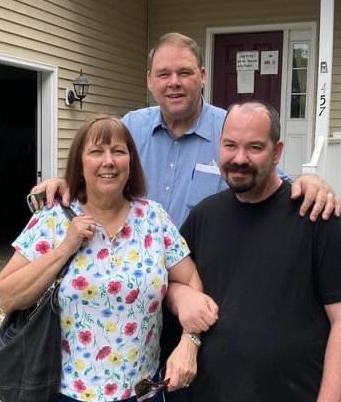
Nick (right) and his pastor, the Rev. Keith Phemister, and Keith’s wife Gloria. Nick has been restricted at least twice this year from visiting his church.
In fact, records indicate that the group home staff have been uncooperative with at least one clinician seeking to determine the cause of Nick’s aggressive outbursts.
In response to the service coordinator’s July 21 email, Alekshun of Bridgewell wrote that she had requested “recent behavioral data from the residence a few times, but haven’t received anything more recent than May.” Such data, she wrote, might “help justify the need for an inpatient placement” for Nick at a hospital setting.
Failure to report injuries
We are also concerned that DDS and provider staff have failed to report potentially serious injuries that Nick suffered in the group home, as required by law. In the most recent case, Cindy said she was forced to report a head injury that Nick suffered on March 16 to the DPPC because the injury had not been reported by the staff.
Both the DDS Decision Letter and subsequent Action Plan resulting from the March 16 incident stated that the alleged abuser didn’t report the injury.
Cindy said the incident resulted in bleeding from Nick’s ear, which would classify the injury as a serious physical injury under DPPC regulations. Nick received emergency room treatment for the injury.
DDS declines full investigation
After Cindy reported Nick’s March 16 head injury, DDS apparently conducted a limited Administrative Review of the incident. Administrative Reviews do not meet DPPC standards for full investigations. The DDS Decision Letter, issued after the review was completed, acknowledged that a “regulatory investigation” had not been conducted.
Given, in particular, that the bleeding Nick suffered from his ear would classify the injury as serious under DPPC regulations, it would appear that either DPPC or DDS should have conducted a full investigation of the matter, and not an Administrative Review. The DDS Decision Letter did not explain why a full “regulatory investigation” was not done.
The DDS Decision Letter concluded that as a result of the limited review, there was insufficient evidence to conclude that Nick had been abused by a staff member, and that Nick had “acknowledged” his injury had been self-inflicted. However, the Decision Letter did not disclose who was interviewed by the investigator. Cindy said she was not interviewed, and it is not clear whether even Nick was interviewed, based on accounts in the Decision Letter and subsequent DDS Action Plan.
The Action Plan, in fact, stated that, “It was reported by the provider that (Nick) exhibited self-injurious behaviors (SIB) causing injury to himself and was restrained.” (my emphasis). This statement appears to imply that the DDS investigator may have relied on an account from the provider, possibly even from the alleged abuser, in concluding that Nick had injured himself.
Both the Decision Letter and Action Plan said only that “during the course of the investigation witness(es) were interviewed and relevant documents were reviewed.” There was no specificity as to which documents were reviewed, or which witness or witnesses were interviewed. In fact, it isn’t clear, based on the word “witness(es),” whether more than one person was actually interviewed.
DPPC regulations (118 CMR 5.02) require that in full investigations, the investigator interview the reporter of the injury — in this case, Cindy. Cindy said that never happened.
The regulations also require that the investigator provide an assessment of the “immediate protective services needs” of the alleged victim to prevent the risk of further harm. There was no indication in the Decision Letter or Action Plan that such an assessment was done in this case.
The Action Plan recommended only that Nick’s residential and day provider staff “create a communication log that documents such incidents so everyone is informed.” There was no recommendation in the Action Plan relating to failure of the provider or DDS to report the injury to DPPC.
Similarly, DDS and DPPC declined to undertake an investigation of an incident in 2018 in which Nick contracted sepsis and spent eight months in a hospital because of the apparent negligence of staff in his group home. That incident was also not reported by the provider staff or by DDS to DPPC.
No response from DDS or Incompass
As noted, on August 25, I sent an email to both DDS Commissioner Ryder and to Phelps, the Incompass CEO, noting our concerns about the restriction on family contact and about reports of poor conditions and staff treatment of Nick that led him to state and text to his mother that he did not want to remain there. As such, I wrote, we are concerned the residence is potentially unsafe for Nick. To date, I haven’t received a response to my email.
We urge DDS and Incompass to reconsider the restrictions placed on family contact with Nick. We also urge DDS to conduct a full investigation of the injury that occurred to Nick on March 16, and to investigate the care and conditions in the residence.
Finally, we urge DDS to work with Cindy to identify another residential setting for Nick or a placement in an Intermediate Care Facility such as the Hogan Regional Center.
DDS client removed against her will from shared-living home in alleged retaliation for reporting abuse
It was on a Monday in May that Mercy Mezzanotti, a client of the Department of Developmental Services (DDS), was taken against her will from the home of Karen Faiola, with whom Mercy had been living for four years.
The person who came to take her worked for Venture Community Services, a nonprofit contractor to DDS. Up to that time, Venture had been paying Karen to provide shared-living services in her home to Mercy.
“I told them (the Venture employee and later other managers of the corporation) this is against my human rights,” Mercy said in a phone interview. “I’m my own guardian. I’m not going along with this. But they wouldn’t tell me anything. This should be under investigation.”
Both Mercy and Karen contend that Venture was retaliating against them because they had complained to managers of the organization in April that two of its employees had been verbally abusive toward Mercy.

Karen Faiola (left) and Mercy Mezzanotti
Mercy, 47, has a mild intellectual disability. As she put it, she has “trouble processing certain things.” But while she attended special needs classes in her school district as a child, she took mainstream classes in English and consistently made the honor roll. “I constantly studied,” she said. “I loved school.”
As her own guardian, Mercy has full legal authority to decide where to live, as well as to make other major life decisions. In our view, Venture’s alleged action to remove her from her home against her will was arbitrary if not unlawful.
Mercy and Karen said that the Venture employee drove Mercy on May 23 from Karen’s home in Sutton to the home of a family in Worcester that Mercy didn’t know. She said none of the people in the home spoke English. The next two days and nights were filled with anxiety and emotional trauma for her, Mercy said.
“I thought I would never see my home and Karen and my two cats that I love again,” she said.
Karen said that she conferred with Mercy’s private therapist after getting calls from Mercy saying she wanted to come home. She said the therapist maintained that Mercy had the right to make that decision; so Karen picked Mercy up on May 25, and drove her back to her home. She said Mercy told her that she no longer wanted to have anything to do with Venture or its employees.
Venture stops payments
On May 23, the same day that Mercy was removed from Karen’s home, Venture notified Karen that they were terminating her shared-living contract to care for Mercy in her home. Karen said DDS officials have subsequently refused to act on her request that her contract be referred to another shared-living manager. She said the organization she suggested to DDS is located near her house and is one that she has experience with.
As a result of the contract termination, Karen said, she has not been paid since May for caring for Mercy in her home. She said that she nevertheless intends to keep Mercy there as long as Mercy wants. “I’m not going to allow anyone to take Mercy to any place she doesn’t want to be,” Karen said.
Under Mercy’s shared living arrangement, DDS had paid Venture to contract directly with Karen for providing residential services to Mercy. Karen said Venture paid her $2,882 a month under the contract.
“Karen has helpd me grow and see my potential and find a voice,” Mercy said. “I feel confident speaking to people.” She said Karen regularly takes her to doctors’ appointments, for pedicures, and to visit her father and a friend of hers.
Mercy added that she and Karen have gone hiking together and go shopping together. She said Karen makes her meals and helps here take care of her cats, while she takes the trash out. “I love Karen,” she said. “She’s such a dream, such a great person.”
No written reason given in shared-living contract termination notice
Karen said a Venture employee alleged in a Zoom meeting with her and other provider personnel on May 19 that Mercy was going to be removed from her home because she had neglected to take Mercy to doctors’ appointments for the previous three years. Karen said this charge was untrue; and she provided COFAR with a doctor’s summary indicating that Mercy’s doctors’ visits and medications were up to date as of March of this year.
In a May 23 letter to Karen, Dorothy Cote, executive vice president and CFO of Venture, gave notice of the termination of Karen’s shared-living contract, but did not include a reason in the letter for the termination.
Cote’s termination letter cited a provision of the contract, which stated that Venture “may terminate (Mercy’s) placement upon due cause, a suspicion of due cause, abuse or neglect.” The letter also said Mercy could be removed from the home “pending the outcome of an investigation.” The letter, however, did not allege due cause, abuse or neglect against Karen. Cote’s letter also did not indicate that an investigation of any kind was pending.
If Venture officials did believe Karen had been neglectful in her role as a caregiver, there appears to be no indication that anyone reported an allegation against Karen of omission of care to the Disabled Persons Protection Commission (DPPC), as they would have been required to do.
Retaliation alleged for reporting abuse
Both Mercy and Karen contend that the sudden removal of Mercy from Karen’s home and termination of Karen’s contract were acts of retaliation by Venture against the two of them.
Karen said Mercy had been living with her for the past four years without incident. But she said that a number of months ago, there were changes in management at Venture, and problems began to develop with the new personnel. One of those new employees, she said, was assigned as a job coach to Mercy.
Mercy maintained that the job coach often harassed her at her job at a Papa Gino’s restaurant by mocking her work ethic. In one instance, in April, she said, the job coach suggested to the Papa Gino’s manager that she should fire Mercy. In another instance, she said, the job coach threatened not to drive Mercy home from work.
Karen said that in addition, a Venture service coordinator assigned to Mercy further abused her emotionally by threatening to remove her from Karen’s home.
Karen said she reported the incidents to a supervisor at Venture, and that led to the removal of Mercy from her home.
Therapist corroborates claims of emotional abuse
Grishelda Hogan, a licensed clinical social worker, has been Mercy’s therapist since 2019. In a July 21 email to Mercy and Karen, Hogan wrote that Mercy had “expressed consistently that she was happy in her home (with Karen)…It was clear in therapy,” Hogan stated, “that (Mercy) was making great strides in her life and I was able to see her self-esteem and self-worth develop as she finally felt seen and heard.“
Hogan stated that Mercy “had been reporting ongoing concerns with her Venture job coach. She reported feeling trapped and unsupported…” Hogan added that Mercy felt she had been lied to, and that the job coach had violated her privacy by talking to another individual on the phone about Mercy’s personal information. She said she passed her concerns on to DDS.
Hogan stated that she contacted Mercy’s DDS service coordinator after she learned that Mercy had been “abruptly moved from her home without warning or discussion despite being her own guardian.
“I shared that Mercy was reporting intense anxiety, difficulty sleeping, feeling sad and defeated, missing her home and her cat and her shared living monitor (Karen),” Hogan stated in her email to Karen and Mercy. “She was reaching out to me consistently asking for help and advocacy to get home.”
Hogan said the service coordinator told her she didn’t know the reason Mercy had been removed from her and Karen’s home. Hogan said Mercy had told her neither Venture nor DDS had ever asked her about concerns in the home prior to the move.
In her email, Hogan wrote that she personally reported to the DPPC that Mercy had been improperly moved from Karen’s home. “Mercy has consistently stated she believes her rights were violated,” Hogan wrote, “and DDS should be held accountable. And she fully believes the move was retaliation due to herself and her shared living monitor (Karen) speaking up.”
DPPC decides against full investigations of emotional abuse allegations
Karen said she also reported three allegations of emotional abuse against Mercy to the DPPC in May, just before Mercy was removed from her home. Those allegations include instances involving the job coach and the service coordinator, and the then pending removal of Mercy from her home.
Subsequent letters addressed to Mercy from DDS Area Director Denise Haley, dated May 27, indicate that Karen’s allegations were referred to DDS for an Administrative Review.
According to DDS regulations, an Administrative Review is undertaken when the DPPC “screens out” abuse and other allegations for full investigations by either the DPPC itself or DDS (115 CMR 9.11). It’s not clear to us why DPPC would have screened out Karen’s and Hogan’s allegations, as both Karen and Mercy stated that Mercy had suffered emotional injury as a result of the alleged abuse.
No response to COFAR query sent to DDS area director and Venture CFO
On July 19, I sent an email query to DDS Area Director Haley and to Cote, the Venture executive vice president and CFO, raising our concerns about the removal of Mercy from Karen’s home and the termination of Karen’s shared-living contract, apparently without written cause. I cc’d Anthony Keane, the DDS Worcester regional director.
In the email, I discussed Karen’s and Mercy’s allegations of retaliation by Venture against them for having alleged abuse by Venture employees. I asked for any comment Cote or Haley might have. To date, I have not received a response from any of those persons to my email.
DDS removes client’s eligibility for Medicaid funding for shared living services
In my email to Haley, Cote, and Keane, I said we were also seeking an explanation for the apparent disqualification by DDS of Mercy from eligibility for Medicaid Intensive Support Waiver Services. A July 6 legal notice from DDS stated that Mercy was being denied eligibility for the Intensive Support Waiver. No reason was given for that denial in the notice, other than an unsupported and unexplained statement that there were “no waiver services” available.
We agree with Mercy that a full investigation is warranted of Venture’s apparently unlawful removal of her from her home, and of the other alleged instances of emotional abuse against her. We also would urge DDS to immediately refer Karen to another shared-living contracting agency, and that she be reimbursed retroactively for having provided shared-living services to Mercy since May.
This case appears to fit a pattern in which family members or other individuals who report abuse or poor care of DDS clients are dismissed or find themselves subject to retaliation by corporate providers or by the Department itself. We are hoping that in continuing to shine a light on these cases that we can help one day break this pattern.
Mother says she is being ‘railroaded’ out of her guardianship by unfair court report
The mother of an intellectually disabled man says she is being unfairly accused in probate court of having a conflict of interest in caring for her son, and that the conflict charge is being used to limit and possibly eliminate her co-guardianship rights.
Valerie Loveland said that in an April 19 Barnstable County Probate Court hearing on Zoom, an investigative attorney appointed by the judge presented a report concluding that Valerie had a conflict because she both sells natural medicinal products to customers and provides those products to her son.
Valerie maintains, however, that she derives no material benefit from the arrangement involving her son. She said her son buys the products directly from the company, Young Living Brand. She said his primary medical care provider approves all of his alternative medicines in accordance with his group home’s policy.
Valerie’s 24-year-old son is a resident of a group home on Cape Cod run by the May Institute, a corporate provider to the Department of Developmental Services (DDS). Valerie has asked that her son’s name be kept private.
We have previously reported that Valerie has been fighting both a motion to limit her co-guardianship of her son and a move to evict her from her subsidized apartment due to an alleged technical violation of her lease.
The motion to limit Valerie’s co-guardianship was filed in March by John Cartwright, an attorney who is paid by DDS to serve as Valerie’s son’s other co-guardian. Cartwright’s motion seeks to remove Valerie’s authority to make medical decisions for her son and to transfer her authority as representative payee for her son’s Social Security funds to the May Institute.
(Valerie said yesterday that her housing situation was being resolved favorably for her after discussions with housing officials.)
Health clinic program director approves natural medicines
In an April 27 letter, Gretchen Eckel, a certified physician assistant and a program medical director at Outer Cape Health Services, said Valerie’s son’s natural medicines have been subject to “shared decision making to permit these treatment plans.”
Eckel said she has seen “no harm or risks” to Valerie’s son caused by the use of the alternative medicines. She described Valerie as “a tremendous advocate for (Valerie’s son’s) needs, and I believe she has always had his best interests in mind.”
Valerie says she was not interviewed by guardian ad litem
Valerie contends she is being “railroaded” by Cartwright’s motion and by the report alleging that she has a conflict of interest in providing the natural medicines to her son. The report was writtten by Christopher Lebherz, who was appointed by the court in the case as a guardian ad litem (GAL). In Massachusetts, a GAL is an independent investigative official, often an attorney, who assists the court in guardianship cases.
Valerie said she was neither interviewed by Lebherz for his report, nor was she provided with a copy of the report either before the hearing or since. She was allowed by the judge in the case, Susan Sard Tierney, only to view the report and take notes on it in the courthouse, following the hearing. She was not allowed to make a copy of it.
The GAL’s report has been made available, however, to both Cartwright and to Carol Coyne, a DDS attorney in the case, according to an April 19 order issued by Tierney.
Valerie said the GAL’s report indicates support for the motion by Cartwright to limit her co-guardianship. Due to the GAL report’s confidential nature, COFAR has not been able to obtain a copy of it.
Valerie termed “caring and concerned mother”
In an email in response to a query I sent, Lebherz said he was “concerned about a conflict of interest or the appearance of a conflict of interest (on Valerie’s part) regarding rep payee.”
Lebherz also said he “spoke with Valerie and all other interested parties” in the case. He said he “asked her (Valerie) and others to summarize all of their positions and send it all along to me.”
Lebherz also said he did not recommend that Valerie lose her medical decision making authority. He added that he “reviewed the case history and all filings,” and that he visited the May institute.
Lebherz declined to respond to my follow-up question whether he had found or presented any evidence in his report that Valerie had derived any material financial benefit from providing natural medicines to her son.
He also declined to respond to my follow-up question whether “speaking” with Valerie and asking her to “summarize her positions” constituted an interview, or whether he had specifically asked her about the alleged conflict of interest.
Lebherz, nevertheless, said, “All parties agree Valerie is a caring concerned mother. These are difficult issues and situations and we all try to do our best.”
While Lebherz said he didn’t recommend that Valerie lose her medical decision making authority, Valerie said that Lebherz stated in his report that he agreed with Cartwright’s motion that her medical decision making be limited to consenting to medical treatments directed by others.
“I raised (her son) completely alone,” Valerie said. “I worked where I could, managed his money and medical appointments, all of it for 18 years, below the poverty line. Now they’re trying to take everything away. What have I done? I’ve never heard of anyone doing everything right and being treated so badly.”
Guardian ad litem standards require an interview and detailed fact finding
Under Massachusetts standards for guardians ad litem, the GAL must “provide each party with a separate interview so that each party may speak with candor.” (Section 4.4)
The GAL must also “conduct the investigation in a fair and balanced manner”(6), and the GAL’s report “should provide accurate, detailed and balanced information about the parties and their children.”(8)
In addition, the GAL report should include “all relevant facts collected from all sources, including facts that are consistent and inconsistent with other reported facts.”(8.2). Further, the report must “set forth the connection between the facts and the conclusions or recommendations.”(8.5)
If Lebherz’s report concluded that Valerie has a conflict of interest, the GAL standards would appear to require that the report include relevant facts that support that conclusion, such as the extent of any financial benefit that Valerie received as a result of the alleged conflict.
No material benefit from providing natural medicines to son
Valerie said the GAL’s report alleged that she has a conflict of interest because she has provided natural medicines and other products to her son, and that she has a business in which she sells those products. She said that appears to be the primary reason that Lebherz recommended that she be removed as rep payee and that all medical decisions be made solely by Cartwright.
In fact, Valerie said, she has not derived a material financial benefit from her son’s use of the medicines. She said her son purchases the products directly from the company with his own money. She and her son both have accounts with the company and receive points for their purchases.
Valerie said she receives an average of $5 a month in “commissions” from her son’s purchases. “I set it up so that when I died whoever handles his account could continue ordering his supplies for him,” she said.
It doesn’t appear that the fact that Valerie sells natural medicines and has established an account for her son for those products would be a conflict unless she received a material financial benefit from that. As a user and seller of natural medicines, she might naturally be inclined to encourage her son to use them.
Valerie says Cartwright, the DDS co-guardian, has long opposed her efforts to provide natural medicines and essential oils to her son.
In her April 27 letter in support of Valerie, Eckel, the certified physician assistant, said Valerie’s son has been her primary care patient since 2014, and that she last examined him on April 27.
Eckel said Valerie raised her son since birth, and raised him independently since the age of three when his biological father left them. She said that since Valerie was appointed as her son’s co-guardian in 2016, Valerie has attended most of his medical visits “with the exception of a very few visits” when he was attended by staff of the May Institute.
Eckel added that “Valerie has opted for natural treatment options when available and safe for (Valerie’s son’s) ailments over the years, and we have used shared decision making to permit these treatment plans as I have seen no harm or risks to these strategies.”
Valerie said natural or alternative medicines are considered complementary to, and not a replacement for, western or modern medicines. She said the natural supplements and treatments provided to her son are in addition to his modern medications, and that he is fully vaccinated for COVID and for childhood diseases.
“I had an informed conversation with Gretchen (Eckel) regarding the vaccinations and their effectiveness, side effects, etc., before giving consent to the May to proceed with their vaccination clinics,” she said. She added that “May staff also reports he’s doing great since these changes (use of natural medicines) have been made.”
This is one of several cases on which we’ve reported, which raise questions about the fairness of the DDS and probate court systems, particularly when it comes to family members who lack financial resources or attorneys to represent them.
Our justice system isn’t supposed to function differently for people who lack those resources; but we’ve seen a number of instances (see here and here) in which that has unfortunately been the case.
 COFAR blog